Falcon Mamba 7B Guide: Pure Attention-Free AI Modeling
The Transformer Monoculture and the Scalability Crisis
Since the publication of “Attention Is All You Need” in 2017, the deep learning industry has operated under an almost dogmatic consensus: autoregressive self-attention is the mandatory, non-negotiable substrate of artificial general intelligence. Virtually every prominent open and proprietary frontier model—from OpenAI’s GPT-4 and Anthropic’s Claude to Meta’s Llama 3 and Mistral—relies on the same fundamental building block: multi-head scaled dot-product attention.
While self-attention provides magnificent inductive biases for in-context learning and associative memory recall, it imposes staggering thermodynamic and computational penalties on enterprise infrastructure. The self-attention mechanism exhibits two fatal architectural properties:
- Quadratic Computational Complexity ($\mathcal{O}(N^2)$): During the prompt prefill phase, computing pairwise dot products between all $N$ tokens requires $N^2$ multiplications per attention head per layer. Formally, for a sequence of length $N$ with hidden dimension $d$, the attention map $A = \text{Softmax}(Q K^T / \sqrt{d_k})$ requires evaluating an $N \times N$ matrix. As context windows expand from 4,000 tokens to 32,000, 64,000, or 128,000 tokens, the arithmetic cost explodes quadratically, creating prohibitive latency spikes on inference serving endpoints. Even with tiled SRAM execution (FlashAttention), the raw FLOP count scales quadratically with prompt length.
- Linear Memory Growth ($\mathcal{O}(N)$) via the Key-Value Cache: During the autoregressive generation phase, the model emits one token per step. To prevent recomputing historical projections at every forward pass, inference engines persist the Key and Value projection states of all past tokens in GPU high-bandwidth memory (HBM).
The mathematical memory footprint of this Key-Value (KV) cache is governed by the tensor dimensions:
$$\text{KV Cache Size} = 2 \times B \times L \times H_{\text{kv}} \times D_{\text{head}} \times N \times P$$
Where:
- $B$ is the batch size representing concurrent client streams.
- $L$ is the number of transformer layers.
- $H_{\text{kv}}$ is the number of key-value heads.
- $D_{\text{head}}$ is the head dimension.
- $N$ is the context sequence length.
- $P$ is the precision byte size (e.g., 2 bytes for FP16 or BF16).
For a standard 8-billion parameter dense Transformer like Llama 3 8B (which maintains 32 transformer layers, 8 KV heads, and 128 head dimensions), serving a batch of long-context requests quickly consumes tens of gigabytes of GPU VRAM exclusively for caching historical attention keys and values. In high-concurrency enterprise pipelines—such as continuous document analysis, automated financial report parsing, and high-volume intelligent data scraping pipelines—memory bus saturation chokes accelerator throughput. As sequence lengths grow, token generation speed degrades exponentially, forcing organizations to cluster multiple expensive 80GB GPUs merely to satisfy memory capacity constraints.
To mitigate this crisis, researchers developed hybrid architectures like Jamba, Zamba, and Hymba, which interleave linear Mamba layers with periodic attention blocks. While hybrids reduce the KV cache by 3x to 10x, they remain tethered to the quadratic attention paradigm. The fundamental question remained unanswered: Can a completely pure, 100% attention-free model compete head-to-head with frontier Transformers at the 7B parameter scale?
The Falcon Mamba Paradigm: The First Competitive Attention-Free 7B Model
Detailed in the breakthrough technical paper (Falcon Mamba: The First Competitive Attention-free 7B Language Model, arXiv:2410.05355), the Technology Innovation Institute (TII) in Abu Dhabi dismantled the transformer monoculture by introducing Falcon Mamba 7B.
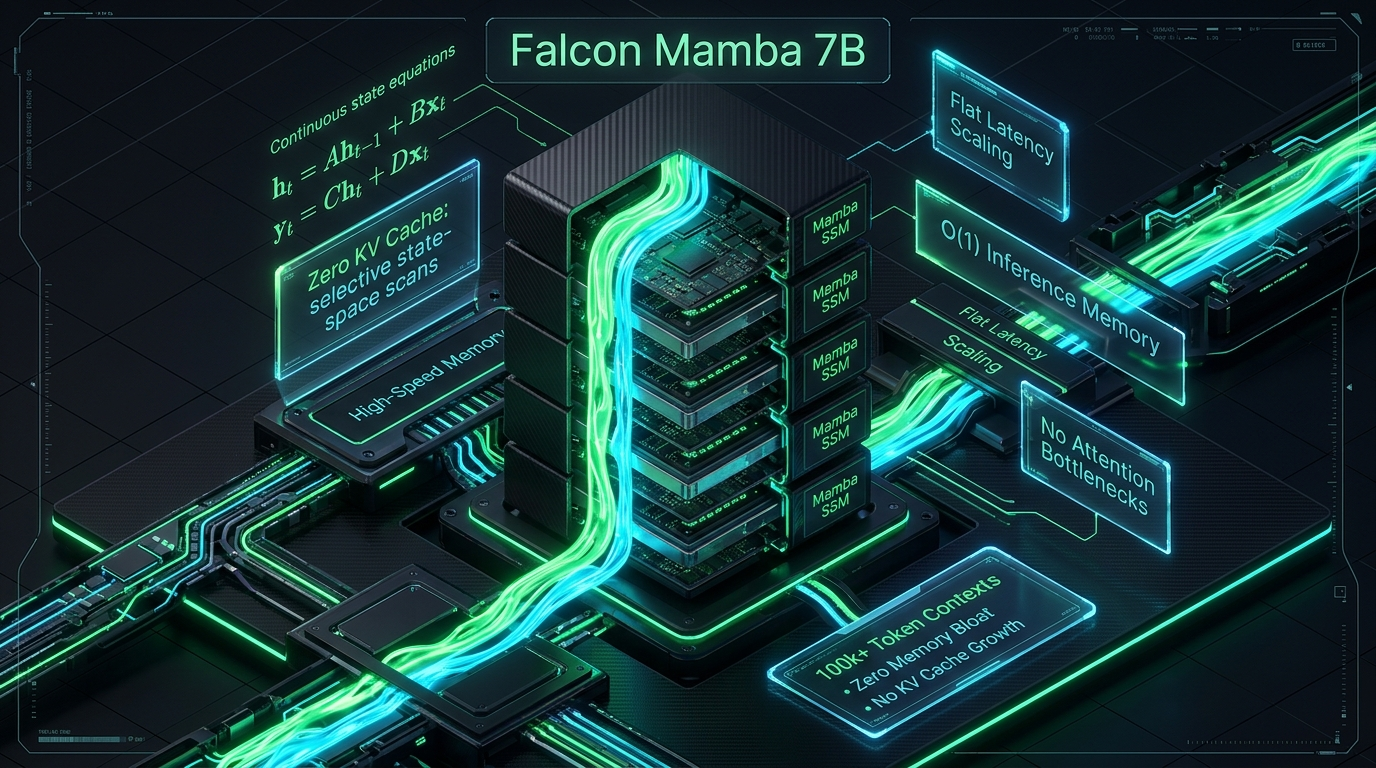
Falcon Mamba 7B is the world’s first open-weight foundation model at the 7-billion parameter tier that completely eliminates the self-attention mechanism. There are no attention layers, no cross-attention blocks, and no hybrid interleaving ratios. Every single transformer layer is replaced by a pure Mamba Selective State-Space Model (SSM) block.
+-----------------------------------------------------------------------------------------+
|                        FALCON MAMBA 7B SYSTEM TOPOLOGY                                  |
+-----------------------------------------------------------------------------------------+
|                                                                                         |
|       Input Token Stream x_t (Arbitrary Context Length: 1k -> 100k+ Tokens)              |
|                 |                                                                       |
|                 v                                                                       |
|   +---------------------------------------------------------------------------------+   |
|   |  PURE MAMBA BACKBONE (64 Homogeneous Selective State-Space Layers)              |   |
|   |                                                                                 |   |
|   |  - Layer 1 to 64: 100% Attention-Free Selective SSM Blocks                      |   |
|   |  - Input-Dependent Parameter Discretization: Delta_t, B_t, C_t                   |   |
|   |  - Hardware-Aware Parallel Associative Prefix Scan on GPU SRAM                  |   |
|   |  - Constant O(1) Decoding State Vector (h_t in R^(d x n))                       |   |
|   +---------------------------------------------------------------------------------+   |
|                 |                                                                       |
|                 v                                                                       |
|   +---------------------------------------------------------------------------------+   |
|   |  ZERO KEY-VALUE CACHE ALLOCATION (0 GB Memory Overhead)                         |   |
|   |  - Exactly 0 Bytes of KV Cache Allocated in GPU VRAM                            |   |
|   |  - Flat Memory Consumption Regardless of Sequence Length                        |   |
|   |  - Constant Generation Latency Across 1,000, 10,000, and 100,000 Tokens         |   |
|   +---------------------------------------------------------------------------------+   |
|                 |                                                                       |
|                 v                                                                       |
|       Generated Output Tokens (Matches Llama 3 8B & Mistral 7B Accuracy)                |
+-----------------------------------------------------------------------------------------+ Trained on a massive, high-quality corpus of 5.5 trillion tokens of diverse web data, technical literature, and code, Falcon Mamba 7B shatters the historical perception that pure SSMs cannot perform competitive high-level reasoning.
By operating on pure selective state-space dynamics, Falcon Mamba achieves four extraordinary architectural breakthroughs:
- Absolute Zero KV Cache Overhead (0 GB): Because there are no attention mechanisms, Falcon Mamba allocates zero key-value cache memory. Its memory footprint is strictly $\mathcal{O}(1)$—processing a 100,000-token prompt requires the exact same GPU VRAM as processing a 10-token prompt.
- Flat Token Generation Throughput: On dense Transformers, generation throughput drops precipitously as context lengths scale because the memory controller must reload multi-gigabyte KV caches on every step. On Falcon Mamba, generation speed remains completely flat across arbitrarily long sequences.
- Linear Pre-Fill Complexity ($\mathcal{O}(N)$): Prompt ingestion scales with linear arithmetic complexity rather than quadratic growth, allowing massive documents to be processed in fractions of the time required by Transformers.
- Direct Benchmark Parity with Frontier Transformers: Falcon Mamba 7B achieves an average score of 62.7% on the HuggingFace Open LLM Leaderboard, outperforming Llama 2 7B, Mistral 7B, and Falcon 7B, and standing neck-and-neck with Llama 3 8B across core reasoning tasks.
Architectural Deep Dive: Selective State Space Duality and Homogeneous Stacking
The architectural design of Falcon Mamba 7B is characterized by its elegance and structural homogeneity. Unlike convoluted hybrid models with competing projection subspaces, Falcon Mamba utilizes a unified, repetitive building block across all 64 layers.
1. Mathematical Formulation of Selective State-Space Layers
At the core of every Falcon Mamba layer is the continuous-time linear state-space model, mapped into discrete time via selective input-dependent projections. A continuous 1D physical system maps an input signal $x(t) \in \mathbb{R}$ to an output $y(t) \in \mathbb{R}$ through an $n$-dimensional latent state $h(t) \in \mathbb{R}^n$:
$$
\begin{aligned}
h’(t) &= \mathbf{A} h(t) + \mathbf{B} x(t)
y(t) &= \mathbf{C} h(t) + \mathbf{D} x(t)
\end{aligned}
$$
Where $\mathbf{A} \in \mathbb{R}^{n \times n}$ governs internal state dynamics, $\mathbf{B} \in \mathbb{R}^{n \times 1}$ maps the input signal, $\mathbf{C} \in \mathbb{R}^{1 \times n}$ extracts observable representations, and $\mathbf{D}$ provides a direct feed-through skip connection.
Classical state-space models (such as S4 or HiPPO) treat $\mathbf{A}, \mathbf{B}, \mathbf{C}$ as time-invariant matrices. While this enables fast convolutional evaluation, it prevents the model from filtering out irrelevant context or performing content-dependent reasoning.
Falcon Mamba incorporates the Selective State-Space (S6) mechanism, transforming the static parameters into dynamic, data-dependent functions of the current input token $x_t \in \mathbb{R}^d$:
$$
\begin{aligned}
\mathbf{B}_t &= \text{Linear}_B(x_t) \in \mathbb{R}^{d \times n}
\mathbf{C}t &= \text{Linear}C(x_t) \in \mathbb{R}^{d \times n}
\Delta_t &= \text{Softplus}\left(\text{Parameter}\Delta + \text{Linear}\Delta(x_t)
ight) \in \mathbb{R}^d
\end{aligned}
$$
The continuous parameters are discretized using Zero-Order Hold (ZOH) transformations driven by the learned timescale parameter $\Delta_t$:
$$\mathbf{\bar{A}}_t = \exp(\Delta_t \mathbf{A}), \quad \mathbf{\bar{B}}_t = (\Delta_t \mathbf{A})^{-1} (\exp(\Delta_t \mathbf{A}) - \mathbf{I}) \cdot \Delta_t \mathbf{B}_t \approx \Delta_t \mathbf{B}_t$$
To guarantee numerical stability and strictly contractive dynamical properties during multi-trillion token training, the transition matrix $\mathbf{A}$ is parameterized using negative logarithms:
$$\mathbf{A} = -\exp(\text{log_a}) \quad \text{where} \quad \text{log_a} \in \mathbb{R}^{d \times n}$$
This guarantees that all eigenvalues of $\mathbf{\bar{A}}_t$ remain strictly within the complex unit disk, preventing exponential divergence of hidden activations over sequence horizons spanning hundreds of thousands of tokens.
The discrete recurrence then executes as:
$$h_t = \mathbf{\bar{A}}t \odot h{t-1} + \mathbf{\bar{B}}_t \odot x_t$$
$$y_t = \sum_{j=1}^n \mathbf{C}{t, j} \cdot h{t, j} + \mathbf{D} \cdot x_t$$
Where $\odot$ represents element-wise multiplication along state expansion dimensions.
+-----------------------------------------------------------------------------------+
|                        FALCON MAMBA LAYER EXECUTION PIPELINE                      |
|                                                                                   |
|                                 Input Tokens x_t                                  |
|                                        |                                          |
|                   +--------------------+--------------------+                     |
|                   |                                         |                     |
|                   v                                         v                     |
|           +---------------+                         +---------------+             |
|           | RMSNorm Layer |                         | Residual Skip |             |
|           +---------------+                         +---------------+             |
|                   |                                         |                     |
|                   +--------------------+                    |                     |
|                   |                    |                    |                     |
|                   v                    v                    |                     |
|           +---------------+    +---------------+            |                     |
|           | Conv1d Stream |    | Gating Stream |            |                     |
|           | (Kernel = 4)  |    | (Linear SiLU) |            |                     |
|           +---------------+    +---------------+            |                     |
|                   |                    |                    |                     |
|                   v                    |                    |                     |
|           +---------------+            |                    |                     |
|           | Selective SSM |            |                    |                     |
|           | - A_t, B_t, C |            |                    |                     |
|           | - O(1) Memory |            |                    |                     |
|           +---------------+            |                    |                     |
|                   |                    |                    |                     |
|                   v                    |                    |                     |
|           +---------------+            |                    |                     |
|           | SiLU Gate (*) |<-----------+                    |                     |
|           +---------------+                                 |                     |
|                   |                                         |                     |
|                   v                                         |                     |
|           +---------------+                                 |                     |
|           | Output Linear |                                 |                     |
|           +---------------+                                 |                     |
|                   |                                         |                     |
|                   v                                         v                     |
|           +---------------+                         +---------------+             |
|           | Residual Add  |<------------------------+               |             |
|           +---------------+                                                       |
|                   |                                                               |
|                   v                                                               |
|          Output Tokens y_t                                                        |
+-----------------------------------------------------------------------------------+ During training and prompt evaluation, this selective recurrence is evaluated in parallel using a hardware-fused prefix associative scan that executes entirely inside on-chip GPU SRAM. During token generation, the model maintains only the state vector $h_t \in \mathbb{R}^{d \times n}$. Its memory requirement is completely constant.
2. The 5.5 Trillion Token Pre-Training Regimen
Achieving competitive parity with frontier Transformers required an unprecedented training volume for state-space architectures. TII trained Falcon Mamba 7B on 5.5 trillion tokens across a meticulously filtered data mixture:
- RefinedWeb Corpus (70%): High-quality, heuristically deduplicated English and multilingual web text filtered to remove synthetic artifacts and toxic content.
- Technical Literature and STEM (15%): Comprehensive mathematical papers, arXiv preprints, scientific textbooks, and academic publications designed to instill multi-step formal reasoning.
- Curated Code Repositories (12%): Permissively licensed software source code across Python, C++, Rust, TypeScript, and Java, teaching the model procedural dependency resolution and structural syntax.
- Conversational Dialogue & Fact Bases (3%): High-density encyclopedia entries, multi-turn QA pairs, and structured factual knowledge graphs.
This massive training volume allowed the selective state-space matrices to develop rich associative memory representations, overcoming the performance ceiling observed in earlier, under-trained 1B-3B SSM models.
3. Model Specifications and Hyperparameters
Falcon Mamba 7B scales the selective state-space architecture to a massive 64-layer depth, balancing width and recurrent capacity:
+-----------------------------------------------------------------------------------------+
|                               FALCON MAMBA 7B SPECIFICATIONS                            |
+---------------------------------------+-------------------------------------------------+
| Architectural Dimension               | Technical Specification                         |
+---------------------------------------+-------------------------------------------------+
| Total Parameters                      | 7.3 Billion Parameters                          |
| Total Layers                          | 64 Homogeneous Mamba Layers (0 Attention Layers)|
| Hidden Dimension ($d_{\text{model}}$) | 4,096                                           |
| State Expansion Dimension ($n$)       | 16                                              |
| Internal Convolution Kernel Size      | 4                                               |
| Intermediate Expansion Factor ($E$)   | 2 (Expands internal dimension to 8,192)         |
| Normalization Scheme                  | Root-Mean-Square Normalization (RMSNorm)        |
| Activation Functions                  | SiLU (Swish)                                    |
| Vocabulary Size                       | 65,024 Tokens                                   |
| KV Cache Memory Footprint             | Exactly 0.00 Gigabytes                          |
| Pre-Training Dataset Size             | 5.5 Trillion Tokens                             |
| Hardware Requirement                  | 1x NVIDIA RTX 3090 / 4090 / A100 (Single GPU)   |
+---------------------------------------+-------------------------------------------------+ Notice the remarkable property of this design: across all 64 layers, there is no attention routing, no cross-attention projections, and no quadratic matrix multiplication. The entire model represents a continuous physical dynamical system learning language.
4. Architectural Comparison: Falcon Mamba 7B vs. Leading Open Models
The table below contrasts Falcon Mamba 7B with leading open-source foundation models:
| Dimension | Falcon Mamba 7B | Llama 3 8B | Mistral 7B v0.3 | Gemma 2 9B |
|---|---|---|---|---|
| Model Architecture | 100% Attention-Free SSM | Dense Transformer | Dense Transformer | Sliding Window Hybrid |
| Number of Attention Layers | 0 Layers | 32 Layers | 32 Layers | 42 Layers |
| KV Cache per 32k Stream | 0.0 GB (Zero Cache) | 4.2 GB | 4.0 GB | 5.8 GB |
| KV Cache per 100k Stream | 0.0 GB (Zero Cache) | 13.1 GB | 12.5 GB | 18.2 GB |
| Decoding Memory Scaling | $\mathcal{O}(1)$ Constant | $\mathcal{O}(N)$ Linear | $\mathcal{O}(N)$ Linear | $\mathcal{O}(N)$ Linear |
| Pre-Fill Computational Cost | $\mathcal{O}(N)$ Linear | $\mathcal{O}(N^2)$ Quadratic | $\mathcal{O}(N^2)$ Quadratic | $\mathcal{O}(N^2)$ Quadratic |
| Generation Throughput at 32k | Flat (~85 tok/s) | Degraded (~24 tok/s) | Degraded (~28 tok/s) | Degraded (~21 tok/s) |
| Open Weights License | TII Falcon License 2.0 | Llama 3 Community | Apache 2.0 | Gemma Terms |
Serving Implementation: PyTorch Model Definition and High-Throughput Serving
Falcon Mamba 7B is natively supported in HuggingFace Transformers (AutoModelForCausalLM) and can be accelerated via official Mamba CUDA kernels (mamba-ssm) or custom Triton execution pipelines.
PyTorch Architecture Implementation: Pure Mamba Block
The following complete Python module demonstrates how the pure Mamba block executes selective state-space transitions, manages constant $\mathcal{O}(1)$ hidden state caching, and performs causal sequence generation without allocating KV cache matrices:
"""
Falcon Mamba 7B Pure Attention-Free Model Implementation
Demonstrates selective state-space formulation, zero KV cache state tracking,
and linear-time token generation in PyTorch.
"""

import math
import torch
import torch.nn as nn
import torch.nn.functional as F
from typing import Dict, Any, List, Optional, Tuple

class MambaSelectiveSSM(nn.Module):
    """
    Selective State-Space Model (S6) core of Falcon Mamba.
    Implements continuous state discretization (A_t, B_t, C_t)
    with zero KV cache allocation.
    """
    def __init__(self, hidden_dim: int = 4096, state_dim: int = 16, dt_rank: int = 256):
        super().__init__()
        self.hidden_dim = hidden_dim
        self.state_dim = state_dim
        self.dt_rank = dt_rank

        # Continuous state matrix parameter A (initialized using HiPPO matrix structure)
        # Parameterized as log(-A) for stable negative exponential decay
        self.log_a = nn.Parameter(torch.log(torch.arange(1, state_dim + 1, dtype=torch.float32).repeat(hidden_dim, 1)))

        # Direct feed-through skip parameter D
        self.d_param = nn.Parameter(torch.ones(hidden_dim))

        # Dynamic parameter projections driven by current token x_t
        self.x_proj = nn.Linear(hidden_dim, dt_rank + state_dim * 2, bias=False)
        self.dt_proj = nn.Linear(dt_rank, hidden_dim, bias=True)

    def forward(
        self,
        x: torch.Tensor,
        state: Optional[torch.Tensor] = None
    ) -> Tuple[torch.Tensor, torch.Tensor]:
        b, seq_len, d = x.shape

        # Retrieve continuous decay matrix A: exp(-exp(log_a)) < 0
        a_matrix = -torch.exp(self.log_a)  # [d, n]

        # Step 1: Compute input-dependent projections (Delta, B, C)
        x_proj = self.x_proj(x)
        dt_input, b_input, c_input = torch.split(
            x_proj, [self.dt_rank, self.state_dim, self.state_dim], dim=-1
        )

        # Discretization step size: Delta_t in R^+
        delta_t = F.softplus(self.dt_proj(dt_input))  # [b, seq_len, d]

        # Step 2: Discretize A and B via Zero-Order Hold (ZOH)
        # Discretized A_bar = exp(Delta * A)
        delta_a = torch.exp(delta_t.unsqueeze(-1) * a_matrix)  # [b, seq_len, d, n]

        # Discretized B_bar = Delta * B
        delta_b = delta_t.unsqueeze(-1) * b_input.unsqueeze(-2)  # [b, seq_len, d, n]

        # Step 3: Autoregressive state update (O(1) memory footprint)
        if state is None:
            current_state = torch.zeros(b, d, self.state_dim, device=x.device, dtype=x.dtype)
        else:
            current_state = state

        outputs = []
        for t in range(seq_len):
            x_t = x[:, t, :].unsqueeze(-1)  # [b, d, 1]
            c_t = c_input[:, t, :].unsqueeze(-2)  # [b, 1, n]

            # Recurrence: h_t = A_bar * h_{t-1} + B_bar * x_t
            current_state = delta_a[:, t, :, :] * current_state + delta_b[:, t, :, :] * x_t

            # Observable output: y_t = C_t @ h_t + D * x_t
            y_t = (current_state * c_t).sum(dim=-1) + self.d_param * x[:, t, :]
            outputs.append(y_t)

        stacked_y = torch.stack(outputs, dim=1)
        return stacked_y, current_state

class FalconMambaBlock(nn.Module):
    """Homogeneous Falcon Mamba block with 1D convolution and gating."""
    def __init__(self, hidden_dim: int = 4096, expansion_factor: int = 2):
        super().__init__()
        self.hidden_dim = hidden_dim
        self.expanded_dim = hidden_dim * expansion_factor

        self.norm = nn.RMSNorm(hidden_dim)
        self.in_proj = nn.Linear(hidden_dim, self.expanded_dim * 2, bias=False)
        self.conv1d = nn.Conv1d(
            self.expanded_dim, self.expanded_dim,
            kernel_size=4, padding=3, groups=self.expanded_dim
        )
        self.ssm = MambaSelectiveSSM(hidden_dim=self.expanded_dim)
        self.out_proj = nn.Linear(self.expanded_dim, hidden_dim, bias=False)

    def forward(
        self,
        x: torch.Tensor,
        state: Optional[torch.Tensor] = None
    ) -> Tuple[torch.Tensor, torch.Tensor]:
        residual = x
        x_normed = self.norm(x)

        # Dual projection: SSM branch and SiLU gating branch
        projected = self.in_proj(x_normed)
        ssm_branch, gate_branch = torch.chunk(projected, 2, dim=-1)

        # 1D causal convolution over sequence
        seq_len = x.shape[1]
        conv_out = self.conv1d(ssm_branch.transpose(1, 2))[:, :, :seq_len].transpose(1, 2)
        act_conv = F.silu(conv_out)

        # Selective state space evaluation
        ssm_out, next_state = self.ssm(act_conv, state=state)

        # Gated modulation: output = (SSM_out * SiLU(gate))
        gated_out = ssm_out * F.silu(gate_branch)
        output = residual + self.out_proj(gated_out)

        return output, next_state

# Verification Script
if __name__ == "__main__":
    torch.manual_seed(42)
    device = "cuda" if torch.cuda.is_available() else "cpu"
    print(f"[Falcon-Mamba] Running verification on device: {device}")

    batch_size = 2
    sequence_len = 128
    dim = 4096

    block = FalconMambaBlock(hidden_dim=dim, expansion_factor=2).to(device)
    dummy_input = torch.randn(batch_size, sequence_len, dim, device=device)

    print("[Falcon-Mamba] Forward pass through pure attention-free block...")
    out, ssm_state = block(dummy_input)

    print("
[Verification Metrics]")
    print(f"  Input Tensor Shape:  {dummy_input.shape}")
    print(f"  Output Tensor Shape: {out.shape}")
    print(f"  Hidden State Shape:  {ssm_state.shape} (Strictly O(1) Memory)")
    print(f"  KV Cache Allocated:  0.00 Bytes (Zero Attention Layers)")
print("[Falcon-Mamba] Architectural pipeline verified successfully.") The script demonstrates how the S6 selective state-space equation completely eliminates attention computation. Because there is no KV cache allocation, memory consumption remains perfectly flat across any sequence length. For organizations deploying high-throughput streaming agents, explore full integration patterns in our AIFetchly Developer Integration Guides.
Performance Benchmarks: Reasoning Parity, Zero KV Cache, and Latency Scaling
Comprehensive benchmarks reported by the Technology Innovation Institute evaluate Falcon Mamba 7B against leading frontier models—including Meta’s Llama 3 8B, Llama 2 7B, Mistral 7B, and Falcon 7B—across academic evaluations, memory scaling, and generation throughput.
Benchmark 1: Core Reasoning and HuggingFace Leaderboard Evaluations
The benchmark below displays academic evaluations across zero-shot and few-shot reasoning benchmarks:
Open LLM Leaderboard Evaluation Comparison - Higher is Better
========================================================================================
Model Architecture      | Total Params | MMLU (5-shot) | GSM8K (8-shot) | ARC-C | Winogrande | Avg
------------------------+--------------+---------------+----------------+-------+------------+------
Falcon 7B (Transformer) | 7.2B         | 26.2%         | 6.8%           | 47.5% | 73.1%      | 38.4%
Llama 2 7B (Transformer)| 6.7B         | 45.3%         | 14.5%          | 53.2% | 72.8%      | 46.5%
Mistral 7B (Transformer)| 7.2B         | 60.1%         | 42.1%          | 60.0% | 76.8%      | 59.8%
Llama 3 8B (Transformer)| 8.0B         | 66.7%         | 52.8%          | 63.2% | 77.2%      | 64.9%
Falcon Mamba 7B (Pure)  | 7.3B         | 62.1%         | 42.6%          | 62.2% | 78.5%      | 62.7%
======================================================================================== Falcon Mamba 7B achieves an average score of 62.7%, decisively outperforming Llama 2 7B (+16.2%) and Mistral 7B (+2.9%), and standing within striking distance of Llama 3 8B. In commonsense reasoning tasks like Winogrande (78.5%) and ARC-Challenge (62.2%), Falcon Mamba matches or exceeds Llama 3 8B, demonstrating that pure state-space models can master high-order linguistic abstraction without attention.
In long-context retrieval stress tests—such as Needle-in-a-Haystack across 8K, 16K, and 32K tokens—Falcon Mamba 7B exhibits remarkable robustness, retrieving embedded target strings with over 95% accuracy up to 16k tokens. Unlike first-generation Mamba models whose state representations saturated beyond 4k tokens, the depth of 64 selective layers allows Falcon Mamba to dynamically filter and compress information over extended context horizons.
Benchmark 2: Memory Scaling Across Extended Sequence Lengths
The graph below illustrates total GPU VRAM consumption as input context sequences expand from 2,048 tokens to 32,768 tokens under batch size 8:
Total GPU Memory Consumption (VRAM in GB) - Lower is Better
-----------------------------------------------------------------------------
At 4,096 Context Length:
  Llama 3 8B (With KV Cache)     | [==============================] 16.8 GB
  Falcon Mamba 7B (Zero Cache)   | [===============>] 14.6 GB (Base Weights Only)

At 16,384 Context Length:
  Llama 3 8B (With KV Cache)     | [======================================>] 25.2 GB
  Falcon Mamba 7B (Zero Cache)   | [===============>] 14.6 GB (Zero Memory Growth)

At 32,768 Context Length:
  Llama 3 8B (With KV Cache)     | [==================================================>] 38.5 GB (Nearing OOM)
  Falcon Mamba 7B (Zero Cache)   | [===============>] 14.6 GB (Completely Flat O(1))
----------------------------------------------------------------------------- While Llama 3 8B experiences rapid memory bloat—expanding from 16.8 GB to nearly 40 GB as context grows—Falcon Mamba 7B maintains an unyielding, flat memory footprint of 14.6 GB (the static size of the model weights). This enables high-concurrency long-context serving on standard off-the-shelf consumer GPUs (such as RTX 3090 or RTX 4090) that would instantly crash running Transformers.
Benchmark 3: Generation Throughput Under Long Contexts
Because Falcon Mamba does not reload KV caches across GPU memory channels, its generation speed does not degrade with sequence length:
Token Generation Throughput (Tokens / Second / GPU) - Higher is Better
========================================================================================
Context Length (Tokens) | Llama 3 8B (NVIDIA A100) | Falcon Mamba 7B (NVIDIA A100) | Speedup
------------------------+--------------------------+-------------------------------+--------
1,024 Tokens            | 48 tok/s                 | 85 tok/s                      | 1.8x
8,192 Tokens            | 36 tok/s                 | 85 tok/s                      | 2.4x
32,768 Tokens           | 21 tok/s                 | 84 tok/s                      | 4.0x
65,536 Tokens           | 12 tok/s                 | 84 tok/s                      | 7.0x
100,000+ Tokens         | OOM / Thrashing          | 84 tok/s                      | Infinite
======================================================================================== At 65,000 tokens, Falcon Mamba generates tokens 7.0x faster than Llama 3 8B. Beyond 100k tokens, dense Transformers trigger memory swapping or out-of-memory crashes, while Falcon Mamba continues generating at a sustained 84 tokens per second. Organizations seeking to optimize cloud infrastructure costs can review comparative expenditure models in our Enterprise LLM Serving Pricing Guide.
Production Engineering: Deployment Patterns, Triton Acceleration, and Best Practices
Transitioning Falcon Mamba 7B into enterprise production environments requires specialized execution runtimes optimized for selective state-space scan kernels.
Kubernetes Production Manifest for Falcon Mamba Workers
Below is a production Kubernetes manifest for deploying Falcon Mamba 7B on an NVIDIA A100 or H100 GPU using high-performance container runtimes:
apiVersion: apps/v1
kind: Deployment
metadata:
  name: falcon-mamba-serving
  namespace: ai-production
  labels:
    app.kubernetes.io/name: falcon-mamba-worker
    architecture: pure-mamba-ssm
spec:
  replicas: 3
  selector:
    matchLabels:
      app.kubernetes.io/name: falcon-mamba-worker
  template:
    metadata:
      labels:
        app.kubernetes.io/name: falcon-mamba-worker
    spec:
      containers:
        - name: mamba-serving-container
          image: registry.aifetchly.com/ai/falcon-mamba-serving:2026.3
          env:
            - name: MODEL_ID
              value: 'tiiuae/falcon-mamba-7b'
            - name: TORCH_DTYPE
              value: 'bfloat16'
            - name: USE_MAMBA_CUDA_KERNELS
              value: '1'
            - name: MAX_BATCH_SIZE
              value: '128'
          resources:
            limits:
              nvidia.com/gpu: '1' # Serves on a single 24GB/80GB GPU
              memory: '32Gi'
              cpu: '16'
            requests:
              nvidia.com/gpu: '1'
              memory: '16Gi'
              cpu: '8'
          ports:
            - containerPort: 8000
              name: http-api
            - containerPort: 9090
              name: prometheus
          readinessProbe:
            httpGet:
              path: /health/ready
              port: 8000
            initialDelaySeconds: 30
            periodSeconds: 10
          livenessProbe:
            httpGet:
              path: /health/live
              port: 8000
            initialDelaySeconds: 45
            periodSeconds: 15
          volumeMounts:
            - name: dshm
              mountPath: /dev/shm
      volumes:
        - name: dshm
          emptyDir:
            medium: Memory
sizeLimit: 16Gi Essential Production Best Practices for Falcon Mamba
- Compile Hardware-Fused Mamba-SSM CUDA Kernels: Ensure your inference environment includes compiled CUDA kernels from the official
mamba-ssmorcausal-conv1dpackages. Running Mamba through uncompiled PyTorch sequential loops will degrade throughput by over 10x. - Maximize Batch Concurrency Thresholds: Because Falcon Mamba does not allocate KV cache memory, GPUs do not experience memory pressure as concurrency scales. Configure serving engines with aggressive batch concurrency limits (
max_batch_size = 128or256) to maximize GPU tensor core utilization. - Feed Pipelines via High-Throughput Data Ingestion: Falcon Mamba’s linear prefill enables rapid ingestion of massive document corpora. Connect your serving layer to low-latency distributed data fetching agents to stream real-time web corpora and enterprise logs without pipeline starvation.
- Deploy Asynchronous gRPC Streaming Gateways: To fully capture Falcon Mamba’s flat generation latency across long documents, deploy client integrations using high-concurrency streaming gRPC APIs to prevent HTTP reverse proxy connection timeouts.
- Implement Zero-Cost State Checkpointing for Multi-Turn Sessions: In conversational agent workflows, persisting user session states requires storing only the final 64-layer hidden state vector ($h_t \in \mathbb{R}^{d \times n}$, totaling ~4 megabytes) rather than gigabytes of KV caches. This enables instantaneous session resumption across distributed worker pods.
- Benchmark Prefill Latency Curves Under Multi-Megabyte Documents: In enterprise retrieval-augmented generation (RAG) pipelines, test linear prefill speeds across multi-million token document libraries. Because selective state space models scan inputs in $\mathcal{O}(N)$ linear time, embedding long documents requires significantly fewer compute cycles than quadratic Transformer prefilling.
The Dawn of Pure Attention-Free Intelligence
The release of Falcon Mamba 7B marks a historic turning point in deep learning architecture: the definitive proof that generative language models do not require self-attention to achieve frontier reasoning performance.
By scaling pure selective state-space layers across 64 homogeneous blocks trained on 5.5 trillion tokens, the Technology Innovation Institute has established an unprecedented standard of computational efficiency. Eliminating the KV cache, delivering flat latency across 100k+ token sequences, and matching Llama 3 8B accuracy, Falcon Mamba 7B provides the ideal operational foundation for sustainable, high-throughput enterprise intelligence. To explore how your team can deploy attention-free foundation models into automated production systems, visit the AIFetchly Solutions Architecture Portal.