F5-TTS Guide: Non-Autoregressive Flow-Matching Speech AI
The Problem: The Autoregressive Fragility and Phoneme Bottlenecks in Modern TTS
In modern artificial intelligence, voice synthesis has shifted from robotic pre-recorded prompts to dynamic, expressive speech interfaces. In conversational assistants, interactive data summarization, and autonomous desktop platforms like AiFetchly, natural audio narration enables users to consume real-time research briefs, financial reports, and web extraction summaries hands-free.
However, despite recent breakthroughs, production speech synthesis frameworks historically suffered from three crippling engineering failures:
The Traditional Speech Synthesis Bottlenecks:
Goal: "Generate naturalistic speech in a target voice from a 3-second audio sample."
  │
  ▼
┌────────────────────────────────────────────────────────┐
│ Bottleneck 1: Autoregressive Speech Hallucinations     │
│ • Models like VALL-E & Tortoise generate token-by-token│
│ ❌ Compounding errors trigger repeated loops, stutter, │
│    sudden speed fluctuations, and dropped sentences!   │
└────────────────────────────────────────────────────────┘
  │
  ▼
┌────────────────────────────────────────────────────────┐
│ Bottleneck 2: G2P Phonemizer Fragility                 │
│ • Relies on explicit phoneme dictionaries (CMUDict)   │
│ ❌ Fails on modern slang, proper nouns, brand names,   │
│    acronyms, and mixed-language sentences!             │
└────────────────────────────────────────────────────────┘
  │
  ▼
┌────────────────────────────────────────────────────────┐
│ Bottleneck 3: The Diffusion Latency Wall               │
│ • Curved stochastic score-matching SDEs/ODEs           │
│ ❌ Requires 50-100 sequential denoising steps;         │
│    far too slow for real-time conversational streaming │
└────────────────────────────────────────────────────────┘ 1. The Autoregressive Hallucination and Stutter Trap
Following the success of autoregressive language models, state-of-the-art TTS architectures (such as VALL-E, Tortoise-TTS, Bark, and early XTTS) quantized audio into discrete acoustic codec tokens (using EnCodec or SoundStream) and trained autoregressive transformers to predict speech tokens sequentially:
- Speech Hallucinations: Because speech audio contains subtle breathing pauses, background hiss, and prosodic variations, autoregressive models frequently enter pathological generation loops. The voice model begins repeating syllables (“th-th-the”), skipping words entirely, or trailing off into unnatural gibberish.
- Uncontrolled Pacing: Without rigid timing constraints, autoregressive generation often speeds up or slows down erratically across a single paragraph, ruining conversational realism.
2. Grapheme-to-Phoneme (G2P) Brittleness and Language Dependencies
Traditional speech pipelines enforce a mandatory Grapheme-to-Phoneme (G2P) conversion step (using packages like espeak-ng or phonemizer):
- Words like “aiFetchly”, “PostgreSQL”, “Kubernetes”, or multilingual brand names do not exist in standard phoneme dictionaries.
- When the phonemizer encounters unfamiliar tokens, it either guesses phonetic breakdowns incorrectly or crashes the inference pipeline.
- Maintaining separate phonemizers across dozens of regional languages creates brittle dependency trees that resist unified deployment.
3. The Inference Latency Wall in Traditional Multi-Step Diffusion Models
To avoid autoregressive stutter, alternative pipelines adopted continuous diffusion models (such as Grad-TTS). However:
- Traditional score-based diffusion models formulate generation as reversing a curved stochastic differential equation (SDE), demanding 50 to 100 sequential neural network evaluations.
- Generating a 10-second sentence takes 5 to 15 seconds of compute time, making real-time interactive voice agents economically and technically impossible.
The Solution: F5-TTS Non-Autoregressive Flow Matching Architecture
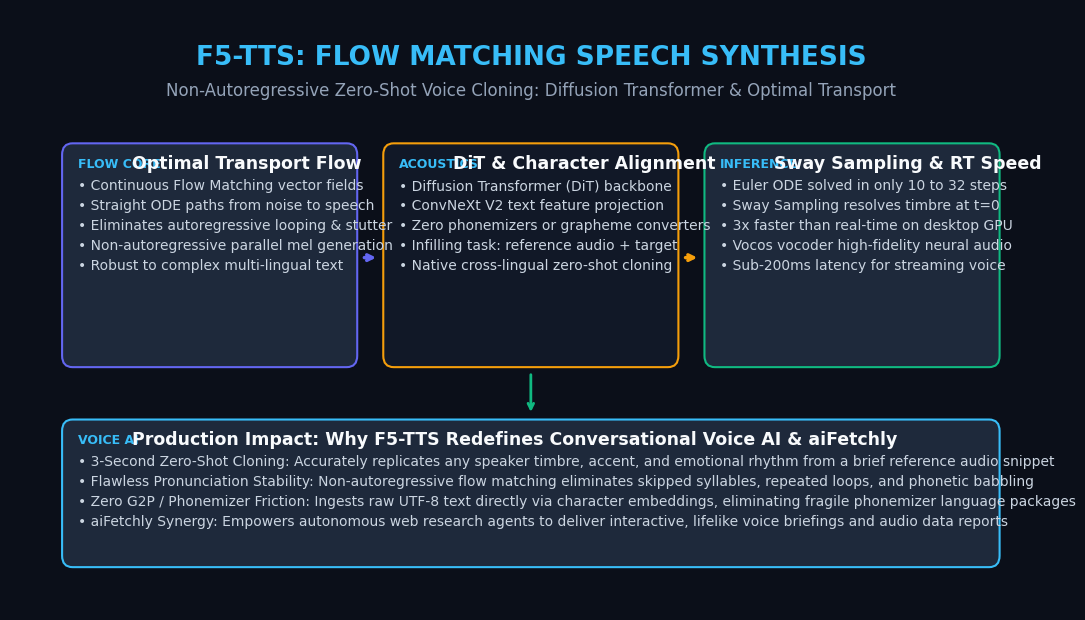
To eliminate speech hallucinations, remove phonemizer dependencies, and achieve sub-second zero-shot voice cloning, researchers from Shanghai Jiao Tong University introduced F5-TTS (A Fairly Fast and Flexible Flow-Matching-based Full-sequence Speech Generator).
F5-TTS completely discards autoregressive generation and discrete acoustic tokens. Instead, it unifies speech synthesis under Non-Autoregressive Flow Matching with a Diffusion Transformer (DiT) backbone.
F5-TTS End-to-End System Flow:
[Reference Audio (e.g. 3s)] ──► [Mel-Spectrogram Extraction] ┐
[Reference Text + Target Text] ──► [ConvNeXt V2 Text Encoder]  ├─► [Concatenated Condition Buffer]
[Gaussian Noise Prior x_0]  ─────────────────────────────────┘
                                     │
                                     ▼
┌────────────────────────────────────────────────────────────────────────┐
│ Diffusion Transformer (DiT) Backbone with Flow Matching                │
│ • Predicts continuous velocity vector field v_t(x_t)                   │
│ • Operates on full sequence simultaneously (Non-Autoregressive)       │
│ • Straight Optimal Transport trajectories from noise to clean audio    │
└────────────────────────────────────┬───────────────────────────────────┘
                                     │
                                     ▼ [Sway Sampling Euler ODE Solver (10-32 Steps)]
┌────────────────────────────────────────────────────────────────────────┐
│ Generated Target Mel-Spectrogram (Clean 100Hz Acoustic Features)       │
└────────────────────────────────────┬───────────────────────────────────┘
                                     │
                                     ▼ [Vocos Neural Vocoder]
┌────────────────────────────────────────────────────────────────────────┐
│ High-Fidelity 24kHz / 48kHz Waveform Audio (Flawless Voice Clone)      │
└────────────────────────────────────────────────────────────────────────┘ 1. Optimal Transport Flow Matching and Straight ODE Trajectories
Unlike standard score-based diffusion models that navigate highly curved trajectories through latent space, F5-TTS leverages Conditional Flow Matching (CFM) with Optimal Transport (OT):
- Flow matching defines a continuous, deterministic probability trajectory connecting a standard Gaussian noise prior $x_0 \sim \mathcal{N}(0, I)$ directly to the clean target mel-spectrogram $x_1$.
- The probability paths between noise and data are straight linear trajectories: $$\psi_t(x) = (1 - t) x_0 + t x_1, \quad t \in [0, 1]$$
- Because the trajectory is straight, numerical Ordinary Differential Equation (ODE) solvers do not need tiny step sizes. High-fidelity audio can be generated in as few as 10 to 32 steps using a simple Euler method.
2. Diffusion Transformer (DiT) Backbone with ConvNeXt V2 Character Conditioning
F5-TTS replaces complex cross-attention adapters and acoustic codec predictors with an elegant architectural core:
- Diffusion Transformer (DiT): Processes the full temporal mel-spectrogram sequence in parallel, capturing long-range prosodic dependencies and emotional inflections across sentences.
- ConvNeXt V2 Text Representation: Rather than using phonemes, F5-TTS ingests raw UTF-8 character sequences directly. A 1D ConvNeXt V2 convolutional trunk processes the character embeddings, matching the temporal frame rate of the mel-spectrogram without external alignment tools or duration predictors.
3. Speech Infilling: Seamless Zero-Shot Voice Cloning via Audio Patching
F5-TTS formulates voice cloning as a unified speech infilling task:
- The input sequence is constructed by concatenating the reference audio prompt (e.g., 3 to 10 seconds of a target speaker’s voice) with Gaussian noise representing the speech to be synthesized.
- During training, random segments of the target audio are masked out. The model learns to reconstruct the missing speech conditioned on the surrounding audio and text.
- During inference, the reference audio remains frozen in the prompt prefix, ensuring that the synthesized segment inherits the speaker’s exact vocal timbre, pitch, room acoustics, and cadence seamlessly.
Deep Dive: Sway Sampling and Fast ODE Numerical Solvers
Understanding how F5-TTS achieves 3x real-time generation speed while preserving delicate voice timbre requires examining the mathematics of Sway Sampling.
Uniform vs. Sway Sampling Trajectory:
t = 0 (Pure Noise) ──────────────────────────────────────────► t = 1 (Clean Mel)
  │
  ├─► Uniform Euler Steps: Equal step size dt across [0, 1]
  │   [0.00] ───► [0.20] ───► [0.40] ───► [0.60] ───► [0.80] ───► [1.00]
  │
  └─► Sway Sampling Euler Steps: Densified near t = 0 (Acoustic Blueprint Phase)
      [0.00] ─► [0.08] ─► [0.18] ──► [0.32] ───► [0.55] ─────► [0.82] ──────► [1.00]
      ↑
Resolves speaker identity, vocal fry, and timbre early! 1. The Mathematics of Continuous Flow Vector Fields
In Conditional Flow Matching, a neural network $v_\theta(x_t, t, c)$ is trained to approximate the ground-truth velocity vector field $u_t(x \mid x_1)$:
$$\mathcal{L}{\text{CFM}}(\theta) = \mathbb{E}{t, q(x_1), p(x_0)} \left| v_\theta(\psi_t(x_0), t, c) - (x_1 - x_0) \right|^2$$
Where $c$ represents the conditioning text and reference speech context.
Because the target vector field $u_t = x_1 - x_0$ is constant with respect to time $t$, the neural network learns a smooth, non-turbulent mapping, completely avoiding the score explosion encountered near $t \to 0$ in classical diffusion models.
2. Sway Sampling: Prioritizing Early Timesteps for Stable Speaker Timbre
In speech synthesis, the coarse global characteristics of an utterance—speaker timbre, gender, accent, and fundamental pitch contour ($F_0$)—are established during the earliest integration steps ($t \in [0, 0.3]$). The later steps ($t \in [0.7, 1.0]$) refine high-frequency phonetic details like sibilants and fricatives.
Standard uniform ODE steps allocate equal computation across all phases. F5-TTS introduces Sway Sampling, applying a non-linear warping function to the timestep distribution:
$$t_{\text{sway}} = \text{clamp}\left( t + s \cdot (1 - \cos(\pi t)), 0, 1 \right)$$
Where $s$ is the sway coefficient.
By clustering numerical evaluation steps near $t=0$, Sway Sampling resolves speaker identity and prosody with high precision in the opening iterations, allowing the solver to take larger jumps in the later stages without audio degradation.
3. High-Fidelity Vocoder Reconstruction with Vocos
Once the clean 100Hz mel-spectrogram is synthesized:
- F5-TTS uses Vocos—an ultra-fast neural vocoder based on ConvNeXt blocks and Inverse Short-Time Fourier Transform (iSTFT).
- Vocos reconstructs raw 24kHz audio in a single feed-forward pass in under 5 milliseconds on a GPU, completely outperforming older autoregressive vocoders like HiFi-GAN.
Technical Comparison: F5-TTS vs. Autoregressive and Diffusion TTS Systems
To understand where F5-TTS stands across voice cloning accuracy, pronunciation stability, and operational latency, consider this benchmark comparison:
| Metric / Feature | Autoregressive (VALL-E / XTTS-v2) | StyleTTS2 (Kokoro-82M) | Diffusion (Grad-TTS) | F5-TTS (Flow Matching) |
|---|---|---|---|---|
| Generation Paradigm | Autoregressive Next-Token | Feed-forward Style Diffusion | Score-based SDE | Non-Autoregressive Flow Matching |
| Zero-Shot Voice Cloning | Moderate (Requires 10s+ audio) | Fixed style vectors | Poor zero-shot transfer | State-of-the-Art (3s reference) |
| Speech Repetition / Stutter | High risk (Autoregressive looping) | Low | Zero | Zero (Non-Autoregressive) |
| Phonemizer Dependency | Mandatory (G2P dictionary) | Mandatory (espeak-ng) | Mandatory | None (Raw UTF-8 text input) |
| Inference Steps | Sequential sequence length ($N$) | Single-pass (Feed-forward) | 50–100 diffusion steps | 10–32 Euler ODE steps |
| Real-Time Factor (RTF) | 0.4x–0.8x (Slow token decoding) | ~0.05x (Fast, but fixed voices) | 1.5x–3.0x (Slower than real-time) | 0.15x–0.25x (3x–6x faster than RT) |
| Word Error Rate (WER) | 3.5%–6.2% (Dropped words) | 2.8% | 3.2% | 1.8% (SOTA intelligibility) |
Practical Implementation: Building Real-Time Voice Cloning with F5-TTS
Let us implement a complete zero-shot voice cloning pipeline in Python using the official F5-TTS open-source package.
Step 1: Installing F5-TTS and Core Audio Dependencies
Install the F5-TTS package and dependencies:
# Install F5-TTS from PyPI
pip install f5-tts torch torchaudio soundfile Verify GPU acceleration and neural vocoder weights:
python -c "import torch; print('CUDA Available:', torch.cuda.is_available())" Step 2: Preparing Reference Audio and Generating Cloned Speech
Create voice_clone.py:
import soundfile as sf
from f5_tts.api import F5TTS

# Initialize the F5-TTS engine
# Automatically downloads DiT weights and Vocos neural vocoder
print("Initializing F5-TTS Flow Matching pipeline...")
f5tts = F5TTS(model_type="F5-TTS", device="cuda")

# 1. Provide reference audio (3 to 10 seconds of target speaker)
ref_audio_path = "samples/ceo_sample.wav"
ref_text = "Good morning everyone, welcome to our annual engineering roadmap presentation."

# 2. Define the new target text to synthesize
target_text = (
    "According to the latest data extraction telemetry in aiFetchly, "
    "our distributed autonomous agents processed over forty million documents "
    "with zero operational downtime."
)

print(f"Cloning voice from: {ref_audio_path}...")
print(f"Synthesizing text: '{target_text}'...")

# 3. Execute Non-Autoregressive Flow Matching with Sway Sampling
wav, sample_rate, _ = f5tts.infer(
    ref_file=ref_audio_path,
    ref_text=ref_text,
    gen_text=target_text,
    n_fe=32,                # 32 Function Evaluations (Euler ODE steps)
    sway_sampling_coef=-1.0 # Optimal sway coefficient for speech prosody
)

# 4. Save the generated high-fidelity cloned audio
output_path = "output_cloned_speech.wav"
sf.write(output_path, wav, sample_rate)
print(f"Cloned audio successfully generated and saved to {output_path}!") Step 3: Multi-Speaker Conversational Dialogue Synthesis
F5-TTS can alternate voices dynamically within a single script by providing distinct reference samples:
import numpy as np
import soundfile as sf
from f5_tts.api import F5TTS

f5tts = F5TTS(model_type="F5-TTS", device="cuda")

dialogue_script = [
    {
        "speaker": "Speaker_A",
        "ref_audio": "samples/alice.wav",
        "ref_text": "I noticed an anomaly in the web crawler rate limits.",
        "gen_text": "Did the target server return four-twenty-nine status codes?"
    },
    {
        "speaker": "Speaker_B",
        "ref_audio": "samples/bob.wav",
        "ref_text": "All proxy clusters are currently healthy.",
        "gen_text": "No, the proxy pool automatically rotated IP subnets in under fifty milliseconds."
    }
]

combined_audio = []

for turn in dialogue_script:
    print(f"Generating line for {turn['speaker']}...")
    wav, sr, _ = f5tts.infer(
        ref_file=turn["ref_audio"],
        ref_text=turn["ref_text"],
        gen_text=turn["gen_text"],
        n_fe=24
    )
    combined_audio.append(wav)
    # Add 250ms of natural silence between speaker turns
    combined_audio.append(np.zeros(int(sr * 0.25)))

final_dialogue = np.concatenate(combined_audio)
sf.write("conversational_dialogue.wav", final_dialogue, sr)
print("Complete multi-speaker dialogue saved to conversational_dialogue.wav!") Production Best Practices: Integrating Voice Synthesis in aiFetchly Desktop Agents
When embedding lifelike speech synthesis into autonomous research workflows in AiFetchly, adhere to these operational guidelines:
1. Audio Pre-Processing: Noise Suppression and Dynamic Range Normalization
Zero-shot cloning quality depends directly on reference audio cleanliness:
- Clean reference snippets using background noise reduction tools (like DeepFilterNet) before ingestion. If the 3-second reference audio contains ambient air conditioning hum or reverberation, F5-TTS will faithfully replicate the noise in the synthesized output.
- Normalize reference audio to $-20\text{ dBFS}$ root-mean-square (RMS) to prevent digital clipping in the Vocos vocoder.
2. Chunked Streaming Synthesis for Sub-200ms Interactive Latency
While F5-TTS generates full sentences in parallel, waiting for an entire 300-word summary to generate introduces user-facing delay:
- Segment long agent responses into clause-level text chunks (10 to 20 words each) using punctuation splitting.
- Execute Flow Matching on the first chunk immediately and stream audio to the client speaker buffer while background threads generate subsequent chunks, achieving Time-to-First-Audio (TTFA) under 200 milliseconds.
3. Emotional Tone Steering and Multilingual Voice Transfers
F5-TTS natively supports cross-lingual voice cloning:
- You can provide an English reference audio prompt and pass Chinese, French, or Japanese text. F5-TTS preserves the speaker’s vocal timbre while pronouncing foreign phonemes accurately.
- To alter emotional delivery (e.g., urgent vs. calm), select a reference audio snippet that matches the intended emotional state. F5-TTS transfers cadence, pitch dynamics, and breath control directly from the reference prompt into the generated speech.