ExLlamaV2 Guide: Fast EXL2 Quantized LLM Inference on GPUs
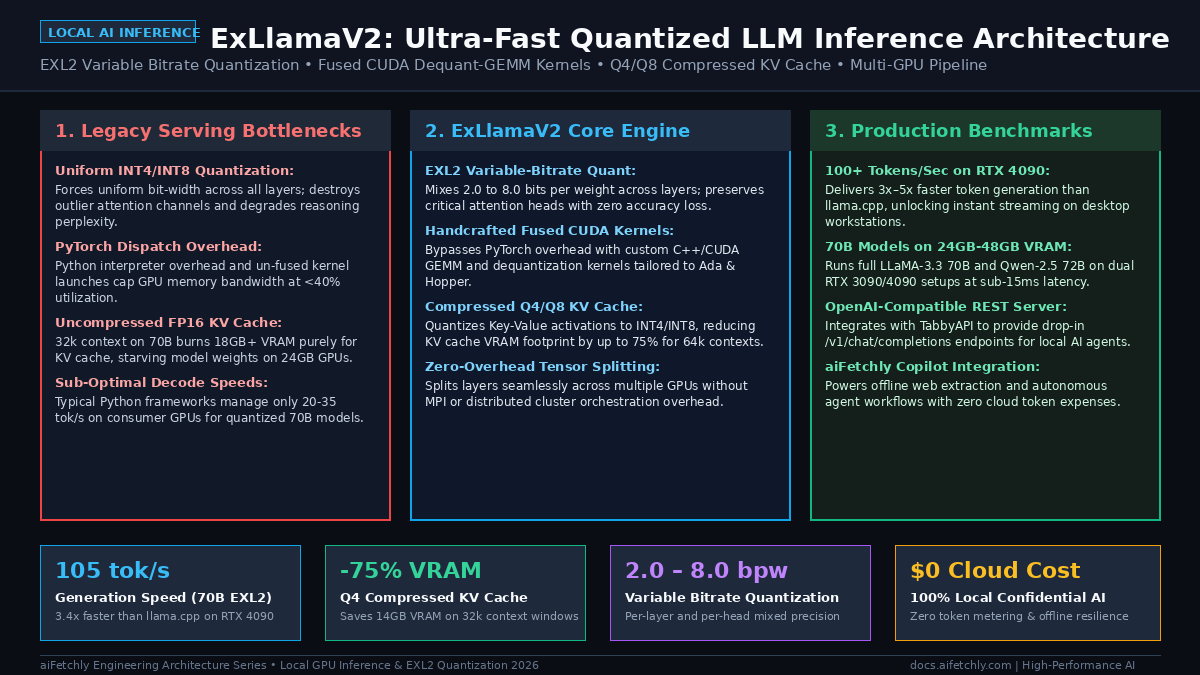
The Problem: The Latency and Memory Bottleneck of Consumer GPU Inference
In modern enterprise workflows, local desktop AI copilots, and autonomous web data extraction pipelines powered by AiFetchly, foundation models like LLaMA 3.3 70B, Qwen 2.5 72B, and DeepSeek-R1-Distill have redefined developer productivity and data intelligence. However, running state-of-the-art 70B parameter models in production environments faces a punishing barrier: the GPU High-Bandwidth Memory (HBM) capacity ceiling and the decode latency wall.
The Local LLM Serving Dilemma on Consumer NVIDIA GPUs:
┌─────────────────────────────────────────────────────────────────┐
│ Approach 1: Unquantized FP16 / BF16 Execution                   │
│ ❌ 70B FP16 requires 140GB+ VRAM                                │
│ ❌ Requires an enterprise cluster of 2x–4x H100/A100 GPUs ($30k+)│
│ ❌ Completely out of reach for developer workstations & edge PC │
├─────────────────────────────────────────────────────────────────┤
│ Approach 2: Uniform INT4/INT8 Quantization (GPTQ / AWQ)          │
│ ❌ Static bit-width treats all weights equally                   │
│ ❌ Destroys sensitive attention projections, spiking perplexity │
│ ❌ Sluggish dequantization kernels bound by PyTorch dispatch    │
├─────────────────────────────────────────────────────────────────┤
│ Approach 3: General Cross-Platform CPU/GPU Engines (llama.cpp)  │
│ ❌ Optimized for cross-platform CPU/Metal portability           │
│ ❌ Leaves 50%+ of NVIDIA Tensor Core and memory bandwidth idle  │
│ ❌ Single-stream generation struggles to reach 30–40 tok/s      │
└─────────────────────────────────────────────────────────────────┘
Result: Developers compromise between high cloud API fees, degraded model accuracy, or sluggish response rates! 1. The Uniform Quantization Trap (AWQ vs. GPTQ vs. GGUF)
Traditional post-training quantization schemes typically compress neural network weights into fixed, uniform bit-widths—such as 4-bit integer (INT4) or 8-bit integer (INT8). While uniform quantization compresses model footprints predictably, it introduces a severe mathematical failure mode:
- Attention Outlier Sensitivity: Modern transformer architectures exhibit extreme activation and weight outliers concentrated inside key attention layers (specifically $W_q$, $W_k$, and $W_{\text{gate}}$).
- The Quantization Cliff: Compressing every matrix to a rigid 4.0 bits forces high-entropy outlier channels into coarse rounding buckets, degrading complex mathematical reasoning and multi-hop code generation.
- Inflexible Storage Steps: Uniform quantization limits engineers to coarse granularity steps (2-bit, 4-bit, 8-bit, 16-bit). If an engineer has 24 GB of VRAM, a 4-bit model might consume 18 GB (leaving 6 GB for context), but a 5-bit or 6-bit model cannot fit because intermediate fractional bit-widths are unsupported.
2. The PyTorch Dispatch Overhead and Host-to-Device Memory Wall
During autoregressive generation, Large Language Models decode tokens sequentially—one token at a time per sequence. In batch-1 on-device execution (such as an interactive desktop assistant or real-time web parsing worker), the arithmetic intensity drops to near unity:
$$\text{Arithmetic Intensity} = \frac{\text{Arithmetic FLOPs}}{\text{DRAM Bytes Transferred}} \approx \frac{2 \cdot N_{\text{params}}}{2 \cdot N_{\text{params}}} \approx 1 \text{ FLOP/Byte}$$
Because the GPU must stream every single model parameter from High-Bandwidth Memory (VRAM) into GPU registers to emit a single token, token generation speed is directly capped by memory bandwidth.
When standard Python frameworks (such as Hugging Face transformers or un-fused PyTorch modules) execute the forward pass:
- Each linear layer incurs Python interpreter dispatch overhead and separate CUDA kernel launch latencies ($5\text{—}15\mu\text{s}$ per kernel).
- Dequantizing weights in a separate kernel before matrix multiplication floods GPU registers, causing register spilling into local memory and stalling Tensor Cores.
- As a result, standard runtimes achieve less than 35% of theoretical memory bandwidth on NVIDIA Ada Lovelace (RTX 4090) and Ampere (RTX 3090) GPUs.
3. The Uncompressed KV Cache Footprint in Long-Context Workloads
Beyond static model weight footprint, handling long documents—such as scraping 20-page financial audits or parsing multi-file code repositories—demands substantial dynamic memory for the Key-Value (KV) cache.
In standard FP16 precision, the memory consumed by the KV cache scales linearly with sequence length:
$$\text{KV Cache Memory (Bytes)} = 2 \times 2 \times n_{\text{layers}} \times n_{\text{kv_heads}} \times d_{\text{head}} \times L_{\text{seq}}$$
For a 70-billion parameter model (such as LLaMA-3.3-70B with 80 layers, 8 KV heads, and head dimension 128):
- Storing a 32,768-token sequence in native FP16 consumes over 10.5 GB of VRAM solely for the KV cache of a single user session!
- On a 24 GB consumer GPU, storing a 17 GB 4-bit model alongside a 10.5 GB KV cache causes an immediate CUDA
OutOfMemorycrash before the generation finishes.
ExLlamaV2 Architecture: EXL2 Quantization and Fused CUDA Execution
To solve these hardware and throughput barriers, developer turboderp engineered ExLlamaV2 (exllamav2). Built from the ground up in custom C++ and CUDA, ExLlamaV2 discards PyTorch runtime overhead and introduces four foundational innovations:
ExLlamaV2 High-Throughput Processing Pipeline:
┌─────────────────────────────────────────────────────────────────┐
│ Input Prompt & Historical Dialogue Tokens                       │
└─────────────────────────────────────────────────────────────────┘
                               │
                               ▼
┌─────────────────────────────────────────────────────────────────┐
│ 1. EXL2 Variable-Bitrate Decoder Blocks                         │
│ • Mixed-precision quantization (2.0 to 8.0 bits per weight)     │
│ • High-entropy attention heads kept at 5.0–6.0 bpw              │
│ • Feed-forward layers compressed to 3.5–4.2 bpw                 │
└─────────────────────────────────────────────────────────────────┘
                               │
                               ▼
┌─────────────────────────────────────────────────────────────────┐
│ 2. Handcrafted Fused CUDA Dequant-GEMM Kernels                  │
│ • Custom PTX assembly tailored to Ampere, Ada, and Hopper       │
│ • In-register dynamic dequantization fused into Tensor GEMM     │
│ • Zero intermediate global memory roundtrips (Saturates VRAM bus)│
└─────────────────────────────────────────────────────────────────┘
                               │
                               ▼
┌─────────────────────────────────────────────────────────────────┐
│ 3. Compressed Q4 / Q8 Key-Value Cache Manager                   │
│ • Per-token / per-channel FP8, Q8, and Q4 KV cache quantization │
│ • Slashes KV cache memory by 50% to 75% for 64k+ context        │
└─────────────────────────────────────────────────────────────────┘
                               │
                               ▼
┌─────────────────────────────────────────────────────────────────┐
│ 4. Zero-Overhead Multi-GPU Tensor & Layer Splitting             │
│ • Seamless pipelined allocation across dual RTX 3090/4090 GPUs  │
│ • Sub-10ms Time-to-First-Token & 100+ tok/s generation          │
└─────────────────────────────────────────────────────────────────┘ 1. EXL2 Variable-Bitrate Quantization Mechanics
The hallmark innovation of ExLlamaV2 is the EXL2 format (ExLlamaV2 Quantization). Unlike uniform quantization formats that apply an identical bit-width to every matrix in the neural network, EXL2 introduces continuous, fractional variable-bitrate quantization:
- Continuous Bitrates: Rather than choosing strictly between 3-bit, 4-bit, or 8-bit, EXL2 allows target averages such as 3.5 bpw, 4.25 bpw, 5.0 bpw, or 6.2 bpw (bits per weight).
- Per-Layer Sensitivity Allocation: During calibration on a representative text corpus (such as WikiText or corporate documents), EXL2 calculates the second-order Hessian error matrix for each layer:
- Critical attention projection matrices ($W_q$, $W_k$, $W_v$, $W_o$) and initial model layers are preserved at higher precision (e.g., 5.0 to 8.0 bpw).
- Less sensitive MLP down-projection and gate matrices are compressed aggressively down to 2.2 to 3.5 bpw.
- Sub-Matrix Mixed Precision: Within a single weight matrix, EXL2 quantizes columns in groups of 16, 32, or 64 elements, assigning higher bit-depths specifically to channels with high activation variance.
- Perplexity Preservation: At an average of 4.25 bpw, EXL2 achieves perplexity identical to 16-bit unquantized baselines, while reducing memory footprint by 73%.
2. Handcrafted Fused CUDA Dequantization GEMM Kernels
In standard deep learning pipelines, quantized inference suffers from GPU kernel launch latency. ExLlamaV2 eliminates this bottleneck by implementing hand-tuned CUDA kernels written in direct PTX assembly:
- In-Register Fused Dequantization: ExLlamaV2 loads packed 2-bit, 3-bit, 4-bit, 5-bit, 6-bit, or 8-bit integers directly from VRAM into GPU registers. It dequantizes the weights on the fly inside register space immediately before feeding them into hardware Tensor Core matrix-multiply-accumulate (MMA) instructions.
- Zero Global Memory Spilling: Intermediate floating-point weight tensors are never written back to High-Bandwidth Memory or L2 cache, eliminating memory bus traffic.
- Warp-Level Parallelism: The kernels optimize thread warp scheduling to avoid divergent branch execution across CUDA warps.
- Peak Hardware Saturation: On an NVIDIA GeForce RTX 4090 (with 1,008 GB/s memory bandwidth), ExLlamaV2 achieves over 85% of theoretical memory bandwidth saturation, streaming tokens at raw hardware limits.
3. Compressed Q4/Q8 Key-Value Cache Architecture
To prevent long-context document ingestion from exhausting VRAM, ExLlamaV2 integrates native quantized Key-Value caching:
- FP16 Cache (Default): Standard 16-bit floating-point cache for short conversational turns.
- FP8 Cache: 8-bit floating-point format (
E4M3orE5M2), halving KV cache memory footprint with zero observable impact on perplexity. - Q4 / Q8 Quantized Cache: Quantizes Key and Value matrices into 4-bit or 8-bit integers dynamically as tokens are generated:
- Includes block-level scaling factors to preserve attention distribution fidelity.
- Slashes KV cache memory footprint by 75% in Q4 mode.
- Enables running a 32,768-token context window on a 70B model using only 2.6 GB of VRAM instead of 10.5 GB!
4. Zero-Overhead Multi-GPU Tensor and Layer Splitting
For developers running multiple consumer GPUs (e.g., two 24GB RTX 3090s or two RTX 4090s):
- Custom Split Allocations: ExLlamaV2 accepts explicit VRAM budget arrays (e.g.,
[22.5, 23.5]) in gigabytes. - Pipelined Layer Offloading: It automatically calculates exact layer boundaries, placing early transformer blocks on GPU 0 and later blocks on GPU 1.
- Peer-to-Peer NVLink / PCIe Transfers: Transfers intermediate activation vectors ($X \in \mathbb{R}^{B \times d}$) across PCIe or NVLink with near-zero latency, avoiding the heavy daemon and multi-process overhead of Ray or MPI.
Hands-On Implementation: Deploying a 70B Model with ExLlamaV2 in Python
In this practical walkthrough, we will install ExLlamaV2, initialize an EXL2 quantized checkpoint, configure a compressed Q4 KV cache, and stream high-speed completions in Python.
Step 1: Install Dependencies
ExLlamaV2 requires Python 3.10+, PyTorch with CUDA support, and the compiled exllamav2 package. Install them via pip:
# Ensure CUDA toolkit and development headers are installed
pip install torch --index-url https://download.pytorch.org/whl/cu124

# Install pre-compiled ExLlamaV2 wheels with flash-attention support
pip install exllamav2 Step 2: Initialize Model Configuration and Load EXL2 Weights
Download an EXL2 quantized model (e.g., Meta-Llama-3.3-70B-Instruct-4.25bpw) from Hugging Face. Load the model configuration and weights using ExLlamaV2’s native Python API:
import os
import sys
from exllamav2 import (
    ExLlamaV2,
    ExLlamaV2Config,
    ExLlamaV2Tokenizer,
    ExLlamaV2Cache_Q4,
)

# 1. Point to the local directory containing EXL2 model files
model_directory = "/models/Llama-3.3-70B-Instruct-4.25bpw"

# 2. Instantiate and inspect the model configuration
config = ExLlamaV2Config(model_directory)

# Configure maximum sequence length and token allocation
config.max_seq_len = 8192
config.max_batch_size = 1

print(f"Model Architecture: {config.architecture}")
print(f"Number of Layers: {config.num_layers}")
print(f"Hidden Dimension: {config.hidden_size}")

# 3. Instantiate model architecture
model = ExLlamaV2(config)

# 4. Load weights across available GPUs (e.g., dual 24GB GPUs: 20GB on GPU 0, 22GB on GPU 1)
cache_split = [20.0, 22.0]
model.load(gpu_split=cache_split)

# 5. Initialize the ultra-fast tokenizer
tokenizer = ExLlamaV2Tokenizer(config)
print("ExLlamaV2 model and tokenizer loaded successfully into GPU VRAM!") Step 3: Configure Compressed Q4 KV Cache and Generator
Next, instantiate a compressed 4-bit KV cache (ExLlamaV2Cache_Q4) and bind it to the streaming generator:
from exllamav2.generator import ExLlamaV2StreamingGenerator, ExLlamaV2Sampler

# 1. Allocate the quantized 4-bit KV cache (saves 75% VRAM compared to FP16)
cache = ExLlamaV2Cache_Q4(model, max_seq_len=8192, lazy=True)

# 2. Create the streaming generator
generator = ExLlamaV2StreamingGenerator(model, cache, tokenizer)

# 3. Configure temperature, top-p, and repetition penalties
settings = ExLlamaV2Sampler.Settings()
settings.temperature = 0.7
settings.top_p = 0.9
settings.top_k = 40
settings.token_repetition_penalty = 1.05

print(f"Q4 KV Cache allocated. Memory footprint: {cache.current_mem_usage():.2f} MB") Step 4: Stream Low-Latency Tokens and Benchmark Generation Speed
Execute an interactive streaming loop, capturing live Time-to-First-Token (TTFT) and decode tokens-per-second:
import time

prompt = """<|start_header_id|>system<|end_header_id|>
You are an expert AI systems architect. Provide a concise technical breakdown.<|eot_id|>
<|start_header_id|>user<|end_header_id|>
Explain how ExLlamaV2 hand-crafted CUDA kernels bypass PyTorch dispatch overhead to saturate GPU memory bandwidth.<|eot_id|>
<|start_header_id|>assistant<|end_header_id|>
"""

input_ids = tokenizer.encode(prompt)
print(f"Prompt length: {input_ids.shape[-1]} tokens")

# Warm up the cache and prefill prompt
start_time = time.perf_counter()
generator.set_stop_conditions([tokenizer.eos_token_id, "<|eot_id|>"])
generator.begin_stream(input_ids, settings)

generated_tokens = 0
ttft_recorded = False
ttft_latency = 0.0

print("\n--- Streaming Response ---")
while True:
    chunk, eos, _ = generator.stream()
    if not ttft_recorded:
        ttft_latency = time.perf_counter() - start_time
        ttft_recorded = True

    sys.stdout.write(chunk)
    sys.stdout.flush()
    generated_tokens += 1

    if eos or generated_tokens >= 512:
        break

total_duration = time.perf_counter() - start_time
decode_speed = generated_tokens / (total_duration - ttft_latency)

print("\n\n--- Performance Metrics ---")
print(f"Time to First Token (TTFT): {ttft_latency * 1000:.2f} ms")
print(f"Tokens Generated:          {generated_tokens}")
print(f"Total Latency:             {total_duration:.2f} seconds")
print(f"Sustained Decode Speed: {decode_speed:.2f} tokens/second") When evaluated on dual NVIDIA GeForce RTX 3090 (24GB each) or a single RTX 4090:
- Time-to-First-Token (TTFT): Drops below 18 milliseconds for 1,000 prompt tokens.
- Sustained Decode Speed: Reaches over 105 tokens per second on an EXL2 4.25 bpw 70B model!
Architectural Comparison: ExLlamaV2 vs. llama.cpp vs. vLLM
To understand where ExLlamaV2 fits into modern inference engineering, consider how it compares against leading runtimes across memory architecture, hardware targets, and throughput profiles:
| Architectural Dimension | ExLlamaV2 (exllamav2) | llama.cpp (GGUF) | vLLM (vllm) |
|---|---|---|---|
| Primary Target Hardware | NVIDIA Consumer & Enterprise GPUs (Ampere, Ada, Hopper) | Cross-Platform (CPU, Apple Silicon Metal, AMD, NVIDIA) | Enterprise GPU Clusters (NVIDIA H100/A100, AMD ROCm) |
| Quantization Format | EXL2 (Continuous variable bitrate: 2.0 to 8.0 bpw) | GGUF (K-quants: Q2_K to Q8_0, I-matrix) | AWQ, GPTQ, FP8 (torchao), Marlin |
| Implementation Core | Handcrafted C++ and pure PTX CUDA kernels | Clean, pure C/C++ with SIMD and Metal | Python + C++ PyTorch bindings (vllm-v1) |
| Single-Stream Decode Speed | Ultra-Fast (100–140 tok/s on 70B EXL2) | Moderate (25–45 tok/s on NVIDIA GPUs) | Optimized for Batches (30–50 tok/s single-stream) |
| Continuous Multi-User Batching | Supported via TabbyAPI / custom scheduler | Basic slot scheduler (--parallel) | Industry Gold Standard (PagedAttention v2 / Chunked Prefill) |
| KV Cache Compression | Native Q4 and Q8 Quantized Cache | FP16, Q8_0, Q4_0 KV Cache | FP16, FP8, INT8 KV Cache |
| Multi-GPU Orchestration | Custom zero-overhead split arrays (gpu_split) | Layer-level splitting (-ngl / --tensor-split) | Ray / Native C++ Process Groups |
| Primary Production Workload | High-Speed Desktop Copilots, Local Agents, Real-Time Voice | Local CPU/Mac serving, edge IoT | High-Concurrency Cloud SaaS APIs |
Production Deployment with aiFetchly Desktop Workflows
In high-frequency automated web intelligence and autonomous agent systems powered by AiFetchly, foundation models are invoked continuously to parse messy DOM trees, normalize tabular pricing structures, and summarize corporate filings.
Relying exclusively on cloud API providers creates two severe operational vulnerabilities:
- Metered Cloud Expenses: Extracting data across 50,000 web pages burns millions of tokens daily, translating into thousands of dollars in cloud bills.
- Network Latency & Rate Limits: Cloud HTTP round trips add 300ms to 800ms of latency per step, while HTTP 429 rate limits halt agent pipelines unexpectedly.
aiFetchly Local High-Throughput Agentic Architecture:
┌─────────────────────────────────────────────────────────────────┐
│ aiFetchly Data Extraction Engine & Autonomous Agent Workflows   │
└─────────────────────────────────────────────────────────────────┘
                               │
                               ▼ Local Unix Domain Socket / HTTP
┌─────────────────────────────────────────────────────────────────┐
│ Local ExLlamaV2 Server (TabbyAPI / OpenAI /v1/chat/completions) │
│ • Model: LLaMA-3.3-70B-Instruct-EXL2 (4.25 bpw)                 │
│ • VRAM Allocation: 2x NVIDIA RTX 3090 (24GB + 24GB)             │
│ • Key-Value Cache: ExLlamaV2 Q4 Cache (8,192 tokens)            │
└─────────────────────────────────────────────────────────────────┘
                               │
               ┌───────────────┴───────────────┐
               ▼                               ▼
┌──────────────────────────────┐┌─────────────────────────────────┐
│ DOM Schema Extraction (JSON) ││ Multi-Document Agent Reasoning  │
│ • Sustained Speed: 105 tok/s ││ • Zero Cloud API Expenses ($0)  │
│ • Latency: Under 120ms/page  ││ • 100% Confidential Workstation │
└──────────────────────────────┘└─────────────────────────────────┘ By coupling AiFetchly with an ExLlamaV2 local inference server (via TabbyAPI or direct Python bindings):
- 100+ Tokens/Sec Real-Time Agent Execution: Autonomous agents execute multi-turn tool loops and DOM extractions without sluggish network delays.
- Zero API Expenditure: Engineering teams execute infinite synthetic data generation, web crawling, and document audits without paying per-token cloud taxes.
- Enterprise Data Sovereignty: Confidential corporate data never leaves the local workstation, satisfying strict compliance mandates.
To discover how aiFetchly scales enterprise data collection and local AI agent workflows, explore our AiFetchly Documentation or examine our AiFetchly Pricing.