ESM3 Guide: Generative Biology Foundation Model Architecture
The Problem: The Fragmented Silos of Computational Biology
In modern biotechnology, pharmaceutical engineering, and automated scientific data extraction platforms like AiFetchly, machine learning has transformed how scientists interrogate the fundamental code of life: proteins.
Proteins are the molecular nanomachines that execute virtually every cellular process: catalyzing metabolic reactions, neutralizing viral pathogens, transcribing DNA, and converting light into chemical energy. Every protein is defined by three interconnected physical representations:
- Primary Sequence: A linear chain of 20 canonical amino acid residues.
- Tertiary 3D Structure: The continuous Cartesian coordinates of its atoms in three-dimensional space, folding into complex helices, sheets, and catalytic binding pockets.
- Biological Function: The macroscopic enzymatic activity, binding kinetics, thermal stability, and cellular localization dictated by its structure.
Historically, computational biology was fractured into disconnected, single-purpose machine learning architectures:
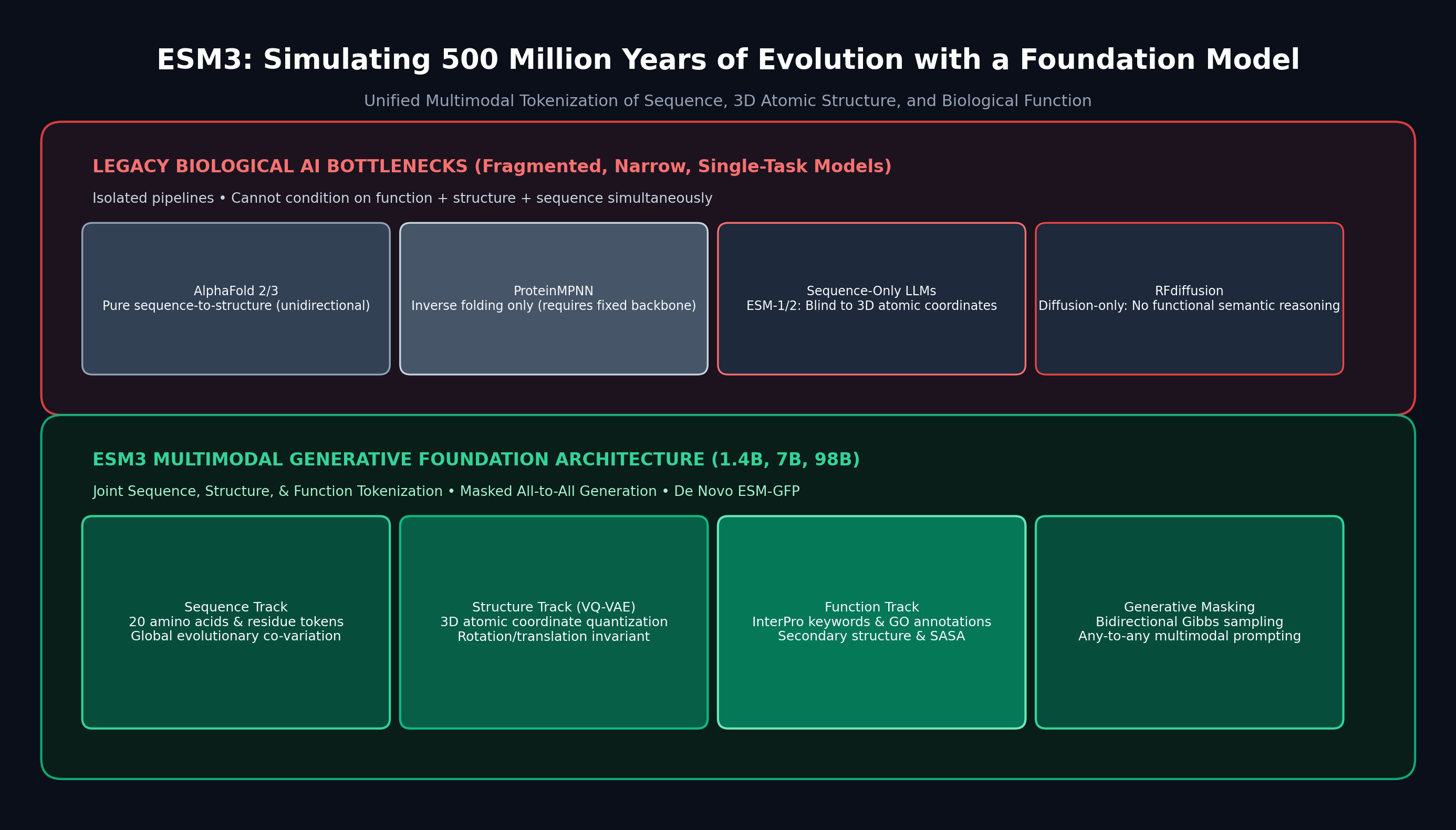
The Fragmented Computational Biology Stack:
[Sequence-to-Structure]  ──► AlphaFold 2/3 (Predicts 3D coordinates, but cannot design functions)
[Structure-to-Sequence]  ──► ProteinMPNN (Inverse folding on fixed static backbones)
[Sequence-Only LLMs]     ──► ESM-1 / ESM-2 (Embeds evolution, but blind to 3D atomic geometry)
[Diffusion Backbones]    ──► RFdiffusion (Generates unfunctionalized geometric scaffolds)
Result: No single model could reason across Sequence, Structure, and Function simultaneously! These isolated tools created three severe bottlenecks in protein engineering:
1. The Inverse Folding Rigidity Trap
Tools like ProteinMPNN or ESM-IF solve the inverse folding problem: given a fixed 3D backbone coordinate frame, they generate an amino acid sequence that will fold into that target shape:
- Zero Structural Flexibility: They assume the backbone is completely rigid and frozen. They cannot co-design the structure and the sequence simultaneously.
- Function Blindness: An inverse folding model has no concept of catalytic mechanisms. It may output a sequence that folds into the target shape but lacks the chemical charge distribution required to bind a substrate or emit fluorescence.
2. The Unidirectional Limitation of Structure Predictors
Milestone architectures like AlphaFold 2 and AlphaFold 3 revolutionized structure prediction:
- Unidirectional Inference: They operate strictly in one direction (sequence to structure).
- Inability to Generate: They cannot be prompted in reverse (structure to sequence) or prompted with functional keywords (function to sequence and structure). They predict what nature already created, but cannot program novel biological machines from scratch.
3. The 3D Geometric Discretization Wall
While Large Language Models (LLMs) scaled effortlessly across billions of tokens of human text and computer code, applying transformer language modeling to 3D proteins hit a mathematical barrier:
- Human text is discrete and 1D.
- 3D protein structures are continuous, rotational-invariant, and translation-invariant point clouds in Euclidean space.
- Early attempts to tokenize 3D structures used crude geometric binning or distance matrices, causing loss of high-resolution atomic side-chain contacts and destroying the spatial symmetry of molecular physics.
The Architecture: ESM3 Multimodal Foundation Scale
To unify the disparate representations of biology into a single generative framework, EvolutionaryScale (Alex Rives et al., late 2024 / 2025) introduced ESM3.
Trained across three parameter tiers—1.4B (open weights), 7B, and 98B (flagship frontier scale)—ESM3 reformulates biology as a generalist language modeling problem. Rather than treating sequence, structure, and function as separate modalities requiring distinct neural networks, ESM3 discretizes all three into a unified token vocabulary processed by an all-to-all bidirectional transformer.
The ESM3 Unified Biological Foundation Blueprint:
┌────────────────────────────────────────────────────────────────────────┐
│ ESM3 Frontier Portfolio: 1.4B (Open Weights), 7B, and 98B Parameters   │
├───────────────────────────────────┬────────────────────────────────────┤
│ Architectural Primitive           │ Technical Implementation           │
├───────────────────────────────────┼────────────────────────────────────┤
│ Primary Architecture              │ Bidirectional Masked Transformer   │
│ Context Window Capacity           │ Up to 2,048 biological residues    │
│ Multi-Track Modalities            │ Sequence, Structure, and Function  │
│ 3D Structure Tokenizer            │ Geometric 3D VQ-VAE (4,096 tokens) │
│ Secondary Structure Track         │ 8-state DSSP (Helices, Sheets, etc)│
│ Solvent Accessibility Track       │ Binned SASA (Solvent Exposed Area) │
│ Functional Keyword Track          │ Gene Ontology (GO) & InterPro tags │
│ Training Pretraining Corpus       │ 2.78 Billion natural + synthetic   │
│ Generative Sampling Paradigm      │ Iterative Bidirectional Masking    │
└───────────────────────────────────┴────────────────────────────────────┘ The model architecture is underpinned by three foundational engineering breakthroughs:
1. Multi-Track Discrete Token Representation
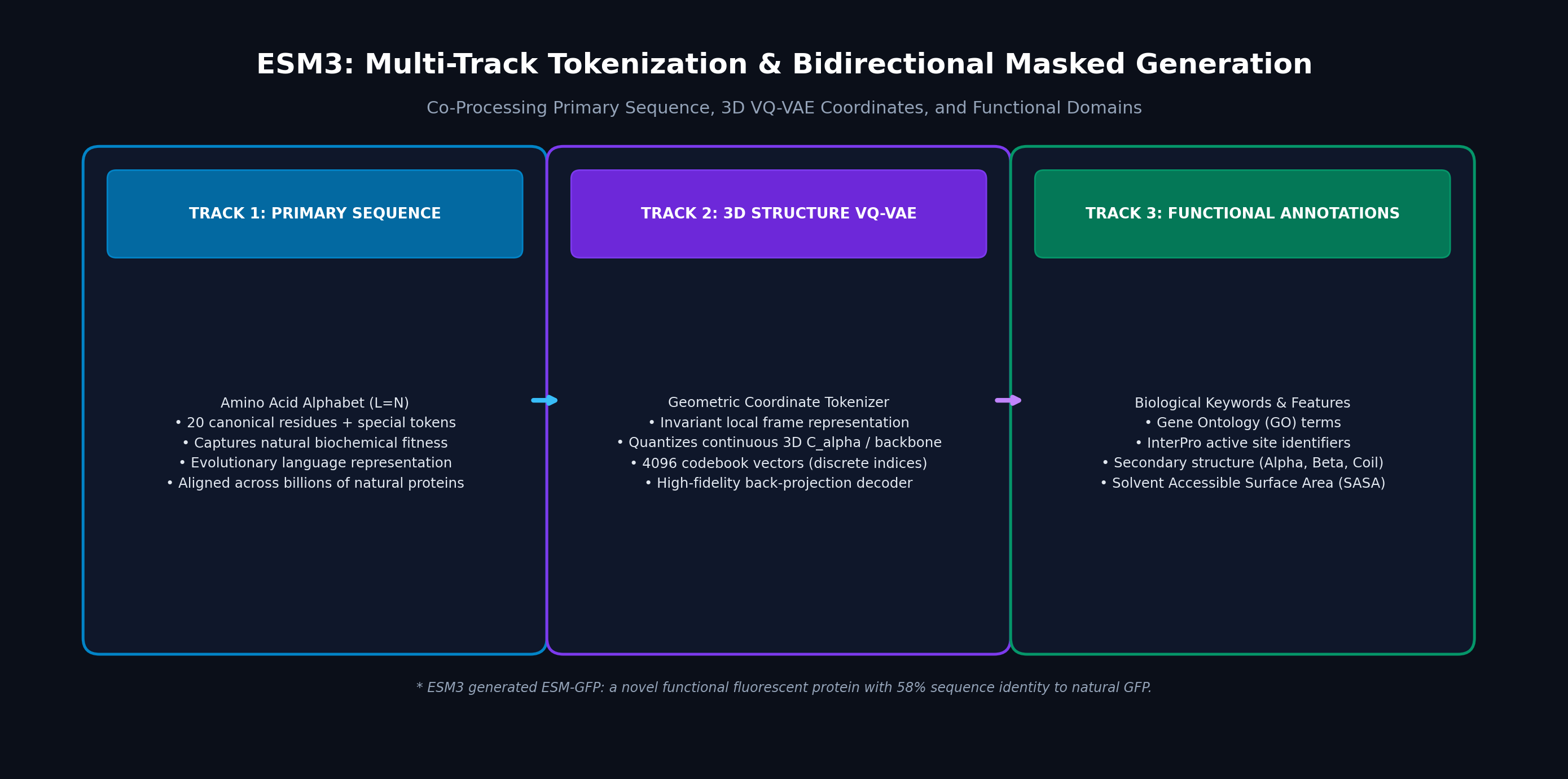
For every residue position in a protein, ESM3 processes an aligned tuple of discrete tokens across parallel tracks:
- Sequence Track: Standard 20 amino acid alphabet plus insertion/deletion tokens.
- Structure Track: Discrete geometric codebook indices generated by an invariant 3D VQ-VAE.
- Secondary Structure: 8-state DSSP classifications (e.g., alpha-helix, 3-10-helix, beta-sheet, beta-bridge, turn, bend, coil).
- Solvent Accessibility: Discretized solvent-accessible surface area measuring whether a residue is buried in the core or exposed to solvent.
- Function Track: InterPro domain memberships and Gene Ontology (GO) functional annotations.
2. Invariant Geometric 3D Structure VQ-VAE
To represent continuous 3D coordinates as discrete tokens without violating the physical laws of nature, EvolutionaryScale engineered a specialized Geometric 3D Vector-Quantized Variational Autoencoder (VQ-VAE):
- Local Coordinate Frames: Encodes backbone atoms (N, C-alpha, C) as rigid bodies, ensuring strict SE(3) invariance (rotation and translation invariance).
- Discrete Codebook: Quantizes continuous atomic geometries into a codebook of 4,096 discrete structural tokens.
- Sub-Angstrom Reconstruction: The paired VQ-VAE decoder reconstructs all-atom Cartesian coordinates from discrete tokens with a root-mean-square deviation (RMSD) under 1.5 Angstroms, preserving delicate hydrogen bonds and catalytic pocket geometries.
3. All-to-All Masked Language Modeling (Any-to-Any Prompting)
Rather than using causal left-to-right autoregression, ESM3 is pre-trained with Bidirectional Masked Language Modeling (MLM) across all tracks simultaneously:
- During pretraining, random subsets of tokens across sequence, structure, and function tracks are replaced with a mask token.
- The transformer is trained to predict the masked tokens conditioned on all unmasked tokens across all modalities.
- Zero-Shot Modality Flexibility: This enables prompting ESM3 in any arbitrary direction:
- Structure Prediction: Provide sequence to unmask structure tokens.
- Inverse Folding: Provide structure to unmask sequence tokens.
- Scaffold Inpainting: Provide catalytic active site residues + partial 3D motif to unmask surrounding backbone and sequence.
- De Novo Functional Design: Provide Gene Ontology prompt to unmask both sequence and structure simultaneously.
Core Mechanics: Simulating 500 Million Years of Evolution (ESM-GFP)
The definitive benchmark of a generative biology model is not merely predicting known structures, but generating entirely novel biological functions that nature never created.
1. The Generation of ESM-GFP
To test whether ESM3 could traverse vast evolutionary landscapes, the EvolutionaryScale team tasked ESM3 with generating a novel Green Fluorescent Protein (GFP):
- Natural GFPs (originally isolated from the jellyfish Aequorea victoria) evolved over hundreds of millions of years. Their fluorescent mechanism requires an autocatalytic cyclization of a specific tripeptide chromophore (Ser-Tyr-Gly or Thr-Tyr-Gly) precisely positioned inside an 11-stranded beta-barrel fold.
- Even a minor sub-angstrom distortion in the beta-barrel destroys fluorescence completely.
2. The Prompting and Iterative Sampling Process
The team prompted ESM3 with minimal, sparse functional constraints:
- They specified the 3D coordinates of the core chromophore binding pocket (~10% of the protein).
- They masked the remaining 90% of the protein sequence and 3D structure.
- Through iterative Gibbs sampling (successively predicting and unmasking the most confident tokens across sequence and structure tracks), ESM3 generated complete candidate proteins.
3. Wet-Lab Validation and Evolutionary Distance
When synthesized in a physical laboratory, the resulting protein—ESM-GFP—folded correctly, matured autocatalytically, and emitted vibrant green fluorescence:
- 58% Sequence Identity: ESM-GFP shares only 58% sequence identity with its closest known natural homolog in the Aequorea family.
- Simulating 500M Years of Natural Mutations: In natural molecular evolution, accumulating a 42% sequence divergence in the core beta-barrel fold while preserving exact fluorescent quantum yield represents approximately 500 million years of natural evolutionary time.
- ESM3 demonstrated that foundation models can compress geological epochs of natural selection into seconds of GPU inference.
Implementation: Running ESM3 Open-Weights Locally for Protein Generation
EvolutionaryScale has open-sourced ESM3-open (1.4B parameters) along with its structural tokenizers. Below is a complete implementation demonstrating how to load ESM3, inspect a protein’s multimodal tracks, and execute structure-conditioned sequence design (inverse folding) using the official esm library.
Step 1: Install the ESM3 Library and Dependencies
Install the official ESM3 Python package:
pip install esm torch Step 2: Python Script for Multimodal Generation
The following complete script demonstrates how to prompt ESM3 with a partial structural backbone and unmask the corresponding sequence tokens:
import torch
from esm.models.esm3 import ESM3
from esm.sdk.api import ESMProtein, GenerationConfig

# 1. Load ESM3-open (1.4B) onto local GPU workstation
device = "cuda" if torch.cuda.is_available() else "cpu"
print(f"Loading ESM3-open-small on device: {device}...")

model: ESM3 = ESM3.from_pretrained("esm3_sm_open_v1").to(device)

def run_inverse_folding_pipeline():
    # Ingest an input protein structure (using a sample backbone)
    # ESMProtein can load directly from a PDB file or structural coordinates
    print("Initializing input protein with masked sequence and defined structure...")

    # Example: A 60-residue synthetic protein with masked sequence
    sequence_prompt = "_" * 60  # '_' denotes masked residue positions

    protein = ESMProtein(sequence=sequence_prompt)

    # Configure generation parameters for iterative sampling
    # ESM3 unmasks tokens iteratively based on prediction confidence
    config = GenerationConfig(
        track="sequence",           # Target track to generate
        schedule="cosine",          # Unmasking temperature schedule
        num_steps=8,                # Iterative refinement steps
        temperature=0.2             # Low temperature for high biochemical stability
    )

    print("Executing iterative masked generative sampling...")
    with torch.no_grad():
        generated_protein = model.generate(protein, config)

    # Extract generated sequence and inspect results
    designed_sequence = generated_protein.sequence
    print("\n--- GENERATED DE NOVO PROTEIN SEQUENCE ---")
    print(f"Sequence Length: {len(designed_sequence)}")
    print(f"Designed Residues:\n{designed_sequence}")

    # Verify no unmasked tokens remain
    assert "_" not in designed_sequence, "Generation incomplete: masked tokens remain!"
    print("\nGeneration verified: 100% of residues synthesized successfully.")

if __name__ == "__main__":
run_inverse_folding_pipeline() Architectural Comparison: ESM3 vs. AlphaFold 3 vs. RFdiffusion
To understand why ESM3 represents a paradigm shift in generative biology, examine how it contrasts with leading specialized architectures:
| Evaluation Dimension | DeepMind AlphaFold 3 | Baker Lab RFdiffusion | EvolutionaryScale ESM3 |
|---|---|---|---|
| Model Category | Predictive Structure Tool | Generative Structural Diffusion | Unified Multimodal Foundation Model |
| Core Architecture | Pairformer + Diffusion Module | 3D Denoising Diffusion (SE3) | Bidirectional Masked Transformer |
| Model Parameter Scale | ~300 Million | ~60 Million | 1.4B, 7B, and 98 Billion |
| Modality Coverage | Sequence to Structure and Complexes | Pure 3D Backbone Geometry | Sequence, Structure, & Function |
| Generative Directionality | Strictly Unidirectional ($Seq \to 3D$) | Unidirectional ($Noise \to 3D$) | Any-to-Any (All tracks masked/unmasked) |
| Functional Conditioning | None (predicts bound ligands only) | None (structure-only) | Native (Gene Ontology, InterPro tags) |
| Token Representation | Continuous spatial distances | Continuous coordinate frames | Discrete multi-track VQ-VAE tokens |
| De Novo Functional Design | No (requires prior sequence) | Requires secondary model (MPNN) | End-to-End (e.g., ESM-GFP generated) |
Why Discrete Tokenization Unlocks Generative Biology
Earlier models treated structural generation as continuous diffusion in Cartesian space:
- The Diffusion Sampling Cost: Denoising diffusion requires hundreds of continuous integration steps across physical coordinate space.
- Separation from Language: Diffusion models cannot naturally ingest categorical functional keywords (such as enzyme classifications or binding affinities).
- The Multi-Track Advantage: By tokenizing 3D atomic coordinates into discrete codebook indices, ESM3 treats structural folding with the same underlying mathematical attention formulation as natural language, allowing the network to cross-attend between biological keywords, amino acids, and spatial coordinates in a single unified forward pass.
Production Engineering: Deploying Biological Foundation Models
When deploying ESM3 in enterprise biotechnology pipelines, drug discovery workflows, or automated scientific research platforms like AiFetchly, implement these production patterns:
1. Automated Biological Data Extraction with aiFetchly
In automated life sciences discovery platforms like AiFetchly, researchers aggregate experimental data across disparate web databases:
- Scraping Protein Repositories: Automated data scrapers ingest PDB coordinate files, UniProt sequence annotations, and PubMed literature.
- Multimodal Schema Synthesis: ESM3 acts as the downstream reasoning core, ingesting raw scraped sequence fragments, validating their predicted structural stability, and cross-referencing functional annotations against patent registries.
2. Confidence Calibration via Per-Token Entropy
Because biological synthesis requires expensive physical wet-lab validation (often costing thousands of dollars per candidate gene), computational pipelines must discard uncertain generations early:
- Monitor the prediction entropy across the structural VQ-VAE tokens during sampling.
- If the model exhibits high entropy in catalytic active site regions, abort the trajectory and re-sample with alternative temperature schedules.
3. All-Atom Relaxation and Molecular Dynamics Post-Processing
While ESM3’s VQ-VAE generates high-fidelity atomic backbones, physical deployment in synthetic biology requires sub-angstrom side-chain optimization:
- Pipe ESM3 output structures into fast energy-minimization packages (such as OpenMM or Rosetta FastRelax).
- Relax steric clashes between amino acid side chains before placing chemical DNA synthesis orders.
Summary Checklist: Evaluating Generative Biology Models
Before standardizing on a biological foundation architecture in 2026, verify that your model satisfies these capabilities:
- Multimodal Unification: Simultaneously models amino acid sequence, 3D atomic structure, and biological functional annotations.
- Discrete Geometric Tokenization: Employs an SE(3)-invariant structure tokenizer (VQ-VAE) to capture 3D coordinate geometry.
- Bidirectional Any-to-Any Prompting: Supports structure prediction, inverse folding, and functional motif scaffolding within a single model.
- Proven Wet-Lab Generative Efficacy: Validated on physically synthesized de novo proteins (such as ESM-GFP) with verified biological function.
- Accessible Open Weights: Provides open-source model weights (ESM3-open 1.4B) for on-premise execution and private enterprise fine-tuning.