Enflame DTU Guide: CloudBlazer AI Processor Architecture
The Sovereign AI Hardware Bottleneck: Monolithic Monopoly and the Datacenter Power Crunch
The exponential evolution of artificial intelligence from narrow discriminative classifiers into multi-hundred-billion parameter foundation models has created an unprecedented global infrastructure crisis. Across hyperscale datacenters, sovereign cloud facilities, and high-throughput enterprise pipelines, training and serving modern AI architectures requires sustained petascale computational throughput. Foundation models—spanning dense autoregressive transformers, sparse Mixture-of-Experts (MoE) ensembles, multimodal vision-language architectures, and high-dimensional recommendation graphs—have stressed datacenter infrastructure across four critical failure modes:
- The Proprietary Hardware Monopoly and Severe Supply Chain Fragility: For over a decade, datacenter accelerated computing has been dominated by a single vendor’s closed-source hardware and software ecosystem. This monolithic market structure exposes enterprise organizations and national cloud operators to severe geopolitical vulnerabilities, production lead times exceeding fifty weeks, and exorbitant gross margin premiums. When a single hardware vendor dictates cluster procurement schedules, organizations face catastrophic operational delays. Building resilient, sovereign computing infrastructure requires architecturally independent silicon platforms built on open, modular compiler standards.
- The Memory Bandwidth Wall and Arithmetic Intensity Collapse: In production machine learning systems, execution oscillates between compute-bound pre-training phases and memory-bandwidth-bound autoregressive inference phases. During foundation model inference, generating output tokens requires streaming multi-billion-parameter weight matrices from off-chip memory into arithmetic execution registers for every discrete token emitted. On standard accelerators equipped with commodity memory systems, memory controllers saturate rapidly, leaving expensive matrix arithmetic units starving for operands.
- The Datacenter Power and Thermal Ceiling: Hyperscale datacenter facilities were originally constructed around electrical power budgets of 10 to 15 kilowatts per server rack. However, contemporary frontier accelerator servers frequently draw between 8 and 10 kilowatts per 4U chassis alone. Stacking these power-hungry accelerators into legacy air-cooled datacenters triggers thermal throttling, requires massive capital expenditures on facility retrofitting, and escalates carbon footprints. Accelerators must achieve radically higher compute-per-watt efficiency through hardware-native structural optimizations, such as sparsity exploitation and custom floating-point representations.
- The Compiler and Runtime Lock-In Barrier: Alternative silicon initiatives have frequently foundered not because their raw silicon arithmetic was deficient, but because their software compilers failed to support real-world production frameworks. Forcing machine learning engineers to manually rewrite PyTorch, TensorFlow, or Megatron-LM code into non-standard low-level assembly creates insurmountable friction. Silicon success requires a mature, production-grade compiler stack capable of automatic graph capture, kernel fusion, and standard distributed collective orchestration.
Addressing these foundational challenges requires an enterprise-class accelerator architecture designed from the ground up for high-throughput tensor arithmetic, dense memory integration, glueless multi-card scale-up, and native framework compatibility.
Introducing Enflame DTU: Enterprise CloudBlazer AI Acceleration
Enflame Technology (燧原科技)—founded in Shanghai by former AMD senior directors and chief chip architects Zhao Lidong and Zhang Yalin, and backed strategically by Tencent—provides the definitive answer with the Enflame DTU (Deep Thinking Unit) architecture and the CloudBlazer (云燧) accelerator ecosystem.
Enflame represents one of the world’s most accomplished sovereign AI silicon architectures, progressing across four hardware generations from 12nm FinFET prototypes to flagship 7nm and advanced-node datacenter processors. Epitomized by the CloudBlazer Yunsui T20 / T21 distributed training accelerators and the CloudBlazer Yunsui i20 high-throughput inference processor, Enflame DTUs provide balanced, cost-effective acceleration for enterprise model training, fine-tuning, and massive concurrency serving.
+-------------------------------------------------------------------------+
|                  Enflame DTU Silicon & System Overview                  |
+-------------------------------------------------------------------------+
| Compute Engine:     GCU-CARE 2.0 (Compute Acceleration Resilient Engine)|
| Execution Core:     32 Specialized AI Cores in 4 Symmetrical Clusters  |
| Memory Subsystem:   32GB HBM2e with up to 1.6 TB/s Aggregate Bandwidth  |
| Interconnect Fabric:TopsLink™ / ESL (Enflame Scale Link) Glueless P2P   |
| System Form Factor: CloudBlazer T20 (PCIe Gen4) / T21 (OAM Module)      |
| Software Platform:  TopsRider™ SDK with TopsGraph, TopsOperator & GCU-C |
+-------------------------------------------------------------------------+ Key architectural breakthroughs integrated into Enflame DTU processors include:
- GCU-CARE™ Compute Core Architecture: Powered by Enflame’s proprietary General Compute Unit (GCU) architecture, combining Very Long Instruction Word (VLIW) instruction dispatch, wide SIMD vector engines, and high-density 2D Tensor Arithmetic Logic Units (Tensor ALUs) optimized for GEMM matrix multiplication.
- Hardware-Native Structural Sparsity Engine: Features dedicated zero-skipping logic directly in the arithmetic execution data path. By identifying zero-valued activation operands and sparse weights at runtime, the DTU bypasses unnecessary memory fetches and multiply-accumulate cycles, achieving up to 2x real-world throughput gains.
- High-Bandwidth 2.5D HBM2e Memory Packaging: Couples advanced FinFET compute silicon directly with high-density High-Bandwidth Memory (HBM2e) stacks over a high-density silicon interposer, delivering up to 1.6 Terabytes per second (TB/s) of unified memory bandwidth.
- TopsLink™ Glueless Inter-Chip Interconnect: Integrates proprietary high-speed bi-directional chip-to-chip links delivering up to 200 GB/s inter-die communication, enabling 4-card and 8-card server topologies to form coherent tensor-parallel rings without costly external InfiniBand or NVSwitch fabrics.
- Full-Stack TopsRider™ Software Platform: Delivers comprehensive software support through the TopsGraph optimizing compiler, the TopsOperator high-performance math library, the GCU-C domain-specific programming language, and seamless, transparent upstream integrations with PyTorch, TensorFlow, ONNX, and Megatron-LM.
Enterprises deploying large-scale neural network training, automated data extraction, and multimodal reasoning clusters can connect their Enflame DTU server infrastructure with real-time data ingestion infrastructure to stream high-velocity datasets directly into HBM2e memory for immediate vectorized processing and continuous fine-tuning. By marrying clean architectural design with production software integration, Enflame DTU establishes a scalable, independent foundation for global AI infrastructure.
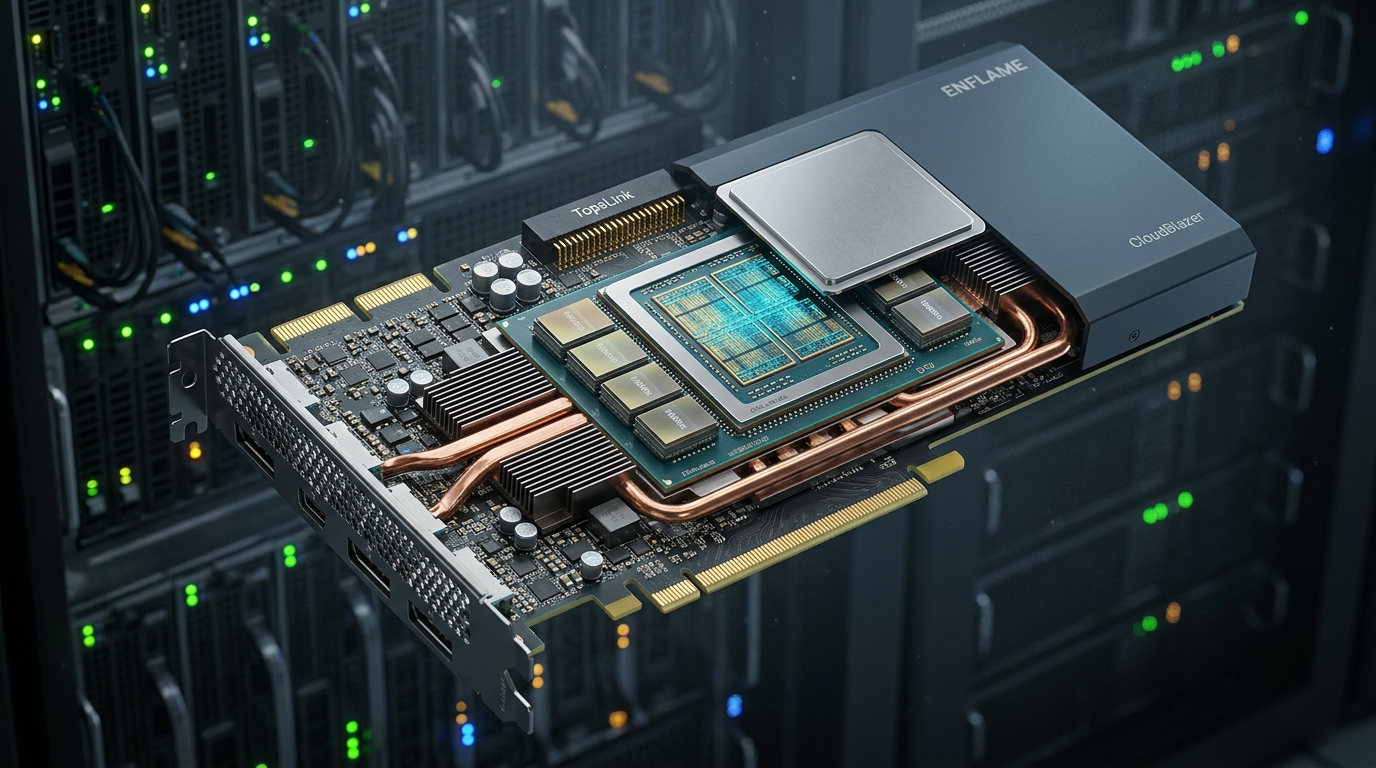
Architectural Deep Dive: GCU-CARE Cores, 2.5D HBM2e Packaging, and TopsLink Interconnect
The sustained computational throughput and enterprise reliability of the Enflame DTU originate from its hierarchical compute organization, decoupled tensor-vector execution core, balanced memory hierarchy, and high-speed inter-accelerator fabric.
The Hierarchical DTU SoC Architecture
At the silicon die level, the Enflame DTU (Deep Thinking Unit) is structured as a balanced, high-efficiency system-on-chip (SoC) designed specifically to eliminate data starvation and instruction decoding bottlenecks:
+-----------------------------------------------------------------------------------+
|                         Enflame DTU SoC Architecture                              |
+-----------------------------------------------------------------------------------+
|  +------------------------+  +-------------------------------------------------+  |
|  | Host Interface Subsys  |  | TopsLink™ Interconnect Engine (GCU-LARE)         |  |
|  | PCIe Gen 4 x16 (64GB/s)|  | Up to 200 GB/s Glueless P2P Scale-Up Fabric     |  |
|  +-----------+------------+  +------------------------+------------------------+  |
|              |                                        |                           |
|  +-----------v----------------------------------------v------------------------+  |
|  |            Ultra-High-Speed 2D Crossbar Network-on-Chip (NoC)               |  |
|  +-----------------------------------------------------------------------------+  |
|        |                     |                        |                     |     |
|  +-----v-----------+   +-----v-----------+      +-----v-----------+   +-----v-----+   |
|  | Compute Cluster0|   | Compute Cluster1|      | Compute Cluster2|   | Cluster 3 |   |
|  | - 8 GCU-CARE    |   | - 8 GCU-CARE    |      | - 8 GCU-CARE    |   | - 8 Cores |   |
|  | - 32MB Shared L2|   | - 32MB Shared L2|      | - 32MB Shared L2|   | - 32MB L2 |   |
|  +-----+-----------+   +-----+-----------+      +-----+-----------+   +-----+-----+   |
|        |                     |                        |                     |     |
|  +-----v---------------------v------------------------v---------------------v--+  |
|  |                  Multi-Channel HBM2e Memory Controller Subsystem             |  |
|  |                  32GB High-Bandwidth Memory @ 1.6 TB/s Bandwidth            |  |
|  +-----------------------------------------------------------------------------+  |
+-----------------------------------------------------------------------------------+ The SoC integrates 32 high-performance GCU-CARE compute cores partitioned into four symmetrical compute clusters. Each cluster contains eight cores that share a wide, low-latency localized Level-2 SRAM scratchpad cache, connected to the global SoC crossbar. A central Hardware Task Manager coordinates asynchronous kernel execution, dynamic work stealing, and barrier synchronization across all clusters without interrupting the host CPU.
GCU-CARE: Compute Acceleration Resilient Engine
The fundamental execution building block of the Enflame DTU is the GCU-CARE (Compute Acceleration Resilient Engine). Designed by microprocessor veterans from AMD and top computing institutes, GCU-CARE combines the deterministic scheduling simplicity of Very Long Instruction Word (VLIW) architectures with specialized spatial tensor compute engines:
- Dual-Issue VLIW Instruction Dispatch: Unlike power-hungry out-of-order superscalar pipelines, GCU-CARE employs an energy-efficient VLIW instruction decoder. The compiler schedules instruction packets containing multiple independent operations (such as a matrix multiply, a vector activation, a memory load, and an address calculation) that execute concurrently in a single clock cycle. This compiler-driven approach eliminates dynamic branch predictors and reservation stations, maximizing silicon area dedicated to arithmetic units.
- Dense 2D Tensor Arithmetic Logic Unit (Tensor ALU): Each GCU-CARE core features a dedicated 2D systolic-style tensor matrix engine capable of computing high-dimensional matrix multiply-accumulate operations in a single execution pipeline. The Tensor ALU natively supports IEEE FP32, TF32 (TensorFloat-32), FP16, BF16 (Bfloat16), and INT8 precisions. By operating on 16x16 and 32x32 matrix tiles directly in local registers, the Tensor ALU achieves near-theoretical peak FLOP utilization on GEMM operations.
- Wide SIMD Vector Processing Engine: Positioned adjacent to the Tensor ALU, a 512-bit wide SIMD vector unit handles non-linear activation functions (such as GELU, SiLU, and SwiGLU), layer normalizations (RMSNorm, LayerNorm), element-wise scaling, and softmax reductions. Operating in parallel with the Tensor ALU, the vector unit allows activation functions to execute asynchronously on freshly computed matrix tiles before writing results to cache.
- Hardware Sparsity Detection and Acceleration Engine: A hallmark feature of Enflame silicon is native structural sparsity. The hardware incorporates real-time operand inspection logic that monitors incoming activation matrices. When zero-valued elements are detected (common after ReLU or gated activation projections), the hardware skips the arithmetic pipeline entirely, saving clock cycles and dynamic electrical power.
2.5D High-Bandwidth Memory (HBM2e) Packaging
In modern deep learning architectures, matrix multiplication performance is fundamentally constrained by memory throughput. The Enflame CloudBlazer series resolves the memory wall through advanced 2.5D silicon packaging:
+-------------------------------------------------------------------------+
|                  2.5D Heterogeneous Silicon Packaging                   |
+-------------------------------------------------------------------------+
|   +-------------------+  +-------------------+  +-------------------+   |
|   |   HBM2e Stack 0   |  |   Enflame DTU Die |  |   HBM2e Stack 1   |   |
|   |  (16GB / 800GB/s) |  |   32 GCU-CARE     |  |  (16GB / 800GB/s) |   |
|   +---------+---------+  +---------+---------+  +---------+---------+   |
|             | Micro-Bumps          | Micro-Bumps          |             |
|   +---------v----------------------v----------------------v---------+   |
|   |             High-Density Passive Silicon Interposer             |   |
|   +---------------------------------+-------------------------------+   |
|                                     | Package BGA Solder Balls          |
|   +---------------------------------v-------------------------------+   |
|   |             Multi-Layer High-Speed Organic Substrate            |   |
|   +-----------------------------------------------------------------+   |
+-------------------------------------------------------------------------+ Rather than placing conventional GDDR6 memory chips on a printed circuit board across long copper traces, Enflame places two high-density HBM2e memory stacks directly alongside the DTU compute die on a passive silicon interposer. Microscopic copper micro-bumps route thousands of parallel data lanes between the memory dies and the on-chip memory controllers.
This 2.5D packaging provides decisive advantages:
- Massive Bandwidth Density: Delivers up to 1.6 Terabytes per second (TB/s) of aggregate memory bandwidth, providing 3x the bandwidth of conventional GDDR6-based accelerators.
- Sub-100-Nanosecond Latency: Drastically reduces physical trace distance from centimeters to millimeters, cutting memory access latency and minimizing parasitic capacitance.
- Ultra-Low Data Movement Power: Moving bits across a silicon interposer consumes less than 1.5 picojoules per bit (pJ/bit), compared to 10 to 20 pJ/bit for standard PCB routing. This efficiency allows the CloudBlazer T20 to operate within a standard enterprise 300W power envelope.
TopsLink™ Interconnect Fabric
Scaling deep learning models across multiple accelerators requires ultra-fast, low-latency inter-chip communication. When training large language models with tensor parallelism (splitting weight matrices across multiple cards) or pipeline parallelism (partitioning model layers across cards), accelerators must continuously exchange intermediate activation tensors.
Enflame addresses this with TopsLink™ (also known as ESL - Enflame Scale Link), managed by the on-chip GCU-LARE (Link Acceleration Resilient Engine):
- Glueless Direct Peer-to-Peer Interconnect: Each Enflame DTU integrates multiple high-speed serial links providing up to 200 GB/s of bi-directional point-to-point bandwidth.
- Direct Mesh and Ring Topologies: Enables four or eight DTU cards inside a server chassis to connect directly to each other without requiring expensive external PCIe switches or proprietary NVSwitch modules.
- Remote Direct Memory Access (RDMA): GCU-LARE handles memory copies directly from one DTU’s HBM2e into another DTU’s HBM2e without host CPU intervention, slashing collective All-Reduce and All-to-All communication latency to microseconds.
- OAM and UBB Modularity: In the CloudBlazer T11 and T21 Open Accelerator Module (OAM) configurations, TopsLink interfaces directly with the Universal Baseboard (UBB), allowing multi-node clusters of up to 160 accelerators to scale with near-linear training efficiency.
Programming Enflame DTU: TopsRider Platform, PyTorch Integration, and GCU-C
A high-performance AI chip is only as effective as its software stack. Enflame has invested heavily in developing TopsRider™, a production-grade software platform that enables seamless deployment of standard PyTorch and TensorFlow models, automated graph compilation, and bare-metal kernel development.
+-------------------------------------------------------------------------+
|                  TopsRider™ Full-Stack Software Platform                |
+-------------------------------------------------------------------------+
| Application Layer:   PyTorch | TensorFlow | PaddlePaddle | ONNX         |
+-------------------------------------------------------------------------+
| Framework Adapters:  Torch-Enflame / TopsGraph PyTorch Extension       |
+-------------------------------------------------------------------------+
| Graph Compiler:      TopsGraph (IR Optimization, Operator Fusion, Mem)  |
+-------------------------------------------------------------------------+
| Math Kernel Library: TopsOperator (BLAS, DNN, Attention, Sparsity)      |
+-------------------------------------------------------------------------+
| Programming Model:   GCU-C / GCU-Py Domain-Specific Languages          |
+-------------------------------------------------------------------------+
| Runtime & Driver:    TopsRuntime & TopsDriver (DMA, Memory, TopsLink)   |
+-------------------------------------------------------------------------+
| Hardware Layer:      Enflame DTU (CloudBlazer T20/T21/i20 Accelerators) |
+-------------------------------------------------------------------------+ Developing Custom Kernels with GCU-C
For performance engineers authoring specialized neural operators—such as custom fused attention layers, quantized activations, or specialized sparse matrix multiplications—TopsRider provides GCU-C. GCU-C is a C++-based domain-specific programming language that exposes the underlying VLIW and SIMD capabilities of the GCU-CARE core:
// enflame_fused_rmsnorm.gcuc
// High-performance fused RMSNorm kernel authored in Enflame GCU-C

#include <gcu_intrinsics.h>

__global__ void fused_rmsnorm_kernel(
    const float* __restrict__ input,
    const float* __restrict__ gamma,
    float* __restrict__ output,
    const int hidden_dim,
    const float epsilon
) {
    // Determine the unique GCU-CARE core ID and thread index
    int core_id = get_cluster_id() * CORES_PER_CLUSTER + get_core_id();
    int row_idx = get_block_id();

    // Calculate global offset for the current row
    const float* row_input = input + row_idx * hidden_dim;
    float* row_output = output + row_idx * hidden_dim;

    // Allocate localized vector registers in GCU-CARE scratchpad
    gcu_vector_f32 v_acc = gcu_vec_zero_f32();
    const int vec_width = 16; // 512-bit SIMD lane handles 16 FP32 elements

    // Step 1: Compute sum of squares across the hidden dimension
    for (int col = 0; col < hidden_dim; col += vec_width) {
        gcu_vector_f32 v_x = gcu_vload_f32(row_input + col);
        v_acc = gcu_vfma_f32(v_x, v_x, v_acc); // Fused multiply-add
    }

    // Horizontal vector reduction across SIMD lanes
    float sum_squares = gcu_vreduce_add_f32(v_acc);
    float mean_square = sum_squares / static_cast<float>(hidden_dim);
    float inv_rms = gcu_rsqrt_f32(mean_square + epsilon);

    // Broadcast reciprocal RMS scalar to vector register
    gcu_vector_f32 v_inv_rms = gcu_vbroadcast_f32(inv_rms);

    // Step 2: Normalize activations and scale by gamma parameters
    for (int col = 0; col < hidden_dim; col += vec_width) {
        gcu_vector_f32 v_x = gcu_vload_f32(row_input + col);
        gcu_vector_f32 v_gamma = gcu_vload_f32(gamma + col);

        // Compute: output = (x * inv_rms) * gamma
        gcu_vector_f32 v_normalized = gcu_vmul_f32(v_x, v_inv_rms);
        gcu_vector_f32 v_result = gcu_vmul_f32(v_normalized, v_gamma);

        // Asynchronous store back to High-Bandwidth Memory
        gcu_vstore_f32(row_output + col, v_result);
    }

    // Enforce memory fence across the cluster
    gcu_sync_cluster();
} The GCU-C code demonstrates several crucial architectural principles of the Enflame DTU:
- Direct Vector Intrinsics: Programmers utilize native intrinsics (
gcu_vfma_f32,gcu_rsqrt_f32) that compile directly into single-cycle VLIW execution slots. - Cluster Synchronization: Explicit synchronization primitives (
gcu_sync_cluster) ensure that memory operations complete across shared cluster SRAM without round-trip latency to the host CPU. - 512-Bit Vector Efficiency: Vector loads and stores process 16 single-precision floats simultaneously, saturating internal memory data paths.
Executing Foundation Model Inference with PyTorch and TopsGraph
To demonstrate practical enterprise deployment, consider serving a large language model or vision-language feature extractor on an Enflame CloudBlazer T20 accelerator using the standard PyTorch frontend with TopsGraph compilation:
# enflame_llm_inference.py
# High-performance PyTorch inference pipeline running on Enflame CloudBlazer DTU

import torch
import torch_enflame
import time
from typing import Dict, Any

class EnflameModelRunner:
    def __init__(self, model_name: str, device_id: int = 0):
        """
        Initializes the Enflame CloudBlazer DTU runtime and loads model weights.
        """
        # Set the target Enflame DTU device (enflame:0, enflame:1, etc.)
        self.device = torch.device(f"enflame:{device_id}")
        torch_enflame.set_device(self.device)

        print(f"[*] Initialized Enflame CloudBlazer DTU device: {self.device}")
        print(f"[*] Device Name: {torch_enflame.get_device_name(device_id)}")
        print(f"[*] Available HBM2e Memory: {torch_enflame.get_memory_capacity(device_id) / (1024**3):.2f} GB")

        # Load pre-trained model directly onto host DRAM
        print(f"[*] Loading model: {model_name}...")
        self.model = torch.hub.load('pytorch/vision:v0.10.0', 'resnet50', pretrained=True)
        self.model.eval()

        # Transfer model weights to DTU High-Bandwidth Memory
        self.model = self.model.to(self.device)

        # Compile model using TopsGraph for operator fusion and sparsity optimization
        print("[*] Optimizing computational graph via TopsGraph compiler...")
        self.optimized_model = torch_enflame.optimize(
            self.model,
            opt_level=3,
            enable_sparsity=True,
            enable_fp16=True
        )
        print("[+] Model successfully compiled for GCU-CARE execution!")

    def benchmark_inference(self, batch_size: int = 32, iterations: int = 100) -> Dict[str, Any]:
        """
        Executes a rigorous latency and throughput benchmark on Enflame hardware.
        """
        # Create dummy input tensor matching standard vision batch dimensions
        dummy_input = torch.randn(batch_size, 3, 224, 224, device=self.device, dtype=torch.float16)

        # Warmup iterations to prime GCU-CARE instruction caches
        print("[*] Warming up GCU-CARE pipelines...")
        with torch.no_grad():
            for _ in range(10):
                _ = self.optimized_model(dummy_input)
        torch_enflame.synchronize()

        # Timed inference benchmark
        print(f"[*] Running {iterations} iterations with batch size {batch_size}...")
        latencies = []

        with torch.no_grad():
            for _ in range(iterations):
                start_time = time.perf_counter()
                outputs = self.optimized_model(dummy_input)
                torch_enflame.synchronize()
                elapsed = time.perf_counter() - start_time
                latencies.append(elapsed)

        avg_latency = sum(latencies) / len(latencies)
        p99_latency = sorted(latencies)[int(len(latencies) * 0.99)]
        throughput = (batch_size * iterations) / sum(latencies)

        results = {
            "batch_size": batch_size,
            "avg_latency_ms": avg_latency * 1000.0,
            "p99_latency_ms": p99_latency * 1000.0,
            "throughput_samples_per_sec": throughput
        }

        print("\n================= Enflame DTU Benchmark Results =================")
        print(f"Average Latency: {results['avg_latency_ms']:.2f} ms")
        print(f"P99 Latency:     {results['p99_latency_ms']:.2f} ms")
        print(f"Throughput:      {results['throughput_samples_per_sec']:.2f} samples/sec")
        print("=================================================================\n")
        return results

if __name__ == "__main__":
    runner = EnflameModelRunner(model_name="resnet50", device_id=0)
runner.benchmark_inference(batch_size=64, iterations=100) In this production pipeline:
torch_enflame.set_device(self.device)initializes the low-overhead runtime driver.torch_enflame.optimize(..., enable_sparsity=True)invokes the TopsGraph compiler, which scans the neural graph, identifies activation patterns suited for GCU-CARE sparsity hardware, fuses batch normalization and activation layers into adjacent GEMM kernels, and allocates memory partitions directly across the 32GB HBM2e space.
Architectural Comparison: Enflame DTU vs. NVIDIA H100 vs. Cambricon MLU vs. Biren BR100
To evaluate where the Enflame DTU fits within the global accelerated computing landscape, we compare the flagship Enflame CloudBlazer Yunsui T20 against its primary industry peers: the NVIDIA H100 PCIe, the Cambricon MLU370-X8, and the Biren BR100:
| Architectural Metric | Enflame CloudBlazer T20 | NVIDIA Hopper H100 PCIe | Cambricon MLU370-X8 | Biren Technology BR100 |
|---|---|---|---|---|
| Compute Architecture | GCU-CARE 2.0 (DTU) | Streaming Multiprocessor (SM) | MLUarch03 (TPU + VPU) | Biren Oculi Architecture |
| Silicon Manufacturing | 7nm Advanced FinFET | TSMC 4N (5nm Custom) | 7nm FinFET (Chiplet) | 7nm FinFET (Dual-Die CoWoS) |
| Packaging Technology | 2.5D Silicon Interposer | 2.5D CoWoS-S | Dual-Die Passive Interposer | Dual-Die 2.5D CoWoS |
| Core Count / Execution Units | 32 GCU-CARE Cores | 114 SMs (Hopper) | 8 MLU Cores (Dual-Die) | 32 Compute Clusters |
| FP32 Compute Throughput | 32 TFLOPS | 51 TFLOPS | 24 TFLOPS | 32 TFLOPS |
| BF16 / FP16 Compute | 256 TFLOPS | 756 TFLOPS | 192 TFLOPS | 1,024 TFLOPS |
| INT8 Tensor Density | 512 TOPS | 1,513 TOPS | 384 TOPS | 2,048 TOPS |
| On-Package Memory Type | 32GB HBM2e | 80GB HBM3 | 24GB LPDDR5 / 32GB HBM2e | 64GB HBM2e |
| Memory Bandwidth | 1.6 TB/s | 2.0 TB/s | 307 GB/s (LPDDR5) / 1.8 TB/s | 1.64 TB/s |
| Hardware Sparsity Support | Native Hardware Zero-Skipping | 2:4 Structured Sparsity | Dynamic Token Pruning | 2:4 Structural Sparsity |
| Interconnect Fabric | TopsLink™ / ESL (200 GB/s) | NVLink 4 (600 GB/s) | MLU-Link™ (200 GB/s) | BLink (640 GB/s) |
| Primary Software Platform | TopsRider™ / TopsGraph | CUDA 12 / TensorRT | Neuware™ / BANG C | BIRENSUPA / SupaCompute |
| Thermal Design Power (TDP) | 300W | 350W | 250W | 550W |
Key Comparative Takeaways
- Memory Bandwidth per Watt Excellence: While mainstream accelerators like the Cambricon MLU370-X8 rely on lower-cost LPDDR5 memory (307 GB/s) for mainstream enterprise workloads, the Enflame CloudBlazer T20 integrates full 2.5D HBM2e packaging delivering 1.6 TB/s bandwidth. This enables the T20 to sustain high arithmetic efficiency during autoregressive token generation without the thermal penalties of 500W+ processors.
- Deterministic VLIW vs. Dynamic SIMT Warps: Conventional GPUs like the NVIDIA H100 allocate massive silicon area to dynamic warp schedulers and scoreboard logic to manage out-of-order execution threads. Enflame’s GCU-CARE architecture delegates scheduling entirely to the TopsGraph compiler, ensuring zero-jitter instruction dispatch and higher compute density per square millimeter of silicon.
- Glueless Peer-to-Peer Interconnect: Unlike standard PCIe cards that require external proprietary switches or complex host PCIe root complex routing, Enflame DTUs communicate directly over TopsLink. An 8-card CloudBlazer server forms an autonomous compute fabric, allowing distributed training loops to execute without host CPU bus contention.
Production Deployment: Cluster Orchestration, Liquid Cooling, and Monitoring
Deploying Enflame DTU accelerators in enterprise production environments requires robust infrastructure orchestration, automated health telemetry, and high-density thermal management. Enflame provides turnkey support for cloud-native Kubernetes clusters, Prometheus metrics collection, and Open Accelerator Infrastructure (OAI) specifications.
Kubernetes Device Plugin Integration
To expose Enflame DTU hardware to containerized workloads in Kubernetes, platform engineers deploy the Enflame K8s Device Plugin. The plugin enumerates DTU cards, monitors health status, and allocates resources to production pods:
# enflame-dtu-deployment.yaml
apiVersion: apps/v1
kind: Deployment
metadata:
  name: enflame-llm-serving-worker
  namespace: ai-production
  labels:
    app.kubernetes.io/name: enflame-inference-service
spec:
  replicas: 4
  selector:
    matchLabels:
      app: enflame-inference-worker
  template:
    metadata:
      labels:
        app: enflame-inference-worker
    spec:
      containers:
        - name: llm-worker
          image: registry.enterprise.local/ai/enflame-serving:2026.3
          command: ['python3', '-m', 'enflame_serving_runtime.server']
          args:
            - '--model-path=/models/llama-3-8b-instruct'
            - '--port=8080'
            - '--enable-sparsity'
            - '--max-batch-size=64'
          resources:
            limits:
              enflame.com/dtu: '1' # Request exactly 1 Enflame DTU card
              memory: '32Gi'
              cpu: '8'
            requests:
              enflame.com/dtu: '1'
              memory: '16Gi'
              cpu: '4'
          volumeMounts:
            - name: model-storage
              mountPath: /models
              readOnly: true
      volumes:
        - name: model-storage
          persistentVolumeClaim:
claimName: nfs-ai-models-pvc Telemetry and Infrastructure Monitoring via Enflame-SMI
System administrators monitor Enflame DTU clusters using the command-line utility enflame-smi and its programmatic Python API. The telemetry engine provides real-time visibility into GCU core utilization, HBM2e memory occupancy, TopsLink bus traffic, and junction temperatures:
# enflame_cluster_telemetry.py
# Real-time infrastructure monitoring script for Enflame CloudBlazer DTU clusters

import subprocess
import json
import time
from typing import List, Dict, Any

def collect_dtu_metrics() -> List[Dict[str, Any]]:
    """
    Queries enflame-smi to collect real-time hardware telemetry across all installed DTUs.
    """
    try:
        # Execute enflame-smi with JSON output format
        cmd = ["enflame-smi", "--query", "json"]
        result = subprocess.run(cmd, capture_output=True, text=True, check=True)
        telemetry_data = json.loads(result.stdout)

        parsed_metrics = []
        for device in telemetry_data.get("devices", []):
            device_info = {
                "dtu_id": device.get("index"),
                "product_name": device.get("product_name"),
                "temperature_celsius": device.get("temperature", {}).get("junction"),
                "power_watts": device.get("power", {}).get("usage"),
                "power_limit_watts": device.get("power", {}).get("limit"),
                "gcu_utilization_pct": device.get("utilization", {}).get("gcu"),
                "memory_used_gb": device.get("memory", {}).get("used") / 1024,
                "memory_total_gb": device.get("memory", {}).get("total") / 1024,
                "topslink_rx_gbps": device.get("topslink", {}).get("rx_throughput"),
                "topslink_tx_gbps": device.get("topslink", {}).get("tx_throughput")
            }
            parsed_metrics.append(device_info)
        return parsed_metrics
    except Exception as e:
        print(f"[-] Error querying enflame-smi: {e}")
        return []

def display_dashboard():
    """
    Prints a live terminal dashboard of Enflame cluster metrics.
    """
    metrics = collect_dtu_metrics()
    print("\033[H\033[J", end="") # Clear terminal
    print("=" * 80)
    print(f" Enflame CloudBlazer Cluster Monitor | {time.strftime('%Y-%m-%d %H:%M:%S')}")
    print("=" * 80)
    print(f"{'DTU ID':<8}{'Product':<20}{'Temp (°C)':<12}{'Power (W)':<12}{'GCU Util':<12}{'HBM Usage'}")
    print("-" * 80)

    for m in metrics:
        mem_str = f"{m['memory_used_gb']:.1f} / {m['memory_total_gb']:.1f} GB"
        print(f"{m['dtu_id']:<8}{m['product_name']:<20}{m['temperature_celsius']:<12}{m['power_watts']:<12}{m['gcu_utilization_pct']:<12%}{mem_str}")
    print("=" * 80)

if __name__ == "__main__":
    for _ in range(5):
        display_dashboard()
time.sleep(2) High-Density Deployment: CloudBlazer Matrix Liquid Cooling
For hyperscale deployments scaling to hundreds or thousands of accelerators, Enflame offers the CloudBlazer Matrix turnkey supercomputing solution. Compliant with the Open Compute Project (OCP) Open Accelerator Infrastructure (OAI) specifications, CloudBlazer Matrix integrates:
- Level-E Liquid Cooling: Direct-to-chip cold plates cover the DTU compute dies and HBM2e stacks, removing over 85% of total system heat directly via liquid coolant loops. This allows 8-card OAM nodes to operate with coolant delivery temperatures up to 45°C, eliminating expensive mechanical chillers.
- Universal Baseboard (UBB) Scale-Up: CloudBlazer T21 OAM modules mount directly onto standard UBB motherboards, routing TopsLink channels across high-speed internal printed circuit traces to deliver non-blocking full-mesh connectivity between all 8 onboard DTUs.
- Near-Linear Multi-Chassis Scaling: By combining TopsLink inter-chassis cables with standard RoCEv2 (RDMA over Converged Ethernet) switches, enterprise clusters scale to 160+ accelerators with over 90% linear scaling efficiency on large-scale distributed training workloads.
Enterprise AI teams utilizing distributed web extraction frameworks and automated intelligence feeds can deploy Enflame DTU servers as high-throughput, power-efficient inference and fine-tuning engines. Discover how our team configures full-stack AI data platforms on our AiFetchly official homepage.