Enfabrica ACF-S Guide: Accelerated Fabric for AI Clusters
Problem: The GPU Server I/O Sprawl, NIC Tax, and Stranded Memory Bottlenecks
The rapid scaling of frontier artificial intelligence foundation models—from dense autoregressive transformers past 100 billion parameters to sparse multi-trillion parameter Mixture-of-Experts (MoE) ensembles—has driven datacenter server engineering into an acute input/output (I/O) crisis. High-throughput distributed intelligence platforms, such as those engineered by AI Fetchly for concurrent data ingestion and structured reasoning, depend heavily on cluster-scale tensor parallel and pipeline parallel communication loops. When enterprise systems continuously process large-scale web document streams using automated web scraping pipelines or index massive multi-modal assets through real-time data ingestion feeds, distributed training and high-concurrency inference must synchronize across thousands of compute accelerators with minimal tail latency.
However, the internal physical architecture of state-of-the-art graphics processing unit (GPU) servers has reached an unsustainable level of component fragmentation and structural inefficiency. For over a decade, system architects assembled accelerated compute nodes by treating compute accelerators, host central processing units (CPUs), network interface cards (NICs), and memory subsystems as separate, discrete building blocks glued together across printed circuit boards (PCBs) via PCIe tree switches.
In a modern 8-GPU artificial intelligence server chassis (such as an HGX H100, H200, or B200 class system), this legacy modularity produces three severe architectural, economic, and thermodynamic penalties:
1. The Prohibitive NIC Tax and Component Multiplicity
To provide adequate network bisection bandwidth for scale-out All-Reduce and All-to-All collective operations, an 8-GPU server requires an independent network interface for every single accelerator socket. Under standard multi-rail datacenter designs:
- An 8-GPU chassis must host eight discrete 400Gbps or 800Gbps PCIe NIC cards (such as NVIDIA ConnectX-7 or ConnectX-8 adapters).
- Connecting eight discrete NICs and eight GPUs to two host CPUs requires an elaborate hierarchy of four to eight discrete PCIe switch ASICs (such as Broadcom PEX chips) plus hundreds of high-speed differential signal traces.
- This sprawling component count—frequently termed the NIC tax—inflates server bill-of-materials (BOM) costs by tens of thousands of dollars per server chassis, consumes up to 25% of chassis electrical power purely on I/O chips and active optical cables, and introduces numerous points of mechanical and physical failure.
Conventional 8-GPU AI Server Architecture (PCIe Sprawl & NIC Tax):
+-----------------------------------------------------------------------------------+
| 8x GPU Accelerators (HGX Baseboard)                                               |
| [GPU 0]   [GPU 1]   [GPU 2]   [GPU 3]   [GPU 4]   [GPU 5]   [GPU 6]   [GPU 7]   |
+----+---------+---------+---------+---------+---------+---------+---------+--------+
     | PCIe    | PCIe    | PCIe    | PCIe    | PCIe    | PCIe    | PCIe    | PCIe
+----+---------+---------+---------+---------+---------+---------+---------+--------+
| Discrete PCIe Switch ASICs (4x to 8x PEX Chips on Motherboard)                    |
+----+---------+---------+---------+---------+---------+---------+---------+--------+
     | PCIe    | PCIe    | PCIe    | PCIe    | PCIe    | PCIe    | PCIe    | PCIe
+----+---------+---------+---------+---------+---------+---------+---------+--------+
| 8x Discrete Host Channel Adapter / PCIe NICs (e.g., 8x 400G/800G ConnectX)        |
| [NIC 0]   [NIC 1]   [NIC 2]   [NIC 3]   [NIC 4]   [NIC 5]   [NIC 6]   [NIC 7]   |
+----+---------+---------+---------+---------+---------+---------+---------+--------+
     | 8x Optical Cables (8x 400G/800G transceivers)                                |
     v                                                                              v
Top-of-Rack Rail-Aligned Leaf Switches (Multi-Rail Network Complexity) 2. Multi-Rail Networking Complexity and Transceiver Overload
Because standard servers cannot dynamically multiplex traffic across disparate NICs, hyperscale operators deploy rigid multi-rail network fabrics. In an 8-rail topology:
- GPU 0 on every server in the datacenter connects exclusively to Leaf Switch Rail 0; GPU 1 connects exclusively to Leaf Switch Rail 1, and so forth.
- If an optical transceiver fails on Rail 3, GPU 3 suffers a communication blackout. Because distributed All-Reduce collective communication algorithms require synchronous participation from all ranks, the entire distributed cluster stalls while waiting for the single disconnected rank.
- Multi-rail alignments prevent dynamic traffic re-routing and necessitate massive numbers of optical transceivers, doubling optical fiber cabling sprawl and driving datacenter cooling overheads beyond sustainable power envelopes.
3. The Memory Wall and Stranded Host DRAM
Modern generative workloads exhibit divergent memory demands. During the prefill phase of large language model inference, compute throughput dominates. During the autoregressive decoding phase and multi-turn agentic conversations, the size and growth of the Key-Value (KV) cache dominates memory capacity.
- High-Bandwidth Memory (HBM3e) attached directly to GPUs is exceptionally fast (over 3 to 8 TB/s per socket) but strictly constrained in physical capacity (typically 80GB to 192GB per accelerator) and exorbitant in capital cost.
- Meanwhile, host CPU server motherboards house hundreds of gigabytes or terabytes of cost-effective DDR5 memory.
- However, because standard PCIe architectures lack native, low-latency coherent memory sharing across disparate accelerators, host memory remains stranded memory. A GPU cannot directly access host memory or peer GPU memory over standard fabrics without incurring heavy OS kernel context switches, host interrupt penalties, and high-latency PCIe root complex traversal.
4. Mathematical Modeling of All-to-All Communication Overhead in MoE Clusters
To rigorously quantify why legacy PCIe and multi-rail network topologies collapse under next-generation AI workloads, systems engineers must model the communication-to-computation ratio during distributed Mixture-of-Experts (MoE) training.
In an MoE architecture with $ total experts distributed across $ participating GPUs, each accelerator routes dynamically selected tokens across the network during every forward and backward layer pass. The volume of data transferred per rank during an All-to-All collective dispatch is formalized by:
34464\text{Data Volume}_{\text{All-to-All}} = 2 \times \left( \frac{P - 1}{P} \right) \times B \times S \times D \times \frac{K}{E}34464
Where $ represents batch size, $ denotes sequence length, $ represents hidden dimension size, and $ represents top-$ active experts per token. As clusters scale from hundreds to tens of thousands of GPUs:
- The collective communication penalty scales linearly with tensor dimensionality and token throughput.
- Because discrete PCIe NICs must serialize and deserialize these tensors across multiple PCIe switch hops, the effective bus utilization drops significantly below theoretical link limits due to packet header overhead, flow control credits, and Root Complex arbitration contention.
- In multi-tier topologies, cross-rail packet hops induce severe queuing delay variance, triggering catastrophic straggler penalties where thousands of accelerators sit idle waiting for the final delayed token packet.
Solution: Converged Silicon Architecture and Accelerated Compute Fabric (ACF)
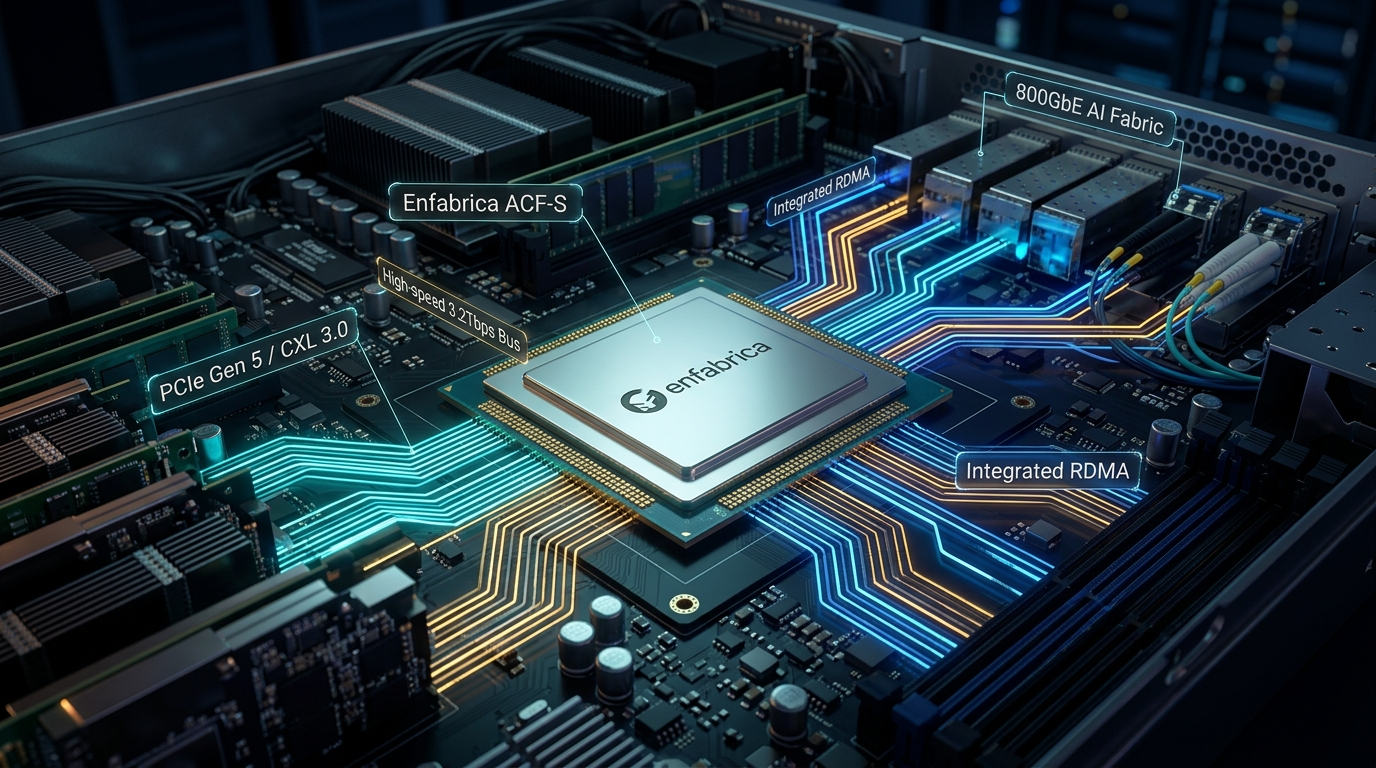
To eliminate the PCIe switch sprawl, eradicate the multi-NIC tax, and unlock universal memory pooling, Enfabrica engineered the Accelerated Compute Fabric Switch (ACF-S) silicon architecture. Rather than treating PCIe switching, remote direct memory access (RDMA) networking, and memory pooling as disparate hardware subsystems, Enfabrica converged all three functional domains onto a single monolithic semiconductor ASIC.
Enfabrica ACF-S Converged Fabric Architecture:
+-----------------------------------------------------------------------------------+
| 8x GPU Accelerators (HGX Baseboard)                                               |
| [GPU 0]   [GPU 1]   [GPU 2]   [GPU 3]   [GPU 4]   [GPU 5]   [GPU 6]   [GPU 7]   |
+----+---------+---------+---------+---------+---------+---------+---------+--------+
     | PCIe Gen 5 / CXL 3.0 Direct Links (Up to 128 Lanes)                          |
+----+------------------------------------------------------------------------------+
| ENFABRICA ACF-S (Accelerated Compute Fabric Switch ASIC)                          |
| - On-Chip Multi-Port PCIe Gen 5 / CXL 3.0 Crossbar Switch                         |
| - High-Performance Multi-Channel Native RDMA / RoCEv2 Engines                     |
| - Hardware Resilient Multipath RDMA (RMR) Packet Spraying                         |
| - CXL.mem Dynamic Shared Memory Pooling Controller                                |
+----+------------------------------------------------------------------------------+
     | Direct 800GbE / 1.6TbE Optical Uplinks (e.g., 4x 800GbE or 8x 400GbE)        |
     v                                                                              v
Standard Open Datacenter Ethernet Spine Network (Flat 2-Tier Clos Topology) The Architectural Breakthrough of ACF-S
The Enfabrica ACF-S introduces a radical simplification of accelerated server design:
- Direct GPU-to-Fabric Integration: The ACF-S chip presents native PCIe Gen 5 x16 root ports directly to host GPUs and CPUs on its local side, while exposing native 800GbE / 1.6TbE Ethernet ports on its network side. A single ACF-S device completely replaces eight discrete PCIe NICs and the entire intermediate PCIe tree switch network.
- Hardware-Native Resilient Multipath RDMA (RMR): Instead of locking each GPU into a dedicated optical cable rail, ACF-S aggregates all GPU traffic and dynamically sprays packets across all available 800GbE network uplinks. If a physical optical link or upstream switch port degrades, ACF-S automatically reroutes traffic across remaining healthy links in hardware within nanoseconds, completely eliminating cluster stragglers.
- CXL.mem Coherent Memory Expansion: With integrated Compute Express Link (CXL 3.0) controllers, ACF-S bridges host DDR5 memory and dedicated CXL memory expansion modules directly to the GPU cluster. GPUs can execute load/store operations into remote memory pools with sub-microsecond latencies, expanding effective KV cache capacity by 4x to 10x without expensive HBM upgrades.
- 50% TCO and Power Reduction: By eliminating discrete NIC cards, secondary PCIe switches, and redundant transceivers, server power dissipation drops by up to 500 Watts per node, cutting total cost of ownership (TCO) across hyperscale clusters by more than half.
Architecture: Silicon Microarchitecture, CXL Pooling, and Resilient Multipath RDMA
The Enfabrica ACF-S silicon architecture is engineered from the ground up for high-radix, ultra-low-latency data movement. Built on TSMC’s cutting-edge monolithic process technology, the ACF-S device integrates multi-terabit PCIe switching, multi-hundred-gigabit SerDes transceivers, specialized DMA engines, and shared SRAM packet buffers into a unified silicon die.
1. Silicon Port and SerDes Configuration
The ACF-S switch processor delivers up to 3.2 Tbps of aggregate bidirectional switching capacity across a flexible matrix of physical interfaces:
- PCIe / CXL Downlink Interfaces: Up to 128 lanes of PCIe Gen 5 (operating at 32 GT/s per lane) and CXL 3.0, bifurcated dynamically into multiple x16, x8, or x4 ports to connect directly to GPU accelerators, CPU host sockets, and CXL memory expansion boards.
- Ethernet Uplink Interfaces: High-density 106.25 Gbps PAM4 SerDes transceivers configurable as 4 ports of 800GbE (8x 100G PAM4), 8 ports of 400GbE (4x 100G PAM4), or 16 ports of 200GbE, supporting standard QSFP-DD800 and OSFP optical transceiver modules.
- On-Chip Shared Memory Fabric: Centralized multi-megabyte SRAM buffer architecture providing cut-through switching between PCIe and Ethernet domains with transit latencies under 250 nanoseconds.
ACF-S Silicon Microarchitecture Block Diagram:
+-----------------------------------------------------------------------------------+
|                           ENFABRICA ACF-S ASIC DIE                                |
|                                                                                   |
|  +--------------------+  +--------------------+  +-----------------------------+  |
|  | PCIe Gen 5 / CXL   |  | Integrated RDMA    |  | Resilient Multipath RDMA    |  |
|  | Switch Crossbar    |  | Engine Array       |  | (RMR) Packet Spraying Core  |  |
|  | (128 Lanes @ 32GT) |  | (Multi-Context)    |  | (Dynamic Flowlet & Cell)    |  |
|  +---------+----------+  +---------+----------+  +--------------+--------------+  |
|            |                       |                            |                 |
|  +---------v-----------------------v----------------------------v--------------+  |
|  |                 Centralized Ultra-Deep Shared Packet Buffer                 |  |
|  |                 (High-Bandwidth On-Chip SRAM Memory Fabric)                 |  |
|  +---------+----------------------------------------------------+--------------+  |
|            |                                                    |                 |
|  +---------v----------+                          +--------------v--------------+  |
|  | CXL.mem Controller |                          | 106.25G PAM4 SerDes Matrix  |  |
|  | (Direct Memory     |                          | 4x 800GbE / 8x 400GbE       |  |
|  |  Expansion Pools)  |                          | Open Ethernet Transceivers  |  |
|  +--------------------+                          +-----------------------------+  |
+-----------------------------------------------------------------------------------+ 2. Resilient Multipath RDMA (RMR) Mechanics
In traditional datacenter networking, RDMA over Converged Ethernet (RoCEv2) relies on static 5-tuple Equal-Cost Multi-Path (ECMP) hashing. When distributed training triggers massive All-Reduce collective communication passes, multiple line-rate “elephant flows” hash to the same physical link. This causes hash polarization, buffer overflow, Priority Flow Control (PFC) pause storms, and deadlock.
Enfabrica eliminates hash polarization through Resilient Multipath RDMA (RMR):
- Packet-Level Spraying: Rather than binding an RDMA queue pair (QP) to a single network path, the ACF-S hardware breaks large RDMA messages into fine-grained packets or flowlets and sprays them dynamically across all available network links.
- Hardware Re-Sequencing Engine: The receiving ACF-S device features an on-chip re-ordering engine that reconstructs out-of-order packets at line rate, presenting clean, sequential PCIe DMA transfers directly into the receiving GPU’s High-Bandwidth Memory (HBM).
- Fast Local Reroute: The ACF-S SerDes monitor continuously evaluates link quality and bit error rates (BER). If an optical cable experiences signal degradation or packet drops, the hardware routing state machine immediately excludes that physical link within 100 nanoseconds, without requiring control-plane BGP convergence or host software intervention.
Resilient Multipath RDMA (RMR) vs. Traditional ECMP Hashing:
Traditional ECMP Hashing (Hash Polarization Disaster):
Flow 1 (800G) ---\
Flow 2 (800G) ----+--> Link 0 (800G Max) ==> 1600G Demand! BUFFER OVERFLOW & PFC DROPS!
Flow 3 (Idle) -------> Link 1 (800G Max) ==> 0% Utilization (Wasted Bandwidth)

Enfabrica RMR (Dynamic Multi-Path Spraying):
Flow 1 (800G) ---\    /--> Link 0 (400G Payload) ==> 50% Utilization
                  +--+
Flow 2 (800G) ---/    \--> Link 1 (400G Payload) ==> 50% Utilization
Result: Perfectly balanced links, zero buffer overflow, deterministic tail latency. 3. CXL.mem Shared Memory Pooling Architecture
The integration of Compute Express Link (CXL 3.0) within the ACF-S fabric silicon creates a revolutionary memory tier for large-scale foundation model inference.
Through CXL.mem protocol support, ACF-S treats host memory modules as a globally addressable, hardware-coherent memory pool:
- Zero-Copy Remote Buffer Access: An accelerator on GPU 0 can directly issue memory load/store operations to a DDR5 memory pool attached to the ACF-S switch, completely bypassing the host x86 CPU operating system kernel.
- KV Cache Offloading with Near-HBM Latencies: In long-sequence inference tasks (e.g., 128k to 1M token contexts), storing active KV caches in GPU HBM rapidly exhausts available video memory. ACF-S enables dynamic offloading of historical KV cache pages into pooled DDR5 or low-latency CXL memory modules across the local PCIe/CXL bus with round-trip latencies under 400 nanoseconds, compared to 15–30 microseconds over standard TCP or RoCE network fabrics.
4. CXL 3.0 Multi-Head and Direct P2P Device Protocols
The Compute Express Link (CXL 3.0) protocol engine within the ACF-S processor implements three distinct protocol layers: CXL.io, CXL.cache, and CXL.mem:
- CXL.io: Handles device discovery, enumeration, error reporting, and PCIe Gen 5 backward-compatible register configuration.
- CXL.cache: Provides coherent caching agent logic, allowing external host CPUs and peer accelerators to cache lines directly from remote memory pools with hardware-managed cache snooping.
- CXL.mem: Delivers direct memory access semantics. Using Type 3 CXL memory expansion controllers and Multi-Head Device (MHD) sharing, ACF-S enables dynamic memory sharing across up to 16 separate compute hosts and 32 accelerator endpoints.
This unified memory architecture enables dynamic memory pooling: rather than stranding unused DRAM in server chassis A while server chassis B runs out of memory, ACF-S virtualizes the entire memory fabric into an addressable global resource pool accessible by any GPU via standard 64-bit load/store instructions.
Implementation: Server Configuration, Linux Kernel Setup, and PyTorch Collective Benchmarking
Deploying an accelerated compute server powered by Enfabrica ACF-S requires minimal software modification because the hardware natively exposes standard PCIe and Ethernet abstractions. The Linux kernel interacts with ACF-S via standard PCIe root port drivers, while user-space distributed frameworks (such as PyTorch, NCCL, and vLLM) utilize high-performance verbs and libfabric interfaces.
1. Host PCIe Enumeration and Interface Verification
Upon system initialization, the Linux PCI subsystem enumerates the ACF-S fabric controller, presenting both high-radix PCIe downstream ports and high-performance RDMA network interfaces:
# Verify Enfabrica ACF-S PCI device presence and link capabilities
lspci -tv | grep -E -i "enfabrica|fabric|pcie"

# Detailed inspection of the primary ACF-S fabric controller
lspci -vvv -d 1ff7: The system administrator can inspect and configure the high-speed Ethernet interfaces exposed by the ACF-S hardware:
#!/usr/bin/env bash
set -euo pipefail

echo "=========================================================="
echo "Enfabrica ACF-S Network Interface and SerDes Initialization"
echo "=========================================================="

# List RDMA capable devices exposed by ACF-S
ibv_devices

# Verify link state, speed, and firmware version on fabric ports
ibv_devinfo -v | grep -E "hca_id|transport|state|active_width|active_speed"

# Configure standard MTU 9000 (Jumbo Frames) for lossless RoCEv2
for iface in $(ip -br link | grep -E "enp|acf" | awk '{print $1}'); do
    echo "Configuring interface: ${iface}"
    sudo ip link set dev "${iface}" mtu 9000 up
    sudo ethtool -G "${iface}" rx 8192 tx 8192 || true
    # Enable Priority Flow Control (PFC) on Traffic Class 3 for lossless RoCE
    sudo ethtool -A "${iface}" rx on tx on || true
done

echo "ACF-S interface configuration completed successfully." 2. High-Performance NCCL Environment Tuning for ACF-S
To maximize throughput across distributed deep learning workloads, NVIDIA Collective Communications Library (NCCL) parameters must be tuned to leverage the unified single-tier fabric of ACF-S. Because ACF-S replaces external multi-NIC hops with direct PCIe-to-network DMA, NCCL avoids multi-rail overhead:
# Export optimized NCCL and RDMA environment settings for Enfabrica ACF-S
export NCCL_DEBUG=INFO
export NCCL_DEBUG_SUBSYS=INIT,COLL,ENV
export NCCL_IB_DISABLE=0
export NCCL_IB_CUDA_SUPPORT=1
export NCCL_IB_GID_INDEX=3
export NCCL_IB_TC=106                  # DSCP marking for RoCEv2 Priority Queue
export NCCL_NET_GDR_LEVEL=5             # Enable GPU Direct RDMA through PCIe bridge
export NCCL_CROSS_NIC=1                 # Allow cross-engine traffic aggregation
export NCCL_BUFFSIZE=16777216           # 16MB ring buffer for 800GbE pipes
export NCCL_ALGO=RING,TREE # High-efficiency collective algorithms 3. Distributed PyTorch All-Reduce Verification Script
The following Python script tests All-Reduce collective throughput and validates that the ACF-S hardware provides zero-loss line-rate scaling across participating GPUs:
import os
import time
import torch
import torch.distributed as dist

def init_distributed():
    rank = int(os.environ.get("RANK", 0))
    world_size = int(os.environ.get("WORLD_SIZE", 1))
    local_rank = int(os.environ.get("LOCAL_RANK", 0))

    torch.cuda.set_device(local_rank)
    dist.init_process_group(
        backend="nccl",
        init_method="env://",
        world_size=world_size,
        rank=rank
    )
    return rank, world_size, local_rank

def benchmark_allreduce(tensor_size_mb: int = 1024, iterations: int = 50):
    rank, world_size, local_rank = init_distributed()
    device = torch.device(f"cuda:{local_rank}")

    # Calculate number of float32 elements
    num_elements = (tensor_size_mb * 1024 * 1024) // 4
    tensor = torch.ones(num_elements, dtype=torch.float32, device=device)

    # Warmup runs
    for _ in range(5):
        dist.all_reduce(tensor, op=dist.ReduceOp.SUM)
    torch.cuda.synchronize(device)

    if rank == 0:
        print(f"[ACF-S Benchmark] Starting All-Reduce: {tensor_size_mb} MB across {world_size} ranks")

    start_time = time.perf_counter()
    for _ in range(iterations):
        dist.all_reduce(tensor, op=dist.ReduceOp.SUM)
    torch.cuda.synchronize(device)
    end_time = time.perf_counter()

    elapsed_time = (end_time - start_time) / iterations
    # In All-Reduce, each rank transfers 2 * ((world_size - 1) / world_size) * tensor_size
    bus_data_bytes = 2 * ((world_size - 1) / world_size) * (tensor_size_mb * 1024 * 1024)
    bus_bandwidth_gbps = (bus_data_bytes / elapsed_time) / (1024 ** 3) * 8

    if rank == 0:
        print(f"Results across {iterations} iterations:")
        print(f"  Average Iteration Latency: {elapsed_time * 1000:.2f} ms")
        print(f"  Effective Bus Bandwidth:   {bus_bandwidth_gbps:.2f} Gbps")
        print("Enfabrica ACF-S fabric validation completed successfully.")

    dist.destroy_process_group()

if __name__ == "__main__":
benchmark_allreduce(tensor_size_mb=512, iterations=20) Comparison: Enfabrica ACF-S vs. Discrete PCIe Switches, ConnectX NICs, and NVLink
To appreciate how Enfabrica alters datacenter infrastructure economics, systems architects must evaluate ACF-S against competing hardware paradigms across component counts, latency characteristics, networking topologies, and memory pooling capabilities.
Comparative Architectural Analysis
| Feature Dimension | Traditional HGX Server (PEX + ConnectX-7) | NVIDIA NVLink + NVSwitch Server | Enfabrica ACF-S Converged Fabric |
|---|---|---|---|
| Component Topology | 4-8x PCIe Switches + 8x Discrete NICs | Proprietary NVSwitch Baseboard + 8x NICs | 1x Monolithic ACF-S ASIC |
| Interconnect Standard | PCIe Gen 5 + InfiniBand / RoCEv2 | Proprietary NVLink 4/5 + InfiniBand | Open PCIe Gen 5 / CXL 3.0 + 800GbE |
| NIC Tax (Hardware Footprint) | Extreme (8 separate PCIe cards + cabling) | High (Separate CX-7/8 cards required) | Zero (RDMA Engines Integrated On-Chip) |
| Scale-Out Network Architecture | Rigid Multi-Rail (8 discrete planes) | Multi-Rail InfiniBand / Spectrum-X | Flat Open Clos (Dynamic Packet Spraying) |
| Memory Expansion Tier | Limited (Host DRAM stranded behind CPU) | High-speed GPU HBM only (Exorbitant cost) | Native CXL.mem Shared Pooling |
| Link Failure Recovery | Slow (Software / BGP path reconvergence) | Proprietary Hardware Failover | Hardware-Level Re-Route (<100ns) |
| Server Power Dissipation (I/O) | High (~600W to 800W per 8-GPU chassis) | Very High (>1,000W including NVSwitches) | Low (~250W to 350W converged envelope) |
| Relative TCO Index | 1.00x (Baseline) | 1.45x (Premium pricing) | 0.50x to 0.60x (50% Cost Reduction) |
Architectural Trade-offs and Considerations
- Discrete NICs + PCIe Switches (Baseline): While built on merchant silicon parts, discrete topologies suffer from severe component sprawl, high physical failure rates, and stranded host memory. Every packet traversing from GPU to network must cross multiple PCIe hops, inflating tail latencies.
- NVIDIA NVSwitch + NVLink: Provides extraordinary scale-up bandwidth (up to 1.8 TB/s per GPU on Blackwell) within an isolated node. However, NVLink remains a closed, proprietary standard that does not extend directly to scale-out Ethernet fabrics or open CXL memory pools, forcing customers into sole-source procurement.
- Enfabrica ACF-S Converged Fabric: Strikes the optimal balance for open hyperscale AI infrastructure. By converging PCIe switching and RDMA networking into a single silicon device, it delivers high performance, native CXL memory expansion, and eliminates vendor lock-in through open Ethernet standards.
Production: Datacenter Deployment Topologies, Resiliency, and Best Practices
Deploying Enfabrica ACF-S in mission-critical hyperscale datacenters requires disciplined attention to physical server packaging, optical interconnect selection, congestion management, and telemetry streaming.
1. Two-Tier Flatter Datacenter Clos Topology
Because ACF-S aggregates internal server traffic and emits high-radix 800GbE uplinks, datacenter network designs can migrate from complex 3-tier multi-rail trees to a simplified 2-tier non-blocking Clos topology:
- Leaf Tier: Top-of-Rack (ToR) switches consisting of open 51.2 Tbps merchant silicon switches (such as Broadcom Tomahawk 5, Cisco Silicon One G200, or Marvell Teralynx 10).
- Spine Tier: High-radix 51.2T spine switches interconnecting all server racks.
- Elimination of Rail Alignment: In an ACF-S deployment, any port on any server can connect to any leaf switch port. The hardware Resilient Multipath RDMA (RMR) engine sprays packets across all uplinks, ensuring that bisection bandwidth remains uniformly distributed across the entire cluster.
Hyperscale 32,000 GPU Cluster Deployment with ACF-S:
+-----------------------------------------------------------------------------------+
|                           SPINE SWITCH TIER (51.2T ASICs)                         |
|   [Spine Switch 0]       [Spine Switch 1]       ...       [Spine Switch 31]       |
+----------+----------------------+-----------------------------------+-------------+
           |                      |                                   |
+----------+----------------------+-----------------------------------+-------------+
|                            LEAF SWITCH TIER (51.2T ASICs)                         |
|   [Leaf Switch 0]        [Leaf Switch 1]        ...       [Leaf Switch 63]        |
+----------+----------------------+-----------------------------------+-------------+
           |                      |                                   |
           | 4x 800GbE Uplinks    | 4x 800GbE Uplinks                 | 4x 800GbE
+----------v----------------------v-----------------------------------v-------------+
|                           SERVER CHASSIS TIER (8x GPUs)                           |
| +-------------------------------------------------------------------------------+ |
| | [GPU 0] [GPU 1] [GPU 2] [GPU 3]       [GPU 4] [GPU 5] [GPU 6] [GPU 7]         | |
| |                   \        |            |        /                            | |
| |                    [Enfabrica ACF-S Fabric ASIC]                              | |
| +-------------------------------------------------------------------------------+ |
+-----------------------------------------------------------------------------------+ 2. Optical Media and Linear Pluggable Optics (LPO) Integration
When wiring clusters spanning thousands of accelerators, optical transceivers represent a major source of thermal dissipation and hardware cost:
- Short-Reach Racks (0 to 3 meters): Utilize passive copper Direct Attach Cables (DACs) to connect ACF-S 800GbE ports directly to in-rack ToR switches. Passive copper draws 0 Watts of electrical power and delivers sub-nanosecond signal transit times.
- Inter-Rack Connections (3 to 100 meters): Deploy 800G Linear Pluggable Optics (LPO) or Active Optical Cables (AOCs). Because ACF-S features high-performance analog SerDes with integrated equalization and forward error correction (FEC), it operates seamlessly with linear optics, eliminating power-hungry internal DSP chips and slashing optical module power from 14 Watts down to 7 Watts per transceiver.
3. Production Failure Recovery and Telemetry Auditing
In a 32,000-GPU cluster, physical hardware faults occur continuously:
- Zero-Stall Link Failover: When an optical fiber or switch transceiver fails, the ACF-S hardware monitoring engine detects loss-of-signal within 50 nanoseconds, immediately modifying its hardware routing table to spray subsequent RDMA packets across surviving healthy ports. The AI training run continues uninterrupted without dropped packets or NCCL timeout aborts.
- In-Band Telemetry (INT) Streaming: Production orchestrators stream telemetry metrics directly from ACF-S hardware counters, tracking buffer occupancy, queue latency percentiles, and PCIe link retransmissions in real time.
import time
import subprocess
import json

def collect_fabric_telemetry():
    telemetry_data = {
        "timestamp": time.time(),
        "devices": []
    }

    try:
        # Query kernel RDMA link statistics
        cmd = ["rdma", "link", "show", "-j"]
        result = subprocess.run(cmd, capture_output=True, text=True, check=True)
        links = json.loads(result.stdout)

        for link in links:
            if "acf" in link.get("ifname", ""):
                telemetry_data["devices"].append({
                    "interface": link.get("ifname"),
                    "netdev": link.get("netdev"),
                    "state": link.get("state"),
                    "physical_state": link.get("physical_state")
                })
    except Exception as e:
        telemetry_data["error"] = str(e)

    return telemetry_data

if __name__ == "__main__":
    snapshot = collect_fabric_telemetry()
    print("[Enfabrica ACF-S Telemetry Snapshot]")
print(json.dumps(snapshot, indent=2)) Production Deployment Checklist
- Verify PCIe Link Integrity: Confirm that all GPU and CPU downstream links negotiate full PCIe Gen 5 width (x16) and maximum transfer speed (32 GT/s) with zero symbol error counts.
- Configure Jumbo Frames & MTU: Set network interface MTU to 9000 across all server adapters and switch ports to minimize packet processing overhead during large RDMA transfers.
- Calibrate RoCEv2 Congestion Control: Enable Priority Flow Control (PFC) on Traffic Class 3 and configure Data Center Quantized Congestion Notification (DCQCN) thresholds to prevent buffer starvation.
- Deploy CXL Memory Pools: Map shared CXL.mem physical address windows into system memory maps, validating sub-microsecond remote read/write latencies before launching long-context inference workloads.