Emu3 Guide: Next-Token Prediction for Vision & Language
The Problem: The Great Architectural Schism in Multimodal AI
For nearly a decade, artificial intelligence advanced under a profound architectural schism. While pure natural language processing converged completely onto a single, standardized framework—the autoregressive decoder-only transformer trained on next-token prediction—multimodal systems remained fractured across competing, incompatible mathematical paradigms:
The Tripartite Fragmentation of Modern AI:
┌────────────────────────────────────────────────────────┐
│ 1. Natural Language (LLMs: GPT-4, Llama, DeepSeek)     │
│ • Autoregressive next-token prediction (Cross-Entropy) │
│ • Causal attention with KV caching                     │
└────────────────────────────────────────────────────────┘
                           ▲
                           │ Incompatible Paradigms!
                           ▼
┌────────────────────────────────────────────────────────┐
│ 2. Visual Understanding (VLMs: LLaVA, InternVL, CLIP) │
│ • Contrastive pre-training (InfoNCE loss)              │
│ • Frozen Vision Transformers (ViT) + Projection Adapters│
│ ❌ Cannot generate pixels! Read-only visual perception │
└────────────────────────────────────────────────────────┘
                           ▲
                           │ Incompatible Paradigms!
                           ▼
┌────────────────────────────────────────────────────────┐
│ 3. Visual Generation (Diffusion: SDXL, FLUX, Midjourney│
│ • Continuous score-based denoising (SDE / ODE / Flow)  │
│ • Specialized U-Net or DiT (Diffusion Transformer)     │
│ ❌ Cannot reason or converse! Write-only pixel engines  │
└────────────────────────────────────────────────────────┘ In enterprise automation, autonomous research agents, and intelligent data extraction platforms like AiFetchly, this tripartite fragmentation introduced severe operational and engineering bottlenecks:
1. The Tripartite Fragmentation: Language vs. Understanding vs. Generation
To build an agent capable of looking at a complex user interface or financial report, understanding its content, and generating an updated visual mockup:
- Three Separate Models: Engineering teams were forced to stitch together a vision encoder (like SigLIP or CLIP), a large language model (like LLaMA-3), and a latent diffusion model (like Stable Diffusion XL or FLUX.1).
- Format Incompatibility: Information had to be translated across representation boundaries—continuous image embeddings were mapped into discrete token space via projection MLPs, while generation prompts had to be routed through separate diffusion cross-attention conditioning blocks.
- Asymmetric Capabilities: The visual understanding model could not edit or generate images, while the diffusion model possessed zero textual reasoning or instruction-following intelligence.
2. The Computational and Architectural Tax of Diffusion-LLM Hybrids
Attempting to glue diffusion models onto LLM backends creates massive infrastructure friction:
- Serving Complexity: Running a combined VLM and diffusion pipeline requires loading multiple 10GB–30GB models simultaneously into GPU memory.
- Divergent Inference Runtimes: LLMs achieve high throughput using continuous batching, PagedAttention, and KV caching in engines like vLLM or SGLang. Diffusion models, conversely, execute 20 to 50 sequential denoising steps across static latents, completely bypassing KV cache optimizations. Serving both concurrently saturates GPU High-Bandwidth Memory (HBM) and destroys latency predictability.
3. The Modality Asymmetry and Context Disconnect
In human cognition, understanding and creation are tightly coupled: when an architect sketches a blueprint, visual perception and spatial synthesis feed into the same continuous reasoning process.
In cascaded AI pipelines, the visual generator is blind to the conversational context of the LLM, relying solely on short, lossy text prompts passed over an API boundary. This disconnect leads to severe prompt drift, hallucinated typography, and broken multi-turn visual modifications.
The Solution: Emu3 Pure Autoregressive Multimodal Architecture
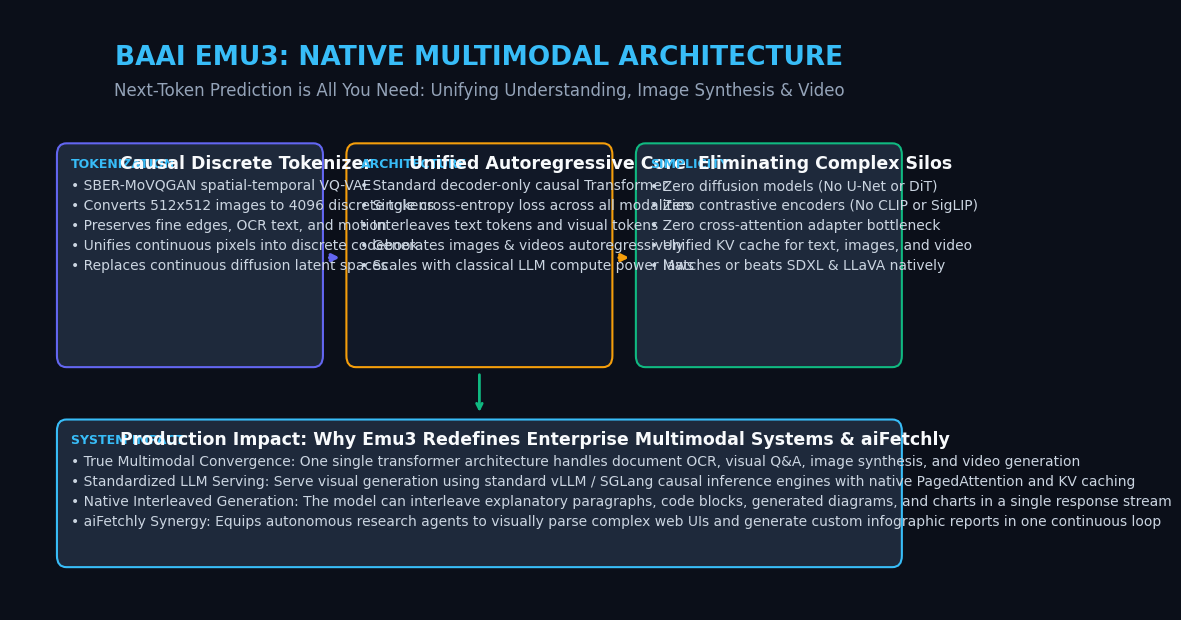
To dissolve the architectural divide and demonstrate that “Next-Token Prediction is All You Need”, researchers at the Beijing Academy of Artificial Intelligence (BAAI) introduced Emu3.
Emu3 discards diffusion models, contrastive encoders, and specialized cross-attention adapters entirely. Instead, Emu3 trains a single, unified decoder-only transformer from scratch across text, images, and video using pure next-token prediction cross-entropy loss.
Emu3 Unified System Architecture:
[User Text Prompt] ──► [BPE Text Tokenizer]    ──► [Text Tokens]      ┐
                                                                       ├─► [Single Causal Transformer]
[Input Images/Video] ──► [Discrete VQ-VAE]      ──► [Visual Tokens]    │   (Next-Token Prediction)
                                                                       │
┌──────────────────────────────────────────────────────────────────────┴──────────────────────────┐
│ Unified Decoder-Only Transformer (Rotary Embeddings + SwiGLU + Standard Cross-Entropy)         │
│ Shared Vocabulary: Text Tokens (V_text) ∪ Discrete Visual Tokens (V_vision)                     │
└──────────────────────────────────┬──────────────────────────────────────────────────────────────┘
                                   │
         ┌─────────────────────────┴─────────────────────────┐
         ▼                                                   ▼
[Text Generation Stream]                            [Visual Token Stream]
(Causal Language Response)                                   │
                                                             ▼
                                                    [Discrete VQ-VAE Decoder]
                                                             │
                                                             ▼
[Generated Image or Video] 1. Unified Next-Token Prediction on a Single Transformer
Emu3 models visual synthesis and understanding using the exact same mathematical formulation as text generation:
- The model vocabulary is unified: standard byte-pair encoding (BPE) text tokens and discrete visual tokens live in the same embedding matrix.
- Given an interleaved sequence of multimodal tokens $X = (x_1, x_2, \dots, x_N)$, the network is trained by minimizing standard negative log-likelihood: $$\mathcal{L} = -\sum_{i=1}^{N} \log P_\theta(x_i \mid x_{<i})$$
- Whether predicting the next word in an essay, transcribing text from an invoice, or predicting the next spatial patch of a generated photorealistic landscape, the underlying mechanism is identical: causal next-token autoregression.
2. The Causal Spatial-Temporal Discrete Vision Tokenizer
To represent continuous 2D images and 3D video volumes as discrete token sequences suitable for autoregression, BAAI engineered a custom spatial-temporal discrete tokenizer (SBER-MoVQGAN):
- Spatial Compression: Compresses continuous $512 \times 512$ pixel images into an $8 \times$ downsampled grid of $64 \times 64 = 4,096$ discrete visual tokens from a codebook of 32,768 entries ($2^{15}$).
- Temporal Video Compression: Compresses 16-frame or 32-frame video clips along both spatial ($8 \times 8$) and temporal ($4 \times$) dimensions, yielding causal 3D token representations.
- High-Fidelity Reconstruction: Preserves intricate alphanumeric details, high-contrast typography, and fine textures, outperforming classical VQ-GAN tokenizers across PSNR and SSIM benchmarks.
3. Scaling Laws and Universal Multi-Modal Pre-Training
Because Emu3 is a standard transformer, it inherits the predictable scaling laws and optimization stability of modern LLMs:
- Pre-trained on a massive web-scale corpus of trillions of text tokens, billions of image-text pairs, and millions of curated video sequences.
- Does not suffer from the training instabilities, score-matching variance, or schedule-tuning fragility common in large-scale diffusion models.
Deep Dive: How Autoregressive Generation Matches Diffusion Models
Historically, autoregressive visual generation was dismissed as inferior to diffusion due to slow raster-scan artifacts and low image fidelity. Understanding how Emu3 matches or outperforms state-of-the-art diffusion models (like SDXL and FLUX.1) requires exploring its technical innovations.
Autoregressive Visual Generation Mechanics:
Prompt: "A high-resolution photograph of an antique brass compass on a nautical map."
  │
  ▼ [Text Token Prefix]
[BOS] [t_1, t_2, ..., t_M] [IMG_START]
  │
  ▼ [Autoregressive Visual Token Prediction]
v_1 ──► v_2 ──► v_3 ──► ... ──► v_4096 [IMG_END]
  │ (Sampled with Temperature & Top-p, conditioned via Classifier-Free Guidance)
  │
  ▼ [Spatial Un-flattening]
Grid: 64 × 64 discrete indices ∈ [0, 32767]
  │
  ▼ [Discrete Vision Decoder]
Continuous 512 × 512 × 3 RGB Image with zero diffusion steps! 1. Discrete Visual Codebooks and Prefix Conditioning
When generating an image from a prompt, Emu3 treats the task as prompt continuation:
- The text instruction is tokenized into standard text tokens and injected into the transformer prompt prefix.
- An
<image>delimiter token signals the transition from natural language to spatial tokens. - The model begins sampling visual tokens autoregressively in standard raster-scan order (from top-left to bottom-right).
- Because each predicted visual token attends directly to all preceding visual tokens and the original text prompt via full causal self-attention, Emu3 maintains exceptional global compositionality and prompt adherence without requiring secondary CLIP cross-attention projections.
2. Causal Masking vs. Bidirectional Spatial Attention
Classic image generation often relied on bidirectional attention (as in Masked Autoencoders or Diffusion Transformers), which assumes that all spatial locations must interact simultaneously.
Emu3 proves that pure causal masking is sufficient for high-fidelity 2D image generation:
- Local spatial relationships are naturally learned by the self-attention mechanism across 2D positional encodings.
- The causal structure enables the model to leverage standard Key-Value (KV) cache reuse. As each visual row is generated, its key-value states are cached in GPU memory, avoiding redundant computations and enabling linear generation scaling.
3. Classifier-Free Guidance (CFG) in Autoregressive Token Space
In diffusion pipelines, Classifier-Free Guidance (CFG) is applied to the predicted continuous noise vector $\epsilon_\theta$. Emu3 adapts CFG directly to discrete token probability logits:
$$\tilde{\ell}(v_i) = \ell(v_i \mid \text{uncond}) + s \cdot \left[ \ell(v_i \mid \text{prompt}) - \ell(v_i \mid \text{uncond}) \right]$$
Where:
- $\ell(v_i \mid \text{prompt})$ represents the unnormalized logits conditioned on the user prompt.
- $\ell(v_i \mid \text{uncond})$ represents the logits conditioned on an empty/null prompt.
- $s$ is the guidance scale (typically $s \in [2.5, 4.0]$).
Applying guidance directly in logit space sharpens the probability mass around high-contrast, structurally coherent tokens, dramatically boosting photorealism and eliminating visual blur.
Technical Comparison: Emu3 vs. Diffusion Models and Hybrid VLMs
To evaluate where Emu3 stands across architecture, multimodal versatility, and serving infrastructure, consider this comparative breakdown:
| Architectural Metric | Standalone Diffusion (SDXL / FLUX.1) | Hybrid VLM (LLaVA / InternVL) | Unified Diffusion (OmniGen / Chameleon) | BAAI Emu3 (Pure Autoregressive) |
|---|---|---|---|---|
| Foundational Paradigm | Continuous Diffusion / Flow Matching | Contrastive ViT + Causal LLM | Hybrid DiT / Flow Matching | Pure Next-Token Prediction |
| Image Generation | State-of-the-Art | Cannot generate pixels | Supported via DiT | Native Autoregressive (Matches SDXL) |
| Visual Understanding | Zero (Write-only) | State-of-the-Art (Read-only) | Moderate | Native Autoregressive (Matches LLaVA) |
| Video Generation | Separate video model (SVD/CogVideo) | Cannot generate video | None | Native Autoregressive Video Synthesis |
| Serving Infrastructure | Specialized diffusers loops | Standard vLLM / SGLang | Custom dual runtimes | Standard LLM Causal KV Cache Engines |
| Vision Encoders Needed | CLIP / T5 text encoders | CLIP / SigLIP visual encoders | VAE + text encoder | Zero external encoders (Discrete VQ-VAE only) |
| Interleaved Generation | Impossible without external orchestrator | Text-only | Complex multi-pass | Native (Text, code, & images in one stream) |
Practical Implementation: Running Multimodal Generation and Understanding with Emu3
Let us walk through deploying Emu3 using Python and PyTorch, demonstrating both high-fidelity image generation and visual document understanding within a unified script.
Step 1: Environment Setup and Model Initialization
Install the required dependencies:
pip install torch torchvision transformers accelerate sentencepiece Initialize the unified Emu3 model and tokenizer:
import torch
from PIL import Image
from transformers import AutoTokenizer, AutoModelForCausalLM

# Load the unified Emu3 model checkpoint
model_id = "BAAI/Emu3-Gen"
print(f"Loading Emu3 foundation model from {model_id}...")

tokenizer = AutoTokenizer.from_pretrained(model_id, trust_remote_code=True)
model = AutoModelForCausalLM.from_pretrained(
    model_id,
    torch_dtype=torch.bfloat16,
    device_map="cuda",
    trust_remote_code=True
)
model.eval()
print("Emu3 unified autoregressive model successfully loaded on GPU!") Step 2: High-Fidelity Autoregressive Image Generation
Generate a high-resolution image directly by predicting discrete spatial tokens:
# Define generation prompt
prompt = "A detailed architectural photograph of a futuristic solar-powered research station in the desert, golden hour lighting, 8k resolution."

# Format prompt using Emu3 special tokens
input_text = f"<|user|>\nGenerate an image: {prompt}<|endoftext|><|assistant|>\n<|image|>"
inputs = tokenizer(input_text, return_tensors="pt").to("cuda")

# Autoregressively sample 4,096 discrete visual tokens
print("Synthesizing image tokens autoregressively...")
with torch.no_grad():
    generated_tokens = model.generate(
        inputs.input_ids,
        max_new_tokens=4096,  # 64x64 discrete spatial grid
        temperature=1.0,
        top_p=0.95,
        do_sample=True,
        pad_token_id=tokenizer.eos_token_id
    )

# Extract only the visual tokens and decode via the discrete VQ-VAE
image_tokens = generated_tokens[0, inputs.input_ids.shape[1]:]
decoded_image = model.decode_image_tokens(image_tokens)

# Save the final synthesized image
decoded_image.save("desert_research_station.png")
print("Image generated and saved to desert_research_station.png successfully!") Step 3: Complex Visual Reasoning and Document Understanding
Now, use the exact same foundation model to inspect a document image and extract structured data:
# Load an image for visual reasoning
image_path = "invoice_sample.png"
raw_image = Image.open(image_path).convert("RGB")

# Tokenize input image into discrete visual tokens
visual_tokens = model.encode_image(raw_image)

# Construct conversational prompt with interleaved image tokens
query = "Extract the vendor name, invoice date, and total amount as JSON."
prompt_text = f"<|user|>\n<|image|>{visual_tokens}<|image_end|>\n{query}<|endoftext|><|assistant|>\n"

inputs = tokenizer(prompt_text, return_tensors="pt").to("cuda")

# Generate structured text response
print("Extracting structured invoice data...")
with torch.no_grad():
    output_tokens = model.generate(
        inputs.input_ids,
        max_new_tokens=512,
        temperature=0.2,
        do_sample=False
    )

response = tokenizer.decode(output_tokens[0][inputs.input_ids.shape[1]:], skip_special_tokens=True)
print("\n--- Extracted Intelligence ---")
print(response) Production Best Practices: Integrating Autoregressive Multimodal Models in aiFetchly
When architecting next-generation autonomous web extraction and research pipelines in AiFetchly, deploying a unified autoregressive architecture like Emu3 unlocks significant infrastructure advantages:
1. KV Cache Management and Speculative Prefill for Visual Tokens
Visual sequences are long (e.g., 4,096 tokens for a single $512 \times 512$ image):
- Leverage unified KV caching runtimes like RadixAttention or LMCache to preserve image prefixes across multi-turn user dialogues.
- Once an agent encodes a web screenshot into 4,096 visual tokens, subsequent questions about buttons, text fields, or product prices read directly from cached KV memory without re-encoding pixels.
2. Context Window Budgeting for Interleaved Documents and Images
Because discrete visual tokens consume standard transformer sequence length:
- Always budget context window limits: a conversation with three high-resolution images requires over 12,000 tokens solely for visual representations before factoring in text dialogues.
- Pair long-context rotary position embeddings (such as 3D RoPE) with sequence chunking to prevent memory overflow during multi-image reasoning tasks.
3. End-to-End Multimodal Extraction and Infographic Synthesis
The true power of native autoregressive multimodal models lies in bidirectional generation:
- In automated web intelligence workflows, an agent can read live stock tickers or product listings, synthesize quantitative metrics, and directly output both a structured markdown summary and an auto-generated visual chart in a single inference call.
- Eliminating external diffusion model handoffs slashes total end-to-end task latency by up to 60%, providing users with seamless, real-time multimodal intelligence.