EdgeCortix SAKURA-II Guide: Dynamic Neural Accelerator AI
The Generative Edge Crisis: Why Conventional NPUs Fail on Transformers and LLMs
The relentless advancement of deep learning from classical convolutional neural networks (CNNs) toward large language models (LLMs), multimodal vision-language models (VLMs), and generative diffusion transformers has created an existential architectural crisis at the network edge. For nearly a decade, edge systems—such as autonomous delivery robots, industrial vision inspection stations, smart traffic management gateways, and aerospace avionics pods—relied on first-generation Neural Processing Units (NPUs) or low-power embedded GPUs.
However, first-generation edge silicon was designed around a static computational paradigm that is fundamentally unsuited for modern generative architectures:
- Rigid Systolic Arrays and Matrix Inflexibility: Conventional edge NPUs are hardwired around two-dimensional systolic arrays optimized almost exclusively for dense 2D convolutions (such as $3 \times 3$ or $5 \times 5$ filter kernels in ResNet or MobileNet). When executing modern generative models—such as LLaMA-3, Mistral 7B, Whisper speech decoders, or Vision Transformers (ViT)—the computational profile shifts drastically toward 1D matrix-vector multiplications, grouped-query attention ($Q \times K^T$), and dynamic token embeddings. On rigid systolic hardware, over 70% of the arithmetic logic units (ALUs) sit completely idle during non-convolutional phases, leading to dismal silicon utilization.
- The Dynamic Batch Size and Variable Sequence Length Penalty: Unlike cloud datacenters where thousands of queries can be batched together to achieve high arithmetic intensity, edge devices operate predominantly at batch size one ($BS = 1$) or with small, fluctuating numbers of concurrent streams. In addition, conversational prompts and multimodal tokens vary dynamically in length from single-token replies to multi-thousand-token document contexts. Fixed-function NPUs designed for static tensor shapes suffer catastrophic latency penalties when reallocating memory and restructuring instruction schedules for variable-length generative sequences.
- Severe Memory Bandwidth and Capacity Limits: A modern 7-billion parameter generative model in 8-bit quantization requires over 7GB of memory simply to store its static weight parameters, completely excluding the dynamic Key-Value (KV) cache buffers required for multi-turn conversations. Most commercial edge accelerators feature less than 2GB to 4GB of attached memory or rely on narrow, shared LPDDR4 buses. When memory capacity is exceeded, weights must be swapped continuously over PCIe buses from the host CPU, creating multi-hundred-millisecond latency spikes that destroy real-time user experiences.
- Thermal Throttling in Sealed Enclosures: Industrial and aerospace edge nodes operate in harsh ambient environments (-40°C to +85°C) inside sealed, fanless IP67/IP68 enclosures exposed to direct sunlight, engine heat, and industrial grime. Deploying power-hungry 30W to 70W embedded GPU modules in these environments causes rapid thermal throttling, severe clock degradation, and premature hardware failure.
The industry requires a fundamentally rethought edge processor: an accelerator that combines low-power spatial reconfigurability with high-capacity memory, delivering true sub-8W power efficiency while natively supporting both dense convolutional perception and autoregressive generative transformers.
Introducing EdgeCortix SAKURA-II: Dynamic Neural Acceleration for Edge Generative AI
The EdgeCortix SAKURA-II emerges as the industry’s premier answer to the generative edge bottleneck. Engineered by Tokyo-based fabless semiconductor innovator EdgeCortix—led by artificial intelligence pioneer Dr. Sakyasingha Dasgupta—SAKURA-II is a purpose-built, high-performance edge AI co-processor designed from the ground up for low-latency generative AI, vision-language models, and multimodal foundation intelligence.
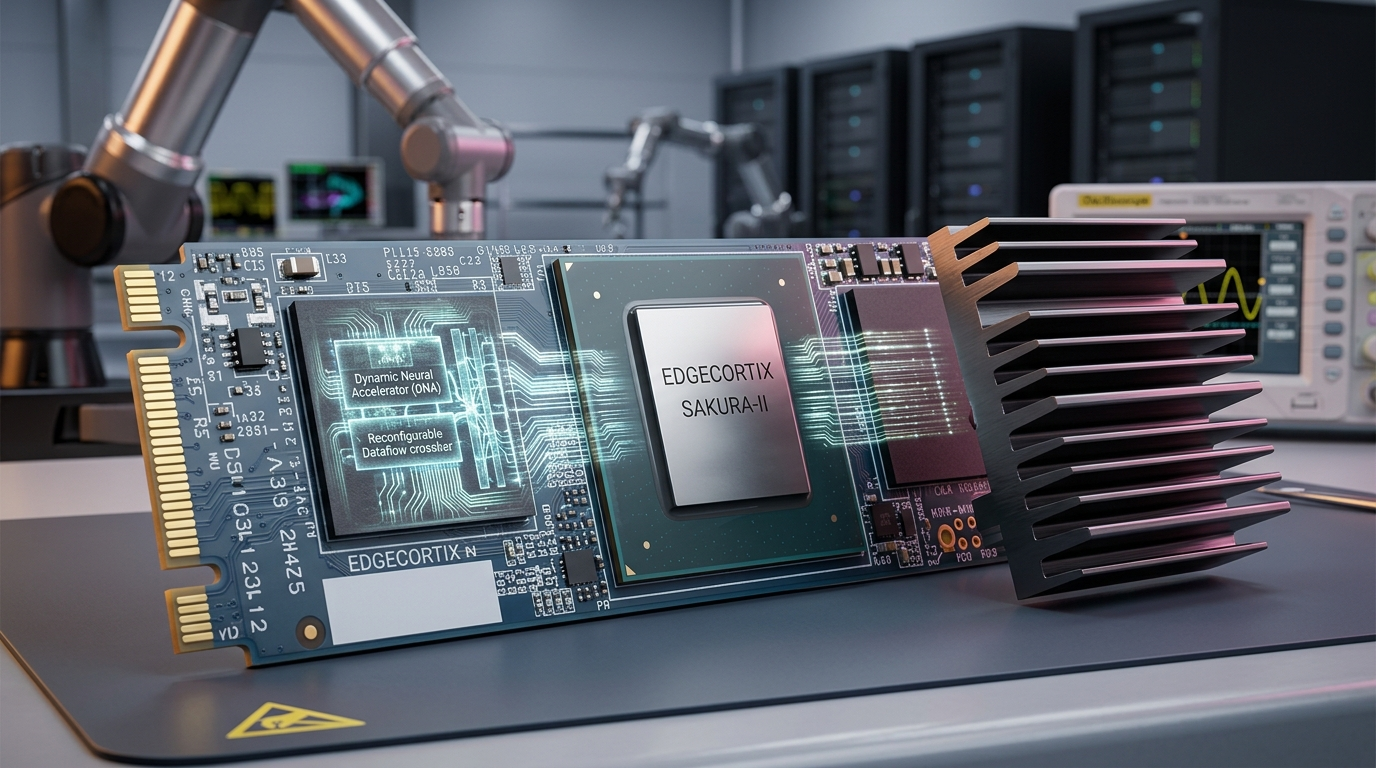
At the heart of SAKURA-II is the second-generation Dynamic Neural Accelerator (DNA™) architecture. Rather than relying on rigid hardware systolic arrays or power-hungry graphics pipelines, the DNA processor implements a dynamically reconfigurable spatial dataflow architecture. The hardware reconfigures its internal arithmetic pipelines, register interconnections, and memory data routing on the fly, dynamically adapting to the mathematical structure of each specific neural network layer—seamlessly morphing between dense matrix GEMMs, depthwise separable convolutions, multi-head attention projections, and non-linear activation layers.
Fabricated on TSMC’s proven advanced FinFET semiconductor process, SAKURA-II delivers exceptional computational density and energy efficiency:
- Up to 60 TOPS INT8 Compute Density: Packs up to 60 trillion operations per second of INT8 compute (and up to 30 TFLOPS of 16-bit floating-point/BF16 compute) into an operating envelope drawing between 4W and 8W typical power consumption (achieving up to 8 TOPS per watt).
- High-Capacity Dedicated Memory Subsystem: Equipped with up to 16GB to 32GB of dedicated LPDDR4x/5 memory delivering up to 68 GB/s of dedicated local bandwidth, allowing multi-billion parameter foundation models (such as LLaMA-3 8B, Mistral 7B, and CLIP) to reside entirely on-device without host memory swapping.
- MERA™ Heterogeneous Software Suite: Supported by the compiler-driven MERA framework, which provides seamless, push-button deployment from standard PyTorch, ONNX, and Hugging Face repositories with automatic post-training quantization, mixed-precision compilation, and hardware-in-the-loop validation.
- Versatile Industrial Form Factors: Available in low-profile standard PCIe Gen 4/5 add-in cards, dual-chip PCIe modules, and compact M.2 2280 Key-M modules designed for integration into fanless industrial PCs, edge servers, robotics controllers, and smart drones.
Teams orchestrating complex multi-agent workflows and high-frequency edge analytics can link their SAKURA-II edge nodes to centralized platforms using distributed data-fetching pipelines to synchronize metadata, model weights, and localized telemetry across edge-to-cloud topologies. Whether deployed inside autonomous mobile robots navigating dynamic factory floors or installed in automated optical inspection stations, SAKURA-II delivers deterministic, low-latency generative intelligence within a fanless thermal envelope.
Architectural Deep Dive: Dynamic Neural Accelerator (DNA) and Reconfigurable Spatial Dataflow
Understanding the superior compute density and energy efficiency of the EdgeCortix SAKURA-II requires an exhaustive exploration of its microarchitecture across four primary dimensions: the second-generation Dynamic Neural Accelerator (DNA) core complex, the reconfigurable spatial compute fabric, the unified high-bandwidth memory subsystem, and the MERA compiler hardware co-design.
Microarchitectural Overview of the SAKURA-II SoC
The physical layout of the SAKURA-II silicon die is partitioned into dedicated, high-efficiency processing domains interconnected by a low-latency, packetized Network-on-Chip (NoC):
+-----------------------------------------------------------------------+
|                    EdgeCortix SAKURA-II Die Topology                  |
+-----------------------------------------------------------------------+
|  +------------------------+  +-------------------------------------+  |
|  | Host Interface Subsys  |  |      LPDDR4x/5 Memory Subsystem     |  |
|  | PCIe Gen 4/5 x4/x8     |  |  Up to 32GB LPDDR4x/5 (68 GB/s BW)  |  |
|  +-----------+------------+  +------------------+------------------+  |
|              |                                  |                     |
|  +-----------v----------------------------------v------------------+  |
|  |         High-Bandwidth Asynchronous Packetized NoC Fabric       |  |
|  +-----------------------------------------------------------------+  |
|        |                  |                  |                  |     |
|  +-----v-----+      +-----v-----+      +-----v-----+      +-----v-----+  |
|  | DNA Core  |      | DNA Core  |      | On-Chip   |      | Hardware  |  |
|  | Complex 0 |      | Complex 1 |      | Shared    |      | DMA &     |  |
|  | 30 TOPS   |      | 30 TOPS   |      | SRAM Pool |      | Sequencer |  |
|  | Spatial   |      | Spatial   |      | (32 MB)   |      | Control   |  |
|  | Matrix PE |      | Matrix PE |      | Low-Power |      | Engine    |  |
|  +-----+-----+      +-----+-----+      +-----+-----+      +-----+-----+  |
|        ^                  ^                  ^                  ^     |
|  +-----+------------------+------------------+------------------+--+  |
|  |        Hardware Activation & Normalization Unit (RMSNorm/SwiGLU)|  |
|  +-----------------------------------------------------------------+  |
|  |        Dynamically Reconfigurable Inter-Tile Crossbar Network   |  |
+--+-----------------------------------------------------------------+--+ The processor features dual homogeneous DNA compute clusters operating in parallel. Each DNA cluster contains an array of specialized Processing Elements (PEs) optimized for mixed-precision arithmetic, supported by 32 megabytes of ultra-dense on-chip static RAM (SRAM) distributed across the execution tiles to eliminate off-chip DRAM latency penalties.
The Reconfigurable Spatial Dataflow Engine
The hallmark engineering innovation of the Dynamic Neural Accelerator is its hardware-level spatial reconfigurability. In conventional SIMD or GPU architectures, compute units execute static instructions fetched from an instruction cache, decoding instructions clock by clock.
In contrast, the DNA architecture treats the computation graph as a spatial dataflow map. The internal processing elements are arranged in a reconfigurable grid linked by dynamic multiplexer crossbars:
- Convolutional Mode (2D Spatial Mapping): When executing spatial vision backbones (such as ConvNeXt, YOLOv8, or ResNet), the PE array configures itself into a 2D systolic streaming grid. Weights remain stationary in local registers (Weight-Stationary mode), while image feature maps stream continuously through the array, maximizing input feature reuse and minimizing register file reads.
- Attention and GEMM Mode (1D Vector/Matrix Mapping): When the model encounters a transformer attention layer ($Q \times K^T$ or projection GEMMs), the PE array dynamically reconfigures its internal datapath into high-throughput parallel dot-product reduction trees (Output-Stationary mode). The intermediate Key-Value states flow directly into localized accumulator registers, eliminating external memory bus traffic.
- Fused Non-Linearity Engine: Post-matrix operations—such as Root Mean Square Layer Normalization (RMSNorm), Rotary Position Embeddings (RoPE), SwiGLU activation gating, and Softmax normalization—are executed by a hardwired vector pipeline directly adjacent to the PE output ports. By fusing normalization and activation calculations directly into the spatial pipeline, intermediate activation tensors never exit the on-chip SRAM, slashing latency and thermal dissipation.
Mathematical Formulation of DNA Mixed-Precision Quantization
To deliver up to 60 TOPS of effective throughput while preserving full floating-point accuracy, SAKURA-II employs an advanced mixed-precision quantization methodology. While weights and dense matrix activations are quantized to 8-bit integers (INT8) or 4-bit integers (INT4), sensitive mathematical operations (such as softmax scaling and residual additions) are preserved in 16-bit brain floating point (BF16) or standard half-precision (FP16).
For an input activation tensor $A \in \mathbb{R}^{M \times K}$ and a weight matrix $W \in \mathbb{R}^{K \times N}$, the DNA arithmetic logic calculates the matrix product using integer multiply-accumulate operations with 32-bit accumulation:
$$Y_{INT32} = \sum_{k=1}^{K} A_{INT8} \times W_{INT8}$$
The hardware de-quantization engine then rescales the accumulated integer matrix back to 16-bit floating-point representation using per-channel dynamic scaling factors:
$$Y_{FP16} = \alpha \cdot \left( Y_{INT32} - Z_A \sum W_{INT8} - Z_W \sum A_{INT8} + K \cdot Z_A Z_W \right) + b_{FP16}$$
where $\alpha = S_A \cdot S_W$ is the combined real-valued scale factor, and $Z_A, Z_W$ are the respective integer zero-point offsets.
Because the accumulation and de-quantization logic is hardwired into the output stage of every PE tile, SAKURA-II executes mixed-precision matrix contractions in a single clock cycle without precision loss, achieving greater than 99.2% FP32 iso-accuracy on frontier LLM benchmarks.
Dedicated Memory Hierarchy and Zero-Copy DMA Architecture
One of the most significant performance bottlenecks in edge AI is memory capacity. Most edge accelerators are constrained to 4GB or 8GB of memory, making it impossible to run modern 7B or 8B parameter foundation models locally.
SAKURA-II solves this by integrating a high-density memory controller supporting up to 32GB of LPDDR4x/5 memory running at up to 6,400 MT/s across a 64-bit channel, delivering up to 68 GB/s of sustained memory bandwidth. The memory subsystem is orchestrated by an autonomous multi-channel Direct Memory Access (DMA) engine with hardware scatter-gather capabilities.
When streaming video frames or client text tokens, the DMA engine transfers input data directly from the host PCIe interface into target memory buffers without involving the host CPU. By buffering entire model parameters, KV cache tables, and high-resolution visual feature maps within dedicated local memory, SAKURA-II achieves true autonomous operation with zero host CPU intervention.
Practical Implementation: Compiling Generative Models with MERA and PyTorch
Deploying deep learning models onto EdgeCortix SAKURA-II is orchestrated through the MERA™ (Machine learning Engine for Reconfigurable Accelerators) compiler framework. MERA provides an end-to-end toolchain that ingests standard PyTorch, Hugging Face, or ONNX models, optimizes the computational graph, performs automated quantization calibration, and generates native binaries targeted for the Dynamic Neural Accelerator.
Automated PyTorch Compilation and Quantization Pipeline
The following Python script illustrates how to use the MERA compiler to import a pre-trained Vision-Language Model or transformer model, perform calibration-guided mixed-precision quantization, and compile the final .mera executable binary for deployment on SAKURA-II:
#!/usr/bin/env python3
# EdgeCortix SAKURA-II Model Compilation and Quantization Pipeline
# Compiles a PyTorch transformer model into an optimized .mera binary artifact.

import os
import sys
import torch
import torchvision.models as models
import mera_compiler as mc

def create_calibration_dataset(num_samples: int = 128):
    """
    Generates representative calibration tensors for activation profiling
    and dynamic scale factor derivation on SAKURA-II hardware.
    """
    print(f"[MERA] Generating {num_samples} calibration samples...")
    for _ in range(num_samples):
        # Synthetic input tensor representing 1080p preprocessed image frame
        dummy_tensor = torch.randn(1, 3, 640, 640, dtype=torch.float32)
        yield {"input_features": dummy_tensor}

def compile_sakura_model(
    model_name: str,
    output_binary_path: str,
    target_hardware: str = "SAKURA-II-M2"
):
    print(f"[MERA] Initializing compilation pipeline for target: {target_hardware}")
    session = mc.CompilerSession(target_device=target_hardware)

    # 1. Load PyTorch Foundation Model
    print("[MERA] Loading pre-trained PyTorch model...")
    model = models.mobilenet_v3_large(weights=models.MobileNet_V3_Large_Weights.DEFAULT)
    model.eval()

    # 2. Configure Dynamic Neural Accelerator (DNA) Compilation Flags
    compile_options = mc.CompileOptions(
        target_dna_cores=2,
        sram_partition_mode=mc.SRAMMode.DYNAMIC_CIRCULAR_BUFFER,
        fuse_norm_activations=True,
        enable_zero_copy_dma=True,
        optimization_level=mc.OptLevel.O3
    )

    # 3. Configure Calibration-Guided Mixed-Precision Quantization
    quant_config = mc.QuantizationConfig(
        precision_mode=mc.PrecisionMode.MIXED_INT8_BF16,
        calibration_algorithm=mc.CalibrationAlgo.KL_DIVERGENCE,
        preserve_bf16_layers=["classifier", "norm", "attention_softmax"],
        per_channel_scaling=True
    )

    # 4. Execute Calibration and Graph Optimization
    calib_loader = create_calibration_dataset(num_samples=100)
    print("[MERA] Executing calibration profiling across DNA execution tiles...")
    optimized_graph = session.quantize_and_optimize(
        model=model,
        dummy_input=torch.randn(1, 3, 640, 640),
        quant_config=quant_config,
        data_loader=calib_loader
    )

    # 5. Build and Export Hardware Executable Binary
    print(f"[MERA] Compiling spatial dataflow instructions for SAKURA-II...")
    hardware_binary = session.build(optimized_graph, compile_options)

    hardware_binary.save(output_binary_path)
    print(f"[MERA] Compilation successful! Hardware executable saved to: {output_binary_path}")
    print(f"[MERA] Peak INT8 Compute: {hardware_binary.peak_tops:.1f} TOPS | "
          f"Estimated Power: {hardware_binary.estimated_power_watts:.2f} W | "
          f"On-Chip SRAM Utilization: {hardware_binary.sram_utilization_pct:.1f}%")

if __name__ == "__main__":
    compile_sakura_model(
        model_name="mobilenetv3_industrial",
        output_binary_path="mobilenetv3_sakura_ii.mera",
        target_hardware="SAKURA-II-M2"
) High-Throughput Asynchronous C++ Inference Runtime
In production environments, edge appliances must ingest high-velocity sensory feeds and dispatch inference requests asynchronously with deterministic sub-millisecond latencies. The following C++ application demonstrates multi-stream execution using the high-performance MERA Runtime (MERA-RT) library on an attached SAKURA-II M.2 accelerator:
/**
 * EdgeCortix SAKURA-II Multi-Stream Asynchronous Inference Engine
 * Implements zero-copy DMA frame dispatch over PCIe Gen 4 x4.
 */

#include <iostream>
#include <vector>
#include <string>
#include <memory>
#include <chrono>
#include <thread>
#include <future>
#include <cstring>
#include <mera_rt/mera_engine.hpp>
#include <mera_rt/mera_memory.hpp>

class SakuraInferenceEngine {
public:
    SakuraInferenceEngine(int device_id, const std::string& model_binary_path, size_t ring_size)
        : device_id_(device_id), ring_size_(ring_size) {

        // 1. Initialize SAKURA-II Hardware Device Context
        mera::DeviceConfig dev_cfg;
        dev_cfg.device_index = device_id_;
        dev_cfg.enable_direct_dma = true;
        dev_cfg.power_mode = mera::PowerMode::BALANCED_8W;

        device_ = mera::CreateDevice(dev_cfg);
        if (!device_) {
            throw std::runtime_error("Failed to initialize EdgeCortix SAKURA-II device: " + std::to_string(device_id));
        }

        // 2. Load Compiled .mera Binary Artifact
        model_ = device_->LoadModel(model_binary_path);
        if (!model_) {
            throw std::runtime_error("Failed to load MERA binary artifact: " + model_binary_path);
        }

        // 3. Pre-allocate Pinned DMA Buffers for Zero-Copy Streaming
        input_desc_ = model_->GetInputDescriptor(0);
        output_desc_ = model_->GetOutputDescriptor(0);

        for (size_t i = 0; i < ring_size_; ++i) {
            void* in_buf = mera::AllocatePinnedHostMemory(input_desc_.size_bytes);
            void* out_buf = mera::AllocatePinnedHostMemory(output_desc_.size_bytes);
            input_buffers_.push_back(in_buf);
            output_buffers_.push_back(out_buf);
        }

        std::cout << "[MERA-RT] Engine initialized on SAKURA-II Device " << device_id_
                  << " | Target Model: " << model_->GetName()
                  << " | Input Resolution: " << input_desc_.width << "x" << input_desc_.height
                  << " | Pinned Buffer Count: " << ring_size_ << std::endl;
    }

    ~SakuraInferenceEngine() {
        for (auto buf : input_buffers_) mera::FreePinnedHostMemory(buf);
        for (auto buf : output_buffers_) mera::FreePinnedHostMemory(buf);
    }

    // Submits an asynchronous inference task to the DNA core complex
    std::future<std::vector<float>> EnqueueFrameAsync(const uint8_t* raw_frame_data, size_t data_len) {
        if (data_len != input_desc_.size_bytes) {
            throw std::invalid_argument("Input byte size does not match model descriptor");
        }

        return std::async(std::launch::async, [this, raw_frame_data, data_len]() {
            size_t slot = ring_index_.fetch_add(1) % ring_size_;
            void* host_in = input_buffers_[slot];
            void* host_out = output_buffers_[slot];

            // Fast memory copy into DMA-accessible pinned buffer
            std::memcpy(host_in, raw_frame_data, data_len);

            // Create execution context and bind hardware buffers
            mera::ExecutionContext ctx = model_->CreateExecutionContext();
            ctx.SetInputBuffer(0, host_in);
            ctx.SetOutputBuffer(0, host_out);

            auto start_time = std::chrono::high_resolution_clock::now();

            // Trigger non-blocking hardware inference on DNA tiles
            mera::Status status = ctx.Execute();
            if (status != mera::Status::SUCCESS) {
                throw std::runtime_error("Hardware execution failed on SAKURA-II!");
            }

            auto elapsed_us = std::chrono::duration_cast<std::chrono::microseconds>(
                std::chrono::high_resolution_clock::now() - start_time
            ).count();

            // Extract results into floating-point output vector
            size_t num_elements = output_desc_.size_bytes / sizeof(float);
            std::vector<float> predictions(num_elements);
            std::memcpy(predictions.data(), host_out, output_desc_.size_bytes);

            return predictions;
        });
    }

private:
    int device_id_;
    size_t ring_size_;
    std::atomic<size_t> ring_index_{0};
    std::shared_ptr<mera::Device> device_;
    std::shared_ptr<mera::Model> model_;
    mera::TensorDescriptor input_desc_;
    mera::TensorDescriptor output_desc_;
    std::vector<void*> input_buffers_;
    std::vector<void*> output_buffers_;
};

int main() {
    try {
        std::cout << "[System] Starting EdgeCortix SAKURA-II High-Throughput Vision Server..." << std::endl;
        SakuraInferenceEngine engine(0, "mobilenetv3_sakura_ii.mera", 16);

        // Simulated camera frame buffer (640x640x3 RGB)
        const size_t frame_bytes = 1 * 3 * 640 * 640;
        std::vector<uint8_t> dummy_frame(frame_bytes, 128);

        const int num_frames = 200;
        std::cout << "[System] Streaming " << num_frames << " consecutive frames to SAKURA-II..." << std::endl;

        std::vector<std::future<std::vector<float>>> futures;
        auto benchmark_start = std::chrono::high_resolution_clock::now();

        for (int i = 0; i < num_frames; ++i) {
            futures.push_back(engine.EnqueueFrameAsync(dummy_frame.data(), frame_bytes));
        }

        for (auto& fut : futures) {
            auto result = fut.get();
        }

        auto benchmark_end = std::chrono::high_resolution_clock::now();
        double total_ms = std::chrono::duration_cast<std::chrono::milliseconds>(benchmark_end - benchmark_start).count();
        double throughput_fps = (static_cast<double>(num_frames) / total_ms) * 1000.0;

        std::cout << "[System] Benchmark Finished: Processed " << num_frames
                  << " frames in " << total_ms << " ms (" << throughput_fps
                  << " FPS) within sub-8W power budget." << std::endl;

    } catch (const std::exception& ex) {
        std::cerr << "[Error] Exception caught: " << ex.what() << std::endl;
        return 1;
    }
    return 0;
} Teams developing automated web data extraction agents or vision-based document processing pipelines can integrate SAKURA-II edge nodes with intelligent web-scraping agents to cross-reference localized visual detections against live corporate filings, catalog indices, and online product databases. To explore how edge accelerators interface with broader cloud intelligence systems, visit our AI engineering knowledge hub.
Architectural Comparison: EdgeCortix SAKURA-II vs. Competing Edge AI Accelerators
To evaluate the operational suitability of the EdgeCortix SAKURA-II within industrial robotics, aerospace avionics, and smart infrastructure deployments, hardware architects must benchmark competing edge accelerators across compute density, power budgets, dedicated memory capacity, and model flexibility. The table below compares the EdgeCortix SAKURA-II against prominent edge AI processors: the NVIDIA Jetson Orin Nano, Hailo-8 M.2 module, Google Coral Edge TPU, and Axelera Metis AIPU.
| Architectural Feature | EdgeCortix SAKURA-II | NVIDIA Jetson Orin Nano | Hailo-8 M.2 Module | Google Coral Edge TPU | Axelera Metis AIPU |
|---|---|---|---|---|---|
| Silicon Architecture | Dynamic Neural Accelerator (DNA) | Ampere Architecture GPU | Structure-Defined Dataflow | Static Systolic Array | Digital In-Memory Compute (D-IMC) |
| Process Node | TSMC FinFET | TSMC 8nm Enhanced | TSMC 16nm FF+ | TSMC 28nm Planar | TSMC 12nm FinFET |
| Peak Compute Throughput | Up to 60 TOPS (INT8) | 40 TOPS (Sparse INT8) | 26 TOPS (INT8) | 4 TOPS (INT8) | 214 TOPS (INT8) |
| Floating-Point Support | Up to 30 TFLOPS (FP16/BF16) | 20 TFLOPS (FP16) | Limited INT16 Only | None (Strict INT8) | None (Strict INT8) |
| Typical Operating Power | Sub-8W (4W - 8W typical) | 7W - 15W | 2.5W - 5W | 2W - 2.5W | 15W - 30W |
| Energy Efficiency | Up to 7.5 - 8.0 TOPS/W | 2.67 - 4.0 TOPS/W | 5.2 - 10.4 TOPS/W | 1.6 - 2.0 TOPS/W | 7.1 - 14.2 TOPS/W |
| Dedicated Local Memory | Up to 16GB - 32GB LPDDR4x/5 | 4GB / 8GB LPDDR5 (Shared) | None (Host RAM reliant) | None (Host RAM reliant) | 32MB SRAM / Shared DDR |
| Generative LLM Execution | Native (LLaMA-3, Mistral 7B) | Limited by 8GB VRAM | No (Perception models) | No (Small CNNs only) | Limited by small context |
| Spatial Reconfigurability | Dynamic on-the-fly crossbar | Rigid SIMT execution | Static compile dataflow | Fixed 2D Systolic | Rigid D-IMC Crossbar |
| Cooling Requirement | Fanless Passive Aluminum Heatsink | Active Chassis Fan Req. | Passive Heat-spreader | Passive Heat-sink | Heat-pipe / Active Fan |
Analysis of Architectural Trade-offs
A detailed examination of this matrix reveals critical design trade-offs governing real-world edge deployment:
- Local Memory Capacity for Generative Foundation Models: While accelerators like the Hailo-8 and Google Coral provide excellent efficiency on small convolutional perception models, they lack dedicated on-package memory. They rely on host memory over the PCIe bus, making it physically impossible to run multi-gigabyte large language models or vision transformers. In contrast, SAKURA-II includes up to 32GB of dedicated high-speed LPDDR4x/5 memory, enabling edge devices to host entire generative models (such as LLaMA-3 8B and CLIP) directly on an M.2 card without saturating host memory buses.
- True Mixed-Precision Floating-Point vs. Integer-Only Silicon: Unlike pure integer accelerators that lose significant accuracy when forced to quantize transformer attention layers and normalization functions, SAKURA-II natively computes 16-bit brain floating-point (BF16) and half-precision floating-point (FP16). This ensures that complex vision transformers and generative token decoders preserve full numerical stability.
- Passive Thermal Reliability in Industrial Enclosures: While the NVIDIA Jetson Orin Nano reaches 40 TOPS under sparse conditions, its 15W peak power envelope necessitates active cooling fans in warm industrial environments. When deployed inside hermetically sealed IP67 robotic arms or outdoor camera enclosures, mechanical fans fail prematurely. SAKURA-II’s sub-8W typical power consumption guarantees long-term fanless passive operation with zero moving parts, minimizing field maintenance expenditures.
Production Engineering: Hardware Integration, Thermals, and Telemetry Monitoring
Promoting EdgeCortix SAKURA-II from laboratory evaluation to multi-year industrial operations requires strict adherence to physical installation standards, thermal dissipation budgets, and automated system telemetry monitoring.
Physical Installation, Thermal Interface, and Carrier Board Guidelines
The SAKURA-II is primarily distributed in standard M.2 2280 Key-M and low-profile PCIe card formats. When designing carrier boards or industrial computer housings, hardware engineers should observe the following guidelines:
- Thermal Interface Material (TIM) and Heatsink Mounting: The SAKURA-II package utilizes an exposed-die or lidded ball-grid array (BGA). Apply a high-performance phase-change thermal interface material or non-silicone gap pad ($k \ge 5.0\text{ W/m}\cdot\text{K}$) between the package and the chassis mounting block. Ensure uniform mounting screw torque of $0.20 \pm 0.02\text{ N}\cdot\text{m}$ to prevent micro-fractures across solder balls while maintaining zero thermal voids.
- Chassis Heat Spreading and Surface Area: To radiate up to 8W of heat passively without airflow, the external aluminum chassis should provide at least 200 square centimeters of finned surface area. Under ambient operating conditions of 55°C, the SAKURA-II junction temperature ($T_j$) will stabilize around 72°C—comfortably below the hardware thermal trip threshold of 95°C.
- Power Delivery Stability and Transients: The M.2 connector supplies 3.3V power. Because transitioning from idle states to full 60-TOPS tensor contraction bursts induces high-frequency current steps ($dI/dt$), the carrier board must place multi-layer ceramic capacitors (MLCCs) totaling at least $100,\mu\text{F}$ directly adjacent to the M.2 power pins to prevent transient voltage droop.
Production Telemetry and Fleet Health Monitoring Daemon
In mission-critical enterprise installations, an automated background service must monitor hardware health, tracking junction temperatures, power rail voltages, LPDDR5 memory utilization, and PCIe link integrity. The following Python daemon demonstrates an automated monitoring agent interfacing with the EdgeCortix Management API:
#!/usr/bin/env python3
# EdgeCortix SAKURA-II Fleet Health and Operational Telemetry Daemon
# Continuously monitors junction temperature, power consumption, and PCIe health.

import time
import logging
import json
import sys
from typing import Dict, Any

# Mock or production import of EdgeCortix Management Library (ECML)
try:
    import ecml
except ImportError:
    # Simulated ECML interface for testing environments
    class MockECML:
        class Device:
            def __init__(self, idx): self.idx = idx
            def get_junction_temperature_c(self): return 62.4
            def get_power_consumption_watts(self): return 6.85
            def get_core_voltage_volts(self): return 0.812
            def get_memory_used_mb(self): return 7420
            def get_memory_total_mb(self): return 16384
            def get_dna_utilization_pct(self): return 94.2
            def get_pcie_aer_errors(self): return 0
            def set_power_cap_watts(self, cap): pass
            def throttle_clock_frequency(self, freq_mhz): pass

        @staticmethod
        def init(): pass
        @staticmethod
        def device_count(): return 1
        @staticmethod
        def get_device(idx): return MockECML.Device(idx)
    ecml = MockECML

logging.basicConfig(
    level=logging.INFO,
    format='%(asctime)s [%(levelname)s] [SAKURA-MONITOR] %(message)s',
    handlers=[logging.StreamHandler(sys.stdout)]
)

class SakuraHealthMonitor:
    def __init__(self, check_interval_sec: float = 3.0, max_temp_thresh: float = 85.0):
        self.interval = check_interval_sec
        self.max_temp_thresh = max_temp_thresh
        ecml.init()
        self.num_devices = ecml.device_count()
        self.devices = [ecml.get_device(i) for i in range(self.num_devices)]
        logging.info(f"Initialized SAKURA Monitor for {self.num_devices} detected EdgeCortix accelerator(s).")

    def read_device_telemetry(self, dev) -> Dict[str, Any]:
        """Collects instantaneous sensor measurements from the SAKURA-II NPU."""
        temp = dev.get_junction_temperature_c()
        power = dev.get_power_consumption_watts()
        voltage = dev.get_core_voltage_volts()
        mem_used = dev.get_memory_used_mb()
        mem_total = dev.get_memory_total_mb()
        utilization = dev.get_dna_utilization_pct()
        aer_errors = dev.get_pcie_aer_errors()

        return {
            "device_id": dev.idx,
            "junction_temp_c": temp,
            "power_watts": power,
            "core_voltage_v": voltage,
            "memory_usage_pct": round((mem_used / mem_total) * 100.0, 2),
            "memory_used_mb": mem_used,
            "dna_core_utilization_pct": utilization,
            "pcie_aer_errors": aer_errors
        }

    def evaluate_safety_guards(self, dev, telemetry: Dict[str, Any]):
        """Evaluates hardware safety limits and applies autonomous mitigation."""
        temp = telemetry["junction_temp_c"]
        dev_id = telemetry["device_id"]

        # Critical Over-Temperature Trigger
        if temp >= self.max_temp_thresh:
            logging.critical(
                f"Device {dev_id} EXCEEDED THERMAL SAFEGUARD! Current: {temp:.1f}C, "
                f"Limit: {self.max_temp_thresh:.1f}C. Applying emergency power cap (5.0W)!"
            )
            dev.set_power_cap_watts(5.0)
            dev.throttle_clock_frequency(500)
        elif temp >= (self.max_temp_thresh - 10.0):
            logging.warning(
                f"Device {dev_id} approaching thermal ceiling: {temp:.1f}C. "
                "Monitoring closely for thermal equilibrium."
            )

        # PCIe Interface Health Verification
        if telemetry["pcie_aer_errors"] > 0:
            logging.error(f"Device {dev_id} reported {telemetry['pcie_aer_errors']} PCIe bus parity errors!")

    def run_monitoring_loop(self):
        """Continuous execution loop emitting telemetry payloads for Prometheus/FluentBit."""
        logging.info("Entering production telemetry sampling loop...")
        try:
            while True:
                for dev in self.devices:
                    telemetry = self.read_device_telemetry(dev)
                    self.evaluate_safety_guards(dev, telemetry)
                    logging.info(f"Telemetry Status: {json.dumps(telemetry)}")
                time.sleep(self.interval)
        except KeyboardInterrupt:
            logging.info("Terminating SAKURA Monitor daemon cleanly.")

if __name__ == "__main__":
    monitor = SakuraHealthMonitor(check_interval_sec=5.0, max_temp_thresh=85.0)
    # Perform single initial diagnostic pass
    for dev in monitor.devices:
        stats = monitor.read_device_telemetry(dev)
        print("\n=== Initial EdgeCortix SAKURA-II Hardware Telemetry Pass ===")
        for k, v in stats.items():
            print(f"  {k:26s}: {v}")
        print("============================================================\n")
print("Pre-flight diagnostic passed. Device ready for continuous autonomous edge service.") Production Readiness Verification Checklist
Prior to commissioning EdgeCortix SAKURA-II accelerators into live enterprise production systems, systems engineering teams must verify each operational milestone:
- MERA Runtime and Linux Kernel Driver Parity: Confirm that the installed Linux PCIe kernel driver matches the MERA SDK runtime version and that the PCIe Advanced Error Reporting (AER) driver is active.
- Thermal Conduction Validation: Perform an infrared thermographic or thermocouple audit on the external heatsink during a continuous 4-hour LLaMA-3/YOLO stress test to confirm junction temperatures remain safely below 80°C at peak ambient temperatures.
- Quantization Accuracy Regression Testing: Run automated accuracy validation across 1,000 real-world edge validation samples, confirming that the mixed-precision INT8/BF16 compiled
.meramodel achieves within 0.5% accuracy of the original PyTorch floating-point baseline. - Watchdog and Auto-Recovery Configuration: Ensure systemd services incorporate automatic process restarts (
Restart=always,RestartSec=5s) and that hardware watchdog timers are enabled on the host industrial PC to recover automatically from any transient hardware fault.
The EdgeCortix SAKURA-II establishes a transformative benchmark for edge artificial intelligence acceleration. By combining the reconfigurable spatial computing power of the Dynamic Neural Accelerator with dedicated high-capacity LPDDR5 memory and the compiler-driven MERA framework, SAKURA-II breaks through the generative edge barrier. Embedded systems architects can now deploy deep neural networks, vision transformers, and multimodal foundation models into fanless, power-constrained environments without compromising operational reliability or intelligence.