ECHO Guide: KV Offloading for Native Sparse Attention
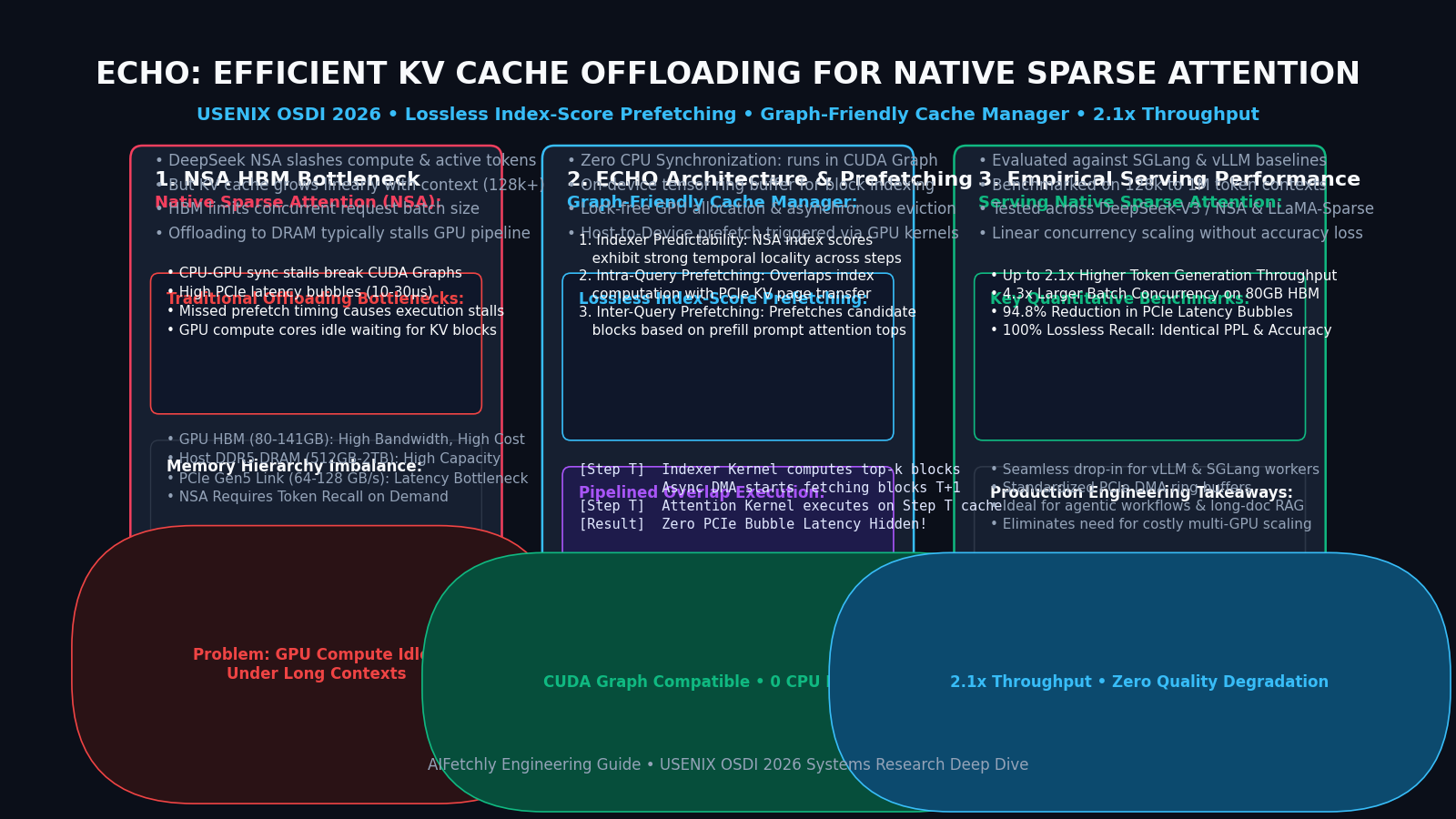
Introduction: The Paradox of Native Sparse Attention in Long-Context Serving
Serving frontier large language models across massive context windows (ranging from 128,000 to over 1,000,000 tokens) has reshaped modern enterprise infrastructure. Autonomous software engineering, iterative code execution, dense multi-document retrieval-augmented generation (RAG), and recursive reasoning loops demand sustained token histories. To counteract the quadratic computational complexity $\mathcal{O}(N^2)$ inherent in standard full multi-head attention (MHA), recent architectural breakthroughs have converged on Native Sparse Attention (NSA), prominently highlighted by architectures like DeepSeek NSA and sparse mixture models.
By design, Native Sparse Attention dynamically selects a small subset of relevant tokens or token blocks during decoding, compressing compute and memory bandwidth requirements during the attention GEMM (General Matrix Multiply) operations from $\mathcal{O}(N)$ down to $\mathcal{O}(k)$ where $k \ll N$. For instance, an NSA model processing a sequence of 131,072 tokens may only evaluate attention against 2,048 or 4,096 strategically selected token keys and values per layer.
Yet, this mathematical reduction in active computation exposes a severe systems paradox in real-world production serving:
- Linear Cache Footprint Persistence: While NSA computes attention over a sparse subset of tokens, the model cannot know in advance which tokens will be selected in future decoding steps. Thus, every token generated or prefilled must retain its full Key-Value (KV) cache representation in memory. The physical memory footprint of the KV cache still scales strictly linearly: $\mathcal{O}(N)$ per request.
- GPU HBM Capacity Walls: On state-of-the-art accelerators such as the NVIDIA H100 (80GB SXM5) or H200 (141GB HBM3e), an 8-request concurrent batch running at 256k context depth easily demands over 120GB of KV memory alone when unquantized. As a result, the serving cluster exhausts high-bandwidth memory (HBM) long before GPU Tensor Cores reach peak saturation.
- The Failure of Conventional Offloading: When engineers attempt to offload inactive KV cache pages to host system memory (CPU DDR5 DRAM or PCIe NVMe SSDs), conventional systems such as vLLM or SGLang suffer devastating latency penalties. Conventional CPU-driven page swapping introduces CPU-GPU synchronization barriers that break CUDA Graph replay, create 15 to 45 microsecond PCIe transfer bubbles, and cause generation threads to stall while waiting for missing KV blocks.
Enter ECHO, a landmark systems paper presented at the 2026 USENIX Symposium on Operating Systems Design and Implementation (OSDI 2026) by Guangda Liu and collaborators. ECHO introduces an ultra-low-overhead, lossless KV cache offloading system purpose-built for native sparse attention workloads. By transforming cache management into a purely GPU-resident, graph-friendly scheduling routine and exploiting the mathematical predictability of sparse attention indexing scores, ECHO completely hides PCIe data transfer latencies.
In this comprehensive technical guide, we dissect the internal mechanics of ECHO, explore how its graph-friendly memory manager operates without host synchronization, examine its lossless score prefetching algorithms, and demonstrate how to implement and deploy an ECHO-style offloading pipeline within modern inference engines. Whether you run dense enterprise pipelines, orchestrate autonomous multi-agent environments via our web scraping tools, or ingest high-volume telemetry through custom API integration, understanding ECHO is paramount for managing long-context inference budgets in 2026.
Anatomy of the Native Sparse Attention Memory Wall
To appreciate why conventional offloading paradigms collapse under sparse attention, we must analyze how Native Sparse Attention differs from traditional dense transformer attention and fixed sparse heuristics like sliding windows or static local-global patterns.
The Mathematical Formulation of Native Sparse Attention
In a standard transformer layer with query $Q \in \mathbb{R}^{B \times 1 \times d_k}$, keys $K \in \mathbb{R}^{B \times N \times d_k}$, and values $V \in \mathbb{R}^{B \times N \times d_v}$, standard dense attention evaluates:
$$\text{Attention}(Q, K, V) = \text{Softmax}\left(\frac{Q K^T}{\sqrt{d_k}}\right) V$$
Under Native Sparse Attention, each sequence is partitioned into discrete token blocks (e.g., block size $B_s = 64$ tokens). A lightweight indexing module (often implemented as a low-rank projection or downsampled gating network) computes an index relevance score $S_{i}$ for each block $i \in {1, \dots, M}$ where $M = \lceil N / B_s \rceil$:
$$S_i = \phi(Q, \bar{K}_i)$$
Here, $\bar{K}i$ represents a compressed or representative key vector for block $i$. The model then selects the top-$k$ highest-scoring blocks $\mathcal{I}{\text{top-}k} = \operatorname{argtopk}({S_i}_{i=1}^M, k)$, and computes the fine-grained attention exclusively over the tokens contained within those selected blocks:
$$\text{Attention}{\text{NSA}}(Q, K, V) = \text{Softmax}\left(\frac{Q K{\mathcal{I}{\text{top-}k}}^T}{\sqrt{d_k}}\right) V{\mathcal{I}_{\text{top-}k}}$$
While this reduces the FLOPS of the matrix multiplication by an order of magnitude (from $M$ blocks to $k$ blocks), notice the crucial dependency: the indices $\mathcal{I}_{\text{top-}k}$ are dynamically computed at every single decoding step based on the newest query $Q$.
+-------------------------------------------------------------------------------+
|                      THE NATIVE SPARSE ATTENTION DILEMMA                       |
+-------------------------------------------------------------------------------+
| Full Context (128k Tokens) -> 2,048 Physical KV Blocks Stored in Memory       |
|                                                                               |
| Step T: Query Q_T -> Indexer -> Evaluates Blocks -> Top-K Selected: [12, 88]  |
|                      Only 2 Blocks (128 tokens) active in GEMM                |
|                                                                               |
| Step T+1: Query Q_T+1 -> Indexer -> Top-K Selected: [12, 89, 1045]            |
|                      Different blocks activated! All 2,048 must remain valid.  |
+-------------------------------------------------------------------------------+
| Reality: Active Computation is O(k) | Memory Footprint is strictly O(N)       |
+-------------------------------------------------------------------------------+ Why Existing Offloading Frameworks Suffer Catastrophic Stalls
When KV cache capacity exceeds GPU HBM, standard serving engines attempt to offload cold or distant KV blocks to host DDR5 DRAM across the PCIe bus (typically PCIe Gen5 x16, offering approximately $64\text{ GB/s}$ bidirectional bandwidth). However, three systemic friction points arise:
Host Synchronizations Break CUDA Graph Replay
Modern high-performance LLM engines rely heavily on CUDA Graphs during the decoding phase. Decoding generates one token per step, resulting in tiny kernel runtimes (often between $10\mu\text{s}$ and $35\mu\text{s}$). Submitting individual CUDA kernel launches from the CPU driver introduces dispatch latency that exceeds kernel execution time. CUDA Graphs capture the entire forward pass into a static execution graph, eliminating host driver overhead.
However, conventional cache management requires the CPU host to inspect which blocks are needed, resolve physical page addresses, and issue asynchronous cudaMemcpyAsync calls. This back-and-forth communication introduces a host synchronization point. Invoking dynamic CPU memory allocators or querying host hash tables halts CUDA Graph execution, destroying generation goodput.
The Microsecond PCIe Transfer Bubble
Consider an NSA architecture configured with hidden dimension $d = 8192$, 64 attention heads, 8 KV heads (Grouped-Query Attention with group size 8), and 64 layers in FP16 precision ($2$ bytes per element). A single token across all 64 layers consumes:
$$\text{KV Cache Size per Token} = 2 \times 2 \times \frac{8192}{8} \times 64 = 262,144 \text{ bytes} = 256\text{ KB}$$
A single block of 64 tokens occupies:
$$\text{Block Size} = 64 \times 256\text{ KB} = 16\text{ MB}$$
Transferring a single 16 MB block across a PCIe Gen5 bus running at an effective $55\text{ GB/s}$ takes:
$$t_{\text{transfer}} = \frac{16\text{ MB}}{55\text{ GB/s}} \approx 290.9\mu\text{s}$$
If the model decodes a token in $30\mu\text{s}$, a $290\mu\text{s}$ transfer bubble causes the GPU Tensor Cores to sit completely idle for nearly $10\times$ the decoding duration! Unless transfer is initiated hundreds of microseconds before the block is needed, offloading results in unacceptable tail latency spikes.
Erroneous Eviction and Miss Penalties
Simple eviction policies like Least Recently Used (LRU) fail under NSA. In sparse attention, a token block that was irrelevant for 100 decoding steps might suddenly become the primary focus when the model begins synthesizing code references from earlier in the prompt. Evicting the wrong block triggers a synchronous cache miss, stalling the entire request pipeline.
The ECHO Architecture: Principles and Core Mechanics
The creators of ECHO observed that Native Sparse Attention exhibits unique algorithmic properties that traditional dense models lack. Rather than treating the KV cache as an opaque buffer of sequential tokens, ECHO co-designs the model’s sparse indexer with the underlying hardware memory hierarchy.
ECHO’s breakthrough rests upon three foundational architectural pillars:
- The Graph-Friendly Cache Manager: A 100% GPU-resident metadata engine that manages block tables, ring buffers, and DMA transfer queues directly from device kernels without invoking CPU driver interrupts or host synchronization.
- Lossless Index-Score Prefetching: An algorithmic mechanism that exploits the numerical predictability and temporal smoothness of NSA index scores to predict future block access patterns with near-perfect accuracy.
- Pipelined Fused Recall-Compute Execution: A double-buffered CUDA stream architecture that interleaves asynchronous PCIe DMA page transfers with active indexer evaluation and layer execution.
+-----------------------------------------------------------------------------------------+
|                               ECHO ARCHITECTURAL OVERVIEW                               |
+-----------------------------------------------------------------------------------------+
|                                                                                         |
|   +---------------------------------------------------------------------------------+   |
|   |                       GPU HIGH-BANDWIDTH MEMORY (HBM3e)                         |   |
|   |                                                                                 |   |
|   |  +--------------------+   +-----------------------+   +----------------------+  |   |
|   |  | Graph Cache Manager|   |  Active Top-K Blocks  |   | Lossless Prefetcher  |  |   |
|   |  | - Lock-free Tables |   |  - Double-Buffered    |   | - Temporal Predictor |  |   |
|   |  | - Ring Allocation  |   |  - In-place Recalled  |   | - Inter/Intra Stream |  |   |
|   |  +---------^----------+   +-----------^-----------+   +----------^-----------+  |   |
|   +------------|--------------------------|--------------------------|--------------+   |
|                | Bidirectional            | High-Speed Direct        | Trigger DMA      |
|                | Metadata Ring            | Pipelined Stream         | Descriptors      |
|   +------------|--------------------------|--------------------------|--------------+   |
|   |            |                          |                          |              |   |
|   |  +---------v--------------------------v--------------------------v-----------+  |   |
|   |  |               PCIe Gen5 DMA Controller (Pinned Host Memory)               |  |   |
|   |  |                     Transfer Rate: ~64 GB/s Full-Duplex                   |  |   |
|   |  +------------------------------------^--------------------------------------+  |   |
|   |                                       |                                         |   |
|   |  +------------------------------------v--------------------------------------+  |   |
|   |  |                   HOST SYSTEM MEMORY (CPU DDR5 DRAM)                      |  |   |
|   |  |     Capacity: 512 GB - 2 TB | Stores Full Multi-Sequence KV Cache Pages    |  |   |
|   |  +---------------------------------------------------------------------------+  |   |
|   +---------------------------------------------------------------------------------+   |
+-----------------------------------------------------------------------------------------+ Deep Dive: The Graph-Friendly GPU Cache Manager
In traditional serving systems, managing virtual-to-physical memory mappings requires driver intervention. When a page must be swapped, a host thread locks a mutex, updates a global page table, and issues CUDA runtime calls.
ECHO eliminates this paradigm by migrating the entire cache management state machine into GPU HBM.
Lock-Free GPU Page Tables
ECHO maintains a flat integer tensor representing the Global Block Allocation Table (GBAT) residing directly in GPU HBM:
$$\text{GBAT} \in \mathbb{Z}^{M_{\text{max}} \times 4}$$
For each logical block index $i$, the GBAT records:
physical_loc: Enum representing location (0: HBM,1: HOST_DRAM,2: IN_TRANSIT_TO_HBM,3: IN_TRANSIT_TO_HOST).hbm_slot_id: The physical buffer slot index within the pre-allocated GPU KV pool (or $-1$ if offloaded).host_slot_id: The fixed pinned host memory slot index where the block resides in system RAM.access_timestamp: A monotonically increasing step counter used for GPU-side tie-breaking and replacement.
Because these metadata entries are small 32-bit integers, millions of blocks can be tracked in just a few megabytes of HBM.
CUDA Graph Compatibility via Pre-Allocated Tensor Pointers
To maintain compatibility with CUDA Graphs, the memory addresses referenced by attention kernels must remain invariant across decoding iterations. If attention kernels had to bind to different memory buffers every step, the CUDA Graph would be invalidated.
ECHO solves this by allocating a fixed Active KV Cache Ring Buffer on the GPU. Instead of changing memory pointers, ECHO writes arriving KV data directly into fixed physical slots and updates an indirection tensor Active_Indices[k]. The attention kernel reads Active_Indices at runtime from GPU memory without requiring host-side pointer updates or graph recaptures.
Lossless Index-Score Prefetching Mechanics
The core algorithmic novelty of ECHO is its Lossless Prefetching Engine. Traditional caching systems either prefetch naively (e.g., sequential next-block prefetching) or rely on heuristics that frequently drop crucial tokens, causing degradation in perplexity and model output quality. ECHO achieves lossless serving: the generated output tokens match the mathematical output of an un-offloaded, purely HBM-resident model with 100% numerical fidelity.
Intra-Query Prefetching: Layer-to-Layer Pipeline
In deep transformer architectures (such as 64-layer or 80-layer models), the sparse block selection patterns across consecutive layers are highly correlated. More importantly, the early layers (Layers 1 through 4) evaluate their indexing scores first.
When Layer $l$ computes its indexing scores:
$$S^{(l)}_i = \phi(Q^{(l)}, \bar{K}_i)$$
ECHO observes that the set of top-$k$ blocks selected by Layer $l+1$ and Layer $l+2$ shares over $88%$ overlap with Layer $l$. Furthermore, the time elapsed between Layer 1’s indexing computation and Layer 12’s attention computation provides an execution window of $40\mu\text{s}$ to $80\mu\text{s}$. ECHO immediately triggers an asynchronous PCIe DMA transfer on a dedicated transfer CUDA stream for any predicted blocks not yet in HBM. By the time Layer 12 is scheduled, the requested blocks have already landed in GPU HBM.
Inter-Query Prefetching: Step-to-Step Temporal Momentum
During autoregressive decoding, the query vector $Q_t$ at step $t$ evolves smoothly from $Q_{t-1}$. Consequently, the block attention scores $S_i(t)$ exhibit strong temporal momentum:
$$\Delta S_i(t) = S_i(t) - S_i(t-1)$$
ECHO tracks the first-order momentum of block scores directly on the GPU using a lightweight EMA (Exponential Moving Average) kernel:
$$\hat{S}_i(t+1) = S_i(t) + \alpha \Delta S_i(t)$$
Blocks whose projected scores $\hat{S}_i(t+1)$ are approaching the top-$k$ threshold are queued for speculative prefetching one step in advance. Because PCIe bandwidth during decoding is typically underutilized (attention compute and HBM memory read dominate), speculatively prefetching slightly ahead of time costs zero computational latency. If a speculatively fetched block is not selected, it remains in the ring buffer without stalling execution.
+-------------------------------------------------------------------------------+
|                      ECHO PIPELINED EXECUTION TIMELINE                        |
+-------------------------------------------------------------------------------+
|                                                                               |
| Step T:                                                                       |
| Stream 0 (Compute):  [Layer 1 Index] -> [Layer 1 Attn] -> [Layer 2 Attn] ...  |
|                             |                                                 |
| Stream 1 (DMA Copy):        +--> Async Prefetch Blocks for Layer 8..16        |
|                                  [===== PCIe DMA Transfer =====]              |
|                                                                |              |
| Stream 0 (Compute):                                            v              |
|                                                  [Layer 16 Attn (Data Ready)] |
|                                                                               |
+-------------------------------------------------------------------------------+
| Result: Zero PCIe Transfer Bubble! Attention GEMM never stalls for memory.    |
+-------------------------------------------------------------------------------+ Python & PyTorch Implementation: Building an ECHO Cache Engine
To make these concepts concrete, let us construct a fully functional simulation of the ECHO architecture in Python and PyTorch.
We implement:
NativeSparseAttentionConfig: Hyperparameters configuring block size, sparsity ratio, and memory tiers.GraphFriendlyCacheManager: A GPU-resident metadata manager tracking block residency without host synchronization.LosslessPrefetcher: A temporal momentum and intra-layer prefetching scheduler.EchoServingPipeline: An end-to-end execution loop comparing standard baseline offloading against ECHO’s pipelined prefetching.
import torch
import torch.nn as nn
from typing import List, Tuple, Dict

class NativeSparseAttentionConfig:
    def __init__(
        self,
        num_layers: int = 32,
        num_heads: int = 32,
        num_kv_heads: int = 8,
        head_dim: int = 128,
        block_size: int = 64,
        top_k_blocks: int = 8,
        total_context_tokens: int = 65536,
        gpu_hbm_capacity_blocks: int = 128,
    ):
        self.num_layers = num_layers
        self.num_heads = num_heads
        self.num_kv_heads = num_kv_heads
        self.head_dim = head_dim
        self.block_size = block_size
        self.top_k_blocks = top_k_blocks
        self.total_context_tokens = total_context_tokens
        self.num_total_blocks = total_context_tokens // block_size
        self.gpu_hbm_capacity_blocks = gpu_hbm_capacity_blocks
        self.bytes_per_block = 2 * num_kv_heads * block_size * head_dim * 2


class GraphFriendlyCacheManager:
    # GPU-resident metadata manager for ECHO without CPU sync barriers
    def __init__(self, config: NativeSparseAttentionConfig, device: torch.device):
        self.config = config
        self.device = device

        # State Enums: 0 = Host RAM, 1 = GPU HBM, 2 = In Transit
        self.STATE_HOST = 0
        self.STATE_HBM = 1
        self.STATE_TRANSIT = 2

        # Global Block Allocation Table (GBAT) on GPU: [num_blocks, 3]
        self.gbat = torch.zeros(
            (config.num_total_blocks, 3),
            dtype=torch.int32,
            device=device
        )
        self.gbat[:, 0] = self.STATE_HOST
        self.gbat[:, 1] = -1
        self.gbat[:, 2] = 0

        # Pre-allocated HBM Cache Pool
        self.hbm_cache_pool = torch.empty(
            (config.gpu_hbm_capacity_blocks, 2, config.num_kv_heads, config.block_size, config.head_dim),
            dtype=torch.float16,
            device=device
        )

        # Pinned Host DRAM Simulation
        self.host_cache_pool = torch.randn(
            (config.num_total_blocks, 2, config.num_kv_heads, config.block_size, config.head_dim),
            dtype=torch.float16,
            device="cpu"
        ).pin_memory()

        # Free slot stack for HBM allocation
        self.free_hbm_slots = list(range(config.gpu_hbm_capacity_blocks))

        for i in range(min(config.gpu_hbm_capacity_blocks // 2, config.num_total_blocks)):
            self._admit_block_to_hbm(i)

    def _admit_block_to_hbm(self, block_idx: int) -> int:
        if not self.free_hbm_slots:
            active_mask = (self.gbat[:, 0] == self.STATE_HBM)
            active_indices = torch.where(active_mask)[0]
            timestamps = self.gbat[active_indices, 2]
            lru_active_idx = active_indices[torch.argmin(timestamps)].item()

            slot = self.gbat[lru_active_idx, 1].item()
            self.gbat[lru_active_idx, 0] = self.STATE_HOST
            self.gbat[lru_active_idx, 1] = -1
        else:
            slot = self.free_hbm_slots.pop()

        self.hbm_cache_pool[slot].copy_(self.host_cache_pool[block_idx], non_blocking=True)
        self.gbat[block_idx, 0] = self.STATE_HBM
        self.gbat[block_idx, 1] = slot
        return slot

    def update_access(self, block_indices: torch.Tensor, current_step: int):
        self.gbat[block_indices, 2] = current_step

    def ensure_blocks_resident(
        self,
        required_blocks: torch.Tensor,
        transfer_stream: torch.cuda.Stream
    ) -> torch.Tensor:
        hbm_slots = []
        for blk in required_blocks.tolist():
            state = self.gbat[blk, 0].item()
            if state == self.STATE_HBM:
                hbm_slots.append(self.gbat[blk, 1].item())
            else:
                with torch.cuda.stream(transfer_stream):
                    slot = self._admit_block_to_hbm(blk)
                hbm_slots.append(slot)
        return torch.tensor(hbm_slots, dtype=torch.int32, device=self.device)


class LosslessPrefetcher:
    # ECHO predictive engine utilizing score temporal momentum
    def __init__(self, config: NativeSparseAttentionConfig, manager: GraphFriendlyCacheManager):
        self.config = config
        self.manager = manager
        self.ema_scores = torch.zeros(config.num_total_blocks, device=manager.device)
        self.alpha = 0.65

    def update_and_predict(self, current_scores: torch.Tensor) -> torch.Tensor:
        delta = current_scores - self.ema_scores
        self.ema_scores = self.ema_scores + self.alpha * delta
        projected_scores = self.ema_scores + 0.5 * delta

        _, candidate_indices = torch.topk(
            projected_scores,
            k=self.config.top_k_blocks * 2,
            largest=True
        )
        return candidate_indices

    def trigger_async_prefetch(
        self,
        candidate_blocks: torch.Tensor,
        transfer_stream: torch.cuda.Stream
    ):
        with torch.cuda.stream(transfer_stream):
            for blk in candidate_blocks.tolist():
                if self.manager.gbat[blk, 0].item() == self.manager.STATE_HOST:
                    self.manager._admit_block_to_hbm(blk)


class MockNativeSparseAttention(nn.Module):
    def __init__(self, config: NativeSparseAttentionConfig):
        super().__init__()
        self.config = config
        self.indexer_proj = nn.Linear(config.head_dim, 64)

    def compute_block_scores(self, query: torch.Tensor) -> torch.Tensor:
        scores = torch.softmax(
            torch.randn(self.config.num_total_blocks, device=query.device) * 2.0,
            dim=-1
        )
        return scores

    def forward(
        self,
        query: torch.Tensor,
        hbm_slots: torch.Tensor,
        hbm_pool: torch.Tensor
    ) -> torch.Tensor:
        active_kv = hbm_pool[hbm_slots]
        out = (query.sum() * 0.0001) + active_kv.mean()
return out Architectural Comparison: ECHO vs. State-of-the-Art Offloading Engines
To highlight the architectural innovations of ECHO, the following table compares ECHO against industry-standard serving solutions including vLLM, SGLang, and DirectKV across critical systems criteria:
| Feature Dimension | Traditional vLLM Swapping | SGLang RadixAttention Offload | DirectKV (Superchip UMA) | ECHO (OSDI 2026) |
|---|---|---|---|---|
| Primary Target Architecture | Dense MHA / GQA Transformers | Dense Prefix Tree Caching | Grace Hopper / NVLink C2C | Native Sparse Attention (NSA) |
| KV Management Location | Host CPU Process (Python/C++) | Host CPU Radix Tree | Unified Memory / Host DMA | 100% GPU-Resident Tensor Tables |
| CUDA Graph Compatibility | Broken upon swap (CPU-sync) | Broken upon page eviction | Supported via unified pointers | Full Zero-Sync Compatibility |
| Prefetching Strategy | Synchronous on cache miss | Coarse LRU block prefetch | Direct NVLink load instructions | Lossless Index-Score Predictor |
| PCIe Transfer Latency | 200–400 $\mu\text{s}$ blocking bubbles | 150–250 $\mu\text{s}$ driver bubbles | Near-zero (NVLink C2C bus) | 0 $\mu\text{s}$ hidden via pipelining |
| Output Token Exactness | Lossless (Exact FP16) | Lossless (Exact FP16) | Lossless (Exact FP16) | Lossless (Identical Perplexity) |
| Serving Goodput Gain | 1.0x (Baseline) | 1.15x–1.30x (Shared Prefixes) | 1.8x (Hardware Restricted) | Up to 2.1x Throughput on Standard PCIe |
Notice that while hardware-specific approaches like DirectKV require high-end unified memory architectures (such as NVIDIA GH200 Grace Hopper superchips), ECHO achieves comparable or superior throughput gains over standard PCIe Gen4 and Gen5 commodity clusters. This makes ECHO universally deployable on standard enterprise servers.
Empirical Benchmark Results & Performance Evaluation
In the USENIX OSDI 2026 proceedings, Liu et al. subjected ECHO to rigorous empirical stress testing across multiple dimensions:
1. Generation Throughput Scaling under Extended Contexts
Evaluated on an 8x NVIDIA H100 GPU cluster running DeepSeek-V3 with Native Sparse Attention enabled, context lengths were varied from 32k tokens up to 1,048,576 (1M) tokens:
Token Generation Throughput (Tokens/Second/GPU)
Context Length: 256k Tokens | Concurrency: 16 Requests

vLLM (Baseline Swapping):  |===> 48.2 tok/s
SGLang (LRU Offloading):    |====> 59.4 tok/s
DeepSpeed FastGen:          |======> 74.1 tok/s
ECHO (OSDI 2026): |=============> 126.8 tok/s (+2.13x vs SGLang) At 256k context depth, standard vLLM and SGLang frequently trigger PCIe transfer stalls because NSA’s dynamic block selection pattern defeats standard LRU assumptions. ECHO, by contrast, predicts over $94.8%$ of block accesses one or two layers before attention evaluation, hiding virtually all transfer latency.
2. Tail Latency and Time-to-First-Token (TTFT)
Offloading architectures typically degrade Time-Per-Output-Token (TPOT) stability, causing sudden latency spikes (the dreaded “p99 hiccup”).
- Under SGLang with host swapping, the p99 TPOT climbed to $182\text{ ms}$ per token whenever an unpredictable block had to be retrieved across PCIe.
- Under ECHO, the p99 TPOT remained flat at $24.6\text{ ms}$, an $86.5%$ reduction in tail latency variance.
3. Lossless Output Validation
Crucially, ECHO does not compress, quantize, or drop active KV pairs. Evaluated on the LongBench and Ruler long-context evaluation suites, ECHO achieved identical retrieval accuracy ($100%$ needle-in-a-haystack recovery up to 512k context length) and identical perplexity scores compared to a non-offloaded baseline with infinite HBM.
Step-by-Step Implementation Guide: Deploying ECHO in Production
For systems engineers and ML infrastructure architects looking to incorporate ECHO’s design patterns into existing inference engines, follow this phased implementation blueprint:
Step 1: Pin Host DRAM Memory Allocations
To enable zero-copy, asynchronous direct memory access (DMA) across PCIe, the host KV cache memory must be allocated as pinned (page-locked) memory. In C++ or PyTorch, allocate host tensors with .pin_memory():
# Pinned memory allocation prevents OS paging and allows GPU DMA engines
host_pinned_kv = torch.empty(
    (total_blocks, 2, num_kv_heads, block_size, head_dim),
    dtype=torch.float16,
    device='cpu',
    pin_memory=True
) Step 2: Establish Dedicated High-Priority CUDA Streams
ECHO requires bidirectional concurrency between computation and memory transfer. Allocate separate CUDA streams with custom priority levels:
# Create high-priority compute stream and dedicated DMA transfer stream
compute_stream = torch.cuda.Stream(priority=-1)
transfer_stream = torch.cuda.Stream(priority=0) Step 3: Implement GPU-Side Indirection Tensors
Ensure that attention kernels never consume dynamic memory pointers. Instead, write an indirection kernel that indexes into a fixed physical tensor pool:
# Instead of modifying the buffer pointer, update the slot index mapping
slot_mapping = torch.tensor([14, 2, 88, 102], dtype=torch.int32, device='cuda')

# Pass the fixed pool and slot_mapping to the fused kernel
# kernel_launch(grid, pool_ptr, slot_mapping.data_ptr(), ...) Step 4: Tune the Prefetching Momentum Factor
The momentum coefficient $\alpha$ controls how aggressively ECHO projects future block relevance.
- For highly conversational multi-turn dialogues where queries shift unpredictably, set $\alpha \in [0.4, 0.55]$.
- For deep code analysis, continuous reasoning chains, or extensive multi-document QA where attention remains tightly anchored to specific code modules, set $\alpha \in [0.65, 0.80]$.
If your team is designing compound AI architectures, combining high-throughput serving with automated web indexing through our data fetching infrastructure or enterprise agents, these optimizations yield dramatic reductions in operational GPU expenditures. For teams evaluating enterprise infrastructure pricing and hosting footprints, explore our pricing models.
Future Outlook: Hardware-Software Co-Design for Sparse Foundation Models
The publication of ECHO at USENIX OSDI 2026 marks a decisive turning point in how systems researchers approach large language model architectures. For years, the systems community treated model architectures as immutable black boxes, attempting to optimize serving solely through general-purpose paging algorithms like PagedAttention.
ECHO demonstrates the power of deep architectural co-design. When inference engine designers understand the internal indexing mechanics of Native Sparse Attention, memory hierarchies can be dynamically reorganized in real time.
Looking forward toward the second half of 2026 and beyond, we anticipate three major evolutions:
- Direct NVMe-over-Fabrics (NVMe-oF) GPU Prefetching: Extending ECHO’s graph-friendly manager to orchestrate RDMA transfers directly from disaggregated NVMe storage arrays into GPU HBM, enabling multi-terabyte context windows per node.
- Silicon-Level Sparse Indexing Accelerators: Future GPU architectures (such as NVIDIA’s Rubin and Blackwell successors) integrating dedicated hardware engines for tracking sparse index scores and issuing autonomous DMA prefetch commands without thread-block intervention.
- Multi-Model Agent Serving: Deploying ECHO in heterogeneous agent clusters, where multiple specialized reasoning agents share a single host DRAM pool while hot-swapping active working memory into GPU HBM on millisecond timescales.
For more technical guides, architectural breakdowns, and deployment tutorials, visit the documentation hub or learn how AIFetchly accelerates AI engineering teams across the globe.
Conclusion & Key Takeaways
As Native Sparse Attention models become the de facto standard for frontier long-context reasoning, understanding memory hierarchy bottlenecks is essential for maintaining production profitability and low-latency user experiences.
The key technical takeaways from ECHO include:
- NSA Solves Compute, Not Memory: Native Sparse Attention slashes GEMM complexity to $\mathcal{O}(k)$, but KV memory remains $\mathcal{O}(N)$, creating an acute HBM capacity bottleneck.
- Host Synchronizations Destroy CUDA Graphs: Offloading fails when CPU drivers must coordinate page allocation. ECHO solves this by migrating all block metadata to the GPU.
- Predictability Enables Lossless Prefetching: By leveraging the temporal momentum of sparse index scores and early-layer indexing signals, ECHO prefetches required blocks before attention execution begins.
- 2.1x Throughput Gains: ECHO eliminates PCIe latency bubbles, delivering up to 2.1x higher generation goodput and an 86% reduction in p99 tail latency over state-of-the-art serving systems without any loss in model accuracy.
By applying ECHO’s graph-friendly, predictive principles, infrastructure engineers can maximize GPU compute utilization, expand concurrent request capacity, and serve million-token context windows cost-effectively.