DuckDB VSS Guide: In-Process Vector Search & Hybrid RAG
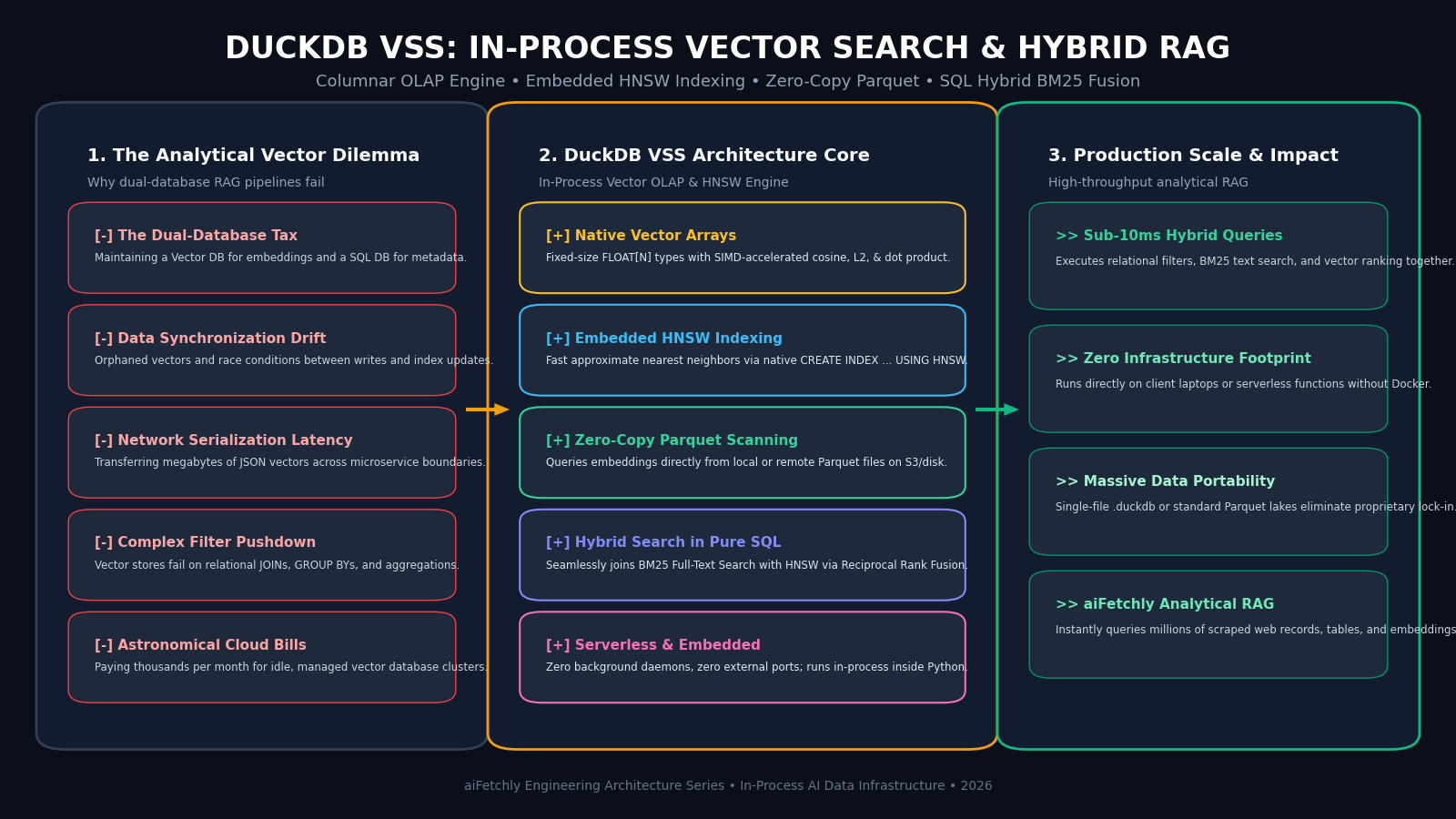
The Problem: The Fragmentation and Dual-Database Tax of Analytical RAG
In modern data intelligence platforms, automated web scraping workflows, and high-throughput analytical pipelines powered by AiFetchly, generative artificial intelligence is rarely limited to simple text question-answering. Enterprise systems increasingly execute Analytical RAG: querying millions of semi-structured web records, financial statements, customer feedback logs, and e-commerce catalogs.
In Analytical RAG, systems must perform both high-dimensional semantic search and deep relational analytics: filtering by timestamp ranges, aggregating metric sums across product categories, computing percentiles, and joining across multi-table foreign keys.
However, traditional AI data architectures approach this problem by separating data into two disjointed systems:
The Traditional Dual-Database RAG Bottleneck:
┌────────────────────────────────────────────────────────┐
│ Client App / AI Agent Orchestrator                     │
└──────────────┬──────────────────────────┬──────────────┘
               │ (Query 1: Vector Search) │ (Query 2: Metadata Join)
               ▼                          ▼
┌─────────────────────────────┐  ┌─────────────────────────────┐
│ Standalone Vector Database  │  │ Relational / OLAP Database  │
│ (Pinecone, Qdrant, Milvus)  │  │ (PostgreSQL, Snowflake)     │
│ • Stores IDs + Vector Floats│  │ • Stores Full Row Records   │
│ ❌ High Cloud Hosting Costs │  │ ❌ Network Serialization Lag│
│ ❌ Inflexible Metadata Filter│ │ ❌ Synchronization Drift    │
└─────────────────────────────┘  └─────────────────────────────┘
               │                          │
               └──────────────┬───────────┘
                              ▼
        ┌───────────────────────────────────────────┐
        │ Application Memory Client Join:           │
        │ ❌ In-memory intersection of ID sets      │
        │ ❌ Post-filtering eliminates top results  │
        │ ❌ High network bandwidth consumption     │
└───────────────────────────────────────────┘ 1. The Dual-Database Architectural Tax
When engineering teams separate vectors from structured data, they incur an immense maintenance and financial penalty:
- Infrastructure Sprawl: Teams must deploy, monitor, and scale two independent database clusters—a dedicated vector database (e.g., Pinecone or Qdrant) alongside a relational analytical warehouse (e.g., PostgreSQL, ClickHouse, or Snowflake).
- Network Serialization Overhead: Performing a single user query requires executing an approximate nearest neighbor (ANN) search across the network, retrieving a list of IDs, serializing them into client memory, and issuing a secondary SQL
WHERE id IN (...)query to fetch the underlying business records.
2. Synchronization Lag and Orphaned Embeddings
Maintaining data parity between two distinct storage engines creates acute consistency failures:
- Dual-Write Anomalies: If an application writes updated product metadata to the analytical warehouse but the background vector ingestion worker fails or experiences backpressure, the two stores drift apart.
- Orphaned Vectors: When records are deleted or archived in the primary analytical database, vector indices frequently retain outdated embeddings, causing agents to retrieve references to nonexistent or expired items.
3. The Collapse of Relational Filter Pushdown in Pure Vector DBs
Standalone vector databases were architected around graph algorithms (such as HNSW) rather than relational algebra:
- Pre-Filtering vs. Post-Filtering Dilemma: If an agent queries for products matching “durable outdoor boots” but restricts the search to items “with inventory > 50, released in Q3, in region ‘EU’”, pure vector stores must choose between:
- Post-filtering: Retrieving the top 100 nearest vectors and filtering out non-matching rows (which frequently leaves zero valid results if the filter is selective).
- Pre-filtering: Filtering candidates before traversing the HNSW graph, which degrades index traversal and slows query latency by orders of magnitude.
- Missing Aggregations: Standalone vector databases cannot compute relational aggregations (
GROUP BY,SUM,AVG,WINDOWfunctions) directly on the retrieved vector partitions.
To eliminate this architectural fragmentation, the database community created DuckDB VSS: an official in-process extension that brings native HNSW vector search directly into DuckDB’s vectorized columnar OLAP engine.
The Solution: DuckDB VSS Architecture, In-Process HNSW & Columnar OLAP
DuckDB is widely recognized as the “SQLite for Analytics”—a lightweight, zero-dependency, in-process columnar database that runs inside Python, Node.js, Rust, Go, or standalone binaries. With the introduction of the official VSS (Vector Similarity Search) extension, DuckDB combines analytical SQL execution with hardware-accelerated vector retrieval.
DuckDB VSS Unified In-Process Architecture:
┌─────────────────────────────────────────────────────────────────┐
│ Host Process: Python / Node.js / CLI (Zero External Daemons)    │
└─────────────────────────────────────────────────────────────────┘
                               │ (Direct In-Memory C API)
                               ▼
┌─────────────────────────────────────────────────────────────────┐
│ DuckDB Vectorized Columnar Engine                               │
│ • Pushdown Predicate Optimization & SIMD-Vectorized Execution   │
│ • Native FLOAT[N] Vector Types & Array Distance Operators       │
│ • Full-Text Search (FTS) Extension with BM25 Scoring Engine    │
│ • Integrated JSON, Spatial, and Remote HTTP/S3 Connectors       │
└──────────────────────────────┬──────────────────────────────────┘
                               │
        ┌──────────────────────┼──────────────────────┐
        ▼                      ▼                      ▼
┌───────────────┐      ┌───────────────┐      ┌───────────────┐
│ Embedded HNSW │      │ Zero-Copy     │      │ Unified SQL   │
│ Graph Index   │      │ Parquet Lake  │      │ Hybrid RAG    │
│ • Sub-10ms ANN│      │ • Scan S3/disk│      │ • HNSW + BM25 │
│ • In-place updates   │ • No ETL step │      │ • RRF Fusion  │
└───────────────┘ └───────────────┘ └───────────────┘ 1. Native Fixed-Size Vector Data Types and SIMD Distance Metrics
DuckDB VSS introduces native fixed-length array types (FLOAT[d]) optimized for embedding representations:
- Memory Layout: High-dimensional vectors are stored contiguously in columnar memory blocks without object serialization overhead.
- Hardware Acceleration: Vector similarity functions are compiled with SIMD instructions (AVX2, AVX-512, and ARM NEON):
array_cosine_distance(v1, v2): Computes normalized angular distance ($1 - \cos(\theta)$).array_distance(v1, v2): Computes Euclidean (L2) distance.array_inner_product(v1, v2): Computes high-speed dot products for pre-normalized unit vectors.
2. Embedded HNSW Vector Graph Indexing
For datasets scaling from thousands to millions of embeddings, sequential scanning becomes compute-bound. DuckDB VSS incorporates an embedded HNSW (Hierarchical Navigable Small World) indexing engine:
- SQL Index Creation: Developers define persistent vector indices using standard DDL syntax:
CREATE INDEX doc_hnsw_idx ON documents USING HNSW (embedding) WITH (metric = 'cosine'); - Dual Query Optimization: When executing a vector query with relational filters (
WHERE category = 'finance' AND date >= '2026-01-01'), DuckDB’s cost-based query optimizer analyzes index statistics to decide whether to traverse the HNSW index or execute vectorized SIMD scans across filtered column chunks.
3. Zero-Copy Parquet and Object Storage Direct Scanning
One of DuckDB’s greatest superpowers is its ability to query external data files directly without an ingestion ETL step:
- Direct Parquet Execution: DuckDB can scan remote Apache Parquet files hosted on AWS S3, Google Cloud Storage, or local disk, read vector columns, evaluate cosine distance, and return top-$k$ matches in milliseconds.
- Zero Duplication: Rather than duplicating gigabytes of embeddings from your data lake into a proprietary vector database, your Parquet lake is your vector database.
4. Unified Hybrid Retrieval: FTS (BM25) and HNSW via Reciprocal Rank Fusion
Production RAG systems require hybrid search—combining lexical keyword matching (for exact part numbers, product names, and acronyms) with dense semantic vector retrieval (for conceptual meaning).
DuckDB solves this natively in pure SQL by pairing the FTS (Full-Text Search) extension with VSS:
- Text columns are indexed with BM25 scoring.
- Dense embeddings are indexed with HNSW cosine distance.
- Both result sets are joined in a single SQL query using Reciprocal Rank Fusion (RRF): $$\text{RRF Score} = \frac{1}{60 + \text{Rank}{\text{dense}}} + \frac{1}{60 + \text{Rank}{\text{bm25}}}$$
5. In-Process Serverless Simplicity and Zero Operational Overhead
Unlike client-server databases, DuckDB operates directly inside the application’s process space:
- No Background Server: Zero Docker daemons, zero network ports, and zero background services to manage.
- Portability: The entire state can be saved as a single self-contained
.duckdbfile or discarded as an in-memory session (duckdb.connect(':memory:')), making it ideal for desktop applications, CLI utilities, and serverless AWS Lambda / Cloudflare Workers.
Architectural Comparison: DuckDB VSS vs. sqlite-vec vs. pgvector vs. Standalone Vector DBs (Pinecone/Qdrant)
The table below contrasts DuckDB VSS with leading alternative vector storage architectures:
| Architectural Metric | Standalone Vector DB (Pinecone / Qdrant) | pgvector (PostgreSQL) | sqlite-vec | DuckDB VSS |
|---|---|---|---|---|
| Execution Architecture | Distributed Client-Server | Client-Server RDBMS | In-Process Embedded (C) | In-Process Columnar OLAP |
| Primary Workload | High-Concurrency Real-Time | Transactional OLTP | Client-Side SQLite Apps | Analytical OLAP & Batch RAG |
| Direct Parquet Scanning | No (Requires Ingestion ETL) | No (Foreign Data Wrapper) | No | Native Zero-Copy Parquet & S3 |
| Vector Index Type | Proprietary HNSW / IVF | HNSW & IVFFlat | In-Memory Flat Brute-Force | Embedded Columnar HNSW |
| Relational Analytics | Extremely Limited / None | Strong (Row-Oriented) | Basic (Row-Oriented) | State-of-the-Art Columnar SQL |
| Hybrid Search (BM25) | Built-in or Secondary Index | Extension (pg_trgm/pg_search) | FTS5 Extension | Native FTS Extension + SQL RRF |
| Deployment Footprint | Managed Cloud or Docker | Heavy PostgreSQL Cluster | Zero-Dependency Single File | Zero-Dependency In-Process Engine |
| Infrastructure Cost | $100s–$1,000s/mo | Shared Database Server | Free / Open Source | 100% Free / In-Memory & Local |
Hands-On Implementation: Building an In-Process Hybrid RAG Pipeline in DuckDB
Below is a complete, production-grade Python walkthrough demonstrating how to install DuckDB, load the VSS and FTS extensions, ingest document vectors, build an HNSW index, and execute a pure SQL hybrid search query with Reciprocal Rank Fusion.
Step 1: Install DuckDB and Load the VSS and FTS Extensions
Install DuckDB using pip:
pip install duckdb sentence-transformers Initialize an in-process DuckDB database, install the community extensions, and configure your session:
import duckdb

# Connect to a local persistent database file (or use ':memory:')
con = duckdb.connect(database="enterprise_rag.duckdb")

# Install and load the official Vector Similarity Search (VSS) and Full-Text Search (FTS) extensions
con.execute("INSTALL vss;")
con.execute("LOAD vss;")

con.execute("INSTALL fts;")
con.execute("LOAD fts;")

# Verify extension loading
extensions = con.execute("SELECT extension_name, installed, loaded FROM duckdb_extensions() WHERE extension_name IN ('vss', 'fts');").fetchall()
print("Loaded Extensions:", extensions) Step 2: Ingest Multi-Modal Datasets and Build an HNSW Index
Create a structured documents table containing textual content, metadata attributes, and a 384-dimensional dense vector column:
from sentence_transformers import SentenceTransformer
import numpy as np

# Initialize a compact, high-speed embedding model
encoder = SentenceTransformer("all-MiniLM-L6-v2")

# Create structured table with FLOAT[384] array type
con.execute("""
CREATE TABLE IF NOT EXISTS knowledge_chunks (
    id VARCHAR PRIMARY KEY,
    document_title VARCHAR,
    content VARCHAR,
    category VARCHAR,
    page_number INTEGER,
    embedding FLOAT[384]
);
""")

# Sample business intelligence records
documents = [
    {
        "id": "doc_001",
        "title": "Cloud Infrastructure Q3 Financials",
        "content": "Operating expenses for enterprise cloud compute expanded by 24% year-over-year, reaching $4.2B due to GPU hardware acquisitions.",
        "category": "finance",
        "page_number": 4
    },
    {
        "id": "doc_002",
        "title": "Web Extraction Scraping Architecture",
        "content": "aiFetchly automated data extractors bypass bot-detection systems by rendering dynamic JavaScript SPAs using headless Playwright sessions.",
        "category": "engineering",
        "page_number": 12
    },
    {
        "id": "doc_003",
        "title": "Database Optimization Post-Mortem",
        "content": "Database latency spikes were resolved by implementing HNSW approximate vector indexes and columnar Parquet partitioning in analytical storage.",
        "category": "engineering",
        "page_number": 2
    }
]

# Generate embeddings and insert records
for doc in documents:
    vec = encoder.encode(doc["content"]).tolist()
    con.execute("""
        INSERT INTO knowledge_chunks (id, document_title, content, category, page_number, embedding)
        VALUES (?, ?, ?, ?, ?, ?);
    """, (doc["id"], doc["title"], doc["content"], doc["category"], doc["page_number"], vec))

print(f"Inserted {len(documents)} records into DuckDB.")

# Build HNSW vector index with cosine metric
con.execute("""
CREATE INDEX IF NOT EXISTS chunk_hnsw_idx
ON knowledge_chunks USING HNSW (embedding)
WITH (metric = 'cosine');
""")

# Build Full-Text Search index for BM25 keyword matching
con.execute("""
PRAGMA create_fts_index('knowledge_chunks', 'id', 'content', 'document_title');
""")
print("HNSW vector index and FTS BM25 index built successfully.") Step 3: Execute a Pure SQL Hybrid Search Query with Reciprocal Rank Fusion
Combine dense semantic vector search with lexical BM25 keyword retrieval using a single SQL query with Common Table Expressions (CTEs):
user_query = "How does automated web extraction handle JavaScript rendering?"
query_vector = encoder.encode(user_query).tolist()

hybrid_sql = """
WITH dense_search AS (
    SELECT
        id,
        document_title,
        content,
        category,
        array_cosine_distance(embedding, ?::FLOAT[384]) AS cosine_dist,
        ROW_NUMBER() OVER (ORDER BY array_cosine_distance(embedding, ?::FLOAT[384]) ASC) AS dense_rank
    FROM knowledge_chunks
    WHERE category = 'engineering' -- Relational filter pushdown
    LIMIT 10
),
bm25_search AS (
    SELECT
        k.id,
        k.document_title,
        k.content,
        k.category,
        score AS bm25_score,
        ROW_NUMBER() OVER (ORDER BY score DESC) AS bm25_rank
    FROM (
        SELECT *, fts_main_knowledge_chunks.match_bm25(id, ?) AS score
        FROM knowledge_chunks
    ) k
    WHERE k.score IS NOT NULL AND k.category = 'engineering'
    LIMIT 10
),
hybrid_candidates AS (
    SELECT id, document_title, content, category, dense_rank, NULL::BIGINT AS bm25_rank FROM dense_search
    UNION ALL
    SELECT id, document_title, content, category, NULL::BIGINT AS dense_rank, bm25_rank FROM bm25_search
)
SELECT
    id,
    document_title,
    content,
    category,
    -- Reciprocal Rank Fusion Formula (k=60)
    SUM(
        COALESCE(1.0 / (60 + dense_rank), 0.0) +
        COALESCE(1.0 / (60 + bm25_rank), 0.0)
    ) AS rrf_score
FROM hybrid_candidates
GROUP BY id, document_title, content, category
ORDER BY rrf_score DESC
LIMIT 5;
"""

# Execute hybrid search with parameters: [query_vec, query_vec, query_text]
results = con.execute(hybrid_sql, (query_vector, query_vector, user_query)).fetchall()

print("\n--- HYBRID SEARCH RESULTS (RRF SCORED) ---")
for row in results:
    doc_id, title, content, cat, rrf = row
    print(f"\n[Score: {rrf:.4f}] {title} ({cat})")
print(f"Content: {content}") Executing this query evaluates vector proximity and BM25 relevance concurrently, outputting the most accurate context chunk without leaving the local Python process.
Production Deployment with aiFetchly
In high-throughput automated web data collection, market research, and competitive intelligence pipelines engineered by AiFetchly, DuckDB VSS serves as the core embedded analytical engine for local vector workloads.
aiFetchly Data Extraction and DuckDB VSS Analytical Architecture:
┌─────────────────────────────────────────────────────────────────┐
│ 1. Autonomous Web Extraction Engine                             │
│ • aiFetchly crawls target domains, extracts structured catalogs │
│ • Normalizes data, generates clean Markdown, and computes vectors│
├─────────────────────────────────────────────────────────────────┤
│ 2. Direct Columnar Parquet Lake                                 │
│ • aiFetchly streams millions of records directly to Parquet      │
│ • Compressed Snappy storage with embedded FLOAT[384] columns     │
├─────────────────────────────────────────────────────────────────┤
│ 3. In-Process DuckDB VSS Analytics Engine                       │
│ • Analysts issue complex hybrid SQL queries across Parquet lakes│
│ • Aggregates metrics, joins external tables, and scores vectors │
├─────────────────────────────────────────────────────────────────┤
│ 4. Zero-Infrastructure Local Intelligence                       │
│ • No recurring cloud vector DB subscriptions                    │
│ • 100% private, sub-10ms response times on consumer hardware    │
└─────────────────────────────────────────────────────────────────┘ - Elimination of Vector Hosting Fees: By storing extracted web datasets in standard Parquet files and querying them via DuckDB VSS, enterprise operations teams process millions of vectors without spending thousands of dollars monthly on managed vector cloud services.
- Instant Complex Relational Filters: Analysts can query scraped e-commerce catalogs for semantically similar customer complaints while filtering by specific pricing tiers, discount percentages, and seller ratings in a single SQL operation.
- Air-Gapped Confidentiality: Because DuckDB VSS executes entirely in-process on local workstations, financial institutions and intelligence researchers analyze sensitive competitive web data without leaking confidential prompts or documents across external networks.
To discover how aiFetchly combines automated web extraction with high-performance embedded data architectures, explore our AiFetchly Documentation or review our AiFetchly Pricing.