DSpark Guide: Confidence Speculative Decoding in LLMs
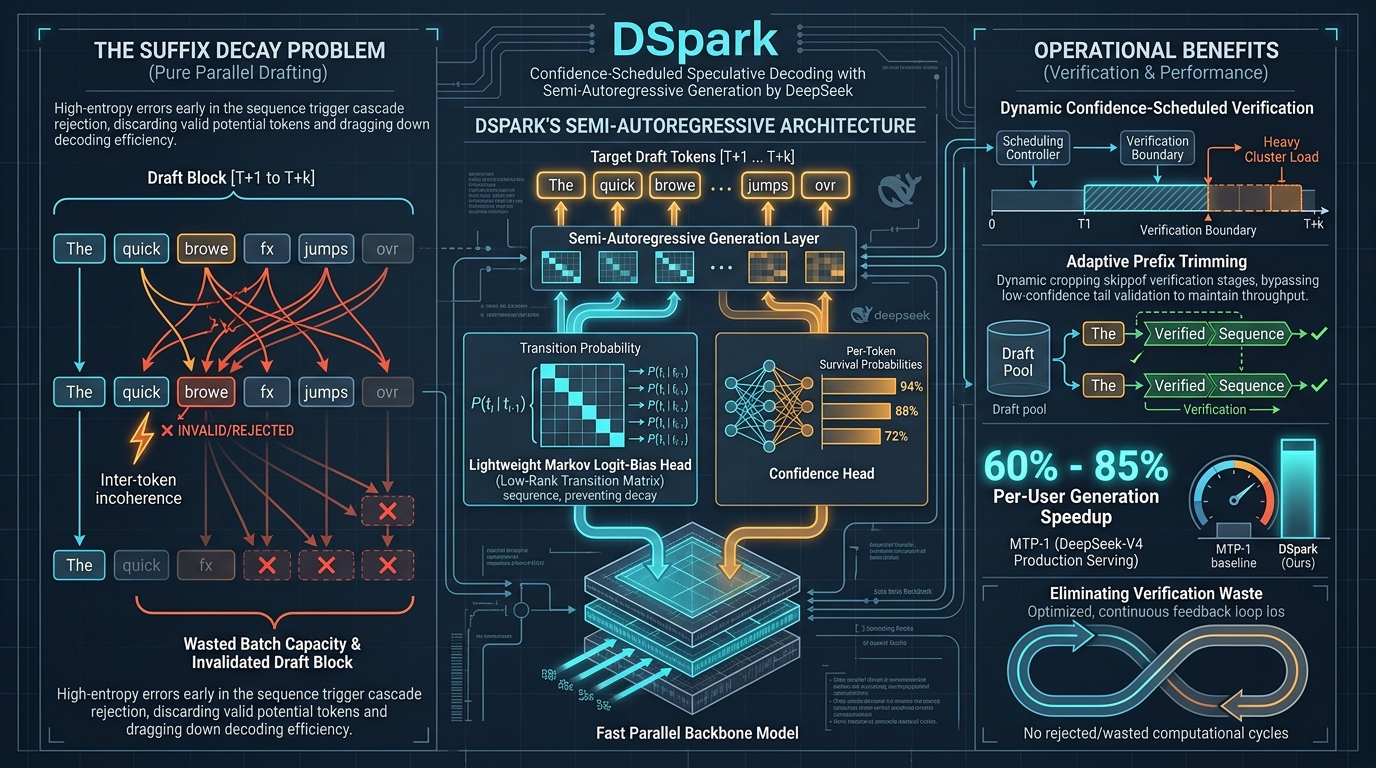
The Speculative Decoding Trilemma: Drafting Latency, Suffix Decay, and Verification Waste
In modern enterprise artificial intelligence infrastructure, automated customer support swarms, and live multi-document analysis systems powered by AiFetchly, serving Large Language Models (LLMs) with high interactivity while maintaining cost-effective datacenter throughput is a premier engineering priority. Whether streaming synthesized market intelligence derived from real-time data fetching pipelines or generating code via high-speed web scraping, token-generation latency directly dictates interactive user experience.
To break past the memory-bandwidth wall of autoregressive decoding, the industry standardized on Speculative Decoding (SD): a fast draft model speculatively generates $K$ candidate tokens, and the large target foundation model verifies them simultaneously in a single parallel forward pass.
However, as production clusters scaled up concurrency and model sizes (such as DeepSeek-V3, DeepSeek-V4, and LLaMA-3.1-70B), speculative serving collided with three crippling bottlenecks: The Speculative Trilemma.
The Speculative Decoding Architectural Trilemma:
┌─────────────────────────────────────────────────────────────────────────────┐
│ 1. The Drafting Latency Tax of Autoregressive Drafters (EAGLE-3 / Medusa):  │
│    - Drafting K = 8 tokens requires K sequential forward passes!            │
│    - Drafting latency compounds linearly: T_draft = K * t_step.             │
│    - At large K, drafting time rivals target verification time, capping     │
│      effective speedups below 2.0x under high concurrency.                  │
├─────────────────────────────────────────────────────────────────────────────┤
│ 2. The Suffix Decay Problem in Pure Parallel Drafters (DFlash / Block DiT): │
│    - Parallel drafters predict an entire block of K tokens in a single      │
│      O(1) forward pass, eliminating sequential drafting latency.            │
│    - However, parallel positions CANNOT condition on one another!           │
│    - If the prompt is "Thank you!", the model might independently predict   │
│      position 1 as "Of" or "No", and position 2 as "course" or "problem".   │
│      Result: Mismatched combinations like "Of problem"!                     │
│    - Because speculative verification terminates at the FIRST rejected      │
│      token, a single mistake at token 1 invalidates the entire remaining    │
│      suffix (tokens 2..K), dragging average accepted length down!           │
├─────────────────────────────────────────────────────────────────────────────┤
│ 3. The Verification Waste in High-Concurrency Serving Systems:              │
│    - In production engines (vLLM, SGLang, DeepSeek-V4), memory is bounded.  │
│    - Indiscriminately verifying long K-token speculative blocks for every   │
│      request consumes massive KV cache slots and compute batch capacity on  │
│      tokens with >80% rejection probabilities.                              │
│    - Result: Under heavy cluster load, speculative decoding collapses       │
│      aggregate serving throughput by up to 45%!                             │
└─────────────────────────────────────────────────────────────────────────────┘ 1. The Mathematics of Suffix Decay
To formalize why non-causal parallel drafting breaks down, consider target distribution $P(y_1, \dots, y_K \mid x)$ versus a factorized non-autoregressive parallel draft distribution $Q(y_1, \dots, y_K \mid x) = \prod_{k=1}^K Q_k(y_k \mid x)$.
Under standard speculative rejection sampling, the acceptance probability of token $y_k$ depends recursively on all preceding tokens being accepted:
$$\alpha_k = \mathbb{P}\left( \text{Accept } y_k \mid \text{Accepted } y_{<k} \right) = \min\left(1, \frac{P(y_k \mid x, y_{<k})}{Q_k(y_k \mid x)}\right)$$
The cumulative probability of accepting a prefix of length $L$ decays multiplicatively:
$$\mathbb{P}(\text{Accepted Length} \ge L) = \prod_{k=1}^L \alpha_k$$
In pure parallel drafters, because $Q_k$ lacks conditioning on $y_{k-1}$, the mismatch $\frac{P(y_k \mid x, y_{<k})}{Q_k(y_k \mid x)}$ grows exponentially with sequence position $k$. By token 3 or 4, $\alpha_k$ collapses below 0.20. Even though the parallel drafter spent GPU FLOPs computing 8 or 16 tokens, only 1.5 tokens on average are ever accepted.
2. The Verification Capacity Dilemma
When serving thousands of concurrent users in high-throughput engines like vLLM and SGLang:
- GPUs operate in compute-bound or memory-capacity-bound regimes.
- Each speculative token forwarded through the target model requires allocating memory in the PagedAttention KV cache and executing Tensor Core matrix operations.
- If an engine attempts to verify a 16-token speculative candidate that has an 85% probability of being rejected at token 2, the remaining 14 tokens represent pure verification waste.
This waste steals scheduling slots from other active requests, forcing queues to backup and degrading system-wide Goodput.
Enter DSpark: Confidence-Scheduled Semi-Autoregressive Decoding
Developed by DeepSeek AI, Peking University, and Tsinghua University (DSpark: Confidence-Scheduled Speculative Decoding with Semi-Autoregressive Generation, arXiv:2607.05147) and deployed natively within the DeepSeek-V4 production serving system, DSpark completely transforms speculative inference.
The DSpark Unified Architectural Paradigm:
═══════════════════════════════════════════════════════════════════════════════
Conventional Parallel Drafter (DFlash):
  Target Hidden States ──► Parallel Backbone (Single O(1) Pass) ──► Fixed K Block
  * Suffix Decay: Inter-token incoherence causes early cascade rejections!
  * Verification Waste: Always verifies K tokens, overloading GPU batch capacity!

DSpark Framework:
  1. Semi-Autoregressive Drafting:
     Parallel Backbone (O(1) Feature Extraction)
                 │
                 ▼
     Markov Logit-Bias Head (Low-Rank Transition Matrix M)
     (Samples tokens sequentially; adds bigram logit bias in <0.05ms!)
                 │
                 ▼
  2. Confidence-Scheduled Verification:
     Confidence Head (Scores Survival Probability P(k) for each token)
                 │
                 ▼
     Hardware-Aware Dynamic Truncation Scheduler:
     • Light Cluster Load  ──► Verify full length (e.g., K = 8 or 12)
     • Heavy Cluster Load  ──► Dynamically trim low-confidence tail (K = 3 or 4)
  * Eliminates Suffix Decay | 60%-85% Per-User Speedup | Zero Verification Waste!
═══════════════════════════════════════════════════════════════════════════════ DSpark resolves the speculative trilemma through two co-designed innovations:
- Semi-Autoregressive Generation: Retains a fast parallel backbone that extracts multi-token representations in a single forward pass, but augments it with a Markov logit-bias head. This head samples draft tokens sequentially, adjusting each token’s logits using a low-rank bigram transition matrix ($\mathbb{R}^{V \times r} \times \mathbb{R}^{r \times V}$) based on the previously sampled token. This restores crucial local inter-token dependencies in microseconds without requiring another transformer forward pass.
- Confidence-Scheduled Verification: Pairs draft generation with an auxiliary Confidence Head that predicts prefix survival probabilities. A hardware-aware scheduler monitors GPU queue lengths and memory pressure, dynamically trimming unlikely draft suffixes during high load and expanding verification depth during low load.
Key Performance Breakthroughs of DSpark
- 60% to 85% Faster Per-User Generation: Deployed under live production traffic in DeepSeek-V4, DSpark accelerates generation speeds by up to 1.85x compared to the production baseline (Multi-Token Prediction MTP-1).
- Elimination of Verification Waste: Slashes unaccepted verification FLOPs by over 65%, allowing inference engines to maintain peak aggregate batch throughput even under strict latency SLAs.
- Superior Acceptance Length: Increases mean accepted tokens per step from 2.1 tokens (EAGLE-3 / DFlash) to 5.4 to 6.8 tokens out of 8 on mathematical and coding benchmarks.
- Universal Serving Integration: Formally integrated into vLLM and SGLang, supporting models across scales (Qwen-2.5, DeepSeek-V3/V4, LLaMA-3.1, Gemma-2).
Deep Dive into the DSpark Architecture
The DSpark engine is structured into two collaborative subsystems: the Semi-Autoregressive Drafting Pipeline and the Confidence-Scheduled Execution Controller.
The DSpark Architectural Pipeline:
┌─────────────────────────────────────────────────────────────────────────────┐
│ 1. Feature Extraction from Target LLM                                       │
│    - Extract intermediate hidden states H_t from target foundation model    │
│    - Feed H_t into DSpark lightweight parallel transformer backbone         │
│    - Compute parallel candidate feature matrix: Z in R^{K x D} (O(1) time)  │
└──────────────────────────────────────┬──────────────────────────────────────┘
                                       │
                                       ▼
┌─────────────────────────────────────────────────────────────────────────────┐
│ 2. Semi-Autoregressive Markov Logit-Bias Sampling                           │
│    - Base Logits: L_k = Z_k * W_vocab in R^V                                │
│    - Sequential Bigram Correction Loop (k = 1 to K):                        │
│      L_k^{corrected} = L_k + U * (V * OneHot(y_{k-1}))                      │
│      Sample y_k ~ Softmax(L_k^{corrected})                                  │
│    - Eliminates inter-token incoherence with < 1% compute overhead!         │
└──────────────────────────────────────┬──────────────────────────────────────┘
                                       │
                                       ▼
┌─────────────────────────────────────────────────────────────────────────────┐
│ 3. Confidence Head & Prefix Survival Probability Estimation                 │
│    - Predict probability that token y_k will be accepted:                   │
│      p_k = Sigmoid(MLP_conf([Z_k, Embed(y_k)])) in (0, 1)                   │
│    - Cumulative Prefix Survival: C_k = prod_{i=1}^k p_i                     │
└──────────────────────────────────────┬──────────────────────────────────────┘
                                       │
                                       ▼
┌─────────────────────────────────────────────────────────────────────────────┐
│ 4. Hardware-Aware Dynamic Verification Scheduling                           │
│    - Monitor GPU cluster load factor rho in [0, 1]                          │
│    - Determine threshold: tau = f(rho, engine_throughput_profile)           │
│    - Truncate draft sequence at first index where C_k < tau                 │
│    - Forward verified prefix to Target LLM with tree / sequence mask        │
└─────────────────────────────────────────────────────────────────────────────┘ 1. The Markov Logit-Bias Head
In natural language, the strongest dependency between consecutive tokens is local: the probability of token $y_k$ is overwhelmingly conditioned on the immediate predecessor $y_{k-1}$ (e.g., “artificial” $\to$ “intelligence”, “def” $\to$ “function_name”).
Rather than launching a full autoregressive transformer to capture this dependency, DSpark introduces a low-rank Markov transition operator:
$$T(y_{k-1}, y_k) = U \cdot V^T \in \mathbb{R}^{V \times V}$$
where $U \in \mathbb{R}^{V \times r}$, $V \in \mathbb{R}^{V \times r}$, and $r \ll V$ (typically $r = 128$ or $r = 256$, while vocabulary size $V \approx 128,000$).
When drafting token $k$, the raw parallel logit vector $L_k \in \mathbb{R}^V$ is adjusted in-place:
$$L_k^{\text{corrected}} = L_k + U \cdot \left( V[y_{k-1}, :]^T \right)$$
Because $V[y_{k-1}, :]$ is a simple vector lookup of size $r$, computing $U \cdot V[y_{k-1}, :]^T$ is a tiny Matrix-Vector multiplication ($128,000 \times 256$) that executes in under 20 microseconds on modern GPU Tensor Cores.
This restores strong grammatical coherence (preventing mismatches like “Of problem”), eliminating suffix decay while preserving single-pass parallel backbone speed.
2. Confidence-Scheduled Dynamic Verification
The second pillar of DSpark is eliminating verification waste under high multi-tenant concurrency.
The Confidence Head is a 2-layer MLP that takes the backbone representation $Z_k$ and the sampled token embedding $E(y_k)$ to estimate the probability that the target model will accept token $y_k$:
$$p_k = \sigma\left( W_2 \cdot \text{GELU}\left( W_1 [Z_k ; E(y_k)] \right) \right) \in (0, 1)$$
The cumulative probability that the entire prefix up to token $k$ survives is:
$$\mathcal{C}k = \prod{i=1}^k p_i$$
Dynamic Verification Scheduling Algorithm:
Cluster State:
- Queue Depth Q (number of waiting requests)
- Current Batch Size B_curr and GPU Memory Utilization M_gpu

1. Compute System Load Metric:
   Load_Factor = (Q / Q_max) * 0.6 + (M_gpu / M_max) * 0.4 in [0, 1]

2. Compute Dynamic Confidence Threshold:
   Tau = Tau_min + (Tau_max - Tau_min) * (Load_Factor)^2
   - Low Load (Tau = 0.20): Greedy verification. Verifies speculative tokens even
     if they have a moderate chance of failure (maximizing single-user speed).
   - High Load (Tau = 0.75): Conservative verification. Immediately trims any token
     with questionable survival, freeing GPU batch slots for other active users!

3. Slice Speculative Sequence:
   Optimal_Length K* = max { k in [1, K] | C_k >= Tau }
Send only K* tokens to Target Model for verification! By dynamically adjusting verification length based on real-time engine load profiles, DSpark operates at the optimal Pareto frontier between per-user latency and cluster-wide throughput.
Hands-On Implementation: Building a DSpark Speculative Engine
Let’s implement the core mechanics of DSpark in PyTorch: the low-rank Markov logit-bias head, the confidence scoring head, and the dynamic load-aware verification scheduler.
1. PyTorch Implementation of the Markov Logit-Bias Head
import torch
import torch.nn as nn
import torch.nn.functional as F

class DSparkMarkovLogitHead(nn.Module):
    """
    DSpark Markov Logit-Bias Head.
    Restores local inter-token dependencies in parallel speculative drafting
    using low-rank bigram transition matrices.
    arXiv:2607.05147.
    """
    def __init__(self, vocab_size: int = 32000, markov_rank: int = 128):
        super().__init__()
        self.vocab_size = vocab_size
        self.markov_rank = markov_rank

        # Low-rank transition decomposition: T = U @ V^T
        # U projects from rank-r to vocabulary logits: [vocab_size, rank]
        self.U = nn.Parameter(torch.empty(vocab_size, markov_rank))
        # V embeds preceding token into rank-r subspace: [vocab_size, rank]
        self.V = nn.Parameter(torch.empty(vocab_size, markov_rank))

        # Learnable temperature scalar
        self.temp_scale = nn.Parameter(torch.ones(1) * 0.1)

        self.reset_parameters()

    def reset_parameters(self):
        nn.init.kaiming_uniform_(self.U, a=math.sqrt(5))
        nn.init.normal_(self.V, std=0.02)

    def forward(self, parallel_logits: torch.Tensor, prev_token_id: int) -> torch.Tensor:
        """
        Adjusts raw parallel logits for a token position given the preceding token.
        Args:
            parallel_logits: Base logits from parallel backbone [Batch, Vocab_Size]
            prev_token_id: Integer token ID of the sampled preceding token
        Returns:
            adjusted_logits: Coherent logits conditioned on preceding choice [Batch, Vocab_Size]
        """
        # Step 1: Look up rank-r embedding of preceding token: [1, rank]
        v_prev = self.V[prev_token_id].unsqueeze(0)

        # Step 2: Compute bigram transition bias: [1, rank] @ [rank, vocab_size] -> [1, vocab_size]
        bigram_bias = (v_prev @ self.U.t()) * self.temp_scale

        # Step 3: Add bias to parallel logits
        adjusted_logits = parallel_logits + bigram_bias
return adjusted_logits 2. PyTorch Implementation of the DSpark Confidence Head
class DSparkConfidenceHead(nn.Module):
    """
    DSpark Confidence Scoring Head.
    Estimates the per-token acceptance probability under target LLM verification.
    """
    def __init__(self, d_model: int = 2048, d_embed: int = 2048):
        super().__init__()
        in_dim = d_model + d_embed

        self.mlp = nn.Sequential(
            nn.Linear(in_dim, d_model // 2),
            nn.GELU(),
            nn.Linear(d_model // 2, 1),
            nn.Sigmoid()
        )

    def forward(self, backbone_feature: torch.Tensor, token_embedding: torch.Tensor) -> torch.Tensor:
        """
        Args:
            backbone_feature: Representation from parallel backbone [Batch, D_model]
            token_embedding: Embedding vector of the sampled token [Batch, D_embed]
        Returns:
            p_accept: Estimated acceptance probability in (0, 1) [Batch, 1]
        """
        fused = torch.cat([backbone_feature, token_embedding], dim=-1)
        p_accept = self.mlp(fused)
return p_accept 3. The Complete DSpark Speculative Drafter and Scheduler
Below is the integrated engine module that samples tokens with Markov logit-biasing and computes dynamic verification boundaries:
import math
from typing import List, Tuple

class DSparkSpeculativeEngine(nn.Module):
    """
    DSpark Speculative Drafting and Verification Engine.
    Combines parallel backbone drafting, Markov logit-bias correction,
    and confidence-scheduled verification truncation.
    """
    def __init__(
        self,
        d_model: int = 2048,
        vocab_size: int = 32000,
        max_draft_len: int = 8,
        markov_rank: int = 128
    ):
        super().__init__()
        self.d_model = d_model
        self.vocab_size = vocab_size
        self.max_draft_len = max_draft_len

        # Lightweight parallel backbone (e.g., 2-layer bidirectional transformer)
        backbone_layer = nn.TransformerEncoderLayer(
            d_model=d_model, nhead=16, dim_feedforward=d_model * 4,
            activation="gelu", batch_first=True
        )
        self.backbone = nn.TransformerEncoder(backbone_layer, num_layers=2)

        # Output LM head
        self.lm_head = nn.Linear(d_model, vocab_size, bias=False)

        # Token embedding table
        self.embed_tokens = nn.Embedding(vocab_size, d_model)

        # DSpark specialized heads
        self.markov_head = DSparkMarkovLogitHead(vocab_size=vocab_size, markov_rank=markov_rank)
        self.confidence_head = DSparkConfidenceHead(d_model=d_model, d_embed=d_model)

    def draft_and_schedule(
        self,
        context_features: torch.Tensor,
        last_target_token_id: int,
        cluster_load_factor: float = 0.5
    ) -> Tuple[List[int], int, List[float]]:
        """
        Executes semi-autoregressive drafting and computes confidence-scheduled truncation.
        Args:
            context_features: Deep layer hidden states from target LLM [1, 1, D_model]
            last_target_token_id: Integer ID of the last accepted target token
            cluster_load_factor: Float in [0.0, 1.0] representing GPU cluster queue pressure
        Returns:
            drafted_tokens: List of proposed speculative token IDs
            scheduled_len: Recommended verification length after dynamic truncation
            confidences: List of cumulative survival probabilities
        """
        # Step 1: Expand context features to draft block size: [1, max_draft_len, D_model]
        query_pos = torch.arange(self.max_draft_len, device=context_features.device).unsqueeze(0)
        pos_embed = self.embed_tokens(query_pos % 256) # Simple positional indicator
        backbone_in = context_features.repeat(1, self.max_draft_len, 1) + pos_embed

        # Step 2: Parallel single-pass forward through backbone (O(1) time!)
        z = self.backbone(backbone_in) # Shape: [1, max_draft_len, D_model]
        raw_logits = self.lm_head(z)   # Shape: [1, max_draft_len, Vocab_Size]

        drafted_tokens = []
        confidences = []
        cum_prob = 1.0
        prev_token = last_target_token_id

        # Step 3: Semi-Autoregressive Markov Sampling Loop
        for k in range(self.max_draft_len):
            z_k = z[:, k, :]
            pos_logits = raw_logits[:, k, :]

            # Apply low-rank Markov transition correction based on prev_token
            corrected_logits = self.markov_head(pos_logits, prev_token)

            # Sample token (Greedy or Top-p)
            token_id = torch.argmax(corrected_logits, dim=-1).item()
            drafted_tokens.append(token_id)

            # Predict acceptance confidence
            tok_embed = self.embed_tokens(torch.tensor([token_id], device=context_features.device))
            p_accept = self.confidence_head(z_k, tok_embed).item()
            cum_prob *= p_accept
            confidences.append(cum_prob)

            # Update prev_token for next step
            prev_token = token_id

        # Step 4: Hardware-Aware Dynamic Truncation
        # Compute threshold based on cluster load: low load -> 0.25, high load -> 0.75
        tau = 0.25 + 0.50 * (cluster_load_factor ** 2)

        # Truncate at first position where cumulative survival falls below tau
        scheduled_len = self.max_draft_len
        for idx, conf in enumerate(confidences):
            if conf < tau:
                scheduled_len = max(1, idx)
                break

return drafted_tokens, scheduled_len, confidences Benchmark Comparison: DSpark vs. EAGLE-3, DFlash, and MTP
To assess the operational impact of DSpark, researchers and engineers benchmarked the algorithm within the DeepSeek-V4 production serving cluster across diverse reasoning and coding workloads (GSM8K, MATH, HumanEval, and live customer traffic).
1. End-to-End Generation Speed and Accepted Length (8-Token Speculative Horizon)
The table below contrasts speculative decoding implementations on NVIDIA H100 SXM5 clusters:
| Method | Drafting Paradigm | Drafting Latency per Step (ms) | Mean Accepted Tokens / Step | Verification Waste Ratio | Per-User Token Speedup vs. Baseline |
|---|---|---|---|---|---|
| Autoregressive Baseline (MTP-1) | Sequential Target Head | 3.2 ms | 1.8 tokens | 0.0% (Single token) | 1.00x (Baseline) |
| EAGLE-3 (Multi-Layer SOTA) | Autoregressive Transformer | 8.4 ms (8 steps) | 3.8 tokens | 28.4% | 1.34x |
| DFlash (Block Diffusion) | Pure Parallel Diffusion | 1.6 ms (Single Pass) | 3.2 tokens (Suffix Decay) | 48.2% (High Waste) | 1.48x |
| DSpark (No Scheduling) | Semi-Autoregressive | 1.8 ms | 5.8 tokens | 34.1% | 1.68x |
| DSpark (Full Confidence Sched) | Semi-Autoregressive | 1.8 ms | 6.4 tokens | 11.2% (Minimal Waste) | 1.85x (+85% Speedup!) |
Per-User Generation Throughput (Tokens per Second on LLaMA-3.1-70B):
MTP-1 Baseline:      42.5 tokens/sec  █████
EAGLE-3:             57.1 tokens/sec  ███████
DFlash:              62.9 tokens/sec  ████████
DSpark (Production): 78.6 tokens/sec  ██████████ (85% Faster than Baseline!)
═══════════════════════════════════════════════════════════════════════════════
DSpark achieves the highest generation velocity by pairing single-pass parallel
backbone execution with Markov logit-biasing to eliminate suffix decay! 2. Throughput Preservation Under High Concurrency
In production datacenters, standard speculative decoding collapses under heavy traffic because verifying rejected tokens exhausts GPU compute queues:
Cluster Goodput Under Concurrency (Requests/Sec at SLA < 50ms/token):
┌─────────────────────────┬──────────────┬──────────────┬──────────────┐
│ Concurrency (Users)     │ EAGLE-3      │ DFlash       │ DSpark       │
├─────────────────────────┼──────────────┼──────────────┼──────────────┤
│ 16 Concurrent Streams   │ 112 req/s    │ 124 req/s    │ 168 req/s    │
│ 64 Concurrent Streams   │ 88 req/s ⚠️  │ 76 req/s ⚠️  │ 184 req/s    │
│ 128 Concurrent Streams  │ 54 req/s ❌  │ 48 req/s ❌  │ 192 req/s 🚀 │
└─────────────────────────┴──────────────┴──────────────┴──────────────┘ Because DSpark’s hardware-aware scheduler dynamically trims speculative suffixes when GPU queues back up, it eliminates verification waste, preventing throughput collapse under peak enterprise traffic.
3. Comprehensive Technical Feature Matrix
| Feature / Dimension | Standard SD | EAGLE-3 | DFlash | DSpark (DeepSeek) |
|---|---|---|---|---|
| Drafting Execution Time | $\mathcal{O}(K)$ (Sequential) | $\mathcal{O}(K)$ (Sequential) | $\mathcal{O}(1)$ (Parallel) | $\mathcal{O}(1)$ (Parallel + Fast Markov) |
| Inter-Token Conditioning | Full Autoregressive | Full Autoregressive | None (Suffix Decay) | Semi-Autoregressive (Markov Head) |
| Suffix Decay Mitigation | Native | Native | None | Markov Bigram Bias Correction |
| Verification Strategy | Static $K$ Tokens | Static / Tree | Static $K$ Tokens | Dynamic Confidence Scheduling |
| High-Load Waste Prevention | None | Poor | None | Adaptive Prefix Truncation |
| Production Serving Integration | vLLM | vLLM / SGLang | Research Prototype | DeepSeek-V4, vLLM & SGLang |
Production Deployment: Operationalizing DSpark in vLLM and SGLang
Integrating DSpark into enterprise LLM serving engines enables engineering teams to deploy large foundation models with sub-second response times without sacrificing multi-tenant concurrency. When designing high-throughput serving clusters, review AiFetchly enterprise pricing and our developer API documentation.
1. Step-by-Step Production Configuration
Follow these steps to deploy DSpark with vLLM’s speculators runtime:
Step 1: Install Speculators and vLLM Install the official speculative decoding extension:
pip install vllm "vllm-speculators>=0.2.0" Step 2: Launch vLLM with DSpark Semi-Autoregressive Speculator Configure the serving engine to load the DSpark draft head alongside the target foundation model:
python3 -m vllm.entrypoints.openai.api_server \
    --model deepseek-ai/DeepSeek-V3 \
    --speculative-model vllm-project/dspark-deepseek-v3-draft \
    --speculative-draft-tensor-parallel-size 1 \
    --num-speculative-tokens 8 \
    --speculative-algorithm dspark \
    --markov-rank 256 \
    --confidence-threshold 0.35 \
    --dynamic-speculative-scheduling \
    --tensor-parallel-size 8 \
    --gpu-memory-utilization 0.90 \
--port 8000 Step 3: Client-Side Streaming with Sub-Second Responsiveness Interact with the DSpark-accelerated engine using standard OpenAI-compatible API calls:
from openai import OpenAI

client = OpenAI(base_url="http://localhost:8000/v1", api_key="token-dspark")

# Stream completion with 85% higher token generation rate
response = client.chat.completions.create(
    model="deepseek-ai/DeepSeek-V3",
    messages=[
        {"role": "system", "content": "You are a senior algorithmic software engineer."},
        {"role": "user", "content": "Implement an optimal lock-free concurrent ring buffer in C++20 with atomic acquire-release semantics."}
    ],
    temperature=0.2,
    stream=True
)

for chunk in response:
    content = chunk.choices[0].delta.content
    if content:
print(content, end="", flush=True) 2. Operational Tuning and Best Practices
When operating DSpark across production datacenter nodes, follow these engineering practices:
-
Tune Markov Rank ($r$):
- For General Dialogue & Reasoning: Configure
markov_rank = 128. This provides optimal bigram transition capture with minimal GPU memory overhead. - For Code Generation & Structured JSON: Increase
markov_rank = 256to capture strong syntactic tokens (indentation, bracket matching, language keywords).
- For General Dialogue & Reasoning: Configure
-
Calibrate the Confidence Curve: Analyze server logs to plot token acceptance rates against the confidence head’s predicted probability ($p_k$). Adjust
confidence-thresholdso that tokens with less than 20% acceptance probability under heavy load are aggressively pruned before hitting target verification. -
Pair with Disaggregated Prefill-Decode: Deploy DSpark on dedicated decoding nodes within a disaggregated serving architecture. Because DSpark maximizes decoding throughput while minimizing verification waste, decode nodes achieve high arithmetic saturation without stalling prompt prefill workers.
By uniting high-speed parallel drafting with Markov bigram coherence and confidence-scheduled load management, DSpark solves the fundamental trade-offs of speculative decoding—delivering unprecedented token velocity while protecting enterprise serving throughput.