DoRA Explained: Weight-Decomposed Low-Rank Adaptation Guide
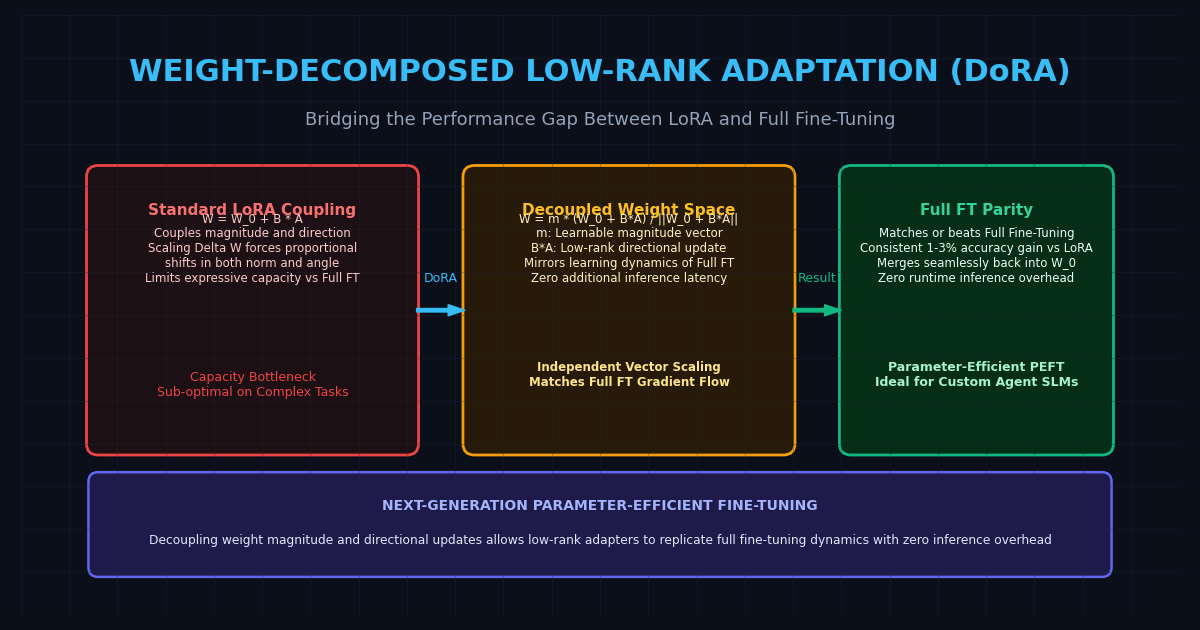
The Problem: The Inherent Capacity Bottleneck of Standard LoRA
Parameter-Efficient Fine-Tuning (PEFT) has become the operational backbone of modern generative AI engineering. When tailoring open foundation models (such as LLaMA-3, Qwen 2.5, or Mistral) for enterprise tasks like web extraction in AiFetchly, fine-tuning all model weights (Full Fine-Tuning) is economically impractical. Full fine-tuning a 70B parameter model requires terabytes of GPU High Bandwidth Memory (HBM) to store optimizer states, gradients, and activations across distributed clusters.
To slash hardware requirements, Low-Rank Adaptation (LoRA) (Hu et al., 2021) froze the pre-trained weight matrix $\mathbf{W}_0 \in \mathbb{R}^{d \times k}$ and introduced a low-rank decomposition:
$$\mathbf{W} = \mathbf{W}_0 + \Delta \mathbf{W} = \mathbf{W}_0 + \frac{\alpha}{r} \mathbf{B} \mathbf{A}$$
Where $\mathbf{B} \in \mathbb{R}^{d \times r}$, $\mathbf{A} \in \mathbb{R}^{r \times k}$, and the rank $r \ll \min(d, k)$. LoRA slashes trainable parameters by over 99% while cutting VRAM requirements dramatically.
The Mystery of the Accuracy Gap
Despite its ubiquity, AI practitioners consistently observe a frustrating ceiling: LoRA systematically underperforms Full Fine-Tuning (FT) on complex reasoning, mathematics, and instruction-following benchmarks. Increasing the rank $r$ from 8 to 64 or 128 yields diminishing returns and fails to close the gap.
In 2024, researchers from NVIDIA and HKUST (Shih-Yang Liu et al., ICML 2024 / 2025) uncovered the root cause: the fundamental structural coupling of magnitude and direction in standard LoRA.
Magnitude vs. Direction in Neural Network Weights
Any linear weight matrix $\mathbf{W} \in \mathbb{R}^{d \times k}$ can be uniquely decomposed into two components:
- A Magnitude Vector $\mathbf{m} \in \mathbb{R}^{1 \times k}$: The Euclidean norm of each column vector, representing the scale or importance of each feature channel: $$m_j = |\mathbf{W}{:, j}|2 = \sqrt{\sum{i=1}^d W{i, j}^2}$$
- A Directional Matrix $\mathbf{V} \in \mathbb{R}^{d \times k}$: The unit-normalized column vectors, representing the orientation or feature direction in embedding space: $$\mathbf{V}{:, j} = \frac{\mathbf{W}{:, j}}{|\mathbf{W}_{:, j}|_2}$$
$$\mathbf{W} = \mathbf{m} \odot \frac{\mathbf{V}}{|\mathbf{V}|_c}$$
_(where $|\cdot|c$ denotes column-wise Frobenius/L2 norm).
How LoRA Restricts Weight Dynamics
When comparing the gradient updates of Full Fine-Tuning against LoRA, empirical analysis reveals a stark divergence:
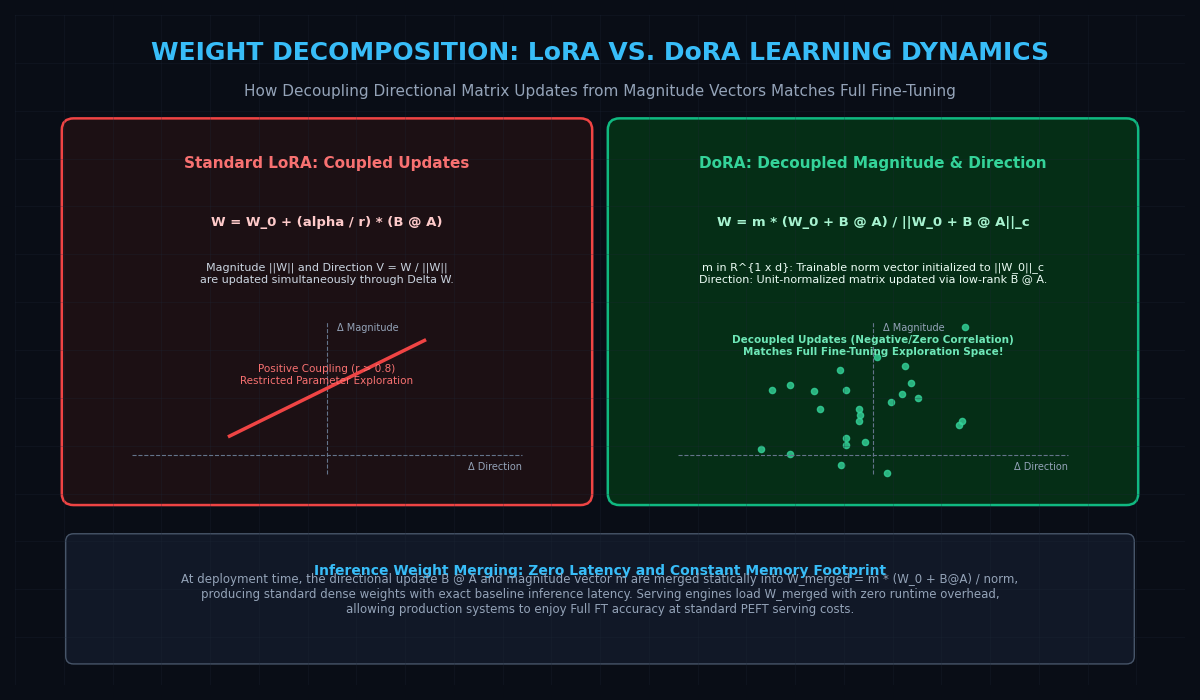
- Full Fine-Tuning Dynamics: Updates to magnitude ($\Delta \mathbf{m}$) and direction ($\Delta \mathbf{V}$) exhibit weak or slightly negative correlation ($r \approx -0.1$ to $0.1$). Full fine-tuning frequently executes large directional rotations while subtly adjusting feature magnitudes, or vice-versa.
- LoRA’s Coupled Constraint: Because LoRA updates weights via a direct additive term ($\mathbf{W}_0 + \mathbf{B}\mathbf{A}$), modifying direction automatically scales magnitude proportionally. Magnitude and direction changes show a rigid positive correlation ($r > 0.85$).
This structural coupling forces LoRA to compromise: it cannot rotate a feature’s direction without distorting its magnitude. The model is constrained from exploring optimal parameter trajectories, creating an unavoidable performance ceiling.
The Solution: Weight-Decomposed Low-Rank Adaptation (DoRA)
To remove this artificial constraint while preserving PEFT’s minimal memory footprint, NVIDIA researchers introduced DoRA (Weight-Decomposed Low-Rank Adaptation).
DoRA explicitly decouples weight matrices into independent magnitude and directional parameters, updating the directional component via low-rank adaptation while tuning the magnitude vector directly.
The DoRA Mathematical Formulation
In DoRA, the adapted weight matrix $\mathbf{W}$ is defined as:
$$\mathbf{W} = \mathbf{m} \odot \frac{\mathbf{V}}{|\mathbf{V}|_c} = \mathbf{m} \odot \frac{\mathbf{W}_0 + \frac{\alpha}{r} \mathbf{B} \mathbf{A}}{\left| \mathbf{W}_0 + \frac{\alpha}{r} \mathbf{B} \mathbf{A} \right|_c}$$
Where:
- $\mathbf{W}_0 \in \mathbb{R}^{d \times k}$ is the frozen pre-trained base weight matrix.
- $\mathbf{m} \in \mathbb{R}^{1 \times k}$ is a learnable magnitude vector, initialized to the exact column norms of the pre-trained weights: $$\mathbf{m}_{\text{init}} = |\mathbf{W}_0|_c$$
- $\mathbf{B} \in \mathbb{R}^{d \times r}$ and $\mathbf{A} \in \mathbb{R}^{r \times k}$ are standard low-rank adapter matrices ($r \ll \min(d, k)$), initialized with $\mathbf{B} = \mathbf{0}$ and $\mathbf{A} \sim \mathcal{N}(0, \sigma^2)$ so that $\mathbf{B}\mathbf{A} = \mathbf{0}$ at step 0.
- $|\cdot|_c$ is the column-wise L2 norm vector across the $k$ columns.
The Forward Pass Mechanics
During forward propagation, the linear layer computation for an input activation vector $\mathbf{x} \in \mathbb{R}^{B \times d}$ is:
$$\mathbf{y} = \mathbf{x} \mathbf{W} = \mathbf{x} \left( \mathbf{m} \odot \frac{\mathbf{W}_0 + \frac{\alpha}{r} \mathbf{B} \mathbf{A}}{\left| \mathbf{W}_0 + \frac{\alpha}{r} \mathbf{B} \mathbf{A} \right|_c} \right)$$
By normalizing the directional matrix $(\mathbf{W}_0 + \mathbf{B}\mathbf{A}) / |\mathbf{W}_0 + \mathbf{B}\mathbf{A}|_c$, the low-rank matrices $\mathbf{B}$ and $\mathbf{A}$ are tasked exclusively with adjusting directional orientation.
Meanwhile, the separate vector $\mathbf{m}$ independently modulates the scale of each feature column. This mirrors the flexible, unconstrained gradient flow of Full Fine-Tuning.
Key Architectural Advantages of DoRA
1. Zero Extra Inference Latency via Static Weight Merging
A common concern with advanced PEFT techniques is whether normalization operations introduce runtime latency during production inference.
With DoRA, runtime inference overhead is strictly zero. Once training is complete, the learned magnitude vector $\mathbf{m}$ and directional adapter $\mathbf{B}\mathbf{A}$ can be baked directly into a single static weight matrix before deployment:
$$\mathbf{W}_{\text{merged}} = \mathbf{m} \odot \frac{\mathbf{W}_0 + \frac{\alpha}{r} \mathbf{B} \mathbf{A}}{\left| \mathbf{W}_0 + \frac{\alpha}{r} \mathbf{B} \mathbf{A} \right|_c}$$
$\mathbf{W}{\text{merged}}$ has the exact same dimensions ($d \times k$) as the original base model layer. Serving engines (such as vLLM, SGLang, and HuggingFace TGI) execute $\mathbf{W}{\text{merged}}$ using standard optimized GEMM kernels. There are no extra normalization steps, no separate adapter branches, and zero added memory during generation.
2. High Parameter Efficiency at Low Ranks
Because standard LoRA couples magnitude and direction, teams often set ranks to $r=32$ or $r=64$ in hopes of recovering lost accuracy.
In contrast, because DoRA isolates directional learning, it achieves superior performance at dramatically lower ranks ($r=4$ or $r=8$). Empirical studies demonstrate that a DoRA adapter with rank $r=8$ consistently outperforms a standard LoRA adapter with rank $r=64$, saving memory during training and adapter storage.
PEFT Architectural Comparison
| Dimension | Full Fine-Tuning (FT) | Standard LoRA | QLoRA | DoRA (Weight-Decomposed) |
|---|---|---|---|---|
| Trainable Parameters | 100% (All parameters) | ~0.1% - 0.5% | ~0.1% - 0.5% | ~0.1% - 0.6% (+0.01% for vector $\mathbf{m}$) |
| Training VRAM (70B Model) | ~400+ GB (Multi-node) | ~80 GB (Single 8x H100) | ~24-48 GB (Quantized base) | ~82 GB (Near-identical to LoRA) |
| Magnitude-Direction Coupling | Decoupled (Flexible) | Rigidly Coupled ($r > 0.85$) | Rigidly Coupled ($r > 0.85$) | Decoupled (Matches Full FT) |
| Downstream Accuracy | Gold Standard (100%) | Baseline (-2% to -5% on math/code) | Baseline (-2% to -5%) | Matches or Exceeds Full FT (+1% to +3% vs LoRA) |
| Inference Latency Overhead | 0ms (Baseline) | 0ms (Merged) | 0ms (Dequantized/Merged) | 0ms (Merged static matrix) |
| Low-Rank Stability ($r=4, 8$) | N/A | Degraded | Degraded | High stability and capacity |
Reference Implementation: DoRA Linear Layer in PyTorch
Below is a self-contained PyTorch implementation demonstrating the DoRA linear layer, directional normalization, independent magnitude scaling, and zero-overhead inference weight merging.
import torch
import torch.nn as nn
import torch.nn.functional as F
from typing import Optional

class DoRALinear(nn.Module):
    """
    Weight-Decomposed Low-Rank Adaptation (DoRA) Linear Layer.
    Decomposes weights into a magnitude vector m and low-rank directional update BA.
    """
    def __init__(
        self,
        in_features: int,
        out_features: int,
        rank: int = 8,
        lora_alpha: float = 16.0,
        bias: bool = False
    ):
        super().__init__()
        self.in_features = in_features
        self.out_features = out_features
        self.rank = rank
        self.scaling = lora_alpha / rank

        # Frozen base weight matrix: [out_features, in_features]
        self.base_weight = nn.Parameter(
            torch.randn(out_features, in_features) * 0.02,
            requires_grad=False
        )

        if bias:
            self.bias = nn.Parameter(torch.zeros(out_features))
        else:
            self.register_parameter('bias', None)

        # Low-rank directional adapters: B and A
        self.lora_A = nn.Parameter(torch.randn(rank, in_features) * (1.0 / rank ** 0.5))
        self.lora_B = nn.Parameter(torch.zeros(out_features, rank))

        # Learnable magnitude vector m: initialized to the L2 norm of base weight columns
        with torch.no_grad():
            base_col_norms = torch.linalg.norm(self.base_weight, dim=1, keepdim=True) # [out_features, 1]
            self.magnitude = nn.Parameter(base_col_norms.clone())

    def get_effective_weight(self) -> torch.Tensor:
        """
        Computes the effective weight matrix:
        W = m * (W_0 + scaling * B @ A) / ||W_0 + scaling * B @ A||
        """
        # Directional matrix update: [out_features, in_features]
        directional_weight = self.base_weight + self.scaling * (self.lora_B @ self.lora_A)

        # Calculate L2 norm across rows/columns
        norm = torch.linalg.norm(directional_weight, dim=1, keepdim=True) # [out_features, 1]

        # Unit-normalize direction and scale by trainable magnitude vector
        norm_directional_weight = directional_weight / (norm + 1e-8)
        effective_weight = self.magnitude * norm_directional_weight
        return effective_weight

    def forward(self, x: torch.Tensor) -> torch.Tensor:
        """Forward pass: y = x @ W^T + b"""
        weight = self.get_effective_weight()
        return F.linear(x, weight, self.bias)

    def merge_and_export(self) -> nn.Linear:
        """
        Merges DoRA magnitude and directional adapters into standard nn.Linear
        for zero-overhead production deployment.
        """
        merged_weight = self.get_effective_weight().detach()
        linear = nn.Linear(self.in_features, self.out_features, bias=(self.bias is not None))
        linear.weight.data.copy_(merged_weight)
        if self.bias is not None:
            linear.bias.data.copy_(self.bias.data)
        return linear


# Verification & Demonstration
if __name__ == "__main__":
    torch.manual_seed(42)
    B, in_dim, out_dim = 2, 256, 512
    dora_layer = DoRALinear(in_features=in_dim, out_features=out_dim, rank=8, lora_alpha=16.0)

    # 1. Forward pass during training
    dummy_input = torch.randn(B, in_dim)
    output = dora_layer(dummy_input)
    print(f"DoRA Layer Output Shape: {list(output.shape)}")

    # 2. Export to merged deployment model
    production_linear = dora_layer.merge_and_export()
    prod_output = production_linear(dummy_input)

    diff = torch.max(torch.abs(output - prod_output)).item()
    print(f"Max difference between DoRA layer and merged Linear: {diff:.8e}")
print("Verification Successful: Exported layer achieves identical output with zero runtime overhead!") Production Scaling and Enterprise Impact
The introduction of DoRA provides enterprise machine learning teams with a decisive upgrade over standard PEFT workflows:
1. Training Frontier-Grade Custom Domain SLMs
In autonomous data ingestion and structured extraction engines like AiFetchly, deploying a massive 405B model for routine web parsing incurs prohibitive API bills.
By applying DoRA to fine-tune compact 3B to 8B Small Language Models (such as Llama-3.2-3B or Qwen-2.5-7B) on domain extraction corpora, engineering teams achieve accuracy on complex nested schemas that matches full fine-tuning—all within the memory constraints of a single 24GB or 48GB GPU workstation.
2. Plug-and-Play Compatibility with the LoRA Ecosystem
Because DoRA only modifies how the adapter delta is scaled and normalized, it integrates seamlessly into existing PEFT infrastructure:
- HuggingFace PEFT: Fully supported via
peft_config = LoraConfig(..., use_dora=True). - Quantization Synergy (QDoRA): Works in tandem with 4-bit NormalFloat (NF4) base weight quantization to enable fine-tuning 70B models on dual RTX 4090 GPUs.
- Serving Parity: Because weights can be statically folded at deployment, downstream serving frameworks (vLLM, Ollama, TensorRT-LLM) require zero custom kernel modifications.
By resolving the core capacity bottleneck of Low-Rank Adaptation, DoRA establishes the new gold standard for parameter-efficient adaptation—delivering Full Fine-Tuning expressivity at PEFT cost.