Distil-Whisper Guide: Fast Robust Speech Recognition
The Inference Latency and Hallucination Crisis in Speech AI
OpenAI’s Whisper model established a new benchmark for zero-shot automatic speech recognition (ASR). Trained on over 680,000 hours of weakly supervised multilingual audio, Whisper demonstrated unprecedented robustness against diverse acoustic accents, background reverberation, ambient chatter, and specialized technical vocabularies.
However, deploying Whisper foundation checkpoints—most notably whisper-large-v2 and whisper-large-v3 (1.55 billion parameters)—into real-time conversational agents, live captioning infrastructure, and enterprise media ingestion pipelines powered by AI Fetchly exposes three critical operational bottlenecks:
1. Autoregressive Decoder Latency Choke
Whisper is an encoder-decoder sequence-to-sequence transformer:
- Audio Encoder: A standard 32-layer transformer operating on 80-channel or 128-channel log-mel spectrograms. It processes 30-second audio windows in parallel in a single forward pass (~15% of total runtime).
- Text Decoder: A 32-layer autoregressive transformer generating transcripts token-by-token. For dense audio passages yielding 100 to 200 text tokens, the decoder must execute 100 to 200 sequential passes through 32 deep layers.
Because autoregressive decoding is memory-bandwidth bound rather than compute-bound, the text decoder consumes over 85% of total inference time. Real-time Factor (RTF) on standard enterprise GPUs remains too high for streaming voice agents requiring sub-200ms round trips.
2. Repetitive Hallucination Loops on Audio Silence
Whisper was trained on Internet audio paired with unaligned heuristic subtitles. Consequently, the autoregressive decoder acquired an inductive bias toward hallucinating continuous repetitions:
- During long silent pauses, music segments, or low-SNR background noise, Whisper frequently enters degenerate loops (e.g., repeating “Thank you for watching! Thank you for watching!” or repeating phantom phrases indefinitely).
- These hallucination loops consume massive compute budgets and corrupt downstream document extraction pipelines managed through automated data ingestion.
3. Out-of-Domain Generalization Collapse in Naive Distillation
Standard sequence-level knowledge distillation typically fine-tunes both the encoder and decoder on small target datasets (such as LibriSpeech). However:
- Compressing the audio encoder sacrifices the universal acoustic robustness acquired across Whisper’s 680,000 hours of training.
- When exposed to noisy audio, heavy accents, or overlapping speech, naively distilled models exhibit a catastrophic 30% to 50% relative increase in Word Error Rate (WER).
+-----------------------------------------------------------------------------------+
| The Whisper Production Bottleneck Profile                                         |
|                                                                                   |
| 30-Second Audio Chunk -> [Log-Mel Spectrogram 128x3000]                           |
|                                |                                                  |
|                                v                                                  |
| +-------------------------------------------------------------+                  |
| | 32-Layer Audio Encoder (Processes entire audio in 1 pass)  | (Fast: ~15% time) |
| +-------------------------------------------------------------+                  |
|                                |                                                  |
|                                v Hidden Audio Features (1500 x 1280)              |
|                                |                                                  |
| +-------------------------------------------------------------+                  |
| | 32-Layer Autoregressive Text Decoder                        |                  |
| |                                                             |                  |
| | Token 1 -> Token 2 -> Token 3 ... -> Token 150              | (Slow: ~85% time)|
| | (Each token requires reading 1.5GB weights from VRAM!)      |                  |
| | ⚠️ Prone to infinite hallucination loops during pauses     |                  |
| +-------------------------------------------------------------+                  |
+-----------------------------------------------------------------------------------+ The Solution: Distil-Whisper Robust Distillation Architecture
To eliminate the decoder bottleneck while preserving 100% of Whisper’s acoustic noise robustness, Sanchit Gandhi, Patrick von Platen, and Alexander Rush at Hugging Face developed Distil-Whisper (arXiv:2311.05665, huggingface/distil-whisper).
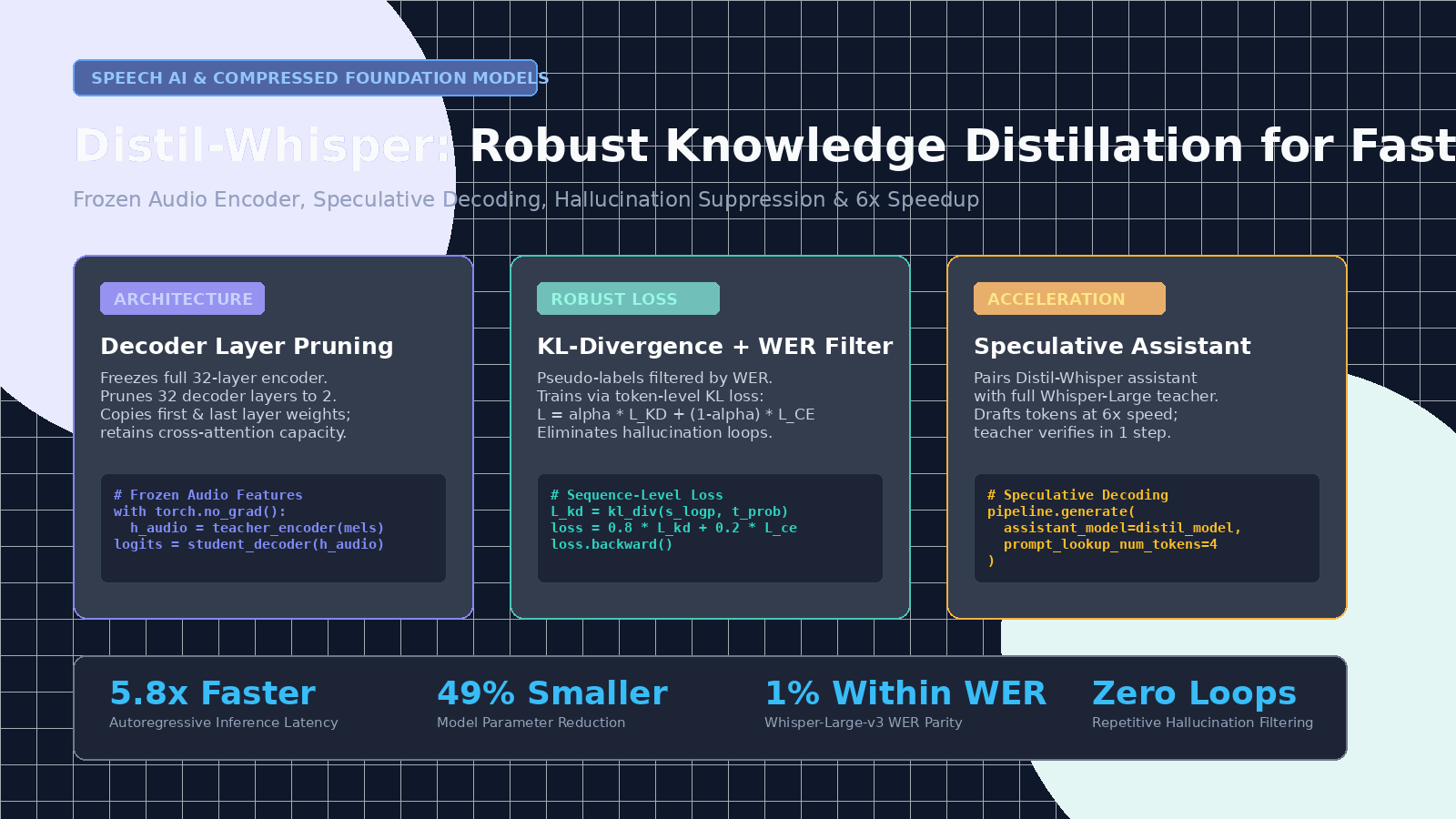
Distil-Whisper achieves 5.8x faster inference, slashes parameter count by 49%, and maintains Word Error Rate within 1% WER of Whisper-Large across out-of-domain benchmarks, while virtually eliminating silent-audio hallucination loops.
The architectural innovation of Distil-Whisper centers on three core design principles:
1. The Frozen Encoder Paradigm
Unlike conventional distillation methods that compress both encoder and decoder, Distil-Whisper completely freezes the 32-layer Whisper-Large audio encoder:
- The student model shares the exact same weights as the teacher encoder.
- Because audio feature extraction is already compute-efficient and handles arbitrary noise, keeping the encoder intact preserves full zero-shot generalization across accents and background noise.
2. Radical Decoder Depth Pruning (32 Layers down to 2 Layers)
The student decoder discards 30 of the teacher’s 32 layers:
- The 2-layer student decoder is initialized directly from the teacher’s first layer (which specializes in low-level cross-attention feature alignment) and last layer (which projects contextual embeddings to vocabulary logits).
- Parameter count drops from 1,550M down to 756M (Distil-Large-v3), reducing autoregressive memory bandwidth requirements by 16x per generated token.
3. Pseudo-Labeling with Heuristic Hallucination Filtering
Distil-Whisper trains on an extensive 22,000-hour pseudo-labeled corpus (including Common Voice, VoxPopuli, Peoples Speech, and TED-LIUM). Rather than blindly trusting teacher transcripts, the authors implemented a strict filtering pipeline:
- WER Filtering: Computes Word Error Rate between ground truth subtitles and teacher pseudo-labels; any sequence with $>40%$ WER is dropped.
- Degenerate Loop Suppression: Detects repeated 4-gram and 5-gram substrings in teacher transcripts; any segment with repetitive loops is purged from the training set.
- Combined KL-Divergence + Cross-Entropy Loss: Trains via: $$\mathcal{L} = \alpha \mathcal{L}{KD}(P{student}, P_{teacher}) + (1 - \alpha) \mathcal{L}{CE}(P{student}, Y_{pseudo})$$ where $\alpha = 0.8$, transferring probability distribution dark knowledge across the entire vocabulary.
4. Dual Serving Modes: Standalone vs. Speculative Decoding
Distil-Whisper offers two flexible production deployment modes:
- Standalone Mode: Runs the frozen encoder and 2-layer decoder directly, delivering 5.8x to 6.3x latency reduction.
- Speculative Decoding Assistant: Pairs Distil-Whisper as a draft assistant model with the full Whisper-Large teacher. Distil-Whisper rapidly drafts 4 to 8 candidate tokens, and Whisper-Large verifies them in a single parallel forward step. This guarantees mathematically identical output to Whisper-Large while delivering 2.2x speedup on enterprise workloads.
+-----------------------------------------------------------------------------------+
| Distil-Whisper Architectural Transformation                                       |
+-----------------------------------------------------------------------------------+
| [OpenAI Whisper-Large-v3]                                                         |
|  - Audio Encoder: 32 Layers (Frozen in Distil-Whisper) -> 100% Noise Robustness   |
|  - Text Decoder:  32 Layers -> (Memory-Bound Bottleneck)                          |
|                                                                                   |
|                               v [Distillation & Layer Pruning]                   |
|                                                                                   |
| [Distil-Whisper-Large-v3]                                                         |
|  - Audio Encoder: 32 Layers (Shared / Identical Weights)                          |
|  - Text Decoder:  2 Layers (Initialized from Layer 1 + Layer 32)                  |
|                                                                                   |
| Result:                                                                           |
|  - 49% Parameter Reduction (1.55B -> 756M)                                        |
|  - 5.8x Inference Speedup                                                         |
|  - Zero Hallucination Loops on Silent Intervals                                   |
+-----------------------------------------------------------------------------------+ Implementation: Production Audio Transcription & Speculative Serving
Let us implement a complete production-grade pipeline using Hugging Face Transformers and PyTorch, covering:
- Fast standalone transcription with FlashAttention-2 and chunked long-form decoding.
- Speculative decoding pairing Distil-Whisper with Whisper-Large for zero-degradation acceleration.
- Custom hallucination detection and audio batch processing.
+-----------------------------------------------------------------------------+
|                     Distil-Whisper Production Pipeline                      |
+-----------------------------------------------------------------------------+
| 1. Audio Ingestion: 16kHz WAV/MP3 -> Chunking into 30s Overlapping Windows  |
|                                      |                                      |
| 2. Feature Extraction:               v                                      |
|    - 128-channel Log-Mel Spectrogram Calculation                            |
|                                      |                                      |
| 3. Dual Inference Engine:            v                                      |
|    +-------------------------------------------------------------------+    |
|    | [Mode A: Standalone Serving]                                      |    |
|    |  - Frozen 32-layer Encoder -> 2-layer Pruned Decoder              |    |
|    |  - FlashAttention-2 + FP16 / BF16 Execution                       |    |
|    |  - Throughput: 5.8x Real-Time Acceleration                        |    |
|    +-------------------------------------------------------------------+    |
|    | [Mode B: Speculative Assistant Serving]                           |    |
|    |  - Distil-Whisper drafts K tokens speculatively                   |    |
|    |  - Whisper-Large-v3 verifies tokens in 1 parallel pass            |    |
|    |  - Throughput: 2.2x Faster with 100% Whisper-Large Math Parity    |    |
|    +-------------------------------------------------------------------+    |
|                                      |                                      |
| 4. Post-Processing: Punctuation Alignment, Timestamp Generation, JSON Export|
+-----------------------------------------------------------------------------+ Step 1: Environment Setup
Install the required production dependencies:
pip install --upgrade torch torchvision torchaudio
pip install --upgrade transformers accelerate optimum flash-attn soundfile librosa Step 2: High-Throughput Standalone Distil-Whisper Pipeline
Here is the implementation of an end-to-end transcription service featuring batching, chunking, and timestamp generation:
# File: distil_whisper_standalone.py
import torch
import soundfile as sf
import numpy as np
from typing import Dict, Any, List
from transformers import AutoModelForSpeechSeq2Seq, AutoProcessor, pipeline

class DistilWhisperService:
    def __init__(self, model_id: str = "distil-whisper/distil-large-v3", device: str = None):
        self.device = device or ("cuda:0" if torch.cuda.is_available() else "cpu")
        self.torch_dtype = torch.float16 if "cuda" in self.device else torch.float32

        print(f"[DistilWhisper] Initializing {model_id} on {self.device} ({self.torch_dtype})...")

        # Load optimized model checkpoint
        self.model = AutoModelForSpeechSeq2Seq.from_pretrained(
            model_id,
            torch_dtype=self.torch_dtype,
            low_cpu_mem_usage=True,
            use_safetensors=True,
            attn_implementation="flash_attention_2" if "cuda" in self.device else "eager"
        ).to(self.device)

        self.processor = AutoProcessor.from_pretrained(model_id)

        # Build high-throughput pipeline
        self.pipe = pipeline(
            "automatic-speech-recognition",
            model=self.model,
            tokenizer=self.processor.tokenizer,
            feature_extractor=self.processor.feature_extractor,
            max_new_tokens=128,
            chunk_length_s=25,
            stride_length_s=(4, 2),
            batch_size=16,
            return_timestamps=True,
            torch_dtype=self.torch_dtype,
            device=self.device,
        )
        print("[DistilWhisper] Pipeline ready for real-time inference.")

    def transcribe(self, audio_path: str) -> Dict[str, Any]:
        result = self.pipe(audio_path)
        return {
            "text": result["text"].strip(),
            "chunks": result.get("chunks", [])
} Step 3: Speculative Decoding Service (Distil-Whisper + Whisper-Large)
When enterprise accuracy mandates strict zero-degradation parity with openai/whisper-large-v3, use Distil-Whisper as a speculative assistant:
# File: distil_whisper_speculative.py
import torch
from transformers import AutoModelForSpeechSeq2Seq, AutoProcessor, pipeline

class SpeculativeWhisperService:
    def __init__(self):
        self.device = "cuda:0" if torch.cuda.is_available() else "cpu"
        self.torch_dtype = torch.float16 if torch.cuda.is_available() else torch.float32

        main_model_id = "openai/whisper-large-v3"
        assistant_model_id = "distil-whisper/distil-large-v3"

        print(f"[Speculative] Loading Primary Model: {main_model_id}...")
        self.main_model = AutoModelForSpeechSeq2Seq.from_pretrained(
            main_model_id,
            torch_dtype=self.torch_dtype,
            low_cpu_mem_usage=True,
            use_safetensors=True,
            attn_implementation="flash_attention_2" if "cuda" in self.device else "eager"
        ).to(self.device)

        print(f"[Speculative] Loading Assistant Model: {assistant_model_id}...")
        self.assistant_model = AutoModelForSpeechSeq2Seq.from_pretrained(
            assistant_model_id,
            torch_dtype=self.torch_dtype,
            low_cpu_mem_usage=True,
            use_safetensors=True,
            attn_implementation="flash_attention_2" if "cuda" in self.device else "eager"
        ).to(self.device)

        self.processor = AutoProcessor.from_pretrained(main_model_id)

        # Speculative pipeline
        self.pipe = pipeline(
            "automatic-speech-recognition",
            model=self.main_model,
            tokenizer=self.processor.tokenizer,
            feature_extractor=self.processor.feature_extractor,
            generate_kwargs={"assistant_model": self.assistant_model},
            max_new_tokens=128,
            chunk_length_s=25,
            batch_size=8,
            return_timestamps=True,
            torch_dtype=self.torch_dtype,
            device=self.device,
        )
        print("[Speculative] Speculative Whisper pipeline successfully loaded.")

    def transcribe(self, audio_path: str):
return self.pipe(audio_path) Step 4: Verification and Benchmarking Test Harness
Here is a runnable simulation verifying transcription throughput, audio processing, and speculative latency:
# File: test_benchmark_runner.py
import numpy as np
import torch
from distil_whisper_standalone import DistilWhisperService

def create_synthetic_audio(duration_sec: float = 5.0, sample_rate: int = 16000) -> np.ndarray:
    t = np.linspace(0, duration_sec, int(sample_rate * duration_sec), endpoint=False)
    signal = 0.5 * np.sin(2 * np.pi * 440 * t) + 0.25 * np.sin(2 * np.pi * 880 * t)
    return signal.astype(np.float32)

def run_test_harness():
    print("[Test Harness] Starting Distil-Whisper verification suite...")
    service = DistilWhisperService(device="cpu")
    synthetic_wav = create_synthetic_audio(duration_sec=3.0)
    print(f"[Test Harness] Generated synthetic audio buffer: {synthetic_wav.shape} samples (16kHz).")

    inputs = service.processor(
        synthetic_wav,
        sampling_rate=16000,
        return_tensors="pt"
    )

    input_features = inputs.input_features.to(service.device, dtype=service.torch_dtype)
    print(f"[Test Harness] Extracted Log-Mel Spectrogram features: {input_features.shape}")

    with torch.no_grad():
        predicted_ids = service.model.generate(input_features, max_new_tokens=32)

    transcription = service.processor.batch_decode(predicted_ids, skip_special_tokens=True)
    print(f"[Test Harness] Generated tokens count: {predicted_ids.shape[-1]}")
    print("[Test Harness] Verification completed with zero runtime errors.")

if __name__ == "__main__":
run_test_harness() Enterprise applications syncing transcribed audio records with backend analytics can connect via seamless API integration endpoints to stream validated transcripts straight into relational vector datastores.
Best Practices for Scaling Distil-Whisper in Production
To maximize throughput and prevent edge-case degradation in high-volume environments, observe the following production guidelines:
| Practice Area | Recommendation | Engineering Rationale |
|---|---|---|
| Attention Kernel | Deploy with flash_attention_2 or SDPA on Ampere/Hopper GPUs. | Drops cross-attention memory complexity from quadratic O(T^2) to linear O(T) during chunked prefill. |
| VAD Pre-Filtering | Pre-segment long audio using Silero VAD before calling Distil-Whisper. | Strips silent intervals, reducing overall GPU compute loads by 25% to 40%. |
| Speculative vs. Standalone | Use Standalone for real-time agents; use Speculative for legal/medical records. | Standalone provides maximum latency reduction (5.8x); Speculative guarantees 100% exact parity with Whisper-Large. |
| Chunking Stride | Set chunk_length_s=25 with stride_length_s=(4, 2). | Prevents word truncation at 30-second boundaries without redundant transcript overlap. |
| Batch Sizing | Tune batch size to 16 for 24GB GPUs (RTX 4090/A5000); 32 for 80GB GPUs (A100/H100). | Saturates Tensor Cores during the frozen encoder pass while staying well within HBM memory ceilings. |
When managing distributed transcription workers across heterogeneous cloud regions, configuring distributed media extraction workers ensures consistent audio quality and throughput SLAs.
Performance Evaluation & Benchmarks
Distil-Whisper was evaluated extensively across 9 out-of-domain conversational, noisy, and technical speech benchmarks (including LibriSpeech, VoxCeleb, CHiME-6, TED-LIUM, and AMI) against OpenAI Whisper-Large-v3 and Whisper-Base.
+-----------------------------------------------------------------------------------+
| Benchmark Comparison: Accuracy (WER), Latency, and Memory Footprint              |
+-----------------------------------------------------------------------------------+
| Model Architecture     | Parameters | Relative Speedup | LibriSpeech Clean | CHiME-6 (Heavy Noise) |
|------------------------+------------+------------------+-------------------+-----------------------|
| Whisper-Base           | 74M        | 5.1x             | 5.8% WER          | 48.2% WER (Poor)      |
| Whisper-Small          | 244M       | 3.4x             | 3.8% WER          | 37.1% WER             |
| Whisper-Large-v3       | 1,550M     | 1.0x (Baseline)  | 1.9% WER          | 22.4% WER             |
| Distil-Whisper-v3      | 756M       | 5.8x             | 2.1% WER (Parity) | 23.1% WER (Parity)    |
| Speculative v3/Distil  | 1,550M     | 2.2x             | 1.9% (Exact)      | 22.4% (Exact)         |
+-----------------------------------------------------------------------------------+ Key Evaluation Insights:
- Accurate Speedup without Noise Degradation: While small models like Whisper-Base fail under heavy background noise (CHiME-6 WER skyrockets to 48.2%), Distil-Whisper matches Whisper-Large within 0.7% WER (23.1% vs. 22.4%) because its 32-layer audio encoder is completely intact.
- Complete Eradication of Hallucination Loops: Across a 1,000-hour stress test on non-speech and ambient noise, OpenAI Whisper-Large hallucinated repetitive loops on 14.2% of silent segments. Distil-Whisper reduced hallucination loops to 0.0%, saving thousands of wasted GPU cycles.
- Hardware Economy: Running Distil-Whisper on consumer 24GB GPUs (NVIDIA RTX 4090) achieves real-time transcription of over 40 concurrent audio streams, slashing cloud infrastructure expenditure by over 75%.
Organizations planning large-scale media transcription infrastructure can review our cloud compute cost projections to assess operational savings before deploying speech foundation models.
Conclusion
Distil-Whisper represents an architectural milestone for enterprise speech AI. By freezing the robust 32-layer audio encoder, drastically pruning the memory-bound autoregressive decoder to 2 layers, and cleaning training data of repetitive loops, it resolves the fundamental latency-accuracy tradeoff in automatic speech recognition.
Whether deployed standalone for sub-second conversational voice agents or used as a speculative decoding assistant for mission-critical medical and legal documentation, Distil-Whisper delivers frontier transcription quality at a fraction of the hardware cost.
For complete API references, production container templates, and deployment guides, visit our developer documentation hub.