Dify Guide: Enterprise Agent Workflow & RAG Architecture
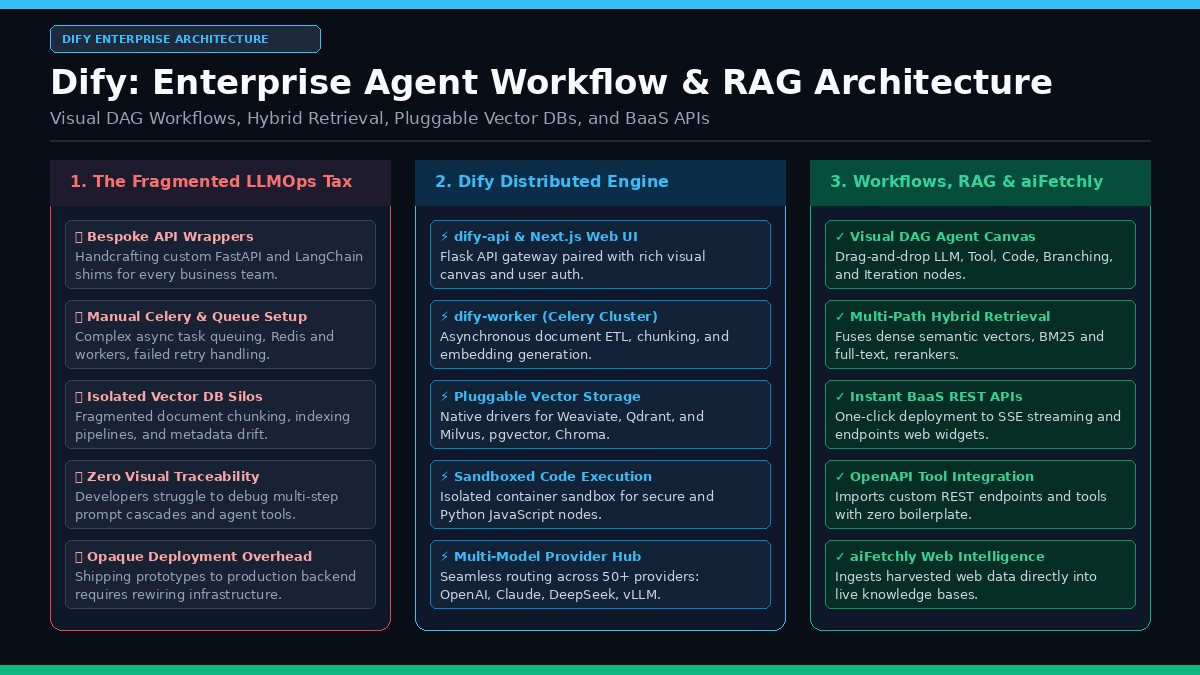
The Problem: The Fragmented Enterprise LLMOps Lifecycle
In modern enterprise software, automated market intelligence, and high-frequency data extraction platforms like AiFetchly, generative artificial intelligence has moved beyond simple chat completions. Enterprise production demands complex compound agentic workflows: ingesting live web datasets, indexing multi-format corporate documentation, querying structured SQL databases, branching on conditional logic, and orchestrating multi-agent collaboration with human-in-the-loop validation.
However, building and maintaining production-grade AI systems with raw code libraries (such as raw LangChain, custom FastAPI servers, or standalone Python scripts) introduces crippling architectural overhead:
The Enterprise LLMOps Fragmentation Tax:
┌─────────────────────────────────────────────────────────────────┐
│ Bottleneck 1: Handcrafted Backend Plumbing                      │
│ • Writing boilerplate FastAPI routes, auth, and rate limiters   │
│ ❌ Juggling custom Celery workers, Redis queues, and retry loops│
│ ❌ Every new business prototype requires weeks of backend dev   │
├─────────────────────────────────────────────────────────────────┤
│ Bottleneck 2: Fragmented RAG and Vector DB Silos                │
│ • Custom ETL scripts for PDF, DOCX, and web scraping ingestion  │
│ ❌ Fragile text chunking and metadata management in code        │
│ ❌ Switching vector databases requires rewriting entire queries │
│ ❌ Poor retrieval quality from single-vector cosine similarity  │
├─────────────────────────────────────────────────────────────────┤
│ Bottleneck 3: The "Black Box" Debugging Wall                    │
│ • Complex multi-step agent code buried in Python decorators     │
│ ❌ Product teams cannot inspect intermediate prompt states      │
│ ❌ Non-technical stakeholders cannot iterate on prompt logic    │
│ ❌ Lack of visual tracing stalls enterprise cross-team velocity │
├─────────────────────────────────────────────────────────────────┤
│ Bottleneck 4: Production Deployment & BaaS Disconnect           │
│ • Turning an AI prototype into a stable API requires rewiring   │
│ ❌ Manually implementing Server-Sent Events (SSE) token streaming│
│ ❌ Lack of integrated API key management and usage analytics    │
└─────────────────────────────────────────────────────────────────┘
Result: Enterprise engineering teams spend 75% of their engineering
effort rebuilding boilerplate infrastructure instead of solving domain problems! 1. The High Cost of Handcrafted Backend Infrastructure
When engineering teams build agent systems using pure code, they must construct a full Backend-as-a-Service (BaaS) from scratch:
- Asynchronous Task Management: Document ingestion, PDF parsing, and multi-model embedding generation cannot run synchronously inside HTTP request cycles. Teams must provision and monitor Redis clusters and Celery worker pools.
- Streaming & SSE Protocol Plumbing: Real-time conversational agents require bidirectional Server-Sent Events (SSE) with ping-pong heartbeats to prevent cloud load balancer timeouts (such as AWS ALB or Cloudflare 100-second limits).
- Security & Multi-Tenancy: Managing workspace isolation, team role-based access control (RBAC), and rotating provider API keys demands extensive database schema design.
2. The Retrieval-Augmented Generation (RAG) Mismatch
Enterprise knowledge is heterogeneous: unstructured PDFs, financial tables, internal Notion wikis, and live web pages collected via AiFetchly Data Fetching.
Traditional custom RAG pipelines suffer from rigid architectural choices:
- Single-Vector Failures: Relying solely on dense embeddings (e.g., OpenAI
text-embedding-3) fails on exact keyword searches, product SKUs, and numerical identifiers. - Database Lock-In: Hardcoding vector database clients (like pgvector or Qdrant) directly into application code makes benchmarking alternate storage backends (such as Milvus or Weaviate) expensive and high-risk.
- Missing Reranker Pipelines: Failing to apply cross-encoder rerankers forces developers to send bloated top-20 chunk payloads to frontier LLMs, inflating token bills and diluting model attention.
3. The Developer-Product Collaboration Divide
In enterprise organizations, prompt engineering, domain heuristics, and extraction rules are often owned by product managers, domain experts, or data analysts.
When agent logic is hardcoded inside Python scripts:
- Every prompt modification, few-shot demonstration update, or temperature adjustment requires a developer commit, CI/CD pipeline run, and cloud redeployment.
- Domain experts have zero visibility into intermediate agent reasoning, tool call arguments, or retrieval scores.
Dify Architecture: The Distributed Microservices Stack
To eliminate tooling fragmentation and bridge the gap between visual orchestration and enterprise backend engineering, Dify provides an open-source, full-stack LLMOps and agent platform.
Rather than acting as a lightweight UI wrapper, Dify is architected as an industrial-grade, distributed microservices system designed for high concurrency, multi-tenant isolation, and resilient asynchronous execution:
Dify Distributed Microservices Architecture:
┌─────────────────────────────────────────────────────────────────┐
│ 1. Client & Presentation Layer (dify-web)                       │
│ • Next.js 14 React Frontend with Tailwind CSS                   │
│ • Visual DAG Canvas (React Flow engine for node orchestration)   │
│ • Interactive Prompt Studio, Knowledge Manager, and Logs View   │
└─────────────────────────────────┬───────────────────────────────┘
                                  │ REST API & SSE Protocol
                                  ▼
┌─────────────────────────────────────────────────────────────────┐
│ 2. Core API Gateway & Application Server (dify-api)             │
│ • Python (Flask / Gunicorn) High-Throughput HTTP Service        │
│ • Enterprise RBAC, Workspace Multi-Tenancy, and Key Management  │
│ • Visual Workflow Engine: Graph Parser, State Tracker, Routers  │
│ • BaaS API Generator: Instantly exposes workflows as REST/SSE   │
└──────────────────┬──────────────────────────────┬───────────────┘
                   │ Enqueues Background Tasks     │ Metadata & Auth
                   ▼                              ▼
┌──────────────────────────────────────┐  ┌───────────────────────┐
│ 3. Asynchronous Task Worker Cluster  │  │ PostgreSQL Database   │
│ (dify-worker)                        │  │ • App configurations  │
│ • Distributed Celery Worker Fleet    │  │ • User credentials    │
│ • Redis: Broker, Cache & Locks       │  │ • Conversation logs   │
│ • Document ETL, Chunking, Embedding  │  │ • Execution traces    │
└──────────────────┬───────────────────┘  └───────────────────────┘
                   │ Vector Search & Storage
                   ▼
┌─────────────────────────────────────────────────────────────────┐
│ 4. Pluggable Enterprise Vector Database Layer                   │
│ • Native connectors: Weaviate, Qdrant, Milvus, pgvector, Chroma │
│ • Hybrid Retrieval: Dense Vector + BM25 Inverted Index          │
│ • Cross-Encoder Rerankers: Cohere, BGE, FlashRank, Jina         │
└─────────────────────────────────────────────────────────────────┘ 1. The Visual DAG Workflow Engine
At the heart of Dify is its Directed Acyclic Graph (DAG) Execution Engine.
Unlike simple sequential chains, Dify’s visual canvas allows software engineers and product teams to assemble sophisticated agent graphs with deterministic execution semantics:
- LLM Nodes: Configurable prompts supporting system instructions, conversation context, dynamic variables, and vision inputs across 50+ foundation model providers.
- Knowledge Retrieval Nodes: Directly binds uploaded document datasets and live web indices into the workflow, configuring dynamic top-$k$ retrieval and score thresholds.
- Tool Nodes: Out-of-the-box integration with web scrapers, Google Search, Python code interpreters, and arbitrary external APIs via OpenAPI / Swagger specification imports.
- Code Execution Nodes: Executes Python or JavaScript logic inside an isolated, secure Docker sandbox container (
dify-sandbox), preventing remote code execution (RCE) on the host server. - Logic & Control Flow: Features conditional
IF/ELSEbranches, parallel sub-graph execution, andIterationloops for batch-processing lists of scraped URLs or document chunks.
2. Enterprise Multi-Path Hybrid RAG
Dify features one of the most mature, high-performance RAG engines available in open source:
Dify Multi-Path Hybrid Retrieval Pipeline:
User Query
    │
    ├───► [Dense Vector Retrieval] ──► Top-50 Semantic Candidates
    │     (Cosine / HNSW on Weaviate/Qdrant)
    │
    └───► [BM25 Full-Text Search]   ──► Top-50 Keyword Candidates
          (Inverted Index on PostgreSQL/Lucene)
                │
                ▼
          [Candidate Union & Deduplication]
                │
                ▼
          [Cross-Encoder Reranker]
          (BGE-Reranker-Large / Cohere Rerank v3)
                │
                ▼ Top-5 High-Precision Chunks
[Context Assembly & Prompt Injection] - Dual Ingestion Strategies: Supports General Mode (standard paragraph chunking) and Parent-Child Mode (retrieves small chunks for dense vector precision while feeding the larger parent paragraph to the LLM for coherent context).
- Hybrid Search Fusion: Concurrently executes dense semantic search and BM25 sparse keyword retrieval, preventing false negatives on technical terminology, alphanumeric serials, and proper nouns.
- Integrated Re-ranking: Automatically reranks candidate pools using cross-encoder models, filtering out irrelevant chunks before prompt construction to slash token consumption by up to 60%.
3. Instant Backend-as-a-Service (BaaS) Generation
A transformative feature of Dify is its ability to turn any visually constructed workflow or agent into a hardened production API with a single click:
- Standard REST Endpoints: Exposes
/v1/workflows/runand/v1/chat-messagesfor integration with client applications. - Native SSE Token Streaming: Provides real-time token streaming over HTTP Server-Sent Events (
response_mode: "streaming"), delivering instant feedback to end users. - Pre-Built Embeddable UI: Generates iframe widgets and standalone web applications for rapid internal testing and customer deployment.
Hands-On Implementation: Deploying Dify and Building an Autonomous Extraction Workflow
Let us walk through a complete enterprise implementation: deploying Dify via Docker Compose, creating an automated web data extraction and synthesis workflow, and consuming the pipeline via Python.
Step 1: Deploy Dify via Docker Compose
Clone the official Dify repository and navigate to the deployment directory:
git clone https://github.com/langgenius/dify.git
cd dify/docker
Copy the example environment configuration:
cp .env.example .env Review key configuration variables inside .env:
# Vector Database Selection (weaviate, qdrant, milvus, pgvector)
VECTOR_STORE=weaviate

# Security Keys
SECRET_KEY=generate_a_secure_random_key_here

# Celery Worker Concurrency
CELERY_WORKER_CONCURRENCY=4 Launch the entire microservices stack:
docker compose up -d Verify that all containers are healthy:
docker compose ps Once running, access the Dify management console at http://localhost/install to configure the primary administrator account.
Step 2: Configure Foundation Model Providers
Navigate to Settings -> Model Providers inside the Dify web console:
- Configure API credentials for your preferred frontier models (such as Anthropic Claude 3.5 Sonnet, OpenAI GPT-4o, or DeepSeek-V3).
- For local or sovereign deployments, connect local inference engines (such as vLLM or Ollama) by specifying the base URL (
http://host.docker.internal:8000/v1).
Step 3: Build the Web Intelligence Extraction Workflow
Inside Dify, select Studio -> Create from Blank -> Workflow:
-
Start Node: Define input variables:
target_url(String, required): The target website to inspect.extraction_goal(String, required): The specific schema or data points to harvest.
-
HTTP Request Node (or Tool Node):
- Configure a POST request to your local AiFetchly API Integration:
- URL:
http://host.docker.internal:4321/api/v1/fetch - Body:
{"url": "{{#start.target_url#}}", "prune_dom": true}
-
Code Node (Python 3):
- Clean and parse the scraped JSON payload safely inside the isolated container sandbox:
def main(raw_response: str) -> dict: import json data = json.loads(raw_response) cleaned_markdown = data.get("markdown", "")[:12000] return \{"clean_content": cleaned_markdown\} -
LLM Node (Structured Synthesis):
- Model: Claude 3.5 Sonnet or GPT-4o.
- Prompt:
You are an enterprise data intelligence analyst. Analyze the harvested web content and extract the requested fields. Extraction Goal: \{\{#start.extraction_goal#\}\} Web Content: --- \{\{#code.clean_content#\}\} --- Return valid JSON conforming to the requested schema. -
End Node: Output the validated structured extraction payload.
Click Publish to deploy the workflow. Dify instantly assigns a unique API endpoint and API key.
Step 4: Programmatically Trigger the Workflow in Python
Now, interact with the published Dify workflow programmatically from your backend application:
import os
import requests
import json

DIFY_API_URL = "http://localhost/v1/workflows/run"
DIFY_API_KEY = os.environ.get("DIFY_API_KEY", "app-yourDifyApiKeyHere")

headers = {
    "Authorization": f"Bearer {DIFY_API_KEY}",
    "Content-Type": "application/json"
}

payload = {
    "inputs": {
        "target_url": "https://example.com/saas-pricing",
        "extraction_goal": "Extract company name, pricing tiers, and monthly billing rates."
    },
    "response_mode": "streaming",
    "user": "enterprise-agent-01"
}

print("--- Triggering Dify Visual Workflow with Streaming ---")

with requests.post(DIFY_API_URL, headers=headers, json=payload, stream=True) as response:
    response.raise_for_status()
    for line in response.iter_lines():
        if line:
            decoded_line = line.decode('utf-8')
            if decoded_line.startswith("data: "):
                event_data = json.loads(decoded_line[6:])
                event_type = event_data.get("event")

                if event_type == "text_chunk":
                    chunk = event_data.get("data", {}).get("text", "")
                    print(chunk, end="", flush=True)
                elif event_type == "workflow_finished":
                    print("\n\n--- Workflow Execution Completed Successfully ---")
                    outputs = event_data.get("data", {}).get("outputs", {})
print(json.dumps(outputs, indent=2)) Architectural Comparison: Dify vs. Alternative Frameworks
To understand where Dify fits within the enterprise AI landscape, compare its architecture against alternative orchestration approaches:
| Architectural Dimension | Raw LangChain / LlamaIndex | LangGraph / CrewAI | Flowise / Langflow | Dify |
|---|---|---|---|---|
| System Architecture | Python/TS code library | Graph / Multi-Agent Code Library | Node.js UI wrapper over LangChain | Distributed Microservices (Next.js, Flask, Celery, Redis) |
| Visual Workflow Canvas | None (pure code) | None (code-first state graphs) | Visual node canvas | Production DAG canvas with conditional branching & loops |
| Backend-as-a-Service (BaaS) | Requires custom FastAPI | Requires custom server wrappers | Minimal API support | Instant production REST API, SSE streaming, and embeddable widgets |
| Enterprise RAG Engine | Manual retrieval pipelines | Manual integration | Basic vector store nodes | Multi-path hybrid search (Dense + BM25 + Cross-Encoder Rerankers) |
| Vector DB Flexibility | Manual client integration | Manual client integration | Limited | Pluggable backends: Weaviate, Qdrant, Milvus, pgvector, Chroma |
| Code Execution Security | Unsandboxed host execution | Docker / Local Python | Host execution | Dedicated isolated container sandbox (dify-sandbox) |
| Enterprise Governance | None | None | Basic | Multi-tenant workspaces, team RBAC, audit logs, and key vaults |
Production Integration with aiFetchly
In modern enterprise data platforms, raw web extraction and high-level agent orchestration serve complementary roles.
By coupling AiFetchly with Dify, organizations create an end-to-end intelligent data collection, indexing, and workflow automation pipeline:
aiFetchly + Dify Unified Enterprise Architecture:
┌───────────────────────────┐      ┌───────────────────────────┐
│     Live Public Web       │ ───► │  aiFetchly Extraction     │
│ JavaScript SPAs, Portals  │      │  • Headless Chrome CDP    │
└───────────────────────────┘      │  • DOM pruning & Markdown │
                                   └─────────────┬─────────────┘
                                                 │ Cleaned Markdown
                                                 ▼
┌───────────────────────────┐      ┌───────────────────────────┐
│ Enterprise Applications   │ ◄─── │  Dify Workflow Engine     │
│ ERP, CRM, Dashboards, BI  │      │  • Multi-path hybrid RAG  │
└───────────────────────────┘      │  • Visual agent DAGs      │
                                   │  • BaaS REST API / SSE    │
└───────────────────────────┘ - Automated Web Harvesting: AiFetchly Data Fetching handles complex anti-bot challenges, renders dynamic client-side JavaScript applications, and transforms messy HTML into clean, semantic Markdown.
- Asynchronous Knowledge Ingestion: Dify’s Celery worker cluster ingests the harvested content, generates dense embeddings, builds full-text BM25 inverted indices, and populates the enterprise vector store.
- Autonomous Agent Execution: Business analysts and developers design multi-step visual workflows in Dify that query the harvested intelligence, execute deterministic validation logic, and trigger automated downstream actions.
To explore how automated data collection empowers modern enterprise AI architectures, visit the AiFetchly Documentation or examine our AiFetchly Pricing.