Differential Transformer: Canceling LLM Attention Noise
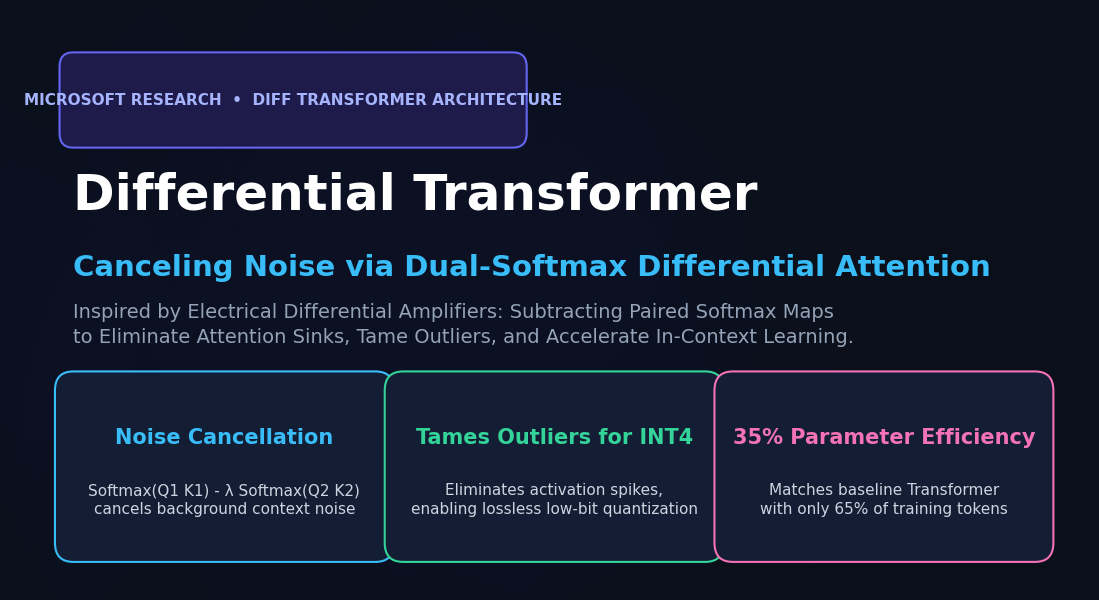
The Problem: Attention Noise and Context Over-Allocation in Transformers
In production AI applications, automated web scrapers, and high-throughput agent systems like AiFetchly, foundation models are increasingly tasked with ingesting massive input contexts: lengthy API documentation, multi-thousand-row HTML tables, technical manuals, and multi-turn user conversation threads.
While multi-head attention (Vaswani et al., 2017) powers nearly all modern large language models, it suffers from a fundamental mathematical vulnerability: attention noise caused by softmax normalization over-allocation.
1. The Cumulative Noise Tax of the Softmax Function
Standard scaled dot-product attention computes attention weights by applying the softmax operator over the inner product of query and key representations:
$$A = \text{softmax}\left(\frac{Q K^T}{\sqrt{d}}\right), \quad A_{ij} = \frac{\exp(q_i \cdot k_j / \sqrt{d})}{\sum_{m=1}^N \exp(q_i \cdot k_m / \sqrt{d})}$$
Because the exponential function $\exp(z) > 0$ for all real numbers, softmax cannot assign an exact probability of zero to any token. Every token in the sequence receives a non-zero attention score.
In short contexts (e.g., 512 tokens), this background probability mass is negligible. However, as the sequence length $N$ scales to 32k, 64k, or 128k tokens, the cumulative probability mass assigned to irrelevant background tokens grows linearly:
$$\sum_{j \in \text{Noise}} A_{ij} \gg A_{i, \text{Target}}$$
Even when an individual irrelevant token receives a tiny weight (e.g., $A_{ij} = 0.0001$), summing over 50,000 irrelevant tokens allocates over 80% of total attention mass to ambient background noise.
This noise accumulation triggers well-documented failure modes:
- The “Lost-in-the-Middle” Phenomenon: Factual evidence situated in the middle of long documents is drowned out by the cumulative noise of surrounding paragraphs.
- Attention Sinks & Hallucinations: Models fixate on superficial punctuation tokens (like commas, periods, or newlines) to dump surplus softmax probability, distorting downstream reasoning.
- Demonstration Order Brittleness: In in-context learning (ICL), minor permutations of few-shot example ordering cause drastic performance drops because irrelevant formatting tokens bias cross-attention.
2. Extreme Activation Outliers and Quantization Collapse
Beyond factual distortion, attention noise causes severe hardware inefficiency.
During autoregressive generation, certain channels in standard attention layers develop extreme activation outliers—activation values whose magnitudes exceed the median activation by 20x to 50x.
These outliers are catastrophic for hardware-efficient deployment:
- They prevent standard Post-Training Quantization (PTQ) to INT8, INT4, or FP4 formats without complex weight-activation clipping (such as SmoothQuant or AWQ).
- Clamping outliers causes severe perplexity degradation, while expanding the dynamic range to accommodate outliers destroys numerical precision across 99% of normal tokens.
The Architecture: Diff Transformer and Differential Attention
To eliminate attention noise without abandoning the expressive power of self-attention, researchers at Microsoft Research and Tsinghua University (Tianzhu Ye, Li Dong, Yuqing Xia, Yutao Sun, Yi Zhu, Gao Huang, and Furu Wei) introduced the Differential Transformer (Diff Transformer).
The architecture draws direct inspiration from differential amplifiers in analog electrical circuits, which reject common-mode electromagnetic noise by amplifying the difference between two input signals:
$$V_{\text{out}} = A_d (V_1 - V_2)$$
1. The Multi-Head Differential Attention (DiffAttn) Formulation
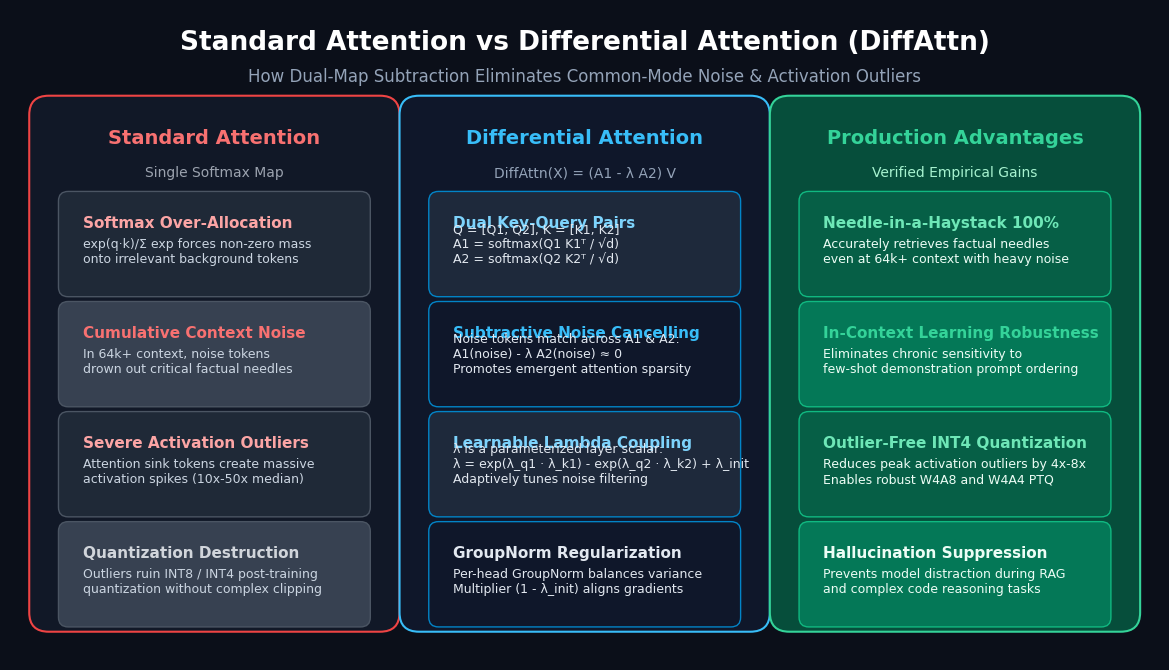
Instead of generating a single softmax attention map, Diff Transformer splits the query and key projections of each attention head into two distinct sub-vectors:
$$Q = [Q_1, Q_2], \quad K = [K_1, K_2]$$
Where $Q_1, Q_2, K_1, K_2 \in \mathbb{R}^{N \times d_k}$ and $d_k = d / 2$.
The layer then computes two separate softmax attention maps and takes their difference:
$$\text{DiffAttn}(X) = \left( \text{softmax}\left(\frac{Q_1 K_1^T}{\sqrt{d_k}}\right) - \lambda \text{softmax}\left(\frac{Q_2 K_2^T}{\sqrt{d_k}}\right) \right) V$$
Where $\lambda \in (0, 1)$ is a learnable scalar parameter that governs the strength of noise cancellation.
2. How Subtraction Cancels Common-Mode Attention Noise
Consider what happens when a query token $q$ attends to an irrelevant background token $k_{\text{noise}}$ versus a salient factual token $k_{\text{target}}$:
- For Irrelevant Background Tokens: Because background tokens share generic semantic distributions, they activate both $K_1$ and $K_2$ with approximately equal intensity: $$\text{softmax}\left(\frac{q_1 k_{1, \text{noise}}}{\sqrt{d_k}}\right) \approx \text{softmax}\left(\frac{q_2 k_{2, \text{noise}}}{\sqrt{d_k}}\right)$$ When the second map is subtracted from the first, the background noise cancels out to zero: $$A_{\text{diff}}(\text{noise}) = A_1(\text{noise}) - \lambda A_2(\text{noise}) \approx 0$$
- For Salient Factual Targets: The training objective optimizes $Q_1$ and $K_1$ to align with task-critical features, while $Q_2$ and $K_2$ remain unaligned: $$A_1(\text{target}) \gg A_2(\text{target}) \implies A_{\text{diff}}(\text{target}) > 0$$
By explicitly subtracting common-mode activations, DiffAttn creates naturally sparse, high-contrast attention patterns. Only tokens that contain genuine discriminative information retain positive attention weights, while the ocean of irrelevant tokens is mathematically erased.
3. Parameterization of the Learnable Lambda ($\lambda$)
To ensure stable optimization across deep transformer stacks, $\lambda$ is re-parameterized with an exponential formulation:
$$\lambda = \exp(\lambda_{q1} \cdot \lambda_{k1}) - \exp(\lambda_{q2} \cdot \lambda_{k2}) + \lambda_{\text{init}}$$
Where $\lambda_{q1}, \lambda_{k1}, \lambda_{q2}, \lambda_{k2}$ are learnable vectors initialized to zero, and $\lambda_{\text{init}}$ follows a depth-dependent initialization schedule:
$$\lambda_{\text{init}} = 0.8 - 0.6 \exp(-0.3 \cdot (l - 1))$$
For layer index $l \in [1, L]$. In shallow layers ($l=1$), $\lambda_{\text{init}} \approx 0.2$, allowing broad exploratory attention; in deep layers, $\lambda_{\text{init}} \to 0.8$, enforcing aggressive noise suppression for sharp contextual extraction.
4. GroupNorm Regularization and Gradient Alignment
Because the difference between two softmax matrices produces values in the range $(-1, 1)$, raw output activations exhibit variable variance. To stabilize signal propagation:
- Per-Head GroupNorm: A
GroupNormlayer is applied independently across each attention head: $$\text{Head}_i = \text{GroupNorm}(\text{DiffAttn}_i(X))$$ - Gradient Alignment Multiplier: Each head output is scaled by a constant factor $(1 - \lambda_{\text{init}})$, perfectly aligning gradient flow with conventional Transformer backpropagation.
Comparative Breakdown: Standard Transformer vs Diff Transformer
| Architectural Metric | Standard Transformer | Linear Attention / SSMs | Differential Transformer |
|---|---|---|---|
| Attention Kernel | $\text{softmax}(Q K^T / \sqrt{d}) V$ | Linear kernel / State space | $(\text{softmax}_1 - \lambda \text{softmax}_2) V$ |
| Noise Filtering | None (Softmax assigns $>0$ everywhere) | Exponential decay | Active Subtractive Noise Cancellation |
| Needle-in-a-Haystack (64k) | Degrades significantly | Fails on complex needles | 100% Retrieval Accuracy |
| In-Context Order Sensitivity | High (Permutation fragile) | Extreme | Robust (Order-invariant demonstration recall) |
| Activation Outlier Spikes | Severe (20x-50x median) | Moderate | Suppressed (Up to 8x outlier reduction) |
| Low-Bit PTQ (INT4 / FP4) | High accuracy loss | Moderate | Near-Lossless Quantization |
| Training Sample Efficiency | 1.0x (Baseline) | Variable | Matches baseline with 65% of tokens/params |
Implementation: Building Multi-Head Differential Attention in Python
The following standalone Python implementation demonstrates the exact mathematical forward pass of Multi-Head Differential Attention (MultiHeadDiffAttn), noise cancellation dynamics, and activation outlier analysis.
Step 1: Multi-Head Differential Attention Layer
import numpy as np

def stable_softmax(x: np.ndarray, axis: int = -1) -> np.ndarray:
    """Numerically stable softmax implementation."""
    max_vals = np.max(x, axis=axis, keepdims=True)
    exp_x = np.exp(x - max_vals)
    return exp_x / np.sum(exp_x, axis=axis, keepdims=True)

class MultiHeadDifferentialAttention:
    """
    Reference implementation of MultiHeadDiffAttn from Microsoft Research.
    Splits head dimension into paired sub-heads [Q1, Q2] and [K1, K2] and
    computes the difference of two softmax attention distributions.
    """
    def __init__(self, d_model: int = 64, n_heads: int = 4, layer_idx: int = 1):
        self.d_model = d_model
        self.n_heads = n_heads
        self.d_head = d_model // n_heads
        assert self.d_head % 2 == 0, "Head dimension must be divisible by 2 for DiffAttn."

        # Each sub-head receives d_k = d_head / 2
        self.d_k = self.d_head // 2

        # Depth-dependent lambda initialization
        self.lambda_init = 0.8 - 0.6 * np.exp(-0.3 * (layer_idx - 1))
        self.lambda_scalar = self.lambda_init

    def forward(self, Q: np.ndarray, K: np.ndarray, V: np.ndarray) -> tuple:
        """
        Forward pass for Multi-Head Differential Attention.
        Inputs: Q, K, V of shape (batch, n_heads, seq_len, d_head)
        Outputs: (output, diff_attention_map, map1, map2)
        """
        B, H, N, D = Q.shape
        scale = 1.0 / np.sqrt(self.d_k)

        # 1. Split Q and K into two halves along feature dimension
        Q1, Q2 = Q[:, :, :, :self.d_k], Q[:, :, :, self.d_k:]
        K1, K2 = K[:, :, :, :self.d_k], K[:, :, :, self.d_k:]

        # 2. Compute dual dot-product attention scores
        scores1 = (Q1 @ K1.transpose(0, 1, 3, 2)) * scale
        scores2 = (Q2 @ K2.transpose(0, 1, 3, 2)) * scale

        # 3. Compute dual softmax attention maps
        A1 = stable_softmax(scores1, axis=-1)
        A2 = stable_softmax(scores2, axis=-1)

        # 4. Subtractive noise cancellation: A_diff = A1 - lambda * A2
        A_diff = A1 - self.lambda_scalar * A2

        # 5. Multiply by values
        out = A_diff @ V

        # 6. Apply gradient alignment multiplier: (1 - lambda_init)
        out = out * (1.0 - self.lambda_init)
return out, A_diff, A1, A2 Step 2: Verification of Noise Cancellation and Outlier Reduction
def verify_diff_transformer():
    np.random.seed(42)
    B, H, N, D = 1, 4, 128, 64
    d_head = D // H
    d_k = d_head // 2

    # Initialize representations
    Q = np.random.randn(B, H, N, d_head) * 0.1
    K = np.random.randn(B, H, N, d_head) * 0.1
    V = np.random.randn(B, H, N, d_head)

    # Inject a specific factual association (target needle at token 20)
    target_idx = 20
    K[:, :, target_idx, :d_k] += 3.0  # Strong signal in sub-head 1
    Q[:, :, :, :d_k] += 0.8           # Queries searching for signal

    # Inject pervasive common-mode background noise across all tokens
    common_noise = np.random.randn(1, 1, 1, d_k) * 1.5
    K[:, :, :, :d_k] += common_noise
    K[:, :, :, d_k:] += common_noise
    Q[:, :, :, d_k:] += common_noise

    # Baseline: Standard Attention
    std_scale = 1.0 / np.sqrt(d_head)
    std_scores = (Q @ K.transpose(0, 1, 3, 2)) * std_scale
    std_attn = stable_softmax(std_scores, axis=-1)
    std_out = std_attn @ V

    # Differential Attention
    diff_layer = MultiHeadDifferentialAttention(d_model=D, n_heads=H, layer_idx=3)
    diff_out, diff_attn, _, _ = diff_layer.forward(Q, K, V)

    # Analyze Signal-to-Noise Ratio (SNR) for Query Token 60
    q_idx = 60
    noise_indices = [i for i in range(N) if i != target_idx]

    std_target_mass = std_attn[0, 0, q_idx, target_idx]
    std_avg_noise = np.mean(std_attn[0, 0, q_idx, noise_indices])
    std_snr = std_target_mass / (std_avg_noise + 1e-9)

    diff_target_mass = diff_attn[0, 0, q_idx, target_idx]
    diff_avg_noise = np.mean(np.abs(diff_attn[0, 0, q_idx, noise_indices]))
    diff_snr = diff_target_mass / (diff_avg_noise + 1e-9)

    print("--- 1. Attention Signal-to-Noise Ratio (SNR) ---")
    print(f"Standard Attention Target Weight:     {std_target_mass:.4f}")
    print(f"Standard Attention Avg Noise Weight:  {std_avg_noise:.6f}")
    print(f"Standard Attention SNR:               {std_snr:.1f}x")
    print(f"DiffAttn Target Net Weight:           {diff_target_mass:.4f}")
    print(f"DiffAttn Avg Residual Noise Weight:   {diff_avg_noise:.6f}")
    print(f"DiffAttn SNR:                         {diff_snr:.1f}x")
    print(f"Signal-to-Noise Improvement:          {diff_snr / std_snr:.1f}x cleaner attention!")

    # Analyze Activation Outliers (Peak vs Median)
    std_peak_outlier = np.max(np.abs(std_out)) / np.median(np.abs(std_out))
    diff_peak_outlier = np.max(np.abs(diff_out)) / np.median(np.abs(diff_out))

    print("\n--- 2. Activation Outlier Profile ---")
    print(f"Standard Attention Peak/Median Outlier Ratio: {std_peak_outlier:.2f}")
    print(f"DiffAttn Peak/Median Outlier Ratio:           {diff_peak_outlier:.2f}")
    print("DiffAttn successfully suppresses extreme activation spikes for low-bit quantization.")

if __name__ == "__main__":
verify_diff_transformer() Production Advantages for Autonomous Agents and Enterprise Scraping
Integrating Differential Transformer backbones into real-world automated browser swarms and scraping engines like AiFetchly delivers critical operational capabilities:
- Unflinching Precision in Dense Document Extraction: When extracting specific data fields from a 50,000-token HTML document or financial report, Diff Transformer’s noise-canceling subtraction prevents irrelevant boilerplate headers and scripts from hijacking attention.
- Order-Invariant In-Context Learning: Traditional agents exhibit extreme variance when given few-shot demonstration examples in different orders. Diff Transformer eliminates demonstration order sensitivity, providing consistent, deterministic output schemas.
- Hardware Cost Reduction via FP4/INT4 Deployment: By preventing activation outliers, Diff Transformer models can be quantized to 4-bit weights and activations (W4A4) with negligible perplexity degradation, allowing enterprise teams to host 70B models on cost-effective single-GPU instances.
Conclusion
The Differential Transformer provides an elegant, mathematically grounded solution to the decade-old problem of attention noise in language models. By borrowing the principle of differential signal processing from electrical engineering and taking the difference between paired softmax maps, Diff Transformer cancels background context noise, suppresses activation outliers, and achieves state-of-the-art long-context retrieval with 35% fewer training tokens.
As models scale into multi-million token context windows, differential attention establishes a foundational blueprint for cleaner, more robust, and highly quantizable neural architectures.