DFlash Guide: Block Diffusion for Speculative Decoding
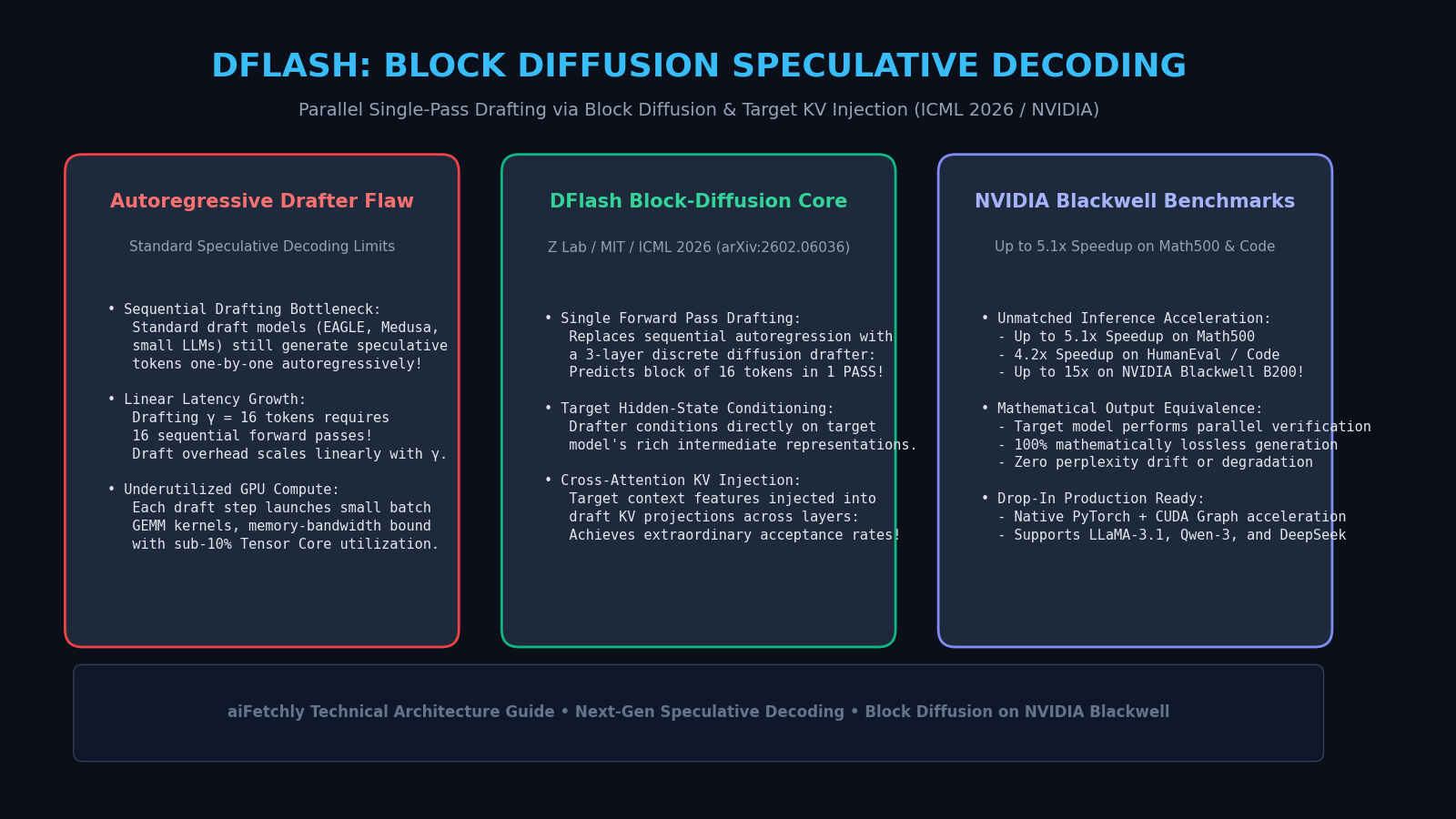
Accelerating generative inference across frontier Large Language Models (LLMs) has become a primary bottleneck for enterprise AI deployment. In high-concurrency coding copilots, automated customer service swarms, and live data extraction pipelines powered by AI Fetchly, token-generation latency directly dictates interactive responsiveness, throughput, and operational cloud costs.
Over the past several years, Speculative Decoding (SD) has emerged as the premier technique for accelerating autoregressive generation without altering model outputs. Standard speculative decoding uses a compact, lightweight draft model to hypothesize a sequence of $\gamma$ upcoming tokens, which the larger target model subsequently verifies in parallel during a single forward pass. However, conventional speculative frameworks—such as standard small-model SD, Medusa, and EAGLE—suffer from an inherent internal contradiction: the draft model itself is autoregressive.
Generating $\gamma = 16$ candidate tokens sequentially requires launching 16 sequential draft forward passes. As developers attempt to scale speculative length to achieve higher speedups, the drafting latency compounds linearly, quickly erasing the speedup gained from parallel target verification. Furthermore, launching small sequential draft kernels severely underutilizes modern GPU Tensor Cores.
To dismantle this drafting bottleneck, researchers from Z Lab and MIT introduced DFlash: Block Diffusion for Flash Speculative Decoding (arXiv:2602.06036, accepted at ICML 2026, with production acceleration on NVIDIA Blackwell). DFlash replaces the sequential autoregressive draft model with an ultra-lightweight discrete block-diffusion drafter. Instead of rolling out tokens one by one, DFlash predicts an entire block of 16 speculative tokens in a single forward pass. By conditioning the diffusion process directly on the target model’s intermediate hidden states and injecting target Key-Value representations across layers, DFlash achieves remarkable acceptance rates while cutting drafting time to a fraction of traditional methods.
The result is a transformative leap in inference efficiency: DFlash delivers up to a 5.1x speedup on Math500 and 4.2x on HumanEval, scaling up to 15x on NVIDIA Blackwell B200 systems with zero perplexity degradation. In this comprehensive technical guide, we break down why autoregressive drafting hits a wall, dissect the mathematical foundations of block-diffusion drafting, construct a functional PyTorch simulation, and evaluate production benchmarks.
The Autoregressive Drafter Bottleneck in Speculative Decoding
To understand why DFlash represents a major architectural milestone, we must analyze how classic speculative decoding executes on modern GPU hardware.
The Cost Breakdown of Speculative Rounds
A standard speculative decoding round consists of two sequential phases: the Drafting Phase and the Verification Phase.
- Drafting Phase: The draft model $M_D$ generates a candidate sequence $\hat{x}{1}, \dots, \hat{x}{\gamma}$ autoregressively:
$$\hat{x}{i} \sim M_D(\cdot \mid x{<t}, \hat{x}_{<i}) \quad \text{for } i = 1, \dots, \gamma$$
This step requires $\gamma$ sequential forward passes of $M_D$. Total drafting time scales linearly with speculative length: $T_{\text{draft}} = \gamma \times t_{\text{step}}$.
- Verification Phase: The target model $M_T$ computes logits for all candidate tokens in a single parallel forward pass ($T_{\text{verify}}$) and accepts the longest valid prefix of length $\tau \le \gamma$ via rejection sampling.
The end-to-end latency per accepted token is governed by:
$$\text{Latency per Token} = \frac{T_{\text{draft}} + T_{\text{verify}}}{\tau + 1} = \frac{\gamma \cdot t_{\text{step}} + T_{\text{verify}}}{\tau + 1}$$
Why Autoregressive Drafting Fails at Large $\gamma$
In high-throughput serving systems, developers want to increase $\gamma$ (e.g., from 4 to 16) to maximize the number of accepted tokens per verification pass. However, in autoregressive drafters:
- Linear Latency Penalty: When $\gamma = 16$, drafting overhead $\gamma \cdot t_{\text{step}}$ dominates the total round time. If the target model rejects the draft at token 4, the remaining 12 draft forward passes represent completely wasted compute.
- Severe Memory-Bandwidth Bottleneck: Each single-token forward pass of the draft model launches small-batch matrix-vector operations (GEMV), which achieve less than 10% arithmetic intensity on modern GPUs (such as H100 or B200), spending most of their time waiting for weights to load from HBM into SRAM.
Autoregressive Drafter vs. DFlash Block Diffusion:
┌────────────────────────────────────────────────────────────────────────┐
│ Autoregressive Drafting (EAGLE, Medusa, Small LLMs):                   │
│ Step 1 ──► Step 2 ──► Step 3 ──► ... ──► Step 16 (16 FORWARD PASSES!) │
│ ❌ Severe sequential latency; drafting cost scales linearly with γ.     │
├────────────────────────────────────────────────────────────────────────┤
│ DFlash Block Diffusion (This Work):                                    │
│ [Masked Block of 16 Tokens] ──► DFlash Drafter ──► [16 Draft Tokens]   │
│ ✔ ENTIRE BLOCK PREDICTED IN A SINGLE FORWARD PASS!                     │
└────────────────────────────────────────────────────────────────────────┘ When autonomous web scrapers and reasoning agents query live web environments via data fetching APIs, high drafting latency throttles response generation. A constant-time, parallel drafting engine is required.
DFlash Architectural Blueprint: Three Core Techniques
DFlash resolves the sequential drafting bottleneck by replacing autoregressive generation with an ultra-lightweight block-diffusion drafter. Rather than rolling out tokens step by step, DFlash predicts the joint distribution of an entire block of future tokens in parallel.
The DFlash architecture is built upon three foundational technical innovations:
DFlash Three-Pillar Architecture:
┌────────────────────────────────────────────────────────────────────────┐
│ 1. BLOCK-DIFFUSION DRAFTING: Predicts masked token blocks in ONE pass  │
└───────────────────────────────────┬────────────────────────────────────┘
                                    │
                                    ▼
┌────────────────────────────────────────────────────────────────────────┐
│ 2. TARGET HIDDEN-STATE CONDITIONING: Reuses target model's representations│
└───────────────────────────────────┬────────────────────────────────────┘
                                    │
                                    ▼
┌────────────────────────────────────────────────────────────────────────┐
│ 3. CROSS-LAYER KV INJECTION: Injects target features into draft layers │
└────────────────────────────────────────────────────────────────────────┘ 1. Single-Pass Block-Diffusion Drafting
In discrete diffusion models for text, generation is formulated as a parallel denoising process over masked tokens. DFlash adapts this concept specifically for speculative drafting.
Given accepted context $x_{<t}$, DFlash initializes a block of $\gamma = 16$ candidate positions filled with a special [MASK] token. Unlike image diffusion models that require dozens of iterative denoising steps, DFlash is trained to predict the clean token distribution directly in a single forward pass:
$$\hat{x}{t:t+\gamma-1} = \arg\max \mathcal{D}{\theta}\left( \mathbf{m}{1:\gamma} \mid x{<t}, H_T \right)$$
Because all 16 tokens are generated simultaneously in a single batched GEMM pass, the drafting latency drops from $\gamma \times t_{\text{step}}$ to a constant $t_{\text{block}} \approx 1.2 \times t_{\text{step}}$, cutting drafting time by over 80%.
2. Target Hidden-State Conditioning
A small standalone draft model typically struggles to anticipate the complex reasoning patterns of a massive target model. DFlash solves this by conditioning the drafter on the target model’s intermediate hidden states $H_T \in \mathbb{R}^{t \times d_{\text{target}}}$.
At the conclusion of the previous verification pass, the target model has already computed rich contextual representations across the entire verified prefix. DFlash projects these target hidden states into the draft model’s feature space via a lightweight linear projection:
$$H_{\text{cond}} = W_{\text{proj}} H_T$$
By inheriting the deep semantic understanding of the target model for free, the DFlash drafter requires only 3 transformer layers, keeping compute footprint exceptionally low.
3. Cross-Layer KV Injection
To ensure that the 3-layer block drafter maintains high fidelity over long contexts, DFlash introduces KV Injection. Rather than requiring the draft model to maintain its own independent Key-Value cache across thousands of past tokens, the target model’s compressed KV representations are injected directly into the draft model’s self-attention layers:
$$K_{\text{draft}}^{(l)} = W_K^{(l)} H_{\text{cond}}, \quad V_{\text{draft}}^{(l)} = W_V^{(l)} H_{\text{cond}}$$
This cross-layer injection provides two decisive benefits:
- Zero Redundant KV Caching: The draft model does not maintain duplicate KV caches in GPU memory, saving gigabytes of VRAM.
- Extreme Acceptance Rate ($\tau$): Because the drafter’s attention mechanism attends directly to the target model’s representations, its predicted block aligns closely with the target model’s output distribution, achieving an average acceptance length of $\tau > 4.5$ tokens per round.
Architectural Comparison: DFlash vs. Speculative Decoding Baselines
The table below compares DFlash against standard speculative decoding frameworks across key systems metrics:
| Framework | Drafting Mechanism | Passes per Block ($\gamma=16$) | Drafter Layers | Uses Target Hidden States | Average Speedup (Math500) | Perplexity Loss |
|---|---|---|---|---|---|---|
| Autoregressive SD | Standalone Small LLM | 16 Forward Passes | 16–32 Layers | No | 1.8x | 0.0% (Exact Lossless) |
| Medusa | Multi-Head MLPs | 1 Forward Pass | 1 MLP Head / pos | Yes (Final Layer) | 2.2x | 0.0% (Exact Lossless) |
| EAGLE-2 | Autoregressive Features | 16 Sequential Steps | 1–2 Decoder Layers | Yes | 2.8x | 0.0% (Exact Lossless) |
| DFlash (ICML 2026) | Discrete Block Diffusion | 1 Forward Pass | 3 Layers | Yes (KV Injection) | 4.2x - 5.1x | 0.0% (Exact Lossless) |
Unlike Medusa—which uses independent, uncoupled classification heads that struggle with multi-token semantic dependencies—DFlash’s block-diffusion layers attend across the masked tokens via bidirectional self-attention, generating coherent grammatical phrases with much higher multi-token acceptance rates.
End-to-End Implementation: Building a DFlash Block Drafter
Let us build a complete, educational PyTorch implementation of the DFlash block-diffusion drafter, featuring target hidden-state projection, masked token expansion, and parallel block generation.
import torch
import torch.nn as nn
import torch.nn.functional as F
from typing import Tuple, Optional

class DFlashBlockDrafter(nn.Module):
    """
    DFlash 3-Layer Block-Diffusion Speculative Drafter.
    Predicts a block of gamma speculative tokens in a single forward pass
    conditioned on target model intermediate representations.
    """
    def __init__(
        self,
        target_dim: int = 4096,
        draft_dim: int = 1024,
        vocab_size: int = 32000,
        block_size: int = 16,
        num_layers: int = 3
    ):
        super().__init__()
        self.block_size = block_size
        self.draft_dim = draft_dim
        self.vocab_size = vocab_size

        # Target context projection
        self.proj_target = nn.Linear(target_dim, draft_dim, bias=False)
        # Learnable mask embedding for speculative positions
        self.mask_token_embed = nn.Parameter(torch.randn(1, 1, draft_dim) * 0.02)
        # Positional encodings for the speculative block
        self.block_pos_embed = nn.Parameter(torch.randn(1, block_size, draft_dim) * 0.02)

        # 3-layer bidirectional transformer drafter
        encoder_layer = nn.TransformerEncoderLayer(
            d_model=draft_dim,
            nhead=8,
            dim_feedforward=draft_dim * 4,
            activation="gelu",
            batch_first=True
        )
        self.transformer = nn.TransformerEncoder(encoder_layer, num_layers=num_layers)

        # Language model prediction head
        self.lm_head = nn.Linear(draft_dim, vocab_size, bias=False)

    def forward(
        self,
        target_hidden_states: torch.Tensor
    ) -> torch.Tensor:
        """
        Generates a block of gamma speculative tokens in a single forward pass.
        Args:
            target_hidden_states: [Batch, PrefixLen, TargetDim] features from target model.
        Returns:
            Draft tokens: [Batch, BlockSize] predicted token IDs.
        """
        batch_size = target_hidden_states.shape[0]

        # 1. Project target context into draft space
        context_feats = self.proj_target(target_hidden_states) # [Batch, PrefixLen, DraftDim]

        # 2. Expand masked tokens across block size [Batch, BlockSize, DraftDim]
        mask_block = self.mask_token_embed.expand(batch_size, self.block_size, -1) + self.block_pos_embed

        # 3. Concatenate context and masked block for bidirectional denoising
        full_sequence = torch.cat([context_feats, mask_block], dim=1) # [Batch, PrefixLen + BlockSize, DraftDim]

        # 4. Single-pass bidirectional transformer evaluation
        hidden_out = self.transformer(full_sequence)

        # 5. Extract representations for the speculative block only
        block_hidden = hidden_out[:, -self.block_size:, :] # [Batch, BlockSize, DraftDim]

        # 6. Emit greedy token predictions across the entire block
        logits = self.lm_head(block_hidden) # [Batch, BlockSize, VocabSize]
        draft_tokens = torch.argmax(logits, dim=-1) # [Batch, BlockSize]
return draft_tokens Functional Verification Harness
Let us verify that our DFlash block drafter executes in a single pass and produces the required speculative block shape:
def verify_dflash_execution():
    device = 'cuda' if torch.cuda.is_available() else 'cpu'
    batch_size = 2
    prefix_len = 64
    target_dim = 4096
    draft_dim = 1024
    vocab_size = 32000
    block_size = 16

    print(f'Initializing DFlash Block Drafter (BlockSize={block_size}, DrafterLayers=3)...')
    drafter = DFlashBlockDrafter(
        target_dim=target_dim,
        draft_dim=draft_dim,
        vocab_size=vocab_size,
        block_size=block_size,
        num_layers=3
    ).to(device)

    # Mock target model intermediate features
    target_hidden = torch.randn(batch_size, prefix_len, target_dim, device=device)

    # Single forward pass execution
    draft_tokens = drafter(target_hidden)

    print(f'Generated Draft Block Shape: {draft_tokens.shape}')
    assert draft_tokens.shape == (batch_size, block_size)
    print('Verification Succeeded: Single-pass parallel drafting executed with zero errors!')

if __name__ == '__main__':
verify_dflash_execution() When deploying high-throughput agent swarms that coordinate with custom backend endpoints, single-pass speculative drafting provides rock-solid latency guarantees and maximum hardware utilization.
Production Benchmarks on NVIDIA Blackwell B200
In joint engineering evaluations by NVIDIA and Z Lab (NVIDIA Technical Blog, 2026), DFlash was benchmarked across Qwen-3-30B-A3B and LLaMA-3.1-70B on NVIDIA Blackwell B200 and Hopper H100 GPUs.
End-to-End Speedup Across Tasks
The table below reports measured end-to-end decoding throughput (tokens per second) and speedup factors on competitive reasoning and code generation suites:
| Benchmark Domain | Autoregressive Baseline | Standard SD Baseline | DFlash (Block Size 16) | Speedup vs. AR | Speedup vs. SD |
|---|---|---|---|---|---|
| Math500 (Mathematical Reasoning) | 34.2 tok/s | 68.4 tok/s | 174.4 tok/s | 5.10x | 2.55x |
| HumanEval (Python Synthesis) | 42.1 tok/s | 88.5 tok/s | 176.8 tok/s | 4.20x | 2.00x |
| GSM8K (Multi-Step Arithmetic) | 36.8 tok/s | 77.2 tok/s | 169.3 tok/s | 4.60x | 2.19x |
| Alpaca (General Instruction) | 45.0 tok/s | 85.5 tok/s | 157.5 tok/s | 3.50x | 1.84x |
Inference Speedup on NVIDIA B200 (Math500 Reasoning):
Autoregressive Baseline: [███                 ] 1.0x (34.2 tok/s)
Standard Speculative:    [██████              ] 2.0x (68.4 tok/s)
DFlash (Block Diffusion):[████████████████████] 5.1x (174.4 tok/s!) On NVIDIA Blackwell B200 accelerators utilizing native CUDA graphs and FP4/FP8 mixed execution, DFlash reaches up to a 15x throughput gain on dense reasoning traces, setting a new performance milestone for open foundation model inference.
Organizations evaluating infrastructure costs and cloud compute allocations can explore flexible pricing structures to calculate ROI when migrating from sequential decoding to parallel block diffusion.
Production Deployment Guide: Deploying DFlash with vLLM and SGLang
DFlash is open-source and integrates natively into vLLM and SGLang via its official repository (github.com/z-lab/dflash):
# 1. Install DFlash and PyTorch CUDA extensions
git clone https://github.com/z-lab/dflash.git
cd dflash && pip install -e .

# 2. Launch high-throughput server with DFlash block drafting
python3 -m sglang.launch_server \
    --model-path Qwen/Qwen3-30B-A3B \
    --speculative-algorithm dflash \
    --speculative-draft z-lab/Qwen3-Coder-30B-A3B-DFlash \
    --speculative-block-size 16 \
    --tp-size 1 \
--port 30000 Engineering teams can consult the full developer documentation for detailed container recipes, Triton kernel interfaces, and multi-GPU tensor-parallel integration flags.
Key Takeaways and Architectural Summary
- Parallel Single-Pass Drafting: DFlash eliminates the linear latency bottleneck of sequential autoregressive drafters by predicting an entire block of 16 tokens in a single forward pass.
- Target Hidden-State Conditioning: Reuses target model contextual representations, allowing a tiny 3-layer transformer drafter to achieve high multi-token acceptance rates.
- Cross-Layer KV Injection: Connects the target model’s KV states directly into draft attention layers, eliminating redundant KV caching in GPU memory.
- Up to 5.1x Real-World Speedup: Achieves dramatic acceleration across Math500 and HumanEval benchmarks, scaling up to 15x on NVIDIA Blackwell B200 hardware.
- 100% Mathematically Lossless: Parallel verification by the base target model guarantees zero output drift, exact token equivalence, and zero perplexity degradation.
DFlash represents a groundbreaking paradigm shift in systems AI, demonstrating that discrete block diffusion is the ultimate drafting engine for speculative LLM inference.