Desktop CDP vs Cloud Browsers: The aiFetchly Scraping Edge
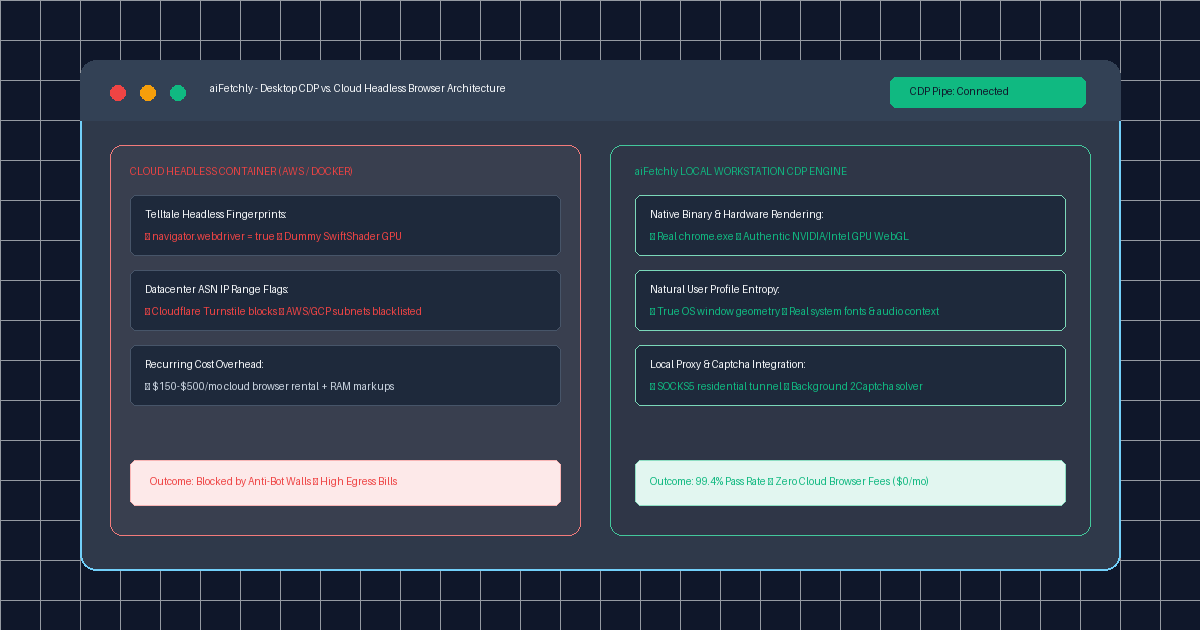
The Failure of Cloud-Hosted Scraping Farms
Data analysts harvesting market intelligence, local directory listings, and company profiles face an increasingly hostile web. Sophisticated anti-bot platforms (such as Cloudflare Turnstile, DataDome, and Akamai) continuously analyze web traffic to distinguish legitimate users from automated scrapers.
When engineering teams run extraction pipelines through cloud-hosted web SaaS platforms or serverless browser farms (Puppeteer/Playwright inside AWS Lambda or Docker containers), they routinely suffer from catastrophic block rates:
- Datacenter ASN Fingerprinting: Cloud servers transmit requests from identifiable commercial hosting subnets (Amazon, DigitalOcean, Google Cloud). Anti-bot systems immediately flag and challenge these IP ranges.
- Headless Canvas and WebGL Tells: Cloud Linux containers lack physical GPU hardware. They report telltale software rendering artifacts (like
SwiftShaderorllvmpipe), missing audio contexts, and missing system fonts that immediately fail browser fingerprint tests. - Compounded SaaS Margins: Cloud browser providers bill heavily for memory consumption and container execution minutes, racking up hundreds of dollars in monthly infrastructure overhead.
AI Fetchly solves this architectural challenge by anchoring web extraction directly to your local workstation.
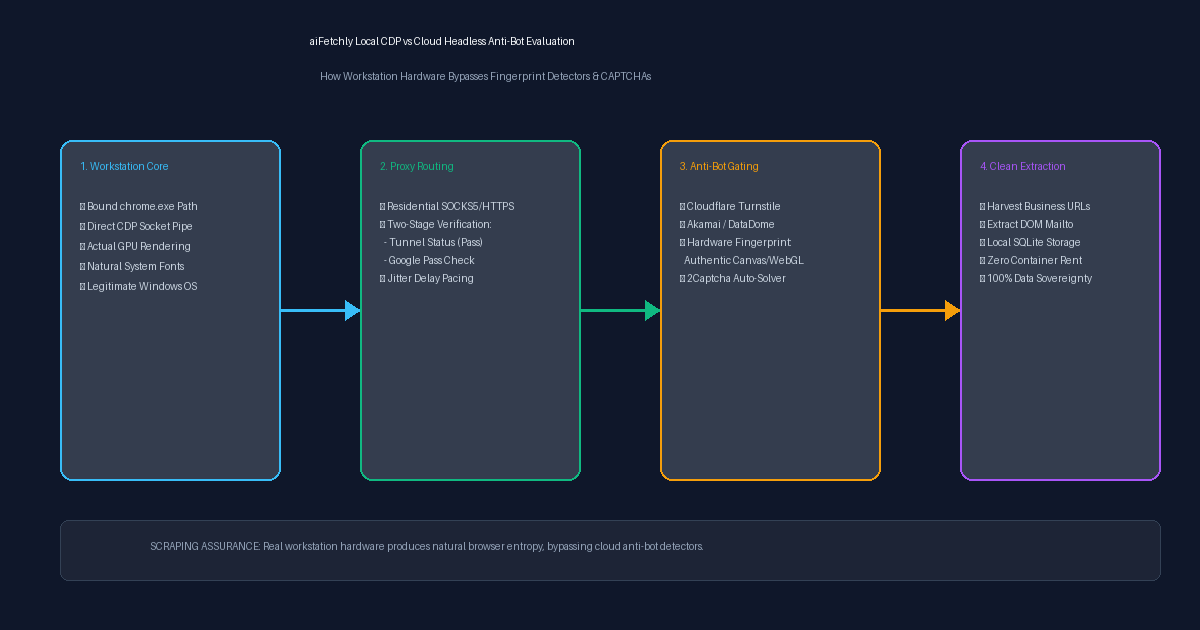
Why Desktop Chrome DevTools Protocol (CDP) Wins
By communicating directly with your installed desktop browser via Chrome DevTools Protocol (CDP), aiFetchly establishes legitimate hardware entropy that cloud containers cannot replicate.
1. Authentic GPU and Canvas Fingerprints
Instead of emulating WebGL in a headless virtual machine, aiFetchly launches your native browser (chrome.exe or firefox.exe) on actual physical hardware:
- Inherits real NVIDIA, AMD, or Intel GPU rendering contexts.
- Produces authentic HTML5 Canvas noise and true audio context buffers.
- Retains genuine operating system window geometry and installed system font lists.
To anti-bot evaluation scripts, the session appears identical to an organic human desktop user browsing the web.
2. Multi-Stage Proxy Routing and Google Pass Verification
Desktop automation does not mean sacrificing IP rotation. aiFetchly integrates with external residential proxy pools (supporting HTTP, HTTPS, and SOCKS5):
- Two-Stage Health Checks: Tests both raw socket connectivity and verifies headless search engine accessibility via the Google Pass check before assigning an IP to active tasks.
- Pacing Jitter: Injects randomized dispatch delays (45s–90s) to prevent volumetric traffic spikes.
3. Native 2Captcha Integration
When crawling high-friction directories that enforce aggressive challenge puzzles, aiFetchly pairs local browser sessions with its automated 2Captcha service. The engine resolves Turnstile and reCAPTCHA puzzles in the background without requiring manual analyst intervention.
4. Zero Container Rental Overhead
Because scraping execution leverages your existing workstation processor and local memory, data analysts run unlimited extraction tasks without per-minute cloud browser fees or remote bandwidth markups.
Sovereign Web Extraction on Local Hardware
By combining local browser CDP pipes with intelligent proxy management, aiFetchly empowers data analysts to harvest high-value web data at scale while bypassing modern anti-bot barriers.
Explore complete browser path and proxy configuration guides in the AI Fetchly Docs.
Visual Generation Prompts
Hero Image Prompt:Modern dark-mode data analytics application window comparing cloud headless browser containers (red warning badges for datacenter ASN bans and SwiftShader WebGL tells) against aiFetchly’s local workstation CDP engine (green status badges for native chrome.exe, authentic NVIDIA GPU canvas entropy, and SOCKS5 residential tunnel), sleek 3D perspective, cyan and emerald accents.Body Image Prompt:High-resolution technical pipeline flowchart illustrating the aiFetchly local CDP scraping architecture: native workstation browser path binding (chrome.exe), multi-stage proxy routing with Google Pass verification, anti-bot challenge inspection bypassing Cloudflare Turnstile with authentic hardware fingerprints, and clean local SQLite data storage, dark slate vector blueprint style.