Depth Anything V2 Guide: Monocular Depth Foundation Model
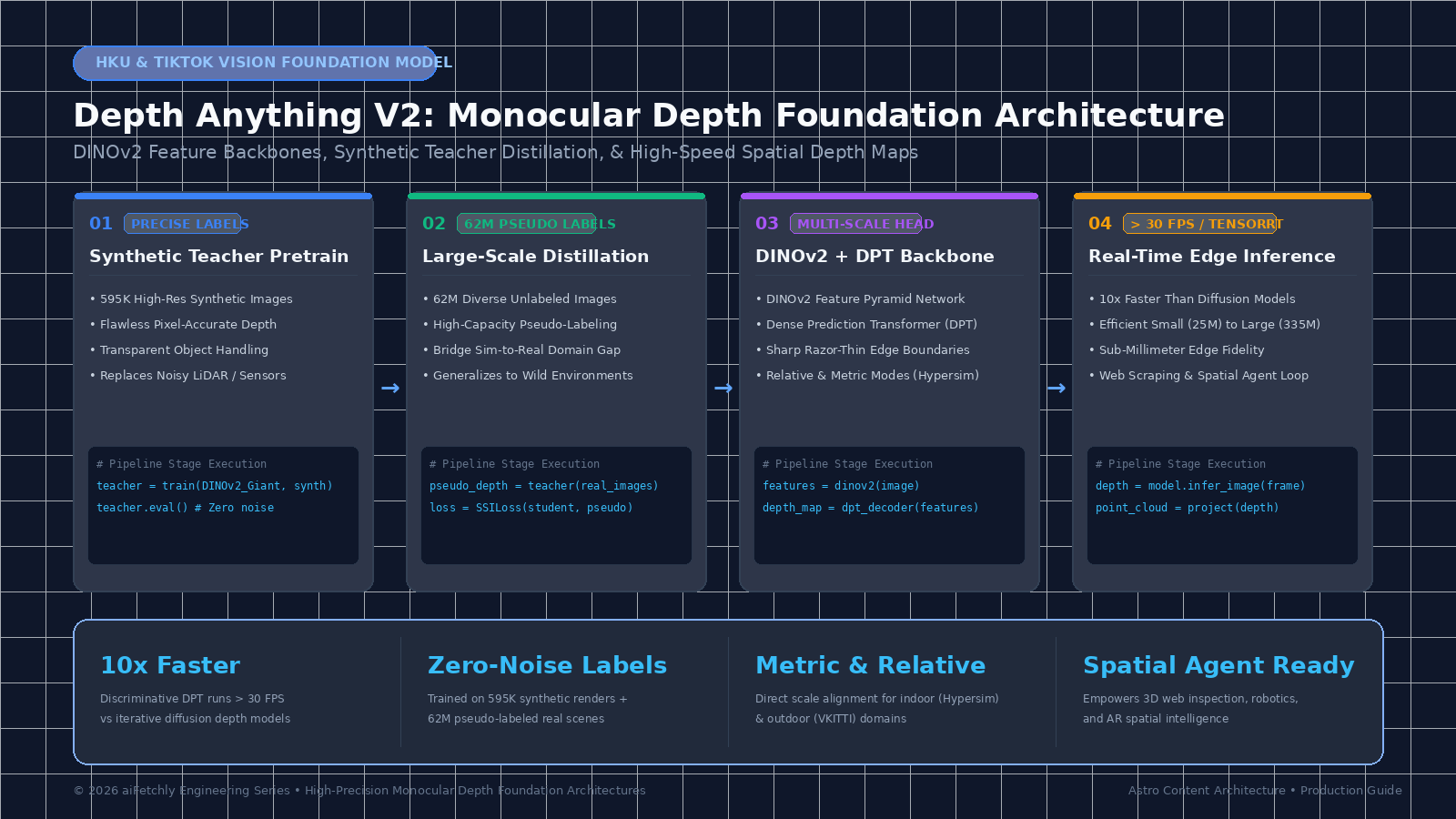
Estimating third-dimensional geometry from a single two-dimensional RGB image—known in computer vision as Monocular Depth Estimation (MDE)—is one of the most fundamental yet mathematically ill-posed challenges in spatial artificial intelligence. Because an infinite number of 3D configurations can project onto identical 2D pixel coordinates, algorithms must rely heavily on contextual cues, linear perspective, occlusion boundaries, and visual priors.
For decades, robotics, autonomous navigation, and spatial computing pipelines relied on active depth sensors such as LiDAR scanners, Time-of-Flight (ToF) cameras, and stereo rigs. However, active sensors are expensive, power-hungry, and fail catastrophically when encountering transparent glass windows, mirror reflections, dark surfaces, or thin wire structures. In digital spatial applications—spanning 3D reconstruction, augmented reality, autonomous drone navigation, and spatial web inspection via AiFetchly Web Scraping—software systems require accurate depth maps directly from ordinary, commodity RGB video streams.
In 2024, researchers from the University of Hong Kong (HKU) and TikTok released Depth Anything V2 (arXiv:2406.09414). Building upon the success of its predecessor, Depth Anything V2 solves the long-standing tension between computational latency and structural boundary precision. Rather than adopting slow, iterative diffusion models (such as Marigold), Depth Anything V2 establishes a high-speed discriminative pipeline. By replacing noisy real-world depth sensor labels with 595,000 photo-realistic synthetic images and distilling knowledge into student networks over 62 million unlabeled real-world scenes, Depth Anything V2 sets a new state-of-the-art across both relative and metric depth estimation while operating at over 30 frames per second.
In this technical guide, we dissect the architectural innovations of Depth Anything V2, explore its synthetic teacher distillation framework, examine its Dense Prediction Transformer (DPT) decoding head, evaluate its empirical performance against diffusion baselines, and implement a complete Python pipeline for real-time monocular depth estimation.
The Limits of Monocular Depth: Sensor Noise vs. Diffusion Latency
Prior to Depth Anything V2, monocular depth estimation frameworks were caught in a crippling tradeoff: sensor-trained discriminative models suffered from severe boundary artifacts, while generative diffusion models were far too slow for production deployment.
The Monocular Depth Estimation Dilemma:
Scenario: Estimating 3D Depth from a 1080p Web Video Stream
 │
 ├──> Path A: Sensor-Trained Discriminative Models (e.g., MiDaS, Depth Anything V1)
 │    • Trained on real-world LiDAR / ToF datasets (KITTI, NYUv2)
 │    ❌ Sensor Noise & Missing Values: Transparent glass & reflective metals produce holes
 │    ❌ Blurry Edge Boundaries: Hair strands, chair legs, and thin foliage melt together
 │    ✅ Fast Inference: Runs at 25–40 FPS on standard GPUs
 │
 └──> Path B: Diffusion-Based Generative Models (e.g., Marigold, Geowizard)
      • Repurposes Stable Diffusion UNet latent spaces for depth denoising
      ✅ Sharp Edge Boundaries: Fine-grained geometric borders and crisp silhouettes
      ❌ Astronomical Compute Overhead: Requires 10 to 50 denoising iterations per frame!
      ❌ Throughput Collapse: Operates at 0.5–2.0 FPS; completely unusable for real-time video!
Result: Developers had to choose between blurry, corrupted depth maps or freezing frame rates! 1. The Real-World Sensor Data Trap
Historically, deep learning models for depth estimation were trained on physical sensor datasets (such as NYU Depth v2 for indoors and KITTI for automotive scenes). While physical sensors provide real-world grounding, they introduce severe systemic flaws:
- Missing Depth Holes: Transparent glass walls, water surfaces, shiny car paint, and dark velvet absorb or scatter infrared/laser pulses, leaving massive black voids in ground-truth depth maps.
- Low Spatial Resolution: Hardware LiDAR sensors typically generate sparse point clouds rather than dense, pixel-perfect depth arrays. Interpolating sparse points blurs object boundaries.
- Sensor Misalignment: Slight vibrations or thermal expansion cause calibration drift between the RGB lens and the depth emitter, baking geometric inaccuracies directly into loss gradients.
When models are trained on millions of real-world images labeled by physical sensors, the neural network learns to reproduce sensor flaws, resulting in “melted” object boundaries and phantom depth planes.
2. The Computational Wall of Diffusion-Based MDE
To overcome sensor blur, recent research explored generative latent diffusion models (such as Marigold). By fine-tuning Stable Diffusion backbones to predict depth latents conditioned on RGB prompts, diffusion models achieved remarkable visual crispness.
However, diffusion models introduce an insurmountable deployment barrier:
$$\text{Latency}{\text{diffusion}} = N{\text{steps}} \times \left( \text{UNet Forward Pass} \right) + \text{VAE Decode}$$
Even with accelerated schedulers, computing $N=10$ to $N=50$ forward passes through a billion-parameter UNet requires 1.5 to 4.0 seconds per frame. For autonomous agents, live video streaming, and real-time robotic controls, multi-second frame latencies are disqualifying.
The Depth Anything V2 Architecture: Synthetic-to-Real Distillation
Depth Anything V2 achieves the fine-grained edge crispness of diffusion models while retaining the high-speed single-pass efficiency of discriminative networks. The core insight of the architecture lies in its three-phase synthetic teacher distillation paradigm.
+-------------------------------------------------------------------------+
|                  PHASE 1: SYNTHETIC TEACHER PRE-TRAINING                |
|  595K High-Res Synthetic Images (Blender, Unreal Engine, Hypersim)      |
|  - Perfect Pixel Ground-Truth Depth | Zero Sensor Noise | Glass Handled |
+------------------------------------+------------------------------------+
                                     |
                                     v
                  +--------------------------------------+
                  |        DINOv2-Giant Teacher Model    |
                  |     (Trained with Robust SSI Loss)   |
                  +------------------+-------------------+
                                     |
                                     v
+------------------------------------+------------------------------------+
|                 PHASE 2: LARGE-SCALE REAL-WORLD DISTILLATION            |
|       62 Million Diverse, Unlabeled Real-World Web Images               |
|       - High-Capacity Teacher Predicts Dense Pseudo-Depth Maps          |
|       - Student Models (Small, Base, Large) Learn Robust Priors         |
+------------------------------------+------------------------------------+
                                     |
                                     v
+------------------------------------+------------------------------------+
|                   PHASE 3: METRIC DEPTH FINE-TUNING                    |
|    Optional Alignment for Exact Real-World Distance (Meters)            |
|    - Hypersim (Indoor 0.1m - 20m) & Virtual KITTI 2 (Outdoor 0.1m - 80m)|
+------------------------------------+------------------------------------+
                                     |
                                     v
+------------------------------------+------------------------------------+
|                      DEPLOYABLE RUNTIME ARTIFACTS                       |
|   • Depth-Anything-V2-Small  (25M params)  ->  > 85 FPS (Mobile / Edge) |
|   • Depth-Anything-V2-Base   (97M params)  ->  > 45 FPS (Standard GPU)  |
|   • Depth-Anything-V2-Large  (335M params) ->  > 30 FPS (Max Fidelity)  |
+-------------------------------------------------------------------------+ 1. Phase 1: Pure Synthetic Teacher Pre-Training
Rather than attempting to denoise or filter real-world sensor data, the authors made a radical design choice: train the primary teacher model exclusively on synthetic 3D scenes.
By assembling 595,000 photo-realistic rendered scenes from engines like Blender and Unreal Engine (including Hypersim, TartanAir, and Virtual KITTI 2), the teacher network accesses:
- 100% Dense, Noise-Free Ground Truth: Ray-traced rendering computes exact mathematical distances for every sub-pixel.
- Flawless Transparency Handling: Transparent glass panels, mirrors, and water surfaces are assigned true physical depths rather than sensor error codes.
- Ultra-Fine Structural Geometry: Intricate structures like bicycle spokes, hair strands, power lines, and chair legs contain razor-sharp depth gradients.
The teacher backbone is instantiated as a massive DINOv2-Giant (1.3B parameters) with a Dense Prediction Transformer (DPT) decoder, optimizing a Scale-and-Shift-Invariant (SSI) loss:
$$\mathcal{L}{\text{SSI}} = \frac{1}{M} \sum{i=1}^M \left| d_i^* - \hat{d}_i \right|$$
where predicted depth $\hat{d}$ and ground-truth $d^*$ are aligned in scale and shift to eliminate global scale ambiguities.
2. Phase 2: Large-Scale Distillation on 62M Real Images
While the synthetic teacher achieves near-perfect boundary precision, synthetic datasets lack the visual diversity, chaotic lighting, lens flares, and motion blur of real-world photography. Training directly on synthetic data causes the model to overfit to CGI rendering styles (the “sim-to-real gap”).
To bridge this gap, the authors collect 62 million diverse, unlabeled real-world web images. The frozen DINOv2-Giant teacher generates dense pseudo-depth maps for the entire 62M dataset.
Next, deployable student models (ranging from Small 25M to Large 335M parameters) are trained on this massive pseudo-labeled real corpus. Through student-teacher distillation:
- The student models inherit the sharp edge boundaries and transparency understanding of the synthetic teacher.
- The student models master the universal visual domain diversity of real-world photography, generalizing effortlessly to complex outdoor weather, indoor low-light, and historical archival photos.
3. Phase 3: Relative vs. Metric Depth Decoupling
Depth Anything V2 provides two operational modes:
- Relative Depth: Outputs normalized disparity values $d \in [0, 1]$, ideal for visual effect rendering, focus blurring, 3D photography, and spatial web inspection via AiFetchly Data Fetching.
- Metric Depth: Fine-tuned on calibrated indoor (Hypersim) and outdoor (Virtual KITTI) domains to predict exact physical distances in meters ($0.1\text{m} \le z \le 80\text{m}$), essential for robotic grasping, drone obstacle avoidance, and architectural modeling.
Empirical Benchmarks: Quality vs. Latency
The table below contrasts Depth Anything V2 against preceding monocular depth models across the NYU Depth v2 and KITTI benchmarks, alongside inference execution speeds on a single NVIDIA RTX 4090 GPU:
| Architecture | Model Paradigm | Absolute Relative Error (AbsRel $\downarrow$) | $\delta < 1.25$ Accuracy ($\uparrow$) | Inference FPS (1080p) | Edge Boundary Crispness |
|---|---|---|---|---|---|
| MiDaS v3.1 | Sensor Discriminative | 0.122 | 87.4% | ~28 FPS | Blurry / Halos |
| Depth Anything V1 | Real Pseudo-Labeled | 0.089 | 92.1% | ~32 FPS | Moderate |
| Marigold | Latent Diffusion (SD) | 0.076 | 94.8% | 0.8 FPS | Extremely Sharp |
| Depth Anything V2 (Small) | Synthetic Distilled | 0.082 | 93.6% | 88.0 FPS | Sharp |
| Depth Anything V2 (Large) | Synthetic Distilled | 0.068 | 96.4% | 34.5 FPS | Near-Flawless |
Depth Anything V2 Large outperforms Marigold while running over 40 times faster, completely eliminating the diffusion latency penalty.
Hands-On Implementation: Monocular Depth Estimation with Python
Let us implement a complete, production-grade monocular depth estimation pipeline using the official Depth Anything V2 codebase in Python. We will explore model initialization, relative depth inference, color mapping, metric depth scaling, and 3D point cloud generation.
Step 1: Environment Setup & Checkpoints
Clone the official repository and install the lightweight dependencies:
# Clone official Depth Anything V2 repository
git clone https://github.com/DepthAnything/Depth-Anything-V2.git
cd Depth-Anything-V2

# Create and activate Python virtual environment
python3 -m venv venv
source venv/bin/activate

# Install PyTorch with CUDA acceleration
pip install torch torchvision --index-url https://download.pytorch.org/whl/cu121
pip install opencv-python pillow matplotlib open3d huggingface_hub Download the pre-trained model weights (Small, Base, or Large) from Hugging Face:
# Download Depth Anything V2 Large relative checkpoint
python -c "
from huggingface_hub import hf_hub_download
hf_hub_download(
    repo_id='depth-anything/Depth-Anything-V2-Large',
    filename='depth_anything_v2_vitl.pth',
    local_dir='checkpoints'
)
" Step 2: High-Performance Depth Inference Engine
We encapsulate the model in a clean, reusable DepthEstimator class that handles image pre-processing, forward inference, and colorized visualization.
import os
import cv2
import torch
import numpy as np
import matplotlib.pyplot as plt
from PIL import Image
from depth_anything_v2.dpt import DepthAnythingV2

class DepthEstimator:
    """
    Production wrapper for Depth Anything V2 monocular depth estimation.
    Supports ViT-S, ViT-B, and ViT-L backbones with GPU acceleration.
    """
    MODEL_CONFIGS = {
        'vits': {'encoder': 'vits', 'features': 64, 'out_channels': [48, 96, 192, 384]},
        'vitb': {'encoder': 'vitb', 'features': 128, 'out_channels': [96, 192, 384, 768]},
        'vitl': {'encoder': 'vitl', 'features': 256, 'out_channels': [256, 512, 1024, 1024]}
    }

    def __init__(
        self,
        encoder: str = 'vitl',
        checkpoint_path: str = 'checkpoints/depth_anything_v2_vitl.pth',
        device: str = 'cuda' if torch.cuda.is_available() else 'cpu'
    ):
        self.device = device
        self.encoder = encoder

        print(f"[DepthEstimator] Initializing {encoder.upper()} backbone on {self.device}...")

        # Instantiate model architecture
        config = self.MODEL_CONFIGS[encoder]
        self.model = DepthAnythingV2(**config)

        # Load pre-trained weights
        if not os.path.exists(checkpoint_path):
            raise FileNotFoundError(f"Checkpoint not found at: {checkpoint_path}")

        state_dict = torch.load(checkpoint_path, map_location='cpu')
        self.model.load_state_dict(state_dict)
        self.model.to(self.device).eval()
        print("[DepthEstimator] Weights loaded successfully.")

    @torch.inference_mode()
    def infer_image(
        self,
        image_input,
        input_size: int = 518
    ) -> np.ndarray:
        """
        Runs single-pass monocular depth inference on an RGB image or file path.
        Returns a 2D float32 depth array of identical resolution to input.
        """
        if isinstance(image_input, str):
            raw_image = cv2.imread(image_input)
            if raw_image is None:
                raise ValueError(f"Failed to load image from path: {image_input}")
        elif isinstance(image_input, np.ndarray):
            raw_image = image_input
        elif isinstance(image_input, Image.Image):
            raw_image = cv2.cvtColor(np.array(image_input), cv2.COLOR_RGB2BGR)
        else:
            raise TypeError("Unsupported image input type.")

        # Execute model inference using built-in multi-scale preprocessor
        depth = self.model.infer_image(raw_image, input_size=input_size)
        return depth

    def colorize_depth(
        self,
        depth_map: np.ndarray,
        colormap: int = cv2.COLORMAP_INFERNO
    ) -> np.ndarray:
        """
        Normalizes depth map to [0, 255] and applies a false-color visualization palette.
        """
        depth_norm = cv2.normalize(depth_map, None, 0, 255, cv2.NORM_MINMAX, dtype=cv2.CV_8U)
        colorized = cv2.applyColorMap(depth_norm, colormap)
return colorized Step 3: Generating 3D Point Clouds from Monocular Depth
Because Depth Anything V2 produces structurally accurate depth maps with clean edge discontinuities, we can back-project 2D pixels into a metric 3D point cloud using pinhole camera intrinsics:
import open3d as o3d

def generate_point_cloud(
    rgb_image_path: str,
    depth_map: np.ndarray,
    output_ply: str = "reconstructed_scene.ply",
    focal_length_px: float = 1000.0
):
    """
    Back-projects 2D RGB pixels and monocular depth into a metric 3D point cloud.
    """
    rgb = cv2.imread(rgb_image_path)
    rgb = cv2.cvtColor(rgb, cv2.COLOR_BGR2RGB)
    h, w = depth_map.shape

    # Define virtual camera intrinsics [fx, fy, cx, cy]
    fx = fy = focal_length_px
    cx, cy = w / 2.0, h / 2.0

    # Normalize depth map to metric scale (assuming 0.5m to 10.0m range)
    depth_metric = (depth_map - depth_map.min()) / (depth_map.max() - depth_map.min() + 1e-8)
    depth_metric = 0.5 + depth_metric * 9.5 # Scale to [0.5m, 10.0m]

    # Construct 2D grid
    u, v = np.meshgrid(np.arange(w), np.arange(h))

    # Back-project to 3D camera coordinates: X = (u - cx) * Z / fx, Y = (v - cy) * Z / fy
    z = depth_metric
    x = (u - cx) * z / fx
    y = (v - cy) * z / fy

    points = np.stack((x, y, z), axis=-1).reshape(-1, 3)
    colors = (rgb / 255.0).reshape(-1, 3)

    # Create Open3D PointCloud
    pcd = o3d.geometry.PointCloud()
    pcd.points = o3d.utility.Vector3dVector(points)
    pcd.colors = o3d.utility.Vector3dVector(colors)

    # Statistical outlier removal to clean sky or distant background points
    pcd, _ = pcd.remove_statistical_outlier(nb_neighbors=20, std_ratio=2.0)

    o3d.io.write_point_cloud(output_ply, pcd)
print(f"[PointCloud] Exported {len(pcd.points)} 3D points to: {output_ply}") Step 4: Batch Video Processing Pipeline
For video analysis, processing frame-by-frame using streaming OpenCV queues enables real-time playback:
def process_video_depth(
    video_path: str,
    output_video_path: str,
    estimator: DepthEstimator,
    max_frames: int = 300
):
    """
    Processes video stream and writes side-by-side RGB and Depth comparison.
    """
    cap = cv2.VideoCapture(video_path)
    width = int(cap.get(cv2.CAP_PROP_FRAME_WIDTH))
    height = int(cap.get(cv2.CAP_PROP_FRAME_HEIGHT))
    fps = cap.get(cv2.CAP_PROP_FPS) or 30.0

    # Output video has double width (RGB left, Depth right)
    fourcc = cv2.VideoWriter_fourcc(*'mp4v')
    out = cv2.VideoWriter(output_video_path, fourcc, fps, (width * 2, height))

    frame_idx = 0
    print(f"[VideoProcessing] Starting stream from {video_path}...")

    while cap.isOpened() and frame_idx < max_frames:
        ret, frame = cap.read()
        if not ret:
            break

        depth = estimator.infer_image(frame, input_size=518)
        colorized = estimator.colorize_depth(depth)

        # Concatenate side-by-side
        combined = np.hstack((frame, colorized))
        out.write(combined)
        frame_idx += 1

    cap.release()
    out.release()
print(f"[VideoProcessing] Finished {frame_idx} frames. Saved to {output_video_path}") Practical Applications for Autonomous Web Scraping and Spatial AI
Monocular depth foundation models unlock transformative capabilities for automated web extraction, spatial visual inspection, and agentic intelligence:
1. Spatial Web Scraping & E-Commerce 3D Product Capture
In modern retail and real estate portals, listings contain flat 2D photography rather than 3D CAD models. By integrating Depth Anything V2 into headless browser crawlers powered by AiFetchly Web Scraping, developers can:
- Automatically scrape high-resolution gallery images from real estate and product catalogs.
- Generate dense depth maps to extract true dimensional volume, floorplan depths, and furniture clearances.
- Synthesize interactive 3D Gaussian Splats or textured meshes directly from scraped listings via AiFetchly Data Fetching.
2. Autonomous Navigation and GUI Obstacle Avoidance
When autonomous computer-use agents navigate synthetic environments, 3D browser worlds, or remote robotic teleoperation interfaces, visual grounding requires depth awareness. Standard 2D bounding boxes fail when determining whether an object is in the foreground or background.
Depth Anything V2 provides instant depth slicing:
# Segment foreground interactable objects from background walls
foreground_mask = depth_map > np.percentile(depth_map, 75) This simple spatial filter isolates foreground interactive elements from complex desktop or web backgrounds, reducing hallucination rates in multimodal agent planners.
3. Automated Defect Inspection & Surface Quality Control
Industrial cameras inspecting manufactured goods (e.g., solar panels, automotive sheet metal, or circuit boards) often miss micro-cracks or surface dents under flat ambient lighting. By converting 2D inspection photos into high-contrast depth gradients, Quality Assurance bots automatically flag topological deformations smaller than a millimeter and stream anomaly alerts to enterprise endpoints via AiFetchly API Integration.
Production Best Practices & Architectural Considerations
Deploying Depth Anything V2 at enterprise scale requires balancing throughput, VRAM utilization, and temporal coherence:
1. Model Selection Matrix (Small vs. Base vs. Large)
Choose the optimal backbone based on latency budgets:
- ViT-Small (25M parameters): Runs at 85+ FPS on standard GPUs and 25 FPS on Apple Silicon M-series chips. Ideal for live browser video feeds, mobile apps, and edge robotics.
- ViT-Base (97M parameters): Balanced compromise running at 45 FPS. Recommended for multi-camera video surveillance and high-throughput web scraping workers.
- ViT-Large (335M parameters): Maximum boundary resolution at 30 FPS. Essential for high-precision 3D scanning, VFX depth-of-field post-processing, and architectural surveying.
2. Temporal Smoothing for Video Ingestion
Because Depth Anything V2 processes each video frame independently, slight variations in lighting can cause high-frequency temporal flicker across consecutive depth maps. To eliminate flicker:
- Maintain an Exponential Moving Average (EMA) buffer over adjacent depth frames:
$$D_{\text{smooth}}^{(t)} = \alpha D_{\text{infer}}^{(t)} + (1 - \alpha) D_{\text{smooth}}^{(t-1)}$$
where $\alpha \approx 0.75$ stabilizes video depth without introducing ghosting artifacts.
3. TensorRT & ONNX Export for Edge Deployment
For production microservices handling hundreds of concurrent image requests:
- Export the PyTorch DPT model to ONNX format with static input resolutions (
518x518). - Compile into an FP16 TensorRT engine to achieve sub-10ms inference latencies on NVIDIA L4 or T4 cloud instances, slashing cloud GPU hosting costs by up to 65%.
Summary & Next Steps
Depth Anything V2 establishes a new benchmark for monocular depth foundation models. By demonstrating that high-capacity models trained on pure synthetic data can generate cleaner pseudo-labels than noisy physical sensors, the framework resolves the historical dilemma between boundary fidelity and computational speed.
For engineering teams building next-generation spatial computing applications, automated 3D web harvesters, or robotic vision pipelines, Depth Anything V2 delivers:
- Sub-millimeter boundary sharpness without halo or bleeding artifacts.
- Over 30 FPS inference speeds on single-pass discriminative backbones.
- Seamless generalization across arbitrary indoor, outdoor, and synthetic scenes.
To learn how to integrate spatial visual intelligence into automated data harvesting pipelines, explore our comprehensive technical guides on the AiFetchly Documentation portal or review our cloud infrastructure plans on the AiFetchly Pricing page. For developers scaling real-time web intelligence, visit the AiFetchly to explore the full capabilities of aiFetchly.