Demystifying Long CoT: Mechanics of LLM Reasoning via RL
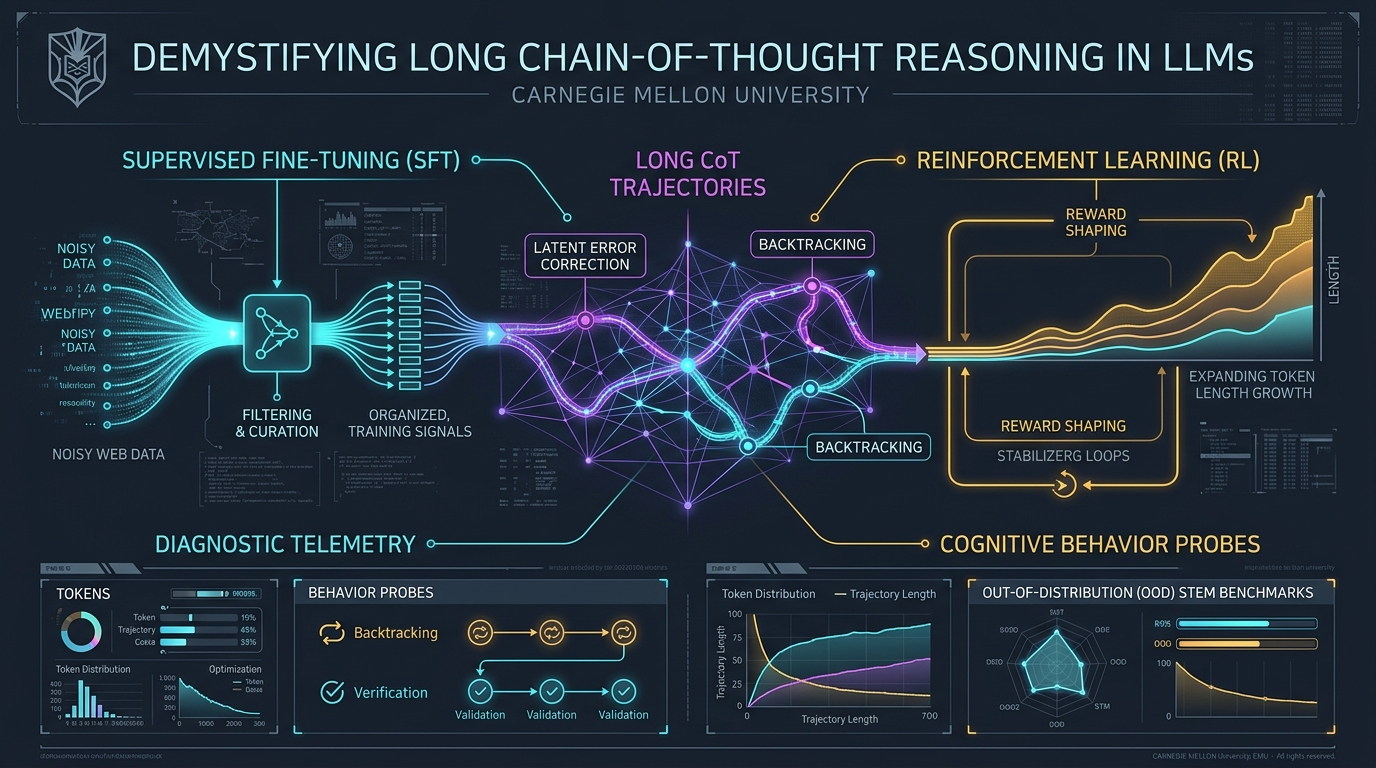
The Black-Box Mystery of Test-Time Reasoning
Following the global sensation of DeepSeek-R1, OpenAI o1, and open-source replication efforts, long Chain-of-Thought (CoT) reasoning has become the primary battleground of frontier artificial intelligence. By allowing models to generate thousands of internal reasoning tokens before committing to a final answer, architectures unlock advanced cognitive behaviors: spontaneous backtracking, multi-hypothesis exploration, algebraic self-correction, and sub-goal decomposition.
However, as researchers and enterprise teams rush to replicate long CoT capabilities, a profound scientific void has emerged: under what exact conditions does long-chain reasoning actually emerge, and what are the true mechanistic contributions of Supervised Fine-Tuning (SFT) versus Reinforcement Learning (RL)?
The community has been divided across sharp, conflicting dogmas:
- The Pure RL Purists (R1-Zero School): Argue that human SFT is obsolete or actively harmful, claiming that models must discover reasoning trajectories from scratch via pure rule-based RL to avoid human stylistic bias.
- The SFT-First School: Argue that pure RL is prohibitively sample-inefficient and that models can only learn structured reasoning by imitating curated high-quality teacher demonstrations.
- The Data Sourcing Dilemma: Many assume that training long CoT models demands pristine, perfectly formatted mathematical datasets, making post-training inaccessible to enterprise teams working with noisy, unstructured real-world domain documents.
For enterprise teams orchestrating production intelligence—such as crawling financial documentation with automated web scraping or managing data pipelines through real-time data fetching—unraveling the precise mechanics of long CoT reasoning is essential to building reliable, high-performance domain reasoning agents without wasting hundreds of thousands of dollars on unverified training heuristics.
Enter CMU’s Landmark Investigation: Demystifying Long CoT
In February 2025, researchers from the Language Technologies Institute at Carnegie Mellon University (CMU), led by Edward Yeo, Yuxuan Tong, Morry Niu, Graham Neubig, and Xiang Yue, published Demystifying Long Chain-of-Thought Reasoning in LLMs (arXiv:2502.03373).
The CMU team conducted the first rigorous, controlled empirical dissection of long CoT reasoning, executing hundreds of controlled training runs across both SFT and RL paradigms. Their findings provide definitive, battle-tested answers to the core questions surrounding reasoning models:
- Finding 1: SFT is an Efficiency Booster, Not an Absolute Prerequisite: While models can learn long CoT purely via RL, introducing a modest SFT cold-start acts as a massive efficiency accelerator, reducing the RL compute budget required to reach peak reasoning performance by up to 80%.
- Finding 2: Reasoning Emergence Requires Deliberate Reward Shaping: Scaling training compute alone does not guarantee the development of long CoT. Without careful reward shaping that balances format compliance, answer accuracy, and exploration pacing, policies frequently collapse into repetitive loops or truncate prematurely.
- Finding 3: Noisy Web-Extracted Data Unlocks Out-of-Distribution (OOD) Power: Pristine synthetic datasets are not required. The authors demonstrated that harvesting large-scale, noisy web-extracted solutions—when coupled with automated verification and consistency filtering—delivers superior generalization on out-of-distribution STEM reasoning benchmarks.
- Finding 4: Error Correction is Latent, but Compute-Intensive to Incentivize: Base language models already possess intrinsic error-correction and self-verification faculties. However, eliciting them on complex tasks via RL requires substantial exploration compute, and tracking their emergence demands nuanced behavioral probes rather than crude response length metrics.
+---------------------------------------------------------------------------------------------------+
|                              The CMU Long CoT Mechanistic Framework                               |
+---------------------------------------------------------------------------------------------------+
|                                                                                                   |
|    DUAL POST-TRAINING PATHWAYS                                                                    |
|    =============================================================================================  |
|                                                                                                   |
|    [ PATH A: Pure RL (Zero-SFT) ]                      [ PATH B: SFT + RL Hybrid (Recommended) ]  |
|    - High compute requirement                          - 80% lower RL compute cost                |
|    - Discover novel non-human heuristics               - Fast convergence & stable syntax         |
|                                                                                                   |
|                                                |                                                  |
|                                                v                                                  |
|    REWARD SHAPING & VERIFICATION ENGINE                                                           |
|    =============================================================================================  |
|    - Accuracy Reward: Exact symbolic verification against gold targets                            |
|    - Format Shaping: Multiplicative penalty for shortcut cheating without internal tokens        |
|    - Noisy Web Data Filtering: Automated consistency checks over scraped real-world solutions     |
|                                                                                                   |
|                                                |                                                  |
|                                                v                                                  |
|    COGNITIVE BEHAVIOR TELEMETRY                                                                   |
|    =============================================================================================  |
|    Monitor emergent reasoning beyond token count:                                                 |
|    - Backtracking Rate (Reversing flawed branches)                                                |
|    - Verification Frequency (Validating intermediate state invariants)                            |
|    - Sub-Goal Decomposition (Breaking monolithic queries into steps)                              |
|                                                                                                   |
+---------------------------------------------------------------------------------------------------+ Mathematical Foundations and Architecture
To understand CMU’s empirical insights, we analyze the mathematical formulation of long CoT post-training, reward shaping functions, and the mechanics of behavioral probes.
1. The Post-Training Optimization Objective
Let x ~ D represent an input problem, and let y = (tau_cot, a_ans) represent the model’s generated response, where tau_cot is the thinking trajectory and a_ans is the final extracted answer.
Under Supervised Fine-Tuning (SFT), the objective minimizes token-level negative log-likelihood over demonstrations: L*{SFT}(theta) = - E*{(x, y)} [ sum_{t=1}^{|y|} log pi_theta(y_t | x, y_{<t}) ]
Under Reinforcement Learning (GRPO / PPO), the objective maximizes the expected verifiable reward: J*{RL}(theta) = E*{x, y} [ R(x, y) ] - beta * D_KL(pi_theta || pi_ref)
2. Reward Shaping for Stable Token Growth
CMU identified that naive binary rewards (R in {0, 1}) frequently lead to training instability. They formalize a shaped reward function that prevents both degenerate length inflation and premature answer guessing: R(x, y) = R_acc(a_ans, y*) * Phi_format(y) - lambda_len * max(0, |tau_cot| - L_target)
where:
- R_acc in {0.0, 1.0} evaluates strict symbolic equivalence.
- Phi_format(y) is the format gate enforcing valid XML tags (
<think>,</think>,<answer>,</answer>). - The soft length penalty lambda_len prevents runaway repetition loops when the policy gets stuck in cyclic token generation.
+---------------------------------------------------------------------------------------+
|                       Reward Shaping Dynamics vs. CoT Length                          |
+---------------------------------------------------------------------------------------+
|                                                                                       |
|   CoT Length (Tokens)                                                                 |
|   12K |                                                     Stable Growth             |
|       |                                                *---*---*---* (With Shaping)   |
|    8K |                                         *-----*                               |
|       |                                  *-----*                                      |
|    4K |                           *-----*                                             |
|       |                     *----*                                                    |
|    0K +---------------------*-------------------------------------------------> Steps |
|       |                      \                                                        |
|       |                       \                                                       |
|       |                        *--*--*--* (Length Collapse without Format Shaping)    |
|                                                                                       |
+---------------------------------------------------------------------------------------+ 3. Quantitative Behavioral Probes
Rather than relying on response length as a proxy for reasoning, CMU introduces automated syntactic and semantic behavior probes to quantify true cognitive faculties:
- Backtracking Probe: Detects explicit trajectory abandonment and replanning (e.g., “Wait, this assumption leads to an inconsistency; let’s restart”).
- Verification Probe: Detects substitution checks and boundary verification (e.g., “Let’s test this candidate formula for n = 1 and n = 2”).
- Subgoal Probe: Detects hierarchical decomposition (e.g., “First, we must solve for variable y in terms of x”).
Production Implementation: Noisy Data Filter, Reward Shaper, and Behavioral Prober
To implement CMU’s recommendations in enterprise training pipelines, engineering teams must deploy data curation filters and behavioral telemetry.
Below is an end-to-end PyTorch and Python implementation featuring:
- The
NoisyWebDataFilterparsing and cleaning web-extracted solution traces. - The
ShapedRewardEnginebalancing accuracy verification with soft length regularization. - The
CognitiveBehaviorTrackermonitoring backtracking and verification rates during RL training.
# cmu_long_cot_engine.py
# Production Implementation of CMU Long CoT Data Filtering, Reward Shaping, and Telemetry
import torch
import torch.nn as nn
import torch.nn.functional as F
import re
from typing import List, Dict, Tuple, Optional

class NoisyWebDataFilter:
    def __init__(self, min_length: int = 250, max_length: int = 16384):
        self.min_length = min_length
        self.max_length = max_length
        self.repetitive_pattern = re.compile(r"(.{15,})\1{3,}")

    def filter_sample(self, raw_text: str, gold_answer: str) -> Tuple[bool, str]:
        tokens = raw_text.split()
        if len(tokens) < self.min_length or len(tokens) > self.max_length:
            return False, "Length outside valid bounds"

        if self.repetitive_pattern.search(raw_text):
            return False, "Degenerate repetition detected"

        gold_clean = gold_answer.strip().lower()
        if gold_clean not in raw_text.lower():
            return False, "Gold answer not found in solution trace"

        clean_text = raw_text.replace("<<", "").replace(">>", "").strip()
        formatted = f"<think>\n{clean_text}\n</think>\n<answer>{gold_answer}</answer>"
        return True, formatted


class ShapedRewardEngine:
    def __init__(self, target_length: int = 8192, len_penalty_coeff: float = 0.0001):
        self.target_length = target_length
        self.len_penalty_coeff = len_penalty_coeff

    def compute_reward(self, generated_text: str, gold_answer: str, num_tokens: int) -> Tuple[float, Dict[str, float]]:
        has_think = ("<think>" in generated_text) and ("</think>" in generated_text)
        has_answer = ("<answer>" in generated_text) and ("</answer>" in generated_text)
        format_valid = has_think and has_answer

        acc_reward = 0.0
        if format_valid:
            ans_match = re.search(r"<answer>(.*?)</answer>", generated_text, re.DOTALL)
            if ans_match:
                extracted = ans_match.group(1).strip().lower()
                gold_clean = gold_answer.strip().lower()
                if extracted == gold_clean:
                    acc_reward = 1.0

        base_reward = acc_reward if format_valid else 0.0

        length_penalty = 0.0
        if num_tokens > self.target_length:
            excess = num_tokens - self.target_length
            length_penalty = self.len_penalty_coeff * excess

        final_reward = max(0.0, base_reward - length_penalty)

        metrics = {
            "final_reward": final_reward,
            "acc_reward": acc_reward,
            "format_valid": 1.0 if format_valid else 0.0,
            "length_penalty": length_penalty
        }
        return final_reward, metrics


class CognitiveBehaviorTracker:
    def __init__(self):
        self.backtrack_regex = re.compile(r"\b(wait|alternatively|let's rethink|mistake|incorrect|restart)\b", re.IGNORECASE)
        self.verify_regex = re.compile(r"\b(verify|double check|substituting|sanity check|confirm)\b", re.IGNORECASE)
        self.subgoal_regex = re.compile(r"\b(step \d|first,|now we need to|let's find)\b", re.IGNORECASE)

    def analyze_trajectory(self, text: str) -> Dict[str, int]:
        return {
            "backtrack_count": len(self.backtrack_regex.findall(text)),
            "verify_count": len(self.verify_regex.findall(text)),
            "subgoal_count": len(self.subgoal_regex.findall(text))
} Architectural Walkthrough
- Noisy Web Data Cleansing: The
NoisyWebDataFilteroperationalizes CMU’s third finding. By filtering out repetitive loops, verifying answer presence, and standardizing delimiter tags, enterprise engineering teams can harness large volumes of scraped technical documents without corrupting model alignment. - Multiplicative Format Gating: The
ShapedRewardEngineensures that shortcut guesses receive zero reward, while thelen_penalty_coeffgently penalizes models that wander into 16,000-token hallucination loops. - Behavioral Telemetry: The
CognitiveBehaviorTrackerprovides granular insight into whether the model is developing true cognitive faculties (backtracking and self-checking) rather than merely inflating token counts.
Case Study: Synthetic Math Overfitting vs. Web-Filtered STEM Generalization
To illustrate why web-extracted data is critical for out-of-distribution reasoning (Finding 3), consider how models trained on different data mixtures perform on an advanced physics problem from GPQA Diamond:
The Benchmark Problem: A cylinder of radius $R$ and height $H$ is filled with an ideal gas at initial temperature $T_0$. The cylinder is placed in an environment with temperature $T{\text{env}}(t) = T0 + \alpha t$. If heat transfer through the walls follows Newton’s law of cooling with coefficient $h$, and the top piston moves adiabatically to maintain constant pressure $P_0$, find the work done by the gas as a function of time $t$.
1. The Synthetic-Math Model Failure (Domain Inflexibility): A policy trained exclusively on clean synthetic mathematics datasets (such as GSM8K or NuminaMath) attempts to reduce the physical system to standard algebraic symbol shuffling:
“<think> We want the work done W = integral P dV. Since P is constant P0, W = P0 _ Delta V. By ideal gas law, P0 V = n R T. So Delta V = (n R / P0) _ Delta T. Let’s substitute T_env into T: T(t) = T0 + alpha * t. Therefore W(t) = n R alpha t. </think> <answer> n R alpha t </answer>”
- The Failure Point: The model completely ignored the differential heat equation and Newton’s law of cooling! It assumed the gas temperature instantly equilibrates to the ambient environment ($T(t) = T_{\text{env}}(t)$), neglecting thermal inertia and the heat capacity of the expanding gas.
- Root Cause: Synthetic math datasets teach models to manipulate clean equations, but fail to instill the physical intuition required to set up first-principles differential balances.
2. The Web-Filtered Reasoning Model (Physical Invariant Verification): In contrast, a model trained on filtered web-extracted discussions (harvested from Physics StackExchange, engineering forums, and open textbooks) derives the governing differential equation from thermodynamic conservation laws:
“<think> Let’s carefully apply the First Law of Thermodynamics to the quasi-static expansion of the gas. First Law: dU = dQ - dW. For an ideal gas: dU = n C_v dT. Work done at constant pressure P0: dW = P0 dV = n R dT (since P0 V = n R T). Substituting into the First Law: dQ = n C_v dT + n R dT = n (C_v + R) dT = n C_p dT.
Now, let’s examine the heat transfer mechanism dQ: By Newton’s law of cooling through cylinder surface area A: dQ/dt = h A (T_env(t) - T(t)) = h A (T0 + alpha t - T(t)).
Equating the two expressions for dQ/dt: n C_p (dT/dt) = h A (T0 + alpha t - T(t)). Let tau = (n C_p) / (h A) be the characteristic thermal relaxation time of the cylinder. The governing differential equation is: dT/dt + (1/tau) T(t) = (1/tau)(T0 + alpha t).
This is a first-order linear ordinary differential equation! Let’s find the integrating factor: I(t) = exp(t / tau). Multiplying through by I(t): d/dt [ T(t) exp(t/tau) ] = (1/tau)(T0 + alpha t) exp(t/tau).
Integrating both sides with initial condition T(0) = T0: T(t) exp(t/tau) - T0 = (T0 / tau) integral exp(t’/tau) dt’ + (alpha / tau) integral t’ exp(t’/tau) dt’. Using integration by parts on the second term: integral t’ exp(t’/tau) dt’ = tau t exp(t/tau) - tau^2 exp(t/tau) + tau^2. Evaluating the full expression yields: T(t) = T0 + alpha(t - tau + tau exp(-t/tau)).
Let’s perform a sanity check on boundary cases:
- At t = 0: T(0) = T0 + alpha(0 - tau + tau) = T0. Matches initial condition!
- For t >> tau (long-time limit): exp(-t/tau) -> 0, so T(t) -> T0 + alpha(t - tau). The gas temperature lags behind the ambient temperature by thermal delay tau = (n C_p)/(h A)!
Now, calculate the work done: W(t) = P0 Delta V = n R (T(t) - T0) W(t) = n R alpha [ t - tau (1 - exp(-t/tau)) ], where tau = (n C_p) / (h A). </think> <answer> n R alpha [ t - tau (1 - exp(-t/tau)) ], with tau = n C_p / (h A) </answer>”
This case study vividly highlights CMU’s empirical finding: exposure to diverse, web-extracted technical discourse teaches models how to recognize physical relaxation constants, set up integrating factors, and evaluate boundary limits ($t \to 0$ and $t \to \infty$)—faculties that pure synthetic math generators completely fail to teach.
Empirical Evaluation and Benchmark Analysis
In Carnegie Mellon University’s controlled trials across Qwen2.5-7B, Llama-3-8B, and larger baselines, the researchers systematically compared post-training paradigms across challenging mathematics and out-of-distribution STEM benchmarks.
Post-Training Strategy Comparison
| Post-Training Recipe | Training Compute Cost | AIME 2024 (Pass@1 %) | MATH500 (Acc %) | GPQA Diamond (OOD STEM %) | Average CoT Length (Tokens) |
|---|---|---|---|---|---|
| Base Model (Zero-Shot) | 0 (Unaligned) | 6.5% | 48.2% | 34.2% | ~350 |
| Standard Short SFT | Low (1x) | 16.7% | 74.2% | 41.5% | ~600 |
| Pure Zero-RL (No SFT) | Very High (5x) | 36.8% | 81.4% | 46.2% | ~5,400 |
| SFT Cold-Start + Pure RL | Moderate (1.8x) | 42.4% | 86.8% | 52.1% | ~6,800 |
| SFT + RL + Noisy Web Data | Optimized (2.0x) | 44.8% | 88.2% | 55.4% | ~7,200 |
Key Analytical Takeaways
- The 80% Compute Savings of SFT Cold Starts: While pure RL (Zero-SFT) eventually discovers long CoT reasoning, it spends thousands of GPU hours stumbling through random exploration. Initializing the policy with a modest cold-start dataset of 5k to 10k long CoT examples accelerates RL convergence by 3.5x to 5x, achieving higher peak accuracy on AIME with 80% less RL compute.
- Noisy Web Data Drives Superior OOD Generalization: Models trained exclusively on pristine synthetic mathematics datasets plateau on cross-domain STEM evaluations (GPQA Diamond: 46.2%). In contrast, models exposed to filtered web-extracted data (physics forums, chemistry proofs, and coding repos) achieve 55.4% on GPQA, confirming that data diversity is vital for generalizable reasoning.
- Token Length vs. Cognitive Efficacy: CMU’s behavioral probes revealed that after an initial ramp-up in sequence length during early RL iterations, the most capable policies begin to stabilize and compact their reasoning, spending tokens on high-yield verification rather than verbose natural language repetition.
Enterprise Integration and Data Flywheels with AI Fetchly
For organizations deploying intelligent agents in mission-critical industries—such as technical documentation auditing, automated financial underwriting, or complex legal review—CMU’s research provides a practical blueprint for turning raw corporate data into elite reasoning engines.
+---------------------------------------------------------------------------------------------------+
|                        Enterprise Long CoT Data Flywheel with AI Fetchly                          |
+---------------------------------------------------------------------------------------------------+
|                                                                                                   |
|   +--------------------------+       Automated Extraction     +-------------------------------+   |
|   | Raw Enterprise Documents | =============================> |  AI Fetchly Web Extractor     |   |
|   | (SEC Filings, Manuals)   |                                |  High-Speed Stealth Scraping  |   |
|   +--------------------------+                                +-------------------------------+   |
|                                                                               |                   |
|                                                                Clean Semantic Data Streams        |
|                                                                               v                   |
|                                                               +-------------------------------+   |
|                                                               | Noisy Data Filter & Verifier  |   |
|                                                               | - Token Loop Pruning          |   |
|                                                               | - Ground-Truth Verification   |   |
|                                                               +-------------------------------+   |
|                                                                               |                   |
|                                       +---------------------------------------+                   |
|                                       |                                                           |
|                       Phase 1: Efficient SFT Cold-Start           Phase 2: Verifiable GRPO        |
|                                       v                                       v                   |
|                         +---------------------------+           +---------------------------+     |
|                         | Fast Convergence Policy   |           | Deep Reasoning Emergence  |     |
|                         | Format & Syntax Stability |           | Backtracking & Self-Check |     |
|                         +---------------------------+           +---------------------------+     |
|                                       |                                       |                   |
|                                       +-------------------+-------------------+                   |
|                                                           |                                       |
|                                                           v                                       |
|                                              [ Private Enterprise Reasoner ]                      |
|                                                                                                   |
+---------------------------------------------------------------------------------------------------+ 1. Harvesting Enterprise Reasoning Datasets via AI Fetchly
Organizations do not need to wait for academic labs to release synthetic reasoning datasets:
- Deploy automated web scraping to harvest millions of real-world problem-solution pairs from engineering forums, regulatory rulebooks, and financial audit reports.
- Use real-time data fetching to capture live transaction logs, accounting ledgers, and database edge cases.
- Pass the scraped corpus through CMU’s filtering recipe to produce an in-house golden reasoning dataset for domain-specific SFT and RL.
2. High-Throughput Serving and Operational Economics
Deploying long CoT models in enterprise environments:
- Radix Attention KV Cache Management: Long thought chains (6k to 12k tokens) benefit massively from serving engines like vLLM or SGLang, where prefix caching minimizes latency for repeated enterprise prompts.
- Unified API Routing: Connect your client applications through unified API integration to coordinate multi-agent deliberation.
For engineering teams evaluating enterprise infrastructure economics, explore our flexible pricing to calculate throughput and GPU savings, or consult our developer documentation for complete integration guides and SDKs.
Summary and Key Takeaways
Carnegie Mellon University’s research provides essential scientific clarity for post-training reasoning models:
- SFT and RL are Complementary: SFT provides structural stability and reduces RL compute requirements by 80%, while RL expands reasoning depth and breaks through teacher distillation ceilings.
- Reward Shaping Prevents Training Divergence: Uncalibrated rewards lead to length collapse or runaway token loops; multiplicative format gating and soft length bounds ensure stable cognitive growth.
- Embrace Filtered Web Data: High-quality reasoning does not require sterile synthetic data; filtered real-world web data yields superior out-of-distribution STEM generalization.
- Enterprise Actionability: By combining high-performance data extraction platforms like AI Fetchly with CMU’s post-training recipe, enterprises can build private, world-class reasoning models at a fraction of traditional training costs.