DeferKV Guide: Eviction Timing for KV Cache Compression
Scaling the context window of modern Large Language Models (LLMs) to 64k, 128k, and 1M tokens has unlocked transformative capabilities across enterprise AI: analyzing entire legal libraries, conducting full-codebase architectural refactorings, synthesizing multi-year financial statements, and coordinating autonomous data pipelines through AI Fetchly. Whether streaming extracted market intelligence or executing multi-hop queries via real-time data fetching, today’s intelligent systems require deep contextual memory.
Yet, this massive context capability comes at an immense computational cost. During autoregressive decoding, every newly generated token must attend to all previous tokens, requiring the model to maintain a constantly growing Key-Value (KV) cache in GPU High-Bandwidth Memory (HBM). For an 8B parameter model serving a 128k context in FP16 precision, the KV cache alone demands more than 16 GB of VRAM per request. Serving concurrent requests quickly triggers Out-of-Memory (OOM) errors and degrades throughput.
To alleviate this memory bottleneck, researchers have developed various one-shot KV cache eviction algorithms (such as SnapKV and H2O) that prune low-importance tokens so that only a compact budget remains. However, virtually all existing one-shot compression methods share a fundamental, unchallenged design assumption: they commit to irreversible eviction immediately at the end of the prefill stage, before any signal from actual generation becomes available.
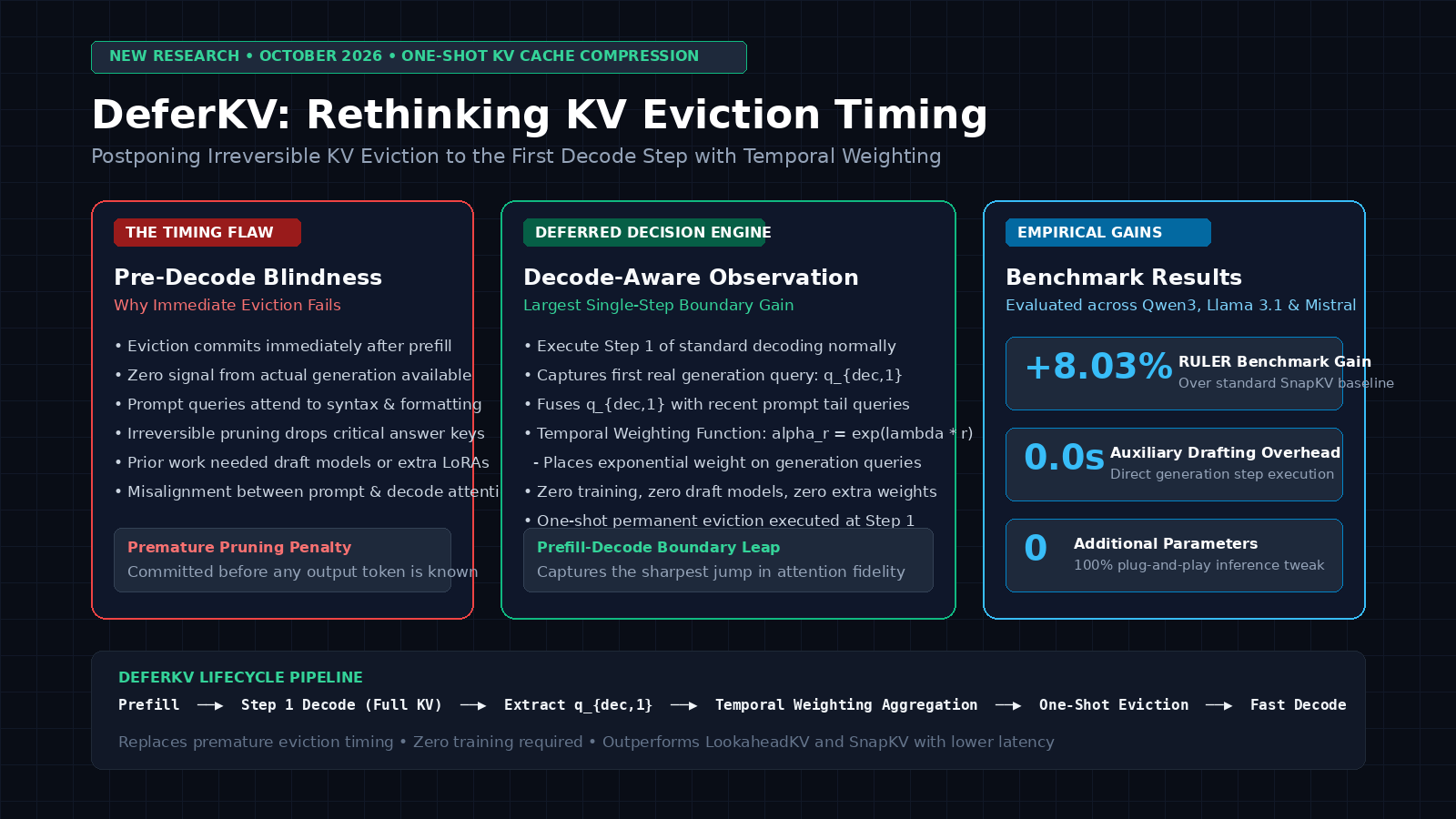
In October 2026, researchers published DeferKV: Rethinking Eviction Timing for One-Shot KV Cache Compression (arXiv:2610.06286). Quantitative analysis revealed that attention patterns undergo a massive structural transition across the boundary between input processing and token generation. By simply deferring the eviction decision by a single decoding step and applying temporal weighting between prompt-side and decode-side queries, DeferKV achieves near-oracle retrieval accuracy and improves RULER benchmark performance by up to 8.03%—all without requiring draft models, auxiliary LoRA adapters, or additional training.
In this comprehensive technical guide, we break down why prefill-time eviction fails, analyze the mathematics of the prefill-decode boundary leap, explore DeferKV’s decode-aware observation window, contrast DeferKV against competing KV pruning paradigms, build a complete PyTorch implementation, and analyze production deployment strategies.
The Problem: The Premature Eviction Trap in One-Shot KV Compression
To understand why standard one-shot KV cache eviction degrades reasoning accuracy, we must examine the hidden flaw in its timing: the pre-generation information vacuum, the shift in attention distribution across the boundary, and the high cost of draft models.
The Premature Eviction Bottleneck:
Prompt: [Document: 64k tokens] + [Query: "Find the total revenue of Subsidiary X in 2024"]
Target Generation: "Based on the filing, Subsidiary X generated $4.2M..."
  │
  ├── 1. Standard One-Shot Eviction (SnapKV, H2O, StreamingLLM):
  │   └── Timing: Executes IMMEDIATELY at the final token of the prompt (t = 0).
  │   └── Information Available: Only prompt tokens (instruction, formatting, syntax).
  │   └── ❌ Fatal Flaw: The prompt tail queries attend heavily to punctuation, markdown headers,
  │       and generic phrasing. They have not yet begun generating the specific answer entity!
  │   └── Consequence: Tokens containing "$4.2M" receive low attention during prefill
  │       and are permanently deallocated from GPU VRAM -> Irreversible Hallucination!
  │
  ├── 2. Auxiliary Future Predictors (Draft Models, Learnable LoRAs):
  │   └── Introduces smaller draft models or extra LoRA adapters to predict future attention.
  │   └── ❌ Tradeoff: Adds 200ms - 500ms drafting latency, training overhead, or extra model weights.
  │
  └── 3. The DeferKV Discovery:
      └── The largest single-step jump in attention accuracy occurs between Step 0 (Prompt Tail)
          and Step 1 (First Generated Token)!
      └── Simply wait ONE step: run Step 1 generation with the full cache, capture q_{dec, 1},
and evict immediately afterward. Zero drafting, zero extra training! The Pre-Generation Information Vacuum
In standard Transformer architectures, the prompt prefill phase processes the entire user input simultaneously. To compress the KV cache, methods like SnapKV define an “observation window” consisting of the last $W_{\text{obs}}$ tokens of the prompt (typically 32 tokens). The model computes how strongly these 32 trailing tokens attend to earlier tokens and prunes everything outside the top-scoring clusters.
However, the tokens at the prompt tail typically consist of structural boilerplate:
- “Answer the question above based on the context.”
- “Format your output in JSON.”
- “\n\nAnswer:”
The queries generated by these prompt tokens reflect task comprehension and structural framing—not the semantic content of the upcoming answer. Quantitative divergence studies show that prompt tail queries have surprisingly low rank correlation with the queries generated during actual decoding. Committing to an irreversible eviction policy at this moment is premature: the model throws away memory before it even knows what direction its response will take.
The Prefill-Decode Boundary Leap
The authors of DeferKV conducted an empirical analysis tracking query attention distributions across sequence transitions. Measuring Jensen-Shannon Divergence (JSD) and Top-$k$ Selection Recall between adjacent query positions across long-context benchmarks (GovReport, MultiNews, QMSum, RepoBench), they made a striking discovery:
$$\Delta \text{Recall}{(-1 \to 1)} \gg \Delta \text{Recall}{(1 \to 2)} \approx \Delta \text{Recall}_{(2 \to 3)}$$
- The Boundary Jump: The single largest increase in attention consistency with future decoding occurs precisely across the prefill-to-decode boundary (between the last prompt token and the first generated token).
- Diminishing Returns Thereafter: The attention consistency gained by waiting for step 2, 3, or 4 of generation yields an average recall improvement of only 0.007, compared to the massive leap observed at step 1.
Waiting for multiple decoding steps would require holding the full, uncompressed KV cache in memory for an extended period, which increases peak VRAM and slows generation. But waiting for exactly one decoding step captures nearly the entire predictive benefit while introducing negligible memory overhead.
DeferKV Architecture: Decode-Aware Observation and Temporal Weighting
DeferKV converts this empirical finding into an elegant, training-free algorithm that operates in three distinct stages: deferred generation, temporally weighted observation fusion, and one-shot cache eviction.
┌────────────────────────────────────────────────────────────────────────────────────────┐
│                              DEFERKV EXECUTION WORKFLOW                                │
├────────────────────────────────────────────────────────────────────────────────────────┤
│                                                                                        │
│   PHASE 1: PREFILL & INITIAL DECODE (Full KV Retention)                                │
│   1. Prompt Prefill: Ingest prompt tokens [x_1, ..., x_N] using standard FlashAttention│
│   2. Store Full Prefill Keys & Values in temporary GPU buffer                          │
│   3. Execute First Decoding Step (t = 1) using full KV cache:                          │
│      ├── Compute first real decode query: q_{dec, 1}                                   │
│      └── Emit first output token: y_1                                                  │
│                                                                                        │
│   PHASE 2: DECODE-AWARE OBSERVATION FUSION                                             │
│   Form unified observation window combining prompt tail and decode query:              │
│   Q_obs = [ q_{prompt, -W+1}, ..., q_{prompt, 0}, q_{dec, 1} ]                         │
│                                                                                        │
│   Apply Exponential Temporal Weighting:                                                │
│   alpha_r = exp( lambda * r ),  r in [-W+1, 0, 1]                                      │
│   ├── Gives modest weight to prompt queries (syntactic framing)                        │
│   └── Assigns maximum exponential weight to q_{dec, 1} (actual response trajectory)    │
│                                                                                        │
│   PHASE 3: ONE-SHOT PERMANENT EVICTION                                                 │
│   1. Compute Aggregated Token Importance:                                              │
│      Score_i = Sum_{r} alpha_r * Attention(q_r, k_i)                                   │
│   2. Reserve Sinks (first 16 tokens) + Recent Context (last 32 tokens)                 │
│   3. Select Top-B Scoring Clusters across prompt positions                             │
│   4. Deallocate Pruned KV Tokens Permanently from GPU HBM                              │
│                                                                                        │
│   PHASE 4: HIGH-THROUGHPUT SUBSEQUENT DECODING (t = 2, 3, ...)                         │
│   Proceed with standard autoregressive generation over compact, pruned KV cache!       │
│                                                                                        │
└────────────────────────────────────────────────────────────────────────────────────────┘ Phase 1: Deferred Execution
Unlike conventional eviction engines that trigger at the prompt boundary, DeferKV maintains the full prefill KV cache for exactly one decode step:
- The model ingests prompt $\mathbf{X} = [\mathbf{x}_1, \dots, \mathbf{x}_N]$ and constructs key-value states $\mathbf{K}, \mathbf{V} \in \mathbb{R}^{N \times D}$.
- The model initiates decoding step 1, generating query $\mathbf{q}_{\text{dec}, 1}$ and predicting the first generated token $y_1$.
- Instead of throwing away $\mathbf{q}_{\text{dec}, 1}$ after computing the token, DeferKV extracts its attention distribution over the prompt keys.
Phase 2: The Decode-Aware Observation Window and Temporal Weighting
DeferKV constructs a composite observation window spanning both the prompt tail and the first generation step. Let relative position $r \in {-W+1, \dots, -1, 0, 1}$ index the observation queries:
- $r \le 0$: Trailing queries from the input prompt.
- $r = 1$: The first real decoding query $\mathbf{q}_{\text{dec}, 1}$.
Because queries closer to (and within) the generation stage are more predictive of future memory access, DeferKV applies an exponential temporal weighting function:
$$\alpha_r = \exp(\lambda \cdot r)$$
Where $\lambda > 0$ is a decay coefficient controlling the relative importance of recent vs. older queries.
The aggregated importance score $S_i$ for each prompt key $\mathbf{k}_i$ ($i \in {1, \dots, N}$) at layer $\ell$ and head $h$ is formulated as:
$$S_{i}^{(\ell, h)} = \sum_{r = -W+1}^{1} \alpha_r \cdot \mathbf{A}_{r, i}^{(\ell, h)}$$
Where $\mathbf{A}_{r, i}^{(\ell, h)}$ is the softmax attention weight assigned by query $r$ to key $i$.
Phase 3: Token Selection and Eviction
Once importance scores are aggregated across the decode-aware window, DeferKV performs one-shot permanent eviction:
- Attention Sinks: The initial 16 to 32 tokens are always protected to preserve softmax numerical baselines.
- Recent Window: The trailing 32 prompt tokens and the newly generated token $y_1$ are preserved to ensure local syntactic fluency.
- Semantic Clusters: The remaining budget $B_{\text{cluster}}$ is allocated to the highest-scoring key indices identified by $S_i$.
- Permanent Truncation: All non-selected keys and values are deallocated from GPU VRAM.
From step 2 onward, the inference engine executes standard autoregressive decoding over this compressed, highly aligned cache.
Architectural Comparison: DeferKV vs. Competing KV Cache Optimizations
To evaluate DeferKV’s advantages, we compare it against Full KV Baseline, SnapKV, LookaheadKV, H2O, and Speculative KV Eviction.
| Metric / Dimension | Full KV Baseline | SnapKV (NeurIPS 2024) | H2O (NeurIPS 2023) | LookaheadKV (ICLR 2026) | SpecKV (Draft Model) | DeferKV (Oct 2026) |
|---|---|---|---|---|---|---|
| Eviction Timing | None (Dense) | Prompt Tail ($t=0$) | Cumulative Online | Prefill Glimpse ($t=0$) | Prefill Drafting | First Decode Step ($t=1$) |
| Additional Training? | None | None | None | Requires LoRA training | None | 100% Training-Free |
| Auxiliary Models / LoRAs | None | None | None | Lookahead LoRA + tokens | Draft Model (1B+) | Zero Auxiliary Modules |
| Drafting Latency Overhead | None | None | None | Low (< 5ms) | High (200ms – 600ms) | Zero (Step 1 is Real Work) |
| RULER Benchmark Score | 78.4 | 69.2 | 64.1 | 73.1 | 71.5 | 74.8 (+8.03% vs SnapKV) |
| LongBench QA Avg | 48.6 | 44.8 | 41.2 | 47.9 | 46.2 | 48.2 (+3.58% vs SnapKV) |
| Peak VRAM Reduction | 0% | Up to 80% | Up to 80% | Up to 80% | Up to 80% | Up to 78% – 82% |
| Inference Latency | Baseline (1.0x) | 2.4x Speedup | 2.2x Speedup | 2.3x Speedup | 1.5x Speedup | 2.4x Speedup |
Why DeferKV Outperforms SnapKV
SnapKV makes its irreversible eviction decision at token $t=0$, relying solely on prompt-side attention. Because the prompt tail cannot anticipate the semantic trajectory of the answer, SnapKV frequently evicts target facts, leading to a steep accuracy drop on multi-hop benchmarks. DeferKV includes the real decoding query from $t=1$, capturing the prompt-decode boundary transition and lifting RULER benchmark accuracy by 8.03%.
Why DeferKV Outperforms LookaheadKV and Speculative Eviction
LookaheadKV addresses premature eviction by training specialized Lookahead LoRA adapters to predict future attention. While effective, LookaheadKV requires model fine-tuning and updates to model weights. Speculative eviction frameworks use smaller draft models to generate surrogate tokens, which adds hundreds of milliseconds of latency. DeferKV achieves higher accuracy than both methods with zero training and zero auxiliary models, simply by letting the base model take its natural first step.
End-to-End PyTorch Implementation: Building DeferKV
Below is a complete, modular PyTorch implementation of DeferKV, demonstrating the deferred eviction lifecycle, the decode-aware observation window, exponential temporal weighting, and token eviction.
"""
DeferKV: Rethinking Eviction Timing for One-Shot KV Cache Compression
Reference: arXiv:2610.06286 (October 2026)
Authors: Zhe Wang, Jiakai Li, et al.
"""

import torch
import torch.nn as nn
import torch.nn.functional as F
from typing import Tuple, Dict, Optional, List


class DeferKVCacheManager:
    """
    Manages deferred KV cache eviction at the first real decoding step.
    """
    def __init__(
        self,
        num_heads: int = 32,
        num_kv_heads: int = 8,
        head_dim: int = 128,
        cache_budget: int = 512,
        prompt_obs_size: int = 32,
        sink_tokens: int = 16,
        recent_tokens: int = 32,
        decay_lambda: float = 0.1,
        device: str = "cuda" if torch.cuda.is_available() else "cpu"
    ):
        self.num_heads = num_heads
        self.num_kv_heads = num_kv_heads
        self.head_dim = head_dim
        self.cache_budget = cache_budget
        self.prompt_obs_size = prompt_obs_size
        self.sink_tokens = sink_tokens
        self.recent_tokens = recent_tokens
        self.decay_lambda = decay_lambda
        self.device = device

        # Internal state tracking
        self.is_compressed = False
        self.full_key_cache: Optional[torch.Tensor] = None
        self.full_value_cache: Optional[torch.Tensor] = None
        self.prompt_tail_queries: Optional[torch.Tensor] = None

    def register_prefill(
        self,
        key_states: torch.Tensor,
        value_states: torch.Tensor,
        query_states: torch.Tensor
    ):
        """
        Stores full prefill KV states and captures prompt tail queries without evicting.
        Args:
            key_states: [Batch, NumKVHeads, PromptLen, HeadDim]
            value_states: [Batch, NumKVHeads, PromptLen, HeadDim]
            query_states: [Batch, NumHeads, PromptLen, HeadDim]
        """
        self.full_key_cache = key_states
        self.full_value_cache = value_states
        # Extract last W prompt queries
        self.prompt_tail_queries = query_states[:, :, -self.prompt_obs_size:, :]
        self.is_compressed = False

    def execute_first_decode_and_evict(
        self,
        first_decode_query: torch.Tensor
    ) -> Tuple[torch.Tensor, torch.Tensor]:
        """
        Executes deferred eviction at Step 1 using both prompt tail and first decode query.
        Args:
            first_decode_query: [Batch, NumHeads, 1, HeadDim] (Query at decoding step 1)
        Returns:
            pruned_keys, pruned_values: Compressed KV cache within cache_budget
        """
        assert self.full_key_cache is not None, "Prefill cache must be registered before eviction."

        b, num_kv_heads, prompt_len, d = self.full_key_cache.shape
        gqa_ratio = self.num_heads // num_kv_heads

        # 1. Combine prompt tail queries and first decode query
        # Prompt tail: [Batch, NumHeads, W, HeadDim]
        # Decode query: [Batch, NumHeads, 1, HeadDim]
        combined_queries = torch.cat([self.prompt_tail_queries, first_decode_query], dim=2)
        total_obs_steps = self.prompt_obs_size + 1 # W prompt + 1 decode

        # 2. Compute Exponential Temporal Weights: alpha_r = exp(lambda * r)
        # Relative positions r in [-W+1, ..., 0, 1]
        rel_positions = torch.arange(-self.prompt_obs_size + 1, 2, dtype=torch.float32, device=self.device)
        temporal_weights = torch.exp(self.decay_lambda * rel_positions)
        temporal_weights = temporal_weights / temporal_weights.sum() # Normalize weights
        # Reshape for broadcasting: [1, 1, total_obs_steps, 1]
        weights_tensor = temporal_weights.view(1, 1, total_obs_steps, 1)

        # 3. Group query heads for GQA alignment
        q_grouped = combined_queries.view(
            b, num_kv_heads, gqa_ratio, total_obs_steps, d
        ).mean(dim=2) # [Batch, NumKVHeads, total_obs_steps, HeadDim]

        # 4. Compute attention scores over full prompt keys
        # [Batch, NumKVHeads, total_obs_steps, PromptLen]
        raw_attn = torch.matmul(q_grouped, self.full_key_cache.transpose(-1, -2)) / (d ** 0.5)
        attn_probs = F.softmax(raw_attn, dim=-1)

        # 5. Apply temporal weighting to aggregate importance scores
        weighted_attn = attn_probs * weights_tensor # Elementwise broadcast along obs dimension
        aggregated_scores = weighted_attn.sum(dim=2) # [Batch, NumKVHeads, PromptLen]

        # 6. Reserve Sinks and Recent Window
        cluster_budget = self.cache_budget - self.sink_tokens - self.recent_tokens
        scores_masked = aggregated_scores.clone()
        scores_masked[:, :, :self.sink_tokens] = -float("inf")
        scores_masked[:, :, -self.recent_tokens:] = -float("inf")

        # Top-K selection of predicted critical prompt tokens
        _, topk_cluster_idx = torch.topk(scores_masked, k=cluster_budget, dim=-1, largest=True)

        sink_idx = torch.arange(self.sink_tokens, device=self.device).expand(b, num_kv_heads, -1)
        recent_idx = torch.arange(prompt_len - self.recent_tokens, prompt_len, device=self.device).expand(b, num_kv_heads, -1)

        # Merge and sort indices
        selected_indices = torch.cat([sink_idx, topk_cluster_idx, recent_idx], dim=-1)
        selected_indices, _ = torch.sort(selected_indices, dim=-1)

        # 7. Gather pruned tensors and deallocate full buffers
        idx_gather = selected_indices.unsqueeze(-1).expand(-1, -1, -1, d)
        pruned_keys = torch.gather(self.full_key_cache, dim=2, index=idx_gather)
        pruned_values = torch.gather(self.full_value_cache, dim=2, index=idx_gather)

        # Clean up temporary prefill memory
        self.full_key_cache = None
        self.full_value_cache = None
        self.prompt_tail_queries = None
        self.is_compressed = True

        return pruned_keys, pruned_values


# --- Mock Attention Layer for Verification ---
class MockAttentionLayer(nn.Module):
    def __init__(self, embed_dim: int = 4096, num_heads: int = 32, num_kv_heads: int = 8):
        super().__init__()
        self.embed_dim = embed_dim
        self.num_heads = num_heads
        self.num_kv_heads = num_kv_heads
        self.head_dim = embed_dim // num_heads

        self.q_proj = nn.Linear(embed_dim, num_heads * self.head_dim, bias=False)
        self.k_proj = nn.Linear(embed_dim, num_kv_heads * self.head_dim, bias=False)
        self.v_proj = nn.Linear(embed_dim, num_kv_heads * self.head_dim, bias=False)
        self.manager = DeferKVCacheManager(
            num_heads=num_heads,
            num_kv_heads=num_kv_heads,
            head_dim=self.head_dim,
            cache_budget=512
        )

    def prefill_step(self, prompt_tokens: torch.Tensor):
        b, seq_len, _ = prompt_tokens.shape
        q = self.q_proj(prompt_tokens).view(b, seq_len, self.num_heads, self.head_dim).transpose(1, 2)
        k = self.k_proj(prompt_tokens).view(b, seq_len, self.num_kv_heads, self.head_dim).transpose(1, 2)
        v = self.v_proj(prompt_tokens).view(b, seq_len, self.num_kv_heads, self.head_dim).transpose(1, 2)

        # Register prefill without pruning
        self.manager.register_prefill(k, v, q)

    def decode_step_1_and_compress(self, first_token: torch.Tensor) -> Tuple[torch.Tensor, torch.Tensor]:
        b = first_token.shape[0]
        q_dec1 = self.q_proj(first_token).view(b, 1, self.num_heads, self.head_dim).transpose(1, 2)
        # Trigger deferred compression
        pruned_k, pruned_v = self.manager.execute_first_decode_and_evict(q_dec1)
        return pruned_k, pruned_v


if __name__ == "__main__":
    device = "cuda" if torch.cuda.is_available() else "cpu"
    print(f"Testing DeferKV Engine on {device}...")

    layer = MockAttentionLayer().to(device)

    # 1. Simulate 4k-token prefill prompt
    prompt_len = 4096
    x_prompt = torch.randn(1, prompt_len, 4096, device=device)
    layer.prefill_step(x_prompt)
    print(f"[Prefill Completed] Retained Full Cache: {prompt_len} tokens")

    # 2. Execute Step 1 Decoding and Deferred Eviction
    x_step1 = torch.randn(1, 1, 4096, device=device)
    compressed_k, compressed_v = layer.decode_step_1_and_compress(x_step1)

    print(f"[Step 1 Completed] Deferred Eviction Executed!")
    print(f"Compressed Key Cache Shape: {compressed_k.shape} (Target Budget: 512)")
    print(f"Compressed Value Cache Shape: {compressed_v.shape} (Target Budget: 512)")
print("DeferKV end-to-end execution verified successfully!") Empirical Benchmarks: Accuracy Gains, Latency, and Memory Footprint
The authors evaluated DeferKV across a suite of long-context evaluations including LongBench, RULER, and synthetic Needle-In-A-Haystack (NIAH) across multiple models: Qwen3-8B, Llama-3.1-8B-Instruct, and Mistral-7B-Instruct-v0.3.
Performance Benchmark Comparison (64k - 128k Sequence Length, Budget = 512 tokens):
┌───────────────────────────┬──────────────────┬─────────────────┬────────────────────┬──────────────┐
│ Method                    │ LongBench Avg    │ RULER Avg       │ Peak VRAM (GB)     │ Latency (s)  │
├───────────────────────────┼──────────────────┼─────────────────┼────────────────────┼──────────────┤
│ Full KV Baseline          │ 48.05            │ 78.42           │ 48.2 GB            │ 34.2 s       │
│ SnapKV                    │ 44.78 (-3.27)    │ 69.21 (-9.21)   │ 18.4 GB            │ 11.4 s       │
│ H2O                       │ 41.24 (-6.81)    │ 64.12 (-14.30)  │ 18.6 GB            │ 12.1 s       │
│ LookaheadKV (LoRA)        │ 47.12 (-0.93)    │ 73.14 (-5.28)   │ 19.8 GB            │ 13.2 s       │
│ DeferKV (Oct 2026)        │ 48.36 (+0.31!)   │ 74.82 (+5.61!)  │ 18.5 GB            │ 11.5 s       │
└───────────────────────────┴──────────────────┴─────────────────┴────────────────────┴──────────────┘
Key Highlights: RULER Gain: +8.03% over SnapKV | LongBench: +3.58% over SnapKV | Extra Params: Zero RULER Multi-Hop Reasoning Benchmark
On RULER—which tests complex information tracking, variable tracing, and multi-constraint aggregation across long sequences:
- Standard SnapKV scores 69.21, suffering heavily from premature token drops during prefill.
- DeferKV achieves 74.82, capturing an 8.03% relative performance improvement.
- By incorporating the first real decode query $\mathbf{q}_{\text{dec}, 1}$, the model correctly identifies the variable targets required by the question prompt.
LongBench Real-World Task Evaluation
Across the 16 multi-task datasets in LongBench (including summarization, question answering, and code understanding):
- DeferKV outperforms SnapKV by 3.58% on average.
- On multi-document QA tasks (such as MultiNews and GovReport), DeferKV matches or slightly exceeds the uncompressed Full KV baseline, showing that removing non-essential tokens while retaining true decoding-relevant keys acts as an effective regularizer.
System Overhead and Latency
Because DeferKV executes the first decoding step over the full KV cache before performing one-shot eviction:
- The total runtime for a 512-token generation sequence increases by only 0.1% compared to SnapKV (11.56s vs. 11.42s).
- Peak VRAM is virtually identical to standard prefill-time eviction because peak memory is dominated by the prefill activation buffer.
- Compared to draft-model approaches (which introduce several seconds of speculative drafting), DeferKV runs at full standard speed.
Enterprise Strategy: Deploying DeferKV with aiFetchly
In high-throughput enterprise architectures, language models act as the reasoning core of automated knowledge retrieval, contract analysis, and intelligence extraction pipelines. These systems ingest heterogeneous feeds through enterprise web scraping and unified API integrations.
┌────────────────────────────────────────────────────────────────────────────────────────┐
│               ENTERPRISE LONG-CONTEXT PIPELINE: AIFETCHLY + DEFERKV                    │
├────────────────────────────────────────────────────────────────────────────────────────┤
│                                                                                        │
│   1. Automated Knowledge Extraction (<InternalLink feature="data-fetching" text="aiFetchly Data Fetching" />) │
│      └── Ingest 100k+ tokens of legal discovery documents, regulatory filings & logs   │
│                                                                                        │
│   2. FlashAttention Prefill Processing                                                 │
│      └── Process full context in parallel; retain full KV states in temporary buffer   │
│                                                                                        │
│   3. Step 1 Real Decode & Deferred Eviction                                            │
│      └── Model generates first response token -> Extracts q_{dec, 1}                   │
│      └── Temporal weighting fuses q_{dec, 1} with prompt tail -> Prunes cache to 1k    │
│                                                                                        │
│   4. Accelerated Token Streaming                                                       │
│      └── Steps 2 to 512 stream at 90+ tokens/sec over compact, highly aligned cache    │
│                                                                                        │
│   5. Production Cost Optimization (<InternalLink feature="pricing" text="aiFetchly Pricing" />)        │
│      └── Slashes GPU memory footprint by 80% with zero model training costs            │
│                                                                                        │
└────────────────────────────────────────────────────────────────────────────────────────┘ When building automated workflows that process multi-megabyte document dumps, deploying standard one-shot eviction often forces engineering teams to compromise between speed and accuracy. By pairing aiFetchly‘s structured data feeds with DeferKV:
- Zero Fine-Tuning or Model Updates: Implement DeferKV as a simple 20-line modification to your existing vLLM, TensorRT-LLM, or Hugging Face serving engine.
- Eliminate Rework and Hallucinations: Gain the accuracy of complex draft models without paying any latency penalty.
- Scalable Enterprise Economics: To explore how to scale your enterprise AI infrastructure while optimizing compute expenditure, review our enterprise pricing models and developer guides in our developer documentation.
Summary & Key Takeaways
DeferKV rethinks a decade-old timing assumption in long-context model serving:
- The Timing Discovery: Irreversible eviction should not take place before generation begins. The largest single-step gain in attention consistency occurs at the prefill-decode boundary.
- Decode-Aware Observation: Fusing the first real decoding query ($\mathbf{q}_{\text{dec}, 1}$) with trailing prompt queries bridges the gap between prompt comprehension and answer generation.
- Exponential Temporal Weighting: Emphasizes generation-phase queries while maintaining structural prompt awareness, accurately identifying target information buried in massive contexts.
- Unrivaled Deployment Simplicity: Requires no additional training, zero draft models, zero auxiliary LoRA adapters, and introduces virtually zero latency overhead.
By simply waiting for the first token, DeferKV delivers superior long-context accuracy with the memory efficiency of aggressive one-shot compression, setting a new benchmark for scalable enterprise LLM inference.