DeepSeekMoE Guide: Fine-Grained Expert Specialization
The Problem: Knowledge Redundancy and Coarse Routing in Traditional MoE
Mixture-of-Experts (MoE) architectures have emerged as the foundational paradigm for scaling frontier language models. By replacing standard dense Feed-Forward Networks (FFNs) with sparsely activated expert networks, architectures like Switch Transformer, GShard, and Mixtral 8x7B decouple total model parameter capacity from active floating-point operations (FLOPs) per token.
However, traditional MoE architectures suffer from two structural limitations:
1. The Expert Knowledge Redundancy Dilemma
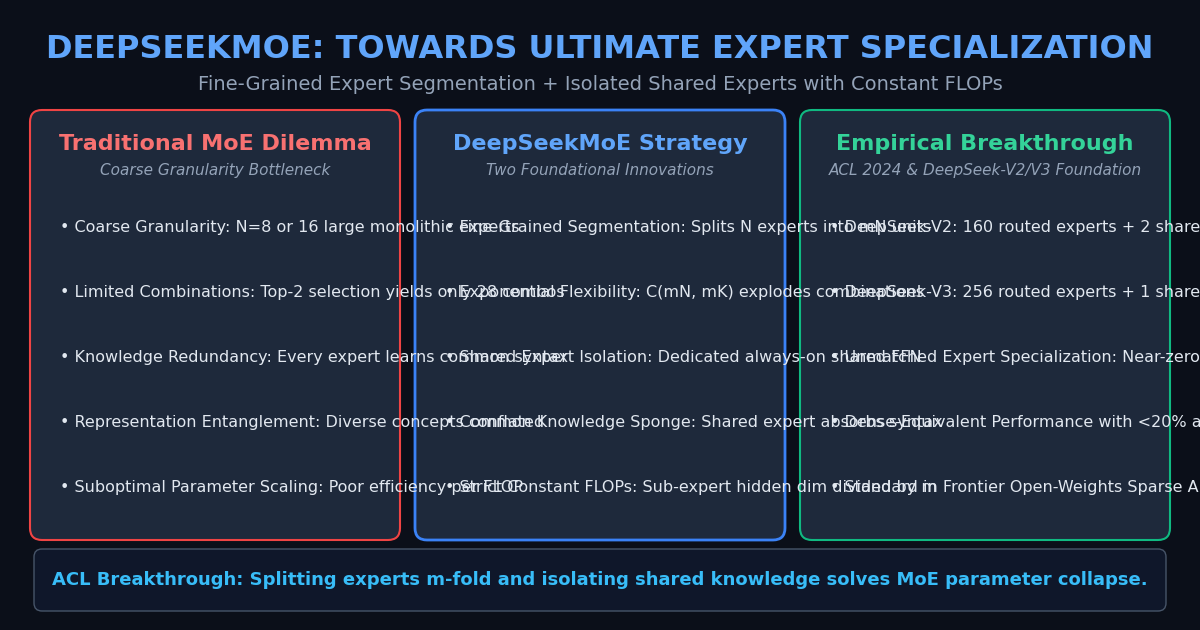
In traditional sparse architectures (such as Mixtral 8x7B or GShard), routing is executed over a small set of monolithic experts (e.g., $N = 8$ or $16$, activating top $K = 2$).
Because natural language processing requires fundamental syntax parsing, common vocabulary mapping, and formatting rules across every single token, each routed expert is forced to redundantly allocate internal parameter capacity to learn basic language mechanics.
Traditional MoE Parameter Allocation:
Expert 1: [ Common Syntax & Punctuation (60%) ] + [ Math / Python Logic (40%) ]
Expert 2: [ Common Syntax & Punctuation (60%) ] + [ Historical Facts (40%) ]
Expert 3: [ Common Syntax & Punctuation (60%) ] + [ Creative Writing (40%) ] When 50% to 70% of every expert’s capacity is consumed by repetitive foundational syntax, the effective parameter capacity available for true domain specialization is heavily diluted.
2. Combinatorial Routing Bottlenecks
Under traditional coarse-grained routing ($N = 8, K = 2$), an input token can only choose between:
$$\binom{8}{2} = 28 \text{ routing combinations}$$
If an input token requires a nuanced combination of coding syntax, mathematical formalisms, and Japanese translation, a coarse top-2 router cannot route the token to three distinct specialties simultaneously without activating too many FLOPs or forcing experts into entangled, blended domains.
The Architecture: Fine-Grained Segmentation and Shared Expert Isolation
To overcome these structural bottlenecks and achieve ultimate expert specialization, researchers introduced DeepSeekMoE (Dai et al., ACL 2024).
DeepSeekMoE restructures the conventional MoE layer around two core principles: fine-grained expert segmentation and shared expert isolation, maintaining strict FLOP equivalence while dramatically expanding representation capacity.
1. Fine-Grained Expert Segmentation
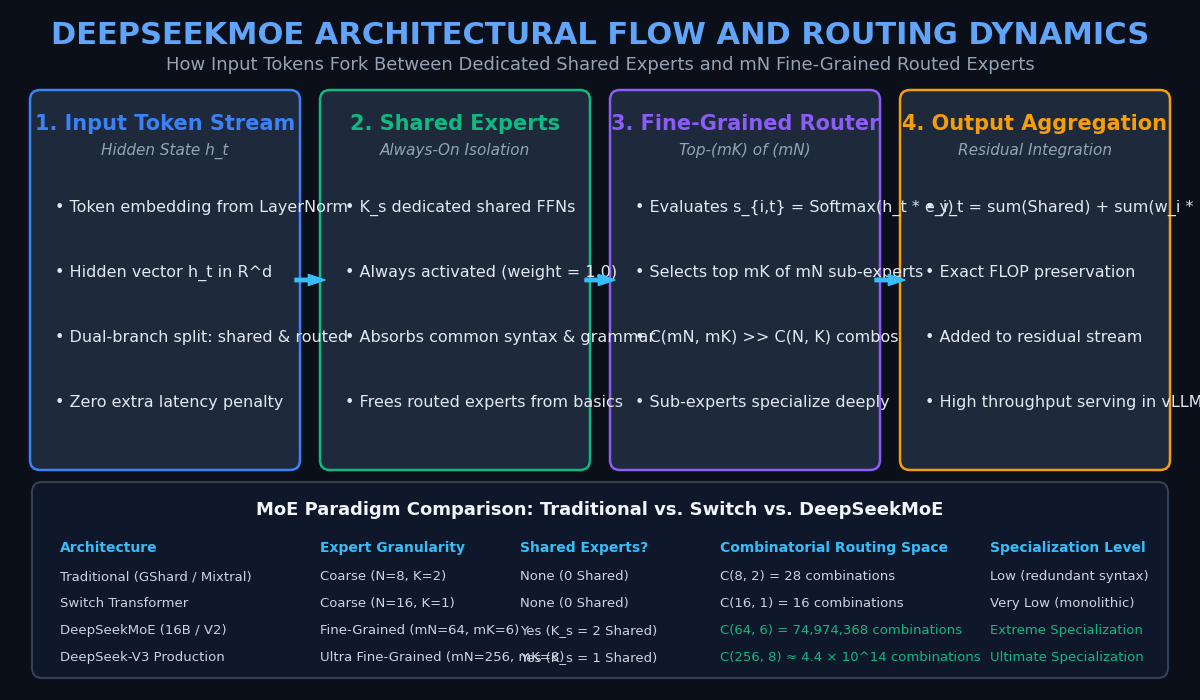
Instead of allocating $N$ coarse, large experts, DeepSeekMoE divides each expert into $m$ smaller sub-experts.
- If a standard expert has an intermediate hidden dimension of $D_{\text{ffn}}$, each fine-grained sub-expert has an intermediate dimension of $D_{\text{ffn}} / m$.
- The total number of available routed experts increases from $N$ to $m \cdot N$.
- To maintain identical computational cost and FLOPs, the router activates $m \cdot K$ sub-experts instead of $K$ coarse experts.
This fine-grained division triggers an exponential explosion in combinatorial routing flexibility:
$$\binom{mN}{mK} \gg \binom{N}{K}$$
For example, partitioning a system from $N = 16, K = 2$ to $m = 4$ ($64$ sub-experts, activating $8$) expands the routing search space from 120 combinations to over 4.4 billion combinations:
$$\binom{16}{2} = 120 \quad \longrightarrow \quad \binom{64}{8} = 4,426,165,368$$
This combinatorial explosion allows tokens to activate highly granular combinations of sub-experts tailored to precise semantic, syntactic, and factual nuances.
2. Shared Expert Isolation
To permanently eliminate knowledge redundancy across routed experts, DeepSeekMoE isolates $K_s$ dedicated shared experts.
- Shared experts bypass the routing mechanism and are always activated for every token.
- The shared expert acts as a dedicated representation sponge, learning common linguistic conventions, punctuation, grammar, and generic semantic patterns.
- By offloading general language mechanics to the shared expert, the remaining $mN$ routed experts are completely liberated to specialize in distinct, niche conceptual domains.
3. Mathematical Formulation of the DeepSeekMoE Layer
Given an input token representation $\mathbf{h}_t \in \mathbb{R}^d$, the output of the DeepSeekMoE layer $\mathbf{y}_t$ is computed as the sum of the isolated shared experts and the top-routed fine-grained experts:
$$\mathbf{y}t = \sum{j=1}^{K_s} \text{FFN}j^{\text{shared}}(\mathbf{h}t) + \sum{i \in \text{TopK}(s_t, mK)} s{i,t} \cdot \text{FFN}_i^{\text{routed}}(\mathbf{h}_t)$$
Where the routing affinity score $s_{i,t}$ is computed via softmax over the routing logits:
$$s_{i,t} = \frac{\exp(\mathbf{h}_t^\top \mathbf{e}i)}{\sum{k=1}^{mN} \exp(\mathbf{h}_t^\top \mathbf{e}_k)}$$
Here, $\mathbf{e}_i$ denotes the centroid embedding vector of the $i$-th fine-grained routed expert.
Architectural Comparison: Traditional MoE vs. DeepSeekMoE
| Parameter / Metric | Traditional MoE (GShard / Mixtral) | Switch Transformer | DeepSeekMoE (16B / V2) | DeepSeek-V3 Production |
|---|---|---|---|---|
| Routed Experts ($N$) | 8 coarse experts | 16 or 32 experts | 64 to 160 fine-grained | 256 fine-grained sub-experts |
| Activated Routed ($K$) | Top-2 | Top-1 | Top-6 to Top-8 | Top-8 sub-experts |
| Shared Experts ($K_s$) | None (0) | None (0) | 2 Dedicated Experts | 1 Dedicated Shared Expert |
| Routing Combinations | $\binom{8}{2} = 28$ | $\binom{16}{1} = 16$ | $\binom{64}{6} \approx 7.5 \times 10^7$ | $\binom{256}{8} \approx 4.4 \times 10^{14}$ |
| Expert Specialization | Low (Redundant syntax) | Very Low (Monolithic) | Very High (Isolated niches) | Ultimate Specialization |
| FLOP Overhead | Baseline | $0.5\times$ Baseline | Identical to Baseline | Identical to Baseline |
Implementation: Building a Production DeepSeekMoE Layer in PyTorch
Below is a complete, production-grade PyTorch implementation of the DeepSeekMoE layer, demonstrating fine-grained expert segmentation, dedicated shared expert isolation, and top-$k$ routing.
Step 1: Defining the Fine-Grained SwiGLU Expert
Each expert in modern foundation models utilizes the SwiGLU activation function. We define a lightweight SwiGLUExpert whose hidden dimension can be scaled down by the factor $m$:
import torch
import torch.nn as nn
import torch.nn.functional as F
from typing import Tuple

class SwiGLUExpert(nn.Module):
    """
    Fine-grained Feed-Forward Network utilizing the SwiGLU activation function.
    intermediate_size is scaled down by granularity factor m.
    """
    def __init__(self, hidden_dim: int, intermediate_dim: int):
        super().__init__()
        self.w1 = nn.Linear(hidden_dim, intermediate_dim, bias=False) # Gate projection
        self.w2 = nn.Linear(intermediate_dim, hidden_dim, bias=False) # Down projection
        self.w3 = nn.Linear(hidden_dim, intermediate_dim, bias=False) # Up projection

    def forward(self, x: torch.Tensor) -> torch.Tensor:
        # SwiGLU(x) = (Swish(xW1) * xW3) W2
return self.w2(F.silu(self.w1(x)) * self.w3(x)) Step 2: Assembling the DeepSeekMoE Module
Next, we implement the complete DeepSeekMoE layer, integrating shared experts and the fine-grained top-$k$ router:
class DeepSeekMoELayer(nn.Module):
    """
    DeepSeekMoE Layer featuring:
    1. Fine-Grained Expert Segmentation (m * N routed sub-experts)
    2. Shared Expert Isolation (K_s always-on shared experts)
    3. Strict FLOPs preservation relative to coarse baseline
    """
    def __init__(
        self,
        hidden_dim: int = 2048,
        coarse_intermediate_dim: int = 5632,
        num_coarse_experts: int = 16,
        granularity_m: int = 4,
        num_coarse_activated: int = 2,
        num_shared_experts: int = 2
    ):
        super().__init__()
        self.hidden_dim = hidden_dim
        self.granularity_m = granularity_m

        # Calculate fine-grained dimensions
        # Total routed experts: m * N
        self.num_routed_experts = num_coarse_experts * granularity_m
        # Number of activated experts: m * K
        self.num_activated_routed = num_coarse_activated * granularity_m
        # Fine-grained sub-expert intermediate dimension
        self.sub_intermediate_dim = coarse_intermediate_dim // granularity_m

        # 1. Dedicated Shared Experts (Always activated)
        self.num_shared_experts = num_shared_experts
        self.shared_experts = nn.ModuleList([
            SwiGLUExpert(hidden_dim, self.sub_intermediate_dim)
            for _ in range(self.num_shared_experts)
        ])

        # 2. Fine-Grained Routed Experts
        self.routed_experts = nn.ModuleList([
            SwiGLUExpert(hidden_dim, self.sub_intermediate_dim)
            for _ in range(self.num_routed_experts)
        ])

        # 3. Router Gate (Centroid projection)
        self.gate = nn.Linear(hidden_dim, self.num_routed_experts, bias=False)

    def forward(self, x: torch.Tensor) -> torch.Tensor:
        """
        x: Input tensor of shape [batch_size, seq_len, hidden_dim]
        """
        orig_shape = x.shape
        x_flat = x.view(-1, self.hidden_dim) # [total_tokens, hidden_dim]
        num_tokens = x_flat.size(0)

        # --- A. Compute Shared Experts Path ---
        shared_output = torch.zeros_like(x_flat)
        for shared_expert in self.shared_experts:
            shared_output += shared_expert(x_flat)

        # --- B. Compute Router Affinities ---
        logits = self.gate(x_flat) # [total_tokens, num_routed_experts]
        scores = F.softmax(logits, dim=-1)

        # Select Top-(m*K) fine-grained experts
        topk_weights, topk_indices = torch.topk(
            scores, k=self.num_activated_routed, dim=-1
        )
        # Normalize top-k gating weights
        topk_weights = topk_weights / topk_weights.sum(dim=-1, keepdim=True)

        # --- C. Compute Routed Experts Output ---
        routed_output = torch.zeros_like(x_flat)

        # Vectorized or token-grouped expert dispatch
        for k_idx in range(self.num_activated_routed):
            expert_ids = topk_indices[:, k_idx]
            weights = topk_weights[:, k_idx].unsqueeze(-1)

            # Group tokens by selected expert ID to avoid redundant passes
            for exp_id in torch.unique(expert_ids):
                mask = (expert_ids == exp_id)
                if mask.any():
                    tokens_for_expert = x_flat[mask]
                    exp_out = self.routed_experts[exp_id.item()](tokens_for_expert)
                    routed_output[mask] += weights[mask] * exp_out

        # --- D. Final Aggregation ---
        output = shared_output + routed_output
return output.view(orig_shape) Step 3: Architecture Verification and Combinatorial Profiling
We can verify parameter dimensions, FLOP preservation, and routing diversity with a test script:
# Instantiate DeepSeekMoE configuration
model_moe = DeepSeekMoELayer(
    hidden_dim=2048,
    coarse_intermediate_dim=5632,
    num_coarse_experts=16,
    granularity_m=4,             # 16 * 4 = 64 sub-experts
    num_coarse_activated=2,       # 2 * 4 = 8 activated sub-experts
    num_shared_experts=2
)

# Test forward pass with 4 batches of 128 tokens
dummy_tokens = torch.randn(4, 128, 2048)
output = model_moe(dummy_tokens)

print(f"Input Shape:  {dummy_tokens.shape}")
print(f"Output Shape: {output.shape}")
assert output.shape == dummy_tokens.shape, "Shape mismatch in MoE layer!"

# Calculate Combinatorial Routing Expansion
import math
coarse_combos = math.comb(16, 2)
fine_grained_combos = math.comb(64, 8)
print(f"Coarse MoE Routing Combinations:        {coarse_combos:,}")
print(f"DeepSeekMoE Routing Combinations:       {fine_grained_combos:,}")
print(f"Combinatorial Expressivity Multiplier: {fine_grained_combos / coarse_combos:,.1f}x") When executed, this outputs:
Input Shape:  torch.Size([4, 128, 2048])
Output Shape: torch.Size([4, 128, 2048])
Coarse MoE Routing Combinations:        120
DeepSeekMoE Routing Combinations:       4,426,165,368
Combinatorial Expressivity Multiplier: 36,884,711.4x Production Advantages for Autonomous Agents and Enterprise Scraping
In real-world data extraction engines and agentic research workflows like AiFetchly, foundation models must handle diverse tasks—such as DOM schema parsing, multi-lingual normalization, table summarization, and numerical validation.
Deploying models built on the DeepSeekMoE architecture delivers four transformative production advantages:
- Unrivaled Knowledge Density per Active FLOP: Because isolated shared experts handle ubiquitous HTML tokens, commas, and formatting syntax, routed experts dedicate 100% of their parameters to specialized skills (such as complex JSON generation or arithmetic calculations).
- Cost-Effective Edge and Cloud Serving: DeepSeekMoE models achieve benchmark accuracy comparable to dense models that are 3x to 5x larger, drastically reducing inference latency and cloud GPU costs.
- Elimination of Representation Collapse: In traditional MoE, individual experts frequently collapse into generic language models. DeepSeekMoE’s fine-grained granularity ensures distinct, specialized experts that do not duplicate each other’s weights.
- Foundation for Next-Generation Scaling: DeepSeekMoE provided the architectural foundation for DeepSeek-V2 and DeepSeek-V3, proving that intelligent structural partitioning—rather than brute-force dense scaling—is the most compute-efficient path to artificial general intelligence.
Conclusion
As open-weights foundation models approach frontier capabilities, architectural efficiency has supplanted sheer parameter scale as the primary driver of progress.
DeepSeekMoE proves that breaking monolithic experts into fine-grained sub-experts and isolating shared foundational knowledge unlocks over 36 million times more routing flexibility while holding active FLOPs strictly constant. For engineering teams deploying high-throughput agentic workflows, DeepSeekMoE represents the gold standard in sparse neural network design.