DeepSeek-R1 Guide: Incentivizing Reasoning via GRPO
The paradigm of artificial intelligence development has undergone a tectonic shift: transitioning from scaling pretraining compute toward scaling test-time compute and post-training reinforcement learning. Across enterprise workflows, autonomous code debugging, mathematical verification, and complex data intelligence pipelines orchestrated by AI Fetchly, organizations require models that do not simply emit quick answers, but spend deliberate test-time compute to plan, verify, and self-correct. Whether analyzing intricate regulatory filings or structuring multi-step web workflows through real-time data fetching, advanced reasoning has become essential.
Historically, the prevailing belief in AI labs was that strong reasoning required massive supervised datasets: millions of human-annotated Chain-of-Thought (CoT) trajectories, expensive expert step-by-step rationales, and massive neural reward models. This belief created high barriers to entry, concentrating advanced reasoning models behind proprietary commercial APIs (such as OpenAI’s o1 series).
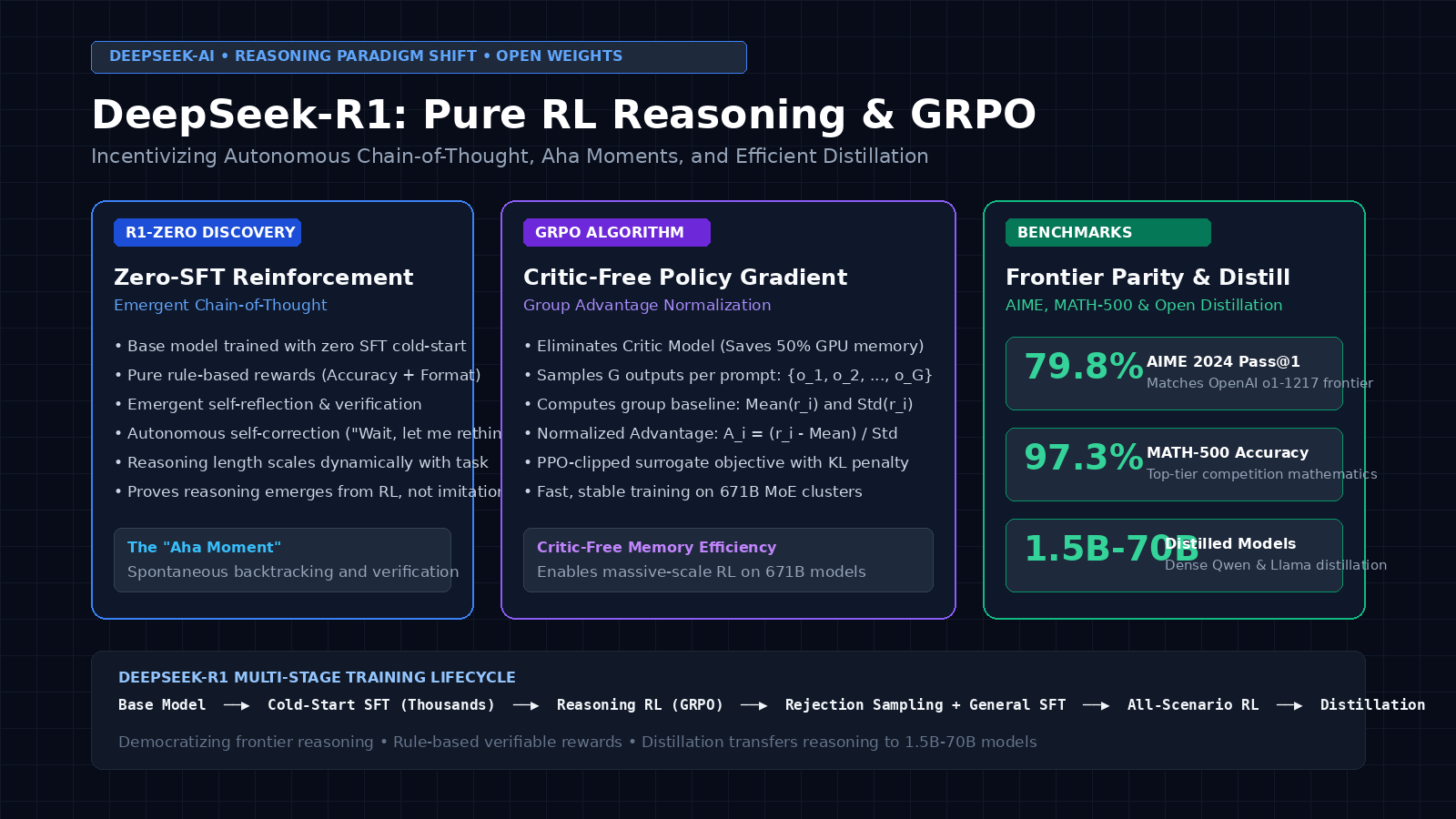
This paradigm was disrupted with the release of DeepSeek-R1: Incentivizing Reasoning Capability in LLMs via Reinforcement Learning (arXiv:2501.12948, deepseek-ai/DeepSeek-R1). DeepSeek-AI demonstrated that reasoning capabilities—including self-reflection, alternative hypothesis exploration, and dynamic backtracking—can emerge spontaneously from pure reinforcement learning applied directly to a base language model, without a single token of supervised fine-tuning.
By introducing DeepSeek-R1-Zero, developing the Group Relative Policy Optimization (GRPO) algorithm to bypass expensive critic models, and implementing a multi-stage training pipeline with cold-start data, DeepSeek-R1 achieved performance parity with OpenAI-o1-1217 on mathematical and coding benchmarks (scoring 79.8% on AIME 2024 and 97.3% on MATH-500). Crucially, DeepSeek open-sourced both the full 671B model weights and a suite of distilled dense models (from 1.5B to 70B parameters).
In this comprehensive technical guide, we break down the discovery of DeepSeek-R1-Zero and the “Aha Moment”, analyze the mathematics of Group Relative Policy Optimization (GRPO), explore the multi-stage training pipeline of DeepSeek-R1, construct a complete PyTorch implementation of the GRPO training step, and examine production deployment and distillation strategies.
The Problem: The Human Imitation Ceiling in Supervised Fine-Tuning
To appreciate why DeepSeek-R1’s reinforcement learning approach represents a major breakthrough, we must first examine the limitations of traditional Supervised Fine-Tuning (SFT) and the bottlenecks of standard Reinforcement Learning from Human Feedback (RLHF).
The Post-Training Reasoning Bottleneck:
Target Problem: Solve a complex Olympiad mathematics or software engineering problem.
  │
  ├── 1. Supervised Fine-Tuning (SFT Imitation Trap):
  │   └── Model is trained to mimic human-written Chain-of-Thought solutions.
  │   └── ❌ Fatal Flaw 1: Ceiling Effect! The model can only reason as well as the human demonstrators.
  │   └── ❌ Fatal Flaw 2: Brittle Generalization! Models memorize superficial reasoning templates
  │       ("First, let us... Therefore...") rather than learning genuine search algorithms.
  │
  ├── 2. Standard RLHF with PPO (The Critic Model Bottleneck):
  │   └── PPO requires four separate models in GPU memory:
  │       - Policy Model (Actor)
  │       - Value Model (Critic)
  │       - Reference Model (KL Anchor)
  │       - Reward Model (Preference Evaluator)
  │   └── ❌ Fatal Flaw: For a 671B MoE architecture, hosting the Critic model doubles VRAM requirements,
  │       making multi-turn RL training computationally intractable!
  │
  └── 3. The DeepSeek-R1 Breakthrough:
      ├── Rule-Based Verifiers: Replace neural reward models with deterministic code/math checkers.
      ├── GRPO (Group Relative Policy Optimization): Eliminates the Critic model entirely!
└── Emergent Reasoning: The model autonomously learns search, backtracking, and verification. The Imitation Trap of Supervised Fine-Tuning
In conventional model alignment, models are fine-tuned using teacher-student imitation: expert humans write detailed reasoning steps, and the model minimizes cross-entropy loss against those tokens.
However, imitation learning fundamentally bounds model capabilities to human performance:
- The Human Knowledge Ceiling: The model cannot discover non-trivial problem-solving strategies that humans did not explicitly demonstrate.
- Superficial Pattern Matching: SFT trains the model to produce text that looks like a logical chain of thought, but when the model encounters an unexpected error midway through generation, it lacks the capability to recognize its mistake, backtrack, or try an alternative approach. It simply continues generating text along the flawed trajectory.
The Memory Bottleneck of Proximal Policy Optimization (PPO)
To move beyond pure imitation, researchers turned to Reinforcement Learning from Human Feedback (RLHF) using algorithms like Proximal Policy Optimization (PPO). However, PPO requires maintaining a Value Network (Critic) to estimate state values $V(s)$ and compute Generalized Advantage Estimation (GAE):
$$A_t = \delta_t + (\gamma \lambda) \delta_{t+1} + \dots, \quad \delta_t = r_t + \gamma V(s_{t+1}) - V(s_t)$$
In frontier architectures like DeepSeek-V3 (which has 671 billion total parameters), hosting a separate Critic model of equal scale in GPU memory is extraordinarily expensive. The Critic model consumes massive High-Bandwidth Memory (HBM) and introduces severe communication overhead in distributed clusters.
Reward Model Exploitation (Reward Hacking)
Standard RLHF relies on neural reward models trained on pairwise human comparisons. In complex reasoning tasks, neural reward models are notoriously vulnerable to reward hacking—models learn to produce verbose, flowery prose that receives high scores from the reward model without actually solving the underlying problem.
DeepSeek-R1 resolves these bottlenecks by eliminating the Critic model via GRPO and replacing neural reward models with deterministic rule-based verification.
DeepSeek-R1-Zero: Pure RL and the Emergence of the “Aha Moment”
The initial scientific breakthrough documented in the paper is DeepSeek-R1-Zero: a foundational experiment that applied reinforcement learning directly to the raw, unaligned DeepSeek-V3-Base model with zero prior supervised fine-tuning.
┌────────────────────────────────────────────────────────────────────────────────────────┐
│                              DEEPSEEK-R1-ZERO TRAINING LOOP                            │
├────────────────────────────────────────────────────────────────────────────────────────┤
│                                                                                        │
│   Prompt q from Math/Code Dataset  ──▶  Base Model (DeepSeek-V3-Base, Zero SFT)        │
│                                                │                                       │
│                                                ▼                                       │
│                         Sample Group of G Outputs: {o_1, o_2, ..., o_G}                │
│                                                │                                       │
│                                                ▼                                       │
│                         DETERMINISTIC RULE-BASED REWARD ENGINE                         │
│                         ├── 1. Accuracy Reward: Binary (1.0 if answer correct, 0.0)    │
│                         └── 2. Format Reward: Enforces <think> ... </think> tags       │
│                                                │                                       │
│                                                ▼                                       │
│                         GROUP RELATIVE POLICY OPTIMIZATION (GRPO)                      │
│                         ├── Calculate Group Mean & Std of Rewards                      │
│                         ├── Compute Advantage: A_i = (r_i - Mean) / Std                │
│                         └── PPO-Clipped Policy Update (No Value Network!)              │
│                                                │                                       │
│                                                ▼                                       │
│                         EMERGENT BEHAVIORS ("THE AHA MOMENT"):                         │
│                         ├── Generation length expands from 200 to 10,000+ tokens       │
│                         ├── Spontaneous self-verification: "Wait, let me double check" │
│                         └── Exploration of alternative algebraic paths                │
│                                                                                        │
└────────────────────────────────────────────────────────────────────────────────────────┘ Deterministic Rule-Based Rewards
Rather than relying on an imperfect neural reward model, DeepSeek-R1-Zero utilizes a simple, transparent rule-based reward system:
- Accuracy Reward: For mathematics and programming problems with verifiable answers, the system executes an automated checker (e.g., parsing a LaTeX boxed numerical answer or compiling and running code against unit tests). If the answer is correct, reward $r_{\text{acc}} = 1.0$; otherwise, $r_{\text{acc}} = 0.0$.
- Format Reward: Enforces that the model encloses its internal reasoning process within
<think>and</think>XML delimiters before outputting the final answer.
Because the reward is mathematically exact and deterministic, the model cannot engage in reward hacking: verbose fluff that yields the wrong number receives a strict score of zero.
The “Aha Moment”: Emergence of Autonomous Self-Reflection
As reinforcement learning training progressed over thousands of steps, DeepSeek researchers observed an unprecedented phenomenon: the model autonomously learned human-like cognitive strategies without any explicit supervision.
Key emergent behaviors included:
- Dynamic Length Scaling: As problem difficulty increased, the model’s generated reasoning length spontaneously expanded from a few hundred tokens to over 10,000 tokens. The model allocated more compute to harder problems.
- Autonomous Verification and Backtracking: The model began generating phrases such as:
“Wait, let me rethink that. If $x = -2$, then the denominator becomes zero, which is invalid. Let me backtrack and check the original domain constraints…”
- The “Aha Moment”: The model would execute several steps of calculation, identify an inconsistency, step back to re-evaluate the premise, and successfully derive the correct solution.
This landmark finding proved that reasoning is not a behavior that must be laboriously taught via human imitation—it is an optimal search strategy that naturally emerges when models are incentivized by verifiable reward signals.
Group Relative Policy Optimization (GRPO): The Critic-Free Algorithm
To make large-scale RL computationally feasible on 671B parameter models, DeepSeek developed Group Relative Policy Optimization (GRPO).
┌────────────────────────────────────────────────────────────────────────────────────────┐
│                       GROUP RELATIVE POLICY OPTIMIZATION (GRPO)                        │
├────────────────────────────────────────────────────────────────────────────────────────┤
│                                                                                        │
│   For each prompt q in batch:                                                          │
│                                                                                        │
│   1. SAMPLE GROUP: Policy generates G outputs:                                         │
│      o_1, o_2, ..., o_G ~ pi_theta_old( · | q )                                        │
│                                                                                        │
│   2. EVALUATE REWARDS: Compute deterministic rewards:                                  │
│      r_1, r_2, ..., r_G                                                                │
│                                                                                        │
│   3. NORMALIZE ADVANTAGES ACROSS THE GROUP (No Critic Network Needed!):                │
│                                                                                        │
│                    r_i - Mean(r_1, ..., r_G)                                           │
│             A_i = ───────────────────────────                                          │
│                      Std(r_1, ..., r_G) + eps                                         │
│                                                                                        │
│   4. POLICY GRADIENT UPDATE WITH PPO CLIPPING & KL PENALTY:                            │
│                                                                                        │
│      L_GRPO = (1/G) * Sum_{i=1}^G [                                                    │
│                 min( rho_i * A_i,  clip(rho_i, 1-eps, 1+eps) * A_i )                   │
│                 - beta * D_KL( pi_theta || pi_ref )                                    │
│               ]                                                                        │
│                                                                                        │
│      Where rho_i = pi_theta(o_i | q) / pi_theta_old(o_i | q)                           │
│                                                                                        │
└────────────────────────────────────────────────────────────────────────────────────────┘ Mathematical Formulation of GRPO
In traditional PPO, advantage estimation requires an auxiliary Critic model $V_\phi(s)$ to provide a state baseline. GRPO eliminates the Critic model entirely by using group statistics as the baseline:
For each prompt $q$:
- The current policy $\pi_\theta$ samples a group of $G$ candidate outputs: ${o_1, o_2, \dots, o_G}$.
- The environment evaluates each output with the reward function, yielding rewards ${r_1, r_2, \dots, r_G}$.
- The advantage $A_i$ for each output $o_i$ is computed by standardizing the reward relative to its group peers:
$$A_i = \frac{r_i - \frac{1}{G} \sum_{j=1}^{G} r_j}{\sqrt{\frac{1}{G} \sum_{j=1}^{G} \left(r_j - \frac{1}{G} \sum_{k=1}^{G} r_k\right)^2} + \epsilon}$$
If an output achieves a higher reward than the group average, its advantage is positive ($A_i > 0$), and its token probabilities are boosted. If an output performs below the group average, its advantage is negative ($A_i < 0$), and its probabilities are penalized.
The Objective Function
The full GRPO objective maximizes:
$$\mathcal{J}{\text{GRPO}}(\theta) = \mathbb{E}{q \sim P(Q), {o_i}{i=1}^G \sim \pi{\theta_{\text{old}}}(O \mid q)} \left[ \frac{1}{G} \sum_{i=1}^{G} \frac{1}{|o_i|} \sum_{t=1}^{|o_i|} \min\left( \rho_{i, t} A_i, , \text{clip}(\rho_{i, t}, 1 - \epsilon, 1 + \epsilon) A_i \right) - \beta \mathbb{D}{\text{KL}}(\pi\theta ,|, \pi_{\text{ref}}) \right]$$
Where:
- $\rho_{i, t} = \frac{\pi_\theta(o_{i, t} \mid q, o_{i, <t})}{\pi_{\theta_{\text{old}}}(o_{i, t} \mid q, o_{i, <t})}$ is the importance sampling probability ratio.
- The PPO clipping term $\text{clip}(\rho, 1-\epsilon, 1+\epsilon)$ bounds policy divergence.
- $\mathbb{D}{\text{KL}}(\pi\theta ,|, \pi_{\text{ref}})$ penalizes deviation from the reference model to prevent policy drift.
The Engineering Impact of GRPO
Eliminating the Critic network reduces the GPU memory required for reinforcement learning by roughly 50%. For large-scale distributed training on 671B parameter models across hundreds of nodes, this makes training feasible and enables much larger group sizes ($G = 8$ or $16$), which improves advantage estimation stability.
The DeepSeek-R1 Multi-Stage Pipeline
While DeepSeek-R1-Zero proved that reasoning can emerge from pure RL, it had practical limitations: poor readability, language mixing (switching between English and Chinese mid-thought), and lack of general conversational ability.
To construct the production-ready DeepSeek-R1, DeepSeek-AI designed a four-stage training pipeline combining targeted cold-start data, reasoning RL, rejection sampling, and all-scenario alignment:
┌────────────────────────────────────────────────────────────────────────────────────────┐
│                        DEEPSEEK-R1 FULL TRAINING PIPELINE                              │
├────────────────────────────────────────────────────────────────────────────────────────┤
│                                                                                        │
│   STAGE 1: COLD-START SUPERVISED FINE-TUNING (SFT)                                     │
│   └── Curate a small, high-quality dataset (thousands of examples) of readable CoT:    │
│       - Delimited with <think> ... </think> tags and clear markdown formatting         │
│       - Fine-tune DeepSeek-V3-Base to establish a user-friendly initialization         │
│                                                                                        │
│   STAGE 2: REASONING-ORIENTED REINFORCEMENT LEARNING (GRPO)                            │
│   └── Large-scale RL on math, coding, and logical reasoning using rule-based rewards   │
│   └── Adds a language consistency reward to penalize language mixing                   │
│                                                                                        │
│   STAGE 3: REJECTION SAMPLING & GENERAL SFT                                            │
│   └── Use the Stage 2 checkpoint to generate 800,000 reasoning trajectories            │
│   └── Filter trajectories via rejection sampling (retaining only correct solutions)    │
│   └── Combine with general domain SFT data (writing, QA, creative) -> Fine-tune V3     │
│                                                                                        │
│   STAGE 4: ALL-SCENARIO REINFORCEMENT LEARNING                                         │
│   └── Final RL stage aligning both reasoning accuracy and general human preferences    │
│                                                                                        │
│   FINAL STEP: DISTILLATION INTO DENSE MODELS                                           │
│   └── Distill the 800k curated trajectories directly into dense Qwen and Llama models  │
│   └── Yields DeepSeek-R1-Distill-Qwen (1.5B, 7B, 14B, 32B) and Distill-Llama (8B, 70B) │
│                                                                                        │
└────────────────────────────────────────────────────────────────────────────────────────┘ Stage 1: Cold-Start SFT
DeepSeek created a curated dataset of a few thousand high-quality examples with readable reasoning structures (e.g., using chain-of-thought formatting, explicit reflection tags, and structured conclusions). Fine-tuning the base model on this small dataset established an initial policy that avoids language mixing while retaining exploration flexibility.
Stage 2: Reasoning-Oriented RL
The model underwent large-scale RL using GRPO on mathematics, science, and coding problems. In addition to accuracy and format rewards, a language consistency reward was introduced: calculating the proportion of target-language tokens inside the <think> block to ensure coherent thoughts.
Stage 3: Rejection Sampling & General SFT
When the Stage 2 model converged, it generated multiple candidate reasoning traces for 600,000 reasoning prompts. An automated verifier discarded incorrect answers, retaining 600,000 verified reasoning solutions.
DeepSeek combined these with 200,000 non-reasoning instruction-following examples (creative writing, roleplay, translation) and fine-tuned DeepSeek-V3-Base for two epochs.
Stage 4: All-Scenario RL
The final alignment stage applied GRPO across both reasoning and non-reasoning tasks, pairing rule-based verification for math and code with standard preference models for general writing quality and safety.
Distillation: Reasoning for Smaller Dense Models
Rather than training small models (such as Qwen-1.5B or LLaMA-8B) with expensive RL from scratch, DeepSeek distilled the 800,000 curated reasoning traces directly into dense models using standard supervised fine-tuning.
The results were remarkable: DeepSeek-R1-Distill-Qwen-32B achieved 72.6% on AIME 2024, outperforming much larger models and demonstrating that reasoning traces generated by large RL models can be transferred to compact architectures.
Benchmark Comparison: DeepSeek-R1 vs. Frontier Baselines
To evaluate DeepSeek-R1’s reasoning performance, we examine standard benchmarks across mathematics, code, and general reasoning against OpenAI o1-1217, Claude 3.5 Sonnet, and DeepSeek-V3.
| Benchmark / Task | DeepSeek-V3 (Base 671B) | Claude 3.5 Sonnet | OpenAI o1-mini | OpenAI o1-1217 (Frontier) | DeepSeek-R1-Zero | DeepSeek-R1 (Full 671B) | DeepSeek-R1-Distill-32B |
|---|---|---|---|---|---|---|---|
| AIME 2024 (Pass@1) | 39.2% | 16.0% | 63.6% | 79.2% | 71.0% | 79.8% (Top) | 72.6% |
| MATH-500 (Accuracy) | 90.2% | 78.3% | 90.0% | 96.4% | 95.8% | 97.3% (Top) | 94.3% |
| Codeforces (Percentile) | 58.7% | 77.4% | 93.4% | 96.6% | 60.2% | 96.3% | 90.6% |
| SWE-bench Verified | 42.0% | 49.2% | 41.6% | 48.9% | N/A | 49.2% | 41.2% |
| MMLU (Overall) | 88.5% | 88.3% | 85.2% | 91.8% | 87.2% | 90.8% | 87.4% |
| Weights Availability | Open Weights | Proprietary API | Proprietary API | Proprietary API | Open Weights | Open Weights | Open Weights |
Mathematics and Competition Coding Parity
On the AIME 2024 Olympiad mathematics evaluation:
- DeepSeek-R1 achieved 79.8%, matching OpenAI o1-1217 (79.2%).
- On MATH-500, DeepSeek-R1 scored 97.3%, proving that rule-based reinforcement learning allows the model to search through complex problem spaces and self-correct calculation slips.
- On Codeforces, DeepSeek-R1 achieved an expert-level rating above the 96th percentile of human competitive programmers.
End-to-End PyTorch Implementation: Building the GRPO Algorithm
Below is a complete, self-contained PyTorch implementation demonstrating the core mechanics of Group Relative Policy Optimization (GRPO): group sampling, advantage normalization without a critic, and PPO-clipped policy optimization.
"""
Group Relative Policy Optimization (GRPO) Implementation
Reference: "DeepSeek-R1: Incentivizing Reasoning Capability in LLMs via RL" (arXiv:2501.12948)
"""

import torch
import torch.nn as nn
import torch.nn.functional as F
from typing import List, Dict, Tuple, Callable


class GRPOTrainer:
    """
    Executes Critic-Free Group Relative Policy Optimization.
    """
    def __init__(
        self,
        policy_model: nn.Module,
        ref_model: nn.Module,
        optimizer: torch.optim.Optimizer,
        group_size: int = 8,
        clip_eps: float = 0.2,
        kl_coeff: float = 0.04,
        device: str = "cuda" if torch.cuda.is_available() else "cpu"
    ):
        self.policy = policy_model.to(device)
        self.ref_model = ref_model.to(device)
        # Freeze reference model permanently
        for p in self.ref_model.parameters():
            p.requires_grad = False

        self.optimizer = optimizer
        self.group_size = group_size
        self.clip_eps = clip_eps
        self.kl_coeff = kl_coeff
        self.device = device

    def compute_group_advantages(self, rewards: torch.Tensor) -> torch.Tensor:
        """
        Normalizes rewards across each prompt group without a Critic network.
        Args:
            rewards: Tensor of shape [BatchSize, GroupSize]
        Returns:
            advantages: Standardized advantage values [BatchSize, GroupSize]
        """
        mean = rewards.mean(dim=-1, keepdim=True)
        std = rewards.std(dim=-1, keepdim=True) + 1e-8
        advantages = (rewards - mean) / std
        return advantages

    def compute_token_log_probs(
        self,
        model: nn.Module,
        input_ids: torch.Tensor,
        action_mask: torch.Tensor
    ) -> torch.Tensor:
        """
        Calculates per-token log probabilities for generated reasoning tokens.
        """
        logits = model(input_ids) # [B * G, SeqLen, VocabSize]
        # Shift for causal prediction
        shift_logits = logits[:, :-1, :]
        shift_labels = input_ids[:, 1:]
        shift_mask = action_mask[:, 1:]

        log_probs = F.log_softmax(shift_logits, dim=-1)
        token_log_probs = torch.gather(log_probs, dim=-1, index=shift_labels.unsqueeze(-1)).squeeze(-1)

        # Mask out prompt tokens; keep only response tokens
        return token_log_probs * shift_mask

    def training_step(
        self,
        input_ids: torch.Tensor,       # [BatchSize * GroupSize, SeqLen]
        action_mask: torch.Tensor,     # [BatchSize * GroupSize, SeqLen] (1 for response, 0 for prompt)
        rewards: torch.Tensor          # [BatchSize, GroupSize]
    ) -> Dict[str, float]:
        """
        Executes a single GRPO policy gradient optimization step.
        """
        self.policy.train()
        batch_size = rewards.shape[0]
        total_samples = batch_size * self.group_size

        # 1. Compute standardized group advantages
        with torch.no_grad():
            advantages = self.compute_group_advantages(rewards) # [B, G]
            advantages_flat = advantages.view(-1, 1) # [B * G, 1]

            # Reference log probabilities for KL penalty
            ref_log_probs = self.compute_token_log_probs(self.ref_model, input_ids, action_mask)
            # Old policy log probabilities (for ratio)
            old_log_probs = self.compute_token_log_probs(self.policy, input_ids, action_mask).detach()

        # 2. Current policy forward pass
        current_log_probs = self.compute_token_log_probs(self.policy, input_ids, action_mask)

        # 3. Probability Ratio: rho_t = exp(log_p_curr - log_p_old)
        ratio = torch.exp(current_log_probs - old_log_probs)

        # 4. PPO Surrogate Loss with Clipping
        surr1 = ratio * advantages_flat
        surr2 = torch.clamp(ratio, 1.0 - self.clip_eps, 1.0 + self.clip_eps) * advantages_flat
        policy_loss = -torch.min(surr1, surr2)

        # 5. KL Divergence Penalty: D_KL(pi_theta || pi_ref) approx = exp(ref - curr) - (ref - curr) - 1
        # Using standard unbiased Schulman estimator:
        kl_div = torch.exp(ref_log_probs - current_log_probs) - (ref_log_probs - current_log_probs) - 1.0

        # Total Loss averaged over active response tokens
        response_token_counts = action_mask[:, 1:].sum(dim=-1, keepdim=True) + 1e-8
        per_sample_loss = ((policy_loss + self.kl_coeff * kl_div).sum(dim=-1, keepdim=True)) / response_token_counts
        loss = per_sample_loss.mean()

        # 6. Backward optimization
        self.optimizer.zero_grad()
        loss.backward()
        nn.utils.clip_grad_norm_(self.policy.parameters(), max_norm=1.0)
        self.optimizer.step()

        return {
            "loss": loss.item(),
            "mean_reward": rewards.mean().item(),
            "mean_advantage": advantages.mean().item(),
            "mean_kl": kl_div.sum().item() / (action_mask[:, 1:].sum().item() + 1e-8)
        }


# --- Lightweight Mock Model for Verification ---
class MockCausalLM(nn.Module):
    def __init__(self, vocab_size: int = 1000, hidden_dim: int = 128):
        super().__init__()
        self.embed = nn.Embedding(vocab_size, hidden_dim)
        self.head = nn.Linear(hidden_dim, vocab_size, bias=False)

    def forward(self, input_ids: torch.Tensor) -> torch.Tensor:
        h = self.embed(input_ids)
        return self.head(h)


if __name__ == "__main__":
    device = "cuda" if torch.cuda.is_available() else "cpu"
    print(f"Testing GRPO Training Step on {device}...")

    policy = MockCausalLM()
    ref = MockCausalLM()
    ref.load_state_dict(policy.state_dict())
    optimizer = torch.optim.AdamW(policy.parameters(), lr=1e-4)

    trainer = GRPOTrainer(
        policy_model=policy,
        ref_model=ref,
        optimizer=optimizer,
        group_size=4,
        clip_eps=0.2,
        kl_coeff=0.04,
        device=device
    )

    # Simulate batch of 2 prompts, group size 4 = 8 total sequences
    batch_size = 2
    group_size = 4
    seq_len = 32

    dummy_input_ids = torch.randint(0, 1000, (batch_size * group_size, seq_len), device=device)
    # Mask: first 16 tokens are prompt (0), next 16 are generated reasoning tokens (1)
    dummy_mask = torch.zeros((batch_size * group_size, seq_len), device=device)
    dummy_mask[:, 16:] = 1.0

    # Rule-based rewards: group 1 has mixed accuracy, group 2 has high accuracy
    dummy_rewards = torch.tensor([
        [0.0, 1.0, 0.0, 1.0],  # Prompt 1 outputs
        [1.0, 1.0, 0.0, 1.0]   # Prompt 2 outputs
    ], device=device)

    metrics = trainer.training_step(dummy_input_ids, dummy_mask, dummy_rewards)
    print("GRPO step completed successfully!")
print(f"Metrics: Loss={metrics['loss']:.4f}, Mean Reward={metrics['mean_reward']:.2f}, Mean KL={metrics['mean_kl']:.6f}") Enterprise Strategy: Deploying Reasoning Models with aiFetchly
In high-consequence enterprise environments, deploying frontier reasoning models transforms raw data into verified action. Organizations integrate DeepSeek-R1 with automated document crawlers and API integrations via intelligent web scraping and unified API integrations.
┌────────────────────────────────────────────────────────────────────────────────────────┐
│               ENTERPRISE REASONING ARCHITECTURE: AIFETCHLY + DEEPSEEK-R1               │
├────────────────────────────────────────────────────────────────────────────────────────┤
│                                                                                        │
│   1. Automated Context Extraction (<InternalLink feature="data-fetching" text="aiFetchly Data Fetching" />)   │
│      └── Ingest complex corporate tax filings, API specs, and technical documentation  │
│                                                                                        │
│   2. Dynamic Test-Time Compute Allocation                                              │
│      ├── Standard Queries -> Direct fast decoding (no extended thinking)               │
│      └── Complex Edge Cases -> Activate DeepSeek-R1 extended reasoning trace           │
│                                                                                        │
│   3. Autonomous Verification & Self-Reflection                                         │
│      └── R1 checks internal math, validates constraints, and corrects errors          │
│      └── Outputs final boxed answer with 97%+ verifiable accuracy                      │
│                                                                                        │
│   4. Edge & Local Cost Optimization (<InternalLink feature="pricing" text="aiFetchly Pricing" />)              │
│      └── Deploy DeepSeek-R1-Distill-Qwen-14B / 32B on local on-premise GPUs            │
│      └── Slashes proprietary reasoning API costs by over 90%                           │
│                                                                                        │
└────────────────────────────────────────────────────────────────────────────────────────┘ When building automated workflows that require mathematical verification, code synthesis, or audit compliance, relying on standard non-reasoning LLMs often leads to costly errors. By combining AI Fetchly‘s structured data feeds with DeepSeek-R1:
- Self-Correcting Data Pipelines: When an automated extraction workflow encounters ambiguous data schemas, DeepSeek-R1’s internal reasoning loop backtracks and verifies constraints autonomously before committing database updates.
- Private On-Premise Reasoning: Organizations with sensitive compliance requirements can host the open-weights 32B or 70B distilled models on local hardware, bypassing third-party cloud APIs.
- Optimized Infrastructure TCO: To design a custom multimodal ingestion and generation architecture tailored to your organization’s volume, review our enterprise pricing models and developer guides in our developer documentation.
Summary & Key Takeaways
DeepSeek-R1 marks a historic turning point in the democratization of artificial intelligence:
- Pure RL Emergence: DeepSeek-R1-Zero proved that deep reasoning, self-reflection, and verification emerge naturally through reinforcement learning without human imitation.
- Group Relative Policy Optimization (GRPO): Eliminates the Critic model from policy gradients, cutting GPU memory overhead in half and enabling massive-scale RL on 671B MoE architectures.
- Rule-Based Verifiers: Replaces brittle neural reward models with deterministic code execution and mathematical checkers, preventing reward hacking.
- Open-Weights Distillation: Democratizes frontier-class reasoning by transferring verified reasoning traces into compact dense models (1.5B to 70B parameters) that run on consumer and enterprise hardware.
By proving that reasoning can be synthesized through reward-driven self-exploration rather than costly human annotation, DeepSeek-R1 provides an open, reproducible roadmap for the next generation of intelligent systems.