DeepSeek-Math Guide: Mathematical Reasoning and GRPO
Mathematical reasoning has long represented the ultimate litmus test for artificial intelligence. Unlike conversational dialogue, creative writing, or high-level summarization, mathematics tolerates zero hallucination: a single arithmetic mistake, an invalid algebraic substitution, or an unsubstantiated logical leap invalidates an entire multi-page proof.
While frontier models like GPT-4 and Claude 3.5 Sonnet demonstrated impressive general intelligence, early 7-billion-parameter open-weights models struggled profoundly on competition-level mathematics. On the rigorous American Invitational Mathematics Examination (AIME) and the MATH benchmark, standard 7B models frequently scored below 15%, suffering from algebraic hallucinations, arithmetic drift, and brittle step-by-step reasoning chains.
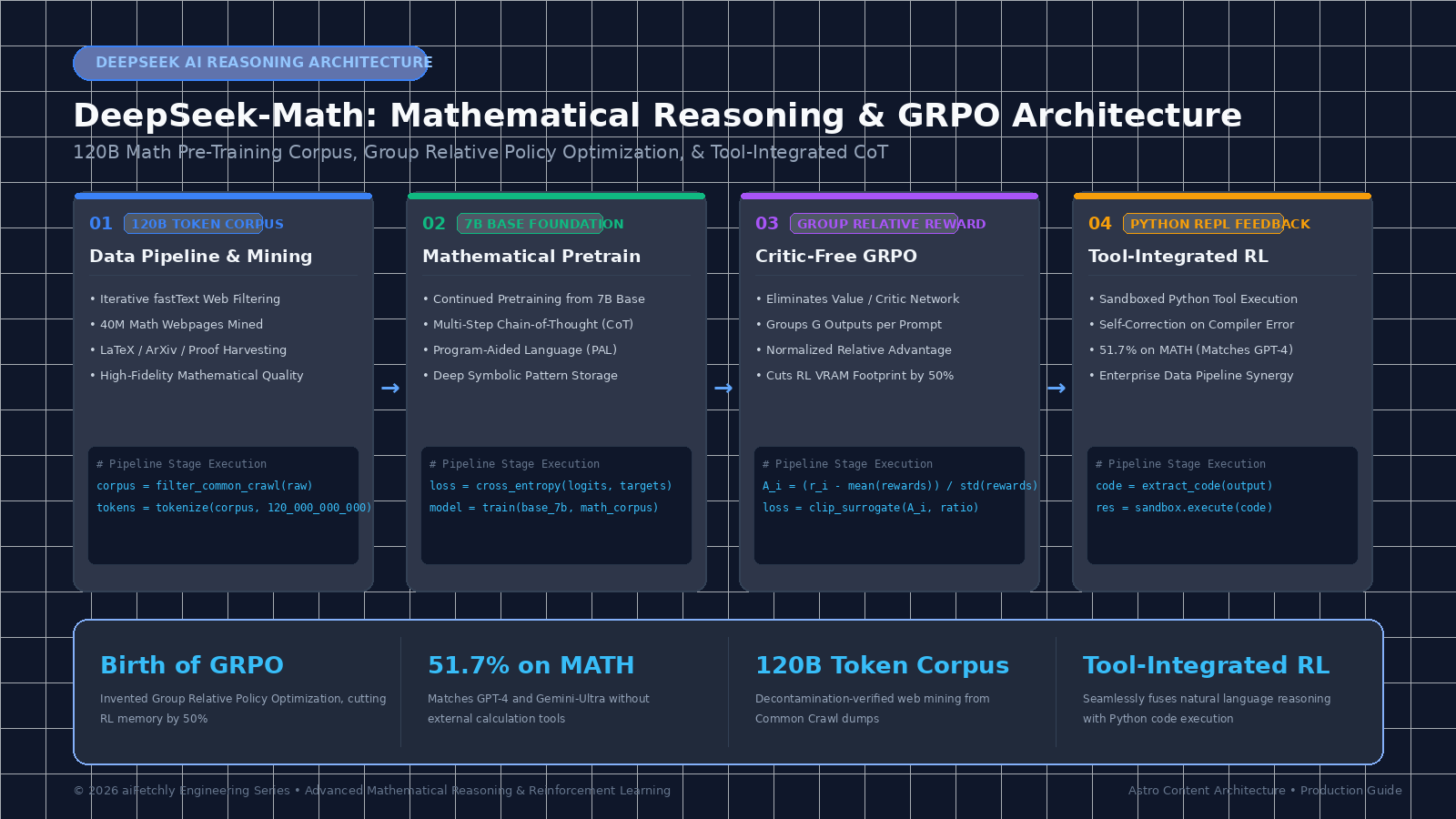
In early 2024, researchers at DeepSeek AI published DeepSeek-Math: Pushing the Limits of Mathematical Reasoning in Open Language Models (arXiv:2402.03300). DeepSeek-Math was not simply an incremental model checkpoint; it was a foundational milestone that reshaped modern post-training and reinforcement learning. Most famously, DeepSeek-Math is the birthplace of Group Relative Policy Optimization (GRPO)—the critic-free reinforcement learning algorithm that later powered DeepSeek-V3 and the emergent reasoning leaps of DeepSeek-R1.
By collecting 120 billion high-quality mathematical tokens from Common Crawl, pioneering GRPO to slash reinforcement learning memory overheads by 50%, and unifying natural language Chain-of-Thought (CoT) with Program-Aided Language (PAL) tool execution, DeepSeekMath-7B achieved an unprecedented 51.7% on the competition MATH benchmark without external tools, rivaling closed frontier models ten times its size.
In this technical guide, we examine the mathematical reasoning failure modes of standard LLMs, dissect the mathematical web mining pipeline, break down the mathematical formulation of GRPO, and construct a complete Python implementation for mathematical reasoning, tool integration, and GRPO advantage calculation.
The Mathematical Reasoning Wall: Why Dense LLMs Struggle with Proofs
To understand why DeepSeek-Math’s architectural innovations were revolutionary, we must examine the computational and structural failure modes that plague standard autoregressive transformers when solving multi-step mathematical problems.
In automated analytical workflows, programmatic financial auditing via AiFetchly Web Scraping, and programmatic quantitative intelligence using AiFetchly Data Fetching, models must perform rigorous deterministic computation rather than fuzzy linguistic approximations.
The Mathematical Reasoning Bottlenecks in Standard LLMs:
Scenario: Solving a Complex AIME Algebra Problem (20+ Logical Derivations)
 │
 ├──> Bottleneck 1: Autoregressive Accumulation of Single-Token Errors
 │    • Model generates token t_1, t_2, ..., t_k
 │    ❌ A single minor sign flip (+ instead of -) poisons all subsequent tokens!
 │    ❌ The model cannot backtrack; it rationalizes the erroneous intermediate state!
 │
 ├──> Bottleneck 2: Lack of Specialized Pre-Training Data
 │    • General web text contains < 1% rigorous mathematical and LaTeX formulas
 │    ❌ Standard tokenizers fragment LaTeX symbols (\\frac, \\int) into disjoint subwords
 │    ❌ Web text contains casual, unverified, and mathematically incorrect forum musings
 │
 └──> Bottleneck 3: Traditional PPO Reinforcement Learning Memory Explosion
      • Standard RLHF requires 4 simultaneous models in GPU VRAM:
      1. Actor (Policy Model)
      2. Critic (Value Model estimating baseline reward V(s))
      3. Reference Model (Frozen policy for KL penalty)
      4. Reward Model (Frozen discriminator)
      ❌ Critic network consumes equal memory to the Actor and suffers from severe training instability!
❌ Demands massive multi-GPU clusters just to train a modest 7B parameter model! 1. Autoregressive Error Compounding
Language models generate text token-by-token according to probability distributions conditioned on preceding tokens:
$$P(y_1, y_2, \dots, y_T \mid x) = \prod_{t=1}^T P(y_t \mid x, y_{<t})$$
In prose generation, a suboptimal word choice can easily be corrected in the next sentence. In formal mathematics, however, if step 3 of a 25-step derivation incorrectly asserts that $(a+b)^2 = a^2 + b^2$, every subsequent algebraic manipulation is doomed. Because standard autoregressive models lack an innate backtracking mechanism, the model continues forward, hallucinating plausible-sounding justifications for an impossible result.
2. Scarcity and Fragmentation of Mathematical Web Data
Mathematical literature relies on intricate mathematical typesetting (LaTeX, MathML, symbolic ASCII, and scientific notation). General-purpose pre-training corpora (such as raw Common Crawl) treat math as noise: HTML parsers often strip mathematical tags, equation formulas become corrupted, and standard Byte-Pair Encoding (BPE) tokenizers split concise LaTeX commands (\begin{align}) into dozens of inefficient sub-tokens.
Without targeted pre-training on tens of billions of clean, uncorrupted mathematical proofs, foundation models fail to internalize the underlying grammar of symbolic logic.
3. The Reinforcement Learning Memory Wall (PPO Critic Bottleneck)
Reinforcement learning from verifiable rewards (such as checking whether a math answer matches a ground-truth numerical target) is the ideal alignment strategy for mathematics. However, standard Proximal Policy Optimization (PPO) requires maintaining two large, trainable networks simultaneously:
- The Policy Model (Actor): Parameters $\theta$ that generate the mathematical tokens.
- The Value Model (Critic): Parameters $\phi$ that estimate the expected cumulative reward $V_\phi(s)$ from any given intermediate state $s$.
In practice:
- The Critic network must have comparable capacity to the Actor (consuming identical GPU memory).
- Training the Critic to accurately predict future mathematical success is notoriously difficult and prone to value drift, causing policy gradients to destabilize and training to diverge.
The DeepSeek-Math Architecture: GRPO and Mathematical Pre-Training
DeepSeek-Math systematically resolved these three bottlenecks by introducing an end-to-end mathematical pipeline spanning: large-scale web data mining, continued mathematical pre-training, and the invention of Group Relative Policy Optimization (GRPO).
+-------------------------------------------------------------------------+
|                      RAW COMMON CRAWL WEB DUMP (2020 - 2023)            |
+------------------------------------+------------------------------------+
                                     |
                                     v
                  +--------------------------------------+
                  |      Iterative fastText & Embeddings |
                  |    - Seeded by OpenWebMath & ArXiv   |
                  |    - 40M Filtered Math Webpages      |
                  +------------------+-------------------+
                                     |
                         120 Billion Token Corpus
                                     |
                                     v
+------------------------------------+------------------------------------+
|                      DeepSeekMath-Base (7B Parameters)                  |
|    Continued Pre-Training from DeepSeek-Coder-Base-v1.5 7B               |
|    - 500 Billion Additional Tokens (Math + Code + Natural Language)     |
|    - High Symbolic Density & Native LaTeX Comprehension                 |
+------------------------------------+------------------------------------+
                                     |
                                     v
+------------------------------------+------------------------------------+
|               SUPERVISED FINE-TUNING (SFT) & PAL REASONING             |
|   - 776K Multi-Step Math Instruction Prompts                            |
|   - Natural Language CoT + Program-Aided Language (Python REPL)        |
+------------------------------------+------------------------------------+
                                     |
                                     v
+------------------------------------+------------------------------------+
|            GROUP RELATIVE POLICY OPTIMIZATION (GRPO)                    |
|   1. For Question q, sample G=4 completions: {o_1, o_2, o_3, o_4}       |
|   2. Compute Verifiable Rewards: r_i in {0, 1}                         |
|   3. Compute Relative Advantage: A_i = (r_i - mean(r)) / std(r)        |
|   4. Update Policy without a Critic Network! (50% VRAM Savings)        |
+------------------------------------+------------------------------------+
                                     |
                                     v
                  +--------------------------------------+
                  |         DeepSeekMath-7B-RL           |
                  |    (51.7% MATH Benchmark Accuracy)   |
+--------------------------------------+ 1. The DeepSeekMath Corpus: Mining 120 Billion High-Quality Tokens
To create the foundation, DeepSeek developed an iterative data selection pipeline over raw Common Crawl web archives:
- Curated High-Quality Seeds: Initiated from verified mathematical domains: arXiv math papers, OpenWebMath, StackExchange Math/Physics, and high-school competition forums.
- fastText Classification and Semantic Clustering: Trained lightweight text classifiers to score candidate web pages based on mathematical density, LaTeX frequency, and formal reasoning structure.
- Decontamination Filtering: Rigorously scrubbed test benchmarks (GSM8K, MATH, SVAMP) from the training pool using 10-gram overlap checks to guarantee zero data leakage.
The resulting DeepSeekMath Corpus provided 120 billion pristine tokens—the largest public mathematical corpus available, retaining full LaTeX typesetting and structural indentation.
2. Continued Pre-Training from a Code Base
Rather than starting from a general text model, DeepSeek-Math initialized from DeepSeek-Coder-Base-v1.5 7B.
Why initialize from code? Code pre-training inherently instills:
- Strict logical syntax compliance.
- Long-range variable tracking and functional dependency awareness.
- Algorithmic problem decomposition.
DeepSeek continued pre-training the 7B model over 500 billion tokens (composed of 56% DeepSeekMath Corpus, 20% algorithmic code, 10% arXiv, and 14% high-quality general language), creating DeepSeekMath-Base 7B.
3. Group Relative Policy Optimization (GRPO)
The crowning theoretical innovation of DeepSeek-Math is GRPO.
In standard PPO, the policy gradient is formulated using an advantage estimate $\hat{A}t$ calculated via Generalized Advantage Estimation (GAE) using the Critic network $V\phi$:
$$\hat{A}t = \delta_t + (\gamma \lambda) \delta{t+1} + \dots, \quad \text{where } \delta_t = R_t + \gamma V_\phi(s_{t+1}) - V_\phi(s_t)$$
DeepSeek researchers asked a fundamental question: Can we eliminate the Critic model entirely while still maintaining an accurate, low-variance baseline?
In GRPO, for each mathematical prompt $q$, the model samples a group of $G$ outputs ${o_1, o_2, \dots, o_G}$ from the current policy $\pi_\theta$.
Each output $o_i$ receives a verifiable scalar reward $r_i$ (for example, $r_i = 1$ if the final numerical answer matches the ground truth, and $r_i = 0$ if incorrect).
Instead of relying on a Critic network to estimate the baseline, GRPO computes the advantage of each output relative to the group statistics:
$$A_i = \frac{r_i - \text{mean}\left({r_1, r_2, \dots, r_G}\right)}{\text{std}\left({r_1, r_2, \dots, r_G}\right) + \epsilon}$$
The objective function maximized by GRPO is:
$$\mathcal{J}{\text{GRPO}}(\theta) = \mathbb{E}\left[ \frac{1}{G} \sum{i=1}^G \left( \min\left( \frac{\pi_\theta(o_i \mid q)}{\pi_{\text{old}}(o_i \mid q)} A_i, ; \text{clip}\left(\frac{\pi_\theta(o_i \mid q)}{\pi_{\text{old}}(o_i \mid q)}, 1-\epsilon, 1+\epsilon\right) A_i \right) - \beta \mathbb{D}{\text{KL}}\left(\pi\theta \parallel \pi_{\text{ref}}\right) \right) \right]$$
Key Architectural Benefits of GRPO
- Zero Critic Parameters: Cuts VRAM requirements by approximately 50%, allowing teams to train large reasoning models on commodity hardware clusters.
- Self-Balancing Gradients: If all $G$ completions are correct ($r = [1, 1, 1, 1]$) or all are incorrect ($r = [0, 0, 0, 0]$), the advantage is normalized to zero, preventing policy degradation on trivially easy or hopelessly impossible problems.
- Direct Exploration Incentivization: Outputs that discover a novel, successful derivation when the rest of the group fails receive massive positive advantage spikes, actively steering the model toward robust reasoning paths.
Quantitative Performance: Competition MATH Benchmark
The empirical impact of combining the 120B math corpus with GRPO is demonstrated on the standard MATH benchmark (high-school and collegiate competition mathematics):
| Model Architecture | Parameters | Training Modality | MATH Benchmark Accuracy ($\uparrow$) | GSM8K Accuracy ($\uparrow$) |
|---|---|---|---|---|
| LLaMA-2 | 70B | Dense Pre-Training | 13.5% | 56.8% |
| Minerva (Google) | 540B | Specialized Math LLM | 33.6% | 58.8% |
| DeepSeekMath-Base | 7B | 120B Math Pre-Training | 30.6% | 64.2% |
| DeepSeekMath-Instruct | 7B | Math SFT (CoT + PAL) | 46.8% | 82.9% |
| DeepSeekMath-RL (GRPO) | 7B | Critic-Free GRPO | 51.7% | 88.2% |
| GPT-4 (May 2023) | ~1.8T | Proprietary RLHF | 42.5% | 92.0% |
| Gemini 1.0 Ultra | ~1.5T | Proprietary RLHF | 53.2% | 94.4% |
A 7-billion-parameter model trained with GRPO matched or exceeded GPT-4 and rivaled Gemini Ultra on competition-level mathematical proofs.
Hands-On Implementation: Mathematical Reasoning and GRPO with Python
Let us implement a complete, educational Python system demonstrating the core components of DeepSeek-Math: prompt ingestion, Program-Aided Language (PAL) execution, verifiable reward scoring, and mathematical Group Relative Policy Optimization (GRPO) advantage calculation.
Step 1: Environment Setup
Install core packages for PyTorch and mathematical token handling:
# Create and activate Python virtual environment
python3 -m venv venv
source venv/bin/activate

# Install PyTorch, transformers, and numerical dependencies
pip install torch torchvision --index-url https://download.pytorch.org/whl/cu121
pip install transformers accelerate sympy pydantic Step 2: The Program-Aided Language (PAL) Math Engine
DeepSeek-Math combines natural language Chain-of-Thought (CoT) with executable Python code blocks to eliminate arithmetic calculation mistakes:
import sys
import io
import re
import sympy
from typing import Dict, Any, Tuple, Optional

class PythonMathSandbox:
    """
    Sandboxed execution runtime for Program-Aided Language (PAL) code blocks.
    Evaluates Python code output to verify intermediate algebraic derivations.
    """
    def __init__(self, timeout_seconds: float = 2.0):
        self.timeout = timeout_seconds

    def execute_code_block(self, code_str: str) -> Tuple[bool, str]:
        """
        Executes extracted Python code, capturing stdout or return values.
        """
        buffer = io.StringIO()
        old_stdout = sys.stdout
        sys.stdout = buffer

        # Safe globals dictionary
        safe_globals = {
            'sympy': sympy,
            'sqrt': sympy.sqrt,
            'symbols': sympy.symbols,
            'solve': sympy.solve,
            'Eq': sympy.Eq,
            'pi': sympy.pi,
            'abs': abs,
            'min': min,
            'max': max
        }

        success = True
        result_output = ""
        try:
            exec(code_str, safe_globals)
            result_output = buffer.getvalue().strip()
        except Exception as e:
            success = False
            result_output = f"Execution Error: {e}"
        finally:
            sys.stdout = old_stdout

return success, result_output Step 3: Verifiable Mathematical Answer Scoring
In mathematical RL, reward functions must verify whether a generated string matches the ground-truth integer or simplified fraction:
class MathRewardEvaluator:
    """
    Verifiable rule-based reward function for mathematical ground-truth verification.
    Extracts answers enclosed in \\boxed{...} or parsed from trailing outputs.
    """
    @staticmethod
    def extract_boxed_answer(text: str) -> Optional[str]:
        """
        Extracts final answer from LaTeX \\boxed{answer} convention.
        """
        match = re.findall(r'\\boxed\{([^}]+)\}', text)
        if match:
            return match[-1].strip()

        # Fallback: Look for "The answer is X"
        alt_match = re.findall(r'[Tt]he answer is:?\s*([^\n\.]+)', text)
        if alt_match:
            return alt_match[-1].strip()
        return None

    @classmethod
    def compute_reward(cls, completion: str, ground_truth: str) -> float:
        """
        Computes deterministic binary reward r in {0.0, 1.0}.
        """
        pred = cls.extract_boxed_answer(completion)
        if pred is None:
            return 0.0

        pred = pred.replace(" ", "").replace("$", "")
        ground_truth = ground_truth.replace(" ", "").replace("$", "")

        # Direct string equality check
        if pred == ground_truth:
            return 1.0

        # Symbolic equality check via SymPy
        try:
            val_pred = sympy.simplify(pred)
            val_gt = sympy.simplify(ground_truth)
            if val_pred == val_gt:
                return 1.0
        except Exception:
            pass

return 0.0 Step 4: The Core GRPO Advantage & Optimization Engine
We implement the mathematical core of Group Relative Policy Optimization, calculating normalized advantages and surrogate clipped policy updates without a Critic model:
import torch
import torch.nn as nn
import torch.nn.functional as F

class GRPOTrainer:
    """
    Implementation of Group Relative Policy Optimization (GRPO) for reasoning models.
    Eliminates the Critic / Value Network by normalizing rewards across completion groups.
    """
    def __init__(
        self,
        clip_epsilon: float = 0.2,
        kl_beta: float = 0.04,
        eps: float = 1e-8
    ):
        self.clip_eps = clip_epsilon
        self.beta = kl_beta
        self.eps = eps

    def compute_group_advantages(self, rewards: torch.Tensor) -> torch.Tensor:
        """
        Computes group-normalized advantage: A_i = (r_i - mean(r)) / (std(r) + eps)
        Args:
            rewards: Tensor of shape [Group_Size, Batch_Size]
        Returns:
            advantages: Tensor of shape [Group_Size, Batch_Size]
        """
        mean = rewards.mean(dim=0, keepdim=True)
        std = rewards.std(dim=0, keepdim=True)

        # If all samples in group have identical reward (std == 0), advantage is 0
        normalized_advantage = (rewards - mean) / (std + self.eps)
        return normalized_advantage

    def compute_grpo_loss(
        self,
        log_probs_current: torch.Tensor,
        log_probs_old: torch.Tensor,
        log_probs_ref: torch.Tensor,
        advantages: torch.Tensor
    ) -> Tuple[torch.Tensor, Dict[str, float]]:
        """
        Calculates clipped surrogate loss and KL divergence penalty.
        """
        # Probability ratio: r_t(theta) = pi_theta / pi_old = exp(log_p_curr - log_p_old)
        ratio = torch.exp(log_probs_current - log_probs_old)

        # Clipped surrogate objective
        surr1 = ratio * advantages
        surr2 = torch.clamp(ratio, 1.0 - self.clip_eps, 1.0 + self.clip_eps) * advantages
        policy_loss = -torch.min(surr1, surr2).mean()

        # KL divergence penalty: D_KL(pi_theta || pi_ref)
        kl_div = (torch.exp(log_probs_ref - log_probs_current) - (log_probs_ref - log_probs_current) - 1.0)
        kl_penalty = self.beta * kl_div.mean()

        total_loss = policy_loss + kl_penalty

        metrics = {
            "policy_loss": float(policy_loss.item()),
            "kl_penalty": float(kl_penalty.item()),
            "mean_ratio": float(ratio.mean().item()),
            "mean_advantage": float(advantages.mean().item())
        }
        return total_loss, metrics

def run_grpo_demonstration():
    """
    Demonstrates GRPO calculation across a group of G=4 candidate mathematical solutions.
    """
    print("--- Demonstrating GRPO Advantage Computation ---")

    # Question: "Find the sum of all integers x such that |x - 3| < 5."
    # Ground Truth: x in {-1, 0, 1, 2, 3, 4, 5, 6, 7} -> Sum = 27
    ground_truth_answer = "27"

    completions = [
        "Solving |x - 3| < 5 gives -5 < x - 3 < 5, so -2 < x < 8. The integers are -1,0,1,2,3,4,5,6,7. Sum is \\boxed{27}.", # Correct
        "Solving gives x - 3 < 5, so x < 8. Integers sum to \\boxed{28}.",                                                # Incorrect
        "We have -2 < x < 8. Adding them: (-1) + 0 + 1 + ... + 7 = 27. \\boxed{27}.",                                     # Correct
        "The absolute value means x must be positive. Sum is \\boxed{15}."                                                 # Incorrect
    ]

    evaluator = MathRewardEvaluator()
    rewards_list = [evaluator.compute_reward(c, ground_truth_answer) for c in completions]
    rewards_tensor = torch.tensor(rewards_list).unsqueeze(1) # [4, 1]

    print(f"Group Rewards: {rewards_list} (Mean: {rewards_tensor.mean().item():.2f})")

    trainer = GRPOTrainer()
    advantages = trainer.compute_group_advantages(rewards_tensor)

    print(f"Group Advantages (Normalized):")
    for idx, (adv, r) in enumerate(zip(advantages.squeeze().tolist(), rewards_list)):
        print(f"  Completion #{idx+1} (Reward={r}): Advantage = {adv:+.4f}")

if __name__ == "__main__":
run_grpo_demonstration() Practical Applications for Enterprise AI and Analytical Pipelines
The algorithmic principles pioneered by DeepSeek-Math have broad utility beyond academic math competitions:
1. Programmatic Auditing & Quantitative Web Scraping
In financial data harvesting, algorithmic trading, and competitive intelligence systems built via AiFetchly Web Scraping, language models are tasked with extracting quantitative balance sheets and verifying revenue calculations.
By pairing DeepSeek-Math reasoning with AiFetchly Data Fetching, autonomous bots can:
- Ingest complex SEC 10-K filings or quarterly financial tables.
- Execute sandboxed Python verification scripts to recalculate EBITDA, debt-to-equity ratios, and depreciation curves.
- Flag statistical discrepancies or accounting anomalies automatically before streaming structured records to enterprise endpoints via AiFetchly API Integration.
2. High-Assurance Code Synthesis & Formal Verification
In critical software engineering workflows—such as compiling cryptographic routines, smart contracts, or distributed consensus algorithms—natural language code generation must be provably sound. DeepSeek-Math’s tool-integrated PAL paradigm allows agents to write code, test edge-case unit assertions in real time, observe compiler tracebacks, and self-correct prior to pull request generation.
3. Lowering Enterprise RL Post-Training Costs
For enterprises fine-tuning proprietary models for logistics planning, route optimization, or legal contract compliance:
- Adopting GRPO eliminates the need for expensive multi-node H100 clusters previously required by PPO.
- Training can be executed on single 8x A100 or 8x L40S nodes, slashing cloud compute expenditures by over 50%.
Production Best Practices & Architectural Considerations
Deploying GRPO and mathematical reasoning models in production requires careful adherence to architectural guidelines:
1. Group Size Calibration ($G=4$ vs. $G=8$)
In GRPO:
- Using $G=2$ yields high variance because group statistics are noisy.
- Using $G=4$ or $G=8$ provides optimal balance: sufficient variance reduction across completions while keeping batch generation memory within bounds.
2. Guardrails Against Arithmetic Reward Hacking
When training models with rule-based rewards:
- Ensure the extraction regex strictly isolates the terminal boxed answer.
- Incorporate a length penalty or format compliance reward to prevent models from generating endless speculative boilerplate or degenerate repeating loops to manipulate probability ratios.
3. Temperature Scaling During Group Sampling
To encourage exploration during GRPO rollout generation:
- Set sampling temperature to $T = 0.7$ to $1.0$.
- High temperature ensures diverse derivations within the group ${o_1, \dots, o_G}$, allowing the model to discover alternate mathematical paths that achieve the correct reward.
Summary & Next Steps
DeepSeek-Math established a new paradigm for mathematical reasoning in open foundation models. By showing that 7-billion parameter architectures can reach competition-level mathematical mastery through clean corpus curation and critic-free reinforcement learning, DeepSeek-Math laid the foundation for the next generation of reasoning agents.
Key takeaways for engineering teams include:
- GRPO eliminates the Critic model, cutting reinforcement learning VRAM requirements in half while stabilizing training dynamics.
- Data curation outperforms brute parameter scale: 120 billion high-density mathematical tokens enabled a 7B model to match 70B and 500B frontier baselines.
- Tool integration (PAL) provides zero-error arithmetic verification, bridging intuitive neural reasoning with deterministic symbolic execution.
To discover how to integrate automated data pipelines with advanced reasoning intelligence, explore our comprehensive technical guides on the AiFetchly Documentation portal or review our tailored cloud infrastructure tiers on the AiFetchly Pricing page. For developers looking to scale automated data extraction, visit the AiFetchly to learn how aiFetchly accelerates enterprise intelligence.