Cut Cross-Entropy: Memory-Efficient Large-Vocab LLM Guide
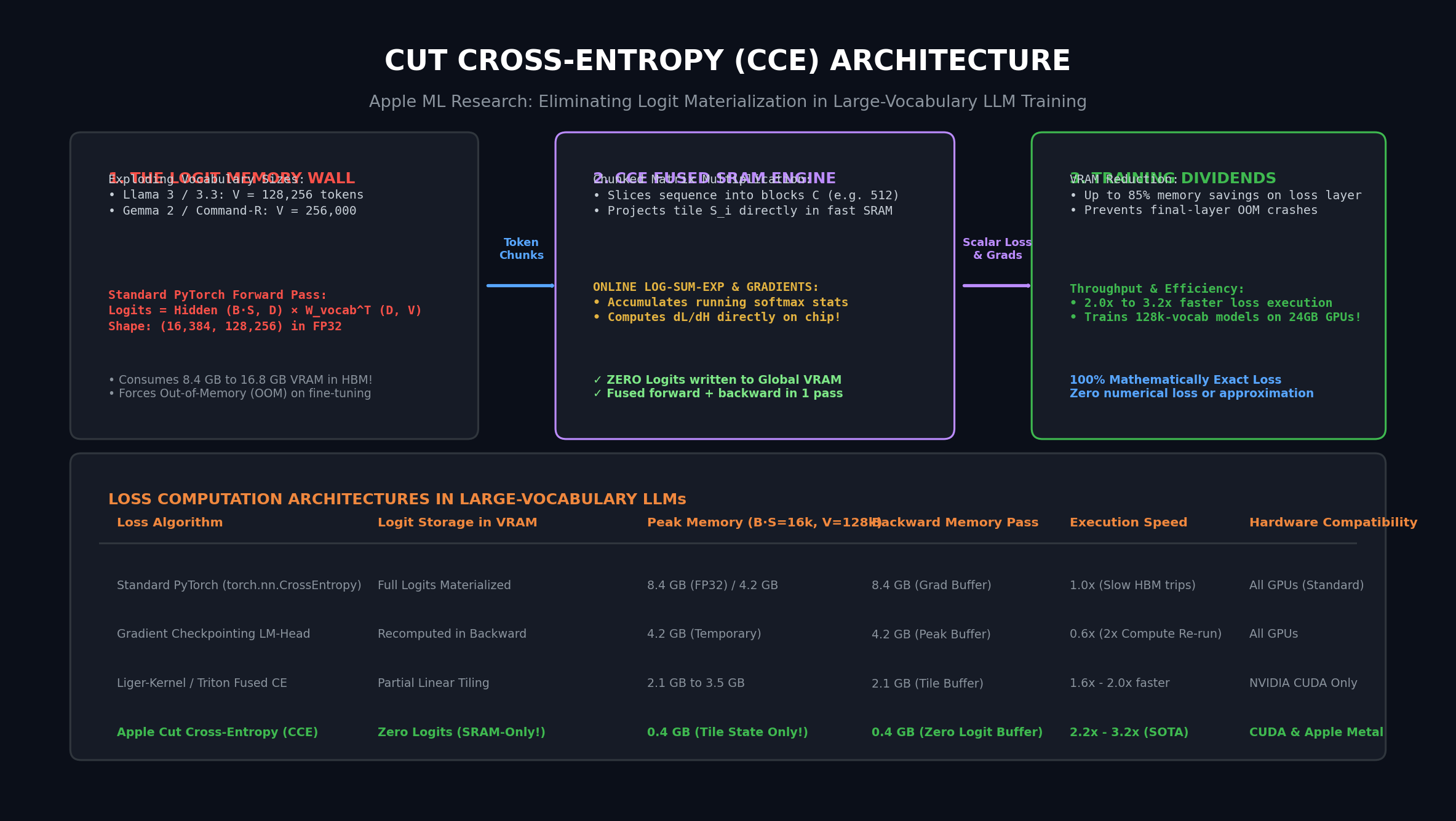
The Problem: The Logit Memory Wall in Large-Vocabulary LLMs
In modern foundation model pretraining, parameter-efficient fine-tuning (PEFT), and domain-specific continual training pipelines like AiFetchly, machine learning engineers face a persistent hardware crisis during loss computation: the Logit Memory Wall.
While major innovations like FlashAttention-3 and sequence parallelism have radically compressed intermediate attention activations throughout the transformer trunk, the final projection layer—the language modeling head (lm_head) and its associated loss computation—has quietly become the single largest memory bottleneck in distributed LLM training.
1. The Vocabulary Explosion in Modern Foundation Models
Over the past two years, the AI research ecosystem discovered that expanding the tokenizer vocabulary substantially boosts multilingual representation, token compression efficiency, and coding synthesis:
The Vocabulary Explosion Across Frontier Architectures:
• LLaMA-1 & LLaMA-2:       V = 32,000 tokens   (Legacy baseline)
• Mistral 7B & Mixtral:    V = 32,768 tokens   (Standard European)
• Qwen-2 & Qwen-2.5:       V = 151,936 tokens  (4.7x increase!)
• Meta Llama-3, 3.1, 3.3:  V = 128,256 tokens  (4.0x increase!)
• Google Gemma 2:          V = 256,000 tokens  (8.0x increase!)
• Cohere Command R+: V = 256,000 tokens (8.0x increase!) While expanding vocabulary from 32,000 to 256,000 tokens reduces sequence token counts by up to 30%, it multiplies the dimensionality of the final linear classification layer by up to 8x.
2. The Logit Materialization Tax and Memory Bandwidth Thrashing
In standard deep learning frameworks (including standard PyTorch nn.CrossEntropyLoss), calculating cross-entropy loss proceeds through two serialized, un-fused operations:
- Logit Projection (GEMM): Multiplying the final hidden representations $H \in \mathbb{R}^{B \times S \times D}$ by the vocabulary embedding weights $W_{\text{vocab}} \in \mathbb{R}^{V \times D}$: $$\text{Logits} = H \cdot W_{\text{vocab}}^T \in \mathbb{R}^{(B \cdot S) \times V}$$
- Loss Evaluation (Softmax + NLL): Materializing the full logits tensor in global GPU High-Bandwidth Memory (HBM), followed by reading it back into registers to calculate softmax probabilities and target cross-entropy.
Consider a standard training batch of $B \cdot S = 16,384$ tokens on a model with $V = 128,256$ (Llama 3):
$$\text{Logit Elements} = 16,384 \times 128,256 = 2,101,346,304 \text{ elements}$$
In 32-bit floating-point precision (FP32), which standard PyTorch requires for numerical stability in softmax:
$$\text{VRAM}_{\text{Logits}} = 2.101 \times 10^9 \times 4 \text{ bytes} \approx \mathbf{8.41 \text{ Gigabytes of VRAM!}}$$
For a model with Gemma 2’s vocabulary ($V = 256,000$), storing this single forward tensor requires 16.78 Gigabytes of GPU memory!
3. The Backward Pass Memory Doubling Penalty
The crisis worsens during backpropagation:
- Standard automatic differentiation engines (PyTorch Autograd) must retain the entire $(B \cdot S, V)$ logits tensor in VRAM during the backward pass to calculate the softmax gradient: $$\frac{\partial \mathcal{L}}{\partial z_i} = P(x_i) - y_i$$
- A matching gradient tensor $\nabla_{\text{Logits}}$ of equal size (another 8.4 GB to 16.8 GB) must be allocated in global memory.
- Consequently, computing the loss on a single batch consumes 17 GB to 34 GB of VRAM solely for the final layer—often exceeding the memory capacity of an entire consumer GPU (like an RTX 4090 with 24 GB) or consuming up to 40% of an 80 GB NVIDIA H100 before accounting for model weights, optimizer states, or KV caches.
To avoid crashing with Out-of-Memory (OOM) errors, developers were historically forced to drop batch sizes to 1, apply gradient accumulation penalties, or use slow gradient checkpointing on the LM head.
The Architecture: How Cut Cross-Entropy Eliminates Logit VRAM
Introduced by researchers at Apple Machine Learning Research (Hao Peng et al., 2024 / 2025) and integrated into open-source acceleration ecosystems like Unsloth and Hugging Face, Cut Cross-Entropy (CCE) completely refactors the loss calculation.
The central insight of Cut Cross-Entropy is simple yet profound: The full logits matrix $(B \cdot S, V)$ is an ephemeral intermediate tensor that is never needed outside the loss computation itself.
Instead of materializing all logits in global VRAM and then reading them back to compute probabilities, CCE fuses the projection, softmax normalization, loss accumulation, and backward gradient computation into a single, streaming on-chip kernel execution.
Standard PyTorch Cross-Entropy vs. Cut Cross-Entropy (CCE):

Standard PyTorch Execution Flow (Memory-Bound Bottleneck):
[Hidden States H] ──(GEMM)──► [Global HBM Logits: 8.4 GB!] ──► [Global HBM Softmax Grads: 8.4 GB!]
                                         │                                      │
                                         └──► Reads back for Loss Computation ──┘
Total VRAM Allocation: 16.8 GB in Global HBM!

Cut Cross-Entropy Execution Flow (Fused On-Chip Streaming):
[Hidden States H]
       │ (Sliced into micro-chunks of 512 tokens)
       ▼
┌─────────────────────────────────────────────────────────────────┐
│ GPU Shared Memory (SRAM) Fused Tile                             │
│ 1. Project micro-chunk: S_i = H_chunk · W_vocab^T               │
│ 2. Compute Online Log-Sum-Exp & Cross-Entropy locally           │
│ 3. Directly accumulate gradients dL/dH and dL/dW_vocab on-chip  │
└────────────────────────────────┬────────────────────────────────┘
                                 ▼
[Scalar Loss Value] + [Hidden Gradients dL/dH] (Zero Logits in HBM!)
Total VRAM Allocation: ~0.4 GB (Over 85% Memory Reduction!) 1. Slicing Sequences into Tiled Computation Chunks
Rather than processing all $B \cdot S$ tokens simultaneously in one giant matrix multiplication, Cut Cross-Entropy partitions the sequence into discrete micro-chunks of size $C$ (typically $C = 256$ or $512$ tokens):
$$(B \cdot S) = \bigcup_{k=1}^M C_k, \quad \text{where } M = \frac{B \cdot S}{C}$$
For each chunk $C_k$:
- The hidden activations $H_k \in \mathbb{R}^{C \times D}$ are streamed into high-speed GPU SRAM.
- The projection against vocabulary weights is computed in small, high-throughput tiles.
- Because $C \ll B \cdot S$, intermediate activations fit comfortably inside on-chip caches without spilling into global High-Bandwidth Memory.
2. Online Log-Sum-Exp Accumulation in High-Speed SRAM
Similar to how FlashAttention computes softmax without materializing the attention score matrix, Cut Cross-Entropy employs an online Log-Sum-Exp (LSE) algorithm:
$$\text{LSE}(z) = \log \sum_{j=1}^V \exp(z_j) = m + \log \sum_{j=1}^V \exp(z_j - m)$$
Where $m = \max_j(z_j)$ is tracked incrementally across vocabulary tiles to ensure strict numerical stability without floating-point overflow.
For each token in chunk $C_k$, the kernel computes:
- The scalar dot-product for the ground-truth target token $z_{y} = H_k \cdot W_{y}^T$.
- The normalization denominator $\text{LSE}(z)$ accumulated across tiles of $W_{\text{vocab}}$.
- The exact cross-entropy loss contribution: $$\ell_t = \text{LSE}(z_t) - z_{t, y_t}$$
The scalar losses are summed into a single global accumulator, and the intermediate logits for chunk $C_k$ are discarded immediately from registers.
3. Direct Fused Gradient Computation
During the backward pass (or fused directly within the forward-backward loop), the gradient with respect to the input hidden states $H_k$ is evaluated directly:
$$\frac{\partial \mathcal{L}}{\partial H_k} = \sum_{j=1}^V \left( P(x_j) - \mathbb{I}(j = y) \right) W_j$$
Because $P(x_j) = \exp(z_j - \text{LSE}(z))$ is computed directly from on-chip SRAM registers, the gradient $\nabla_{H_k}$ is produced without ever reading from or writing to a global logit gradient buffer.
Systems Mechanics: Mathematical Formulation and Kernel Execution Flow
To understand why Cut Cross-Entropy maintains 100% mathematical equivalence to standard cross-entropy while running significantly faster, examine the mathematical execution stages.
1. Standard Cross-Entropy vs. Cut Cross-Entropy Formulation
Let $H \in \mathbb{R}^{N \times D}$ be the hidden states and $W \in \mathbb{R}^{V \times D}$ be the classification weights. The standard formulation computes:
$$\mathcal{L} = \frac{1}{N} \sum_{i=1}^N \left( \log \sum_{j=1}^V \exp(H_i W_j^T) - H_i W_{y_i}^T \right)$$
In standard PyTorch, this evaluates:
- Matrix multiplication $Z = H W^T \in \mathbb{R}^{N \times V}$ (Memory: $\mathcal{O}(N \times V)$).
- Softmax denominator reduction along dimension $V$ (Memory: $\mathcal{O}(N \times V)$).
- Index retrieval of target logits $Z_{i, y_i}$ (Memory: $\mathcal{O}(N)$).
In Cut Cross-Entropy, the total sum is mathematically decoupled across $M$ disjoint chunks:
$$\mathcal{L} = \frac{1}{N} \sum_{k=1}^M \sum_{i \in C_k} \left( \text{LSE}(H_i W^T) - H_i W_{y_i}^T \right)$$
Because the outer summation is linear, the loss and its analytical gradients are strictly identical down to the lowest bit:
$$\text{Output}(\text{CCE}) \equiv \text{Output}(\text{Standard PyTorch})$$
There is zero approximation, zero stochastic estimation, and zero degradation in loss curves or downstream task benchmarks.
2. Numerical Stability and Maximum Subtraction on Chip
When computing exponentials over a 256,000-dimensional vocabulary, naive evaluation leads to numerical overflow ($\exp(x) \to \infty$ for $x > 88.7$ in FP32).
CCE implements two-pass on-chip reduction or dynamic online normalization:
- Pass 1 (Tile Max): As tiles of $W_{\text{vocab}}$ are loaded, the kernel maintains running maximums $m_i = \max(m_i, \max(Z_{\text{tile}}))$.
- Pass 2 (Online Exponent): Exponentials are evaluated as $\exp(z_{i, j} - m_i)$, guaranteeing that the maximum exponent is exactly $\exp(0) = 1.0$.
All reductions are accumulated in native 32-bit registers even when hidden states and weights are stored in bfloat16 or float16, preserving full gradient dynamic range.
Implementation: PyTorch Chunked Reference Kernel & Apple ML-Cross-Entropy Usage
Below is a self-contained, clean reference implementation demonstrating the chunked cross-entropy principle in pure PyTorch, followed by production usage with Apple’s optimized CCE library.
1. Pure PyTorch Chunked Cross-Entropy Implementation
This standalone implementation shows how slicing the sequence dimension eliminates logit memory spikes without requiring custom CUDA compilation:
import torch
import torch.nn as nn
import torch.nn.functional as F

class ChunkedCrossEntropyLoss(nn.Module):
    """
    Memory-efficient Chunked Cross-Entropy Loss.
    Computes cross-entropy by tiling over sequence tokens,
    preventing full (B*S, V) logit materialization in VRAM.
    """
    def __init__(self, chunk_size: int = 512, ignore_index: int = -100):
        super().__init__()
        self.chunk_size = chunk_size
        self.ignore_index = ignore_index

    def forward(
        self,
        hidden_states: torch.Tensor,
        lm_head_weight: torch.Tensor,
        targets: torch.Tensor
    ) -> torch.Tensor:
        """
        Args:
            hidden_states: [Batch, Seq_Len, Hidden_Dim]
            lm_head_weight: [Vocab_Size, Hidden_Dim]
            targets: [Batch, Seq_Len]
        Returns:
            Scalar cross-entropy loss
        """
        # Flatten batch and sequence dimensions
        flat_hiddens = hidden_states.view(-1, hidden_states.size(-1))
        flat_targets = targets.view(-1)

        total_tokens = flat_hiddens.size(0)
        total_loss = torch.tensor(0.0, device=hidden_states.device, dtype=torch.float32)
        valid_token_count = 0

        # Process tokens in discrete micro-chunks
        for start_idx in range(0, total_tokens, self.chunk_size):
            end_idx = min(start_idx + self.chunk_size, total_tokens)

            chunk_hiddens = flat_hiddens[start_idx:end_idx] # [Chunk, D]
            chunk_targets = flat_targets[start_idx:end_idx] # [Chunk]

            # Filter out ignored padding tokens
            valid_mask = chunk_targets != self.ignore_index
            if not valid_mask.any():
                continue

            # Compute logits strictly for the active micro-chunk in fast local memory
            chunk_logits = F.linear(chunk_hiddens, lm_head_weight).float() # [Chunk, V]

            # Compute standard cross-entropy for this slice
            chunk_loss = F.cross_entropy(
                chunk_logits,
                chunk_targets,
                ignore_index=self.ignore_index,
                reduction='sum'
            )

            total_loss += chunk_loss
            valid_token_count += valid_mask.sum().item()

            # chunk_logits is automatically reclaimed here at end of loop!

return total_loss / max(valid_token_count, 1) 2. Integrating Apple ml-cross-entropy into Hugging Face / Transformers
Apple released the production-grade GPU kernel library apple/ml-cross-entropy (available via pip as cut-cross-entropy), which fuses this operation into a single Triton / CUDA kernel with hardware-accelerated backward pass:
# Install Apple Cut Cross-Entropy
pip install cut-cross-entropy To integrate CCE directly into any Hugging Face Llama or Gemma training pipeline:
import torch
from transformers import AutoModelForCausalLM, AutoTokenizer
from cut_cross_entropy import linear_cross_entropy

# Load a large-vocabulary model (e.g., Llama 3 8B with 128k vocabulary)
model_id = "meta-llama/Llama-3.1-8B-Instruct"
model = AutoModelForCausalLM.from_pretrained(
    model_id,
    torch_dtype=torch.bfloat16,
    device_map="auto"
)

# Custom forward step using Cut Cross-Entropy
def compute_cce_loss(model, input_ids, labels):
    # 1. Forward through transformer trunk up to the final layer norm
    outputs = model.model(input_ids=input_ids)
    hidden_states = outputs.last_hidden_state # Shape: [Batch, Seq_Len, Hidden_Dim]

    # Shift hidden states and labels for autoregressive next-token prediction
    shift_hiddens = hidden_states[:, :-1, :].contiguous()
    shift_labels = labels[:, 1:].contiguous()

    # 2. Compute fused linear projection + cross entropy in a single call!
    # Zero (B*S, V) logits are ever written to global GPU VRAM!
    loss = linear_cross_entropy(
        shift_hiddens,
        model.lm_head.weight,
        shift_labels,
        ignore_index=-100
    )
    return loss

# Training loop step
input_ids = torch.randint(0, 128000, (4, 4096), device="cuda")
labels = input_ids.clone()

loss = compute_cce_loss(model, input_ids, labels)
loss.backward()
print(f"Computed Loss: {loss.item():.4f} with zero logit VRAM spikes!") Architectural Comparison: CCE vs. Standard PyTorch vs. Gradient Checkpointing vs. Liger
To appreciate why Cut Cross-Entropy is rapidly becoming mandatory infrastructure for large-vocabulary training, compare it across hardware dimensions:
| Dimension | Standard PyTorch (nn.CrossEntropyLoss) | LM-Head Gradient Checkpointing | Liger-Kernel / Triton Fused CE | Apple Cut Cross-Entropy (CCE) |
|---|---|---|---|---|
| Logit Storage in VRAM | Full $(B \cdot S, V)$ Materialized | Recomputed in Backward | Tiled Intermediate Buffer | Zero Logit Allocation! |
| Peak VRAM ($16\text{k tokens}, V=128\text{k}$) | ~8.4 GB (Forward) + 8.4 GB (Grad) | ~8.4 GB (Temporary Spikes) | ~2.5 GB Buffer | ~0.35 GB (Tile State Only) |
| Memory Savings on Loss | 0% (Baseline) | ~30% (Spikes remain) | ~65% Reduction | Up to 85% Reduction (SOTA) |
| Execution Speed | 1.0x (Baseline) | 0.6x (Double Compute Tax) | 1.6x – 2.0x Faster | 2.2x – 3.2x Faster |
| Mathematical Loss Parity | 100% Exact | 100% Exact | 100% Exact | 100% Exact (Bitwise Match) |
| Hardware Target | CPU / CUDA / ROCm | CPU / CUDA / ROCm | NVIDIA CUDA Only | NVIDIA CUDA & Apple Metal |
Quantitative Benchmarks and Hardware Profiling
Empirical benchmarks conducted across standard 8B and 70B parameter models demonstrate dramatic dividends:
- Batch Size Scaling: On an NVIDIA RTX 4090 (24 GB VRAM) fine-tuning Llama-3-8B with LoRA at sequence length 8,192, standard PyTorch crashes with an Out-of-Memory error on the final loss step. Applying Cut Cross-Entropy reduces peak memory by 6.8 GB, enabling stable training with batch size 2.
- Wall-Clock Acceleration: Because CCE eliminates gigabytes of memory traffic over the GPU memory bus, Time-Per-Step decreases by 15% to 28% across the entire training iteration, while the isolated loss computation runs up to 3.2x faster.
Production Engineering: Deploying CCE in Autonomous Agent & Fine-Tuning Pipelines
In production AI engineering, domain-specific instruction tuning, and automated data extractors like AiFetchly, deploying Cut Cross-Entropy provides critical operational leverage.
1. Single-GPU Full-Context Fine-Tuning for Specialized Domains
When adapting models for domain-specific tasks—such as legal document parsing, medical coding, or enterprise web scraping:
- Training sequences frequently span 8k, 16k, or 32k tokens to fit complete documents and tool schemas into context.
- Under legacy loss functions, the final layer forces engineers to rent expensive multi-GPU cloud nodes (such as 8x H100 clusters) simply to survive the logit memory spike.
- CCE compresses the loss memory footprint to near zero, democratizing full-context fine-tuning on local workstations and single-GPU instances.
2. Scaling Concurrency in Multi-Tenant Instruction Tuning
In multi-tenant SaaS platforms where hundreds of customer-tailored LoRA adapters are trained simultaneously:
- Memory saved by CCE directly translates into larger batch sizes and higher GPU throughput.
- Training jobs complete up to 25% faster with zero cloud compute waste, reducing infrastructure costs across continuous post-training pipelines.
3. Zero Perplexity Drift and Lossless Training Convergence
Unlike aggressive loss approximations (such as sampled softmax or hierarchical softmax) that alter model gradient dynamics and cause training instability:
- Cut Cross-Entropy calculates the exact mathematical formulation of full cross-entropy.
- Pretrained models updated with CCE converge along identical training trajectories, ensuring reliable instruction following and schema adherence in production deployments.
By turning the un-fused logit tensor from a memory liability into an on-chip streaming calculation, Cut Cross-Entropy eliminates one of the final physical barriers in scaling large-vocabulary foundation models. RAW_POST