CrewAI Architecture: Multi-Agent Role-Playing Orchestration
The Problem: The Cognitive Collapse of Monolithic Prompts and Unstructured Agents
As enterprise engineering teams deploy generative AI to automate complex data workflows—such as competitive market intelligence, automated compliance auditing, and multi-source web extraction platforms like AiFetchly—they quickly run into the limits of single-agent systems.
When developers attempt to solve multi-stage challenges with a single monolithic prompt, systems inevitably experience three severe architectural failures:
1. The Cognitive Dilution of Generalist Personas
A language model tasked with simultaneously behaving as an investigative researcher, a web scraping engineer, a quantitative financial analyst, and an executive copywriter suffers from acute attention dilution:
- In a single context window, instructions for CSS DOM selector extraction compete for attention weights against financial calculation constraints and executive formatting rubrics.
- Under heavy prompt pressure, the model routinely drops instructions, hallucinating numeric values or skipping critical validation steps.
- Generalist system prompts fail to instill the domain-specific skepticism, defensive heuristics, and meticulous edge-case handling characteristic of specialized human professionals.
2. Context Drift in Ad-Hoc Multi-Agent Scripts
To circumvent the monolithic prompt ceiling, engineering teams historically wrote ad-hoc Python glue scripts that daisy-chained several independent LLM calls:
- Output from Step 1 was string-concatenated into Step 2, which was passed to Step 3.
- Because these scripts lacked formal contract boundaries, intermediate responses frequently accumulated rambling natural language chatter, apologies, and markdown formatting inconsistencies.
- As context drifted across sequential calls, downstream agents misinterpreted intermediate inputs, triggering cascading errors that ruined the final output payload.
3. The Lack of Supervisory Delegation and Quality Revisions
Real-world enterprise teams do not function by simply passing unverified work down a rigid assembly line:
- In human organizations, managers assign work based on individual strengths, review preliminary drafts against objective standards, and send incomplete deliverables back for revisions with targeted critique.
- In naive agent scripts, there is no autonomous supervisory layer: if Agent A outputs corrupted JSON or misses key data fields, Agent B processes that flawed data without recourse, delivering a broken artifact to the end customer.
The Solution: The CrewAI Role-Playing Framework
To solve these organizational bottlenecks, CrewAI introduced a human-centric orchestration paradigm: modeling autonomous agents as a collaborative, specialized Crew governed by role-playing psychology and structured processes.
Under the CrewAI architecture, multi-agent systems are decomposed into four core primitives: Agents, Tasks, Tools, and Processes.
1. Agents: Role-Playing Cognitive Personas
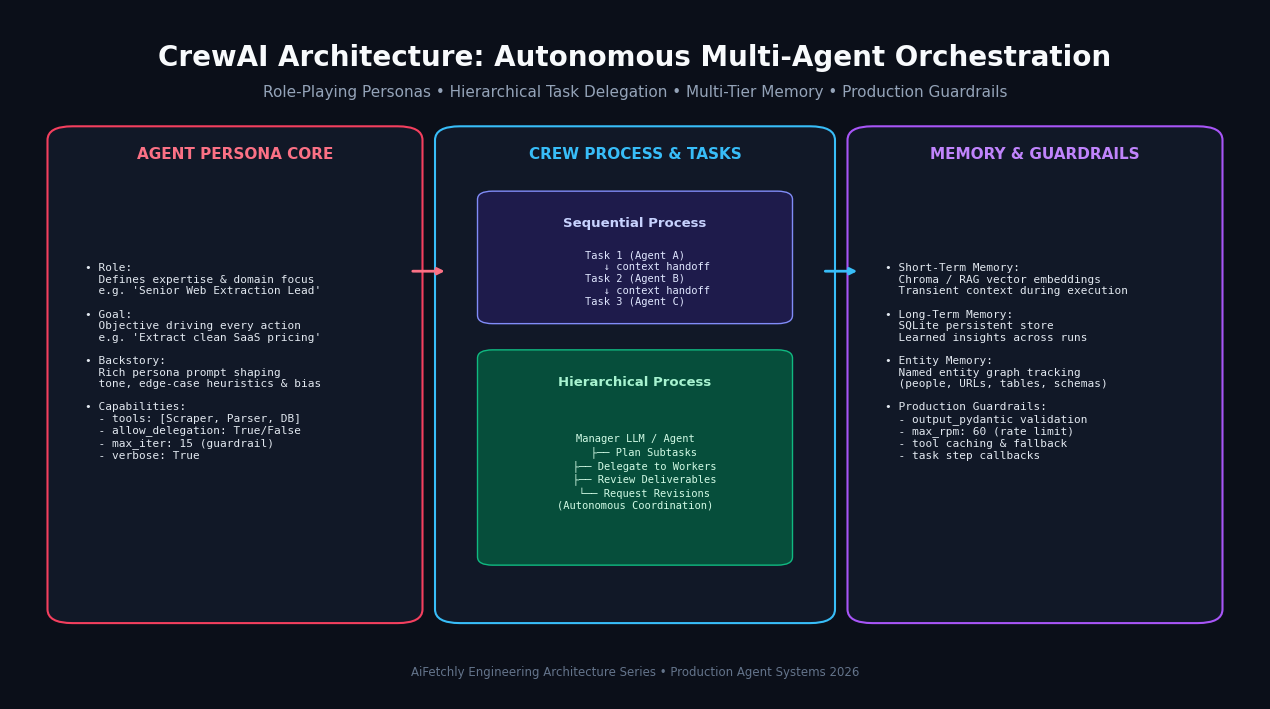
In CrewAI, an agent is not merely a model name and an API key. It is a carefully calibrated role-playing actor defined by three core psychological attributes:
- Role: Defines the agent’s core function and domain identity (e.g., “Principal SaaS Extraction Engineer”). The role serves as an anchor in the LLM’s latent space.
- Goal: The objective function that directs the agent’s planning and tool selection (e.g., “Extract every enterprise pricing tier, billing interval, and seat limit with 100% precision”).
- Backstory: Contextual grounding that provides depth, tone, and behavioral heuristics (e.g., “You are a veteran web scraping specialist who mistrusts dynamic client-side DOMs and meticulously verifies extracted table data against raw HTML payloads”).
Beyond role-playing parameters, CrewAI equips agents with concrete execution controls:
tools: A curated list of executable Python functions or APIs (e.g., web scrapers, database queries, calculators).allow_delegation: A boolean flag determining whether the agent can autonomously delegate subtasks to peer agents or request assistance.max_iter: Maximum reasoning iterations before halting, preventing infinite tool loops.max_rpm: Rate-limiting controls ensuring agent operations do not exceed cloud API quotas.
2. Tasks: Actionable, Measurable Contracts
Tasks in CrewAI represent distinct units of work assigned to specific agents. Unlike vague prompt instructions, a CrewAI Task enforces strict input-output boundaries:
description: A clear, unambiguous prompt detailing what needs to be accomplished and any operational constraints.expected_output: A precise specification of the required output format (e.g., “A bulleted summary followed by a valid JSON array of pricing tiers”).context: An explicit list of upstream tasks whose outputs must be injected as background context, establishing deterministic data dependencies.output_pydantic/output_json: Built-in schema enforcement that forces the LLM to output structured data validated directly against Pydantic models.
3. Orchestration Processes: Sequential vs. Hierarchical
CrewAI provides two primary execution processes governing how tasks flow through the crew:
Sequential Process: Tasks execute in a deterministic linear sequence. The output of Task $N$ is automatically appended as context to Task $N+1$. This is ideal for predictable workflows like Research $ o$ Summarize $ o$ Translate.
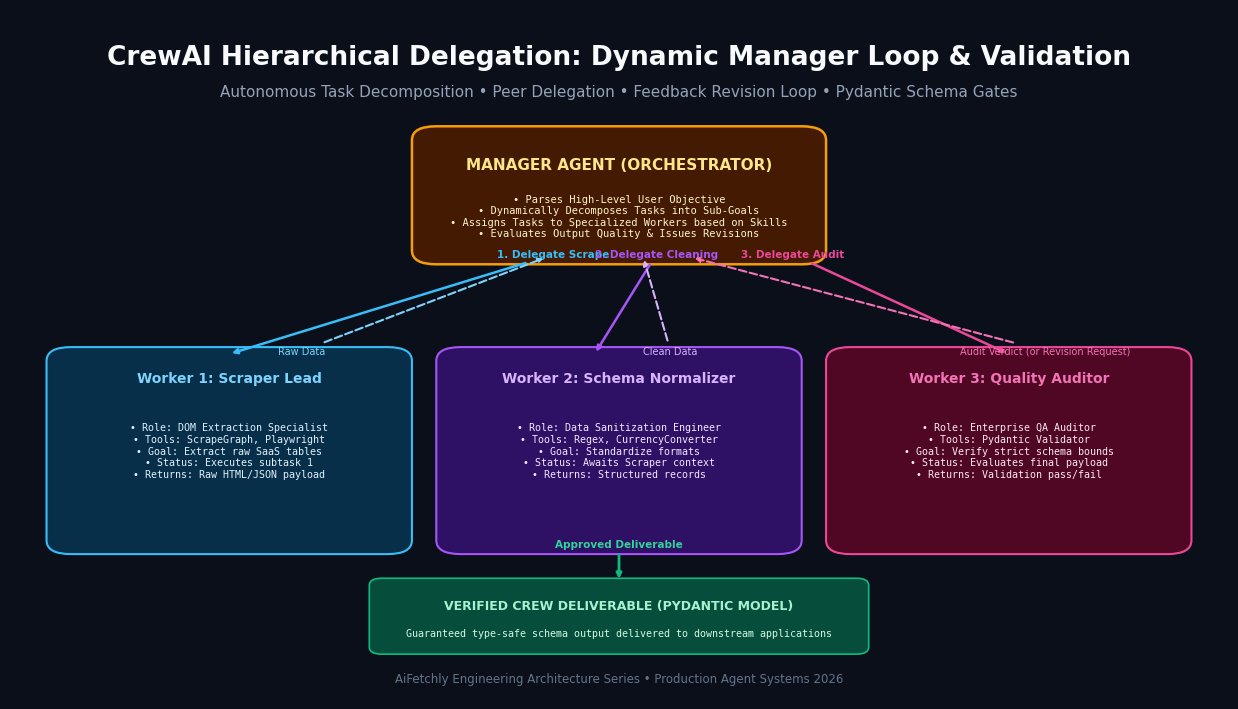
Hierarchical Process: The defining enterprise feature of CrewAI is its autonomous Hierarchical Process:
- When configured with
process=Process.hierarchical, CrewAI automatically provisions an intelligent Manager Agent (or allows developers to supply a custom manager). - The Manager receives the high-level project objective and dynamically breaks it down into granular subtasks.
- The Manager delegates tasks to the most suitable worker agents based on their defined
Role,Goal, and availableTools. - When a worker completes a subtask, the Manager reviews the deliverable. If the output fails quality or schema requirements, the Manager sends it back with specific revision instructions.
- Once all worker contributions satisfy standards, the Manager synthesizes the final comprehensive deliverable.
The Memory Engine: Short-Term, Long-Term, and Entity Memory
A common failure mode in autonomous multi-agent systems is context amnesia: agents repeat identical tool calls across tasks, forget user preferences, or lose track of specific numerical entities identified earlier in an execution run.
CrewAI resolves context amnesia through an integrated Multi-Tier Memory System:
1. Short-Term Memory (RAG-Driven Vector Store)
- Built on embedded vector databases (e.g., ChromaDB).
- During task execution, intermediate tool calls, agent thoughts, and observations are automatically embedded.
- When an agent approaches a new subtask, CrewAI performs semantic similarity searches against the short-term store to inject relevant historical thoughts into the current context window, ensuring cognitive continuity without bloating prompt tokens.
2. Long-Term Memory (Cross-Session SQLite Persistence)
- Stored in a durable local SQLite database.
- Captures overall task outcomes, critique results, and final deliverables across distinct execution runs.
- When a crew executes similar workflows in the future, the long-term memory layer retrieves past successful patterns and error resolutions, allowing the crew to self-improve over time.
3. Entity Memory (Named Entity Graph)
- Tracks crucial domain entities (such as company names, pricing numbers, product SKUs, and URLs) across all agent interactions.
- Ensures that when Worker A discovers an entity name, Worker B and the Manager maintain consistent referencing without spelling distortions or hallucinated variations.
Implementation: Building an Enterprise SaaS Extraction Crew
To demonstrate CrewAI’s power, let us build an enterprise-grade market intelligence crew that extracts SaaS pricing models, sanitizes raw extraction data, and validates the output against strict Pydantic schemas using a hierarchical orchestration process.
import os
from typing import list, Optional
from pydantic import BaseModel, Field
from crewai import Agent, Crew, Process, Task
from crewai.tools import BaseTool

# 1. Define Strict Pydantic Data Contracts
class PricingTier(BaseModel):
    name: str = Field(description="Tier name, e.g., Starter, Pro, Enterprise")
    price_monthly: Optional[float] = Field(description="Monthly price in USD, null if custom")
    price_annual_per_month: Optional[float] = Field(description="Annualized monthly price in USD")
    features: list[str] = Field(description="List of key features included in this tier")
    seat_limit: Optional[int] = Field(description="Maximum user seats, null if unlimited")

class SaaSPricingReport(BaseModel):
    company_name: str
    target_url: str
    currency: str
    tiers: list[PricingTier]
    enterprise_custom_quote: bool
    summary_analysis: str

# 2. Define Custom Extraction Tools
class MockWebScraperTool(BaseTool):
    name: str = "Enterprise DOM Scraper"
    description: str = "Fetches and cleans raw HTML pricing tables from target URLs."

    def _run(self, url: str) -> str:
        # In production, integrates with Playwright, ScrapeGraph, or aiFetchly APIs
        return """
        <div class="pricing-matrix">
            <div class="tier"><h3>Growth</h3><span class="price">$49/mo</span> (billed annually at $39/mo). Up to 5 seats. Includes: API Access, Automated Exports.</div>
            <div class="tier"><h3>Scale</h3><span class="price">$199/mo</span> (billed annually at $159/mo). Up to 20 seats. Includes: Dedicated Proxies, Priority Support.</div>
            <div class="tier"><h3>Enterprise</h3><span class="price">Contact Us</span>. Unlimited seats. Custom SLA, SSO.</div>
        </div>
        """

# 3. Instantiate Specialized Role-Playing Agents
scraper_tool = MockWebScraperTool()

researcher = Agent(
    role="Principal Web Extraction Specialist",
    goal="Extract complete, uncorrupted pricing structures from the target SaaS platform",
    backstory=(
        "You are an elite data extraction engineer with a decade of web scraping experience. "
        "You never miss hidden pricing tiers, footnotes, or annual discount toggles."
    ),
    tools=[scraper_tool],
    allow_delegation=False,
    verbose=True
)

normalizer = Agent(
    role="Quantitative Data Sanitization Analyst",
    goal="Normalize currency symbols, billing frequencies, and seat numbers into uniform metrics",
    backstory=(
        "You are a meticulous data engineer obsessed with data hygiene. You strip noise, "
        "standardize monthly versus annual pricing math, and ensure numeric types are strictly preserved."
    ),
    tools=[],
    allow_delegation=False,
    verbose=True
)

auditor = Agent(
    role="Enterprise Compliance & QA Auditor",
    goal="Verify that extracted records perfectly adhere to enterprise schema constraints",
    backstory=(
        "You are a ruthlessly detail-oriented auditor. You verify that all features are mapped, "
        "null fields are properly attributed, and no mathematical inconsistencies exist in annualized tiers."
    ),
    tools=[],
    allow_delegation=False,
    verbose=True
)

# 4. Define Contractual Tasks
research_task = Task(
    description="Scrape and extract all pricing tiers, costs, and limits from {target_url}.",
    expected_output="Raw extracted text detailing all available pricing plans and features.",
    agent=researcher
)

normalization_task = Task(
    description=(
        "Take the raw pricing data from the research task, compute annual vs monthly rates, "
        "and structure each plan into clean fields."
    ),
    expected_output="A structured dictionary of sanitized pricing tiers and metadata.",
    agent=normalizer,
    context=[research_task]
)

audit_task = Task(
    description=(
        "Audit the sanitized data for accuracy, ensure all currency fields are valid floats, "
        "and produce the final validated SaaSPricingReport."
    ),
    expected_output="A fully validated, type-safe SaaSPricingReport object.",
    agent=auditor,
    context=[normalization_task],
    output_pydantic=SaaSPricingReport
)

# 5. Assemble Crew with Hierarchical Orchestration and Memory
intelligence_crew = Crew(
    agents=[researcher, normalizer, auditor],
    tasks=[research_task, normalization_task, audit_task],
    process=Process.hierarchical,
    manager_llm="gpt-4o",  # The manager dynamically delegates and reviews tasks
    memory=True,            # Enables Short-Term, Long-Term, and Entity Memory
    verbose=True
)

# 6. Execute the Crew Workflow
if __name__ == "__main__":
    inputs = {
        "target_url": "https://example-saas-platform.com/pricing"
    }
    result = intelligence_crew.kickoff(inputs=inputs)
    print("--- CREW EXECUTION COMPLETED ---")
print(f"Validated Pydantic Output: {result.pydantic}") Architectural Comparison: Multi-Agent Orchestration Frameworks
Understanding the trade-offs between modern multi-agent systems is critical for selecting the right architecture:
| Architectural Dimension | CrewAI | AutoGen (Microsoft) | MetaGPT | LangGraph (LangChain) |
|---|---|---|---|---|
| Core Abstraction | Role-Playing Personas & Crews | Conversational Group Chat | Corporate SOP Waterfalls | Cyclical State Graphs |
| Primary Interaction Model | Hierarchical / Sequential Process | Autonomous Chat Dialogue | Pub-Sub Message Broker | Nodes & Conditional Edges |
| Task & Schema Typing | Native Pydantic / JSON output | Function calling schemas | DataClass PRD / UML Schemas | TypedDict State Reducers |
| Delegation Mechanism | Autonomous Manager Agent | LLM Speaker Selection | Static SOP Role Handoff | Dynamic Router Edges |
| Memory Architecture | Vector + SQLite + Entity Memory | In-memory message list | File-based memory index | Superstep Checkpointer (ACID) |
| Human-in-the-Loop | Built-in task approval prompts | User proxy agent | Human SOP feedback step | Granular Superstep Interrupts |
| Primary Ideal Use-Case | Collaborative business workflows | Conversational research | End-to-end software factory | Stateful infrastructure pipelines |
While LangGraph provides low-level, graph-theoretic precision and MetaGPT excels at rigid software generation workflows, CrewAI provides the highest developer ergonomics for building intuitive, role-playing agent teams with autonomous hierarchical delegation.
Production Engineering: Enterprise Guardrails and Best Practices
When deploying CrewAI crews to automate mission-critical extraction and analysis pipelines, enterprise teams should adopt four architectural best practices:
1. Enforcing Schema Contracts via Pydantic
Never allow production agents to pass raw, unvalidated strings to customer-facing databases:
- Always configure terminal tasks with
output_pydantic. - If an agent generates an invalid field, CrewAI automatically catches the validation exception and prompts the agent to self-correct its JSON output before completing the task.
- This creates an impervious type-safety boundary between probabilistic LLM generation and deterministic backend storage.
2. Guarding Against API Rate Limits (max_rpm)
In complex hierarchical crews, manager and worker agents can generate dozens of LLM calls in rapid succession:
- Always specify
max_rpmon individual agents or across the crew (e.g.,max_rpm=60). - CrewAI includes an intelligent rate-limiting throttle that pauses agent execution when approaching provider quotas, eliminating abrupt HTTP 429 exceptions in production.
3. Caching Deterministic Tool Invocations
Expensive tool executions—such as scraping heavy JavaScript SPAs or executing vector similarity lookups—should not be re-run if input parameters remain identical:
- CrewAI provides native tool caching out of the box.
- By enabling caching on custom tools (
cache_function=True), if an agent queries the same URL or database row across multiple reasoning iterations, the tool instantly returns the cached response, saving GPU time and API costs.
4. Hybrid Orchestration: Embedding CrewAI inside State Graphs
For the most sophisticated enterprise architectures, engineering teams do not need to choose between CrewAI and LangGraph:
- Use LangGraph to model the top-level, mission-critical infrastructure pipeline (database writes, authentication state, transactional rollback logic, and superstep persistence).
- Wrap specialized CrewAI Crews inside individual LangGraph nodes as domain-specific problem solvers (e.g., a “Market Research Crew” node that autonomously scrapes and analyzes competitive data).
By structuring autonomous agents into well-defined personas, enforcing strict task dependency contracts, and leveraging hierarchical manager supervision, organizations can build agentic AI systems that consistently deliver enterprise-grade accuracy and business value.