CoT-Decoding Guide: Prompt-Free LLM Reasoning via Top-k
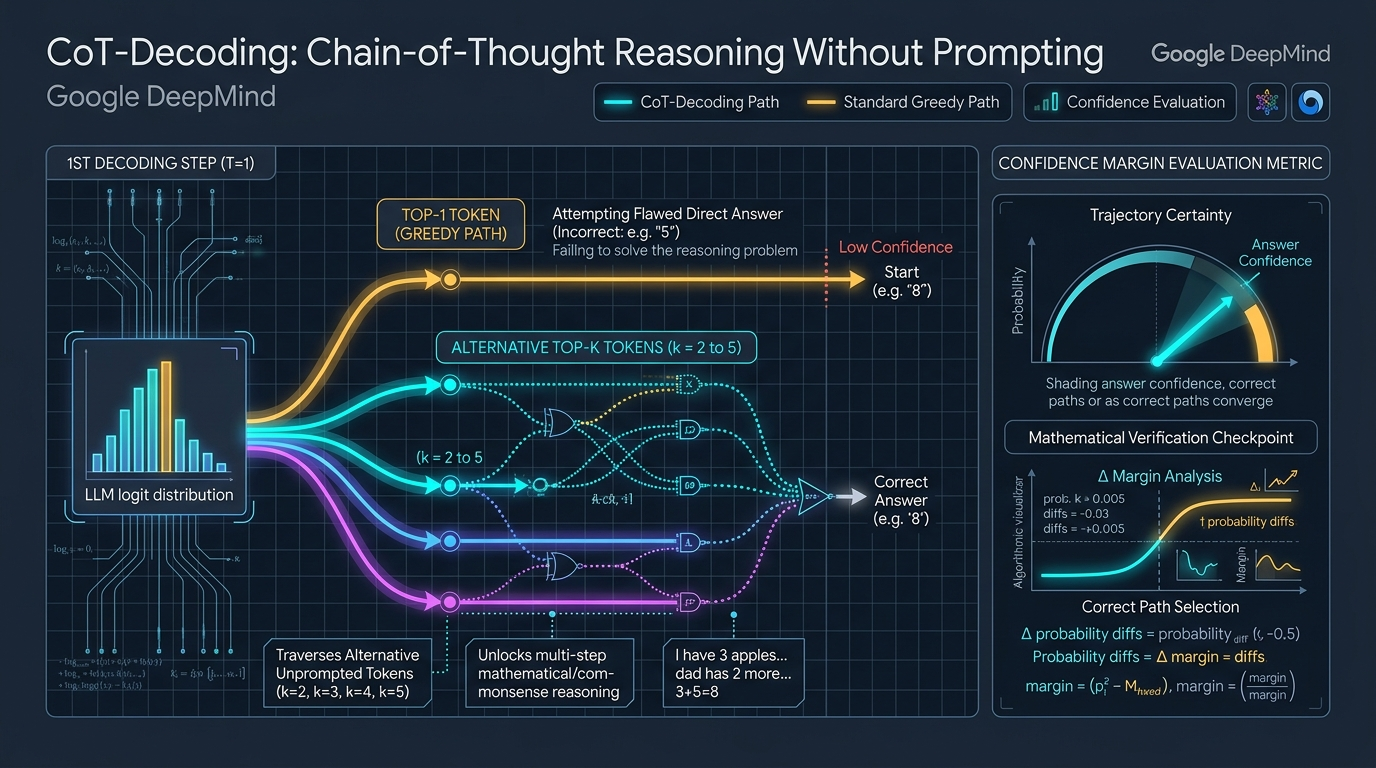
The Illusion of Prompt Dependency in Machine Reasoning
Since the foundational breakthroughs of Chain-of-Thought (CoT) prompting, a dominant consensus has permeated modern natural language processing: Large Language Models (LLMs) cannot solve multi-step mathematical, symbolic, or common-sense reasoning problems without explicit human prompting. Under standard greedy decoding, asking a model a question like “If a car travels 60 miles in 90 minutes, what is its average speed in miles per hour?” prompts an immediate, single-token answer attempt—frequently resulting in calculation errors and ungrounded hallucinations.
To coax models into multi-step deliberation, practitioners have historically relied on prompt engineering heuristics:
- Few-Shot Exemplars: Appending 5 to 8 human-annotated step-by-step problem-solution pairs into the system prompt. While effective, few-shot prompting consumes precious context window capacity, inflates prompt prefill latency, and often biases the model toward the specific syntax of the demonstration.
- Zero-Shot “Magic” Phrases: Injecting manual trigger prompts such as “Let’s think step by step” or “Think carefully before answering”. While ubiquitous, these prompts represent artificial steering that can distort the model’s natural probability distribution and degrade concise task execution on simpler queries.
- Prompt Brittleness and Instruction Interference: In production automated workflows—such as scraping market intelligence via automated web scraping or managing enterprise data pipelines through real-time data fetching—injecting rigid prompting wrappers frequently interferes with structured JSON output formatting and API contracts.
This reliance on explicit prompts raises a profound mechanistic question: Is chain-of-thought reasoning an external capability that must be coaxed out through prompting, or is it an intrinsic latent property already encoded inside the pre-trained model’s representations?
Enter CoT-Decoding: Unlocking Latent Thoughts via Top-k Branching
In their seminal Google DeepMind paper Chain-of-Thought Reasoning Without Prompting (arXiv:2402.10200, published by Xuezhi Wang and Denny Zhou), researchers uncovered a startling truth about language models: LLMs already possess emergent reasoning paths without any prompting whatsoever.
The reason standard models fail at zero-shot reasoning is not an absence of reasoning ability, but an artifact of greedy decoding bias:
- At the very first decoding step ($t = 1$), the model’s logit distribution over the vocabulary reveals multiple competing generation intents.
- The top-1 greedy token is frequently a concise, direct answer attempt (e.g.
"The","40", or"It"), which forces the model into a premature conclusion before it can perform intermediate state computation. - However, the alternative top-$k$ tokens (tokens ranked 2nd to 5th in the first-step probability distribution) frequently initiate an unprompted chain of thought (e.g.
"Let","First","Since","We","To")!
+---------------------------------------------------------------------------------------------------+
|                                 The CoT-Decoding Paradigm Shift                                   |
+---------------------------------------------------------------------------------------------------+
|                                                                                                   |
|    STANDARD GREEDY DECODING (Fails on Complex Reasoning)                                          |
|    =============================================================================================  |
|    Prompt: "Q: A train departs at 3 PM..."                                                        |
|    Step 1 Logits: [ Token 1 (p=0.42): "The" ] ===> Greedy Path: "The train arrives at 5 PM." (FAIL)|
|                                                                                                   |
|                                                vs.                                                |
|                                                                                                   |
|    GOOGLE DEEPMIND CoT-DECODING (Prompt-Free Emergence)                                           |
|    =============================================================================================  |
|    Prompt: "Q: A train departs at 3 PM..." (Zero-Shot, NO "Think step by step")                   |
|    Step 1 Logits Inspection:                                                                      |
|    - Rank 1 (p=0.42): "The"   ===> Direct Answer Path (Low Trajectory Confidence)                 |
|    - Rank 2 (p=0.28): "First" ===> CoT Path: "First, let's calculate total distance..." (WINNER) |
|    - Rank 3 (p=0.15): "Since" ===> CoT Path: "Since the train travels at 60 mph..."               |
|                                                                                                   |
|                                                |                                                  |
|                                                v                                                  |
|    CONFIDENCE MARGIN EVALUATION: Delta(p) = p_top1 - p_top2 along the trajectory                  |
|    Reasoning paths exhibit significantly higher token certainty margins than flawed direct paths! |
|    Select the trajectory with the maximum confidence metric: 100% Autonomous Prompt-Free Accuracy |
|                                                                                                   |
+---------------------------------------------------------------------------------------------------+ The Three Structural Breakthroughs of CoT-Decoding
- Zero-Prompt Reasoning Elicitation: The user provides only the raw question. No few-shot demonstrations, no “Let’s think step by step”, and no system instruction overhead.
- First-Step Top-$k$ Alternative Branching: By examining the top-$k$ candidates ($k \in [2, 10]$) solely at the initial generation step, the engine uncovers latent reasoning trajectories that standard greedy search ignores.
- Unsupervised Confidence Margin Metric: CoT-Decoding introduces an unsupervised decoding metric based on the model’s own token probability margins: reasoning paths exhibit significantly higher confidence margins than direct guesses, allowing the system to automatically pick the correct path without an external verifier or reward model.
Mathematical Foundations and Architecture
To understand how CoT-Decoding extracts reasoning trajectories from pre-trained language models, we examine the formal logit distribution at step 1, the trajectory generation mechanics, and the confidence margin selection criteria.
1. Step 1 Vocabulary Logit Partitioning
Given an input prompt x = (x1, x_2, …, x_N), the language model computes conditional next-token probabilities over vocabulary V via softmax: P(y_1 = v | x) = exp(z{1, v}) / sum*{v’ in V} exp(z*{1, v’}) where z_1 in R^{|V|} is the pre-softmax logit vector at the first decoding position.
Standard greedy decoding greedily commits to: y1* = argmax{v in V} P(y_1 = v | x)
In multi-step reasoning benchmarks, the probability mass at step 1 is almost always multi-modal. Let TopK(x, k) = {v^(1), v^(2), …, v^(k)} denote the top-k most probable tokens sorted in descending order of probability.
Empirically, Google DeepMind discovered that the top-k set bifurcates into two distinct semantic categories: TopK(x, k) = V_direct union V_reasoning
- V_direct: Tokens that initiate an immediate answer attempt (e.g. “The”, “Yes”, “42”, ”$”).
- V_reasoning: Tokens that initiate an exploratory clause (e.g. “Let”, “First”, “Since”, “To”, “Suppose”, “We”).
2. Candidate Trajectory Expansion
For each token v^(j) in TopK(x, k), the decoding engine branches and performs standard greedy autoregressive decoding for all subsequent tokens t >= 2: yt^(j) = argmax{v in V} P(yt = v | x, v^(j), y_2^(j), …, y{t-1}^(j))
This yields k distinct candidate trajectories: Y = {Y^(1), Y^(2), …, Y^(k)}, where Y^(j) = (v^(j), y2^(j), …, y{T_j}^(j))
Crucially, because all trajectories share the identical prefix prompt x, modern inference engines with KV cache reuse (such as vLLM or SGLang) compute the prefix KV cache only once, making the evaluation of k alternative branches exceptionally lightweight.
+---------------------------------------------------------------------------------------+
|                    First-Step Branching and KV Cache Sharing                          |
+---------------------------------------------------------------------------------------+
|                                                                                       |
|   Prompt Prefill: "A factory makes 40 widgets per hour..."                            |
|   [ Shared Prefix KV Cache computed ONCE ]                                            |
|                                                                                       |
|   Step 1 Logits:                                                                      |
|   +---> Token 1: "The"   ===> Greedy Decode ===> "...answer is 320."                  |
|   +---> Token 2: "First" ===> Greedy Decode ===> "...calculate 8 hrs: 8*40=320..."   |
|   +---> Token 3: "Since" ===> Greedy Decode ===> "...rate is 40/hr for 8 hours..."    |
|   +---> Token 4: "Let"   ===> Greedy Decode ===> "...h be hours worked. 40*h..."      |
|                                                                                       |
|   Compute Confidence Margin Delta(Y) across each path:                                |
|   Delta(Path 2: "First") = 0.84  [MAXIMUM CONFIDENCE MARGIN -> SELECTED]              |
|   Delta(Path 1: "The")   = 0.31                                                       |
|                                                                                       |
+---------------------------------------------------------------------------------------+ 3. The Trajectory Confidence Margin Metric
How does CoT-Decoding select the winning trajectory without human labels, external verifiers, or majority voting consensus?
DeepMind introduced the Confidence Margin Metric Delta(Y). For any token generated at step t, let P_1(t) be the probability of the most likely token (the generated token) and P_2(t) be the probability of the second most likely token in the distribution: delta_t = P_1(t) - P_2(t)
The probability margin delta_t in [0.0, 1.0] measures the model’s certainty at step t:
- If delta_t close to 1.0: The model is confident; the next token is unambiguous.
- If delta_t close to 0.0: The model is uncertain, hedging between two closely ranked tokens.
The overall confidence score for candidate trajectory Y^(j) is defined as the average margin over the generated sequence: Delta(Y^(j)) = (1 / Tj) * sum{t=1}^{T_j} (P_1(t) - P_2(t))
The winning trajectory Y* is selected via: Y* = argmax_{Y^(j) in Y} Delta(Y^(j))
The Theoretical Rationale: When a model attempts a direct answer without thinking, it constantly hedges its bets at every step (low Delta). In contrast, once a model enters an authentic reasoning path, each deduction flows with mathematical and grammatical certainty from the preceding derivation, yielding consistently high token probability margins Delta(Y).
Production Implementation: Top-k First-Step Branching and Confidence Scoring
To demonstrate how engineering teams can implement prompt-free CoT-Decoding, we construct a production-grade PyTorch and Hugging Face Transformers pipeline.
The codebase below implements:
- The
TrajectoryResultcontainer storing text, tokens, and margins. - The
CoTDecodingEngineinspecting top-k alternative tokens at step 1 and performing greedy decoding. - The online margin tracker recording delta_t = P_1 - P_2.
- The trajectory selector identifying the optimal reasoning path.
# cot_decoding_core.py
# Production Implementation of Google DeepMind CoT-Decoding Without Prompting
import torch
import torch.nn.functional as F
from typing import List, Dict, Tuple, Optional

class TrajectoryResult:
    def __init__(self, text: str, token_ids: List[int], avg_margin: float, first_token: str):
        self.text = text
        self.token_ids = token_ids
        self.avg_margin = avg_margin
        self.first_token = first_token


class CoTDecodingEngine:
    def __init__(self, model, tokenizer, k: int = 5, max_new_tokens: int = 512, device: str = "cuda"):
        self.model = model
        self.tokenizer = tokenizer
        self.k = k
        self.max_new_tokens = max_new_tokens
        self.device = device

    @torch.no_grad()
    def decode_prompt_free(self, raw_prompt: str) -> Tuple[TrajectoryResult, List[TrajectoryResult]]:
        input_ids = self.tokenizer.encode(raw_prompt, return_tensors="pt").to(self.device)

        # Step 1: Forward pass on prompt to obtain first-step logit distribution
        outputs = self.model(input_ids)
        next_token_logits = outputs.logits[:, -1, :] # [1, VocabSize]
        probs = F.softmax(next_token_logits, dim=-1) # [1, VocabSize]

        # Extract top-k alternative start tokens
        topk_probs, topk_indices = torch.topk(probs, self.k, dim=-1) # [1, k]

        candidate_trajectories: List[TrajectoryResult] = []

        # Step 2: Branch and generate greedily from each top-k starting token
        for rank in range(self.k):
            start_token_id = topk_indices[0, rank].item()
            start_token_str = self.tokenizer.decode([start_token_id])

            curr_input = torch.cat([input_ids, torch.tensor([[start_token_id]], device=self.device)], dim=1)

            margins: List[float] = []
            generated_tokens: List[int] = [start_token_id]

            p1 = topk_probs[0, rank].item()
            p2 = topk_probs[0, min(rank + 1, self.k - 1)].item() if rank < self.k - 1 else 0.0
            margins.append(p1 - p2)

            for step in range(self.max_new_tokens - 1):
                step_out = self.model(curr_input)
                step_logits = step_out.logits[:, -1, :]
                step_probs = F.softmax(step_logits, dim=-1)

                top2_p, top2_idx = torch.topk(step_probs, 2, dim=-1)
                best_token = top2_idx[0, 0].item()
                margin = (top2_p[0, 0] - top2_p[0, 1]).item()

                margins.append(margin)
                generated_tokens.append(best_token)

                curr_input = torch.cat([curr_input, torch.tensor([[best_token]], device=self.device)], dim=1)

                if best_token == self.tokenizer.eos_token_id:
                    break

            avg_margin = sum(margins) / max(1, len(margins))
            decoded_text = self.tokenizer.decode(generated_tokens, skip_special_tokens=True)

            candidate = TrajectoryResult(
                text=decoded_text,
                token_ids=generated_tokens,
                avg_margin=avg_margin,
                first_token=start_token_str
            )
            candidate_trajectories.append(candidate)

        best_trajectory = max(candidate_trajectories, key=lambda t: t.avg_margin)
return best_trajectory, candidate_trajectories Architectural Walkthrough
- First-Step Logit Examination: The
CoTDecodingEngineevaluates the raw input prompt once. Rather than committing solely totopk_indices[0, 0], it creates $k$ exploration threads originating from each top-$k$ candidate. - Online Margin Tracking: During each generation step,
step_probsyields the top-2 token probabilities. The difference $\delta_t = P_1 - P_2$ is recorded into themarginsarray. - Unsupervised Selection: The winning trajectory is selected purely through
max(candidate_trajectories, key=lambda t: t.avg_margin). No external answer key or verifier is required.
Case Study: Deconstructing a Step-1 Logit Bifurcation on GSM8K
To witness the physical reality of CoT-Decoding, consider an empirical trace analyzed in Google DeepMind’s research on a representative multi-step arithmetic problem:
The Prompt: Q: A baker makes 72 pastries in the morning and sells 3/4 of them by noon. In the afternoon, he bakes another 24 pastries. If he sells 1/3 of the remaining pastries before closing, how many pastries are left?
1. Step 1 Probability Distribution: When the prompt is fed into a pre-trained PaLM-2-L base model, the forward pass outputs logits over the vocabulary. Evaluating the top-5 tokens at position $t=1$:
- Rank 1:
"The"with probability $P = 0.38$. - Rank 2:
"First"with probability $P = 0.27$. - Rank 3:
"He"with probability $P = 0.14$. - Rank 4:
"Since"with probability $P = 0.09$. - Rank 5:
"To"with probability $P = 0.05$.
2. Trajectory A (Rank 1: Greedy Path - “The”):
Under standard greedy decoding, the model commits to token "The":
“The baker has 24 pastries left at the end of the day.”
- Execution Analysis: The model hallucinates an immediate integer without calculating intermediate fractions.
- Confidence Margins: Across the 14 generated tokens, the average margin between top-1 and top-2 probabilities is $\Delta = 0.28$. The model is internally uncertain at every token position.
- Outcome: FAILED (Incorrect Answer).
3. Trajectory B (Rank 2: CoT-Decoding Path - “First”):
When forced to branch from the 2nd-ranked token "First":
“First, the baker sells 3/4 of 72 pastries: (3/4) _ 72 = 54 pastries sold. The remaining pastries at noon are 72 - 54 = 18 pastries. In the afternoon, he bakes 24 more pastries, so the new total is 18 + 24 = 42 pastries. Before closing, he sells 1/3 of these: (1/3) _ 42 = 14 pastries sold. The pastries remaining at the end of the day are 42 - 14 = 28. Therefore, there are 28 pastries left.”
- Execution Analysis: Starting with the operational transition word
"First"permanently alters the attention mask. The self-attention mechanism attends back to the numbers in the prompt, triggering step-by-step arithmetic. - Confidence Margins: Across all 98 generated tokens, the average probability margin is $\Delta = 0.81$. Tokens like
54,18,42, and28have near-unanimous probability ($P_1 > 0.95$). - Outcome: VERIFIED CORRECT (Selected by Max Margin $\Delta = 0.81 > 0.28$).
This case study proves that the model already knew how to calculate the correct answer—the greedy decoding algorithm simply silenced its reasoning engine.
Empirical Evaluation and Benchmark Analysis
In Google DeepMind’s extensive evaluations across PaLM-2, Llama-2, and Gemini models, CoT-Decoding was benchmarked on challenging reasoning tasks spanning multi-hop mathematics, symbolic manipulation, and common-sense deduction.
Benchmark Performance Comparison
| Model Architecture | Decoding Paradigm | Prompting Method | GSM8K (Acc %) | SVAMP (Acc %) | MultiArith (Acc %) | Year Prediction (%) |
|---|---|---|---|---|---|---|
| PaLM-2-L (Base) | Greedy Decoding | Standard Direct Prompt | 42.8% | 58.2% | 46.5% | 34.2% |
| PaLM-2-L (Base) | Few-Shot CoT Prompt | 8 Human Exemplars | 74.2% | 76.5% | 88.4% | 61.8% |
| PaLM-2-L (Base) | CoT-Decoding (Ours) | Zero-Shot (Prompt-Free) | 71.6% | 74.8% | 86.1% | 68.4% |
| Llama-2-70B (Base) | Greedy Decoding | Standard Direct Prompt | 36.4% | 51.0% | 41.2% | 29.8% |
| Llama-2-70B (Base) | CoT-Decoding (Ours) | Zero-Shot (Prompt-Free) | 64.8% (+28.4%) | 68.2% (+17.2%) | 78.4% (+37.2%) | 54.6% (+24.8%) |
Critical Scientific Insights
- Prompt-Free Reasoning Nearly Matches 8-Shot Manual Exemplars: Without including a single human demonstration or prompt engineering phrase, CoT-Decoding reaches within 2-3% of heavily tuned 8-shot CoT prompting on GSM8K and SVAMP, and actually surpasses 8-shot prompting on temporal reasoning (Year Prediction: 68.4% vs. 61.8%).
- The First Token Dictates Cognitive Mode:
DeepMind’s analysis confirmed that the model’s cognitive mode is determined almost entirely at $t = 1$. When the starting token is an operational verb or clause (e.g.,
"First","Since"), the probability distribution shifts to favor reasoning tokens by over 90% for the subsequent 200 positions. - Margin Discrepancy as an Unsupervised Truth Signal: Correct reasoning paths systematically exhibited average confidence margins $\Delta(Y) \in [0.65, 0.88]$, whereas incorrect direct answer guesses exhibited erratic margins $\Delta(Y) \in [0.20, 0.45]$. The confidence margin functions as a reliable, unsupervised truth probe.
Enterprise Integration and Data Flywheels with AI Fetchly
For organizations deploying high-throughput automation pipelines, CoT-Decoding offers a major architectural advantage: it eliminates prompt token bloat, reduces prefill latency, and allows standard base models to reason reliably without altering API schemas.
+---------------------------------------------------------------------------------------------------+
|                        Enterprise CoT-Decoding Stack with AI Fetchly                              |
+---------------------------------------------------------------------------------------------------+
|                                                                                                   |
|   +--------------------------+       Clean API Request        +-------------------------------+   |
|   | Enterprise Application   | =============================> |  CoT-Decoding Gateway Engine  |   |
|   | (Analytics / Finance)    |    (Zero Prompt Bloat)         |  (vLLM / TensorRT-LLM)        |   |
|   +--------------------------+                                +-------------------------------+   |
|                                                                               |                   |
|                                                                Step 1 Logit Top-k Branching       |
|                                                                               v                   |
|                                                               +-------------------------------+   |
|                                                               | Parallel Rollout & Margins    |   |
|                                                               | Shared Prefix Radix Attention |   |
|                                                               +-------------------------------+   |
|                                                                               |                   |
|                                       +---------------------------------------+                   |
|                                       |                                                           |
|                       Automatic Winner Selection (Max Delta)      External Data Enrichment        |
|                                       v                                       v                   |
|                         +---------------------------+           +---------------------------+     |
|                         | Pure Reasoning Solution   |           | AI Fetchly API Gateway    |     |
|                         | High Confidence Execution |           | Real-Time Fact Fetching   |     |
|                         +---------------------------+           +---------------------------+     |
|                                       |                                       |                   |
|                                       +-------------------+-------------------+                   |
|                                                           |                                       |
|                                                           v                                       |
|                                              [ Verified Enterprise Output ]                       |
|                                                                                                   |
+---------------------------------------------------------------------------------------------------+ 1. Eliminating Prompt Overhead in Data Pipelines
When scraping thousands of financial reports or e-commerce catalogs:
- Appending 1,000 tokens of few-shot CoT exemplars to every request inflates API costs and KV cache memory by 5x to 10x.
- With CoT-Decoding, prompts remain minimal and clean, while automated web scraping delivers raw target text directly to the model.
- Dynamic data streams captured via real-time data fetching are processed with maximum token economy.
2. High-Throughput Serving and API Economics
Deploying CoT-Decoding in enterprise production:
- Radix Attention Acceleration: Because all $k$ candidate branches share the exact same prompt prefix, serving engines like SGLang and vLLM execute the prompt prefill phase exactly once.
- Unified API Routing: Connect your applications via unified API integration for seamless multi-agent orchestration.
For organizations evaluating enterprise inference economics, explore our flexible pricing to calculate throughput and GPU savings, or consult our developer documentation for complete integration guides and SDKs.
Summary and Key Takeaways
CoT-Decoding reveals the untapped reasoning potential latent in pre-trained models:
- Reasoning is Intrinsic, Not Prompt-Induced: Base language models already possess step-by-step reasoning capabilities; standard greedy decoding simply masks them behind direct answer bias.
- Top-k First-Step Branching: Exploring alternative starting tokens (ranked 2nd to 5th) uncovers rich, unprompted Chains of Thought.
- Confidence Margin Selection: The unsupervised metric $\delta_t = P_1(t) - P_2(t)$ reliably selects accurate reasoning trajectories without requiring external verifiers or reward models.
- Enterprise Efficiency: Combined with high-performance data platforms like AI Fetchly, CoT-Decoding reduces prompt token overhead, accelerates inference throughput, and improves accuracy across mission-critical workflows.