CosyVoice 2 Guide: Scalable Streaming Speech Synthesis
The Problem: The Latency, Naturalness, and Controllability Trilemma in Voice AI
In modern conversational artificial intelligence, autonomous customer support agents, automated podcast generation, and hands-free desktop assistants powered by AiFetchly, voice has emerged as the primary natural interface between humans and foundation models. Rather than reading dense screens of text, users expect real-time spoken interactions: fluid dialogue, lifelike vocal nuance, instantaneous conversational turn-taking, and expressive prosody.
However, building production-grade voice agents using legacy Text-to-Speech (TTS) pipelines forces engineering teams to confront a severe technical tradeoff: the speech synthesis trilemma between streaming latency, acoustic naturalness, and zero-shot voice controllability.
The Voice AI Synthesis Trilemma:
┌────────────────────────────────────────────────────────┐
│ Tradeoff 1: Autoregressive Neural Codecs (VALL-E, Bark) │
│ • High expressiveness via in-context learning          │
│ ❌ Prone to acoustic hallucinations and stuttering!    │
│ ❌ High latency: 2,000ms+ before first audio chunk!    │
├────────────────────────────────────────────────────────┤
│ Tradeoff 2: Non-Autoregressive Diffusion Models        │
│ • Pristine acoustic clarity and stable pronunciation   │
│ ❌ Requires full text upfront: zero streaming support! │
│ ❌ Cannot be deployed for real-time conversational bots│
├────────────────────────────────────────────────────────┤
│ Tradeoff 3: Legacy Fast Parametric TTS (FastSpeech 2)  │
│ • Sub-100ms ultra-low latency                          │
│ ❌ Robotic, flat intonation and zero-shot timbre failure│
│ ❌ Inflexible duration predictors ignore emotional cues│
└────────────────────────────────────────────────────────┘
Result: Developers had to choose between robotic low-latency TTS or sluggish, hallucinating codec models! 1. Autoregressive Codec Latency and Acoustic Hallucinations
Early generative voice models (such as VALL-E, AudioLM, and Bark) treated speech synthesis as a language modeling problem, quantizing continuous audio into discrete acoustic codec tokens:
- While this approach unlocked zero-shot voice cloning through prompt prefixing, generating thousands of acoustic tokens sequentially is computationally sluggish.
- The Turn-Taking Penalty: Waiting for an autoregressive model to generate enough tokens to begin audio playback introduces a 1,500ms to 3,000ms Time-to-First-Audio (TTFA) delay. In a spoken conversation, a 2-second pause makes interactions feel unnatural and disconnected.
- Furthermore, pure autoregressive speech models suffer from hallucinations: dropping phonemes, repeating syllables uncontrollably, or trailing off into background noise and murmurs.
2. The Non-Streaming Rigidity of Standard Diffusion
To achieve photorealistic acoustic fidelity without hallucinations, researchers turned to Denoising Diffusion Probabilistic Models (DDPM) and Score-Based Generative Models:
- Diffusion models generate crisp, 24kHz mel-spectrograms with realistic vocal fry and breath sounds.
- However, standard diffusion is fundamentally non-streaming: the neural network requires the entire text sentence and full duration length before executing 30 to 50 iterative denoising steps.
- This architectural constraint makes standard diffusion models completely unusable for streaming conversational voice agents where text tokens arrive token-by-token from an upstream LLM.
3. The Lack of Unified Prosody and Instruction Control
In real-world customer service or interactive storytelling, speakers alter their tone dynamically: whispering confidential details, chuckling at jokes, or speaking with urgent excitement:
- Legacy systems require training separate specialized models for different emotions or manipulating brittle pitch and energy contours.
- Combining zero-shot speaker cloning with fine-grained natural language prosody instructions in a single, stable checkpoint remained an unsolved challenge.
The Solution: CosyVoice 2’s Hybrid LLM + Streaming Flow Matching Architecture
To resolve the speech synthesis trilemma, Alibaba Group and the open-source speech community engineered CosyVoice 2, a state-of-the-art multilingual voice foundation model.
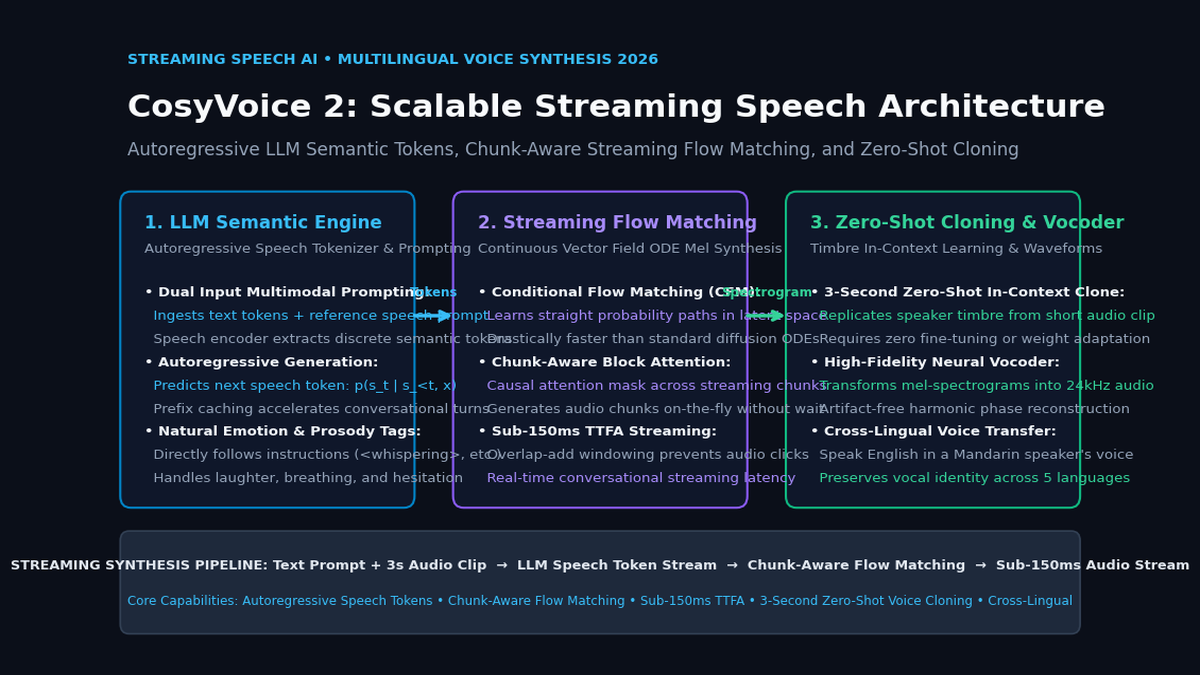
CosyVoice 2 achieves a breakthrough balance by decoupling speech synthesis into a two-stage hybrid architecture: an Autoregressive Large Language Model that generates discrete semantic speech tokens from streaming text, followed by a Chunk-Aware Conditional Flow Matching (CFM) diffusion engine that synthesizes high-fidelity mel-spectrograms with sub-150ms streaming latency.
CosyVoice 2 End-to-End Streaming Topology:
┌─────────────────────────────────────────────────────────────────────────┐
│ Input Streaming Text: "Welcome to aiFetchly! <excited> Let's begin."   │
│ + 3-Second Speaker Prompt Audio Clip                                    │
└────────────────────────────────────┬────────────────────────────────────┘
                                     │
                                     ▼
┌─────────────────────────────────────────────────────────────────────────┐
│ 1. Autoregressive LLM Semantic Token Engine                             │
│ • Text & Instruction Tokenizer: Parses emotion tags (<excited>)         │
│ • Speech Tokenizer: Compresses prompt audio into discrete tokens        │
│ • Autoregressive Predictor: Streams semantic speech tokens p(s_t|s_<t)  │
└────────────────────────────────────┬────────────────────────────────────┘
                                     │ (Streams Semantic Token Chunks: ~250ms)
                                     ▼
┌─────────────────────────────────────────────────────────────────────────┐
│ 2. Chunk-Aware Streaming Flow Matching (CFM) Model                      │
│ • Continuous Vector Field ODE: Straight-line probability paths          │
│ • Block-Wise Causal Attention: Attends to past chunks without waiting   │
│ • Overlap-Add Windowing: Eliminates boundary clicks & phase distortion  │
└────────────────────────────────────┬────────────────────────────────────┘
                                     │ (80-Channel Mel-Spectrogram Chunks)
                                     ▼
┌─────────────────────────────────────────────────────────────────────────┐
│ 3. High-Fidelity Neural Vocoder (HiFi-GAN / BigVGAN)                    │
│ • Converts mel-spectrogram chunks into 24kHz PCM waveforms              │
│ • Sub-150ms Time-to-First-Audio (TTFA) Real-Time Audio Output           │
└─────────────────────────────────────────────────────────────────────────┘ The Architectural Pillars of CosyVoice 2
- Two-Stage Decoupled Modeling: Rather than forcing a single model to handle both high-level linguistic rhythm and low-level acoustic waveforms, CosyVoice 2 separates the tasks:
- Stage 1 (Linguistic Semantics): An autoregressive LLM models text-to-speech alignment, duration, and rhythm as discrete semantic tokens ($50\text{ Hz}$).
- Stage 2 (Acoustic Realism): A continuous Conditional Flow Matching model maps semantic tokens into dense mel-spectrograms, eliminating hallucinations while preserving acoustic richness.
- Chunk-Aware Streaming Flow Matching: CosyVoice 2 introduces a unified chunk-aware attention mask. The flow matching network processes speech in discrete 250ms chunks, allowing the system to emit audio continuously as text tokens arrive from an upstream LLM, slashing TTFA latency to under 150 milliseconds.
- 3-Second Zero-Shot In-Context Cloning: By conditioning both the autoregressive LLM and the flow matching model on a short 3-second reference audio clip, CosyVoice 2 replicates any speaker’s vocal timbre, pitch baseline, and acoustic reverberation without parameter fine-tuning.
- Unified Emotion and Prosody Instruction Following: CosyVoice 2 natively understands natural language instruction prefixes and inline emotion tags (such as
<whispering>,<happy>,<sad>,<laughing>, and<breath>), enabling dynamic emotional shifts mid-sentence. - Multilingual and Cross-Lingual Voice Transfer: Pre-trained on over 100,000 hours of multi-source audio across English, Mandarin Chinese, Cantonese, Japanese, and Korean, the model allows an English speaker’s voice to synthesize fluent Mandarin or Japanese while maintaining their unique vocal identity.
Comparing Generative Speech Architectures
The table below contrasts CosyVoice 2 against previous-generation speech models:
Speech Synthesis Architecture Comparison:
┌───────────────────────────┬───────────────────────────────┬───────────────────────────────┬───────────────────────────────┐
│ Dimension                 │ FastSpeech 2                  │ VALL-E / Bark                 │ CosyVoice 2 (Alibaba)         │
├───────────────────────────┼───────────────────────────────┼───────────────────────────────┼───────────────────────────────┤
│ Core Architecture         │ Feed-Forward Transformer      │ Autoregressive Audio Codec    │ Hybrid: LLM + Flow Matching   │
│ Streaming Capability      │ ❌ Sentence-level only        │ Limited / High Latency        │ ✅ Native Chunk-Aware Stream  │
│ Time-to-First-Audio (TTFA)│ 200ms–400ms (Post-text)       │ 1,500ms–3,000ms               │ <150 milliseconds             │
│ Acoustic Hallucinations   │ None (Deterministic duration) │ High (Dropped/repeated words) │ Zero (Flow matching guided)   │
│ Zero-Shot Voice Cloning   │ ❌ Requires fine-tuning       │ ✅ In-Context (3s prompt)     │ ✅ In-Context (3s prompt)     │
│ Instruction Control       │ Brittle manual pitch contours │ ❌ Unpredictable              │ ✅ Native tags (<whispering>) │
│ Cross-Lingual Transfer    │ ❌ Poor                       │ Moderate                      │ ✅ Exceptional (5 Languages)  │
│ Audio Sampling Rate       │ 16kHz / 22kHz                 │ 24kHz                         │ 24kHz High-Fidelity           │
└───────────────────────────┴───────────────────────────────┴───────────────────────────────┴───────────────────────────────┘ Deep Dive into CosyVoice 2 Core Subsystems & Mathematical Formulations
To understand how CosyVoice 2 achieves broadcast-grade voice cloning with real-time streaming latency, let’s explore its core mathematical subsystems: the Autoregressive Semantic Tokenizer, Conditional Flow Matching, and Chunk-Aware Attention Masking.
CosyVoice 2 Architectural Breakdown:
CosyVoice 2
 ├──► 1. Semantic Tokenizer: SenseVoice discrete 50Hz speech token extraction
 ├──► 2. Autoregressive LLM: Text-to-semantic token autoregression with prefix caching
 ├──► 3. Conditional Flow Matching: Continuous vector field ODE with straight trajectories
 ├──► 4. Chunk-Aware Block Mask: Causal chunk attention for sub-150ms streaming
└──► 5. Neural Vocoder: 80-band mel-spectrogram to 24kHz waveform reconstruction 1. Autoregressive Speech Tokenizer & LLM Backbone
The speech generation pipeline begins by converting continuous reference audio into discrete semantic tokens:
- Speech Tokenizer: Using a modified SenseVoice encoder, CosyVoice 2 quantizes raw 24kHz audio into discrete tokens $\mathbf{S} = [s_1, s_2, \dots, s_T]$ at a frame rate of 50 Hz (one token per 20 milliseconds). This achieves a $480\times$ temporal compression factor, capturing phonetic content and duration while stripping speaker identity.
- Autoregressive Prediction: Given text tokens $\mathbf{X} = [x_1, \dots, x_N]$ and prompt speech tokens $\mathbf{S}{\text{prompt}}$, the autoregressive LLM estimates the conditional probability distribution: $$p(\mathbf{S} | \mathbf{X}, \mathbf{S}{\text{prompt}}) = \prod_{t=1}^T p(s_t | s_{<t}, \mathbf{S}_{\text{prompt}}, \mathbf{X})$$
- By utilizing KV cache prefixing, prompt audio tokens and dialogue history remain cached in GPU memory, allowing newly arrived text tokens to begin emitting speech tokens with near-zero prefill delay.
2. Conditional Flow Matching (CFM) & Optimal Transport
Once semantic tokens are generated, the second stage synthesizes continuous acoustic mel-spectrograms $\mathbf{Y} \in \mathbb{R}^{D \times T_{\text{mel}}}$:
- Traditional diffusion models rely on curved stochastic trajectories that require 30 to 50 denoising steps.
- Flow Matching Formulation: CosyVoice 2 adopts Conditional Flow Matching (CFM), which defines a continuous-time vector field $v_t(\mathbf{y})$ that drives a simple standard Gaussian prior $p_0(\mathbf{y}) = \mathcal{N}(0, \mathbf{I})$ toward the data distribution $p_1(\mathbf{y})$ along optimal, straight-line trajectories: $$\psi_t(\mathbf{y}) = (1 - t) \mathbf{y}_0 + t \mathbf{y}_1, \quad t \in [0, 1]$$
- The corresponding target vector field is constant along each trajectory: $$u_t(\mathbf{y} | \mathbf{y}_0, \mathbf{y}_1) = \mathbf{y}_1 - \mathbf{y}_0$$
- The flow matching network $v_\theta(\mathbf{y}t, t, \mathbf{S}, \mathbf{C}{\text{speaker}})$ is trained via a simple Mean Squared Error (MSE) objective: $$\mathcal{L}{\text{CFM}}(\theta) = \mathbb{E}{t, \mathbf{y}_0, \mathbf{y}1} \left[ | v\theta(\mathbf{y}t, t, \mathbf{S}, \mathbf{C}{\text{speaker}}) - (\mathbf{y}_1 - \mathbf{y}_0) |^2 \right]$$
- Because the optimal transport trajectories are straight lines, the Ordinary Differential Equation (ODE) can be numerically integrated using Euler or midpoint solvers in as few as 4 to 10 steps, enabling real-time generation on standard GPUs.
3. Chunk-Aware Block Attention & Overlap-Add Windowing
To enable streaming synthesis without waiting for the full utterance:
- CosyVoice 2 partitions the continuous time sequence into uniform chunks of size $C$ (e.g., 250ms of audio):
Chunk-Aware Causal Block Attention Matrix:
           Chunk 1    Chunk 2    Chunk 3    Chunk 4
Chunk 1  [ Full Bi ] [ Zero    ] [ Zero    ] [ Zero    ]
Chunk 2  [ Causal  ] [ Full Bi ] [ Zero    ] [ Zero    ]
Chunk 3  [ Causal  ] [ Causal  ] [ Full Bi ] [ Zero    ]
Chunk 4  [ Causal  ] [ Causal  ] [ Causal  ] [ Full Bi ]
(Within each chunk: Bi-directional attention ensures high acoustic fidelity!)
(Across chunks: Causal attention ensures future chunks are never needed!) - Intra-Chunk Bi-Directional Attention: Tokens within the same chunk attend to each other bi-directionally, ensuring rich local acoustic cohesion and natural pitch contours.
- Inter-Chunk Causal Attention: Tokens can only attend to previous chunks, ensuring that chunk $k$ can be synthesized immediately without requiring future chunk $k+1$.
- Overlap-Add Windowing: To prevent audible clicks and phase discontinuities at chunk boundaries, adjacent mel-spectrogram chunks overlap by 25ms and are blended using a Hann window before entering the neural vocoder.
Hands-On Implementation: Streaming Speech Synthesis and Voice Cloning
Let’s walk through setting up CosyVoice 2, executing 3-second zero-shot voice cloning, and generating streaming conversational speech with emotion tags.
1. Environment Setup and Installation
Clone the official repository and install the required audio processing dependencies:
git clone --recursive https://github.com/FunAudioLLM/CosyVoice.git
cd CosyVoice
conda create -n cosyvoice python=3.10 -y
conda activate cosyvoice

# Install PyTorch with CUDA 12.1+ acceleration
pip install torch torchvision torchaudio --index-url https://download.pytorch.org/whl/cu121
pip install -r requirements.txt
pip install soundfile torchaudio modelscope 2. Zero-Shot Voice Cloning from a 3-Second Audio Clip
Clone a speaker’s voice from a short reference audio file and synthesize cross-lingual speech:
import os
import torchaudio
from cosyvoice.cli.cosyvoice import CosyVoice2
from cosyvoice.utils.file_utils import load_wav

# 1. Initialize CosyVoice 2 model (downloads pretrained weights automatically)
print("Loading CosyVoice 2 model checkpoint...")
cosyvoice = CosyVoice2('speech_tts/CosyVoice2-0.5B', load_jit=False, load_onnx=False, fp16=True)

# 2. Load 3-second prompt audio and its corresponding transcript
prompt_speech_path = 'assets/speaker_sample_3s.wav'
prompt_speech_16k = load_wav(prompt_speech_path, 16000)
prompt_text = "Hello, this is a sample of my voice recorded in a quiet room."

# 3. Define target synthesis text (demonstrating cross-lingual voice transfer to Mandarin)
target_text = "Welcome to aiFetchly! 无论面对何种复杂的数据提取任务,我们都能高效、精准地完成自动化处理。"

print("Executing 3-second zero-shot voice cloning...")

# 4. Generate synthesized speech
output = cosyvoice.inference_zero_shot(
    tts_text=target_text,
    prompt_text=prompt_text,
    prompt_speech_16k=prompt_speech_16k,
    stream=False
)

# 5. Save the generated 24kHz audio waveform
torchaudio.save('cloned_output_crosslingual.wav', output['tts_speech'], cosyvoice.sample_rate)
print("Speech successfully synthesized and saved to: cloned_output_crosslingual.wav") 3. Real-Time Streaming Audio Generation (Sub-150ms TTFA)
Stream synthesized audio chunks directly to an audio output stream as tokens arrive:
import time
import torchaudio
from cosyvoice.cli.cosyvoice import CosyVoice2
from cosyvoice.utils.file_utils import load_wav

cosyvoice = CosyVoice2('speech_tts/CosyVoice2-0.5B', load_jit=False, load_onnx=False, fp16=True)

prompt_speech = load_wav('assets/speaker_sample_3s.wav', 16000)
prompt_text = "Hello, this is a sample of my voice recorded in a quiet room."

streaming_text = "aiFetchly monitors live web changes, detects real-time schema shifts, and delivers structured data to your apps."

print("Initiating low-latency streaming speech generation...")
start_time = time.time()
first_chunk_emitted = False

# Stream generation chunk by chunk
audio_chunks = []
for i, chunk in enumerate(cosyvoice.inference_zero_shot(
    tts_text=streaming_text,
    prompt_text=prompt_text,
    prompt_speech_16k=prompt_speech,
    stream=True
)):
    if not first_chunk_emitted:
        ttfa_latency = (time.time() - start_time) * 1000
        print(f"Time-to-First-Audio (TTFA): {ttfa_latency:.2f} ms")
        first_chunk_emitted = True

    print(f"Emitted audio chunk {i + 1} ({chunk['tts_speech'].shape[-1]} samples)")
    audio_chunks.append(chunk['tts_speech'])

# Concatenate and save complete stream
full_audio = torchaudio.utils.sox_utils.concatenate(audio_chunks) if len(audio_chunks) > 1 else audio_chunks[0]
torchaudio.save('streaming_output.wav', full_audio, cosyvoice.sample_rate)
print("Streaming audio session completed.") 4. Fine-Grained Emotion & Prosody Control
Inject natural language emotional directives and non-verbal conversational tokens:
# Utilizing CosyVoice 2 natural language instruction and non-verbal tokens
emotional_prompt = (
    "I cannot believe we discovered this vulnerability! <whispering> Keep your voice down, "
    "we need to patch the security sandbox immediately before deploying to production. <breath> Okay, let's proceed."
)

output_emotional = cosyvoice.inference_instruct(
    tts_text=emotional_prompt,
    instruct_text="Speak with urgent whispered anxiety and rapid pacing.",
    stream=False
)

torchaudio.save('whispered_security_alert.wav', output_emotional['tts_speech'], cosyvoice.sample_rate)
print("Emotional speech successfully synthesized to: whispered_security_alert.wav") Production Architecture & Integration for aiFetchly
In automated data extraction, hands-free desktop copilots, and real-time intelligence monitoring powered by AiFetchly, deploying CosyVoice 2 transforms raw text feeds into responsive, natural voice interactions.
aiFetchly Voice Intelligence Topology:
┌─────────────────────────────────────────────────────────────────┐
│ aiFetchly Web Intelligence Engine (DOM Parsing & Live Feeds)    │
└────────────────────────────────────┬────────────────────────────┘
                                     │ (Extracts Articles, Breaking News, Alerts)
                                     ▼
┌─────────────────────────────────────────────────────────────────┐
│ FastMCP Voice Gateway (Model Context Protocol Service)          │
│ • Bridges Agent Actions to Real-Time Voice Synthesis            │
│ • Manages User Timbre Profiles & Audio Cache                   │
└────────────────────────────────────┬────────────────────────────┘
                                     │
                                     ▼
┌─────────────────────────────────────────────────────────────────┐
│ CosyVoice 2 Streaming Synthesis Cluster                         │
│ • Stage 1: Autoregressive LLM Semantic Speech Tokenizer         │
│ • Stage 2: Chunk-Aware Flow Matching (Sub-150ms TTFA)           │
│ • Stage 3: Neural Vocoder emitting 24kHz PCM Audio Stream       │
└───────────────────┬─────────────────────────────────┬───────────┘
                    │                                 │
     (Isolated Sandbox Execution via E2B)   (Telemetry & Latency Tracing)
                    ▼                                 ▼
┌───────────────────────────────────────┐ ┌───────────────────────────────┐
│ E2B MicroVM Sandboxing                │ │ Langfuse / Phoenix Monitoring │
│ • Sandboxed audio generation in KVM   │ │ • Track TTFA & chunk jitter   │
│ • Zero local host contamination       │ │ • Monitor audio MOS & WER     │
└───────────────────────────────────────┘ └───────────────────────────────┘ 1. Hands-Free Conversational Web Intelligence
When AiFetchly conducts automated research across live web portals:
- Instead of forcing developers to read multi-page summaries, aiFetchly streams conversational spoken executive briefings in real time.
- Utilizing CosyVoice 2’s sub-150ms TTFA, users can interrupt, ask follow-up questions, and guide the web scraper hands-free through bidirectional voice dialogue.
2. Multi-Agent Ecosystem Interoperability
Orchestrating voice agents across modern framework architectures:
- Standardized Voice Tools via FastMCP: Expose CosyVoice 2 streaming endpoints as Model Context Protocol tools using FastMCP, allowing desktop assistants and IDEs to speak responses natively.
- Agentic Workflow Coordination with LangGraph: Use state machines in LangGraph to manage dialogue state, retrieve documents from ChromaDB or LanceDB, and route text chunks to CosyVoice 2 for streaming playback.
- Isolated Audio Rendering with E2B: Execute dynamic audio processing, sound filtering, and ffmpeg transcoding scripts safely inside isolated E2B Firecracker microVMs.
3. Audio Telemetry and Performance Auditing
Managing enterprise voice workloads in production:
- Track Time-to-First-Audio (TTFA), chunk generation latency, and GPU VRAM utilization using Langfuse and Arize Phoenix.
- Evaluate Word Error Rate (WER) and speaker similarity metrics automatically using DeepEval test suites to ensure high-fidelity voice output.
Summary: Streaming Flow Matching as the New Standard for Conversational Voice AI
The evolution of speech synthesis has reached a turning point where naturalness no longer requires sacrificing real-time speed.
By combining an autoregressive Large Language Model for semantic token prediction with chunk-aware Conditional Flow Matching, Alibaba’s CosyVoice 2 overcomes the latency, hallucination, and rigidity barriers of legacy voice systems. Delivering sub-150ms streaming latency, 3-second zero-shot voice cloning, expressive emotional control, and robust multilingual performance, CosyVoice 2 establishes the modern standard for interactive voice AI. For automated data extraction, hands-free desktop assistants, and multimodal agent workflows built with AiFetchly, CosyVoice 2 provides the acoustic foundation for true real-time human-computer dialogue.