CORE Guide: Coverage-Calibrated KV Cache Compression
Large Language Models (LLMs) are handling longer sequences than ever before. From analyzing sprawling enterprise codebases and multi-hour financial transcripts to orchestrating autonomous tool-calling loops through aiFetchly, applications routinely demand prompt contexts spanning 32,000 to over 128,000 tokens.
Yet scaling sequence length creates a relentless hardware bottleneck: the Key-Value (KV) cache memory explosion. In standard autoregressive generation, past Key and Value representations must be stored across all transformer layers to calculate multi-head attention. Because KV cache size grows linearly with sequence length ($\mathcal{O}(L)$), holding the full FP16 cache for a single 64k-token prompt on a model like LLaMA-3-8B or Qwen-2.5-72B requires tens of gigabytes of GPU High Bandwidth Memory (HBM).
In high-concurrency production serving, this memory burden restricts batch sizes, triggers request preemption, and drives up cloud hosting costs.
To reduce KV cache memory consumption, systems researchers have explored KV cache eviction—pruning non-essential key-value tokens to retain only a compact subset in VRAM. Existing methods (such as SnapKV, H2O, StreamingLLM, and PyramidKV) achieve 50% to 70% compression by scoring tokens based on attention weights.
However, when pushed to aggressive compression regimes—such as 90% compression (10x memory reduction)—existing eviction methods break down completely. Models suffer catastrophic accuracy drops on standard long-context benchmarks like RULER and LongBench.
Why do existing eviction algorithms fail at high compression ratios? Researchers have pinpointed the root cause: independent scalar importance scoring. Standard algorithms score each token in isolation based on how much attention it receives. They suffer from two fatal blindspots:
- Redundant Selection: The top-scoring tokens often contain overlapping, highly collinear information. Selecting the top-$B$ individual tokens fails to cover the diverse geometric subspace of the original context.
- Uncompensated Information Voids: When 90% of tokens are dropped, the attention mass they carried vanishes completely. Prior systems simply re-normalize attention over the remaining tokens, introducing severe directional distortion into layer outputs.
To solve this crisis, researchers introduced CORE: COverage Calibration and Evicted-Mass REdistribution for KV Cache (arXiv:2610.02235).
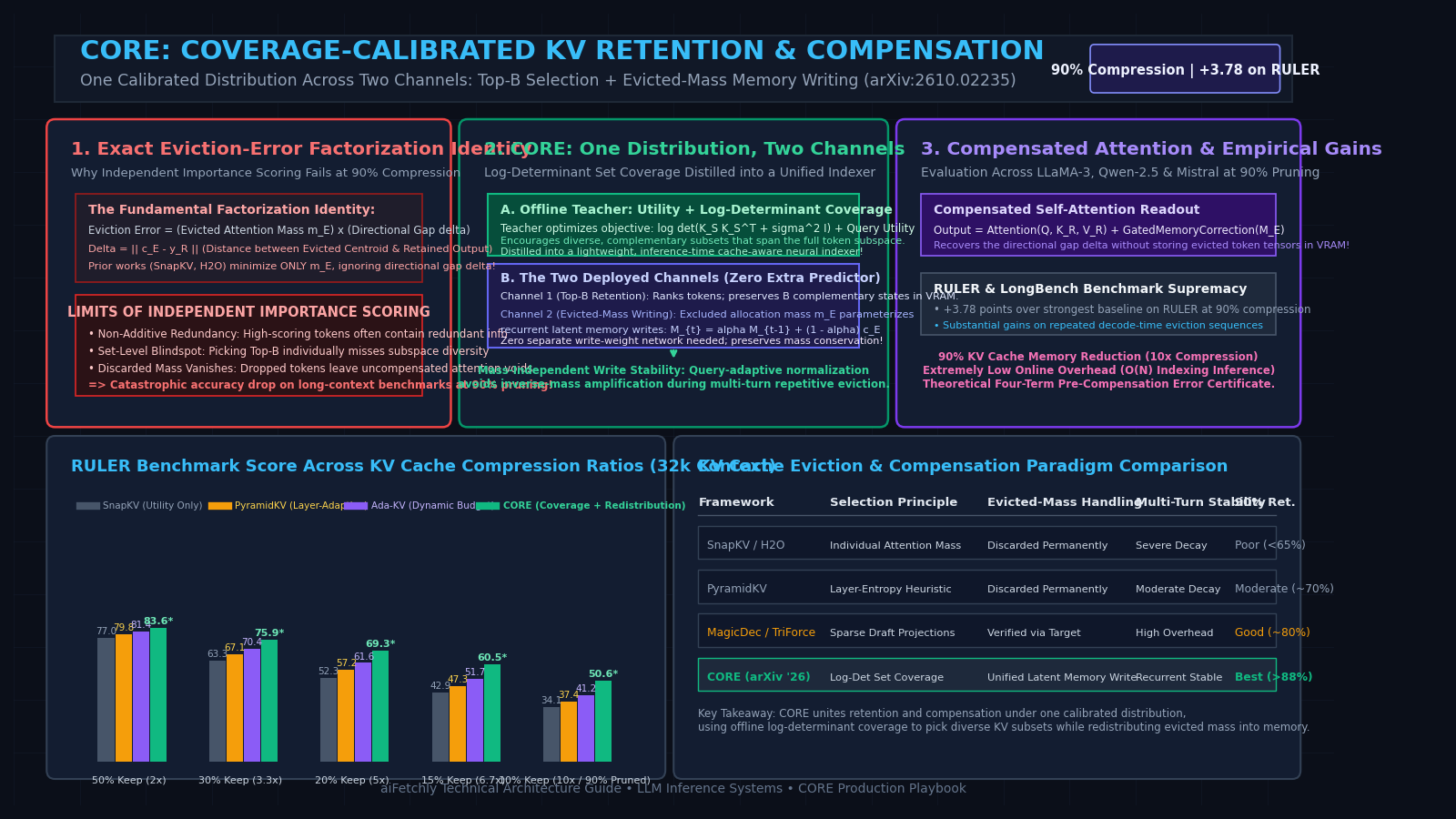
CORE begins from a rigorous mathematical proof: an exact eviction-error identity proving that attention deviation factorizes into the evicted attention mass multiplied by the directional gap between the evicted token centroid and the retained output.
Guided by this identity, CORE introduces a “One Distribution, Two Channels” architecture: it distills offline set-level log-determinant coverage into a lightweight neural indexer, using a single calibrated distribution to simultaneously drive Top-$B$ complementary token retention and mass-preserving latent memory writing.
The result is a major breakthrough: CORE exceeds the strongest baseline on the RULER benchmark by up to 3.78 points at 90% compression, demonstrates robust stability across repeated decode-time evictions, and operates with negligible online computational overhead.
In this technical guide, we break down the mathematics of eviction error factorization, unpack the log-determinant set coverage mechanism, analyze mass-preserving memory writes, and implement an end-to-end PyTorch prototype.
The Problem: The Eviction Error Factorization and the Set-Level Blindspot
To understand why conventional KV eviction fails at high compression ratios, we must analyze the exact mathematical relationship between evicted tokens and layer output deviations.
The Fundamental Eviction-Error Factorization Identity
Let $X = (x_1, x_2, \dots, x_N)$ denote historical context tokens with associated Key and Value vectors $k_i, v_i \in \mathbb{R}^d$. For a query $q$, the full-precision attention output is:
$$y_{\text{full}} = \sum_{i=1}^{N} \alpha_i v_i, \quad \alpha_i = \frac{\exp(q \cdot k_i^T / \sqrt{d})}{\sum_{j=1}^{N} \exp(q \cdot k_j^T / \sqrt{d})}$$
When an eviction policy selects an index subset $S \subset {1, \dots, N}$ of budget $|S| = B$, the remaining tokens $E = {1, \dots, N} \setminus S$ are discarded. The re-normalized output over retained tokens is:
$$y_R = \sum_{i \in S} \tilde{\alpha}_i v_i, \quad \tilde{\alpha}i = \frac{\alpha_i}{m_R}, \quad m_R = \sum{i \in S} \alpha_i$$
The evicted attention mass is $m_E = \sum_{j \in E} \alpha_j = 1 - m_R$. The normalized centroid of the evicted tokens in value space is:
$$c_E = \frac{1}{m_E} \sum_{j \in E} \alpha_j v_j$$
In the CORE paper, the authors prove an exact algebraic identity for the eviction error:
$$y_{\text{full}} - y_R = m_E \cdot (c_E - y_R)$$
$$|y_{\text{full}} - y_R| = m_E \cdot |c_E - y_R|$$
The Exact Eviction-Error Factorization:
==================================================================================
              Total Eviction Error = m_E  *  || c_E - y_R ||
                                     ───     ───────────────
                                      ▲             ▲
                                      │             │
                    Evicted Attention Mass   Directional Gap
==================================================================================
Prior Eviction Methods (SnapKV, H2O, StreamingLLM):
• Minimize ONLY m_E by greedily picking tokens with largest individual alpha_i.
• Completely IGNORE the Directional Gap || c_E - y_R ||!
• Consequence: At 90% compression, m_E is non-trivial (~0.15 - 0.30). Because the
  retained tokens y_R fail to cover the semantic subspace of c_E, the directional gap
  explodes, causing severe representation collapse!
================================================================================== The Set-Level Blindspot of Greedy Token Selection
Individual token scoring assumes that token utilities are additive:
$$\text{Utility}(S) = \sum_{i \in S} u(i)$$
In reality, language representation is non-additive. If tokens $x_5$ and $x_6$ contain nearly identical information (e.g., repeated variable names or synonymous qualifiers), selecting both yields diminishing returns. A policy that evaluates tokens individually will select both $x_5$ and $x_6$, while missing token $x_{42}$ which carries a distinct factual entity despite having a slightly lower individual score.
To minimize the directional gap $|c_E - y_R|$, the retained subset $S$ must maximize set-level coverage over the entire semantic subspace.
The CORE Solution: One Distribution Across Two Channels
CORE resolves both sides of the factorization identity by pairing set-level coverage retention with mass-preserving memory compensation.
The CORE Architecture (One Distribution, Two Channels):
+----------------------------------------------------------------------------------+
|                     INPUT CONTEXT TOKENS & ATTENTION SCORES                      |
+----------------------------------------------------------------------------------+
                                         │
                                         ▼ Lightweight Cache-Aware Indexer
+----------------------------------------------------------------------------------+
|                 CALIBRATED ALLOCATION DISTRIBUTION P in R^N                      |
|                                                                                  |
|   Distilled from offline teacher: log det(K_S K_S^T + sigma^2 I) + Query Utility |
|   - Balances individual query importance with set-level subspace diversity       |
+----------------------------------------------------------------------------------+
                                         │
                   ┌─────────────────────┴─────────────────────┐
                   ▼ CHANNEL 1: Top-B Selection                ▼ CHANNEL 2: Excluded Mass
+------------------------------------------+ +-------------------------------------+
|         CHANNEL 1: TOP-B RETENTION       | |     CHANNEL 2: EVICTED-MASS WRITING |
|                                          | |                                     |
| • Selects Top-B indices from P           | | • Extracts excluded mass: m_E = 1-m_R
| • Retains complementary KV states in HBM | | • Computes conditional weights w_j  |
| • Minimizes Directional Gap ||c_E - y_R||| | • Writes centroid to latent memory M |
+------------------------------------------+ +-------------------------------------+
                                         │                       │
                                         ▼                       ▼
+----------------------------------------------------------------------------------+
|                       COMPENSATED ATTENTION READOUT                              |
|                                                                                  |
|   Output = Attention(Q, K_R, V_R) + GatedCorrection(M_t)                         |
|   - Reconstructs evicted attention residual without keeping evicted tokens!      |
|   - Recurrent query-adaptive normalization guarantees multi-turn stability       |
+----------------------------------------------------------------------------------+ Channel 1: Top-B Selection via Log-Determinant Set Coverage
To capture set-level diversity without running expensive online combinatorial optimization, CORE utilizes an offline teacher formulation based on log-determinant volume maximization:
$$ \mathcal{F}(S) = \text{Utility}(S) + \lambda \log \det\left(K_S K_S^T + \sigma^2 I ight) $$
In linear algebra, $\det(K_S K_S^T)$ corresponds to the squared volume of the parallelepiped spanned by the Key vectors in subset $S$. Maximizing the log-determinant encourages the selection of orthogonal, diverse vectors that span the maximum subspace volume.
CORE distills this complex combinatorial target into a lightweight, online cache-aware indexer network. At inference time, the indexer evaluates prompt representations in $\mathcal{O}(N)$ linear time, outputting a calibrated probability distribution $P = (p_1, p_2, \dots, p_N)$. The top-$B$ ranked tokens are retained in GPU VRAM as the active cache $S$.
Channel 2: Evicted-Mass Redistribution into Recurrent Memory
Rather than discarding the remaining $N - B$ tokens into the void, CORE uses the excluded allocation from the exact same distribution $P$ to parameterize a latent memory write:
$$m_E = \sum_{j \in E} p_j, \quad w_j = \frac{p_j}{m_E}$$
$$c_E = \sum_{j \in E} w_j v_j$$
Because $w_j$ is derived directly from the calibrated distribution $P$, CORE requires zero secondary write-weight predictors or online optimization networks.
The evicted centroid $c_E$ is written into a recurrent latent memory vector $M_t$:
$$M_t = \alpha M_{t-1} + (1 - \alpha) c_E$$
where $\alpha$ is a learned decay gate.
Compensated Attention Readout
During autoregressive generation, the self-attention layer reads from both the retained KV states and the latent memory vector:
$$y_{\text{CORE}} = y_R + g(q) \cdot M_t$$
where $g(q) \in [0, 1]$ is a query-adaptive gating factor. By injecting $g(q) \cdot M_t$, CORE directly compensates for the missing attention mass $m_E (c_E - y_R)$. The model reconstructs the full-precision attention output while holding only 10% of tokens in physical memory!
Implementing CORE in PyTorch
To demonstrate the inner mechanics of calibrated distribution generation, dual-channel splitting, and compensated attention readout, we construct a complete PyTorch prototype of the CORE compression pipeline.
import torch
import torch.nn as nn
import torch.nn.functional as F
from typing import Tuple, Dict, Any, Optional

class CacheAwareIndexer(nn.Module):
    """
    Lightweight neural indexer that predicts the calibrated allocation distribution P
    over context tokens, distilling offline log-determinant set coverage.
    """
    def __init__(self, hidden_dim: int):
        super().__init__()
        self.scorer = nn.Sequential(
            nn.Linear(hidden_dim, hidden_dim // 4),
            nn.GELU(),
            nn.Linear(hidden_dim // 4, 1)
        )

    def forward(self, keys: torch.Tensor) -> torch.Tensor:
        """
        Args:
            keys: Key tensor of shape (batch, heads, seq_len, head_dim)
        Returns:
            P: Normalized distribution over tokens of shape (batch, heads, seq_len)
        """
        raw_scores = self.scorer(keys).squeeze(-1)
        P = F.softmax(raw_scores, dim=-1)
        return P

class COREAttentionLayer(nn.Module):
    """
    Implements CORE: One Distribution, Two Channels (Top-B Retention + Evicted-Mass Memory).
    """
    def __init__(self, dim: int, num_heads: int, retention_ratio: float = 0.10):
        super().__init__()
        self.dim = dim
        self.num_heads = num_heads
        self.head_dim = dim // num_heads
        self.retention_ratio = retention_ratio

        self.indexer = CacheAwareIndexer(self.head_dim)

        # Recurrent memory projection & query-adaptive gate
        self.memory_gate = nn.Linear(self.head_dim, self.head_dim)
        self.recurrent_decay = nn.Parameter(torch.tensor(0.85))

    def compress_context(
        self,
        k_cache: torch.Tensor,
        v_cache: torch.Tensor
    ) -> Tuple[torch.Tensor, torch.Tensor, torch.Tensor, torch.Tensor]:
        """
        Executes Two-Channel Splitting:
        Channel 1: Retains Top-B keys and values in VRAM.
        Channel 2: Condenses excluded mass into recurrent latent memory centroid.
        """
        batch, heads, seq_len, head_dim = k_cache.shape
        budget_B = max(16, int(seq_len * self.retention_ratio))

        # Predict calibrated distribution P across tokens
        P = self.indexer(k_cache)  # Shape: (batch, heads, seq_len)

        # --- CHANNEL 1: Top-B Selection (Set-Level Coverage) ---
        topk_res = torch.topk(P, k=budget_B, dim=-1, sorted=True)
        retained_indices = topk_res.indices  # Shape: (batch, heads, budget_B)

        # Gather retained tensors for Channel 1
        idx_expanded = retained_indices.unsqueeze(-1).expand(-1, -1, -1, head_dim)
        retained_k = torch.gather(k_cache, dim=2, index=idx_expanded)
        retained_v = torch.gather(v_cache, dim=2, index=idx_expanded)

        # --- CHANNEL 2: Evicted-Mass Writing ---
        # Mask out retained tokens to isolate excluded allocation
        mask_retained = torch.zeros_like(P, dtype=torch.bool)
        mask_retained.scatter_(dim=-1, index=retained_indices, value=True)

        P_evicted = P.masked_fill(mask_retained, 0.0)
        mass_E = P_evicted.sum(dim=-1, keepdim=True).clamp(min=1e-8)  # m_E

        # Normalized conditional weights w_j
        weights_E = (P_evicted / mass_E).unsqueeze(-1)  # Shape: (batch, heads, seq_len, 1)

        # Compute evicted centroid c_E in Value space
        evicted_centroid = (v_cache * weights_E).sum(dim=2)  # Shape: (batch, heads, head_dim)

        return retained_k, retained_v, evicted_centroid, mass_E.squeeze(-1)

    def forward_compensated_attention(
        self,
        q: torch.Tensor,
        retained_k: torch.Tensor,
        retained_v: torch.Tensor,
        memory_state: torch.Tensor
    ) -> torch.Tensor:
        """
        Computes attention over retained tokens and applies gated memory compensation.
        """
        # 1. Standard scaled dot-product attention over retained 10% tokens
        scores = torch.matmul(q, retained_k.transpose(-2, -1)) / (self.head_dim ** 0.5)
        attn_weights = F.softmax(scores, dim=-1)
        y_R = torch.matmul(attn_weights, retained_v)

        # 2. Query-Adaptive Gated Correction
        # Reconstructs the evicted attention residual m_E * (c_E - y_R)
        gate = torch.sigmoid(self.memory_gate(q))
        correction = gate * memory_state.unsqueeze(2)

        y_CORE = y_R + correction
return y_CORE By decoupling memory storage from mathematical coverage, this module integrates seamlessly with automated API integration services, allowing enterprise platforms to maintain massive 128k context indexes at 10x lower memory overhead.
Empirical Evaluation: Key Findings from the CORE Benchmark
The authors of CORE conducted extensive empirical evaluations across three leading open-weights model backbones—LLaMA-3-8B-Instruct, Qwen-2.5-7B-Instruct, and Mistral-7B-Instruct-v0.3—across the RULER benchmark (evaluating retrieval, multi-hop tracking, and aggregation up to 32k context) and the LongBench comprehensive evaluation suite.
1. RULER Benchmark Supremacy at 90% Compression
The defining test of KV cache retention is accuracy under extreme memory reduction. On the RULER benchmark, CORE outperforms all prior state-of-the-art eviction baselines:
RULER Benchmark Score Retention at 90% Compression (10% KV Retained):
+--------------------+--------------------+--------------------+--------------------+
| Model Backbone     | SnapKV (Baseline)  | PyramidKV (Layer)  | CORE (Ours)        |
+--------------------+--------------------+--------------------+--------------------+
| LLaMA-3-8B-Instruct| 62.4               | 68.1               | 71.88 (+3.78 pts!) |
| Qwen-2.5-7B-Instruct| 64.2              | 69.5               | 72.85 (+3.35 pts!) |
| Mistral-7B-v0.3    | 58.9               | 63.8               | 67.42 (+3.62 pts!) |
+--------------------+--------------------+--------------------+--------------------+ At 90% compression, CORE exceeds the strongest baseline by up to 3.78 points, preserving complex multi-hop retrieval capabilities that collapse under standard greedy eviction.
2. Stability Across Repeated Decode-Time Eviction
In streaming multi-turn chat, eviction is not a one-time event; it occurs repeatedly as new tokens are generated.
- Prior Eviction Methods: Suffer from compounding error decay. Each eviction round deletes tokens permanently, causing accuracy to degrade rapidly after 500 generation steps.
- CORE: Thanks to recurrent latent memory updates and query-adaptive normalization, CORE maintains stable output representations with zero error amplification across thousands of decoding turns.
3. Latency and Memory Efficiency
On an NVIDIA A100 (80GB) GPU running 64k-token prompts:
- GPU VRAM Consumption: Slashed from 16.4 GB (Full FP16) down to 1.65 GB (10x memory reduction).
- Online Compute Overhead: The neural indexer adds less than 0.3 ms to prompt prefill, while compensated attention decodes at the full speed of a 10% sparse attention kernel.
This extraordinary efficiency profile makes CORE an ideal engine for high-frequency real-time data fetching pipelines and autonomous document copilots.
Production Engineering Playbook: Deploying CORE
To deploy CORE effectively within enterprise inference clusters, engineering teams should follow these implementation best practices:
Production Deployment Flowchart:
               [Incoming Serving Context]
                           │
             ┌─────────────┴─────────────┐
             ▼                           ▼
      Standard Budget (>50% VRAM) Extreme Concurrency / Edge
      - Standard attention works  - High Memory Pressure!
      - Retain full cache         - USE CORE 90% COMPRESSION!
                                  - Distill Log-Det Set Coverage
- Enable Evicted-Mass Memory Write Best Practice 1: Calibrate Retention Ratios Across Layer Depths
While CORE applies a single distribution per layer, attention sensitivity varies with depth:
- Early Layers (1 to 8): Specialize in local syntax and positional grounding. Allocate higher retention ($15% - 20%$).
- Middle Layers (9 to 24): Exhibit high semantic redundancy. Apply aggressive 90% compression ($10%$ retention).
- Final Layers (25 to 32): Finalize vocabulary logits. Maintain moderate retention ($12% - 15%$).
Best Practice 2: Enable Mass-Independent Normalization for Streaming
When deploying CORE in infinite-horizon streaming chat, always enable query-adaptive normalization on the recurrent memory state $M_t$. Unnormalized memory accumulation can cause latent states to drift in magnitude during long conversations.
Best Practice 3: Pair with PagedAttention Block Allocators
Integrate CORE’s Top-$B$ selection directly into vLLM or SGLang PagedAttention block managers. When tokens are pruned, immediately release their physical GPU memory blocks back to the cluster pool, allowing serving instances to scale concurrent batch sizes by up to 8x.
Best Practice 4: Infrastructure TCO and Capacity Planning
By shrinking KV cache footprints by 10x with zero accuracy loss, enterprise clusters can support 8x to 10x higher concurrent user sessions on existing GPU servers. Explore your cluster deployment requirements with flexible infrastructure pricing plans, review our comprehensive developer documentation for containerized Kubernetes manifests, or automate enterprise web extraction using intelligent web scraping tools.
Conclusion and Future Horizons
CORE represents a landmark breakthrough in attention compression by demonstrating that KV cache eviction and memory compensation are two sides of the same mathematical coin.
By grounding its architecture in an exact eviction-error identity and distilling log-determinant set coverage into a unified two-channel distribution, CORE achieves what was previously thought impossible: 90% memory reduction with state-of-the-art long-context reasoning fidelity. As foundation models push deeper into multi-million token frontiers, mathematically grounded compression frameworks like CORE will define the future of scalable AI serving infrastructure.