Continue.dev Guide: Open-Source AI Code Assistant Engine
The Problem: The Lock-In and Context Blindness of Proprietary Code Copilots
In modern software engineering, developer tools, and desktop applications like AiFetchly, AI coding assistants have transitioned from novelties into essential programming accelerators. Whether authoring complex asynchronous scrapers, refactoring frontend UI components, or generating unit test suites, software engineers rely on in-editor model suggestions to maintain flow state.
However, the rapid adoption of proprietary code assistants (such as GitHub Copilot, Cursor, or commercial cloud plugins) has introduced three critical operational vulnerabilities: severe vendor lock-in, intellectual property leakage risks, and superficial codebase context retrieval.
The Proprietary AI Code Assistant Dilemma:
┌─────────────────────────────────────────────────────────────────┐
│ Approach 1: Closed SaaS Code Copilots (GitHub Copilot, Cursor)  │
│ ❌ IP Exfiltration: Proprietary code and API keys stream to SaaS│
│ ❌ Monolithic Model Lock-In: Bound to vendor-chosen cloud LLMs  │
│ ❌ Offline Fragility: Zero autocomplete during air-gapped coding│
├─────────────────────────────────────────────────────────────────┤
│ Approach 2: Shallow Context Windows (Active File Truncation)    │
│ ❌ No Cross-File Awareness: Blind to custom types in `types.ts` │
│ ❌ Hallucinated Signatures: Invents nonexistent function params │
│ ❌ Arbitrary Line Splits: Chops classes in half across chunks   │
├─────────────────────────────────────────────────────────────────┤
│ Approach 3: Brute-Force Local Terminal Scripts (Raw CLI Loops)  │
│ ❌ No Editor Integration: Clumsy copy-paste between terminal & IDE│
│ ❌ High Latency: Lacks keystroke debouncing & FIM tokenization  │
└─────────────────────────────────────────────────────────────────┘
Result: Developers trade source-code privacy for convenience, or suffer sluggish tools! 1. Intellectual Property Risk and Cloud Vendor Lock-In
In enterprise software engineering, codebases are crown-jewel assets:
- Data Exfiltration: Closed assistants stream every keystroke, active file buffer, and terminal output to external vendor cloud servers. For companies developing proprietary algorithms, handling regulated financial systems, or operating under strict security certifications (SOC 2, ISO 27001), streaming unencrypted code to third-party endpoints violates data governance mandates.
- Model Inflexibility: Proprietary tools lock developers into specific model vendors. When breakthrough open-weights coding models emerge (such as Qwen2.5-Coder, DeepSeek-Coder, or Mistral Codestral), developers are trapped waiting for the commercial vendor to support them.
2. The Autocomplete Latency Wall (< 50ms Human Threshold)
Tab autocomplete operates under extreme latency constraints:
- Sociolinguistic and ergonomic developer studies demonstrate that inline code completion must appear within 50 to 100 milliseconds of a keystroke pause to feel instantaneous.
- Cloud roundtrips alone consume 150ms to 300ms, creating noticeable stutter.
- Furthermore, naive autoregressive generation fails when editing existing code. If a developer edits inside an existing function body, standard models generate trailing code while ignoring the existing code below the cursor, creating duplicate blocks and syntax errors.
3. Shallow Context and the AST Boundary Blindness
When an AI assistant suggests code:
- Naive plugins only send a few dozen lines above and below the cursor.
- If the current file depends on custom database schemas defined in another directory, utility helper functions in a shared library, or imported interface types, the model hallucinates signatures and parameters.
- Text-blind chunkers that split files by raw line counts frequently split functions in half, breaking AST syntax trees and poisoning retrieval indices.
The Solution: Continue.dev’s Open-Source Modular Architecture
To liberate software engineers from proprietary walled gardens and deliver context-aware, privacy-first code intelligence, developers created Continue.dev.
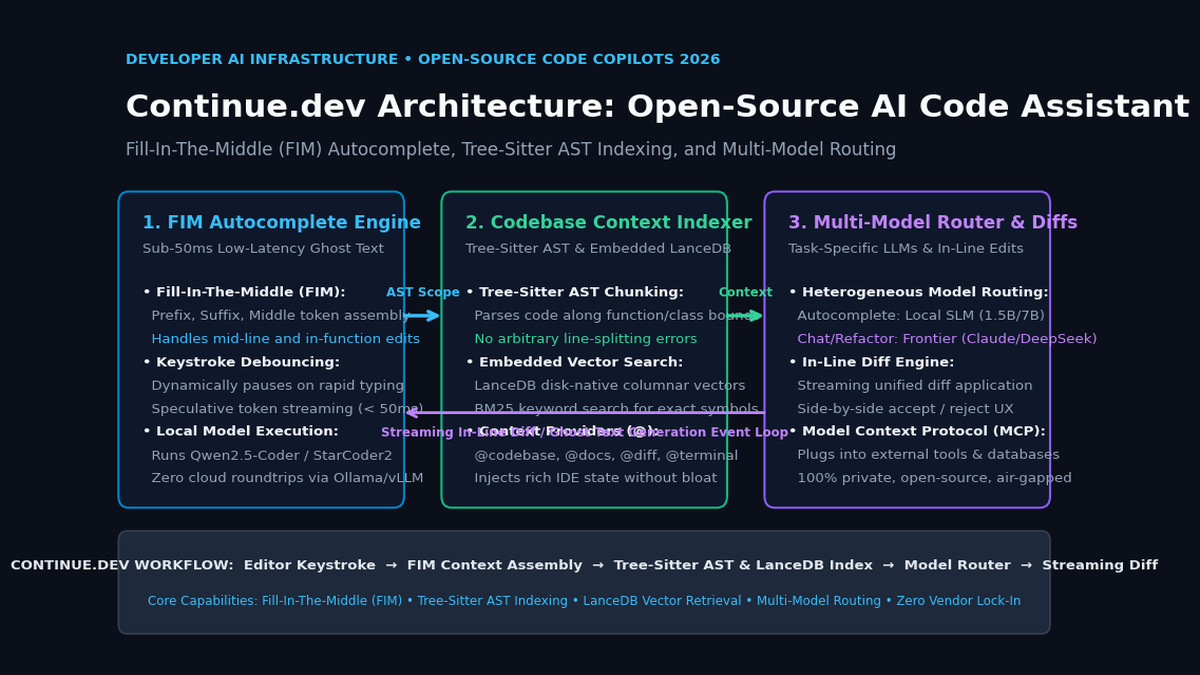
Continue.dev is an open-source, vendor-agnostic AI code assistant for Visual Studio Code and JetBrains IDEs. Built on a modular client-server architecture, Continue decouples the IDE interface from underlying models, allowing developers to route different programming tasks to optimal local or cloud foundation models while executing Fill-In-The-Middle (FIM) tab autocomplete, Tree-Sitter AST codebase indexing, and Model Context Protocol (MCP) integrations.
Continue.dev System Architecture:
┌─────────────────────────────────────────────────────────────────┐
│ Developer IDE Workspace (VS Code / JetBrains / Cursor Fork)     │
└─────────────────────────────────────────────────────────────────┘
 │
 ▼ (Bidirectional JSON-RPC / Protocol Buffer Event Stream)
┌─────────────────────────────────────────────────────────────────┐
│ Continue Core Background Daemon                                 │
│                                                                 │
│ ┌─────────────────────────────────────────────────────────────┐ │
│ │ Fill-In-The-Middle (FIM) Autocomplete Engine                │ │
│ │ • Keystroke Debouncer & Cache (< 50ms response budget)      │ │
│ │ • Formats `<fim_prefix>`, `<fim_suffix>`, `<fim_middle>`    │ │
│ └─────────────────────────────────────────────────────────────┘ │
│                                │                                │
│        ┌───────────────────────┴───────────────────────┐        │
│        ▼                                               ▼        │
│ ┌─────────────────────────────┐ ┌─────────────────────────────┐ │
│ │ Tree-Sitter AST Indexer     │ │ Heterogeneous Model Router  │ │
│ │ • Syntax-aware code chunking│ │ • Autocomplete: Local SLM   │ │
│ │ • Embedded LanceDB Vectors  │ │ • Chat / Refactor: Frontier │ │
│ │ • BM25 symbol definitions   │ │ • In-Line Edit: Fast Mid-Tier│ │
│ └─────────────────────────────┘ └─────────────────────────────┘ │
│                                │                                │
│                                ▼                                │
│ ┌─────────────────────────────────────────────────────────────┐ │
│ │ Context Providers & Model Context Protocol (MCP) Manager    │ │
│ │ • Dynamic Context: @codebase, @docs, @diff, @terminal, @web │ │
│ └─────────────────────────────────────────────────────────────┘ │
└─────────────────────────────────────────────────────────────────┘
 │
 ▼ (Streaming Unified Diffs)
┌─────────────────────────────────────────────────────────────────┐
│ Interactive Editor Diff UI (Side-by-Side Accept / Reject View)  │
└─────────────────────────────────────────────────────────────────┘ The Architectural Pillars of Continue.dev
- Fill-In-The-Middle (FIM) Autocomplete: Leverages specialized FIM token formats supported by models like Qwen2.5-Coder and StarCoder2, allowing the model to condition simultaneously on the code before the cursor (prefix) and the code after the cursor (suffix) to generate precise completions without repeating code.
- Tree-Sitter Abstract Syntax Tree (AST) Indexing: Parses repository files using Tree-Sitter language grammars, chunking code strictly along function, class, and method boundaries. Chunks are indexed into an embedded LanceDB vector store and BM25 inverted index for fast cross-file symbol retrieval.
- Dynamic Context Providers (
@): Allows developers to explicitly inject rich IDE runtime state into conversational prompts using@codebase,@diff(git changes),@terminal(recent stdout/stderr),@docs(scraped documentation), and external Model Context Protocol (MCP) servers. - Heterogeneous Multi-Model Routing: Completely separates model assignment by task. Developers can run ultra-fast 1.5B parameter models locally via Ollama for zero-cost, sub-50ms tab completions, while delegating complex system design to Claude 3.5 Sonnet, DeepSeek-V3, or GPT-4o.
- Streaming In-Line Diff Engine: Generates unified diffs directly within the active editor buffer, presenting side-by-side or inline visual diffs that developers can accept, reject, or iterate upon with keyboard shortcuts.
- 100% Data Privacy & Air-Gapped Operation: Capable of running completely offline on local hardware via Ollama or vLLM, ensuring zero lines of proprietary code ever leave the local workstation.
Comparing Modern AI Code Assistants
The table below contrasts Continue.dev against other prominent code copilot frameworks:
AI Code Assistant Architectural Comparison:
┌───────────────────────────┬───────────────────────────────┬───────────────────────────────┬───────────────────────────────┐
│ Dimension                 │ GitHub Copilot                │ Cursor                        │ Continue.dev                  │
├───────────────────────────┼───────────────────────────────┼───────────────────────────────┼───────────────────────────────┤
│ Open Source               │ No (Proprietary Microsoft)    │ No (Proprietary Forked VSCode)│ Yes (Apache 2.0 License)      │
│ Model Support             │ Vendor-locked (GPT-4o, Claude)│ Vendor-selected cloud models  │ Any Model (Local + Any Cloud) │
│ Local & Offline Serving   │ No (Requires internet access) │ No (Cloud dependent)          │ Yes (Ollama, vLLM, LM Studio) │
│ Codebase Indexing Engine  │ Cloud remote index            │ Custom Rust embeddings index  │ Tree-Sitter AST + LanceDB     │
│ Context Protocol          │ Proprietary internal format   │ Proprietary internal format   │ Open Model Context Protocol   │
│ Editor Compatibility      │ VS Code, JetBrains, Visual St │ Standalone forked IDE only    │ Standard VS Code & JetBrains  │
│ Telemetry & Privacy       │ Cloud data collection         │ Cloud telemetry               │ Optional / Zero Exfiltration  │
│ FIM Token Formatting      │ Closed proprietary backend    │ Closed proprietary backend    │ Transparent & Configurable    │
└───────────────────────────┴───────────────────────────────┴───────────────────────────────┴───────────────────────────────┘ Deep Dive into Continue.dev Core Primitives & Engines
Continue achieves responsive, context-aware coding assistance through four integrated subsystems: the FIM Autocomplete Engine, AST-Driven Codebase Indexing, Context Providers, and Multi-Model Routing.
Continue.dev Core Subsystems:
Continue.dev Engine
 ├──► 1. FIM Autocomplete: Prefix/Suffix/Middle token formatting with debouncing
 ├──► 2. AST Code Indexer: Tree-sitter grammar chunking + LanceDB vector store
 ├──► 3. Context Providers: Declarative `@` injectors (@codebase, @diff, @terminal)
 ├──► 4. Model Router: Specialized task routing (Autocomplete, Chat, Edit)
└──► 5. Diff Engine: Streaming unified diffs with keyboard accept/reject UX 1. Fill-In-The-Middle (FIM) Autocomplete Mechanics
In standard causal language modeling, text generation is strictly unidirectional. However, coding requires inserting logic between existing lines. Continue structures autocomplete prompts using specialized FIM delimiters:
FIM Token Assembly Format:
<fim_prefix>
def calculate_moving_average(data_stream: list[float], window_size: int) -> list[float]:
    if window_size <= 0:
        raise ValueError("Window size must be positive")
    <CURSOR LOCATION>
<fim_suffix>
    return moving_averages
<fim_middle>
    # Model generates ONLY the middle tokens:
    moving_averages = []
    current_sum = sum(data_stream[:window_size])
    moving_averages.append(current_sum / window_size)
    for i in range(len(data_stream) - window_size):
        current_sum += data_stream[i + window_size] - data_stream[i]
moving_averages.append(current_sum / window_size) - Keystroke Debouncing: When a developer types continuously at 80 WPM, launching an inference request for every character keystroke would overwhelm the inference engine. Continue debounces input, delaying the trigger until typing pauses for 75 to 150 milliseconds.
- Context Pruning: Autocomplete prompts are capped at 1,024 to 2,048 tokens, prioritizing the 50 lines immediately surrounding the cursor to guarantee single-batch inference times under 40 milliseconds on local GPUs.
2. Codebase Indexing via Tree-Sitter & Embedded LanceDB
To allow models to answer repository-wide questions without exceeding context limits, Continue implements an embedded retrieval pipeline:
- Tree-Sitter Parsing: Files are parsed into concrete syntax trees across 20+ programming languages. Instead of arbitrary line splitting, Continue extracts complete functions, classes, and struct definitions as discrete atomic units.
- LanceDB Vector Storage: Embeddings are generated using lightweight models (such as
all-MiniLM-L6-v2ornomic-embed-text) and stored in a disk-native, serverless LanceDB database located in.continue/index. - Hybrid Symbol Search: Combines vector similarity with BM25 keyword matching to ensure that exact type names (
UserAuthenticationService) are retrieved with 100% precision.
3. Context Providers and Model Context Protocol (MCP)
Continue exposes a declarative context provider interface:
@codebase: Automatically queries the local LanceDB index, extracting the top 5 to 10 most relevant code snippets across the repository.@diff: Captures unstaged git changes, allowing the model to review recent modifications or generate commit messages.@terminal: Reads active terminal history, enabling instant debugging of stack traces and compilation errors.- Model Context Protocol (MCP): Connects to external tool servers (such as PostgreSQL databases, GitHub issues, and web search APIs) to ground completions in live enterprise state.
Hands-On Implementation: Configuring a Fully Local, Private AI IDE Setup
Let’s configure a production-grade, 100% local, private AI coding environment in VS Code using Continue.dev, Ollama, and Qwen2.5-Coder.
1. Installation & Environment Prerequisites
Install the Continue extension from the Visual Studio Code Marketplace or Open VSX:
# Install Continue extension via VS Code CLI
code --install-extension Continue.continue Install and start Ollama on your local machine:
# Pull fast 1.5B model for tab autocomplete and 7B model for chat
ollama pull qwen2.5-coder:1.5b-base
ollama pull qwen2.5-coder:7b-instruct
ollama pull nomic-embed-text 2. Configuring config.yaml for Heterogeneous Model Routing
Open ~/.continue/config.yaml (or .continue/config.json) and configure task-specific model routing:
# ~/.continue/config.yaml
name: Local Private AI Assistant
version: 1.0.0

# 1. Chat & Refactoring Model (High Reasoning)
models:
  - name: Qwen2.5-Coder 7B (Local)
    provider: ollama
    model: qwen2.5-coder:7b-instruct
    apiBase: http://localhost:11434
    roles:
      - chat
      - edit

  # Optional: Fallback cloud model for complex architectural audits
  - name: Claude 3.5 Sonnet (Cloud)
    provider: anthropic
    model: claude-3-5-sonnet-latest
    apiKey: '${ANTHROPIC_API_KEY}'
    roles:
      - chat

# 2. Tab Autocomplete Model (Ultra-Low Latency FIM)
tabAutocompleteModel:
  title: Qwen2.5-Coder 1.5B FIM
  provider: ollama
  model: qwen2.5-coder:1.5b-base
  apiBase: http://localhost:11434

# 3. Codebase Embeddings Model
embeddingsProvider:
  provider: ollama
  model: nomic-embed-text
  apiBase: http://localhost:11434

# 4. Context Providers
context:
  - name: codebase
    params:
      nRetrieve: 10
      nFinal: 5
  - name: diff
  - name: terminal
- name: docs 3. Autocomplete Configuration Tuning
Fine-tune autocomplete debouncing and token parameters in config.yaml:
tabAutocompleteOptions:
  debounceDelay: 100 # Wait 100ms after last keystroke before triggering
  maxPromptTokens: 1024 # Limit prefix/suffix budget for sub-50ms execution
  multilineCompletions: always
useCache: true # Cache prefix/suffix completions in memory 4. Running a Codebase Indexing Job
Trigger codebase indexing across your project directly from the VS Code command palette:
1. Press `Cmd + Shift + P` (or `Ctrl + Shift + P` on Linux/Windows).
2. Type and select: "Continue: Rebuild Codebase Index".
3. Continue parses all repository files via Tree-Sitter, generates embeddings via nomic-embed-text, and persists vectors to `.continue/index`. 5. Using In-Line Diffs and Context Providers in Practice
In your editor, highlight an existing function and press Cmd + I (or Ctrl + I):
Prompt:
"Refactor this scraper to use asyncio.gather with a semaphore of 5 concurrent workers."

Continue streams the unified diff directly into the editor buffer:
- Green highlights represent additions.
- Red strikethroughs represent deletions.
- Press `Cmd + Shift + Enter` to accept, or `Cmd + Shift + Backspace` to reject. In the chat sidebar (Cmd + L), query repository-wide context:
Prompt:
"@codebase Where is the SQLite connection initialized, and how are write locks handled?"

Continue retrieves the relevant files via LanceDB and synthesizes an exact explanation with clickable file links. Production Architecture & Integration for aiFetchly
Integrating Continue.dev into developer workflows, automated web harvesting systems, and desktop copilots like AiFetchly establishes a private, high-productivity engineering pipeline.
aiFetchly Developer AI Architecture:
┌─────────────────────────────────────────────────────────────────┐
│ aiFetchly Engineering Workstation (Local VS Code / JetBrains)   │
└─────────────────────────────────────────────────────────────────┘
 │
 ├──► Tab Autocomplete: Sub-40ms FIM Loop via Local Ollama (1.5B)
 │
 ├──► Codebase Search: Tree-Sitter AST + Embedded LanceDB Vectors
 │
 ▼ (Agentic Chat & Architectural Refactoring)
┌─────────────────────────────────────────────────────────────────┐
│ Continue Core Router                                            │
│ • Injects @diff, @terminal, and @codebase context blocks        │
│ • Dispatches tasks across heterogeneous model backends          │
└─────────────────────────────────────────────────────────────────┘
 │
 ├── Local Offline Mode: LLaMA-3.3 70B via TensorRT-LLM / Ollama
 └── Cloud Frontier Mode: Claude 3.5 Sonnet / DeepSeek-V3
 │
 ▼
┌─────────────────────────────────────────────────────────────────┐
│ Full-Stack Observability & Trace Auditing (Arize Phoenix)       │
│ • Measures FIM acceptance rates, prompt latency, and token costs│
└─────────────────────────────────────────────────────────────────┘ 1. Air-Gapped Engineering for Confidential Data Pipelines
When developing proprietary data harvesters, custom scraping scrapers, and internal database connectors in AiFetchly:
- Developers operate in complete offline mode.
- Autocomplete, chat refactoring, and AST codebase search execute strictly against on-premise hardware using local models in Ollama or TensorRT-LLM.
- Zero proprietary code or customer database schemas are ever transmitted over external networks.
2. Synergizing Tree-Sitter Chunking with Multi-Tenant Storage
Continue’s syntax-aware AST chunking logic can be directly mirrored in AiFetchly’s backend document ingestion pipelines:
- Instead of naive character splitting, code and structured configuration files are partitioned along syntactic boundaries.
- Chunks can be ingested directly into enterprise vector stores like ChromaDB or Weaviate for multi-tenant code search across development teams.
3. Monitoring Copilot Quality and Latency with OpenTelemetry
To ensure developer productivity remains high:
- Export Continue’s internal telemetry to Arize Phoenix using OpenTelemetry.
- Track metrics including:
- Autocomplete Acceptance Rate: Percent of ghost-text completions accepted with the
Tabkey. - Time-to-First-Token (TTFT): Ensuring local FIM completions stay strictly below 60ms.
- Context Relevance: Validating that
@codebaseretrieval pulls valid dependent files rather than noisy matches.
- Autocomplete Acceptance Rate: Percent of ghost-text completions accepted with the
Summary: Empowering Developers with Autonomous, Private Code Intelligence
Modern artificial intelligence code assistants should enhance developer autonomy, not enforce proprietary vendor lock-in or compromise proprietary intellectual property.
By combining low-latency Fill-In-The-Middle (FIM) tab autocomplete, Tree-Sitter AST codebase indexing, embedded LanceDB vector storage, and flexible multi-model routing, Continue.dev delivers a customizable, open-source programming assistant directly inside your IDE. For software engineers building next-generation desktop intelligence tools and high-performance data extraction platforms with AiFetchly, Continue.dev provides the architectural blueprint for fast, private, and context-aware AI software development.