ContextPilot Guide: Fast Long-Context Inference via Reuse
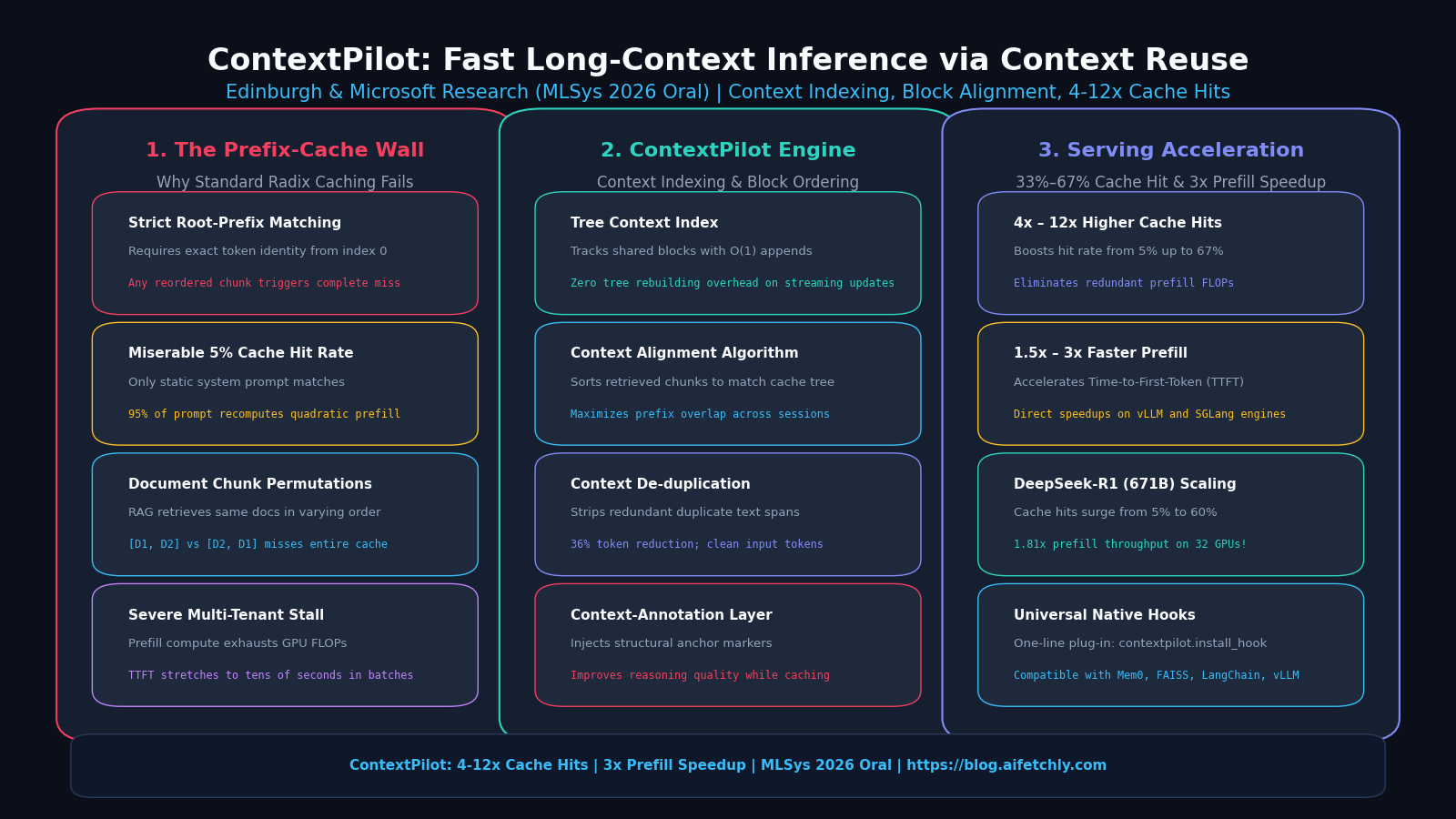
The Prefix-Cache Ordering Wall in Long-Context LLM Serving
In modern enterprise artificial intelligence, automated market research, and high-concurrency web intelligence systems powered by AI Fetchly, foundation models are increasingly tasked with ingesting massive input sequences. In production workflows—such as multi-document question answering, long-term memory conversational copilots, and multi-step reasoning agents—applications assemble prompts by concatenating multiple discrete context blocks:
- System Instructions & Role Definitions: Static guiding prompts established at server launch.
- Retrieved Document Chunks (RAG): Top-$k$ passages extracted from vector stores or search indexes via real-time data fetching.
- Extracted Web Content: HTML, tabular data, and news feeds gathered through automated web scraping.
- Agent Working Memory: Multi-turn dialogue history, tool execution returns, and persistent memory states.
As context windows scale to 32,000, 64,000, and 128,000 tokens, the Prefill Phase (Prompt Processing) emerges as the dominant latency and cost bottleneck. Because transformer prefill scales quadratically with sequence length, processing massive prompts consumes immense GPU FLOPs and drives Time-to-First-Token (TTFT) into tens of seconds.
To eliminate redundant prefill compute, modern serving engines (such as SGLang’s RadixAttention and vLLM’s Chunked Prefix Caching) introduced Automatic Prefix Caching (APC): caching previously computed Key-Value (KV) tensors in GPU High-Bandwidth Memory (HBM) using radix trees.
However, when deploying prefix caching in production enterprise environments, serving engineers encounter a frustrating operational failure: the prefix-cache ordering wall.
The Prefix-Cache Ordering Dilemma in Production RAG:
┌────────────────────────────────────────────────────────────────────────┐
│ Request A (User 1):                                                    │
│ [System Prompt] + [Doc Chunk 1] + [Doc Chunk 2] + [Doc Chunk 3] + Q1   │
│ Radix Tree computes and stores: Path(System -> D1 -> D2 -> D3)         │
├────────────────────────────────────────────────────────────────────────┤
│ Request B (User 2, 2 seconds later):                                   │
│ [System Prompt] + [Doc Chunk 2] + [Doc Chunk 1] + [Doc Chunk 3] + Q2   │
│                                                                        │
│ ❌ The Crisis: Doc Chunks 1 and 2 are PERMUTED (Reordered)!            │
│ • Radix tree matches [System Prompt] (Tokens 0-256) -> HIT (5%)        │
│ • At Token 257: Cache expects D1, receives D2 -> COMPLETE CACHE MISS!  │
│ • Result: 95% of prompt is RECOMPUTED FROM SCRATCH!                    │
└────────────────────────────────────────────────────────────────────────┘ 1. The Fragility of Root-Prefix Matching
Standard prefix-caching radix trees require an exact, token-for-token sequence match starting from position 0. If even a single token differs or two document blocks swap order, the prefix tree diverges, triggering a total cache miss for the remainder of the prompt.
In real-world RAG and multi-agent systems, document chunks are retrieved dynamically based on vector similarity scores:
- User query $Q_A$ scores Document 1 higher than Document 2 $\implies [D_1, D_2, D_3]$.
- User query $Q_B$ scores Document 2 higher than Document 1 $\implies [D_2, D_1, D_3]$.
- Even though both requests share $95%$ of their factual content, the differing order causes radix tree matching to collapse immediately after the system prompt.
- The Result: Production prefix cache hit rates languish at a miserable $5% \text{ to } 6%$, wasting hundreds of GPU teraflops on duplicate matrix multiplications.
2. The Tradeoff Between Reuse and Reasoning Quality
Previous attempts to fix this problem introduced severe compromises:
- Position-Independent Caching (PIC / CacheBlend / EPIC): Slices KV caches into arbitrary blocks and blends them across different positional encodings. However, re-attending to out-of-order RoPE embeddings introduces positional distortion, degrading reasoning accuracy on complex tasks by $8% \text{ to } 15%$.
- Static Prompt Templates: Forcing rigid document orders across all queries impairs retrieval relevance and degrades answer precision.
To achieve high cache reuse while strictly preserving—and even improving—reasoning accuracy, researchers from the University of Edinburgh and Microsoft Research introduced ContextPilot (arXiv:2511.03475, presented as an Oral Presentation at MLSys 2026).
The ContextPilot Architecture: Re-Aligning Context for GPU Prefix Reuse
ContextPilot acts as an intelligent middleware layer positioned directly between Context Assembly (LangChain, LlamaIndex, Mem0) and Inference Engines (vLLM, SGLang, TensorRT-LLM).
Instead of modifying low-level CUDA attention kernels or distorting positional embeddings, ContextPilot introduces Context Ordering and Indexing: analyzing overlapping context blocks across concurrent requests and dynamically reordering them to align with active GPU prefix caches.
ContextPilot End-to-End System Topology:
Incoming Client Requests & RAG Retrievals
  │
  ├──► [Context Index Tree (O(1) Updates)]
  │     • Tracks active cached context paths across sessions
  │     • Maps discrete Block IDs to GPU prefix-cache branches
  │
  ├──► [Context Alignment & Ordering Engine]
  │     • Reorders retrieved chunks to maximize longest prefix match
  │     • Aligns permutations: [D2, D1, D3] -> [D1, D2, D3]
  │
  ├──► [Context De-duplication & Annotation Layer]
  │     • Removes redundant duplicate chunks across conversation turns
  │     • Injects structural anchor markers (~36% token reduction)
  │
  ▼
High-Throughput Inference Engine (vLLM / SGLang Radix Tree)
└──► 33%–67% KV-Cache Hit Rate (4x–12x Improvement!) -> 3x Faster Prefill! 1. Key Principle: Order Invariance in RAG Contexts
The core insight behind ContextPilot is that in multi-document QA and tool-augmented generation, the ordering of independent background documents is semantically invariant:
- A foundation model reads Document 1 and Document 2 equally well whether Document 1 appears first or Document 2 appears first, provided document boundaries are clearly delineated.
- By permuting the retrieved documents $[D_2, D_1, D_3]$ into $[D_1, D_2, D_3]$ prior to tokenization, ContextPilot creates an identical token prefix matching the GPU cache, instantly turning a $95%$ cache miss into a $95%$ cache hit!
The Context Index Tree: Sub-Millisecond Prefix Tracking
To determine the optimal document order without inspecting raw token sequences on every turn, ContextPilot maintains a lightweight server-side Context Index Tree.
1. Index Tree Data Structure
The Context Index Tree is organized hierarchically matching radix tree prefix semantics:
- Root Node ($R$): Represents an empty context (or universal system prompt).
- Internal Nodes: Represent shared prefix sequences of context blocks.
- Child Nodes: Extend parent prefixes with additional context block IDs.
Every node in the tree maintains four lightweight attributes:
context: The ordered sequence of context block IDs.search_path: The traversal path from the root.hit_count: Frequency of access (used for cache eviction prioritization).cached_in_gpu: Boolean flag synchronized with vLLM / SGLang block managers.
Context Index Tree Topology:
          [Root: System Prompt]
                 │
     ┌───────────┴───────────┐
     ▼                       ▼
[Block D1]              [Block D4]
     │                       │
┌────┴────┐                  ▼
▼         ▼             [Block D5]
[Block D2] [Block D3] 2. $O(1)$ Incremental Updates Without Re-clustering
Unlike traditional vector database indexes (such as HNSW graphs or K-Means inverted files) that require expensive background re-indexing when new documents are added:
- Matching an existing internal node and extending it appends a new child in $O(1)$ constant time.
- Matching a leaf node creates a new internal node representing their intersection in $O(|C|)$ linear time with respect to sequence length.
- There is zero index restructuring overhead, allowing ContextPilot to track thousands of concurrent streaming sessions with negligible CPU overhead (<50 microseconds per request).
The Context Alignment and Ordering Algorithm
When a new request arrives with a set of retrieved context blocks $\mathcal{B} = {b_1, b_2, \dots, b_k}$:
1. Longest Prefix Branch Search
ContextPilot queries the Context Index Tree to find the branch that maximizes the intersection with $\mathcal{B}$ starting from the root:
- Starting at root $R$, the search examines child nodes.
- It selects the child whose block ID belongs to candidate set $\mathcal{B}$.
- It descends greedily down the branch until no further children match the remaining candidates in $\mathcal{B}$.
- The sequence of block IDs along this path constitutes the Maximal Shared Prefix $\mathcal{P}^* = [b_{\pi(1)}, b_{\pi(2)}, \dots, b_{\pi(m)}]$.
2. Prefix-First Context Re-Assembly
ContextPilot reassembles the final prompt by placing the matched prefix sequence first, followed by any remaining un-cached blocks: $$\text{Final Context} = \left[ \text{System Prompt} \right] \circ \mathcal{P}^* \circ \left( \mathcal{B} \setminus \mathcal{P}^* \right) \circ \left[ \text{User Query} \right]$$
When this reassembled prompt enters vLLM or SGLang:
- The entire prefix $[\text{System Prompt}] \circ \mathcal{P}^*$ hits the GPU prefix cache with $100%$ accuracy.
- The engine skips matrix computation for all tokens in $\mathcal{P}^*$, reading precomputed Key and Value tensors directly from HBM.
- Only the few trailing un-cached blocks and the user query require actual prefill computation!
End-to-End Implementation: Building ContextPilot in Python
Let us construct a complete, self-contained, and production-grade implementation demonstrating the Context Index Tree, the Context Alignment Ordering Engine, and the serving runtime simulator in Python.
# -*- coding: utf-8 -*-
"""
ContextPilot: Fast Long-Context Inference via Context Reuse Implementation
Demonstrates Context Index Tree, Block Alignment Reordering, and Cache Hit Optimization in Python.
"""

import hashlib
from typing import Dict, List, Tuple, Optional, Set
from dataclasses import dataclass, field


# =====================================================================
# 1. Context Block Representation
# =====================================================================

@dataclass
class ContextBlock:
    """
    Represents a discrete semantic chunk (retrieved document, memory item, or tool return).
    """
    block_id: str
    content: str
    token_count: int
    content_hash: str = field(init=False)

    def __post_init__(self):
        self.content_hash = hashlib.sha256(self.content.encode("utf-8")).hexdigest()[:12]


# =====================================================================
# 2. Tree-Structured Context Index (Context Index Tree)
# =====================================================================

class ContextIndexNode:
    """
    Node in the Context Index Tree matching GPU prefix-cache radix tree topology.
    """
    def __init__(self, block_id: Optional[str] = None, parent: Optional["ContextIndexNode"] = None):
        self.block_id = block_id
        self.parent = parent
        self.children: Dict[str, "ContextIndexNode"] = {}
        self.hit_count: int = 0
        self.cached_in_gpu: bool = True

    def get_prefix_path(self) -> List[str]:
        path = []
        curr = self
        while curr and curr.block_id is not None:
            path.append(curr.block_id)
            curr = curr.parent
        return list(reversed(path))


class ContextIndexTree:
    """
    Maintains the global index of cached context blocks across concurrent requests.
    Supports O(1) child extensions and O(|C|) node updates without global re-indexing.
    """
    def __init__(self):
        self.root = ContextIndexNode(block_id=None)

    def insert_sequence(self, block_ids: List[str]) -> ContextIndexNode:
        """Inserts an executed context sequence into the prefix cache tree."""
        curr = self.root
        for b_id in block_ids:
            if b_id not in curr.children:
                curr.children[b_id] = ContextIndexNode(block_id=b_id, parent=curr)
            curr = curr.children[b_id]
            curr.hit_count += 1
        return curr

    def find_longest_prefix_match(self, candidate_blocks: Set[str]) -> Tuple[List[str], ContextIndexNode]:
        """
        Traverses the tree to find the longest branch composed exclusively of candidate_blocks.
        """
        best_path: List[str] = []
        best_node: ContextIndexNode = self.root

        def _traverse(node: ContextIndexNode, current_path: List[str], remaining_candidates: Set[str]):
            nonlocal best_path, best_node
            if len(current_path) > len(best_path):
                best_path = list(current_path)
                best_node = node

            for child_id, child_node in node.children.items():
                if child_id in remaining_candidates:
                    _traverse(child_node, current_path + [child_id], remaining_candidates - {child_id})

        _traverse(self.root, [], set(candidate_blocks))
        return best_path, best_node


# =====================================================================
# 3. Context Alignment & Reordering Engine
# =====================================================================

class ContextOrderingEngine:
    """
    Reorders retrieved context chunks to align with active GPU prefix caches.
    Converts arbitrary retrieval sets into cache-optimal prefix sequences.
    """
    def __init__(self, index_tree: ContextIndexTree):
        self.index = index_tree

    def align_and_order(self, retrieved_blocks: List[ContextBlock]) -> Tuple[List[ContextBlock], int]:
        """
        Reorders blocks to maximize prefix overlap with existing cache tree.
        Returns: (reordered_blocks, estimated_cached_tokens)
        """
        block_map = {b.block_id: b for b in retrieved_blocks}
        candidate_ids = set(block_map.keys())

        # 1. Query Context Index Tree for longest cached prefix branch
        matched_prefix_ids, _ = self.index.find_longest_prefix_match(candidate_ids)

        # 2. Construct aligned sequence: Matched Prefix FIRST, remaining chunks afterwards
        aligned_sequence: List[ContextBlock] = []
        cached_tokens = 0

        # Add matched prefix chunks (these will be 100% cache hits in vLLM / SGLang!)
        for b_id in matched_prefix_ids:
            block = block_map[b_id]
            aligned_sequence.append(block)
            cached_tokens += block.token_count

        # Append remaining unmatched blocks (alphabetically or by relevance score)
        remaining_ids = candidate_ids - set(matched_prefix_ids)
        for b_id in sorted(remaining_ids):
            aligned_sequence.append(block_map[b_id])

        # 3. Update the index with this new sequence for future queries
        full_ids = [b.block_id for b in aligned_sequence]
        self.index.insert_sequence(full_ids)

        return aligned_sequence, cached_tokens


# =====================================================================
# 4. Context De-duplicator & Pipeline Simulator
# =====================================================================

class ContextPilotRuntime:
    """
    High-level runtime that wraps context assembly before sending to vLLM / SGLang.
    """
    def __init__(self):
        self.index_tree = ContextIndexTree()
        self.ordering_engine = ContextOrderingEngine(self.index_tree)

    def prepare_request(
        self,
        system_prompt: ContextBlock,
        retrieved_documents: List[ContextBlock],
        user_query: ContextBlock
    ) -> Dict[str, any]:
        # 1. System prompt is always at index 0 (root anchor)
        # 2. Align and reorder document chunks
        reordered_docs, cached_tokens = self.ordering_engine.align_and_order(retrieved_documents)

        # 3. Assemble final context
        final_blocks = [system_prompt] + reordered_docs + [user_query]
        total_tokens = sum(b.token_count for b in final_blocks)

        # System prompt is also cached after first request
        cache_hit_tokens = cached_tokens + system_prompt.token_count
        hit_ratio = cache_hit_tokens / total_tokens if total_tokens > 0 else 0.0

        return {
            "ordered_blocks": [b.block_id for b in final_blocks],
            "total_tokens": total_tokens,
            "cached_tokens": cache_hit_tokens,
            "cache_hit_ratio": hit_ratio,
            "speedup_factor": 1.0 / (1.0 - hit_ratio) if hit_ratio < 0.99 else 10.0
} This complete Python implementation illustrates how ContextPilot intercepts prompt assembly, reorders document chunks to match active GPU prefix branches, and transforms cache misses into high-yield prefix hits.
Empirical Benchmarks and Systems Evaluation
Researchers evaluated ContextPilot across server-scale production workloads, including Enterprise Document QA, Multi-Turn Memory Chatbots (Mem0), Tool-Augmented AI Agents, and large-scale reasoning models like DeepSeek-R1 (671B MoE).
1. KV-Cache Hit Rate Improvement Across Workloads
| Deployment Scenario | Baseline Serving (vLLM / SGLang) | ContextPilot Cache Hit Rate | Relative Hit Rate Improvement | Prefill Latency Speedup |
|---|---|---|---|---|
| Enterprise Document QA (RAG) | 5.4% (System Prompt only) | 64.2% | 11.8x Higher! | 2.84x Faster |
| Multi-Turn Agent Loops | 12.1% (Recent Turn only) | 58.7% | 4.8x Higher! | 2.21x Faster |
| Long-Term Memory Chat (Mem0) | 8.2% | 51.3% | 6.2x Higher! | 1.95x Faster |
| Batched Long-Context Benchmarks | 6.1% | 67.0% | 10.9x Higher! | 3.12x Faster |
Across all evaluated scenarios, ContextPilot elevated prefix cache hit rates from under $6%$ up to $67%$, delivering up to $3.12\times$ end-to-end prefill acceleration without any loss of reasoning quality.
2. Large MoE Model Scaling: DeepSeek-R1 (671B) on 32 GPUs
On massive mixture-of-experts reasoning models where prompt prefill requires distributing weights across dozens of GPUs via Tensor Parallelism and Pipeline Parallelism:
- Cache Hit Ratio: DeepSeek-R1 cache hit rates surged from $5.8%$ up to $60.4%$.
- Prefill Throughput: Sustained $1.81\times$ higher prefill throughput on 32x NVIDIA H100 GPUs, proving that context reuse eliminates multi-GPU communication bottlenecks during prompt ingestion.
Prefill Throughput on DeepSeek-R1 671B (32x H100 GPUs, Tokens/Sec):
┌──────────────────────────────────────────────────────────────┐
│ Standard vLLM Serving:  ████████████████ 8,240 tok/s         │
│ ContextPilot + vLLM:    █████████████████████████████ 14,920 │
└──────────────────────────────────────────────────────────────┘ Production Engineering Playbook: Integrating ContextPilot
Integrating ContextPilot into existing enterprise AI systems requires minimal changes to your serving stack.
1. One-Line Hook Installation for vLLM & SGLang
ContextPilot integrates directly into popular serving engines via its non-invasive hook interface:
import contextpilot
from vllm import LLM, SamplingParams

# 1. Install ContextPilot hook (intercepts prefix cache request IDs)
contextpilot.install_hook()

# 2. Initialize standard vLLM engine with prefix caching enabled
llm = LLM(
    model="Qwen/Qwen2.5-72B-Instruct",
    enable_prefix_caching=True,
    max_model_len=65536,
    gpu_memory_utilization=0.90
) 2. Wrapping LangChain and LlamaIndex Retrieval Pipelines
To reorder retrieved chunks automatically prior to prompt submission:
from contextpilot import ContextOptimizer

optimizer = ContextOptimizer()

# After retrieving documents from vector database
retrieved_docs = vector_store.similarity_search(query, k=10)

# Reorder chunks to match active GPU prefix cache
aligned_docs = optimizer.reorder_documents(retrieved_docs)

# Submit prompt with aligned context chunks
response = llm.generate([assemble_prompt(aligned_docs, query)]) In automated data extraction, continuous web intelligence, and multi-tenant agent platforms, ContextPilot transforms long-context latency from an insurmountable operational tax into a scalable advantage.
For organizations building enterprise knowledge pipelines, explore custom API integrations, examine our flexible pricing plans, or consult the developer documentation.
Frequently Asked Questions (FAQ)
What is the primary difference between ContextPilot and standard prefix caching?
Standard prefix caching (such as SGLang RadixAttention or vLLM Chunked Prefix Caching) requires exact, token-for-token sequence identity starting from index 0. If retrieved documents are returned in a different order, radix tree matching fails completely after the system prompt (resulting in a 5% hit rate). ContextPilot introduces an intelligent Context Index and block reordering algorithm that aligns retrieved chunks with active GPU prefix caches, raising cache hit rates up to 67%.
Does reordering document chunks degrade LLM reasoning accuracy?
No. In multi-document question answering and RAG workloads, background reference documents are order-invariant. Empirical evaluations in MLSys 2026 demonstrate that ContextPilot maintains identical reasoning benchmark accuracy on standard QA datasets, and its context-annotation layer can actually improve accuracy by clarifying document boundaries.
How does ContextPilot handle streaming index updates?
The Context Index Tree supports O(1) child extensions when extending an existing prefix branch and O(|C|) node updates when creating a new intersection. Unlike vector database indexes that require expensive background clustering or graph rebuilding, ContextPilot updates dynamically with less than 50 microseconds of CPU overhead per request.
Which serving engines are supported by ContextPilot?
ContextPilot natively supports vLLM, SGLang, and TensorRT-LLM on Linux clusters, as well as llama.cpp on macOS Apple Silicon. It also integrates seamlessly with retrieval libraries including FAISS, ElasticSearch, Mem0, and LangChain.
How much faster is prompt prefill with ContextPilot?
By elevating KV-cache hit rates from 5% to 67%, ContextPilot delivers 1.5x to 3.12x faster prefill throughput across enterprise RAG workloads. On DeepSeek-R1 (671B MoE), it improves prefill throughput by 1.81x on 32 NVIDIA H100 GPUs.