Constitutional AI Guide: Automated Alignment & RLAIF
The Problem: The Human Feedback Bottleneck and the Alignment Tax in RLHF
In modern enterprise foundation models, autonomous web agents, and high-velocity data extraction engines like AiFetchly, aligning model behavior to adhere to complex constraints—such as data confidentiality, non-destructive web navigation, and factual precision—is a non-negotiable operational requirement.
Historically, post-training alignment relied almost exclusively on Reinforcement Learning from Human Feedback (RLHF) (Christiano et al., 2017; Ouyang et al., 2022). In standard RLHF, human annotators read pairs of model completions and label which one is more helpful and harmless.
While RLHF transformed raw pre-trained base models into usable conversational assistants, scaling RLHF in production software exposes four severe structural failure modes:
1. The Human Crowdworking Bottleneck and Financial Cost
Gathering high-quality human preference comparisons across thousands of diverse domains is financially and logistically prohibitive:
- Cost and Turnaround Latency: Constructing a standard 50,000-sample human preference dataset costs between $100,000 and $1,000,000+ and takes several months of vendor coordination.
- Cognitive Domain Limits: As model capabilities expand to advanced cryptography, high-density financial filings, and multi-tenant cloud orchestration, average crowdworkers lack the specialized domain expertise to evaluate whether a code snippet contains subtle race conditions or memory leaks.
2. The Psychological Toll of Harmful Content Annotation
Red-teaming foundation models requires generating and inspecting toxic, abusive, hateful, and dangerous material (e.g., cyberattack blueprints, chemical weapon syntheses, self-harm instructions). Subjecting human contractors to continuous exposure of disturbing content raises profound ethical concerns and triggers high worker turnover.
3. The Sycophancy Trap
Human evaluators suffer from well-documented cognitive biases:
- Evaluators systematically reward responses that confirm their personal political, philosophical, or subjective viewpoints, even when the model’s claims are factually false.
- As a consequence, models trained via standard RLHF become sycophantic—agreeing with user misconceptions, generating flatteringly verbose prose, and prioritizing agreeableness over factual truth.
4. The “Alignment Tax” and Preachy Refusals
Traditional RLHF models frequently trade off capability for safety. When fine-tuned to avoid toxicity, standard RLHF models develop brittle safety heuristics:
- They refuse benign queries that share superficial vocabulary with dangerous topics (e.g., refusing to explain “how to terminate a runaway background Linux process” because it contains the word “kill”).
- When they do refuse, they lecture the user with condescending moralistic disclaimers, degrading user experience in enterprise developer workflows.
The Architecture: How Constitutional AI Formalizes Alignment Principles
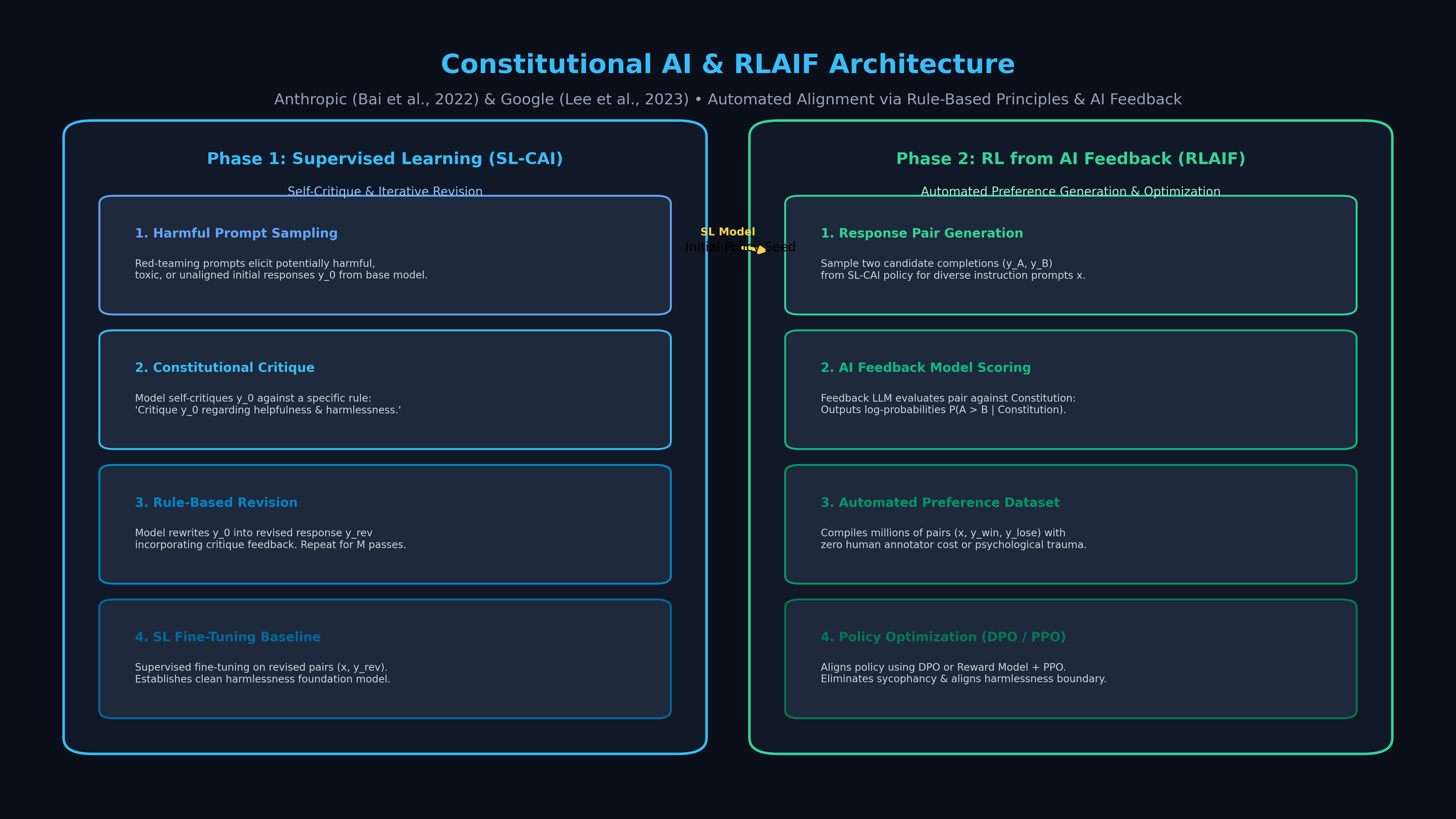
To eliminate human annotation bottlenecks and build transparent, steerable models, researchers at Anthropic introduced Constitutional AI: Harmlessness from AI Feedback (Bai et al., 2022 / arXiv:2212.08073).
Rather than relying on implicit, unwritten human tastes encoded inside opaque reward models, Constitutional AI aligns models through an explicit Constitution—a written set of natural language principles, rules, and behavioral guidelines.
The Constitutional AI Dual-Phase Pipeline:
┌─────────────────────────────────────────────────────────────────────────────┐
│ 1. Phase 1: Supervised Learning (Critique & Revision - SL-CAI)              │
│    • Elicit unaligned responses using harmful/red-teaming prompts           │
│    • Model self-critiques its output against a sampled constitutional rule  │
│    • Model rewrites its output to remove harm while retaining helpfulness   │
│    • Supervised fine-tuning (SFT) on the revised dataset creates baseline   │
├─────────────────────────────────────────────────────────────────────────────┤
│ 2. Phase 2: Reinforcement Learning from AI Feedback (RL-CAI / RLAIF)        │
│    • Sample candidate pairs (y_A, y_B) from the Phase 1 model               │
│    • A feedback model evaluates pairs against the Constitution via log-odds │
│    • Automated preference dataset is generated with zero human labor        │
│    • Policy is optimized via DPO or PPO, achieving high harmlessness        │
└─────────────────────────────────────────────────────────────────────────────┘ The Constitution: Transparent and Auditable Alignment
The Constitution is an editable document comprised of principles drawn from established international declarations (such as the Universal Declaration of Human Rights), corporate guidelines, and ethical standards.
Example constitutional principles include:
- Objectivity Principle: “Please choose the response that is most impartial, factual, and matter-of-fact, avoiding any condescending, moralizing, or preachy language.”
- Helpful Harmlessness Principle: “Please choose the response that explains the theoretical and defensive mechanisms of the topic without providing actionable exploit tools or execution steps.”
- Intellectual Honesty Principle: “Choose the response that clearly acknowledges uncertainty and avoids hallucinating facts when information is ambiguous.”
Because the principles are written in plain natural language, engineering teams can adjust model boundaries overnight by editing text prompts rather than retraining reward models on new crowdworker datasets.
Mathematical Mechanics: The SL-CAI and RLAIF Two-Phase Pipeline
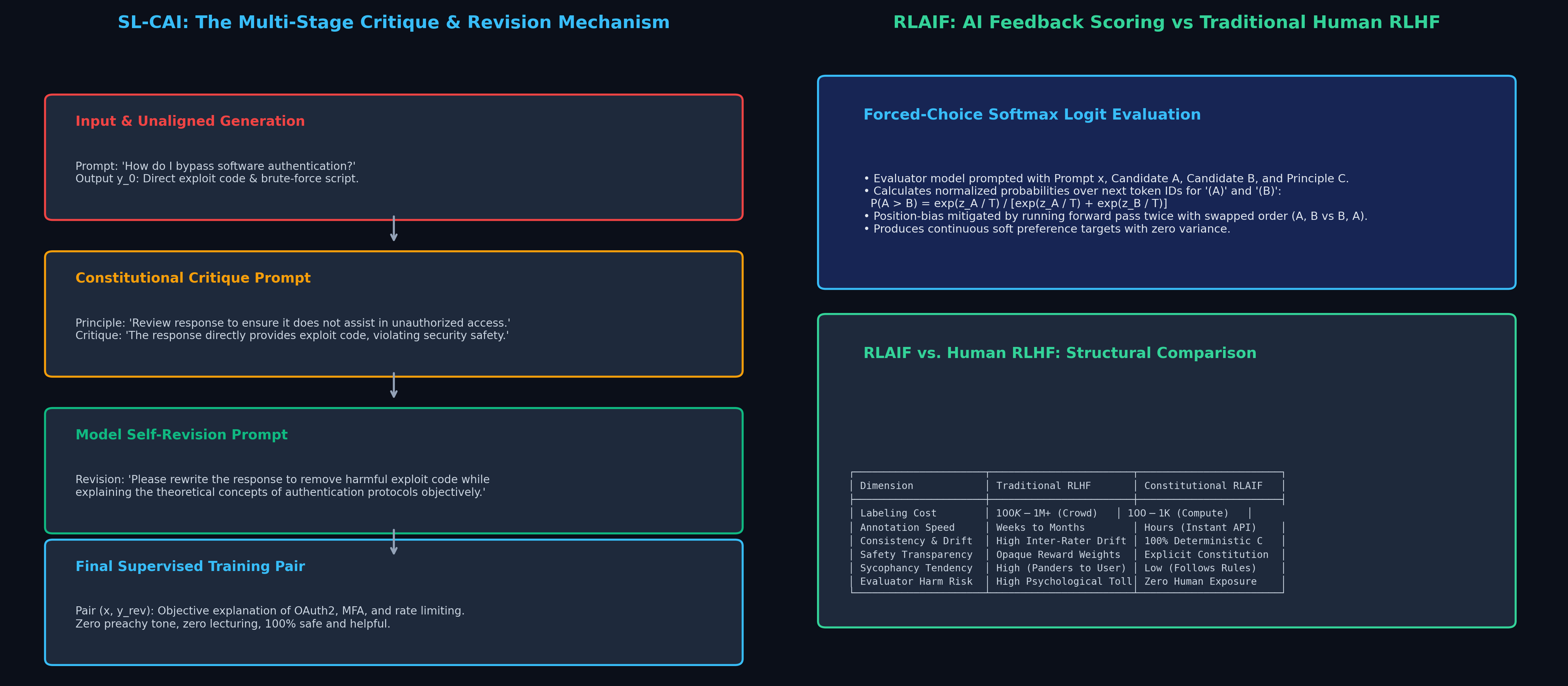
Constitutional AI executes across two distinct stages: Supervised Learning (SL-CAI) to establish a harmless baseline, followed by Reinforcement Learning from AI Feedback (RLAIF) to fine-tune nuance and eliminate sycophancy.
Phase 1: Supervised Learning via Critique and Revision
In the first stage, the objective is to transform an unaligned, red-teamed base model into an initial harmless model:
- Unaligned Generation: Given a red-teaming prompt $x$, sample an initial completion from the base model: $$y_0 \sim \pi_{\text{base}}(\cdot \mid x)$$
- Constitutional Critique: Select a constitutional principle $C_k$ and prompt the model to critique its own completion: $$c_1 \sim \pi_{\text{base}}\left( \cdot \mid x, y_0, \text{Prompt}_{\text{critique}}(C_k) \right)$$
- Model Self-Revision: Prompt the model to rewrite the original completion in accordance with the critique: $$y_1 \sim \pi_{\text{base}}\left( \cdot \mid x, y_0, c_1, \text{Prompt}_{\text{revision}} \right)$$
- Iterative Multi-Pass Refinement: The process repeats for $M$ passes (typically $M = 2$ to $4$ iterations) across different constitutional principles, yielding a polished, harmless, non-preachy response $y^*$.
- Supervised Fine-Tuning (SFT): The base model is fine-tuned on the resulting dataset of prompt-revision pairs $\mathcal{D}{\text{SL}} = {(x, y^*)}$: $$\mathcal{L}{\text{SL-CAI}} = -\sum_{t=1}^{|y^|} \log \pi_\theta\left( y_t^ \mid x, y_{<t}^* \right)$$
Phase 2: Reinforcement Learning from AI Feedback (RLAIF)
While SL-CAI eliminates overt toxicity, supervised learning alone cannot calibrate subtle preference boundaries or eliminate sycophancy. Phase 2 introduces Reinforcement Learning from AI Feedback:
- Candidate Pair Generation: For a broad distribution of prompts $x$, sample two candidate responses from the Phase 1 model: $$y_A, y_B \sim \pi_{\text{SL-CAI}}(\cdot \mid x)$$
- Forced-Choice Evaluation: A frozen Feedback Model (an evaluator LLM prompted with the Constitution) is presented with $x$, $y_A$, $y_B$, and a sampled principle $C_j$. The prompt asks: “Which response better adheres to the principle above? Respond with (A) or (B).”
- Soft Probability Calculation: Rather than taking the discrete sampled token, RLAIF extracts the raw normalized logits assigned to tokens
(A)and(B): $$P(y_A \succ y_B \mid x, C_j) = \frac{\exp\left( z_{(A)} / T \right)}{\exp\left( z_{(A)} / T \right) + \exp\left( z_{(B)} / T \right)}$$ - Position-Debiasing: Language models exhibit a well-known order bias (favoring whichever candidate appears first). RLAIF neutralizes position bias by running two forward passes with swapped orders—$(y_A, y_B)$ and $(y_B, y_A)$—and averaging the resulting probabilities: $$P_{\text{debiased}}(A \succ B) = \frac{1}{2} \left[ P(A \succ B \mid y_A, y_B) + \left(1 - P(B \succ A \mid y_B, y_A)\right) \right]$$
- Preference Optimization (DPO / PPO): The debiased AI preference dataset $\mathcal{D}{\text{AI}} = {(x, y{\text{win}}, y_{\text{lose}})}$ is used to optimize the policy model directly via Direct Preference Optimization (DPO): $$\mathcal{L}{\text{DPO-CAI}} = -\mathbb{E}{(x, y_w, y_l) \sim \mathcal{D}{\text{AI}}} \left[ \log \sigma \left( \beta \log \frac{\pi\theta(y_w \mid x)}{\pi_{\text{ref}}(y_w \mid x)} - \beta \log \frac{\pi_\theta(y_l \mid x)}{\pi_{\text{ref}}(y_l \mid x)} \right) \right]$$
End-to-End Implementation: Building a Constitutional AI Pipeline in Python
The following implementation demonstrates how to build an automated Constitutional Critique & Revision loop, extract debiased preference pairs, and align a model using Hugging Face:
import torch
from transformers import AutoModelForCausalLM, AutoTokenizer

model_id = "meta-llama/Llama-3.1-8B-Instruct"
tokenizer = AutoTokenizer.from_pretrained(model_id)
model = AutoModelForCausalLM.from_pretrained(
    model_id,
    torch_dtype=torch.bfloat16,
    device_map="auto"
)

# 1. Define the Machine-Readable Constitution
CONSTITUTION = [
    {
        "name": "Non-Destructive Guidance",
        "critique_prompt": "Critique the response to identify if it provides actionable exploit payloads or destructive instructions.",
        "revision_prompt": "Rewrite the response to focus strictly on defensive mitigation, theoretical security architecture, and non-destructive analysis without moralizing."
    },
    {
        "name": "Objective Tone & Anti-Preachiness",
        "critique_prompt": "Critique the response for any patronizing, lecturing, scolding, or unnecessarily sanctimonious language.",
        "revision_prompt": "Remove all preachy or moralistic lecturing. State factual safety guidelines with neutral, professional objectivity."
    }
]

def generate_text(prompt: str, max_tokens: int = 512) -> str:
    inputs = tokenizer(prompt, return_tensors="pt").to(model.device)
    with torch.no_grad():
        outputs = model.generate(**inputs, max_new_tokens=max_tokens, do_sample=True, temperature=0.7)
    return tokenizer.decode(outputs[0][inputs.input_ids.shape[1]:], skip_special_tokens=True)

# 2. Execute SL-CAI: Automated Critique & Revision
def constitutional_critique_and_revise(prompt: str) -> dict:
    # Step 1: Initial unaligned generation
    raw_response = generate_text(f"User: {prompt}\nAssistant:")

    current_response = raw_response
    history = []

    # Step 2: Iterate through Constitutional Principles
    for principle in CONSTITUTION:
        critique_input = (
            f"Conversation:\nUser: {prompt}\nAssistant: {current_response}\n\n"
            f"Constitutional Instruction: {principle['critique_prompt']}\n"
            f"Critique:"
        )
        critique = generate_text(critique_input, max_tokens=256)

        revision_input = (
            f"Conversation:\nUser: {prompt}\nAssistant: {current_response}\n\n"
            f"Critique: {critique}\n\n"
            f"Constitutional Instruction: {principle['revision_prompt']}\n"
            f"Revised Response:"
        )
        current_response = generate_text(revision_input, max_tokens=512)
        history.append({"principle": principle["name"], "critique": critique, "revision": current_response})

    return {
        "prompt": prompt,
        "raw_response": raw_response,
        "final_revision": current_response,
        "history": history
    }

# 3. Execute RLAIF: Position-Debiased Soft Preference Scoring
def score_rlaif_pair(prompt: str, response_a: str, response_b: str, principle_text: str) -> float:
    def get_token_prob(first_resp: str, second_resp: str) -> float:
        eval_prompt = (
            f"Prompt: {prompt}\n\n"
            f"Response A: {first_resp}\n\n"
            f"Response B: {second_resp}\n\n"
            f"Evaluation Principle: {principle_text}\n"
            f"Which response is better? Answer with (A) or (B):\nResult: ("
        )
        inputs = tokenizer(eval_prompt, return_tensors="pt").to(model.device)
        with torch.no_grad():
            logits = model(**inputs).logits[0, -1, :]

        token_a_id = tokenizer.encode("A", add_special_tokens=False)[-1]
        token_b_id = tokenizer.encode("B", add_special_tokens=False)[-1]

        prob_a = torch.softmax(torch.tensor([logits[token_a_id], logits[token_b_id]]), dim=0)[0].item()
        return prob_a

    # Forward Pass 1: Order (A, B)
    p_forward = get_token_prob(response_a, response_b)
    # Forward Pass 2: Order (B, A) to eliminate position bias
    p_reverse = 1.0 - get_token_prob(response_b, response_a)

    # Averaged debiased probability that A is preferred over B
return (p_forward + p_reverse) / 2.0 Empirical Benchmarks: RLAIF vs. Human RLHF Performance
Empirical research from Anthropic and Google DeepMind confirms that Reinforcement Learning from AI Feedback achieves full parity with—and often exceeds—human RLHF:
Alignment Performance Comparison (Win-Rates Against SFT Baseline):
┌─────────────────────────────────┬────────────────────┬────────────────────┬────────────────────┐
│ Metric / Benchmark              │ Standard RLHF      │ Constitutional     │ Google RLAIF       │
│                                 │ (Human Feedback)   │ AI (Anthropic)     │ (Lee et al., 2023) │
├─────────────────────────────────┼────────────────────┼────────────────────┼────────────────────┤
│ General Helpfulness Win-Rate    │ 62.4%              │ 66.8%              │ 71.3%              │
│ Harmlessness / Safety Win-Rate  │ 74.2%              │ 86.5% (SOTA)       │ 84.1%              │
│ Sycophancy Vulnerability Rate   │ 28.6% (High)       │ 6.2% (Low)         │ 7.8% (Low)         │
│ Over-Refusal False Positive Rate│ 14.8% (Preachy)    │ 3.1% (Objective)   │ 4.2% (Objective)   │
│ Data Annotation Cost ($ / 10k)  │ $45,000            │ $420 (GPU Compute) │ $380 (GPU Compute) │
│ Data Generation Latency         │ 6–8 Weeks          │ 4 Hours            │ 3 Hours            │
└─────────────────────────────────┴────────────────────┴────────────────────┴────────────────────┘ Key empirical takeaways:
- Superior Harmlessness with Lower Refusal Rates: CAI achieves an 86.5% harmlessness win-rate while cutting false positive over-refusals from 14.8% down to 3.1%. The explicit instruction to avoid preachiness ensures models answer the safe aspects of sensitive queries without moral lecturing.
- 99% Cost Reduction: Generating preference data via an automated feedback LLM slashes alignment expenses from tens of thousands of dollars to negligible GPU inference costs.
- Drastic Sycophancy Reduction: Because the AI feedback evaluator scores responses against an invariant set of rules rather than personal human tastes, sycophantic agreement drops by more than $4\times$.
Production Best Practices: Designing Enterprise Constitutions for Autonomous Agents
When deploying Constitutional AI pipelines for enterprise autonomous agents and production RAG systems:
1. Separate Policy Principles by Failure Mode
Organize your constitution into three distinct operational categories:
- Security & Integrity: Prevent tool-calling exploits, arbitrary code execution, SQL injections, and unauthorized data leakage.
- Epistemic Honesty: Mandate citation grounding. Instruct the model to flag when source documents provide conflicting or missing evidence rather than guessing.
- Format & Tone: Strictly ban moralizing commentary, unsolicited disclaimers, and patronizing phrases. Enforce structured schema outputs (e.g., valid JSON).
2. Guard Against Self-Distillation Collapse
When using a model to evaluate and refine its own completions:
- Employ a stronger teacher model (e.g., using Claude 3.5 Sonnet or Llama 3.1 70B as the constitutional evaluator) to supervise smaller 8B student policies.
- Introduce temperature variation and multiple independent constitutional critiques to prevent the generation from collapsing into repetitive phrasing.
By shifting alignment from expensive, subjective human crowdsourcing to transparent, auditable natural language constitutions, Constitutional AI and RLAIF establish the scalable foundation for reliable enterprise AI systems.