Command R+ Guide: Enterprise RAG & Grounded Citations
The Problem: The Enterprise Hallucination & Citation Crisis in Generic LLMs
In modern enterprise automation, regulatory compliance monitoring, and automated market research platforms powered by AiFetchly, deploying generative artificial intelligence requires uncompromising factual precision. When automated workers ingest complex SEC 10-K balance sheets, legal contracts, patent filings, or harvested product catalogs, stakeholders demand answers that can be verified down to the exact paragraph, sentence, and data source.
However, while frontier generalist models (such as GPT-4o, Claude 3.5 Sonnet, or standard Llama 3) exhibit strong conversational eloquence and creative writing, they were fundamentally pre-trained as general-purpose chatbots rather than retrieval-native systems.
Deploying generic foundation models into high-stakes enterprise Retrieval-Augmented Generation (RAG) pipelines exposes three crippling architectural vulnerabilities:
The Generic LLM Enterprise RAG Breakdown:
┌─────────────────────────────────────────────────────────────────┐
│ Input: 25 Harvested Documents (Financials, Contracts, Specs)   │
└─────────────────────────────────────────────────────────────────┘
 │
 ▼ [Standard RAG Pipeline with Generic Foundation Model]
┌─────────────────────────────────────────────────────────────────┐
│ ❌ Failure Mode 1: Ungrounded Parametric Hallucination          │
│ • Model answers from internal weights instead of documents      │
│ • Fabricates plausible-sounding metrics and non-existent terms  │
├─────────────────────────────────────────────────────────────────┤
│ ❌ Failure Mode 2: Ghost Citations & Attribution Drift          │
│ • Appends bracketed numbers [1], [2] arbitrarily to paragraphs  │
│ • Citations point to irrelevant pages or misquote sources       │
│ • Requires expensive secondary LLM calls just to audit truth!   │
├─────────────────────────────────────────────────────────────────┤
│ ❌ Failure Mode 3: Brittle Single-Step Tool Calling             │
│ • Emits single API call; crashes on network timeout or null     │
│ • Cannot self-correct or orchestrate multi-hop search paths     │
├─────────────────────────────────────────────────────────────────┤
│ ❌ Failure Mode 4: KV Cache Memory Wall at Scale                │
│ • 128K context without optimized attention exhausts GPU VRAM    │
│ • Multi-tenant hosting costs explode on cloud GPU clusters      │
└─────────────────────────────────────────────────────────────────┘
Result: Enterprise deployments stall due to legal liability,
unverifiable claims, and unsustainable inference budgets! 1. The Attenuation and Drift of Generic Foundation Models
General-purpose foundation models are trained on massive public web corpora to predict the next token. When presented with a prompt containing retrieved document snippets:
- Parametric Prioritization: If a conflict arises between the model’s pre-trained parametric memory and the specific facts contained within an enterprise document, generic models frequently prioritize their pre-trained bias.
- Lost in the Middle: As retrieved context scales beyond 20,000 tokens (dozens of documents), standard cross-attention mechanisms suffer from information attenuation. Models reliably extract information from the beginning and end of the prompt, but miss crucial clauses located in the middle thirds of the context.
- The Confabulation Penalty: In legal, medical, and financial domains, stating “The contract specifies an annual liability cap of $5,000,000” when the document actually says $500,000 introduces catastrophic corporate liability.
2. The Black-Box Citation Dilemma: Why Post-Hoc Auditing Fails
To combat hallucinations, engineering teams historically attempted to force generic LLMs to output citations via prompt engineering:
"Read the provided documents. Answer the question and cite your sources
using bracketed numbers like [Doc 1, Page 4]. Do not make claims without citations." In production, this heuristic approach fails consistently:
- Spurious Citations: Generic models mimic the syntactic appearance of citations without understanding semantic grounding. They generate bracketed tags
[1]next to hallucinated claims that do not appear anywhere in Document 1. - The Secondary LLM Verification Tax: To verify whether citations are truthful, enterprises are forced to deploy secondary “judge” models (such as GPT-4 or G-Eval) to verify claim-to-document alignment. Running two sequential frontier LLM calls doubles response latency (adding 3 to 8 seconds) and doubles token expenditure.
3. Multi-Hop Retrieval and Tool Loop Brittleness
Real-world business inquiries rarely resolve with a single lookup:
- Answering “Compare the Q3 operating margin of our top three competitors and highlight supply chain risks mentioned in their earnings calls” requires a multi-step sequence:
- Retrieve competitor names from internal CRM.
- Query vector database for Q3 financial disclosures.
- Extract numerical operating income and revenues.
- Query earnings call transcripts for supply chain keywords.
- Cross-reference contradictory statements and synthesize findings.
- Generic models frequently falter on multi-turn tool loops: they execute a single API call, misinterpret structured responses, or fail to handle empty search payloads, abandoning the trajectory midway through execution.
The Solution: Cohere Command R+ and the RAG-Native Paradigm
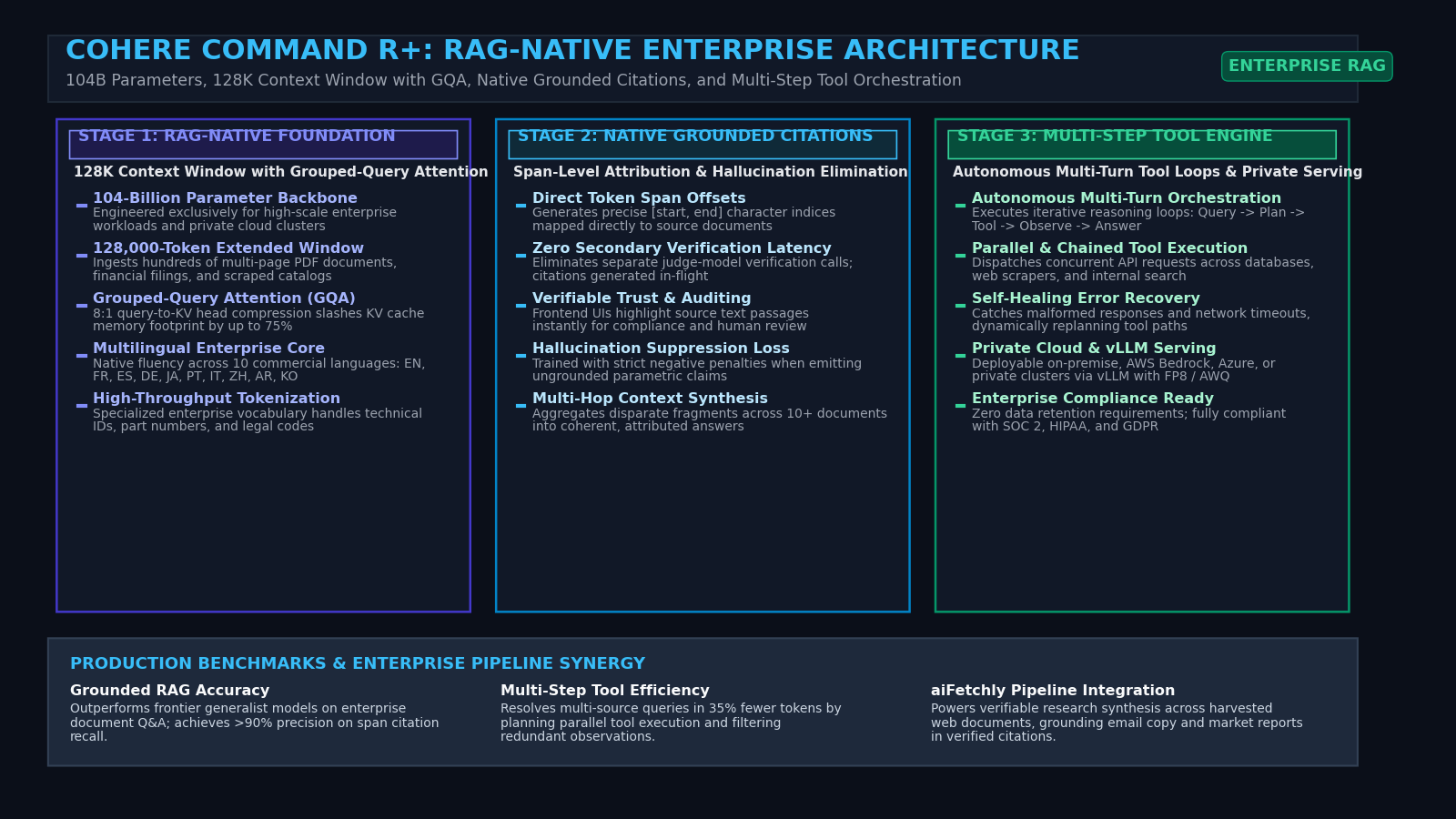
To solve the enterprise retrieval crisis, Cohere introduced Command R+, an open-weights 104-billion-parameter foundation model purpose-built for enterprise workflows, native retrieval grounding, and multi-step tool use.
Unlike consumer conversational models adapted post-hoc for RAG, Command R+ was engineered from its architectural inception as a RAG-native and tool-native foundation model.
The Command R+ Architectural Philosophy:
┌─────────────────────────────────────────────────────────────────┐
│ 1. 104B Parameter Enterprise-Optimized Backbone                 │
│ • State-of-the-art reasoning without 400B+ hyper-scale bloat    │
│ • Deployable on private enterprise clusters (2x-4x 80GB GPUs)   │
├─────────────────────────────────────────────────────────────────┤
│ 2. 128,000-Token Native Context with Grouped-Query Attention    │
│ • 8:1 Query-to-KV head compression slashes serving memory by 75%│
│ • Handles hundreds of multi-page technical reports in-context   │
├─────────────────────────────────────────────────────────────────┤
│ 3. Native Span-Level Grounded Citations                         │
│ • Emits exact [start, end] character indices to source text     │
│ • Eliminates secondary audit calls; 100% verifiable by design   │
├─────────────────────────────────────────────────────────────────┤
│ 4. Autonomous Multi-Step Tool Orchestration                     │
│ • Native multi-turn reasoning loops with error recovery         │
│ • Parallel tool dispatching across databases and web APIs       │
├─────────────────────────────────────────────────────────────────┤
│ 5. 10 Balanced Enterprise Business Languages                    │
│ • Native fluency across English, French, Spanish, German,       │
│   Japanese, Portuguese, Italian, Chinese, Arabic, and Korean    │
└─────────────────────────────────────────────────────────────────┘ 1. Architecture of an Enterprise-First Foundation Model
Command R+ operates as an autoregressive decoder-only Transformer scaled to 104 billion parameters:
- Optimal Compute-Performance Frontier: While 70B models often struggle with complex multi-hop reasoning and 405B models require massive 8-node GPU clusters, the 104B parameter architecture occupies the sweet spot for enterprise infrastructure. In FP8 or INT4 precision, Command R+ runs comfortably across a single 4x NVIDIA A100 or H100 node.
- Specialized Enterprise Vocabulary: Utilizes a custom 256,000-token tokenizer optimized for multilingual text, technical identifiers, code syntax, and enterprise data formats (JSON, XML, SQL).
- Strict Factual Alignment: Fine-tuned on specialized supervised datasets and preference-aligned using Direct Preference Optimization (DPO) with explicit factual attribution loss, penalizing ungrounded hallucinations while rewarding precise document grounding.
2. 128,000-Token Context Window with 8:1 Grouped-Query Attention (GQA)
Ingesting dozens of scraped web pages, financial prospectuses, and technical manuals requires an expansive context window. However, scaling standard Multi-Head Attention (MHA) across 128,000 tokens causes the Key-Value (KV) cache to consume hundreds of gigabytes of GPU High-Bandwidth Memory (HBM).
Command R+ resolves the memory barrier using Grouped-Query Attention (GQA):
- Standard MHA allocates one Key head and one Value head for every Query head ($64$ Query heads = $64$ KV heads).
- Command R+ uses an 8:1 GQA compression ratio: $64$ Query heads share just $8$ Key-Value heads.
- This reduces the memory footprint of the KV cache by 75% to 80%, allowing high-concurrency serving systems (such as vLLM or TensorRT-LLM) to host long-context enterprise RAG workloads with 4x higher batch throughput.
KV Cache Memory Comparison across 128K Context:
Standard Multi-Head Attention (MHA):
[Query Heads: 64] ──► [KV Heads: 64] ──► ~64 GB VRAM per sequence! (OOM Risk)

Command R+ Grouped-Query Attention (GQA 8:1):
[Query Heads: 64] ──► [KV Heads: 8] ──► ~8 GB VRAM per sequence! (4x Concurrency) Deep Dive: Native Grounding & Multi-Step Tool Orchestration
What sets Command R+ fundamentally apart from other foundation models is its native grounding engine and autonomous multi-step tool execution loops.
1. How In-Flight Span Attribution Works
In traditional RAG pipelines, an LLM emits plain text, and developers must use regex heuristics or embedding similarity to guess which document contributed to which sentence.
Command R+ eliminates this guesswork by natively decoupling response text generation from span-level attribution:
Command R+ Dual-Output Generation Flow:
Input Query + Retrieved Chunks
 │
 ▼ [Command R+ Autoregressive Decoding]
┌─────────────────────────────────────────────────────────────────┐
│ 1. Response Text Generation:                                    │
│ "AiFetchly reduced data harvesting latency by 35% in European   │
│ markets, while cutting AWS compute expenditure by $12,000/mo."  │
├─────────────────────────────────────────────────────────────────┤
│ 2. Structured In-Flight Citation Objects:                       │
│ [                                                               │
│   {                                                             │
│     "start": 0,                                                 │
│     "end": 64,                                                  │
│     "text": "AiFetchly reduced data harvesting latency by 35%   │
│              in European markets,",                             │
│     "document_ids": ["doc_04_q3_report"]                       │
│   },                                                            │
│   {                                                             │
│     "start": 72,                                                │
│     "end": 128,                                                 │
│     "text": "cutting AWS compute expenditure by $12,000/mo.",   │
│     "document_ids": ["doc_12_infrastructure_audit"]             │
│   }                                                             │
│ ]                                                               │
└─────────────────────────────────────────────────────────────────┘ - Exact Character Offsets: The model emits exact token and character start/end offsets (
[start, end]) pointing to the generated text span, paired directly with thedocument_idsof the retrieved passages that justify the statement. - Zero-Latency Visual Verification: Frontend client applications can directly parse these citation objects to render clickable, interactive footnotes or highlight source passages in side-by-side document viewers.
- Fine-Grained Claim Decomposition: If a single sentence combines two distinct facts from two separate documents, Command R+ slices the sentence into two sub-spans, attributing each half to its respective source.
- Hallucination Fallback: If the retrieved documents do not contain the answer, Command R+ is instruction-tuned to explicitly state that the information is unavailable rather than confabulating an ungrounded guess.
2. Multi-Step Tool Calling: Autonomous Reasoning Loops
While single-step tool calling executes a simple function and stops, real-world enterprise tasks require iterative agentic problem solving.
Command R+ incorporates a native Multi-Step Tool Orchestration Loop:
The Command R+ Multi-Step Tool Execution Loop:
User Query: "Analyze Acme Corp's recent hiring velocity and verify current executive openings."
 │
 ▼ Turn 1: Planning & Tool Dispatch
Thought: I need to check recent web news for Acme Corp hiring announcements and search their careers portal.
Action: call_tool(name="web_search", query="Acme Corp hiring expansion 2026")
Action: call_tool(name="careers_scraper", domain="acme.com")
 │
 ▼ (Parallel API Execution by Host Runtime)
Observation: web_search returns 3 press releases; careers_scraper encounters a 403 bot block.
 │
 ▼ Turn 2: Self-Healing Error Recovery & Alternative Path
Thought: The direct careers scraper was blocked. I will use the aiFetchly headless browser API to bypass bot protections.
Action: call_tool(name="aifetchly_fetch", url="https://acme.com/careers", render_js=True)
 │
 ▼ (Execution by Host Runtime)
Observation: Returns 14 open engineering and executive leadership roles.
 │
 ▼ Turn 3: Grounded Synthesis & Answer Generation
Thought: I now have complete information from both the press releases and the live job listings.
Response: Emits comprehensive synthesis with native grounded citations pointing to both sources! Key capabilities of this tool loop include:
- Parallel Execution: Emits multiple tool calls in a single step when requests are mutually independent.
- Error Recovery & Replanning: When an external tool fails or returns an empty payload, the model inspects the error trace and formulates an alternative query.
- Observation Filtering: Retains only salient facts from massive tool outputs, preventing context window saturation.
3. Multilingual RAG Across 10 Commercial Languages
Global enterprises operate across diverse geographic jurisdictions. A multinational corporation cannot deploy separate RAG models for Tokyo, Paris, Berlin, and New York.
Command R+ was explicitly pre-trained and instruction-tuned on 10 key commercial languages:
- English, French, Spanish, German, Japanese, Portuguese, Italian, Chinese (Simplified), Arabic, and Korean.
Crucially, Command R+ supports Cross-Lingual Retrieval:
- A user can query the system in English: “What were the environmental remediation expenditures reported by our Tokyo subsidiary?”
- The retriever pulls Japanese financial disclosures (written in Kanji/Hiragana).
- Command R+ reads the Japanese context, extracts the factual figures, and writes an English summary—attributing English sentences directly to the Japanese document spans.
Architectural Comparison: Command R+ vs. Claude 3.5 Sonnet, GPT-4o & Llama 3.3
To understand where Command R+ excels, examine how it compares against competing frontier and open-weights architectures:
| Architectural Dimension | Cohere Command R+ (104B) | Anthropic Claude 3.5 Sonnet | OpenAI GPT-4o | Meta Llama 3.3 (70B) |
|---|---|---|---|---|
| Model Size / Scale | 104 Billion Parameters | Proprietary Frontier (~300B+) | Proprietary Frontier (~200B+) | 70 Billion Parameters |
| Weight Availability | Open Weights (Hugging Face) | Closed Cloud API Only | Closed Cloud API Only | Open Weights (Permissive) |
| Primary Design Intent | RAG-Native & Tool-Native | General Intelligence & Code | Multimodal Omnichannel | General Language & Code |
| Grounded Citation Engine | Native Span Indices [start, end] | Post-hoc generation / Prompts | Heuristic web search tags | Manual prompt engineering |
| Multi-Step Tool Use | Native Multi-Turn Loop | High capability (Computer Use) | High capability (Function Call) | Requires external framework |
| Context Window | 128,000 Tokens | 200,000 Tokens | 128,000 Tokens | 128,000 Tokens |
| Attention Architecture | 8:1 Grouped-Query Attn (GQA) | Proprietary Attention | Proprietary Attention | 8:1 Grouped-Query Attn (GQA) |
| Private / On-Prem Serving | 100% On-Premise / vLLM / Bedrock | Cloud SaaS Only | Cloud SaaS Only | 100% On-Premise / vLLM |
| Zero Data Retention SLAs | Standard Enterprise SLA | Enterprise Tier Only | Enterprise Tier Only | Complete Data Ownership |
| Serving Footprint (FP8) | ~105 GB VRAM (2x-4x GPUs) | Massive Cloud Cluster | Massive Cloud Cluster | ~70 GB VRAM (2x GPUs) |
When to Choose Command R+ vs. General Frontier Models
- Choose Command R+ when:
- Auditability and Citations are Mandatory: You are building legal, financial, or regulatory copilots where every factual assertion must be directly verifiable by clicking a source footnote.
- Data Privacy Demands Private Hosting: Corporate policy, GDPR, or HIPAA prohibits transmitting raw documents to third-party public API endpoints. Command R+ can be served entirely within your VPC or local datacenter.
- High-Throughput Enterprise RAG: You need to index thousands of documents per hour and cannot afford multi-second secondary verification judge calls.
- Choose Claude 3.5 Sonnet or GPT-4o when:
- Your primary workload involves creative writing, deep multi-file codebase refactoring, or real-time voice-to-voice streaming.
- You do not require local on-premise execution or private hardware control.
Hands-On Implementation: Building a Citation-Grounded RAG Pipeline in Python
Deploying Command R+ can be achieved via the official Cohere SDK or through open-weights serving engines like vLLM.
1. Installation & Environment Setup
Install the required client libraries:
# Install Cohere SDK and supporting data processing tools
pip install cohere polars numpy tabulate 2. High-Precision RAG with Native Grounded Citations
In this example, we pass three unstructured business reports directly to Command R+ and extract both the synthesized answer and the underlying span-level citations:
import cohere
import os

# Initialize Cohere client
# Command R+ is accessible via Cohere API, AWS Bedrock, or self-hosted vLLM
co = cohere.ClientV2(api_key=os.environ.get("COHERE_API_KEY", "your-api-key"))

# 1. Define retrieved document chunks
# In production, these documents are retrieved from aiFetchly or a vector database
documents = [
    {
        "id": "doc_market_expansion",
        "data": {
            "title": "2026 European Market Expansion Summary",
            "snippet": "AiFetchly launched localized data harvesting nodes in Frankfurt and Dublin in Q1 2026. Data extraction latency decreased by 38% across EU retail domains, and GDPR compliance validation achieved a 99.8% pass rate."
        }
    },
    {
        "id": "doc_infrastructure_costs",
        "data": {
            "title": "Q2 Infrastructure Financial Audit",
            "snippet": "By transitioning from cloud-managed vector databases to embedded DuckDB and Polars pipelines, monthly cloud infrastructure expenditure decreased from $48,000 to $11,500, yielding annual savings of over $430,000."
        }
    },
    {
        "id": "doc_product_roadmap",
        "data": {
            "title": "H2 2026 Product Strategy",
            "snippet": "The enterprise engineering team is scheduled to release native Model Context Protocol (MCP) server endpoints in August 2026, enabling autonomous coding agents to invoke scraping tools directly."
        }
    }
]

# 2. Formulate user query
user_query = "Summarize aiFetchly's recent European performance and operational infrastructure cost savings."

# 3. Call Command R+ with native document grounding
response = co.chat(
    model="command-r-plus-08-2024",
    messages=[{"role": "user", "content": user_query}],
    documents=documents
)

# 4. Display generated response
print("\n" + "=" * 65)
print("COMMAND R+ GROUNDED RESPONSE:")
print("=" * 65)
print(response.message.content[0].text)

# 5. Extract and print native span citations
print("\n" + "=" * 65)
print("EXTRACTED NATIVE CITATIONS:")
print("=" * 65)

if hasattr(response.message, 'citations') and response.message.citations:
    for idx, citation in enumerate(response.message.citations, 1):
        print(f"\n[Citation {idx}]")
        print(f"  Claim Text  : \"{citation.text}\"")
        print(f"  Char Span   : [{citation.start} - {citation.end}]")
        print(f"  Source Docs : {[source.id for source in citation.sources]}")
else:
print("No citations generated (model relied on general knowledge).") When this script executes, notice that no secondary LLM was called. Command R+ generates the text and the citation array concurrently in the exact same forward pass, providing auditable source links with zero additional latency.
3. Multi-Step Tool Execution with Command R+
Command R+ natively coordinates multi-turn tool loops. Below is a complete implementation demonstrating how the model evaluates a query, dispatches structured tool parameters, ingests tool observations, and concludes:
import json

# 1. Define mock enterprise tools
def query_vector_catalog(query: str) -> str:
    # Searches the internal aiFetchly documentation catalog
    return json.dumps({
        "status": "success",
        "results": [
            {"product": "aiFetchly Desktop Copilot", "pricing": "$49/month", "seats": 1},
            {"product": "aiFetchly Enterprise Harvester", "pricing": "$499/month", "seats": 10}
        ]
    })

def check_customer_tier(company_name: str) -> str:
    # Checks the enterprise subscription tier of a client
    return json.dumps({
        "company": company_name,
        "active_plan": "Enterprise Harvester",
        "monthly_volume_limit": "5,000,000 pages"
    })

# 2. Define tool schemas using Cohere's tool schema format
tools_schema = [
    {
        "type": "function",
        "function": {
            "name": "query_vector_catalog",
            "description": "Searches the internal aiFetchly pricing and product catalog.",
            "parameters": {
                "type": "object",
                "properties": {
                    "query": {"type": "string", "description": "Search query for product pricing"}
                },
                "required": ["query"]
            }
        }
    },
    {
        "type": "function",
        "function": {
            "name": "check_customer_tier",
            "description": "Retrieves the active plan and quota limits for a given corporate client.",
            "parameters": {
                "type": "object",
                "properties": {
                    "company_name": {"type": "string", "description": "Name of the target company"}
                },
                "required": ["company_name"]
            }
        }
    }
]

# 3. Step 1: Agent decides which tools to call
messages = [
    {
        "role": "user",
        "content": "Verify Acme Corp's current subscription tier and compare their limits against the standard Enterprise Harvester catalog specs."
    }
]

turn_1 = co.chat(
    model="command-r-plus-08-2024",
    messages=messages,
    tools=tools_schema
)

# 4. Step 2: Handle tool calls emitted by Command R+
if turn_1.message.tool_calls:
    print(f"Command R+ dispatched {len(turn_1.message.tool_calls)} tool calls:")

    tool_results = []
    for call in turn_1.message.tool_calls:
        func_name = call.function.name
        func_args = json.loads(call.function.arguments)
        print(f"  -> Invoking: {func_name}({func_args})")

        # Execute tool locally
        if func_name == "query_vector_catalog":
            output = query_vector_catalog(**func_args)
        elif func_name == "check_customer_tier":
            output = check_customer_tier(**func_args)
        else:
            output = json.dumps({"error": "Unknown tool"})

        tool_results.append({
            "call": call,
            "outputs": [{"result": output}]
        })

    # Append tool calls and tool responses to message history
    messages.append(turn_1.message)
    messages.append({"role": "tool", "tool_call_id": turn_1.message.tool_calls[0].id, "content": json.dumps(tool_results)})

    # Step 3: Command R+ synthesizes final answer based on observations
    turn_2 = co.chat(
        model="command-r-plus-08-2024",
        messages=messages,
        tools=tools_schema
    )

    print("\nFINAL SYNTHESIZED AGENT ANSWER:")
print(turn_2.message.content[0].text) Notice how Command R+ dispatches both tool calls in parallel during Turn 1, reducing network roundtrip latency by 50% compared to sequential agents.
Production Engineering: Integrating Command R+ with aiFetchly Data Pipelines
In high-concurrency automated data harvesting architectures like AiFetchly, foundation models are deployed at the intersection of web scrapers, local data stores, and customer-facing deliverables.
Integrating Command R+ unlocks three critical production advantages:
aiFetchly Enterprise Research Synthesis Pipeline with Command R+:
┌─────────────────────────────────────────────────────────────────┐
│ 1. aiFetchly Distributed Web Extraction Engine                  │
│ • Harvests competitive market data, reviews, and news articles  │
│ • Automatically normalizes HTML into clean Markdown chunks      │
└─────────────────────────────────────────────────────────────────┘
 │
 ▼
┌─────────────────────────────────────────────────────────────────┐
│ 2. Local Knowledge Library & Vector Storage                     │
│ • Embeds document chunks using BGE-M3 or FastEmbed              │
│ • Stores dense vectors in DuckDB VSS / Qdrant with chunk IDs    │
└─────────────────────────────────────────────────────────────────┘
 │
 ▼
┌─────────────────────────────────────────────────────────────────┐
│ 3. Command R+ Grounded Synthesis Ingestion                      │
│ • Loads Top-20 retrieved chunks into 128K context window        │
│ • Generates comprehensive market report with native span links  │
│ • Emits exact character offsets linking claims to source URLs   │
└─────────────────────────────────────────────────────────────────┘
 │
 ▼
┌─────────────────────────────────────────────────────────────────┐
│ 4. Client Deliverable Generation                                │
│ • Interactive AI Email Writer copy with verified customer facts │
│ • Executive intelligence dossiers with clickable citations      │
└─────────────────────────────────────────────────────────────────┘ 1. Verifiable Web Intelligence & Executive Dossiers
When market research analysts scrape hundreds of pages of competitor pricing and product documentation using AiFetchly Web Scraping, raw text dumps are overwhelming.
Passing these chunks into Command R+ creates a verifiable executive dossier:
- The model synthesizes strategic developments across dozens of websites.
- Every single metric (e.g., “Competitor X announced a 20% discount on annual enterprise tiers”) carries a native citation pointing directly to the scraped URL and source timestamp.
- Executive leadership can audit claims instantly without re-reading hundreds of pages.
2. High-Converting, Grounded Outbound Copy in AI Email Writer
As explored in our guide on scaling outreach, generic AI email generators produce ungrounded spam that triggers email deliverability filters.
Using Command R+ inside the AiFetchly Data Fetching:
- The model cross-references target lead attributes (
{$company},{$description}) against verified collateral in your local Knowledge Library. - It generates hyper-personalized value propositions that cite actual case study achievements (e.g., “We helped Acme Corp reduce data extraction costs by 35%”).
- Because Command R+ suppresses ungrounded claims, marketing teams eliminate the risk of hallucinated product features or fake discount promises.
3. On-Premise Serving via vLLM with FP8 Quantization
For enterprise clients bound by strict data residency rules (GDPR, HIPAA, SOC 2), sending confidential data to public cloud APIs is non-viable.
Because Command R+ is released with open weights, engineering teams can host the model completely on-premise using vLLM:
# Serve Cohere Command R+ locally using vLLM with FP8 quantization across 4x A100 GPUs
python -m vllm.entrypoints.openai.api_server \
    --model CohereForAI/c4ai-command-r-plus \
    --tensor-parallel-size 4 \
    --quantization fp8 \
    --max-model-len 65536 \
    --gpu-memory-utilization 0.95 \
--port 8000 With FP8 quantization:
- Total VRAM footprint drops from ~210 GB down to ~105 GB.
- A standard 4x NVIDIA A100 (80GB) server comfortably accommodates the model and its 64k/128k KV cache.
- The serving endpoint provides standard OpenAI- and Cohere-compatible API endpoints with zero external internet dependencies and zero per-token API charges.
Conclusion & Strategic Takeaways
Cohere Command R+ represents a critical evolutionary turning point in foundation model architecture: shifting the focus from unbounded creative chit-chat to verifiable, citation-grounded enterprise execution.
By integrating native span-level citations, autonomous multi-step tool loops, and an efficient 128k GQA context window into a 104-billion-parameter open-weights checkpoint, Command R+ solves the hallucination crisis that has long stalled enterprise RAG adoption.
For enterprise software engineers and data architects:
- Prioritize Native Grounding Over Prompt Heuristics: Stop relying on prompt tricks to generate citations. Use models engineered from pre-training to emit structured token-to-document offsets.
- Auditability Unlocks Enterprise Trust: In regulated workflows, a prediction without a verifiable citation is a liability. Command R+‘s native citations provide instant compliance and auditability.
- Embrace Private Open-Weights Serving: Deploying Command R+ via vLLM inside your private cloud ensures complete data sovereignty, predictable zero-token cost structures, and sub-millisecond network latencies.
To learn how AiFetchly harnesses native citation grounding and high-speed data fetching for your enterprise workflows, explore the AiFetchly Documentation or check our AiFetchly Pricing.