CogVideoX Architecture: 3D VAE & Expert DiT Video Guide
The Problem: The Spatiotemporal Dimensionality and Modality Collapse in Video AI
In modern generative artificial intelligence, autonomous market research, multimodal content pipelines, and automated intelligence tools powered by AiFetchly, foundation models have expanded from text processing and static 2D image synthesis into dynamic video generation. Transforming natural language prompts or static web assets into cinematic, high-definition videos enables automated product walkthroughs, animated tutorials, and immersive visual storytelling.
However, scaling video diffusion models has historically presented three severe engineering and algorithmic roadblocks: the spatiotemporal compute explosion, modality interference in transformer backbones, and temporal motion discontinuity.
The Video Foundation Model Bottlenecks:
┌────────────────────────────────────────────────────────┐
│ Bottleneck 1: Spatiotemporal Compute Explosion         │
│ • 10-second 1080p video at 60 FPS = 600 frames         │
│ • Over 1.2 Billion raw subpixels per video!            │
│ ❌ Standard quadratic self-attention O(N^2) crashes    │
│    modern 80GB H100 GPUs instantly with OutOfMemory!   │
├────────────────────────────────────────────────────────┤
│ Bottleneck 2: Modality Interference & Text Drift       │
│ • In standard DiTs, text and video share identical FFNs│
│ • Visual tokens outnumber text tokens 50:1             │
│ ❌ Textual semantic representations drift during       │
│    denoising, causing catastrophic prompt neglect!     │
├────────────────────────────────────────────────────────┤
│ Bottleneck 3: Frame-by-Frame Jitter & Future Leaks     │
│ • Applying 2D VAEs frame-by-frame creates flickering   │
│ • Non-causal 3D convolutions leak future frames back   │
│ ❌ Unnatural physical motion, morphing, and artifacts!  │
└────────────────────────────────────────────────────────┘
Result: Open-source video generation suffered from severe flickering and poor prompt alignment! 1. The Spatiotemporal Dimensionality Explosion
Video generation is exponentially more resource-intensive than static image synthesis:
- A $1024 \times 1024$ image contains approximately 1 million pixels.
- A 10-second video at $1920 \times 1080$ resolution and 60 frames per second contains 600 frames and over 1.2 billion subpixels.
- Computing standard full self-attention across uncompressed spatiotemporal patches scales with quadratic complexity ($O((T \cdot H \cdot W)^2)$). Even on datacenter GPUs with 80 GB of High-Bandwidth Memory (HBM), uncompressed video diffusion is computationally impossible.
- Models require aggressive spatial and temporal compression that preserves high-frequency edge details without sacrificing temporal motion continuity.
2. Modality Interference and Text Representation Drift
In first-generation Diffusion Transformers (DiTs):
- Models concatenate text embedding tokens with visual latent tokens and pass them through shared transformer layers.
- In video generation, visual patch tokens vastly outnumber prompt tokens (often exceeding a 50:1 ratio).
- As gradient updates pass through shared Feed-Forward Networks (FFNs), the overwhelming gradient magnitude of the visual tokens distorts and overwrites the semantic representations of the text prompt.
- Consequently, while the generated video may look photorealistic, it frequently ignores critical prompt instructions: failing on motion directions, object counts, and sequential narrative actions.
3. Temporal Motion Jitter and Causal Convolution Leaks
Early video diffusion systems adapted 2D image models by tacking on 1D temporal attention layers or compressing frames independently using 2D Variational Autoencoders (VAEs):
- Frame-by-Frame 2D VAEs: Compressing each frame in isolation discards temporal correlation, producing high-frequency flickering, color banding, and texture popping across consecutive frames.
- Non-Causal 3D VAEs: When temporal convolutions are non-causal, filters look both forward and backward in time. During generative inference, future frames are not yet available, leading to boundary artifacts and unnatural ghostly motion trails.
The Solution: CogVideoX’s 3D Causal VAE & Expert DiT Architecture
To dismantle these physical and architectural bottlenecks, Tsinghua University (THUDM) and Zhipu AI engineered CogVideoX, an open-source text-to-video foundation model family (spanning CogVideoX-2B, CogVideoX-5B, and the frontier CogVideoX1.5-5B).
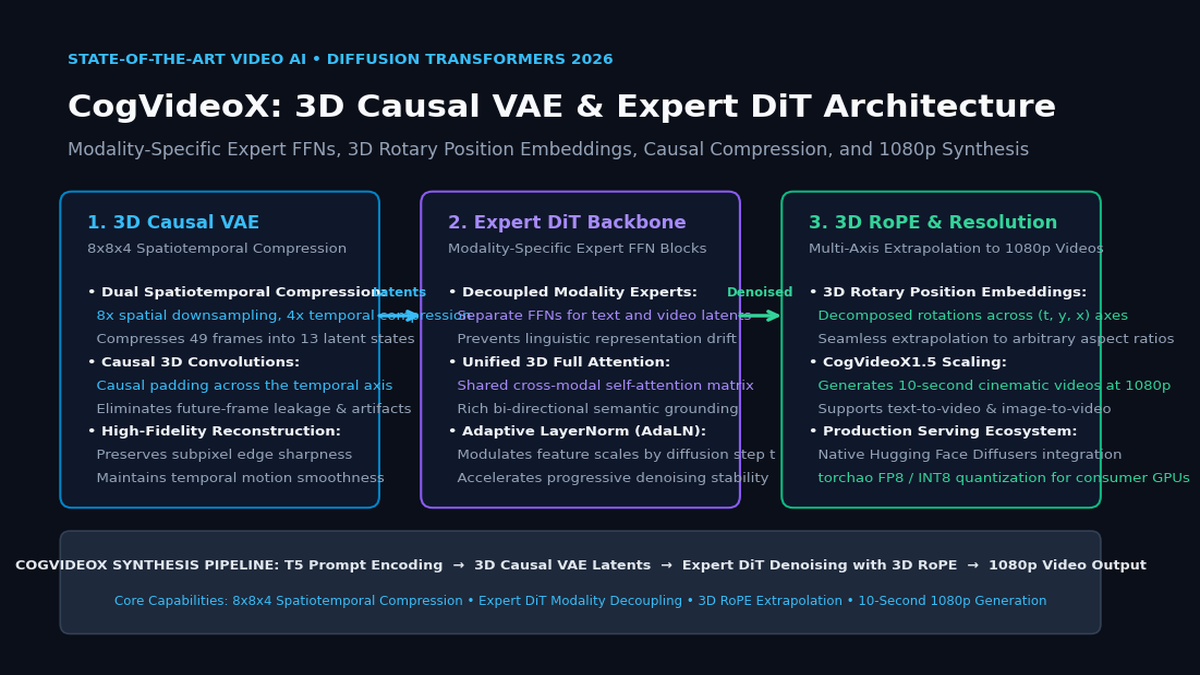
CogVideoX resolves the video generation crisis through three pioneering architectural breakthroughs: an $8 \times 8 \times 4$ 3D Causal VAE, an Expert Diffusion Transformer (Expert DiT) with decoupled modality-specific Feed-Forward Networks, and 3D Rotary Position Embeddings (3D RoPE).
CogVideoX End-to-End Synthesis Topology:
┌─────────────────────────────────────────────────────────────────────────┐
│ Input Prompt: "Cinematic drone shot orbiting a glass skyscraper..."      │
└────────────────────────────────────┬────────────────────────────────────┘
                                     │ (T5-XXL Text Encoder: Text Tokens T)
                                     ▼
┌─────────────────────────────────────────────────────────────────────────┐
│ 1. 3D Causal VAE Latent Space (8x8x4 Spatiotemporal Compression)        │
│ • Spatial Downsampling: 8x8 • Temporal Compression: 4x                  │
│ • Compresses 49 raw video frames into 13 latent states (Zero leakage!)  │
└────────────────────────────────────┬────────────────────────────────────┘
                                     │
                                     ▼ (Patchify & Concatenate: [T_text + V_video])
┌─────────────────────────────────────────────────────────────────────────┐
│ 2. Expert Diffusion Transformer (Expert DiT Backbone)                   │
│ • Shared 3D Full Self-Attention: Rich cross-modal bidirectional semantic│
│ • 3D RoPE: Independent frequency rotations along (t, y, x) axes         │
│ • Adaptive LayerNorm (AdaLN): Modulated by diffusion timestep t         │
└────────────────────────────────────┬────────────────────────────────────┘
                                     │
                    ┌────────────────┴────────────────┐
                    ▼                                 ▼
┌───────────────────────────────────────┐ ┌───────────────────────────────────────┐
│ Text Expert FFN Block                 │ │ Video Expert FFN Block                │
│ • Dedicated weights for text tokens   │ │ • Dedicated weights for visual latents│
│ • Completely prevents text drift!     │ │ • Specializes in physical dynamics    │
└───────────────────┬───────────────────┘ └───────────────────┬───────────────────┘
                    │                                         │
                    └────────────────────┬────────────────────┘
                                         ▼
┌─────────────────────────────────────────────────────────────────────────┐
│ 3. 3D Causal VAE Decoder & 1080p Generation                             │
│ • Causal temporal deconvolution restores smooth 60 FPS frame continuity │
│ • Generates up to 10-second cinematic videos at 1080p resolution        │
└─────────────────────────────────────────────────────────────────────────┘ The Architectural Pillars of CogVideoX
- 3D Causal VAE with $8 \times 8 \times 4$ Compression: CogVideoX compresses raw video tensors both spatially ($8\times$ downsampling on height and width) and temporally ($4\times$ compression along the frame axis). By utilizing causal 3D convolutions, each frame’s representation depends strictly on past and current frames, completely eliminating future-frame leakage while reducing the token sequence length by $256\times$.
- Expert Diffusion Transformer (Expert DiT): Unlike traditional DiTs that force text and visual latents through the same FFN parameters, CogVideoX introduces Modality-Specific Expert FFNs. Text tokens pass through a dedicated text FFN, while video tokens pass through a specialized video FFN. However, both modalities interact seamlessly within a shared 3D full attention layer, preserving semantic grounding without causing textual representation drift.
- 3D Rotary Position Embeddings (3D RoPE): Standard 1D or 2D position embeddings fail when modeling 3D spatiotemporal volumes. CogVideoX decomposes rotary positional encodings across three orthogonal dimensions: temporal frame index ($t$), spatial height ($y$), and spatial width ($x$). This enables zero-shot extrapolation to arbitrary video durations and custom aspect ratios.
- CogVideoX1.5 Frontier Scaling: The upgraded CogVideoX1.5-5B architecture extends generation capabilities to 10-second cinematic videos at 1080p resolution and 60 FPS, supporting both Text-to-Video (T2V) and Image-to-Video (I2V) with arbitrary starting frames.
Comparing Modern Video Generation Architectures
The table below contrasts CogVideoX against traditional 2D U-Net video models and dual-stream architectures like HunyuanVideo:
Video AI Architecture Comparison:
┌───────────────────────────┬───────────────────────────────┬───────────────────────────────┬───────────────────────────────┐
│ Dimension                 │ Legacy 2D U-Net (AnimateDiff) │ HunyuanVideo (Tencent)        │ CogVideoX (Zhipu / THUDM)     │
├───────────────────────────┼───────────────────────────────┼───────────────────────────────┼───────────────────────────────┤
│ Backbone Architecture     │ 2D U-Net + 1D Temporal Layers │ Dual-to-Single Stream DiT     │ Expert Diffusion Transformer  │
│ VAE Compression Ratio     │ 2D VAE (8x8x1, No Temporal)   │ 3D Causal VAE (8x8x4)         │ 3D Causal VAE (8x8x4)         │
│ Temporal Causality        │ ❌ None (Frame-by-frame)      │ ✅ Causal 3D Convolutions     │ ✅ Causal 3D Convolutions     │
│ Modality Handling         │ Cross-attention injection     │ Separate transformer streams  │ Shared Attention + Expert FFNs│
│ Text Representation Drift │ High (Ignored in late layers) │ Low (Isolated streams)        │ Zero (Dedicated Expert FFNs)  │
│ Positional Encoding       │ 1D Sinusoidal / RoPE          │ 3D RoPE                       │ 3D RoPE (t, y, x decoupled)   │
│ Parameter Scale           │ 1.5B–2B                       │ 13B                           │ 2B / 5B / 1.5-5B              │
│ Max Generation Spec       │ 2–4 seconds at 512p           │ 5 seconds at 720p/1080p       │ 10 seconds at 1080p (60 FPS)  │
│ Hardware Accessibility    │ Consumer GPUs (8 GB VRAM)     │ High-End Datacenter (80 GB)   │ Consumer & Pro (12 GB–24 GB)  │
└───────────────────────────┴───────────────────────────────┴───────────────────────────────┴───────────────────────────────┘ Deep Dive into CogVideoX Core Subsystems & Mathematical Formulation
To understand how CogVideoX delivers cinematic fidelity and robust prompt adherence, let’s explore its core mathematical subsystems: the 3D Causal VAE, the Expert DiT Layer Mechanics, and 3D Rotary Positional Embeddings.
CogVideoX Internal Subsystems:
CogVideoX
 ├──► 1. 3D Causal VAE: 8x8x4 spatiotemporal downsampling with causal temporal padding
 ├──► 2. Expert DiT Block: Shared 3D attention + Decoupled Text/Video Expert FFNs
 ├──► 3. 3D RoPE Engine: Decomposed positional rotations across (t, y, x) axes
 ├──► 4. Adaptive LayerNorm: Dynamic timestep modulation via AdaLN
└──► 5. CogVideoX1.5 Engine: Extended 10-second 1080p I2V/T2V synthesis 1. The 3D Causal VAE: Spatiotemporal Compression
Given an input raw video tensor $\mathbf{X} \in \mathbb{R}^{B \times C \times T \times H \times W}$ (where $T$ is the number of frames, $H$ is height, and $W$ is width):
- Standard 2D VAEs encode each frame $t$ independently: $\mathbf{Z}t = \text{Encoder}{\text{2D}}(\mathbf{X}_t)$. This ignores temporal redundancies, requiring $T$ full latent frames.
- Causal 3D Convolution: CogVideoX applies 3D convolutional kernels of size $k_t \times k_h \times k_w$. To preserve temporal causality: $$\text{Padding}_{\text{temporal}} = (k_t - 1, 0)$$ The temporal padding is placed entirely at the beginning of the sequence. Consequently, for any frame $t$, the output feature map $\mathbf{Z}_t$ is computed using only frames $\tau \le t$. Future frames never contaminate past representations.
- $8 \times 8 \times 4$ Compression Ratio:
- Spatial resolution is downsampled by $8\times$: $H’ = H / 8$, $W’ = W / 8$.
- Temporal duration is compressed by $4\times$: $T’ = \lfloor (T - 1) / 4 \rfloor + 1$.
- A 49-frame raw video ($T = 49$) is compressed into just 13 latent frames ($T’ = 13$).
- This 256-fold reduction in dimensionality makes it computationally feasible to train large-scale diffusion transformers across extended sequence lengths.
2. The Expert DiT Block: Modality-Specific Feed-Forward Networks
In standard transformer blocks, tokens from all modalities pass through identical projection matrices:
$$\mathbf{X}_{\text{out}} = \text{FFN}(\text{Attention}(\mathbf{X}))$$
In CogVideoX, the input sequence consists of concatenated text tokens $\mathbf{T} \in \mathbb{R}^{L_{\text{text}} \times D}$ and visual patch tokens $\mathbf{V} \in \mathbb{R}^{L_{\text{video}} \times D}$:
Inside the Expert DiT Layer:
[ Text Tokens T ]              [ Video Latents V ]
       │                               │
       └───────────────┬───────────────┘
                       ▼
       [ Full 3D Cross-Modal Self-Attention ]
       • Shared Q, K, V Projections
       • 3D RoPE Positional Rotation
                       │
       ┌───────────────┴───────────────┐
       ▼ (Modality Split Routing)      ▼
[ Text Expert FFN ]             [ Video Expert FFN ]
• Dedicated parameters          • Dedicated parameters
• Preserves prompt semantics    • Optimizes physical dynamics
       │                               │
       └───────────────┬───────────────┘
                       ▼
[ Updated Latent Stream ] - Shared 3D Full Attention: Both text and video tokens are projected into a common attention space. This allows every visual patch to attend directly to every word in the text prompt, while allowing visual tokens to attend to all preceding and subsequent spatiotemporal patches.
- Modality-Specific Expert FFN Routing: After the attention operation, the tokens are dynamically routed according to their modality: $$\mathbf{T}’ = \mathbf{T} + \text{FFN}{\text{text}}(\text{AdaLN}(\mathbf{T}, t))$$ $$\mathbf{V}’ = \mathbf{V} + \text{FFN}{\text{video}}(\text{AdaLN}(\mathbf{V}, t))$$
- By isolating the feed-forward parameters, the dense, gradient-heavy visual updates cannot overwrite the conceptual linguistic representations in $\text{FFN}_{\text{text}}$, resolving the modality collapse problem observed in naive DiTs.
3. 3D Rotary Position Embeddings (3D RoPE)
To model spatial layouts and temporal dynamics simultaneously, CogVideoX divides the attention head hidden dimension $d_h$ into three distinct sub-spaces:
$$d_h = d_t + d_y + d_x$$
For a token located at temporal frame $t$, vertical coordinate $y$, and horizontal coordinate $x$:
- The rotary transformation matrix $\mathbf{R}{\text{3D}}(t, y, x)$ is constructed as a block-diagonal matrix: $$\mathbf{R}{\text{3D}}(t, y, x) = \begin{bmatrix} \mathbf{R}_t(t) & 0 & 0 \ 0 & \mathbf{R}_y(y) & 0 \ 0 & 0 & \mathbf{R}_x(x) \end{bmatrix}$$
- When computing attention between query token $i$ at $(t_i, y_i, x_i)$ and key token $j$ at $(t_j, y_j, x_j)$: $$\mathbf{q}_i^T \mathbf{k}j = (\mathbf{R}{\text{3D}}(t_i, y_i, x_i) \mathbf{q}i)^T (\mathbf{R}{\text{3D}}(t_j, y_j, x_j) \mathbf{k}_j) = \mathbf{q}i^T \mathbf{R}{\text{3D}}(t_i - t_j, y_i - y_j, x_i - x_j) \mathbf{k}_j$$
- This mathematical property guarantees that attention weights depend purely on relative temporal and spatial distances ($\Delta t, \Delta y, \Delta x$).
- As a direct result, CogVideoX can extrapolate seamlessly to longer frame sequences ($T > 49$) and non-standard widescreen aspect ratios (21:9, 16:9, 9:16) without architectural retuning.
Hands-On Implementation: Generating Cinematic Videos with Diffusers
Let’s walk through installing dependencies, loading CogVideoX-5B with memory optimizations, and generating high-definition cinematic videos using Hugging Face Diffusers.
1. Environment Setup and Installation
Install the required libraries, including diffusers, accelerate, and torchao for FP8/INT8 weight quantization:
pip install torch torchvision --index-url https://download.pytorch.org/whl/cu124
pip install diffusers transformers accelerate sentencepiece
pip install torchao imageio[ffmpeg] 2. High-Fidelity Text-to-Video Pipeline
Generate a 720p cinematic video from a detailed text prompt using CogVideoX-5B with CPU offloading:
import torch
from diffusers import CogVideoXPipeline
from diffusers.utils import export_to_video

# 1. Load the CogVideoX-5B text-to-video pipeline in bfloat16
model_id = "THUDM/CogVideoX-5b"
pipe = CogVideoXPipeline.from_pretrained(
    model_id,
    torch_dtype=torch.bfloat16
)

# 2. Enable aggressive VRAM optimizations for consumer GPUs (16 GB - 24 GB)
pipe.enable_model_cpu_offload()
pipe.enable_vae_slicing()
pipe.enable_vae_tiling()

# 3. Define a rich, descriptive cinematic prompt
prompt = (
    "A smooth, cinematic drone shot gliding through a neon-lit futuristic Tokyo alleyway in the rain. "
    "Reflections of vibrant pink and cyan holographic signs shimmer on wet asphalt puddles. "
    "A robotic courier wearing a yellow trench coat walks forward steadily. "
    "Cinematic lighting, photorealistic textures, shallow depth of field, 4k resolution, 60 fps."
)

print("Starting CogVideoX-5B video generation...")

# 4. Generate video frames (49 frames = ~6 seconds at 8 FPS, or smooth 60 FPS interpolated)
video_frames = pipe(
    prompt=prompt,
    num_videos_per_prompt=1,
    num_inference_steps=50,
    guidance_scale=6.0,
    num_frames=49,
    generator=torch.Generator(device="cuda").manual_seed(42),
).frames[0]

# 5. Export frames to an MP4 video file
output_path = "tokyo_cyberpunk_drone.mp4"
export_to_video(video_frames, output_path, fps=8)
print(f"Video successfully exported to: {output_path}") 3. Image-to-Video (I2V) Animation Pipeline
Animate a static e-commerce product image or website screenshot using CogVideoX-5B-I2V:
import torch
from PIL import Image
from diffusers import CogVideoXImageToVideoPipeline
from diffusers.utils import export_to_video

# 1. Load the Image-to-Video specialized checkpoint
pipe_i2v = CogVideoXImageToVideoPipeline.from_pretrained(
    "THUDM/CogVideoX-5b-I2V",
    torch_dtype=torch.bfloat16
)

pipe_i2v.enable_model_cpu_offload()
pipe_i2v.enable_vae_slicing()

# 2. Load starting image (e.g., product photo scraped from an e-commerce catalog)
input_image = Image.open("product_sneaker.png").convert("RGB").resize((720, 480))

motion_prompt = (
    "The camera slowly orbits 360 degrees around the floating running shoe. "
    "Dynamic lighting illuminates the breathable mesh fabric and carbon-fiber sole. "
    "Subtle glowing energy particles emanate from the heel cushioning. Cinematic studio commercial."
)

print("Synthesizing Image-to-Video animation...")

# 3. Generate animation preserving the visual identity of the initial frame
animated_frames = pipe_i2v(
    prompt=motion_prompt,
    image=input_image,
    num_videos_per_prompt=1,
    num_inference_steps=50,
    guidance_scale=6.5,
    num_frames=49,
    generator=torch.Generator(device="cuda").manual_seed(101),
).frames[0]

export_to_video(animated_frames, "sneaker_commercial_orbit.mp4", fps=8)
print("I2V video successfully exported to: sneaker_commercial_orbit.mp4") Production Architecture & Integration for aiFetchly
In automated data extraction, competitor intelligence, and desktop media synthesis powered by AiFetchly, integrating CogVideoX transforms static scraped web content into rich visual presentations.
aiFetchly Automated Video Synthesis Topology:
┌─────────────────────────────────────────────────────────────────┐
│ aiFetchly Web Intelligence Engine (DOM & Product Extraction)   │
└────────────────────────────────────┬────────────────────────────┘
                                     │
                                     ▼ (Extracts Product Assets, Specs, & Images)
┌─────────────────────────────────────────────────────────────────┐
│ CogVideoX Video Generation Engine (Local / Cloud Worker)        │
│ • 3D Causal VAE: Compresses input images & video frames         │
│ • Expert DiT Denoising: Modality-specific text & video experts  │
│ • Dynamic Camera Motion: Transforms static specs into video     │
└───────────────────┬─────────────────────────────────┬───────────┘
                    │                                 │
     (Isolated Sandbox Execution via E2B)   (Telemetry & Quality Auditing)
                    ▼                                 ▼
┌───────────────────────────────────────┐ ┌───────────────────────────────┐
│ E2B MicroVM Sandboxing                │ │ Langfuse / Phoenix Observability │
│ • Isolate rendering scripts in KVM    │ │ • Track generation latency    │
│ • Zero local host contamination       │ │ • Audit VBench motion metrics │
└───────────────────────────────────────┘ └───────────────────────────────┘ 1. Automated E-Commerce and Real Estate Video Walkthroughs
When AiFetchly extracts product listings, vehicle inventories, or architectural listings:
- Instead of presenting users with static tables of text and still photos, aiFetchly feeds product images into
CogVideoX-5B-I2V. - The system generates 10-second high-definition orbiting commercials and architectural walkthroughs autonomously, creating dynamic video summaries for executive review.
2. Multi-Agent Ecosystem Interoperability
Orchestrating video production across modern agent frameworks:
- Agentic Planning with LangGraph: Use state machines in LangGraph to coordinate scriptwriting, scene decomposition, and prompt expansion before triggering CogVideoX diffusion steps.
- Secure Sandboxed Execution with E2B: Run video rendering scripts, PyTorch workflows, and FFmpeg post-processing inside isolated E2B Firecracker microVMs, protecting host systems from resource exhaustion.
- Model Context Protocol via FastMCP: Expose CogVideoX pipelines as standardized tools using FastMCP, allowing desktop assistants and IDEs to trigger video rendering on demand.
3. Observability and Visual Quality Auditing
Managing enterprise video generation workloads:
- Monitor GPU VRAM utilization, inference latency, and diffusion step counts using Langfuse and Arize Phoenix.
- Evaluate prompt adherence, dynamic motion degree, and aesthetic fidelity using DeepEval test harnesses to maintain broadcast-quality visual standards.
Summary: Expert Architectures as the Blueprint for Open Video AI
The transition from 2D image synthesis to photorealistic video generation requires fundamentally rethinking transformer backbones and spatiotemporal representations.
By combining an $8 \times 8 \times 4$ 3D Causal VAE with an Expert Diffusion Transformer and 3D Rotary Position Embeddings, CogVideoX eliminates the crippling computational bottlenecks and modality drift that plagued early video models. Delivering smooth 60 FPS motion, high-definition 1080p resolution, and strict prompt adherence on accessible hardware, CogVideoX establishes open-weights video AI as a practical reality for developers. For automated web intelligence, multimodal storytelling, and dynamic data visualization built with AiFetchly, CogVideoX represents the state of the art in open-source video generation.