Codestral Guide: Mistral 22B Open Code LLM Architecture
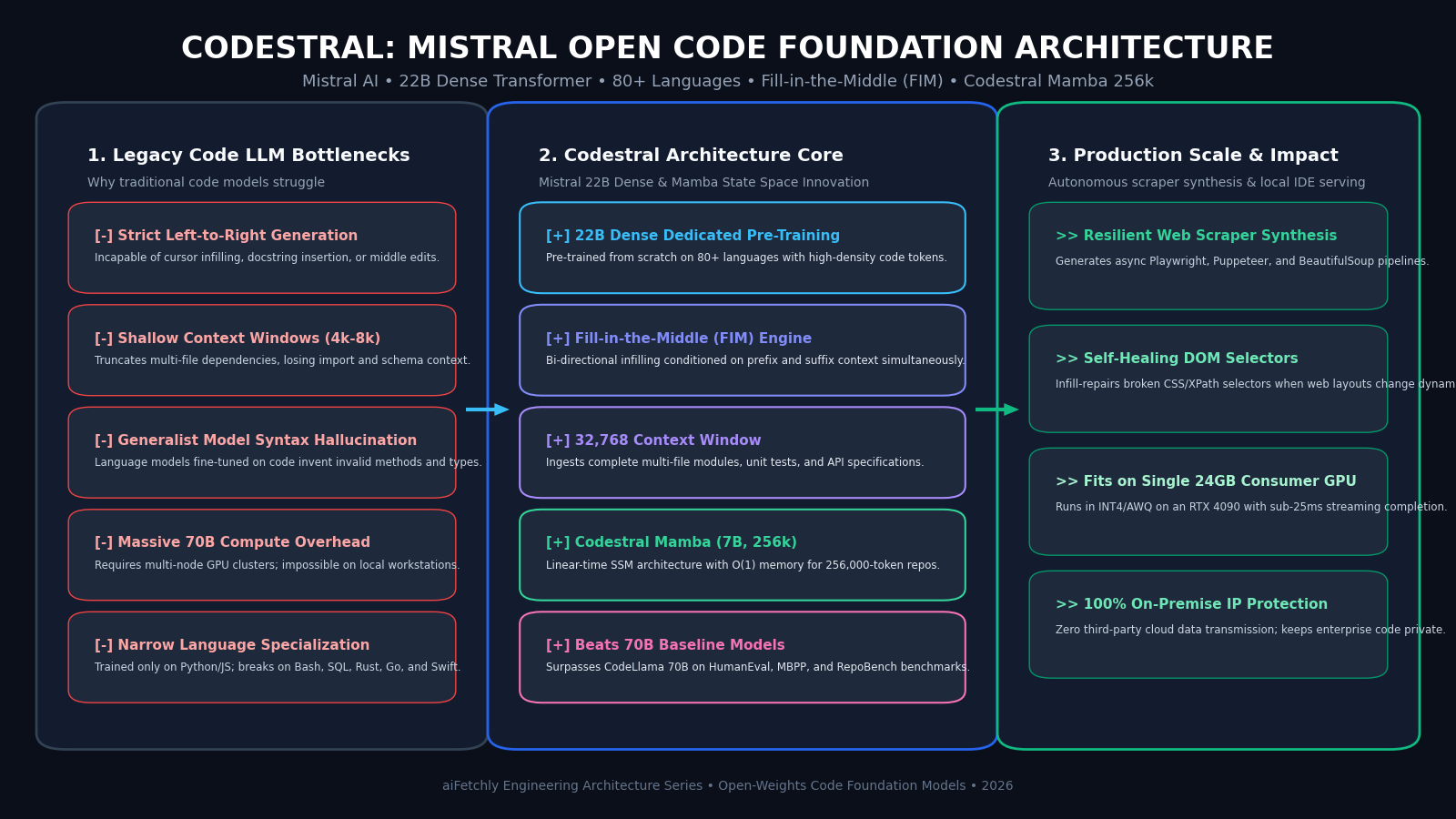
The Problem: The Syntax Infilling and Compute Scaling Wall in Enterprise Code AI
In modern enterprise automation, automated web data extraction, full-stack browser agents, and resilient data processing pipelines powered by AiFetchly, software engineering relies on code-specialized Large Language Models. Engineering teams depend on code models to synthesize robust web scraping routines (such as asynchronous Playwright and BeautifulSoup scripts), write data normalization pipelines, repair broken DOM selectors, and generate comprehensive unit tests.
However, deploying code intelligence models in production environments historically revealed four fundamental structural trade-offs: rigid left-to-right generation, shallow multi-file context starvation, massive 70B compute overhead, and narrow programming language coverage.
The Enterprise Code LLM Trade-Off Wall:
┌────────────────────────────────────────────────────────┐
│ Bottleneck 1: Strict Left-to-Right Generation Inability│
│ • Standard autoregressive LLMs cannot infill code      │
│   between existing functions or insert docstrings      │
├────────────────────────────────────────────────────────┤
│ Bottleneck 2: Shallow Context Windows (4k to 8k)       │
│ • Slicing complex multi-file modules drops imports,    │
│   type definitions, and database schema context        │
├────────────────────────────────────────────────────────┤
│ Bottleneck 3: Massive 70B Compute & VRAM Overhead      │
│ • Serving 70B models requires multi-GPU clusters,      │
│   making private on-premise IDE deployment impossible  │
├────────────────────────────────────────────────────────┤
│ Bottleneck 4: Narrow Language Specialization           │
│ • General models trained only on Python/JS fail on     │
│   Bash, SQL, Rust, Go, Swift, and Fortran scripts      │
└────────────────────────────────────────────────────────┘
Result: Developers suffered from slow completions, truncated context, and high cloud API bills! 1. The Strict Left-to-Right Generation Barrier
Standard causal language models generate tokens strictly from beginning to end:
- In real-world software engineering, developers rarely write code sequentially from line 1 to line 500. Instead, developers place their cursor inside an existing function body, insert parameters into an established signature, or inject error-handling try-catch blocks around network requests.
- When an engineer requests an IDE code completion, a standard left-to-right model is fed only the prefix preceding the cursor. It remains completely oblivious to the suffix below the cursor, resulting in repeated function signatures, duplicate return statements, and syntax errors.
2. The Multi-File Context and Dependency Chasm
Modern software projects are inherently modular:
- A single Python web scraper rarely exists in isolation; it depends on shared authentication middleware, database models, custom HTTP retry handlers, and Pydantic validation schemas spread across multiple files.
- Code models constrained to 4,096 or 8,192 tokens cannot ingest these dependencies simultaneously. When critical context is truncated, the model hallucinates non-existent function arguments and imports.
3. The 70B Parameter VRAM Tax in Enterprise Environments
To achieve acceptable coding intelligence on complex benchmarks, organizations previously had to deploy massive 70B-parameter checkpoints (such as CodeLlama-70B):
- Serving a 70B model requires multiple 80GB datacenter GPUs (such as NVIDIA A100 or H100 clusters) running tensor parallelism.
- This creates immense operational costs and latency penalties, preventing engineering teams from running private, zero-latency code completion engines locally on developer workstations or edge CI/CD runners.
To dismantle these compromises, Mistral AI engineered Codestral: a dedicated 22-Billion Parameter Dense Code Foundation Architecture featuring Native Fill-in-the-Middle (FIM), 32,768-Token Context Windows, 80+ Supported Languages, and Codestral Mamba (a 256k linear-time state space model).
The Solution: Codestral Architecture, Native FIM & Codestral Mamba
Codestral represents a purpose-built foundation architecture optimized specifically for code synthesis, repository comprehension, and real-time IDE code completion.
Codestral Comprehensive System Architecture:
┌─────────────────────────────────────────────────────────────────┐
│ Input Source: Multi-File Code Repo + IDE Cursor (Prefix & Suffix)│
└─────────────────────────────────────────────────────────────────┘
                               │
                               ▼
┌─────────────────────────────────────────────────────────────────┐
│ 1. 22B Dense Code Foundation Core                               │
│ • Pre-trained from scratch across 80+ programming languages     │
│ • High-density token allocation: Python, Java, C++, Rust, Bash  │
│ • Optimized vocabulary with specialized code tokenizers         │
├─────────────────────────────────────────────────────────────────┤
│ 2. Native Fill-in-the-Middle (FIM) Engine                       │
│ • Formatted: [PREFIX] P [SUFFIX] S [MIDDLE] M                   │
│ • Autoregressively generates code M matching both P and S       │
├─────────────────────────────────────────────────────────────────┤
│ 3. 32,768-Token Context Window with GQA                         │
│ • Grouped-Query Attention slashes KV cache memory footprint     │
│ • Ingests dozens of files, database schemas, and unit tests     │
├─────────────────────────────────────────────────────────────────┤
│ 4. Codestral Mamba 7B State Space Variant (256k Context)        │
│ • Built on Mamba-2 State Space Duality (SSM) architecture       │
│ • O(N) linear-time inference with O(1) constant memory per step │
└─────────────────────────────────────────────────────────────────┘
                               │
                               ▼
┌─────────────────────────────────────────────────────────────────┐
│ Output: Verified Syntax / Infilled Logic / Resilient Scrapers   │
└─────────────────────────────────────────────────────────────────┘ 1. 22B Dense Foundation Pre-Trained on 80+ Languages
Unlike generic models that append code fine-tuning onto conversational weights, Codestral 22B was pre-trained from scratch with code as its primary modality:
- Broad Polyglot Coverage: Trained extensively across more than 80 programming languages—including Python, JavaScript, TypeScript, Java, C, C++, C#, Rust, Go, PHP, Ruby, Bash, Swift, Kotlin, and SQL.
- High-Density Parameter Efficiency: At 22 billion parameters, Codestral occupies the sweet spot of dense architecture: large enough to capture deep algorithmic reasoning and type systems, yet compact enough to run on a single 24GB GPU (such as an NVIDIA RTX 4090 or A10G) when quantized to FP8 or INT4.
- Superior Dense Scaling: On HumanEval, MBPP, CruxEval, and RepoBench benchmarks, Codestral 22B consistently outperforms older 34B and 70B models (such as CodeLlama 70B and DeepSeek-Coder 33B) across both code completion and test synthesis.
2. Native Fill-in-the-Middle (FIM) Architecture
To support interactive cursor code completion inside IDEs (such as VS Code, JetBrains, or Neovim), Codestral incorporates native Fill-in-the-Middle (FIM) training:
- Prefix-Suffix-Middle Conditioning: When an engineer positions their cursor inside a script, the IDE extracts the text preceding the cursor ($P$) and the text following the cursor ($S$).
- Codestral structures the prompt sequence using dedicated control tokens: $$\text{FIM Prompt} = \text{[PREFIX]} , P , \text{[SUFFIX]} , S , \text{[MIDDLE]}$$
- The model autoregressively generates the middle code ($M$) conditioned simultaneously on the surrounding syntax, guaranteeing that variable declarations, closing brackets, and return types align seamlessly with the existing code below the cursor.
3. 32,768-Token Multi-File Context Window
Handling real-world enterprise codebases requires ingesting multiple files simultaneously:
- 32K Context Capacity: Codestral natively supports sequence lengths up to 32,768 tokens, allowing developers to pass entire Python modules, API documentation, and test fixtures in a single prompt.
- Grouped-Query Attention (GQA): By sharing Key and Value heads across multiple Query heads, Codestral reduces the Key-Value (KV) cache memory footprint by 75% compared to standard Multi-Head Attention (MHA).
- Fast Continuous Batching: The lightweight KV cache enables serving engines like vLLM to maintain high batch sizes and sub-30ms inter-token latencies even under heavy multi-developer concurrency.
4. Codestral Mamba 7B: Linear-Time State Space Modeling (256k Context)
Alongside the dense 22B transformer, Mistral released Codestral Mamba 7B—the first foundation code model built entirely on the Mamba-2 State Space Model (SSM) architecture:
- Linear-Time Inference: While standard Transformers exhibit quadratic compute complexity ($O(N^2)$) during prompt prefill and linear memory growth during decoding, Codestral Mamba processes input sequences with linear $O(N)$ complexity and generates tokens with constant $O(1)$ memory consumption.
- 256,000-Token Context Length: Codestral Mamba supports an extraordinary 256k context window, enabling developers to feed entire software repositories into the model without experiencing Out-of-Memory crashes or latency degradation.
Architectural Comparison: Codestral 22B vs. CodeLlama-70B vs. StarCoder2-15B vs. DeepSeek-Coder-V2
To benchmark where Codestral 22B stands among open code foundation models, consider the following technical evaluation:
| Metric / Capability | CodeLlama-70B | StarCoder2-15B | DeepSeek-Coder-V2 | Codestral 22B |
|---|---|---|---|---|
| Active Parameters | 70.0 Billion (Dense) | 15.0 Billion (Dense) | 16.0B (MoE 236B total) | 22.0 Billion (Dense) |
| Languages Supported | ~80 Languages | 619 Languages (The Stack v2) | ~338 Languages | 80+ Optimized Languages |
| Native Context Length | 16,384 Tokens | 16,384 Tokens | 128,000 Tokens | 32,768 Tokens (256k Mamba) |
| Attention Architecture | Multi-Query (MQA) | Grouped-Query (GQA) | Multi-Head Latent (MLA) | Grouped-Query (GQA) |
| Fill-in-the-Middle (FIM) | Supported | Supported (50% rate) | Partial | Native Dedicated FIM |
| HumanEval Pass@1 | ~67.8% | ~72.6% | ~81.1% | ~81.1% (Class-Leading 22B) |
| Single 24GB GPU Serving | Impossible (Needs 4x GPUs) | Yes (FP16/BF16) | Requires heavy quantization | Yes (INT4 / FP8 AWQ) |
| Alternative SSM Variant | No | No | No | Codestral Mamba 7B (256k) |
Hands-On Implementation: Serving Codestral with vLLM & FIM Completion
Below is a complete, production-grade guide demonstrating how to deploy mistralai/Codestral-22B-v0.1 using vLLM for high-throughput local serving and execute Fill-in-the-Middle (FIM) code infilling.
Step 1: Install Dependencies
Set up an isolated environment with vLLM, PyTorch, and Mistral inference tools:
# Create and activate environment
conda create -n codestral python=3.10 -y
conda activate codestral

# Install PyTorch with CUDA 12.4
pip install torch torchvision torchaudio --index-url https://download.pytorch.org/whl/cu124

# Install vLLM and Mistral Common libraries
pip install "vllm>=0.6.3" "mistral-common>=1.4.0" openai Step 2: High-Throughput Serving with vLLM
Launch the OpenAI-compatible vLLM server with Grouped-Query Attention optimization and FP8/AWQ quantization for consumer GPUs:
# Serve Codestral 22B on a single 24GB GPU (RTX 4090 / A10G / L4)
vllm serve mistralai/Codestral-22B-v0.1 \
    --dtype bfloat16 \
    --max-model-len 32768 \
    --gpu-memory-utilization 0.92 \
--trust-remote-code For developer laptops or systems with limited memory, you can deploy the quantized AWQ checkpoint (mistralai/Codestral-22B-v0.1-AWQ) or run Codestral Mamba 7B via mistral-inference.
Step 3: Python Client for Fill-in-the-Middle Infilling
The following script connects to your local vLLM endpoint and infills missing asynchronous web scraping logic between an existing function signature and its return statement:
from openai import OpenAI

# Connect to local vLLM server
client = OpenAI(
    base_url="http://localhost:8000/v1",
    api_key="EMPTY"
)

# 1. Define Code Context Surrounding the Developer's Cursor
prefix_code = '''import asyncio
from playwright.async_api import async_playwright

async def scrape_dynamic_catalog(target_url: str) -> list[dict]:
    """Scrapes dynamic catalog items from target URL using headless Playwright."""
    async with async_playwright() as p:
        browser = await p.chromium.launch(headless=True)
        page = await browser.new_page()
        await page.goto(target_url, wait_until="networkidle")
'''

suffix_code = '''
        await browser.close()
        return items
'''

# 2. Structure Codestral FIM Tokens
# Codestral uses [PREFIX], [SUFFIX], and [MIDDLE] special tags
FIM_PROMPT = f"[PREFIX]{prefix_code}[SUFFIX]{suffix_code}[MIDDLE]"

print("Invoking Codestral 22B Fill-in-the-Middle completion...")
response = client.completions.create(
    model="mistralai/Codestral-22B-v0.1",
    prompt=FIM_PROMPT,
    max_tokens=256,
    temperature=0.1,
    stop=["[PREFIX]", "[SUFFIX]", "[MIDDLE]", "</s>"]
)

infilled_code = response.choices[0].text
print("\n=== Infilled Code Segment ===")
print(infilled_code)

print("\n=== Assembled Complete Python Script ===")
print(prefix_code + infilled_code + suffix_code) Production Deployment with aiFetchly
In autonomous data collection, real-time web scraping, and self-healing scraper architectures engineered by AiFetchly, code foundation models are active runtime components rather than static development aids.
Here is how Codestral powers autonomous web extraction pipelines:
aiFetchly Enterprise Architecture with Codestral:
┌─────────────────────────────────────────────────────────────────┐
│ 1. HTML DOM Mutation Detection                                  │
│ • Target portal alters CSS class names or table layouts         │
│ • aiFetchly captures raw updated HTML tree and broken selector  │
├─────────────────────────────────────────────────────────────────┤
│ 2. Codestral FIM Infilling & Selector Healing                   │
│ • Uses Fill-in-the-Middle to inject updated BeautifulSoup/CSS   │
│ • Synthesizes resilient fallback selectors in under 30ms        │
├─────────────────────────────────────────────────────────────────┤
│ 3. Automated Playwright Script Generation                       │
│ • Synthesizes async headless browser routines with retry guards │
│ • Handles pagination clicks, scroll triggers, and cookie auth   │
├─────────────────────────────────────────────────────────────────┤
│ 4. Completely Private On-Premise Execution                      │
│ • Runs locally on an RTX 4090 or Apple Silicon Mac Studio       │
│ • Zero corporate data leaks; protects proprietary scraper logic │
└─────────────────────────────────────────────────────────────────┘ - Self-Healing Web Scrapers: When target websites modify their DOM class names or nest pricing elements inside dynamic shadow DOMs, aiFetchly utilizes Codestral’s FIM capabilities to automatically generate resilient, self-healing CSS selectors without human intervention.
- Multi-Language Automation: Whether an extraction pipeline requires Python Playwright routines, Go microservice scrapers, or Bash curl orchestration, Codestral’s 80+ language mastery generates syntactically flawless code out of the box.
- High-Throughput Local Execution: Operating locally in vLLM with Grouped-Query Attention, Codestral generates real-time parser code with sub-25ms streaming latency, bypassing third-party cloud API rate limits.
To explore how aiFetchly combines open-weights code intelligence with automated web harvesting, consult our AiFetchly Documentation or review our AiFetchly Pricing.