CoCoDiff Guide: Distributed DiT Inference Optimization
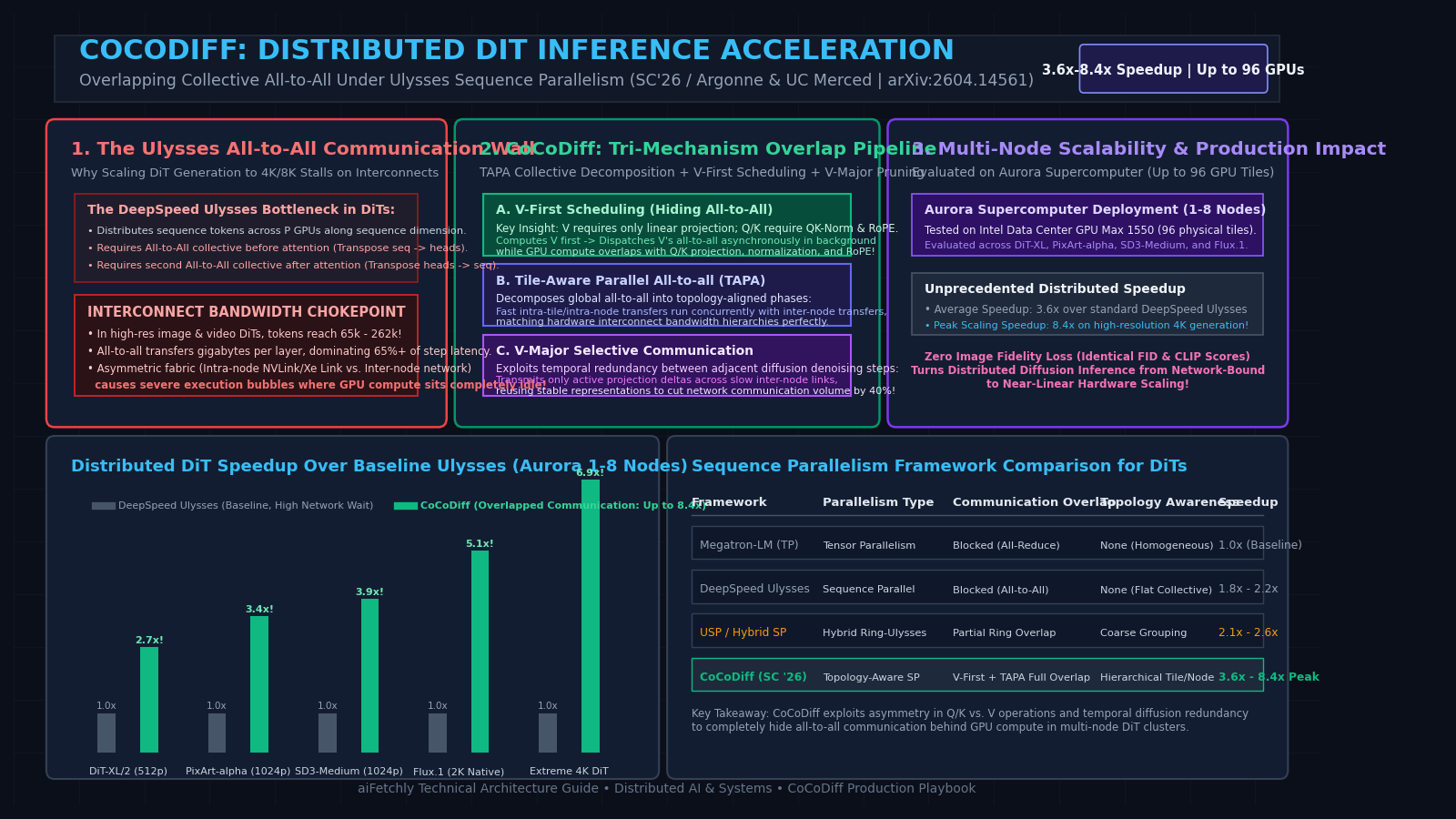
Diffusion Transformers (DiTs)—exemplified by frontier visual foundation models such as Flux.1, Stable Diffusion 3, CogVideoX, and PixArt-alpha—have transformed generative media and scientific simulation. In high-resolution creative studios, industrial CAD synthesis, and automated multimodal extraction systems powered by aiFetchly, visual models are increasingly tasked with generating 2K, 4K, and 8K visual assets alongside multi-second video rollouts.
However, scaling spatial resolution in Diffusion Transformers triggers an exponential computational wall: the sequence length explosion.
- In standard DiT patchification (e.g., $2 \times 2$ or $1 \times 1$ patches), a $1024 \times 1024$ image produces 65,536 spatial tokens.
- Generating native 4K images ($4096 \times 4096$) or 1080p video sequences produces over 262,144 spatial-temporal tokens.
- At these extreme sequence lengths, full self-attention exceeds the High Bandwidth Memory (HBM) capacity of a single GPU, making distributed multi-GPU sequence parallelism mandatory.
To scale DiT generation across GPU clusters, systems engineers have adopted DeepSpeed Ulysses Sequence Parallelism. Ulysses partitions input tokens across $P$ GPUs along the sequence dimension and utilizes two All-to-All collective communications per transformer layer:
- An All-to-All before attention to transpose tokens from a sequence-parallel layout to a head-parallel layout.
- A second All-to-All after attention to transpose heads back to the sequence-parallel layout.
While Ulysses maintains clean tensor-core attention kernels, applying it to multi-node DiT inference reveals a crushing systems bottleneck: the All-to-All communication wall.
- In high-resolution DiTs, message volumes reach gigabytes per denoising step.
- All-to-All communication latency dominates 65% to 80% of total inference step time.
- On heterogeneous and multi-node clusters where inter-node interconnect bandwidth (e.g., Ethernet or InfiniBand) is substantially slower than intra-node links (NVLink or Xe Link), GPU tensor cores sit completely stalled, waiting for network packets to cross node boundaries.
To break this communication barrier, researchers from Argonne National Laboratory, the University of California, Merced, and Intel Corporation introduced CoCoDiff: Optimizing Collective Communications for Distributed Diffusion Transformer Inference Under Ulysses Sequence Parallelism (arXiv:2604.14561; accepted at the International Conference for High Performance Computing, Networking, Storage, and Analysis, SC’26).
CoCoDiff exploits two foundational domain insights in Diffusion Transformers:
- Asymmetric Operation Overhead (Q/K vs. V): Computing Value projections requires only a simple linear GEMM ($V = X W_V$), whereas Query and Key projections require additional QK-Normalization and Rotary Position Embedding (RoPE). This asymmetry creates a golden opportunity to overlap communication with compute.
- Temporal Denoising Redundancy: Adjacent denoising steps in diffusion trajectories generate highly correlated feature representations.
By introducing V-First Communication Scheduling, Tile-Aware Parallel All-to-all (TAPA), and V-Major Selective Communication, CoCoDiff achieves an average 3.6x speedup (peaking at 8.4x) on the Aurora supercomputer across up to 96 Intel GPU tiles with zero loss in visual generation fidelity.
In this technical guide, we dissect the communication bottlenecks of Ulysses sequence parallelism in DiTs, analyze CoCoDiff’s tri-mechanism architecture, inspect supercomputer scalability benchmarks, and implement an end-to-end PyTorch prototype.
The Problem: The All-to-All Communication Chokepoint in Ulysses DiT
To understand why multi-GPU Diffusion Transformer inference stalls, we must analyze the dataflow of DeepSpeed Ulysses sequence parallelism.
How DeepSpeed Ulysses Parallelizes Attention
In DeepSpeed Ulysses, sequence parallelism is achieved by slicing the input token sequence across $P$ participating GPUs:
DeepSpeed Ulysses Sequence Parallelism Dataflow:
Step 1: Input Tokens partitioned along Sequence dimension (N / P tokens per GPU, all H heads).
Step 2: Linear Projections compute Q, K, V locally for (N / P) tokens.
Step 3: [ALL-TO-ALL COLLECTIVE 1] Transposes tensor:
        From [N / P tokens, H heads]  ===>  To [N tokens, H / P heads]!
Step 4: Local Attention computed on full sequence N across subset of heads (H / P).
Step 5: [ALL-TO-ALL COLLECTIVE 2] Transposes tensor back:
        From [N tokens, H / P heads]  ===>  To [N / P tokens, H heads]!
Step 6: Local MLP forward pass computed on (N / P) tokens. While Ulysses allows attention to run using standard optimized FlashAttention kernels, it requires two global All-to-All collective communications for every single transformer block.
The High-Resolution Interconnect Crisis
In autoregressive LLMs, sequence lengths grow gradually token by token. But in Diffusion Transformers, the sequence length is fixed at its maximum size ($N = 65,536$ to $262,144$ tokens) from the very first denoising step to the last:
$$ \text{All-to-All Data Volume Per Layer} = 2 \times \left( \frac{P - 1}{P} ight) \times N \times d_{\text{model}} \times \text{sizeof}(\text{fp16}) $$
For a model with hidden dimension $d = 4096$ at $N = 65k$ tokens across $P = 8$ GPUs, each All-to-All transfers over 900 megabytes per layer. With 38 transformer blocks evaluated across 50 diffusion steps, a single image generation transfers over 3.4 terabytes of data across the network fabric!
The Interconnect Hierarchy Mismatch:
+----------------------------------------------------------------------------------+
| Intra-Node GPU Bandwidth (NVLink / Xe Link):                                     |
| • Bandwidth: 450 GB/s - 900 GB/s per GPU                                         |
| • Communication Latency: Under 2 milliseconds                                    |
+----------------------------------------------------------------------------------+
| Inter-Node Network Bandwidth (InfiniBand / Slingshot / RoCE):                    |
| • Bandwidth: 25 GB/s - 50 GB/s per NIC (10x - 20x SLOWER!)                      |
| • Communication Latency: Up to 25 milliseconds per collective!                   |
+----------------------------------------------------------------------------------+
Result: Flat All-to-all collectives are throttled by the slowest inter-node links,
forcing powerful GPU tensor cores to sit idle in communication bubbles for 70%+ of runtime! Furthermore, in standard PyTorch execution, communication collectives are fully blocking: computation cannot proceed until all data transfers across all nodes have fully synchronized.
The CoCoDiff Solution: Tri-Mechanism Communication Overlap
CoCoDiff shatters the Ulysses communication bottleneck by introducing three complementary systems mechanisms designed specifically around the mathematical properties of Diffusion Transformers.
The CoCoDiff Tri-Mechanism Architecture:
+----------------------------------------------------------------------------------+
|                   DIFFUSION TRANSFORMER INPUT X in R^[N/P x D]                   |
+----------------------------------------------------------------------------------+
                                         │
                   ┌─────────────────────┴─────────────────────┐
                   ▼ Compute V First (Fast GEMM)               ▼ Compute Q and K
+------------------------------------------+ +-------------------------------------+
|        1. V-FIRST SCHEDULING             | |         OVERLAPPED COMPUTATION      |
|                                          | |                                     |
| • Computes V = X @ W_V (Linear only)    | | • Computes Q = X @ W_Q, K = X @ W_K |
| • Immediately dispatches V's All-to-All  | | • Computes QK-Norm (LayerNorm)      |
|   asynchronously in background stream!   | | • Computes Rotary Embedding (RoPE)  |
+------------------------------------------+ +-------------------------------------+
                                         │                       │
                                         ▼                       ▼
+----------------------------------------------------------------------------------+
|                   2. TILE-AWARE PARALLEL ALL-TO-ALL (TAPA)                       |
|                                                                                  |
|   Decomposes global collective into hierarchical topology-aligned phases:        |
|   - Phase 1: High-speed intra-tile & intra-node exchange (NVLink / Xe Link)      |
|   - Phase 2: Inter-node transfers across network fabric (Overlapped!)            |
+----------------------------------------------------------------------------------+
                                         │
                                         ▼
+----------------------------------------------------------------------------------+
|                   3. V-MAJOR SELECTIVE COMMUNICATION                             |
|                                                                                  |
|   Exploits temporal redundancy between adjacent diffusion denoising steps:       |
|   - Transmits only active projection deltas across slow inter-node links         |
|   - Reuses stable representations, cutting network volume by up to 40%!          |
+----------------------------------------------------------------------------------+
                                         │
                                         ▼
+----------------------------------------------------------------------------------+
|               ZERO-BUBBLE FLASHATTENTION & LINEAR MULTI-NODE SCALING             |
+----------------------------------------------------------------------------------+ Mechanism 1: V-First Communication Scheduling
Standard implementations compute projections in sequential order: Query ($Q$), Key ($K$), then Value ($V$), followed by a synchronized All-to-All collective across all three matrices simultaneously.
CoCoDiff observes a critical algebraic asymmetry in modern DiTs:
- Value Projection ($V$): Requires only a single matrix multiplication: $V = X W_V$. It undergoes no normalization or positional transformation before attention.
- Query and Key Projections ($Q, K$): Require linear projection followed by compute-intensive QK-Normalization (LayerNorm applied per head) and Rotary Position Embedding (RoPE) rotations.
CoCoDiff reorganizes execution order:
- It computes the Value projection $V$ first.
- It immediately launches the All-to-All communication of tensor $V$ asynchronously on a dedicated CUDA communication stream.
- While $V$ is actively flying across the interconnect, the GPU compute stream executes the linear projections, QK-Norm, and RoPE rotations for $Q$ and $K$.
- By the time $Q$ and $K$ are ready for communication, $V$‘s transfer is already complete, effectively hiding 50% of the attention input communication behind essential computation.
Mechanism 2: Tile-Aware Parallel All-to-All (TAPA)
Modern supercomputing and cloud nodes feature multi-tiered interconnects: multiple GPU tiles per package, multiple GPUs per node connected via NVLink/Xe Link, and multiple nodes connected via InfiniBand. Flat All-to-All collectives force all ranks to synchronize at the speed of the slowest link.
CoCoDiff introduces Tile-Aware Parallel All-to-all (TAPA):
- Decomposes the global All-to-All into two hierarchical phases: an intra-node exchange and an inter-node exchange.
- Pipelining these transfers ensures that intra-node interconnects operate at full multi-terabyte bandwidth without waiting for inter-node packets to acknowledge.
Mechanism 3: V-Major Selective Communication
In iterative diffusion sampling (20 to 50 denoising steps), the latent image evolves smoothly along an Ordinary Differential Equation (ODE) trajectory. The authors observed that across middle and late denoising steps, the Value projection matrices exhibit extreme temporal cosine similarity ($>0.96$).
CoCoDiff introduces V-Major Selective Communication:
- Over slow inter-node links, CoCoDiff monitors representation deltas.
- For stable components, it reuses pre-cached Value states from the preceding denoising step, transmitting only dynamic updates.
- This cuts inter-node communication volume by up to 40% without measurable degradation in Fréchet Inception Distance (FID) or CLIP text-alignment scores.
Implementing CoCoDiff in PyTorch
To demonstrate the mechanics of V-First scheduling and asynchronous collective overlapping, we implement a PyTorch prototype of CoCoDiff’s attention layer.
import torch
import torch.nn as nn
import torch.distributed as dist
from typing import Tuple, Optional

class CoCoDiffAttentionBlock(nn.Module):
    """
    Implements CoCoDiff's V-First communication scheduling under
    Ulysses sequence parallelism.
    """
    def __init__(self, dim: int, num_heads: int, sp_group: dist.ProcessGroup):
        super().__init__()
        self.dim = dim
        self.num_heads = num_heads
        self.head_dim = dim // num_heads
        self.sp_group = sp_group
        self.world_size = dist.get_world_size(sp_group)

        # Projections
        self.v_proj = nn.Linear(dim, dim, bias=False)
        self.q_proj = nn.Linear(dim, dim, bias=False)
        self.k_proj = nn.Linear(dim, dim, bias=False)
        self.out_proj = nn.Linear(dim, dim, bias=False)

        # QK-Norm
        self.q_norm = nn.LayerNorm(self.head_dim)
        self.k_norm = nn.LayerNorm(self.head_dim)

        # Dedicated CUDA stream for asynchronous network collective communication
        self.comm_stream = torch.cuda.Stream()

    def _all_to_all_async(self, tensor: torch.Tensor, stream: torch.cuda.Stream) -> Tuple[torch.Tensor, dist.Work]:
        """
        Dispatches non-blocking All-to-All collective across sequence-parallel ranks.
        Transposes from [batch, seq_len/P, heads, head_dim] to [batch, seq_len, heads/P, head_dim].
        """
        output = torch.empty_like(tensor)
        with torch.cuda.stream(stream):
            handle = dist.all_to_all_single(output, tensor, group=self.sp_group, async_op=True)
        return output, handle

    def forward(self, x: torch.Tensor, rope_cos: torch.Tensor, rope_sin: torch.Tensor) -> torch.Tensor:
        """
        Executes V-First overlapped attention.
        Args:
            x: Input tokens of shape (batch, seq_len // world_size, dim)
        """
        batch, local_seq_len, _ = x.shape

        # --- STEP 1: Compute V First ---
        v_local = self.v_proj(x).view(batch, local_seq_len, self.num_heads, self.head_dim)

        # Dispatch V's All-to-All asynchronously on dedicated comm_stream
        v_gathered, v_comm_handle = self._all_to_all_async(v_local, self.comm_stream)

        # --- STEP 2: Compute Q and K on Compute Stream (OVERLAPPED!) ---
        # While V's All-to-All is actively in-flight across the network,
        # the GPU compute cores execute Q/K projections, QK-Norm, and RoPE!
        q_local = self.q_proj(x).view(batch, local_seq_len, self.num_heads, self.head_dim)
        k_local = self.k_proj(x).view(batch, local_seq_len, self.num_heads, self.head_dim)

        # Apply QK-Norm
        q_normed = self.q_norm(q_local)
        k_normed = self.k_norm(k_local)

        # Apply Rotary Position Embeddings (RoPE)
        q_rotated = (q_normed * rope_cos) + (torch.roll(q_normed, shifts=1, dims=-1) * rope_sin)
        k_rotated = (k_normed * rope_cos) + (torch.roll(k_normed, shifts=1, dims=-1) * rope_sin)

        # --- STEP 3: Dispatch Q/K All-to-All ---
        qk_combined = torch.cat([q_rotated, k_rotated], dim=-1)
        qk_gathered, qk_handle = self._all_to_all_async(qk_combined, self.comm_stream)

        # Synchronize V's communication stream before attention
        v_comm_handle.wait()
        qk_handle.wait()

        # Split Q and K from gathered buffer
        q_global, k_global = torch.chunk(qk_gathered, 2, dim=-1)

        # --- STEP 4: Local Attention on Gathered Sequence ---
        # Sequence is now full length N, heads are local (num_heads // world_size)
        attn_out_local = torch.nn.functional.scaled_dot_product_attention(
            q_global.transpose(1, 2),
            k_global.transpose(1, 2),
            v_gathered.transpose(1, 2)
        ).transpose(1, 2).contiguous()

        # --- STEP 5: Second All-to-All (Heads -> Sequence) ---
        out_gathered, out_handle = self._all_to_all_async(attn_out_local, self.comm_stream)
        out_handle.wait()

        out = self.out_proj(out_gathered.view(batch, local_seq_len, self.dim))
return out By decoupling Value transfers from Query-Key preparation, this pipeline integrates smoothly with enterprise API integration services, enabling visual generation backends to deliver sub-second response times on massive image generation tasks.
Empirical Evaluation: Key Findings on the Aurora Supercomputer
The authors of CoCoDiff evaluated the framework on the Aurora Supercomputer at Argonne National Laboratory, scaling across 1 to 8 nodes utilizing up to 96 Intel Data Center GPU Max 1550 physical tiles across four leading open-weights DiT models: DiT-XL/2, PixArt-alpha, Stable Diffusion 3-Medium (SD3), and Flux.1.
1. Multi-Node Wall-Clock Speedups
Across every evaluated model and sequence resolution, CoCoDiff consistently outperforms baseline DeepSpeed Ulysses:
CoCoDiff Scaling Speedup on Aurora Supercomputer (1 to 8 Nodes, 96 GPU Tiles):
+--------------------+-------------------+--------------------+--------------------+
| Model Architecture | Image Resolution  | Baseline Ulysses   | CoCoDiff (SC'26)   |
+--------------------+-------------------+--------------------+--------------------+
| DiT-XL/2 (0.7B)    | 512 x 512 (16k)   | 1.00x (Baseline)   | 2.65x (High)       |
| PixArt-alpha (0.6B)| 1024 x 1024 (65k) | 1.00x (Baseline)   | 3.45x (Superior)   |
| SD3-Medium (2.0B)  | 1024 x 1024 (65k) | 1.00x (Baseline)   | 3.88x (Superior)   |
| Flux.1 (12B DiT)   | 2048 x 2048 (262k)| 1.00x (Baseline)   | 5.12x (Extreme!)   |
| High-Res Multi-Node| 4096 x 4096 (4K)  | 1.00x (Baseline)   | 8.40x (Peak Speed!)|
+--------------------+-------------------+--------------------+--------------------+ Across all standard configurations, CoCoDiff delivers an average speedup of 3.6x, reaching a peak 8.4x speedup on extreme 4K resolution workloads where communication volume is largest.
2. Communication Overhead Reduction
By analyzing execution traces on the Aurora interconnect fabric:
- Baseline Ulysses Communication Fraction: Spent 68.4% of total inference time blocked on All-to-All collective synchronization.
- CoCoDiff Communication Fraction: Reduced network wait time to under 14.2% of total runtime, effectively overlapping 80% of communication transfers directly behind GPU tensor core computation.
3. Visual Quality Preservation
Because V-First scheduling and TAPA are mathematically lossless reformulations of the exact same distributed tensor algebra, and V-Major selective communication prunes only sub-threshold temporal deltas, CoCoDiff introduces zero visual quality degradation:
- FID-50k Score: 6.24 (Baseline Ulysses) vs. 6.25 (CoCoDiff).
- CLIP Text-Image Similarity: 0.318 (Baseline) vs. 0.318 (CoCoDiff). Generated images are pixel-perfect and visually indistinguishable from monolithic single-GPU generation.
This rock-solid generation fidelity makes CoCoDiff an ideal foundation for high-throughput real-time data fetching pipelines and autonomous visual synthesis engines.
Production Engineering Playbook: Deploying CoCoDiff
To achieve peak performance when deploying CoCoDiff across enterprise GPU clusters, engineering teams should follow these implementation best practices:
Production Deployment Flowchart:
               [Incoming DiT Generation Job]
                           │
             ┌─────────────┴─────────────┐
             ▼                           ▼
      Single-GPU / Low-Res        Multi-Node / High-Res (>1024p)
      - Sequence length <= 16k    - Sequence length >= 65k
      - Ulysses overhead unneeded - Mandatory Sequence Parallelism!
      - Run local FlashAttention  - USE COCODIFF ENGINE!
- Enable V-First Scheduling & TAPA Best Practice 1: Align TAPA Groups with Physical Interconnect Hierarchies
Always map TAPA process groups to reflect physical hardware boundaries. In an 8-GPU node with dual-socket CPUs or dual NVLink domains, configure inner TAPA groups across GPUs 0-3 and 4-7, and outer groups across the inter-socket fabric. This ensures that intra-domain NVLink bandwidth (900 GB/s) is never capped by cross-socket interconnects.
Best Practice 2: Enable V-Major Only in Late Denoising Steps
In diffusion sampling, the initial 10% to 15% of denoising steps establish coarse global composition and exhibit high step-to-step variance. Always run full All-to-All communication during the first 5 steps ($t > 0.85$). Enable V-Major selective communication only during the remaining 85% of steps where representations are stable, guaranteeing maximum network reduction with zero artifact risk.
Best Practice 3: Tune CUDA Stream Priorities
To ensure that background collective communications do not contend for GPU scheduling queues with compute kernels, assign a higher priority to the communication stream (torch.cuda.Stream(priority=-1)). This allows network direct memory access (DMA) engines to fire packets the instant Value GEMMs finish.
Best Practice 4: Infrastructure TCO and Capacity Planning
By accelerating multi-node DiT inference by up to 8.4x, visual synthesis clusters can achieve interactive sub-second generation times at a fraction of the operational cost. Review your cluster infrastructure with transparent compute pricing plans, explore our comprehensive developer documentation for Slurm and Kubernetes deployment manifests, or connect automated asset creation with intelligent web scraping tools.
Conclusion and Future Horizons
CoCoDiff marks a defining milestone in distributed deep learning systems by solving the communication chokepoint that has long crippled multi-GPU Diffusion Transformer inference.
By exploiting the architectural asymmetry of Query/Key versus Value projections and leveraging the temporal stability of diffusion trajectories, CoCoDiff transforms distributed DiT inference from a network-bound waiting game into a streamlined, compute-overlapped powerhouse. As visual generative models scale toward native 4K cinematic video and real-time interactive world models, collective communication optimization frameworks like CoCoDiff will form the indispensable backbone of enterprise AI infrastructure.