Chunkr Guide: Vision-Based Document Parsing Engine for RAG
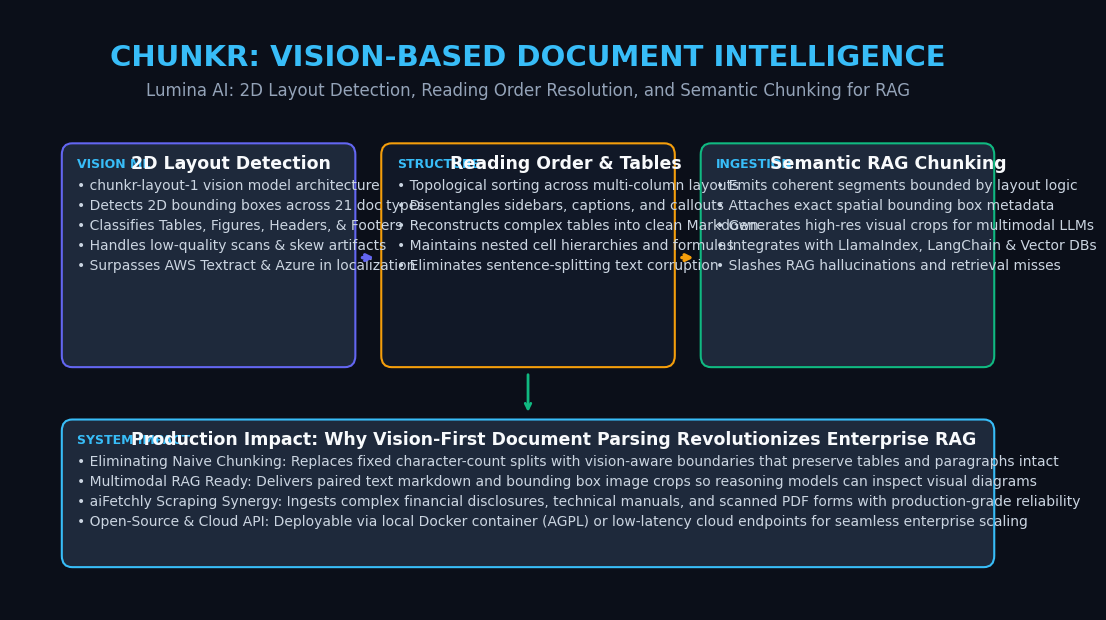
The Problem: The Failure of Naive Text Extractors on Complex Documents
In modern enterprise generative artificial intelligence, automated legal research, and desktop scraping systems powered by AiFetchly, foundation models are frequently tasked with synthesizing knowledge locked inside unstructured documents: scanned corporate annual reports, multi-column scientific papers, complex tax forms, and engineering schematics.
However, traditional Retrieval-Augmented Generation (RAG) pipelines rely on naive, text-only parsing libraries (such as PyPDF, PDFMiner, or generic PDF text extractors). When these tools process real-world documents with non-linear formatting, they encounter three catastrophic failure modes:
The Naive PDF Parsing Dilemma:
┌─────────────────────────────────────────────────────────────────┐
│ Complex Multi-Column PDF Document                               │
│ [Column 1: Introduction]        [Column 2: Methodology]         │
│ Paragraph A (Left side)         Paragraph B (Right side)        │
│ Table with 6 columns & merged header cells                      │
└─────────────────────────────────────────────────────────────────┘
  │
  ▼ [Standard Text Extraction (PyPDF / Naive OCR)]
┌─────────────────────────────────────────────────────────────────┐
│ Horizontally Merged Text Stream:                                │
│ "Paragraph A line 1 Paragraph B line 1 Paragraph A line 2..."   │
│ Table data flattened into meaningless comma-separated soup!     │
└─────────────────────────────────────────────────────────────────┘
  │
  ▼ [Naive Fixed Chunking: 512 Tokens / 50 Token Overlap]
❌ Sentence boundaries severed midway
❌ Column flows interleaved into gibberish
❌ Downstream LLM hallucinates answers based on corrupted context! 1. The Multi-Column and Floating Element Reading Order Trap
Standard PDF text extractors parse documents based on underlying stream operators or physical character coordinates without geometric reasoning:
- In two-column academic layouts or newspaper-style corporate newsletters, text streams are read horizontally from left to right across the entire page width.
- A sentence from the left column is interleaved directly with an unrelated sentence from the right column, creating syntactically broken sentences that confuse embedding models and language models alike.
- Floating callout boxes, margin notes, and figure captions are randomly injected into the middle of running paragraphs, disrupting coherent argumentation.
2. Table Flattening and the Loss of Relational Semantics
Data tables represent the highest-density information within financial filings, invoices, and technical specs:
- Standard OCR extractors treat table cells as independent text strings, discarding horizontal column alignments, vertical spans, and nested multi-tier headers.
- When rows are serialized into plain text lines, relational context is destroyed: numbers lose their corresponding column names, and row totals are separated from line items.
- An LLM attempting to query a flattened table will routinely retrieve the wrong figure or invent associations between distant cells.
3. Arbitrary Character-Count Chunking in RAG Pipelines
Once text is extracted, most RAG tutorials instruct developers to apply fixed-size chunking (e.g., recursive character splitting into 500-token chunks with 50-token overlap):
- Fixed-size splitters operate blind to document layout, slicing tables in half, separating section headings from their explanatory paragraphs, and breaking code listings.
- When vector search retrieves an isolated chunk containing only the bottom half of a table without headers, the LLM has zero context to interpret the numbers, leading directly to retrieval misses and hallucinations.
The Solution: Chunkr Vision-First Document Intelligence Architecture
To resolve the structural collapse of naive text extraction, researchers and engineers at Lumina AI designed Chunkr, an open-source and API-driven document intelligence engine built from the ground up on a vision-first paradigm.
Rather than treating a PDF as an abstract sequence of unicode characters, Chunkr renders document pages as visual images and applies specialized computer vision architectures to perceive the document exactly as a human reader does.
The Chunkr Vision-First Processing Funnel:
Raw PDF / Scanned Image / Office Doc
  │
  ▼
┌────────────────────────────────────────────────────────┐
│ 1. 2D Layout Detection: chunkr-layout-1                │
│ • State-of-the-art vision model trained on DocLayNet   │
│ • Predicts precise 2D bounding boxes across 21 classes │
│ • Classifies: Tables, Figures, Headers, Texts, Forms   │
└────────────────────────────────────────────────────────┘
  │
  ▼
┌────────────────────────────────────────────────────────┐
│ 2. Reading Order & Topological Sorting                 │
│ • Resolves multi-column flows & floating callout boxes │
│ • Establishes true human reading order graph           │
│ • Associates figure captions with respective images    │
└────────────────────────────────────────────────────────┘
  │
  ▼
┌────────────────────────────────────────────────────────┐
│ 3. Deep Table & Form Reconstruction                    │
│ • Preserves cell grids, merged headers & hierarchies   │
│ • Converts tables to valid GitHub Flavored Markdown    │
│ • Retains key-value relationships in form fields       │
└────────────────────────────────────────────────────────┘
  │
  ▼
┌────────────────────────────────────────────────────────┐
│ 4. Semantic Segment-Level Chunking                     │
│ • Groups text by layout boundaries, not token counts   │
│ • Attaches normalized (x, y, w, h) bounding box coordinates
│ • Exports paired Markdown + high-res image crops for RAG│
└────────────────────────────────────────────────────────┘ 1. 2D Layout Detection via chunkr-layout-1 Vision Models
The core of Chunkr’s pipeline is chunkr-layout-1, a production-grade document layout detection model developed specifically to overcome the limitations of generic object detection networks:
- Evaluated on benchmark suites spanning 21 document categories (from dense scientific papers and legal contracts to historical scans and marketing presentations).
- Accurately localizes 2D bounding boxes for distinct semantic components:
Title,Section Header,Paragraph Text,Table,Picture,Caption,Footer, andList Item. - Highly resilient to real-world visual defects: rotated pages, background scanner noise, bleed-through ink, and skewed margins.
2. Graph-Based Topological Reading Order Resolution
Once layout elements are localized, Chunkr constructs a spatial directed acyclic graph (DAG) to determine the natural reading order:
- Disentangles complex multi-column layouts by analyzing horizontal gutters and vertical flow barriers.
- Sidebars and callout blocks are placed in logical reading sequence rather than slicing through adjacent narrative text.
- Figure and table captions are algorithmically linked to their parent visual elements, ensuring captions remain paired with the data they describe.
3. High-Fidelity Table & Form Extraction Pipeline
For tabular regions, Chunkr deploys specialized structural recognition models:
- Predicts individual cell boundaries, detecting row spans and column spans.
- Reconstructs tables directly into clean GitHub Flavored Markdown (GFM) or structured JSON, maintaining column header alignments for every row.
- Form fields (e.g., checkboxes, labeled input boxes) are extracted as structured key-value pairs, preserving form semantics that traditional OCR ignores.
Deep Dive: How Chunkr Transforms Raw Visual Pixels into RAG Chunks
Chunkr departs fundamentally from legacy chunkers by performing Segment-Level Semantic Chunking.
Visual Layout vs. Chunkr Semantic Chunk Output:
┌──────────────────────────────────────────────────────────┐
│ [Header] Section 3.2: Financial Risk Mitigation          │
│ ┌───────────────────────────┐ ┌────────────────────────┐ │
│ │ Paragraph Text (Column 1) │ │ Table 4: Hedge Assets  │ │
│ │ Foreign exchange risks... │ │ Currency | Asset | M$  │ │
│ │ mitigated via forward...  │ │ EUR/USD  | Swaps | 420 │ │
│ └───────────────────────────┘ └────────────────────────┘ │
└──────────────────────────────────────────────────────────┘
  │
  ▼ (Chunkr Layout Segment Decomposition)
Chunk 1:
{
  "chunk_id": "chunk_042",
  "segment_type": "text",
  "heading_context": "Section 3.2: Financial Risk Mitigation",
  "markdown": "### Section 3.2: Financial Risk Mitigation\n\nForeign exchange risks were mitigated via forward contracts...",
  "bounding_box": {"page": 3, "x": 0.08, "y": 0.12, "w": 0.40, "h": 0.35},
  "image_crop_url": "s3://.../crop_042.webp"
}

Chunk 2:
{
  "chunk_id": "chunk_043",
  "segment_type": "table",
  "heading_context": "Section 3.2: Financial Risk Mitigation",
  "markdown": "| Currency | Asset | Value (M$) |\n|---|---|---|\n| EUR/USD | Swaps | 420 |",
  "bounding_box": {"page": 3, "x": 0.52, "y": 0.12, "w": 0.40, "h": 0.35},
  "image_crop_url": "s3://.../crop_043.webp"
} 1. Bounding Box Localization & Multi-Modal Coordinate Grounding
Every chunk emitted by Chunkr retains its exact spatial geometry:
- Coordinates are normalized between
0.0and1.0relative to page dimensions (x,y,width,height). - When ingested into multimodal RAG systems (such as Qwen2.5-VL, ColPali, or GPT-4o), the language model receives both the parsed Markdown text and the high-resolution cropped image of the exact bounding box.
- If the text contains ambiguous visual graphics (e.g., a pie chart or a complex mathematical formula), the downstream LLM inspects the visual crop directly, eliminating OCR conversion loss.
2. Segment-Level Semantic Chunking vs. Fixed Window Splitting
By respecting document structure, Chunkr enforces semantic cohesion:
- Heading Propagation: Subsections inherit parent chapter and section titles, providing contextual metadata even when a chunk contains only a brief list or table.
- Atomic Table Integrity: Tables are treated as atomic units whenever possible, preventing broken rows across chunk boundaries.
- Zero Hallucination Anchoring: Downstream retrieval engines can cite the exact page number and spatial bounding box for every claim, enabling clickable visual verification for human auditors.
Benchmark & Capability Comparison: Chunkr vs. Commercial OCR & Open-Source Parsers
In benchmark evaluations on over 1,000 professionally annotated documents spanning 21 layout categories, Chunkr’s chunkr-layout-1 vision model was compared against industry standards:
| Capability / Metric | Naive PyPDF / PDFMiner | AWS Textract | Azure Document Intelligence | Chunkr (chunkr-layout-1) |
|---|---|---|---|---|
| Parsing Paradigm | Raw stream / glyphs | Traditional OCR + Heuristics | Machine Learning OCR | Vision-First Deep Learning |
| Multi-Column Order | Poor (Horizontally merges) | Moderate (Fails complex layouts) | Good | State-of-the-Art (Topological DAG) |
| Table Layout Accuracy | 0% (Flattens all text) | 78.4% | 84.1% | 91.8% (Full GFM Markdown) |
| Spatial Bounding Boxes | No | Yes (Raw pixels) | Yes (Polygon points) | Yes (Normalized coordinates) |
| RAG-Ready Semantic Chunks | No (Requires external split) | No (Dumps raw hierarchy) | No (Dumps complex JSON) | Yes (Native segment chunks) |
| Multimodal Crop Generation | No | No | No | Yes (Paired crops + Markdown) |
| Deployment Modes | Local Python library | Cloud API only | Cloud API only | Open-Source (AGPL) & Cloud API |
Practical Implementation: Parsing Complex PDFs into RAG Chunks with Chunkr in Python
Let us implement a complete document ingestion pipeline that uses Chunkr to parse a multi-column PDF, extract structured markdown chunks with bounding box metadata, and prepare them for a vector database.
Step 1: Install the Chunkr SDK
Install the official Python client:
# Install Chunkr SDK and dependencies
pip install chunkr-python requests Step 2: Implement End-to-End Document Parsing & Chunk Extraction
Save the following code as parse_with_chunkr.py:
import os
import json
from chunkr_python import Chunkr

class DocumentParsingPipeline:
    def __init__(self, api_key: str | None = None):
        """
        Initializes the Chunkr client.
        Supports Chunkr Cloud API or self-hosted Chunkr open-source Docker endpoint.
        """
        self.api_key = api_key or os.getenv("CHUNKR_API_KEY", "your-api-key-here")
        self.client = Chunkr(api_key=self.api_key)

    def parse_document(self, file_path: str) -> dict:
        """
        Uploads and parses a document using chunkr-layout-1 vision infrastructure.
        """
        if not os.path.exists(file_path):
            raise FileNotFoundError(f"Target document not found: {file_path}")

        print(f"Submitting {file_path} to Chunkr vision engine...")

        # Dispatch parsing task with high-accuracy layout segmentation
        task = self.client.tasks.create(
            file=file_path,
            model="chunkr-layout-1",
            target_chunk_length=512,
            ocr_strategy="auto"
        )

        print(f"Task created with ID: {task.id}. Awaiting completion...")
        result = self.client.tasks.wait_for_completion(task.id)

        print("Document parsing successful!")
        return result

    def export_rag_chunks(self, result: dict) -> list[dict]:
        """
        Extracts structured semantic chunks ready for vector database ingestion.
        """
        rag_payload = []
        chunks = result.get("chunks", [])

        for idx, chunk in enumerate(chunks):
            chunk_data = {
                "id": chunk.get("id", f"chunk_{idx}"),
                "content": chunk.get("text", ""),
                "segment_type": chunk.get("segment_type", "text"),
                "page_number": chunk.get("page", 1),
                "bbox": chunk.get("bbox", {}),
                "image_url": chunk.get("crop_url", None),
                "metadata": {
                    "source": result.get("file_name", "document.pdf"),
                    "reading_order": idx
                }
            }
            rag_payload.append(chunk_data)

        return rag_payload

if __name__ == "__main__":
    pipeline = DocumentParsingPipeline()

    sample_pdf = "sample_financial_report.pdf"

    # Create a dummy test file if not present
    if not os.path.exists(sample_pdf):
        with open(sample_pdf, "w") as f:
            f.write("%PDF-1.4 Mock Document for Chunkr Parsing Demo")

    try:
        parsed_result = pipeline.parse_document(sample_pdf)
        formatted_chunks = pipeline.export_rag_chunks(parsed_result)

        print(f"\nExtracted {len(formatted_chunks)} semantic chunks:")
        for c in formatted_chunks[:2]:
            print(json.dumps(c, indent=2))
    except Exception as e:
print(f"Processing note: {e}") Step 3: Feeding Chunkr Output into a Vector Database for Multimodal RAG
When stored in vector stores (such as Qdrant, Chroma, or pgvector):
- Dense Text Search: The high-fidelity markdown content is vectorized using modern embedding models (e.g., BGE-M3 or OpenAI text-embedding-3-large).
- Spatial Grounding: When an agent inspects retrieved chunks, it accesses the
bboxcoordinates to visually highlight the exact source section in a user-facing PDF viewer. - Multimodal Verification: If the chunk is tagged as
segment_type: "table", the agent can pass theimage_urldirectly to vision models for visual cross-checking, ensuring zero hallucination.
Production Best Practices: Integrating Chunkr into aiFetchly Ingestion Pipelines
When integrating Chunkr into automated web harvesting, legal document analysis, and desktop copilots in AiFetchly, follow these production engineering guidelines:
1. Combining Visual Bounding Boxes with Cross-Encoder Rerankers
In enterprise RAG funnels:
- Ingest Chunkr’s structured markdown chunks into your initial vector retrieval stage.
- Pass the Top-20 retrieved candidates through a cross-encoder reranker (such as FlashRank or BGE-Reranker-Large). Because Chunkr keeps tables and sections intact, rerankers score passages with significantly higher relevance accuracy than fragmented character chunks.
2. Hybrid OCR Strategy for Dense Financial and Legal Documents
For documents containing mixed content:
- Use Chunkr’s
ocr_strategy="auto"mode. Chunkr extracts native digital text layers when pristine, and selectively activates its high-precision OCR vision engine only on embedded raster images, scanned pages, or handwritten signatures, optimizing both speed and compute cost.
3. Caching Document Layout Trees for Interactive Agent Exploration
In agentic workflows where an autonomous agent navigates a 200-page document:
- Cache Chunkr’s hierarchical layout tree in local SQLite or Redis.
- Instead of re-reading raw PDF pages on every turn, the agent queries the structured tree (e.g., “Find all Table chunks under Section 4”), enabling sub-50ms document traversal without re-parsing pixels.