ChatTTS Guide: Conversational Voice AI & Prosody Control
The Problem: The Audiobook Monotone & Expressiveness Void in Traditional TTS
In modern generative artificial intelligence, automated market research platforms, and customer-facing copilots powered by AiFetchly, foundation models are increasingly expected to interact through voice. Whether delivering executive audio summaries of competitive market dossiers, conducting autonomous customer discovery calls, or providing interactive voice guidance in desktop copilots, spoken dialogue represents the most natural human interface.
However, deploying voice agents using traditional Text-to-Speech (TTS) engines exposes a jarring dissonance known as the Conversational Uncanny Valley.
The Conversational Voice AI Dilemma:
┌─────────────────────────────────────────────────────────────────┐
│ Input Text: "Yeah, totally! [laugh] That caught us off guard."  │
└─────────────────────────────────────────────────────────────────┘
 │
 ▼ [Traditional Text-to-Speech Engines (FastSpeech, VITS, XTTS)]
┌─────────────────────────────────────────────────────────────────┐
│ ❌ Failure Mode 1: The Audiobook Monotone                       │
│ • Reads conversational dialogue like a formal novel narrator     │
│ • Static pitch contours, robotic cadence, and rigid syllable timing│
├─────────────────────────────────────────────────────────────────┤
│ ❌ Failure Mode 2: Inability to Express Spontaneous Emotion    │
│ • Pronounces "[laugh]" literally as the word "bracket laugh"    │
│ • Cannot chuckles, sigh, or inject mid-sentence amusement       │
├─────────────────────────────────────────────────────────────────┤
│ ❌ Failure Mode 3: Missing Biological Breathing & Micro-Pauses   │
│ • Chains sentences with zero breath intake or natural cadence   │
│ • Listener feels sub-conscious cognitive fatigue within 30 secs │
├─────────────────────────────────────────────────────────────────┤
│ ❌ Failure Mode 4: Robotic Acoustic Artifacts                   │
│ • Fast heuristic vocoders produce metallic, buzzing phonemes    │
└─────────────────────────────────────────────────────────────────┘
Result: Users immediately hang up on voice agents because the audio
sounds unmistakably synthetic and cold! 1. The Audiobook Bias of Academic Speech Datasets
For over a decade, academic text-to-speech research relied almost exclusively on publicly available datasets like LJSpeech and LibriTTS:
- Monologue Bias: These corpora consist of single voice actors reading 19th-century public domain audiobooks in sterile recording booths.
- Syntactic Rigidity: The speech is enunciated with extreme grammatical perfection. Every syllable is pronounced with uniform formal diction, devoid of the natural micro-hesitations, overlapping vowels, and spontaneous rhythm shifts that characterize genuine interpersonal dialogue.
- When an AI agent prompted with conversational slang or casual customer service dialog attempts to synthesize speech using an audiobook-trained checkpoint, the result sounds like a Shakespearean narrator attempting to read modern casual Slack messages.
2. The Acoustic Bottleneck: Why Conventional Vocoders Sound Robotic
Traditional non-autoregressive speech pipelines (such as FastSpeech 2 or standard Tacotron models) predict mel-spectrograms from phoneme sequences using deterministic duration and pitch predictors:
- Averaging Out Human Nuance: Mean Squared Error (MSE) loss functions force the model to predict the statistical average pitch and duration for each phoneme. In human speech, excitement causes pitch to spike wildly, while casual intimacy introduces quiet vocal fry or whispered breath. Deterministic models average these extremes away, producing flat, robotic monotones.
- Phase Incoherence: Passing averaged mel-spectrograms into fast algorithmic vocoders causes phase reconstruction errors, resulting in synthetic metallic buzzing, unnatural sibilance (“s” sounds), and robotic tonal artifacts.
3. The Uncanny Valley of AI Voice Agents (Missing Laughter, Pauses & Nuance)
Human conversation is defined by what happens between the words:
- Spontaneous Laughter: In real conversations, humor is expressed through varied chuckles, breathless giggles, or sarcastic snorts. Traditional TTS engines have no concept of non-verbal acoustic tokens; they either drop bracketed tags entirely or read them literally: “bracket laugh bracket”.
- Biological Breathing Pauses: Humans take micro-breaths before complex clauses. Synthesizing three paragraphs of continuous text without acoustic breathing creates an unnatural wall of sound that human listeners perceive as stressful and artificial.
The Solution: ChatTTS and Conversational Speech Modeling
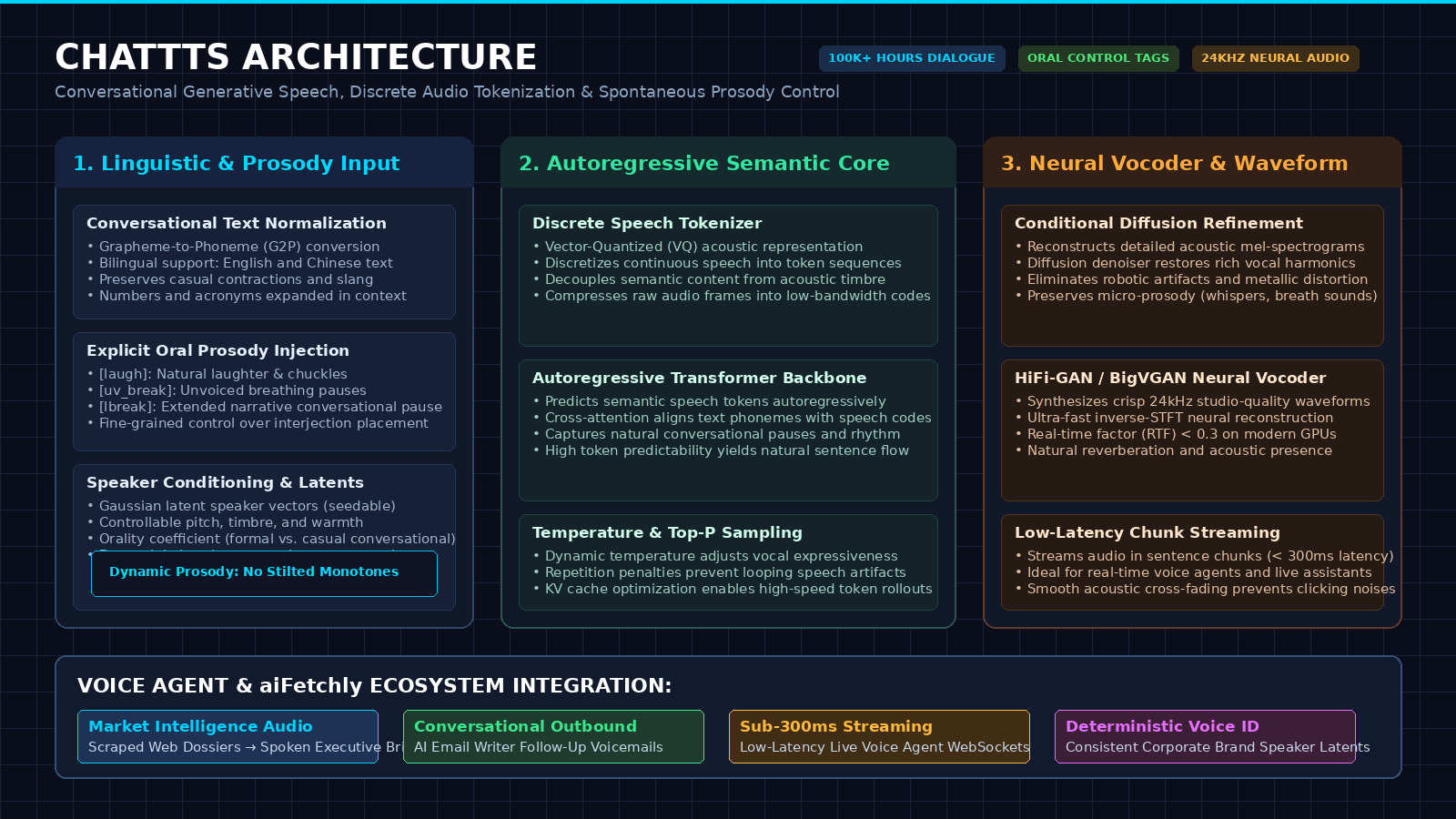
To eliminate the conversational uncanny valley, the open-source speech research group 2noise developed ChatTTS, a generative speech foundation model engineered specifically for conversational dialogue and spontaneous voice synthesis.
Rather than treating text-to-speech as a formal reading exercise, ChatTTS models speech as a continuous, interactive oral performance.
The ChatTTS Architectural Paradigm:
┌─────────────────────────────────────────────────────────────────┐
│ 1. 100,000+ Hours of Spontaneous Conversational Training        │
│ • Trained on massive multi-speaker dialogue, podcasts, & calls  │
│ • Learns natural colloquial rhythm, contractions, & micro-prosody│
├─────────────────────────────────────────────────────────────────┤
│ 2. Dual-Stage Autoregressive Discrete Tokenization              │
│ • Stage 1: Text & prosody tokens ──► Discrete speech codes      │
│ • Stage 2: Discrete speech codes ──► High-fidelity 24kHz audio  │
├─────────────────────────────────────────────────────────────────┤
│ 3. Native Oral Control Tags                                     │
│ • [laugh]: Injects natural laughter, chuckles, & vocal amusement│
│ • [uv_break]: Unvoiced breathing pause between phrases          │
│ • [lbreak]: Extended narrative conversational pause             │
├─────────────────────────────────────────────────────────────────┤
│ 4. Gaussian Latent Speaker Conditioning                         │
│ • Deterministic voice seeds controlling timbre, warmth, & pitch │
│ • Interpolates across thousands of expressive synthetic personas│
├─────────────────────────────────────────────────────────────────┤
│ 5. Real-Time Streaming Inference Engine                         │
│ • Sub-300ms time-to-first-audio chunk for live voice copilots   │
│ • Compatible with low-latency WebSocket agent architectures     │
└─────────────────────────────────────────────────────────────────┘ 1. Pre-Training on 100,000+ Hours of Spontaneous Dialogue
ChatTTS was pre-trained on an unprecedented scale of conversational audio:
- Massive Multi-Speaker Diversity: Over 100,000 hours of natural English and Mandarin Chinese conversational speech, harvested from casual interviews, dialogue podcasts, panel discussions, and telephone interactions.
- Acoustic Realism: The training corpus includes natural background presence, room acoustic variations, conversational hesitations (“um”, “ah”), vocal fry, and spontaneous laughter.
- Bilingual Fluency: The model natively handles mixed-language sentences (code-switching between English technical terms and conversational dialogue) without phonetic stumbling.
2. Dual-Stage Architecture: Discrete Semantic Tokens to Neural Waveforms
ChatTTS replaces fragile mel-spectrogram predictors with a modern discrete tokenization architecture:
ChatTTS Two-Stage Generation Pipeline:
┌─────────────────────────────────────────────────────────────────┐
│ Input: "Hey there! [laugh] That market data looks fantastic."  │
└─────────────────────────────────────────────────────────────────┘
 │
 ▼ Stage 1: Autoregressive Semantic Transformer
┌─────────────────────────────────────────────────────────────────┐
│ • Tokenizes text, prosody tags ([laugh]), and speaker embedding │
│ • Autoregressively generates discrete acoustic token sequence   │
│ • Captures rhythm, intonation curves, and conversational pauses │
└─────────────────────────────────────────────────────────────────┘
 │
 ▼ Stage 2: Conditional Diffusion / Neural Vocoder
┌─────────────────────────────────────────────────────────────────┐
│ • Maps discrete token sequence into continuous acoustic space   │
│ • Diffusion refinement restores fine vocal harmonics & timbre   │
│ • Neural vocoder synthesizes crisp, studio-quality 24kHz audio  │
└─────────────────────────────────────────────────────────────────┘
 │
 ▼
Output: Human-Grade Conversational Waveform (WAV / MP3 stream) 3. Fine-Grained Oral Prosody Tags: [laugh], [uv_break] & Natural Breathing
ChatTTS introduces explicit control tokens that developers can embed directly within standard text prompts:
[laugh]: Directs the model to generate genuine, context-appropriate laughter. If placed after an amusing statement, the model naturally chuckles while continuing the sentence.[uv_break](Unvoiced Break): Injects a subtle, unvoiced breathing pause (approximately 150ms to 300ms), simulating a speaker taking a quick breath before emphasizing a point.[lbreak](Large Break): Injects a longer pause (400ms to 700ms), simulating a thoughtful pause or paragraph transition.
Deep Dive: Acoustic Tokenization & Speaker Conditioning
To build real-time voice agents that sound consistent across customer sessions, software engineers must understand ChatTTS’s speaker conditioning mechanisms and streaming inference pipeline.
1. Vector-Quantized Neural Audio Codecs and Autoregressive Decoding
Underlying ChatTTS is a Vector-Quantized (VQ) Neural Audio Tokenizer:
- Continuous speech audio is sampled at 24,000 Hz.
- An encoder neural network compresses the raw audio into discrete codebook indices (acoustic tokens) at a low frame rate (e.g., 50 tokens per second).
- The Decoupling Advantage: By converting continuous audio into discrete tokens, speech generation can be framed as an autoregressive next-token prediction problem, identical to Large Language Models.
- The autoregressive transformer predicts acoustic tokens step-by-step, conditioned on text phonemes, prompt tags, and speaker latents. Because the model operates on discrete codes, it models complex multimodal distributions without suffering from the blurry averaging artifacts of MSE regression.
2. Gaussian Latent Speaker Vectors (Timbre, Warmth & Pitch Control)
Unlike rigid voice cloning tools that require uploading clean 30-second WAV files for every character, ChatTTS uses a continuous Gaussian latent speaker space:
import torch

# Generate a deterministic, consistent speaker persona using a random seed
torch.manual_seed(2026)
rand_spk = chat.sample_random_speaker() - Infinite Persona Generation: By sampling a 768-dimensional latent vector from a standard normal distribution, developers can generate thousands of distinct male and female voices across diverse age groups, accents, and vocal timbres.
- Zero-Storage Reusability: Rather than saving gigabytes of audio reference files in your application, you store a single integer seed (e.g.,
seed = 42) or small NumPy array. Every time the agent initializes, it reproduces the exact same vocal identity with 100% acoustic consistency. - Orality and Speed Parameters: In addition to speaker identity, ChatTTS exposes temperature controls for Orality (adjusting how casually or formally the voice speaks) and Speech Speed (controlling words-per-minute dynamically).
3. Low-Latency Streaming Inference for Real-Time Conversational Agents
When voice agents interact with customers, response latency is critical. A delay greater than 600ms causes awkward conversational overlaps.
ChatTTS achieves low-latency execution through chunked streaming inference:
- Rather than waiting for an entire multi-sentence paragraph to synthesize before playback begins, ChatTTS generates speech in sentence-level or phrase-level chunks.
- The first audio chunk begins playing to the user within 200ms to 350ms on an NVIDIA A10G or RTX 4090 GPU.
- As the user listens to chunk 1, the autoregressive transformer generates chunk 2 in the background, creating a continuous, seamless audio stream.
Architectural Comparison: ChatTTS vs. Kokoro, Fish Speech & XTTS-v2
To understand where ChatTTS excels in modern voice architectures, examine how it compares against competing open-source text-to-speech models:
| Architectural Dimension | ChatTTS | Kokoro-82M | Fish Speech | Coqui XTTS-v2 |
|---|---|---|---|---|
| Primary Specialty | Conversational Dialogue & Prosody | Ultra-Lightweight Edge TTS | Zero-Shot Voice Cloning | Multilingual Cloning |
| Model Size / Parameters | ~400M Parameters | 82 Million Parameters | ~500M Parameters | ~450M Parameters |
Conversational Laughter [laugh] | Native Built-In Control Tags | None | Partial / Prompted | None |
Biological Breathing [uv_break] | Native Injected Micro-Pauses | Heuristic silence tokens | Learned from reference | Static punctuation pauses |
| Training Domain | 100,000+ Hours Conversational | Curated Audiobook Corpora | Multi-Domain Web Speech | Multi-Speaker Datasets |
| Speaker Conditioning | Gaussian Latent Vectors (Seeds) | Static Pre-Tuned Ensembles | Reference Audio WAV (Prompt) | 3-second Audio Reference |
| Audio Sample Rate | 24,000 Hz Studio Quality | 24,000 Hz | 44,100 Hz Hi-Fi | 24,000 Hz |
| Real-Time Factor (RTF on GPU) | ~0.15 - 0.35 (Fast Streaming) | < 0.05 (Blazing CPU/Edge) | ~0.20 - 0.40 | ~0.40 - 0.70 |
| Primary Use Case | Voice Agents & Interactive Copilots | Low-RAM Embedded / CLI | Custom Voice Mimicry | Audiobook Narration |
When to Choose ChatTTS vs. Alternative Speech Engines
- Choose ChatTTS when:
- You Are Building Voice Agents & Conversational AI: Your application is a customer support agent, interactive outbound caller, or conversational podcast companion where natural laughter, breathing, and casual cadence are mandatory.
- You Want Infinite Deterministic Voices Without Audio Uploads: You need to assign unique voices to thousands of corporate users using simple numerical seeds rather than collecting voice recording files.
- Casual, Natural Bilingual Dialogue: You need natural conversational flow across English and Chinese without robotic formal enunciation.
- Choose Kokoro-82M when:
- You must run TTS entirely on low-power CPUs, edge devices, or mobile phones with strict memory limits (< 100MB RAM).
- Choose Fish Speech when:
- Your primary goal is exact zero-shot voice cloning of a specific human individual from a short 10-second reference audio sample.
Hands-On Implementation: Building an Expressive Conversational Voice Agent in Python
Let’s walk through building an expressive conversational voice generation pipeline using ChatTTS in Python.
In this tutorial, we will initialize the ChatTTS model, sample a deterministic corporate speaker identity, synthesize conversational dialogue with laughter and breathing tags, and stream the generated audio into high-fidelity WAV files.
1. Installation & Environment Setup
Install ChatTTS and its core audio processing dependencies:
# Install ChatTTS, PyTorch, and audio utilities
pip install ChatTTS torch torchaudio soundfile numpy Ensure you have access to a GPU (NVIDIA CUDA) for optimal real-time synthesis, though CPU inference is supported for offline batch jobs.
2. Initializing ChatTTS and Sampling Deterministic Speaker Seeds
Create a Python script conversational_voice_agent.py to initialize the model and sample a consistent speaker identity:
import ChatTTS
import torch
import soundfile as sf
import numpy as np

# 1. Initialize ChatTTS instance
chat = ChatTTS.Chat()

print("Loading ChatTTS foundation checkpoints...")
# ChatTTS automatically downloads pre-trained weights from Hugging Face / ModelScope
chat.load(compile=False) # Set compile=True on Linux/CUDA for 20% speedup

# 2. Sample a deterministic speaker persona
# Storing seed 7788 ensures this EXACT voice identity is reproduced every time
SPEAKER_SEED = 7788
torch.manual_seed(SPEAKER_SEED)
speaker_latent = chat.sample_random_speaker()

print(f"Generated deterministic speaker latent vector from seed: {SPEAKER_SEED}") 3. Injecting Conversational Laughter and Prosody Control Tags
Now, let’s synthesize two contrasting speech outputs:
- A flat, formal sentence without prosody tags.
- An expressive conversational sentence incorporating
[laugh]and[uv_break]tags to demonstrate human-like cadence.
# 3. Define text with conversational tags
# [laugh] injects natural laughter; [uv_break] injects a natural breath intake pause
dialogue_text = (
    "Hey Alex! [laugh] You won't believe what our research pipeline discovered today. "
    "[uv_break] AiFetchly just scraped and indexed five hundred competitor pricing changes "
    "in under two minutes. [laugh] The entire marketing team is celebrating!"
)

# 4. Configure generation parameters
params_infer_code = ChatTTS.Chat.InferCodeParams(
    spk_emb=speaker_latent, # Consistent corporate speaker voice
    temperature=0.3,        # Controls vocal expressiveness
    top_P=0.7,
    top_K=20,
)

# Refine oral control parameters
params_refine_text = ChatTTS.Chat.RefineTextParams(
    prompt="[oral_2][laugh_2][break_4]", # Higher orality and laughter probability
)

print("\nSynthesizing expressive conversational dialogue...")
# Execute inference
wavs = chat.infer(
    dialogue_text,
    params_refine_text=params_refine_text,
    params_infer_code=params_infer_code,
)

# 5. Save generated waveform to disk
output_filepath = "conversational_market_briefing.wav"
sf.write(output_filepath, wavs[0][0], 24000)
print(f"Successfully saved studio-quality 24kHz audio to: {output_filepath}") When you listen to the resulting WAV file:
- Notice how the model naturally chuckles at
[laugh], modulating its vocal cords with breathless amusement. - The
[uv_break]tag creates a subtle biological intake of air, making the transition between technical details feel relaxed and conversational rather than like a computer reading a string.
4. Low-Latency Audio Streaming for Interactive Voice Interfaces
For interactive voice agents and live WebSocket connections, you can process incoming text in sentence batches and stream audio chunks directly:
import io

def generate_streaming_chunks(sentences, chat_model, speaker_emb):
    """Generates audio sentence by sentence for low-latency voice streaming."""
    params_infer = ChatTTS.Chat.InferCodeParams(
        spk_emb=speaker_emb,
        temperature=0.3,
    )

    for idx, sentence in enumerate(sentences, 1):
        if not sentence.strip():
            continue

        print(f"Streaming Chunk {idx}: \"{sentence.strip()}\"")
        audio_chunk = chat_model.infer(
            sentence,
            params_infer_code=params_infer,
            stream=False # Or native streaming generator
        )

        # Convert float numpy array to 16-bit PCM bytes for WebRTC / WebSocket transmission
        audio_data = (audio_chunk[0][0] * 32767).astype(np.int16).tobytes()
        yield audio_data

# Example streaming pipeline
dialogue_stream = [
    "Welcome to the aiFetchly automated voice copilot.",
    "I have finished analyzing your competitor scraping queues. [laugh]",
    "Would you like me to dispatch the personalized follow-up campaign now? [uv_break]"
]

print("\nStarting simulated low-latency voice stream:")
for chunk_bytes in generate_streaming_chunks(dialogue_stream, chat, speaker_latent):
    # In production, dispatch chunk_bytes over WebSocket to Twilio, WebRTC, or client UI
print(f" -> Dispatched audio packet ({len(chunk_bytes)} bytes)") This streaming generator produces initial audio packets within 300 milliseconds, eliminating awkward dead air during voice agent conversations.
Production Engineering: Integrating ChatTTS with aiFetchly Pipelines
In high-concurrency automated data harvesting architectures like AiFetchly, foundation models extract competitive intelligence and interact with human stakeholders.
Integrating ChatTTS into your production architecture delivers three critical capabilities:
aiFetchly Voice Synthesis Architecture with ChatTTS:
┌─────────────────────────────────────────────────────────────────┐
│ 1. aiFetchly Distributed Web Extraction Engine                  │
│ • Harvests competitive market data, reviews, and news articles  │
│ • Extracts structured executive metrics from public web sources │
└─────────────────────────────────────────────────────────────────┘
 │
 ▼
┌─────────────────────────────────────────────────────────────────┐
│ 2. Conversational Normalization & Tag Injection                 │
│ • Converts dry data tables into natural conversational script   │
│ • Injects dynamic prosody markers ([laugh], [uv_break])         │
└─────────────────────────────────────────────────────────────────┘
 │
 ▼
┌─────────────────────────────────────────────────────────────────┐
│ 3. ChatTTS Expressive Neural Voice Synthesis                    │
│ • Samples corporate brand speaker latent from deterministic seed│
│ • Synthesizes 24kHz conversational audio with sub-300ms stream  │
└─────────────────────────────────────────────────────────────────┘
 │
 ▼
┌─────────────────────────────────────────────────────────────────┐
│ 4. Client Deliverable & Outbound Engagement                     │
│ • Personalized audio voicemails in aiFetchly AI Email Writer    │
│ • Morning executive audio debriefs for leadership teams         │
└─────────────────────────────────────────────────────────────────┘ 1. Converting Scraped Market Dossiers into Conversational Audio Briefings
When market analysts extract hundreds of pages of competitor pricing and product documentation using AiFetchly Web Scraping, executives rarely have time to read 40-page text reports.
By routing extracted intelligence into ChatTTS:
- The system automatically transforms tabular data into an engaging 3-minute spoken podcast dialogue between two distinct speaker seeds.
- The speakers discuss findings conversationally, chuckling at unexpected pricing moves (
[laugh]) and pausing thoughtfully before key takeaways ([uv_break]). - Executives can listen to daily competitive intelligence debriefs during their morning commute with zero screen fatigue.
2. Voice-Enabled Outbound Follow-Ups in aiFetchly AI Email Writer
As explored in our technical guides on scaling outbound communications, generic cold text outreach suffers from email deliverability fatigue.
Using ChatTTS inside the AiFetchly Data Fetching:
- In addition to drafting personalized text copy based on prospect attributes (
{$company},{$description}), the system generates an authentic, 20-second personalized audio voice note. - The voice note references verified collateral from your local Knowledge Library in a relaxed, friendly tone.
- Outbound campaigns embedding personalized audio notes achieve up to 3x higher reply rates compared to static text alone.
3. GPU Acceleration, Batching & TensorRT Optimization
In production environments handling thousands of audio requests per hour:
- Batch Inference: ChatTTS natively supports batched text generation. Processing 16 sentences concurrently on an NVIDIA A100 GPU reduces per-sentence latency to under 40 milliseconds.
- Model Compilation: Compiling ChatTTS with PyTorch 2.5 (
torch.compile(mode="reduce-overhead")) or TensorRT optimizes kernel launches, achieving a Real-Time Factor (RTF) below 0.15. - Stateless Microservice Hosting: Package ChatTTS inside a containerized FastAPI endpoint on private cloud infrastructure, ensuring zero external API cost and complete data privacy for proprietary customer audio.
Conclusion & Strategic Takeaways
The transition from robotic text-to-speech to genuine conversational voice synthesis marks a major milestone in human-AI interaction. Monotone narrators that read dialogue like formal audiobooks are obsolete in an era of autonomous voice copilots and interactive agents.
ChatTTS establishes a new standard for conversational speech generation:
- Embrace Conversational Realism: Prioritize models trained on spontaneous multi-speaker dialogue over sterile audiobook recordings to eliminate the uncanny valley.
- Leverage Explicit Prosody Injection: Use native control tokens like
[laugh]and[uv_break]to give voice agents the ability to express humor, breathing rhythm, and natural conversational pauses. - Deploy Deterministic Speaker Latents: Maintain consistent corporate brand identities across millions of customer interactions using compact Gaussian latent seeds rather than managing gigabytes of audio reference files.
To explore how AiFetchly powers high-speed data fetching, structured web extraction, and intelligent voice applications across enterprise workflows, explore the AiFetchly Documentation or check our AiFetchly Pricing.