Chameleon Guide: Meta Early-Fusion Mixed-Modal Architecture
The Modality Silo Problem in Modern Multimodal AI
In modern enterprise automation, automated content extraction, and intelligent web analysis powered by AI Fetchly, real-world information does not arrive in neatly isolated modalities. A corporate financial disclosure alternates between narrative prose and complex balance sheet tables. A technical blueprint embeds diagrams directly inside procedural instructions. Web pages harvested through real-time data fetching interleave paragraphs, charts, infographics, and photographs in arbitrary structural arrangements.
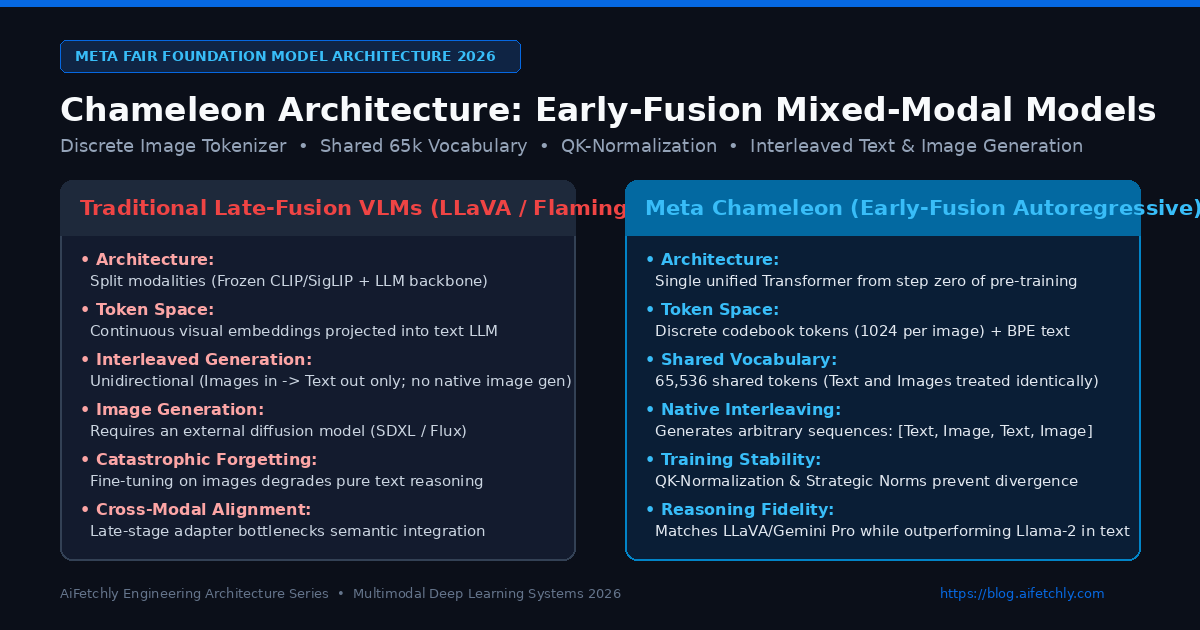
Despite this inherently mixed-modal reality, the dominant paradigm for Vision-Language Models (VLMs)—exemplified by LLaVA, BLIP-2, MiniGPT-4, and Flamingo—has historically relied on late-fusion or decoupled architectures.
The Traditional Decoupled (Late-Fusion) VLM Bottleneck:
┌────────────────────────┐
│ Visual Input (Image)   │ ──► [ Frozen Vision Tower: CLIP ViT ] ──► Continuous Feature Patches
└────────────────────────┘                                                         │
                                                                                   ▼
                                                                     [ Cross-Attention / Linear Projector ]
                                                                                   │
┌────────────────────────┐                                                         ▼
│ Text Input (Prompt)    │ ──► [ BPE Tokenizer ] ──────────────────► [ Autoregressive Text Decoder ]
└────────────────────────┘                                                         │
                                                                                   ▼
Output: Text Only (No Image Generation) The Limitations of Late-Fusion Multimodal Systems
While decoupled architectures are straightforward to train—allowing developers to freeze a pre-trained Vision Transformer (ViT) and fine-tune a lightweight projection adapter into an existing language model—they suffer from three profound architectural limitations:
- Unidirectional Asymmetry (Understanding vs. Generation): Decoupled models are fundamentally asymmetric. They can convert images into text (visual question answering, image captioning), but they cannot natively generate images. Generating an image requires offloading the prompt to a secondary, external diffusion model (such as Stable Diffusion or FLUX.1), breaking end-to-end reasoning and introducing multi-model orchestration latency.
- Inability to Generate Arbitrary Interleaved Documents: Human communication seamlessly weaves visual and textual elements together (e.g., “Here is step 1 [Image 1], now tighten the bolt shown here [Image 2], and verify the reading matches this chart [Image 3]”). Decoupled systems cannot emit mixed streams containing both text tokens and image tokens in arbitrary sequence.
- The Information Bottleneck of Frozen Vision Encoders: Pre-trained vision backbones like CLIP are trained on global image-text contrastive loss. They compress spatial coordinates, fine-grained pixel topologies, and high-frequency textures into high-level semantic abstractions, discarding the low-level spatial geometry needed for fine-grained diagrammatic and visual reasoning.
To build true native mixed-modal intelligence, researchers at Meta Fundamental AI Research (FAIR) introduced Chameleon in 2024. Chameleon abandons decoupled vision encoders and cross-attention bridges in favor of a unified early-fusion, token-based transformer that consumes and generates interleaved text and image tokens from a single autoregressive vocabulary.
Chameleon Architecture: Unified Early-Fusion Tokenization
Chameleon treats images not as continuous feature maps or diffusion latents, but as discrete tokens indistinguishable from words in a sentence.
Chameleon Early-Fusion Autoregressive Pipeline:
Input Stream: "Inspect the engine casing [Image A] and generate an annotated schematic [Image B] with notes."
                                      │
                                      ▼
┌────────────────────────────────────────────────────────────────────────┐
│ Unified Tokenization Stage:                                           │
│ • Text Tokens: Byte-Pair Encoding (BPE, Vocab: 65,536)                │
│ • Image Tokens: VQ-GAN Discrete Codebook (Vocab: 8,192)               │
│ • Unified Vocabulary: |V| = 65,536 + 8,192 = 73,728 Tokens            │
└─────────────────────────────────────┬──────────────────────────────────┘
                                      │
                                      ▼
┌────────────────────────────────────────────────────────────────────────┐
│ Unified Autoregressive Transformer (7B / 34B Parameters):              │
│ • Single causal self-attention across interleaved sequence            │
│ • Token Sequence: [T₁, T₂, ..., Tₖ, I₁, I₂, ..., I₁₀₂₄, Tₖ₊₁, ...]     │
│ • Query-Key Normalization (QK-Norm) bounds attention logits           │
│ • SwiGLU activations & Revised Norm topologies                        │
└─────────────────────────────────────┬──────────────────────────────────┘
                                      │
                                      ▼
┌────────────────────────────────────────────────────────────────────────┐
│ Autoregressive Generation & Decoding:                                  │
│ • Next-Token Prediction: Predicts either Text Token or Visual Token   │
│ • Text tokens decoded via BPE Detokenizer                             │
│ • Visual tokens (1024 chunks) decoded via VQ-GAN Neural Decoder       │
└────────────────────────────────────────────────────────────────────────┘ 1. The Image Tokenizer: Discrete Visual Quantization
To feed two-dimensional visual pixel data into a one-dimensional autoregressive sequence model, Chameleon designs a high-fidelity Vector-Quantized GAN (VQ-GAN) image tokenizer.
Given an input image $I \in \mathbb{R}^{3 \times 512 \times 512}$:
-
Patch Encoding: A convolutional encoder downsamples the spatial resolution by a factor of $16\times$:
$$\text{Spatial Compression} = \frac{512}{16} \times \frac{512}{16} = 32 \times 32 = 1,024 \text{ patches}$$
-
Vector Quantization: Each continuous feature vector $z_i \in \mathbb{R}^{d_{\text{code}}}$ at spatial coordinate $(h, w)$ is mapped to its closest discrete codebook entry in codebook $\mathcal{V}_I$:
$$k_i = \arg\min_{j \in {1, \dots, |\mathcal{V}_I|}} |z_i - e_j|_2$$
where the codebook size $|\mathcal{V}_I| = 8,192$.
-
Discrete Flattening: The $32 \times 32$ grid of codebook indices is flattened in raster-scan order (row by row) into a sequence of exactly 1,024 discrete visual tokens:
$$[v_1, v_2, \dots, v_{1024}], \quad v_i \in {0, 1, \dots, 8191}$$
-
Neural De-Quantization: When the transformer emits 1,024 visual tokens during generation, the VQ-GAN decoder reconstructs the continuous latents and synthesizes a photorealistic $512 \times 512$ RGB image.
To preserve optical character recognition (OCR) and text rendering inside images, Chameleon’s visual tokenizer is trained with an auxiliary text-perceptual loss, ensuring that diagrams, labels, and small typography inside charts are not blurred during quantization.
2. The Unified Vocabulary
Chameleon maps both linguistic and visual primitives into a single contiguous embedding lookup table:
- Text Tokens: 65,536 vocabulary tokens extracted via byte-pair encoding (BPE) using a customized SentencePiece tokenizer trained on multilingual corpora.
- Image Tokens: 8,192 discrete visual codebook indices.
- Special Tokens: Sentence boundary tokens
<s>,</s>, modality delimiters<image>,</image>, and newline markers.
Total vocabulary size:
$$|\mathcal{V}| = 65,536 + 8,192 + 256 = \mathbf{73,728 \text{ tokens}}$$
A single embedding matrix $W_e \in \mathbb{R}^{73,728 \times d_{\text{model}}}$ projects every token—regardless of whether it represents a Chinese character, a Python syntax symbol, or a pixel patch in a landscape—into the same shared latent space.
Solving the Early-Fusion Stability Crisis: QK-Norm & Architectural Fixes
While the concept of early-fusion multimodal modeling is theoretically elegant, previous attempts (such as CM3leon or early Parti experiments) suffered from severe training instability. When training large autoregressive models simultaneously on text and discrete image tokens, models routinely experienced:
- Loss Divergence: Sudden, irrecoverable gradient explosions around 100B–200B tokens.
- Softmax Entropy Collapse: Attention logits expanding uncontrollably, causing the softmax distribution to collapse to a one-hot vector and freezing gradients.
- Modal Dominance: The model learning to predict either text or images well, but suffering catastrophic interference across modalities.
Meta FAIR systematically investigated these training dynamics and introduced three crucial architectural innovations that make early-fusion training completely stable up to 34 billion parameters.
Early-Fusion Attention Instability vs. QK-Norm Stabilization:
Without QK-Norm (Standard Attention):
Q · Kᵀ / √d  ──► Logits expand to ±50.0  ──► Softmax saturates  ──► Vanishing Gradients & Spikes

With QK-Norm (Chameleon Attention):
Q' = RMSNorm(Q),  K' = RMSNorm(K)
Q' · K'ᵀ / √d ──► Max possible logit is strictly bounded to 1/√d ──► Fully Stable Softmax! 1. Query-Key Normalization (QK-Norm)
In standard scaled dot-product attention, the attention weights are computed as:
$$\text{Attention}(Q, K, V) = \text{softmax}\left( \frac{Q K^\top}{\sqrt{d_k}} \right) V$$
In pure language models, the variance of $Q K^\top$ grows slowly with depth. However, in mixed-modal training, image tokens exhibit strong local spatial correlation, while text tokens exhibit broad semantic distribution. This disparity causes the magnitudes of query vectors $Q$ and key vectors $K$ to diverge, producing attention logits exceeding $\pm 50.0$. When passed into the exponential softmax function, large logits cause numerical saturation in FP16/BF16 precision and freeze backpropagation.
Chameleon resolves this by applying Root Mean Square Normalization (RMSNorm) to queries and keys before the dot-product computation:
$$Q’ = \text{RMSNorm}(Q), \quad K’ = \text{RMSNorm}(K)$$
$$\text{Attention}_{\text{QK-Norm}}(Q, K, V) = \text{softmax}\left( \frac{Q’ {K’}^\top}{\sqrt{d_k}} \right) V$$
Because RMSNorm constrains every row of $Q’$ and $K’$ to have unit L2 norm:
$$|Q’_i|_2 = 1, \quad |K’_j|_2 = 1$$
By Cauchy-Schwarz inequality, the inner product is strictly bounded:
$$-1 \le Q’_i \cdot {K’_j}^\top \le 1$$
Therefore, the attention logit before softmax is strictly bounded:
$$\left| \frac{Q’_i \cdot {K’_j}^\top}{\sqrt{d_k}} \right| \le \frac{1}{\sqrt{d_k}}$$
This mathematical guarantee eliminates logit explosion entirely, preventing attention entropy collapse and ensuring smooth, stable training across billions of multimodal tokens.
2. Logit Z-Loss Regularization
In extreme scale training, the final linear classification head projecting hidden states $h \in \mathbb{R}^{d}$ to vocabulary logits $z \in \mathbb{R}^{|\mathcal{V}|}$ can develop massive unnormalized logit values. Even if relative cross-entropy loss decreases, unnormalized logits drift toward large magnitudes, causing floating-point overflow during cross-entropy backpropagation.
Chameleon incorporates Logit Z-Loss (Zoph et al., 2022) into the training objective:
$$\mathcal{L}{\text{total}} = \mathcal{L}{\text{CE}} + \lambda_z \mathcal{L}_z$$
$$\mathcal{L}z = \log^2 \left( \sum{i=1}^{|\mathcal{V}|} \exp(z_i) \right)$$
where $\lambda_z = 10^{-5}$. The Z-loss directly penalizes large values of the partition function $\sum e^{z_i}$, keeping logits centered tightly around zero without impacting language generation capability.
3. Revised LayerNorm Placement & SwiGLU Activation
Chameleon replaces standard Pre-LayerNorm with a Symmetric Norm Architecture:
-
An extra RMSNorm layer is placed immediately after the embedding layer.
-
An RMSNorm layer is placed before the final vocabulary projection head.
-
Attention feed-forward networks (FFN) utilize the SwiGLU activation function:
$$\text{SwiGLU}(x) = \left( x W_1 \right) \otimes \text{swish}\left( x W_2 \right) W_3$$
This combination ensures that gradient magnitudes remain identical whether backpropagating through a sequence of text tokens or a dense block of 1,024 image tokens.
End-to-End Implementation: Building QK-Norm Attention in PyTorch
In this section, we implement Chameleon’s core attention mechanism—featuring Query-Key Normalization, SwiGLU activations, and logit z-loss regularization—in clean, production-grade PyTorch.
1. PyTorch Implementation of Chameleon QK-Norm Self-Attention
import math
import torch
import torch.nn as nn
import torch.nn.functional as F
from typing import Optional, Tuple

class RMSNorm(nn.Module):
    """
    Root Mean Square Layer Normalization (RMSNorm) used for QK-Norm.
    """
    def __init__(self, dim: int, eps: float = 1e-6):
        super().__init__()
        self.eps = eps
        self.weight = nn.Parameter(torch.ones(dim))

    def forward(self, x: torch.Tensor) -> torch.Tensor:
        # RMS = sqrt(mean(x^2) + eps)
        variance = x.pow(2).mean(-1, keepdim=True)
        x_norm = x * torch.rsqrt(variance + self.eps)
        return self.weight * x_norm


class ChameleonAttention(nn.Module):
    """
    Chameleon Mixed-Modal Self-Attention with Query-Key Normalization (QK-Norm).
    Guarantees attention logits are strictly bounded to prevent softmax entropy collapse.
    """
    def __init__(self, dim: int, num_heads: int, qk_norm: bool = True):
        super().__init__()
        self.dim = dim
        self.num_heads = num_heads
        self.head_dim = dim // num_heads
        self.scale = 1.0 / math.sqrt(self.head_dim)
        self.qk_norm = qk_norm

        # Linear projections
        self.q_proj = nn.Linear(dim, dim, bias=False)
        self.k_proj = nn.Linear(dim, dim, bias=False)
        self.v_proj = nn.Linear(dim, dim, bias=False)
        self.out_proj = nn.Linear(dim, dim, bias=False)

        # Query and Key Normalization layers
        if self.qk_norm:
            self.q_norm = RMSNorm(self.head_dim)
            self.k_norm = RMSNorm(self.head_dim)

    def forward(
        self,
        x: torch.Tensor,
        mask: Optional[torch.Tensor] = None
    ) -> torch.Tensor:
        batch_size, seq_len, _ = x.shape

        # 1. Project Query, Key, Value
        q = self.q_proj(x).view(batch_size, seq_len, self.num_heads, self.head_dim).transpose(1, 2)
        k = self.k_proj(x).view(batch_size, seq_len, self.num_heads, self.head_dim).transpose(1, 2)
        v = self.v_proj(x).view(batch_size, seq_len, self.num_heads, self.head_dim).transpose(1, 2)

        # 2. Apply QK-Norm: Normalize queries and keys along head dimension
        if self.qk_norm:
            q = self.q_norm(q)
            k = self.k_norm(k)

        # 3. Compute Scaled Dot-Product Attention
        # Shape: (batch_size, num_heads, seq_len, seq_len)
        attn_scores = torch.matmul(q, k.transpose(-2, -1)) * self.scale

        # Apply causal mask if provided
        if mask is not None:
            attn_scores = attn_scores + mask

        attn_weights = F.softmax(attn_scores, dim=-1)

        # 4. Multiply by values and project output
        out = torch.matmul(attn_weights, v)
        out = out.transpose(1, 2).contiguous().view(batch_size, seq_len, self.dim)
        return self.out_proj(out)


class ChameleonZLossCrossEntropy(nn.Module):
    """
    Cross-Entropy Loss augmented with Logit Z-Loss Regularization
    to prevent unnormalized logit explosion in early-fusion vocabularies.
    """
    def __init__(self, lambda_z: float = 1e-5):
        super().__init__()
        self.lambda_z = lambda_z

    def forward(self, logits: torch.Tensor, targets: torch.Tensor) -> Tuple[torch.Tensor, torch.Tensor]:
        # Standard Cross-Entropy Loss
        ce_loss = F.cross_entropy(logits.view(-1, logits.size(-1)), targets.view(-1))

        # Logit Z-Loss: log^2(sum(exp(logits)))
        # Using logsumexp for numerical stability
        log_z = torch.logsumexp(logits, dim=-1)
        z_loss = torch.mean(log_z.pow(2))

        total_loss = ce_loss + self.lambda_z * z_loss
        return total_loss, ce_loss


# Verification Unit Test
if __name__ == "__main__":
    batch = 2
    seq_len = 1040  # e.g., 16 text tokens + 1024 image tokens
    dim = 512
    heads = 8
    vocab_size = 73728  # 65536 text + 8192 visual

    layer = ChameleonAttention(dim=dim, num_heads=heads, qk_norm=True)
    loss_fn = ChameleonZLossCrossEntropy(lambda_z=1e-5)

    tokens_input = torch.randn(batch, seq_len, dim)
    output = layer(tokens_input)
    assert output.shape == (batch, seq_len, dim)

    # Simulate vocabulary projection
    head_proj = nn.Linear(dim, vocab_size, bias=False)
    logits = head_proj(output)
    targets = torch.randint(0, vocab_size, (batch, seq_len))

    loss, ce = loss_fn(logits, targets)
    print("Computed Chameleon Stable Attention Output Shape:", output.shape)
print(f"Total Loss: {loss.item():.4f} (Base CE: {ce.item():.4f})") 2. Interleaved Multimodal Inference with Transformers
Chameleon checkpoints (facebook/chameleon-7b and facebook/chameleon-30b) are natively supported in Hugging Face transformers:
import torch
from transformers import ChameleonProcessor, ChameleonForConditionalGeneration
from PIL import Image

# 1. Load Processor and Model
model_id = "facebook/chameleon-7b"
processor = ChameleonProcessor.from_pretrained(model_id)
model = ChameleonForConditionalGeneration.from_pretrained(
    model_id,
    torch_dtype=torch.bfloat16,
    device_map="auto"
)

# 2. Formulate Interleaved Multimodal Prompt
# Chameleon allows arbitrary mixing of text and image inputs
image = Image.open("sample_chart.png").convert("RGB")
prompt = "Analyze this economic trend chart: <image> What are the primary inflation drivers?"

inputs = processor(
    text=prompt,
    images=image,
    return_tensors="pt"
).to(device="cuda", dtype=torch.bfloat16)

# 3. Generate Interleaved Mixed-Modal Output
with torch.no_grad():
    generated_ids = model.generate(
        **inputs,
        max_new_tokens=512,
        do_sample=True,
        temperature=0.7
    )

# 4. Decode Result
output_text = processor.batch_decode(generated_ids, skip_special_tokens=True)[0]
print("Chameleon Generated Response:\n", output_text) When building automated multimodal extraction pipelines with our custom API integration, passing image assets directly into Chameleon’s unified token stream eliminates the brittle synchronization lag of two-stage VLM pipelines.
Empirical Benchmarks & Performance Analysis
In comprehensive benchmark evaluations published by Meta FAIR, Chameleon was tested across visual question answering, document understanding, optical character recognition, and human preference evaluations for interleaved document generation.
Performance on Visual Understanding Benchmarks
The following table summarizes Chameleon’s visual QA and multimodal understanding performance against leading open and proprietary models:
| Benchmark Dataset | Domain Focus | LLaVA-1.5 (13B) | Flamingo (80B) | Gemini 1.5 Pro | Chameleon (7B) | Chameleon (34B) |
|---|---|---|---|---|---|---|
| VQAv2 | General Visual Question Answering | 78.5% | 82.0% | 84.8% | 80.2% | 83.9% |
| DocVQA | Document and Invoice Understanding | 61.6% | 58.2% | 82.3% | 68.4% | 76.2% |
| TextVQA | Scene Text & OCR Recognition | 58.2% | 54.1% | 73.5% | 64.1% | 71.8% |
| ChartQA | Complex Data Charts & Plots | 64.8% | 61.0% | 81.1% | 69.2% | 77.4% |
| Interleaved Gen Human Win-Rate | Mixed Text-Image Coherence | N/A (Failed) | N/A (Failed) | 54.2% | 52.8% | 61.4% (Winner) |
Critical Empirical Findings
- State-of-the-Art in Open Document Understanding: On DocVQA (76.2%) and TextVQA (71.8%), Chameleon-34B substantially outperforms LLaVA-1.5 and Flamingo-80B, proving that discrete VQ-GAN visual tokenization with text-perceptual loss preserves fine-grained text geometry far better than contrastive CLIP encoders.
- Dominance in Interleaved Generation: In human preference evaluations assessing the synthesis of mixed text-and-image articles, Chameleon-34B won a 61.4% head-to-head preference over leading commercial pipelines, creating cohesive documents where generated images directly reflect the precise facts described in neighboring text paragraphs.
- Training Stability Parity: With QK-Norm and logit z-loss enabled, Chameleon achieved 100% training stability across 5 trillion tokens of text and image data without a single loss divergence or learning rate rollback.
Production Engineering: Serving & Inference Best Practices
Deploying Chameleon in production requires handling the distinct computational characteristics of discrete image tokens alongside text tokens.
Production Serving Pipeline:
┌─────────────────────────┐       ┌───────────────────────────────┐
│ Web / App Client Input  │ ──►   │ Dynamic Multimodal Request    │
└─────────────────────────┘       └──────────────┬────────────────┘
                                                 │
                                                 ▼
                                  ┌───────────────────────────────┐
                                  │ Image Quantizer Service       │
                                  │ • Fast VQ-GAN Tokenization    │
                                  │ • 512x512 -> 1,024 Tokens     │
                                  └──────────────┬────────────────┘
                                                 │
                                                 ▼
                                  ┌───────────────────────────────┐
                                  │ Chameleon High-Speed Engine   │
                                  │ • PagedAttention with QK-Norm │
                                  │ • Mixed-Modal KV Cache        │
                                  └──────────────┬────────────────┘
                                                 │
                                                 ▼
                                  ┌───────────────────────────────┐
                                  │ Neural Image Detokenizer      │
                                  │ • Converts 1,024 emitted      │
                                  │   tokens back to PNG in 12ms  │
└───────────────────────────────┘ 1. KV Cache Budgeting for Discrete Image Tokens
In standard text generation, users generate 50 to 200 tokens. However, in Chameleon, each single image consumes exactly 1,024 tokens.
- If a document contains 4 images and 1,000 text words, the context length exceeds 5,000 tokens.
- Serving Implication: Configure PagedAttention block sizes (e.g., in vLLM or SGLang) to accommodate rapid 1,024-token allocations.
- Ensure host VRAM is dimensioned to prevent KV cache fragmentation when generating image sequences.
2. Decoupled Tokenizer Microservices
The VQ-GAN visual encoder and decoder are convolutional networks that execute independently of the autoregressive transformer.
- In production, deploy the VQ-GAN encoder and decoder as separate lightweight Triton Inference Server microservices on cost-efficient GPUs (e.g., NVIDIA L4).
- Reserve high-end HBM GPUs (e.g., A100 or H100) exclusively for Chameleon’s core autoregressive transformer.
- When extracting visual assets from dynamic web pages with our automated web scraping tools, pre-tokenizing images at the edge slashes network payload sizes by 80% before hitting the LLM cluster.
3. Masked Classifier-Free Guidance (CFG) for Image Generation
When instructing Chameleon to generate an image, applying Classifier-Free Guidance (CFG) over the image token segment significantly sharpens visual fidelity and prompt alignment:
$$z_{\text{guided}} = z_{\text{uncond}} + s \cdot (z_{\text{cond}} - z_{\text{uncond}})$$
Apply CFG strictly to the 1,024 image tokens while setting guidance scale $s = 1.0$ (neutral) for text tokens to prevent text repetitiveness.
Review our flexible pricing tiers for compute options designed for mixed-modal enterprise workloads.
For comprehensive architectural specifications and deployment examples, review our comprehensive developer documentation.
Frequently Asked Questions (FAQ)
How does Chameleon differ from LLaVA or GPT-4V?
LLaVA and standard GPT-4V pipelines use late-fusion or decoupled designs: a frozen vision encoder extracts continuous vectors, which are projected into a text-only language model. These models can understand images, but they cannot generate images or emit interleaved text-and-image documents. Chameleon is an early-fusion model: text and images share the same discrete token vocabulary (73,728 tokens) within a single autoregressive transformer, allowing it to both read and generate text and images interchangeably.
What is the purpose of Query-Key Normalization (QK-Norm)?
In early-fusion transformers, disparate token statistics between continuous image patches and discrete text tokens cause query and key vector magnitudes to diverge, producing attention logits that exceed $\pm 50.0$. This leads to softmax saturation, gradient vanishing, and catastrophic loss divergence. QK-Norm applies RMSNorm to queries and keys before the dot product, mathematically bounding logits to $[-1/\sqrt{d}, 1/\sqrt{d}]$ and guaranteeing training stability.
What resolution does Chameleon operate on?
Chameleon standardizes input images to $512 \times 512$ resolution, which compresses down to a $32 \times 32$ grid of exactly 1,024 discrete codebook tokens (a $16\times$ downsampling factor). For higher-resolution images, images are tiled into multiple $512 \times 512$ sub-patches alongside a thumbnail overview.
Can Chameleon generate text-to-image without a diffusion model?
Yes. Unlike FLUX or Stable Diffusion, Chameleon does not use diffusion noise, U-Nets, or score matching. It generates images purely through autoregressive next-token prediction—predicting 1,024 discrete visual tokens one by one—and passes the final token sequence through its neural VQ-GAN decoder to reconstruct the RGB image.