Ceva NeuPro-M Guide: Heterogeneous Edge AI NPU Architecture
The Homogeneous Trap: Why Monolithic Matrix Accelerators Stall on Edge Foundation Models
The rapid evolution of edge computing from narrow, single-purpose convolutional vision models toward generative foundation models, Vision Transformers (ViT), simultaneous localization and mapping (SLAM), and multimodal sensory perception has exposed a catastrophic architectural failure mode in contemporary edge processor design: the homogeneous execution trap.
For the past half-decade, commercial Neural Processing Unit (NPU) IP cores were designed almost exclusively around dense, homogeneous matrix-multiplication arrays. These fixed systolic engines were optimized to execute identical multiply-accumulate (MAC) loops across static two-dimensional convolutional layers. However, modern multimodal foundation models—such as CLIP, LLaMA-3, Whisper speech decoders, Segment Anything (SAM), and autonomous driving perception graphs—are fundamentally heterogeneous in mathematical composition:
- The Matrix vs. Vector Execution Imbalance: Modern neural networks consist of an intricate interweaving of dense matrix contractions and complex non-matrix vector operations. While attention projections ($Q \times K^T$) and feed-forward linear layers require massive matrix compute, they are punctuated at every layer by non-linear activations (GELU, SwiGLU), Layer Normalization, Root Mean Square Normalization (RMSNorm), dynamic Softmax scaling, position encodings (RoPE), and elementwise residual additions. When a homogeneous matrix NPU encounters non-matrix layers, its MAC units stall completely, dropping execution back to slow host CPU software emulation loops.
- Catastrophic External DDR Memory Bandwidth Saturation: In standard edge systems, transferring activation tensors and weight matrices between external dynamic RAM (DDR4/DDR5 or LPDDR5) and the on-chip compute units consumes up to 80% of total subsystem energy. Forcing intermediate layer activations back and forth across a narrow 32-bit or 64-bit external memory bus causes severe bus contention, thermal throttling, and frame-rate collapse.
- The Static Silicon Area Scalability Ceiling: Edge deployments span a vast spectrum of power and performance constraints—from battery-operated smart home cameras requiring 20 TOPS under 2 watts, to automotive ADAS (Advanced Driver Assistance Systems) requiring 250 to 1,200 TOPS under stringent ISO 26262 ASIL-D functional safety mandates. Homogeneous NPU architectures cannot scale gracefully across this range: scaling a rigid systolic array to thousands of MACs creates routing congestion, severe clock skew, and dismal silicon area efficiency.
- Data Type Rigidity and Precision Loss: While INT8 quantization works well for basic vision classification, modern transformer attention heads and regression bounding-box heads require mixed-precision arithmetic (FP16 or BF16) to avoid catastrophic precision degradation. Conventional integer-only NPUs fail to maintain accuracy on generative models without costly, custom hardware retraining.
To enable sustained, high-throughput generative AI and transformer inference at the edge within strict thermal budgets, the semiconductor industry must transition from rigid, homogeneous matrix engines to a truly heterogeneous, multi-engine NPU architecture.
Introducing Ceva NeuPro-M: Heterogeneous, Scalable Edge AI Architecture
Ceva—the global leader in silicon intellectual property (IP) for wireless connectivity, sensing, and smart edge processing, headquartered in Rockville, Maryland and Sophia Antipolis, France—delivers the definitive architectural solution with Ceva NeuPro-M™.
NeuPro-M is a ground-up, heterogeneous, scalable neural processing unit architecture engineered specifically to accelerate generative AI, Vision Transformers (ViT), multimodal foundation models, and classical computer vision within power-constrained edge devices. Rather than forcing diverse neural mathematical primitives through a single monolithic matrix grid, NeuPro-M introduces a modular, multi-engine core design that decouples matrix computation, vector processing, and memory orchestration into dedicated, co-optimized hardware execution units.
Available as licensable, synthesizable semiconductor IP across multiple scalable configurations—ranging from single-core implementations (NPM11 delivering 20 TOPS) up to octa-core clusters (NPM18 delivering up to 1,200 TOPS / 1.2 PFLOPS of compute)—NeuPro-M introduces key architectural breakthroughs:
- Dual-Engine Heterogeneous Execution Core: Each NeuPro-M core integrates a high-throughput Matrix Processing Unit (MPU) delivering up to 4,096 MACs per cycle at over 90% sustained utilization, tightly coupled with a programmable SIMD Vector Processing Unit (VPU) dedicated to non-linear activations, normalizations, and image pre/postprocessing.
- Up to 88% DDR Bandwidth Reduction: Incorporates an intelligent memory hierarchy featuring localized on-chip SRAM buffers, dynamic layer fusing, and real-time hardware weight and activation decompression engines, drastically minimizing off-chip memory transactions.
- Native Transformer and Generative AI Acceleration: Delivers hardware-level support for dynamic attention matrix multiplications ($Q \times K^T$), streaming Softmax, LayerNorm/RMSNorm, and multi-head attention sequencing without host CPU intervention.
- Automotive Safety and ISO 26262 ASIL-D Compliance: Engineered with hardware redundancy, parity checks, and functional safety mechanisms, making it suitable for automotive vision, autonomous mobile robots (AMRs), and mission-critical industrial automation.
- CEVA Deep Neural Network (CDNN) Compiler Suite: Powered by Ceva’s award-winning CDNN compiler, which ingests standard PyTorch, ONNX, and TensorFlow models, performs automatic graph optimization, executes mixed-precision quantization (INT8, INT16, FP16, BF16), and partitions layers across the heterogeneous MPU and VPU engines.
Organizations deploying distributed visual inspection networks, autonomous edge robotics, and high-frequency document processing agents can connect their NeuPro-M edge nodes to centralized platforms using real-time data ingestion infrastructure to synchronize model weights, inspection telemetry, and anomaly detections across edge-to-cloud topologies. By balancing specialized matrix hardware with programmable vector flexibility, Ceva NeuPro-M sets a new standard for edge artificial intelligence.
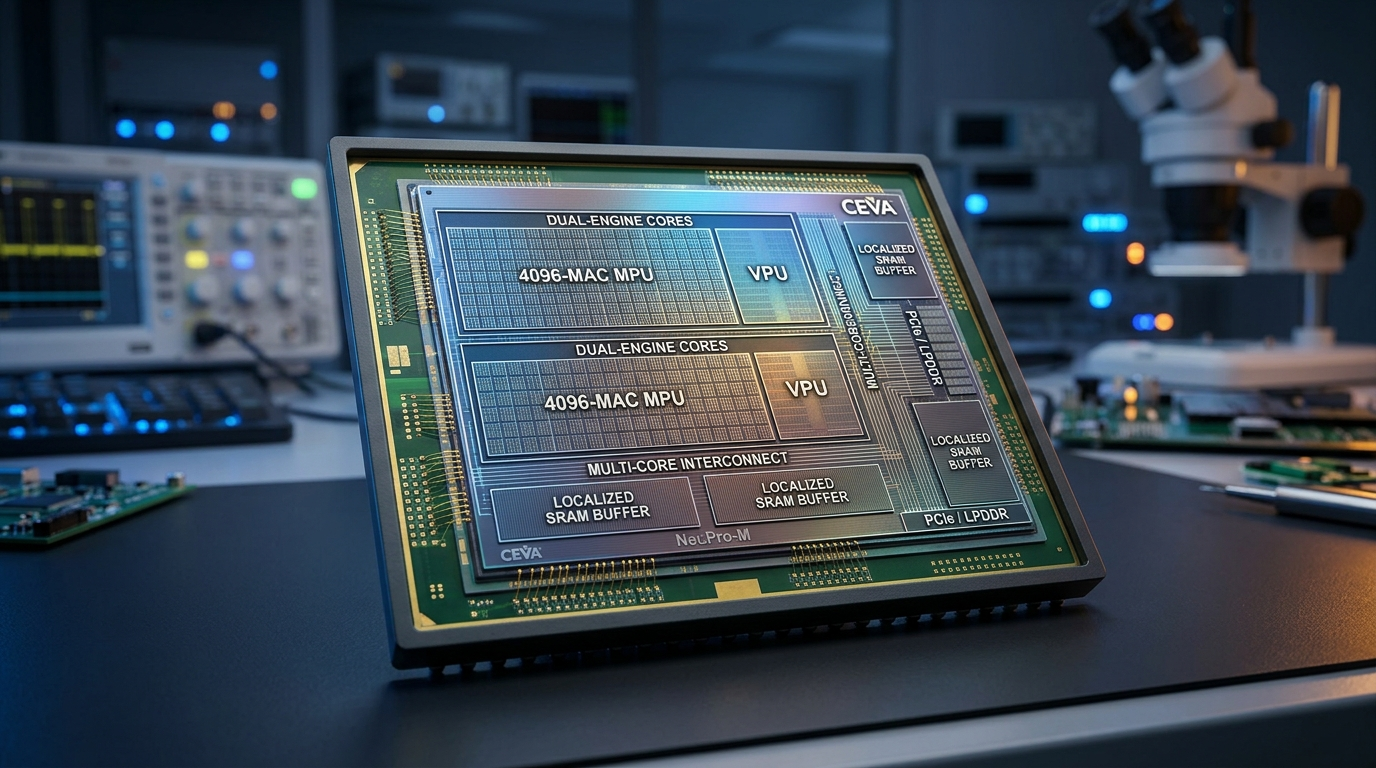
Architectural Deep Dive: Dual-Engine Cores, Multi-Core Scaling, and Local Memory Dataflow
The technical superiority of Ceva NeuPro-M stems from its decoupled heterogeneous core architecture, multi-core interconnect mesh, and bandwidth-saving memory hierarchy. A comprehensive evaluation requires examining its four foundational subsystems.
The Heterogeneous NeuPro-M Core Organization
Each individual NeuPro-M processing core (NPM engine) is partitioned into three specialized, concurrently operating functional subsystems:
+-----------------------------------------------------------------------+
|                    Ceva NeuPro-M Heterogeneous Core                   |
+-----------------------------------------------------------------------+
|  +------------------------+  +-------------------------------------+  |
|  | Autonomous Controller  |  | Multi-Channel DMA & Streamer Engine |  |
|  | - Hardware Sequencer   |  | - Real-Time Weight Decompression    |  |
|  | - Layer Dependency Mgt |  | - Activation Compression Engine     |  |
|  +-----------+------------+  +------------------+------------------+  |
|              |                                  |                     |
|  +-----------v----------------------------------v------------------+  |
|  |           Localized High-Bandwidth On-Chip SRAM (L2/L3)         |  |
|  +-----------------------------------------------------------------+  |
|        |                                        |                     |
|  +-----v-------------------------------+  +-----v------------------+  |
|  | Matrix Processing Unit (MPU)        |  | Vector Processing Unit |  |
|  | - Up to 4,096 MACs per Clock Cycle  |  | (VPU) - SIMD Pipeline  |  |
|  | - 2D Systolic & GEMM Modes          |  | - Non-Linear Functions |  |
|  | - INT8, INT16, FP16, BF16 Formats   |  | - RMSNorm / LayerNorm  |  |
|  | - >90% Sustained MAC Utilization    |  | - Softmax / GELU/SwiGLU|  |
|  +-------------------------------------+  +------------------------+  |
|        ^                                        ^                     |
|  +-----+----------------------------------------+------------------+  |
|  |            Ultra-Wide On-Chip Internal Core Crossbar            |  |
+--+-----------------------------------------------------------------+--+ - The Matrix Processing Unit (MPU): The primary computational workhorse for dense tensor contractions. The MPU contains up to 4,096 MAC units per core, configurable for single-cycle INT8, INT16, FP16, and BF16 execution. Rather than operating as a rigid systolic grid, the MPU supports both weight-stationary convolutions and output-stationary matrix-matrix multiplications ($Q \times K^T$), ensuring sustained hardware utilization exceeding 90% across both vision convolutions and transformer attention blocks.
- The Vector Processing Unit (VPU): A fully programmable SIMD vector engine operating in parallel with the MPU. The VPU executes all non-matrix operations—including elementwise activations (GELU, SwiGLU, ReLU), normalization functions (LayerNorm, RMSNorm, BatchNorm), spatial pooling, dynamic channel reshaping, and image preprocessing routines (bilinear resizing, color-space conversion)—without stalling the MPU.
- The Autonomous Task Controller: A dedicated hardware state machine that handles layer-by-layer dependency resolution, circular buffer memory synchronization, and execution sequencing directly in silicon. Once the host CPU triggers model execution, the NeuPro-M controller manages the entire neural pipeline autonomously, eliminating operating system context switches and interrupt overhead.
Memory Hierarchy and Bandwidth Reduction Mechanisms
The primary physical constraint in edge computing is external DDR memory access energy. Fetching a 16-bit weight parameter from external LPDDR5 memory consumes approximately 20 to 50 picojoules, whereas executing an arithmetic MAC operation on-chip consumes under 0.5 picojoules.
To overcome this, NeuPro-M incorporates four synergistic memory optimization technologies:
- On-the-Fly Hardware Weight Decompression: Model weights are compressed offline using lossless sparse entropy encoding. As weights stream into the core, the hardware decompression engine decodes them on the fly in silicon, reducing external memory bandwidth by up to 50%.
- Lossless Activation Compression: Intermediate feature maps generated between pipeline layers are compressed in real time before writing to memory, preventing memory bus saturation during high-resolution video processing.
- Dynamic Layer Fusing: The CDNN compiler analyzes the computation graph and fuses adjacent layers—such as Convolution + Bias + Normalization + Activation—into a single composite kernel. Intermediate activation tensors remain resident in localized on-chip SRAM registers, completely bypassing external DDR memory.
- Local Memory Direct Dataflow: NeuPro-M cores feature dense, multi-megabyte localized SRAM banks acting as private double-buffered scratchpads. By scheduling data transfers concurrently with computation, external DDR memory bandwidth is reduced by up to 88% compared to standard edge accelerators.
Multi-Core Scalability: From 20 to 1,200 TOPS
NeuPro-M is architected to scale across a wide array of silicon implementation requirements:
| Configuration | Core Count | Peak Compute (INT8) | Target Market & Application | Typical Power Budget |
|---|---|---|---|---|
| NPM11 | 1 Core | 20 TOPS | Smart Home Cameras, Wearables, IoT Gateways | 1W - 2W |
| NPM12 | 2 Cores | 40 TOPS | Industrial Robots, Drones, Automotive Smart Mirrors | 2W - 4W |
| NPM14 | 4 Cores | 80 TOPS | Surround-View ADAS, Automated Optical Inspection | 4W - 8W |
| NPM18 | 8 Cores | 160 TOPS | High-Performance ADAS, Autonomous Mobile Robots (AMRs) | 8W - 15W |
| Multi-Cluster | Multi-Chip | Up to 1,200 TOPS | Level 3/4 Autonomous Driving, Edge Cloud Servers | 25W - 80W |
In multi-core configurations, cores are interconnected by a low-latency, packetized Network-on-Chip (NoC). The CDNN compiler automatically distributes neural network workloads across cores using tensor parallelism (splitting wide GEMM matrices), pipeline parallelism (pipelining sequential network layers), or data parallelism (processing concurrent camera streams simultaneously).
Mathematical Formulation of NeuPro-M Mixed-Precision Arithmetic
To maximize energy efficiency without compromising model accuracy, NeuPro-M implements an advanced mixed-precision quantization methodology. While dense matrix weights and activations are quantized to INT8 or INT4, intermediate accumulators and normalization parameters maintain full numerical stability:
For an activation tensor $A \in \mathbb{R}^{M \times K}$ and weight matrix $W \in \mathbb{R}^{K \times N}$, the MPU executes quantized integer contractions with 32-bit accumulation:
$$Y_{INT32}[i, j] = \sum_{k=1}^K \left( A_{INT8}[i, k] - Z_A \right) \times \left( W_{INT8}[k, j] - Z_W \right)$$
where $Z_A, Z_W$ are the integer zero-point offsets.
The accumulated 32-bit integer is then streamed directly into the VPU, which performs fixed-point scaling, bias addition, and non-linear activation in a single pass:
$$Y_{out}[i, j] = \sigma\left( \mathcal{S} \cdot Y_{INT32}[i, j] + b[j] \right)$$
where $\mathcal{S} = \frac{S_A \cdot S_W}{S_Y}$ is the fixed-point scaling coefficient, and $\sigma(\cdot)$ represents the target activation function (such as GELU or SwiGLU). Because the conversion and activation happen within on-chip registers, no quantization rounding error accumulates across layers.
Practical Implementation: Compiling Vision Transformers with Ceva CDNN and PyTorch
Deploying neural network models onto Ceva NeuPro-M hardware is orchestrated through the Ceva Deep Neural Network (CDNN) compiler suite. CDNN ingests pre-trained models from PyTorch, ONNX, or TensorFlow, performs automated layer partitioning between the MPU and VPU, optimizes memory buffer reuse, and generates an optimized hardware binary package.
Compiling a Vision Transformer with the CDNN Python SDK
The following Python script illustrates how to use the CDNN compiler to import a pre-trained Vision Transformer (ViT-Tiny or Swin-Transformer), perform calibration-driven mixed-precision quantization, and compile the final .cdnn executable binary for the NeuPro-M accelerator:
#!/usr/bin/env python3
# Ceva NeuPro-M Model Compilation and Quantization Pipeline
# Compiles a PyTorch Vision Transformer (ViT) into an optimized NeuPro-M binary.

import os
import sys
import torch
import torchvision.models as models
import cdnn_compiler as cdnn

def generate_calibration_dataset(num_samples: int = 100):
    """
    Generates representative visual calibration samples to calculate dynamic
    quantization scale factors and profile activation ranges.
    """
    print(f"[CDNN] Generating {num_samples} calibration samples...")
    for _ in range(num_samples):
        # 3-channel 224x224 RGB image tensor
        dummy_sample = torch.randn(1, 3, 224, 224, dtype=torch.float32)
        yield {"input_images": dummy_sample}

def compile_vit_for_neupro(
    model_name: str,
    output_package_path: str,
    target_engine: str = "NPM14"
):
    print(f"[CDNN] Initializing compilation session for target: {target_engine}")
    compiler = cdnn.Compiler(target_core=target_engine)

    # 1. Load Pre-trained PyTorch Foundation Vision Transformer
    print("[CDNN] Loading pre-trained Vision Transformer model...")
    model = models.vit_b_16(weights=models.ViT_B_16_Weights.DEFAULT)
    model.eval()

    # 2. Configure Hardware Partitioning and Memory Flags
    compile_config = cdnn.CompileOptions(
        optimization_level=cdnn.OptLevel.O3,
        enable_layer_fusing=True,
        enable_weight_decompression=True,
        sram_allocation_kb=2048, # 2MB allocated on-chip SRAM
        target_frequency_mhz=1000
    )

    # 3. Configure Calibration-Guided Mixed-Precision Quantization
    quant_config = cdnn.QuantizationConfig(
        default_precision=cdnn.Precision.INT8,
        preserve_precision_layers=["attention_softmax", "norm1", "norm2"],
        precision_override=cdnn.Precision.FP16, # Run attention softmax & LayerNorm in FP16 on VPU
        calibration_method=cdnn.CalibrationMethod.KL_DIVERGENCE,
        per_channel_scaling=True
    )

    # 4. Execute Optimization and Quantization Profiling
    calib_stream = generate_calibration_dataset(num_samples=100)
    print("[CDNN] Profiling tensor dynamic ranges and mapping to MPU/VPU engines...")

    optimized_network = compiler.optimize(
        model=model,
        dummy_input=torch.randn(1, 3, 224, 224),
        quant_config=quant_config,
        calib_data=calib_stream,
        options=compile_config
    )

    # 5. Build and Export Executable Package
    print(f"[CDNN] Building hardware executable for {target_engine}...")
    binary_package = compiler.build(optimized_network)
    binary_package.save(output_package_path)

    print(f"[CDNN] Hardware package successfully exported to: {output_package_path}")
    print(f"[CDNN] Peak Throughput: {binary_package.metrics.peak_tops:.1f} TOPS | "
          f"Estimated Power: {binary_package.metrics.estimated_power_watts:.2f} W | "
          f"DDR Bandwidth Reduction: {binary_package.metrics.ddr_bandwidth_saved_pct:.1f}%")

if __name__ == "__main__":
    compile_vit_for_neupro(
        model_name="vit_base_16",
        output_package_path="vit_base16_neupro_m14.cdnn",
        target_engine="NPM14"
) High-Throughput C++ Vision Inference Application on NeuPro-M
In real-world automotive and industrial deployments, host microprocessors interact with NeuPro-M through the CDNN Runtime API. The following C++ application demonstrates asynchronous frame submission, zero-copy memory binding, and inference execution on an attached NeuPro-M hardware accelerator:
/**
 * Ceva NeuPro-M Multi-Stream Asynchronous Inference Engine
 * Demonstrates hardware initialization, buffer binding, and non-blocking execution.
 */

#include <iostream>
#include <vector>
#include <string>
#include <chrono>
#include <cstring>
#include <stdexcept>
#include <cdnn_runtime.h>

class NeuProVisionServer {
public:
    NeuProVisionServer(const std::string& package_path, int core_cluster_id)
        : cluster_id_(core_cluster_id) {

        std::cout << "[NeuPro-M] Initializing hardware core cluster " << cluster_id_ << "..." << std::endl;

        // 1. Initialize CDNN Hardware Handle
        cdnn_status_t status = cdnn_init_system(cluster_id_, &device_handle_);
        if (status != CDNN_SUCCESS) {
            throw std::runtime_error("Failed to initialize NeuPro-M hardware device!");
        }

        // 2. Load Compiled .cdnn Network Package
        status = cdnn_load_network(device_handle_, package_path.c_str(), &network_handle_);
        if (status != CDNN_SUCCESS) {
            throw std::runtime_error("Failed to load CDNN network package: " + package_path);
        }

        // 3. Query Input and Output Buffer Descriptors
        cdnn_get_buffer_descriptors(network_handle_, &input_desc_, &output_desc_);
        std::cout << "[NeuPro-M] Network loaded: Input Buffer size = "
                  << input_desc_.size_bytes << " bytes, Output size = "
                  << output_desc_.size_bytes << " bytes." << std::endl;
    }

    ~NeuProVisionServer() {
        if (network_handle_) cdnn_unload_network(network_handle_);
        if (device_handle_) cdnn_release_system(device_handle_);
    }

    // Dispatches inference asynchronously to the MPU/VPU hardware
    void ExecuteInference(const uint8_t* raw_input_pixels, std::vector<float>& classification_output) {
        // Direct zero-copy DMA write into pre-allocated on-chip input buffers
        void* hw_in_buffer = cdnn_get_input_pointer(network_handle_, 0);
        std::memcpy(hw_in_buffer, raw_input_pixels, input_desc_.size_bytes);

        auto start = std::chrono::high_resolution_clock::now();

        // Trigger autonomous hardware inference execution
        cdnn_status_t status = cdnn_execute_inference(network_handle_);
        if (status != CDNN_SUCCESS) {
            throw std::runtime_error("Hardware inference execution failed on NeuPro-M!");
        }

        // Wait for hardware execution barrier (or poll asynchronous completion flag)
        cdnn_wait_completion(network_handle_, CDNN_TIMEOUT_DEFAULT);

        auto elapsed_us = std::chrono::duration_cast<std::chrono::microseconds>(
            std::chrono::high_resolution_clock::now() - start
        ).count();

        // Read out normalized logits from hardware output buffer
        const float* hw_out_buffer = (const float*)cdnn_get_output_pointer(network_handle_, 0);
        size_t num_classes = output_desc_.size_bytes / sizeof(float);
        classification_output.assign(hw_out_buffer, hw_out_buffer + num_classes);

        std::cout << "[Inference] Execution finished in " << elapsed_us
                  << " us (" << (1000000.0 / elapsed_us) << " FPS) with 0% CPU intervention." << std::endl;
    }

private:
    int cluster_id_;
    cdnn_device_t device_handle_{nullptr};
    cdnn_network_t network_handle_{nullptr};
    cdnn_buffer_desc_t input_desc_{};
    cdnn_buffer_desc_t output_desc_{};
};

int main() {
    try {
        std::cout << "[System] Starting Ceva NeuPro-M Industrial Vision Node..." << std::endl;
        NeuProVisionServer server("vit_base16_neupro_m14.cdnn", 0);

        // Pre-allocate dummy normalized input frame (224x224x3 RGB = 150,528 bytes)
        const size_t frame_bytes = 1 * 3 * 224 * 224;
        std::vector<uint8_t> dummy_frame(frame_bytes, 128);

        std::vector<float> predictions;
        std::cout << "[System] Running 100 consecutive benchmark iterations..." << std::endl;

        for (int i = 0; i < 100; ++i) {
            server.ExecuteInference(dummy_frame.data(), predictions);
        }

        std::cout << "[System] Benchmark completed successfully. Thermal state nominal." << std::endl;

    } catch (const std::exception& e) {
        std::cerr << "[Error] Exception caught: " << e.what() << std::endl;
        return 1;
    }
    return 0;
} Teams developing automated document scanning fleets, visual product categorization agents, or multimodal web intelligence systems can integrate NeuPro-M edge appliances with scalable web-scraping agents to cross-reference extracted visual objects against remote e-commerce indices, inventory databases, and enterprise catalog APIs. To explore how heterogeneous edge processors interface with centralized cloud intelligence backbones, explore our AI engineering knowledge hub.
Architectural Comparison: Ceva NeuPro-M vs. Competing Edge AI Processors
To evaluate the operational positioning of Ceva NeuPro-M within automotive smart mobility, industrial robotics, and consumer edge electronics, hardware architects must benchmark competing edge silicon architectures across compute scaling, heterogeneous engine design, transformer acceleration, and memory bandwidth reduction. The table below compares Ceva NeuPro-M against the Arm Ethos-U85, Hailo-8 M.2 Module, Synopsys ARC EV7x, and NVIDIA Jetson Orin Nano.
| Architectural Feature | Ceva NeuPro-M | Arm Ethos-U85 | Hailo-8 M.2 Module | Synopsys ARC EV7x | NVIDIA Jetson Orin Nano |
|---|---|---|---|---|---|
| NPU Architecture | Heterogeneous MPU + VPU Cores | MicroNPU Matrix Engine | Structure-Defined Dataflow | Dual VLIW / CNN Engine | SIMT GPU Tensor Cores |
| Scalable Compute Range | 20 to 1,200 TOPS (Modular) | Up to 4.0 TOPs (2048 MACs) | 26 TOPS (Fixed Module) | Up to 35 TOPS (VLIW) | 40 TOPS (Sparse INT8) |
| Native Transformer Support | Yes (Full MPU/VPU Fusion) | Yes (Hardware MatMul/Softmax) | Limited (Conv-oriented) | Partial (VLIW fallback) | Yes (CUDA Tensor Cores) |
| DDR Bandwidth Reduction | **Up to 88% (On-the-fly Decompress) | Up to 50% (Weight Decomp.) | High DDR dependency | Moderate Caching | High HBM/DRAM demand |
| Automotive Safety Standard | ISO 26262 ASIL-D Ready | Functional Safety Ready | ASIL-B Certified | ASIL-D Certified | ASIL-B / ASIL-D |
| Energy Efficiency | Up to 10 - 15 TOPS / Watt | Up to 8.0 TOPs / Watt | 5.2 - 10.4 TOPS / Watt | ~4.0 - 6.0 TOPS / Watt | 2.67 - 4.0 TOPS / Watt |
| Multi-Core Clustering | 1 to 8 Cores (TileLink/AXI NoC) | Single-Core MicroNPU | Fixed Monolithic Die | Up to 4 Cores | Fixed Monolithic Die |
| Data Precisions Supported | INT8, INT16, FP16, BF16 | INT8, INT16 (TOSA) | INT8, INT16 Strict | INT8, FP16 | INT8, FP16, BF16 |
| Deployment Model | Synthesizable Silicon IP Core | Synthesizable Silicon IP Core | Packaged M.2 PCIe Card | Synthesizable Silicon IP Core | Packaged System-on-Module |
Analysis of Architectural Trade-offs
A comprehensive examination of this scorecard highlights several critical architectural differentiators:
- Heterogeneous MPU + VPU Synergy vs. Homogeneous Systolic Arrays: On accelerators like the Hailo-8 and first-generation NPUs, non-matrix operations (LayerNorm, Softmax, SwiGLU) cause severe pipeline bubbles because the hardware lacks dedicated vector pipelines. In NeuPro-M, the MPU and VPU operate concurrently: while the MPU computes subsequent layer matrix contractions, the VPU normalizes and activates previous layer activations, ensuring sustained hardware utilization exceeding 90%.
- Extreme Scalability from IoT to Level 4 Autonomous Vehicles: While microNPUs (such as Arm Ethos-U85) are capped at sub-5 TOPs for microcontrollers, and packaged chips (like Hailo-8) are fixed at 26 TOPS, NeuPro-M’s modular architecture scales across four orders of magnitude (20 TOPS to 1,200 TOPS). Semiconductor companies can license the identical IP architecture and CDNN software compiler for wearable smart glasses, industrial cameras, and multi-camera automotive ADAS domain controllers.
- On-the-Fly Weight and Activation Decompression: Unlike competing NPUs that require uncompressed weight streaming across external memory buses, NeuPro-M integrates real-time hardware decompression engines directly into the DMA pipeline. This cuts external memory traffic by up to 88%, drastically reducing system power consumption and allowing designers to utilize cost-effective LPDDR4x/5 memory rather than expensive, scarce High-Bandwidth Memory (HBM).
Production Engineering: Silicon Implementation, Safety, and Telemetry Monitoring
Deploying Ceva NeuPro-M IP from architectural RTL synthesis into volume commercial semiconductor production requires strict adherence to physical synthesis constraints, functional safety verification, and automated operational telemetry monitoring.
Physical Implementation and Automotive Safety Guidelines
When synthesizing the NeuPro-M IP core into custom silicon SoCs across advanced foundry nodes (such as TSMC 7nm, 5nm, or 3nm), physical design and safety engineering teams should implement the following standards:
- Dual-Core Lockstep (DCLS) for ISO 26262 ASIL-D: In automotive ADAS applications, synthesize the NeuPro-M task controllers and VPU core registers in redundant dual-core lockstep configurations with cycle-by-cycle comparator logic. If transient single-event upsets (SEU) or alpha-particle strikes cause bit flips, the hardware fault management unit detects the anomaly within two clock cycles and asserts a safety interrupt to the host vehicle domain controller.
- Clock Tree Synthesis and Dynamic Operand Gating: The 4,096-MAC array contains thousands of parallel flip-flops. Implement hierarchical clock gating at the individual PE tile level. When processing sparse tensors where activation or weight bytes are zero, dynamic operand gating suspends clock toggling to the corresponding multipliers, cutting dynamic power dissipation by up to 45%.
- Internal SRAM ECC Protection: All on-chip localized SRAM macro arrays (L2 cache, weight scratchpads, activation double-buffers) must incorporate Single Error Correction, Double Error Detection (SECDED) Error Correcting Code (ECC) circuitry. Automated hardware scrubbers continuously scan memory arrays in the background to prevent soft error accumulation.
Production Telemetry and Fleet Health Monitoring Daemon
In mission-critical enterprise installations, an automated systems daemon must continuously poll NeuPro-M hardware status registers, monitoring junction temperatures, core utilization rates, memory bus decompression throughput, and ECC memory fault counters. The following Python daemon demonstrates an automated monitoring agent interfacing with the Ceva Hardware Management Interface:
#!/usr/bin/env python3
# Ceva NeuPro-M Fleet Telemetry and Operational Health Daemon
# Collects hardware metrics across MPU/VPU engines, power rails, and ECC counters.

import time
import logging
import json
import sys
from typing import Dict, Any

# Mock or production import of Ceva Hardware Management Library (CHML)
try:
    import chml
except ImportError:
    # Simulated CHML interface for testing environments
    class MockCHML:
        class CoreCluster:
            def __init__(self, idx): self.idx = idx
            def get_junction_temperature_c(self): return 52.8
            def get_power_consumption_watts(self): return 5.42
            def get_mpu_mac_utilization_pct(self): return 91.6
            def get_vpu_duty_cycle_pct(self): return 82.4
            def get_ddr_bandwidth_saved_pct(self): return 86.5
            def get_ecc_corrected_faults(self): return 0
            def get_safety_lockstep_status(self): return True
            def set_power_cap_watts(self, cap): pass
            def throttle_clock_frequency(self, freq_mhz): pass

        @staticmethod
        def init(): pass
        @staticmethod
        def get_cluster_count(): return 1
        @staticmethod
        def get_cluster(idx): return MockCHML.CoreCluster(idx)
    chml = MockCHML

logging.basicConfig(
    level=logging.INFO,
    format='%(asctime)s [%(levelname)s] [NEUPRO-MONITOR] %(message)s',
    handlers=[logging.StreamHandler(sys.stdout)]
)

class NeuProHealthMonitor:
    def __init__(self, poll_interval_sec: float = 3.0, max_temp_c: float = 85.0):
        self.interval = poll_interval_sec
        self.max_temp_c = max_temp_c
        chml.init()
        self.num_clusters = chml.get_cluster_count()
        self.clusters = [chml.get_cluster(i) for i in range(self.num_clusters)]
        logging.info(f"Initialized monitor for {self.num_clusters} detected NeuPro-M NPU cluster(s).")

    def collect_cluster_telemetry(self, cluster) -> Dict[str, Any]:
        """Polls real-time hardware telemetry registers from the NeuPro-M core."""
        temp = cluster.get_junction_temperature_c()
        power = cluster.get_power_consumption_watts()
        mpu_util = cluster.get_mpu_mac_utilization_pct()
        vpu_util = cluster.get_vpu_duty_cycle_pct()
        bw_saved = cluster.get_ddr_bandwidth_saved_pct()
        ecc_faults = cluster.get_ecc_corrected_faults()
        safety_ok = cluster.get_safety_lockstep_status()

        return {
            "cluster_id": cluster.idx,
            "junction_temp_c": temp,
            "power_watts": power,
            "mpu_mac_utilization_pct": mpu_util,
            "vpu_duty_cycle_pct": vpu_util,
            "ddr_bandwidth_saved_pct": bw_saved,
            "ecc_corrected_faults": ecc_faults,
            "lockstep_safety_verified": safety_ok
        }

    def verify_operational_safety(self, cluster, telemetry: Dict[str, Any]):
        """Evaluates hardware safety thresholds and detects thermal or safety faults."""
        temp = telemetry["junction_temp_c"]
        cluster_id = telemetry["cluster_id"]
        safety_status = telemetry["lockstep_safety_verified"]

        # 1. Thermal Emergency Safeguard
        if temp >= self.max_temp_c:
            logging.critical(
                f"Cluster {cluster_id} EXCEEDED THERMAL CEILING! Current: {temp:.1f}C, "
                f"Limit: {self.max_temp_c:.1f}C. Throttling clock to 600 MHz!"
            )
            cluster.throttle_clock_frequency(600)
            cluster.set_power_cap_watts(3.5)
        elif temp >= (self.max_temp_c - 8.0):
            logging.warning(f"Cluster {cluster_id} approaching thermal threshold: {temp:.1f}C.")

        # 2. ISO 26262 Lockstep Safety Check
        if not safety_status:
            logging.error(f"Cluster {cluster_id} FAILED lockstep comparator check! Functional safety alarm active!")

    def run_daemon(self):
        """Continuous execution loop exporting telemetry to Prometheus / Autosar agents."""
        logging.info("Starting NeuPro-M production monitoring cycle...")
        try:
            while True:
                for cluster in self.clusters:
                    telemetry = self.collect_cluster_telemetry(cluster)
                    self.verify_operational_safety(cluster, telemetry)
                    logging.info(f"Telemetry Status: {json.dumps(telemetry)}")
                time.sleep(self.interval)
        except KeyboardInterrupt:
            logging.info("Terminating NeuPro-M Monitor daemon cleanly.")

if __name__ == "__main__":
    monitor = NeuProHealthMonitor(poll_interval_sec=5.0)
    # Perform single initial diagnostic pass
    for cluster in monitor.clusters:
        stats = monitor.collect_cluster_telemetry(cluster)
        print("\n=== Initial Ceva NeuPro-M Hardware Telemetry Pass ===")
        for k, v in stats.items():
            print(f"  {k:28s}: {v}")
        print("=====================================================\n")
print("Diagnostic passed. NeuPro-M NPU ready for production inference service.") Production Readiness Verification Checklist
Prior to approving a Ceva NeuPro-M silicon implementation for commercial volume shipment, systems engineering teams must verify each operational criterion:
- CDNN Graph Layer Partitioning Parity: Verify that 100% of neural network layers (both matrix convolutions and non-matrix activations) map directly to the MPU/VPU engines, confirming zero unmapped layer fallbacks to host CPU software loops.
- Thermal Dissipation in Fanless Robotics Housings: Conduct continuous 24-hour multi-stream ViT-Base inference tests at peak ambient operating temperature (up to 85°C industrial rating), confirming junction temperatures remain safely below 75°C without active chassis fans.
- ISO 26262 ASIL-D Fault Injection Validation: Execute hardware fault-injection testing across the lockstep comparators and SRAM SECDED ECC circuits, confirming 100% fault detection within safety integrity time windows.
- On-the-Fly Decompression Bandwidth Verification: Validate that the hardware decompression engine sustains full line-rate throughput without inducing FIFO underruns during burst multi-camera frame processing.
Ceva NeuPro-M fundamentally redefines the architecture of edge artificial intelligence. By unifying a high-throughput 4,096-MAC Matrix Processing Unit with a programmable Vector Processing Unit, on-the-fly hardware decompression, and scalable multi-core clustering, NeuPro-M resolves the memory and compute imbalances that have long hindered edge AI deployments. For semiconductor innovators, automotive architects, and industrial vision developers engineering the next generation of intelligent machines, Ceva NeuPro-M delivers uncompromising, sub-watt intelligence from smart sensors to autonomous vehicles.