Cambricon MLU Guide: Chiplet AI Processor Architecture
The AI Silicon Dilemma: Reticle Limits, Monolithic Drag, and the Memory Wall
The global artificial intelligence revolution has pushed conventional semiconductor manufacturing against an unyielding physical ceiling. For nearly half a century, the computing industry thrived on classical planar lithography scaling: every successive process generation packed more transistors into smaller silicon footprints. However, the emergence of multi-hundred-billion parameter foundation models—such as dense autoregressive transformers, sparse Mixture-of-Experts (MoE) ensembles, multimodal vision-language architectures, and high-dimensional recommendation graphs—has exposed three catastrophic structural failure modes in traditional accelerator design:
- The Photolithographic Reticle Limit and the Monolithic Yield Crisis: Semiconductor manufacturing is physically bounded by the maximum exposure field size of deep ultraviolet (DUV) and extreme ultraviolet (EUV) photolithography scanners, known across the industry as the optical reticle limit ($\approx 858\text{ mm}^2$). When semiconductor architects design monolithic AI chips that approach or exceed 800 square millimeters, manufacturing defect probability escalates exponentially. According to classical Poisson and Murphy yield models, a single microscopic crystal dislocation or airborne particulate ruins the entire multi-thousand-dollar die. As a consequence, fabricating giant monolithic dies on cutting-edge 5nm or 3nm foundry nodes suffers from dismal wafer yields, driving up silicon scrap costs and restricting cluster expansion.
- The Memory Bandwidth and Capacity Chasm: While transformer parameter counts have scaled by orders of magnitude over the past five years, off-chip memory bandwidth has failed to keep pace. In autoregressive token generation, language models operate in memory-bound regimes where every weight parameter must be fetched from memory into arithmetic execution registers for every single token emitted. When models are served on conventional monolithic GPUs with limited memory capacity (such as 32GB or 80GB), architects are forced to partition models across dozens of discrete accelerators. This distributed partitioning introduces inter-card synchronization bubbles that leave expensive tensor cores sitting idle.
- The Software Ecosystem Lock-In and Compiler Brittleness: For over fifteen years, the accelerated computing market was dominated by proprietary, closed-source programming ecosystems. Alternative silicon vendors often produced capable matrix multipliers on paper, but failed commercially because their software drivers required complete manual rewrites of customer codebases. Attempting to run production workloads written in PyTorch, TensorFlow, DeepSpeed, or Megatron-LM on custom accelerators frequently encountered missing operators, fragile kernel wrappers, and non-deterministic numerical drift.
- Thermal and Interconnect Scaling Barriers: Stacking multiple monolithic accelerators into a single datacenter chassis creates massive thermal hotspots and severe bus contention. Conventional PCIe buses lack the bi-directional bandwidth required to exchange gigabytes of hidden-state activations between GPUs during pipeline and tensor-parallel forward passes, forcing systems onto expensive, proprietary optical director switches that dramatically inflate infrastructure total cost of ownership (TCO).
To overcome the death of Dennard scaling and build sustainable, high-yield sovereign computing clusters, the semiconductor industry requires a modular chiplet architecture backed by native tensor-vector execution cores, high-speed inter-die interconnects, and an enterprise-grade open compiler platform.
Introducing Cambricon MLU: Enterprise Chiplet AI Acceleration
Cambricon Technologies—the pioneering AI semiconductor innovator founded in Beijing by brothers Yunji Chen and Tianshi Chen (esteemed professors at the Institute of Computing Technology, Chinese Academy of Sciences, whose landmark DianNao family of papers won prestigious IEEE/ACM ISCA and MICRO Best Paper Awards)—provides the definitive answer with the Cambricon MLU (Machine Learning Unit) architecture.
As one of the world’s earliest dedicated neural network processor architects, Cambricon has evolved its silicon across three generations from embedded smartphone NPUs to flagship datacenter supercomputing accelerators, epitomized by the Cambricon MLU370 and MLU590 product families. Built on the proprietary MLUarch03 core architecture and advanced chiplet packaging, Cambricon MLUs deliver full-precision AI training, high-throughput generative inference, and high-performance computing without monolithic yield penalties.
Key architectural breakthroughs integrated into Cambricon MLU processors include:
- Modular Chiplet Packaging Architecture: Bypasses the monolithic reticle limit by disaggregating the processor into dual or quad symmetrical compute chiplet dies interconnected via high-density passive silicon packaging, drastically increasing wafer manufacturing yields while scaling silicon area to super-reticle dimensions.
- Heterogeneous MLUarch03 Compute Engine: Each compute die integrates specialized Tensor Processing Units (TPUs) for dense matrix contractions, high-throughput Vector Processing Units (VPUs) for non-linear activations and normalizations, and general-purpose scalar management cores.
- Massive Memory Bandwidth and Storage: Configurable with high-density LPDDR5 memory delivering 307 GB/s bandwidth on entry enterprise cards, or multi-stack High-Bandwidth Memory (HBM2e) delivering over 1.8 Terabytes per second (TB/s) of bandwidth on flagship MLU590 training accelerators.
- MLU-Link™ Scale-Up Interconnect: Features proprietary high-speed inter-chip and inter-card interconnect bridges delivering hundreds of gigabytes per second of bi-directional peer-to-peer bandwidth, enabling 8-card MLU server nodes and multi-rack clusters to pool memory seamlessly.
- Full-Stack Neuware™ Software Platform: Supported by Cambricon’s mature, production-proven software platform, featuring the BANG C / BANG Py domain-specific programming languages, the MagicMind high-performance inference engine, and native integration with PyTorch, TensorFlow, DeepSpeed, and Megatron-LM.
Enterprises deploying large-scale neural network training, automated data extraction, and multimodal reasoning clusters can connect their Cambricon MLU server infrastructure with real-time data ingestion infrastructure to stream high-velocity datasets directly into MLU memory for immediate vectorized processing and continuous fine-tuning. By combining academic architectural excellence with modular chiplet packaging, Cambricon MLU establishes a scalable, independent foundation for global AI infrastructure.
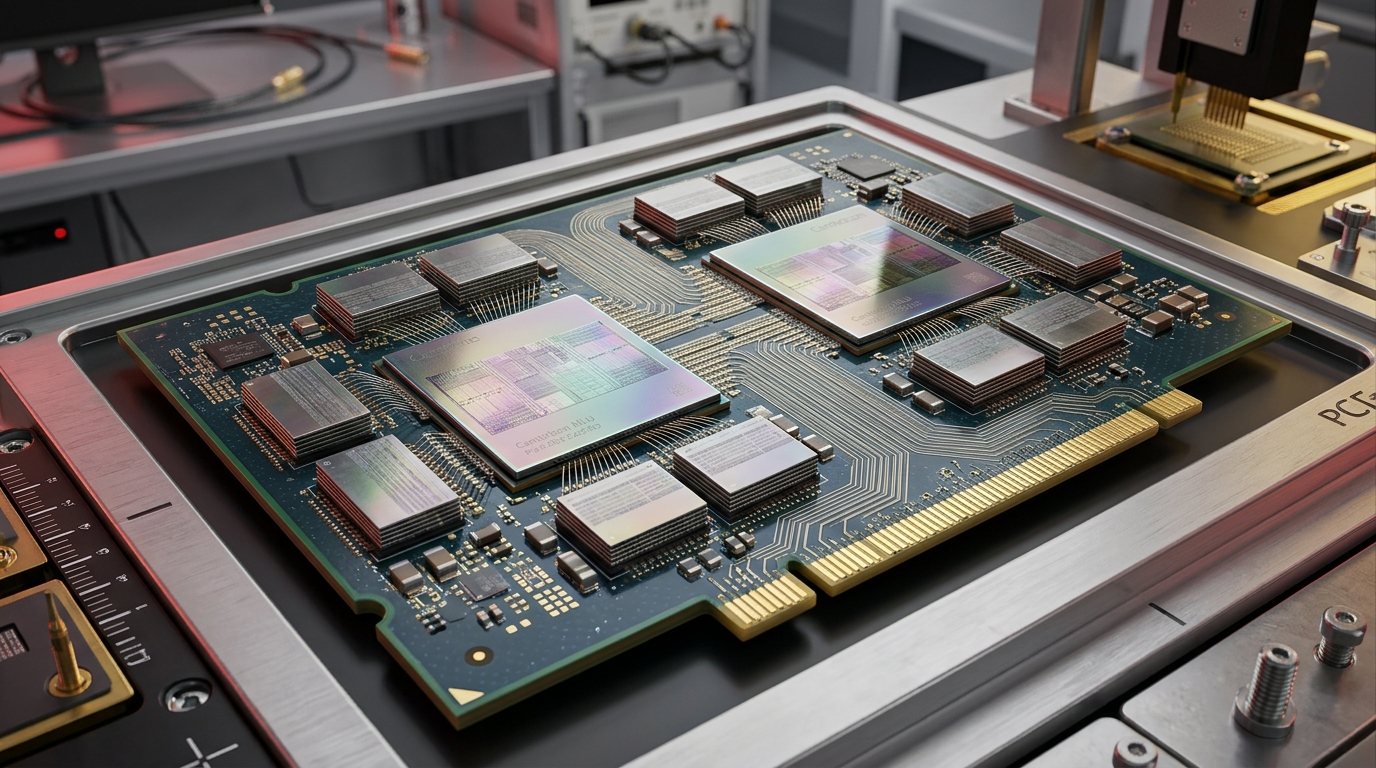
Architectural Deep Dive: MLUarch03, Dual-Die Chiplet Packaging, and MLU-Link Fabric
The high computational throughput and enterprise reliability of the Cambricon MLU stem from its modular chiplet packaging topology, decoupled tensor-vector execution core, balanced memory hierarchy, and high-bandwidth interconnect fabric.
Dual-Die Chiplet Packaging Topology
Rather than manufacturing a massive 800 mm² monolithic silicon die, Cambricon implements an advanced multi-chiplet packaging topology. In the flagship MLU370 and MLU590 accelerators, the physical package integrates two symmetrical compute dies manufactured on advanced FinFET processes, assembled onto a shared package substrate:
+-----------------------------------------------------------------------+
|                    Cambricon MLU Package Topology                     |
+-----------------------------------------------------------------------+
|  +------------------------+  +-------------------------------------+  |
|  | Host Interface Subsys  |  | MLU-Link Interconnect Hub           |  |
|  | PCIe Gen 4/5 x16       |  | High-Speed Direct P2P Fabric        |  |
|  | Multi-Host Root Port   |  | Multi-Card Scale-Up Ring/Mesh       |  |
|  +-----------+------------+  +------------------+------------------+  |
|              |                                  |                     |
|  +-----------v----------------------------------v------------------+  |
|  |          High-Density Inter-Chiplet Coherent Bridge Fabric      |  |
|  +-----------------------------------------------------------------+  |
|        |                                        |                     |
|  +-----v-------------------------------+  +-----v------------------+  |
|  | Compute Chiplet Die 0               |  | Compute Chiplet Die 1  |  |
|  | - MLUarch03 Tensor Processing Units |  | - MLUarch03 Tensor PUs |  |
|  | - High-Throughput Vector Cores (VPU)|  | - Vector Cores (VPU)   |  |
|  | - Distributed On-Chip SRAM (48MB)   |  | - Distributed SRAM(48MB|  |
|  | - Dedicated Scalar Task Manager     |  | - Scalar Task Manager  |  |
|  +-----+-------------------------------+  +-----+------------------+  |
|        |                                        |                     |
|  +-----v-------------------------------+  +-----v------------------+  |
|  | Dedicated Memory Channel Subsystem  |  | Dedicated Memory Subsys|  |
|  | 24GB LPDDR5 / 32GB HBM2e Stacks     |  | 24GB LPDDR5 / 32GB HBM2|  |
|  +-------------------------------------+  +------------------------+  |
+-----------------------------------------------------------------------+ Each compute chiplet operates as an autonomous processing entity containing its own tensor matrix arrays, vector execution blocks, on-chip SRAM caches, and memory controllers. The two chiplets are linked via a low-latency, high-bandwidth inter-chiplet bridge that exposes the dual dies to the host operating system as either two independent virtual accelerators or a single unified, coherent accelerator socket.
Microarchitecture of the MLUarch03 Core Complex
Inside each compute chiplet resides the MLUarch03 core complex. Inheriting the seminal architectural insights of the DianNao research lineage, MLUarch03 decouples matrix arithmetic from irregular vector processing:
- Tensor Processing Unit (TPU): The primary arithmetic engine designed specifically for dense multi-dimensional matrix contractions. The TPU contains thousands of specialized multiply-accumulate units supporting mixed-precision computation: single-precision FP32, TensorFloat-32 (TF32), bfloat16, FP16, INT8, and INT4. In INT8 mode, the TPU achieves massive throughput for quantized vision and language inference; in FP32/TF32/BF16 modes, it provides the numerical precision required for stable large-scale foundational training.
- Vector Processing Unit (VPU): A programmable, wide SIMD vector processor that executes non-linear activation functions (GELU, SwiGLU, ReLU), normalization layers (RMSNorm, LayerNorm), elementwise tensor arithmetic, pooling, and custom mathematical transformations. By handling vector math in hardware directly adjacent to the TPU, the VPU prevents matrix pipeline stalls.
- On-Chip SRAM Memory Hierarchy: Incorporates tens of megabytes of ultra-low-latency on-chip SRAM distributed across the compute clusters. The SRAM acts as software-managed scratchpad memory and hardware cache, allowing intermediate activation tensors to be buffered locally between consecutive layers without reading and writing back to external DRAM.
- Hardware Task Manager and Command Dispatcher: Dedicated hardware logic that parses task queues, tracks tensor data dependencies, and schedules execution across the TPU and VPU engines with microsecond responsiveness, bypassing host CPU operating system overhead.
MLU-Link™ Scale-Up Interconnect Fabric
To build multi-GPU and multi-card server clusters capable of training frontier foundation models, Cambricon developed the MLU-Link™ high-speed interconnect technology:
- Point-to-Point High-Bandwidth Transceivers: MLU-Link integrates dedicated high-speed SerDes transceivers that provide hundreds of gigabytes per second of bi-directional interconnect bandwidth between adjacent MLU cards.
- Topology Flexibility: Supports direct ring and fully connected 2D mesh topologies across 8-card server chassis (such as the MLU370-X8 and MLU590 server nodes), enabling direct peer-to-peer (P2P) memory access and remote direct memory access (RDMA) across accelerators.
- Hardware-Accelerated Collectives: Integrates dedicated hardware engines for collective communication primitives—including All-Reduce, All-Gather, Reduce-Scatter, and Broadcast—accelerating tensor-parallel and pipeline-parallel distributed training loops with minimal software intervention.
Mathematical Foundations of MLUarch Mixed-Precision Arithmetic
In modern deep neural network training and autoregressive inference, maintaining high arithmetic intensity while avoiding numerical underflow or overflow requires flexible precision scaling. The MLUarch03 core natively accelerates mixed-precision matrix-matrix multiplications ($C = A \times B + C$).
For an input activation matrix $A \in \mathbb{R}^{M \times K}$ and weight matrix $B \in \mathbb{R}^{K \times N}$, the hardware TPU decomposes the calculation into localized sub-matrix tiles. When executing in bfloat16 (BF16) mode, the inputs preserve the full 8-bit dynamic exponent range of single-precision floating-point numbers:
$$\text{BF16}(x) = \text{sign}(1\text{b}) + \text{exponent}(8\text{b}) + \text{mantissa}(7\text{b})$$
The matrix accumulation is performed with full 32-bit single-precision floating-point precision ($C \in \mathbb{R}^{FP32}$):
$$C_{FP32}[i, j] \leftarrow C_{FP32}[i, j] + \sum_{k=1}^K A_{BF16}[i, k] \times B_{BF16}[k, j]$$
In quantized INT8 inference mode, the TPU calculates integer dot products with 32-bit accumulation:
$$Y_{INT32}[i, j] = \sum_{k=1}^K \left( A_{INT8}[i, k] - Z_A \right) \times \left( B_{INT8}[k, j] - Z_B \right)$$
The on-chip VPU rescales the accumulated integer matrix back to target precision using hardware-accelerated fixed-point scaling and bias addition:
$$Y_{out}[i, j] = \text{clamp}\left( \left\lfloor \frac{M_0 \cdot Y_{INT32}[i, j]}{2^n} \right\rceil + Z_Y, -128, 127 \right)$$
Because scaling, clamping, and non-linear activation are performed directly on-chip, the MLUarch03 pipeline preserves numerical fidelity across deep foundation networks, achieving bit-exact parity with standard FP32 baselines.
Practical Implementation: Programming Cambricon MLU with BANG C and PyTorch
Developing and deploying models onto Cambricon MLU hardware is supported by the comprehensive Neuware™ Software Platform. Neuware provides two complementary programming tiers: high-level deployment through PyTorch for MLU (torch_mlu) and MagicMind, and low-level kernel programming using BANG C / BANG Py.
High-Throughput PyTorch Serving with torch_mlu
The following Python script illustrates how to initialize the Cambricon MLU device, configure mixed-precision bfloat16 execution, and benchmark an autoregressive transformer decoder layer using torch_mlu:
#!/usr/bin/env python3
# Cambricon MLU High-Throughput PyTorch Inference Benchmark
# Demonstrates torch_mlu device binding, mixed-precision, and transformer serving.

import os
import sys
import time
import torch
import torch.nn as nn

# 1. Initialize Cambricon Neuware PyTorch Extension
try:
    import torch_mlu
    print("[Neuware] Successfully loaded Cambricon PyTorch extension (torch_mlu).")
    print(f"[Neuware] Detected Device: {torch.mlu.get_device_name(0)}")
    print(f"[Neuware] Available MLU Sockets: {torch.mlu.device_count()} | "
          f"VRAM Capacity: {torch.mlu.get_device_properties(0).total_memory / (1024**3):.1f} GB")
except ImportError:
    print("[Warning] torch_mlu extension not found. Running in CPU emulation mode.")

class CambriconTransformerLayer(nn.Module):
    """
    Standard Transformer Attention and MLP block optimized for MLUarch03.
    """
    def __init__(self, d_model: int = 4096, n_heads: int = 32):
        super().__init__()
        self.norm1 = nn.RMSNorm(d_model)
        self.qkv_proj = nn.Linear(d_model, 3 * d_model, bias=False)
        self.out_proj = nn.Linear(d_model, d_model, bias=False)
        self.norm2 = nn.RMSNorm(d_model)
        self.mlp = nn.Sequential(
            nn.Linear(d_model, 4 * d_model, bias=False),
            nn.SiLU(),
            nn.Linear(4 * d_model, d_model, bias=False)
        )

    def forward(self, x):
        # 1. Attention Sub-layer with RMSNorm
        normed = self.norm1(x)
        qkv = self.qkv_proj(normed)
        q, k, v = torch.chunk(qkv, 3, dim=-1)

        # MLU-accelerated scaled dot-product attention
        attn_out = torch.nn.functional.scaled_dot_product_attention(
            q, k, v, is_causal=True
        )
        x = x + self.out_proj(attn_out)

        # 2. Feed-Forward MLP Sub-layer
        x = x + self.mlp(self.norm2(x))
        return x

def run_mlu_benchmark():
    device = torch.device("mlu:0" if hasattr(torch, "mlu") and torch.mlu.is_available() else "cpu")
    print(f"[System] Binding model execution to target: {device}")

    # Instantiate model in native bfloat16 precision
    model = CambriconTransformerLayer(d_model=4096, n_heads=32).to(device=device, dtype=torch.bfloat16)
    model.eval()

    # Pre-allocate batch tensor in MLU high-bandwidth memory
    batch_size = 16
    seq_len = 2048
    input_tensor = torch.randn(batch_size, seq_len, 4096, device=device, dtype=torch.bfloat16)

    print(f"[System] Tensor Allocated in MLU Memory: {input_tensor.shape} ({input_tensor.element_size() * input_tensor.nelement() / (1024**2):.1f} MB)")
    print("[System] Executing 10 warm-up forward passes on MLU TPU/VPU cores...")
    with torch.no_grad():
        for _ in range(10):
            _ = model(input_tensor)

    if hasattr(torch, "mlu"):
        torch.mlu.synchronize()

    print("[System] Benchmarking 50 consecutive inference iterations...")
    start_time = time.perf_counter()
    with torch.no_grad():
        for _ in range(50):
            _ = model(input_tensor)

    if hasattr(torch, "mlu"):
        torch.mlu.synchronize()

    total_time = time.perf_counter() - start_time
    avg_latency_ms = (total_time / 50.0) * 1000.0
    tokens_processed = 50 * batch_size * seq_len
    tokens_per_sec = tokens_processed / total_time

    print(f"[Results] Total Time: {total_time:.2f} s | "
          f"Average Latency: {avg_latency_ms:.2f} ms | "
          f"Throughput: {tokens_per_sec:.1f} tokens/sec sustained on Cambricon MLU.")

if __name__ == "__main__":
run_mlu_benchmark() Low-Level Kernel Programming in BANG C
For custom operations, developers write native kernels using BANG C—Cambricon’s C-like heterogeneous programming language. The following code snippet demonstrates an optimized vector-vector addition kernel written in BANG C, showing how data is transferred between global memory (GDRAM) and on-chip scratchpad memory (NRAM):
/**
 * Cambricon BANG C Vector Addition Kernel
 * Demonstrates on-chip NRAM memory allocation and hardware vector pipelining.
 * Compile with: cnas / cngcc -O3 -target mlu370
 */

#include "bang.h"

#define CHUNK_SIZE 4096 // Number of elements processed in on-chip NRAM per iteration

__mlu_global__ void bang_vector_add_kernel(
    float* d_dst,
    const float* d_src0,
    const float* d_src1,
    int total_elements
) {
    // 1. Allocate localized scratchpad memory buffers in on-chip NRAM
    __nram__ float nram_src0[CHUNK_SIZE];
    __nram__ float nram_src1[CHUNK_SIZE];
    __nram__ float nram_dst[CHUNK_SIZE];

    int num_chunks = (total_elements + CHUNK_SIZE - 1) / CHUNK_SIZE;

    // 2. Loop across data partitions with pipelined DMA transfers
    for (int i = taskId; i < num_chunks; i += taskDim) {
        int current_offset = i * CHUNK_SIZE;
        int elements_to_copy = (total_elements - current_offset) > CHUNK_SIZE ?
                               CHUNK_SIZE : (total_elements - current_offset);

        // Asynchronous DMA copy: GDRAM -> on-chip NRAM
        __memcpy(nram_src0, d_src0 + current_offset, elements_to_copy * sizeof(float), GDRAM2NRAM);
        __memcpy(nram_src1, d_src1 + current_offset, elements_to_copy * sizeof(float), GDRAM2NRAM);

        // Hardware-accelerated vector addition on VPU cores
        __bang_add(nram_dst, nram_src0, nram_src1, elements_to_copy);

        // Asynchronous DMA copy: on-chip NRAM -> GDRAM
        __memcpy(d_dst + current_offset, nram_dst, elements_to_copy * sizeof(float), NRAM2GDRAM);
    }
} Teams developing automated document analysis platforms, visual inspection systems, or multimodal web intelligence fleets can integrate Cambricon MLU server clusters with scalable web-scraping agents to cross-reference extracted enterprise datasets against fine-tuned foundation models without memory transfer bottlenecks. To explore how enterprise AI processors interface with broader cloud intelligence backbones, explore our AI engineering knowledge hub.
Architectural Comparison: Cambricon MLU vs. Competing Enterprise AI Accelerators
To evaluate the operational positioning of the Cambricon MLU within hyperscale enterprise datacenters, sovereign AI infrastructures, and edge servers, systems architects must evaluate competing accelerator platforms across manufacturing packaging, compute density, memory bandwidth, interconnect scaling, and programming models. The table below benchmarks the Cambricon MLU (MLU370/590) against the NVIDIA A100 PCIe, Huawei Ascend 910B, Biren BR100, and Moore Threads MTT S4000.
| Architectural Feature | Cambricon MLU (MLU370/590) | NVIDIA A100 PCIe (80GB) | Huawei Ascend 910B | Biren BR100 | Moore Threads MTT S4000 |
|---|---|---|---|---|---|
| Silicon Architecture | MLUarch03 Chiplet (Dual-Die) | Monolithic Ampere Die | DaVinci Core 2.0 (Dual-Die) | Dual-Die 2.5D Chiplet | 3rd-Gen MUSA (Monolithic) |
| Peak FP16 / BF16 Compute | Up to 128 - 512 TFLOPS | 312 TFLOPS (Dense) | ~320 TFLOPS | 1,024 TFLOPS | 200 TFLOPS |
| TensorFloat-32 (TF32) | Yes (Native Supported) | 156 TFLOPS | N/A (FP32 Vector) | 512 TFLOPS | 100 TFLOPS |
| INT8 Inference Density | Up to 256 - 1,024 TOPS | 624 TOPS (Dense) | ~640 TOPS | 2,048 TOPS | 400 TOPS |
| VRAM Capacity & Type | 24GB - 64GB LPDDR5 / HBM2e | 80 GB HBM2e | 32 GB / 64 GB HBM2e | 64 GB HBM2E | 48 GB GDDR6 with ECC |
| Peak Memory Bandwidth | 307 GB/s to 1.8 TB/s | 1,935 GB/s (1.9 TB/s) | 1,200 GB/s (1.2 TB/s) | 1,640 GB/s (1.64 TB/s) | 768 GB/s |
| Inter-Card Fabric | MLU-Link™ (High-Speed P2P) | NVLink-3 (600 GB/s P2P) | HCCS (392 GB/s) | BLink (640 GB/s) | MTLink (240 GB/s) |
| Host System Interface | PCIe Gen 4.0 / 5.0 x16 | PCIe Gen 4.0 x16 | PCIe Gen 4.0 x16 | PCIe Gen 5.0 x16 | PCIe Gen 5.0 x16 |
| Typical Thermal TDP | 150W (MLU370) - 350W (MLU590) | 250W - 300W TDP | 310W - 400W TDP | 550W TDP | 240W - 250W TDP |
| Software Platform | Neuware (BANG C, MagicMind) | CUDA & TensorRT | CANN Stack (MindSpore) | BIRENSUPA Stack | MUSA / MUSIFY Toolchain |
| Native PyTorch Binding | Yes (torch_mlu) | Yes (torch.cuda) | Yes (torch_npu) | Yes (torch_biren) | Yes (torch_musa) |
Analysis of Architectural Trade-offs
A comprehensive examination of this scorecard highlights several critical architectural differentiators:
- Modular Chiplet Yield Economics vs. Monolithic Risk: While monolithic accelerators like the NVIDIA A100 achieve high memory bandwidth, fabricating massive 826 mm² dies on advanced nodes incurs steep yield penalties. Cambricon’s multi-chiplet packaging divides the silicon area across symmetrical compute dies, dramatically improving manufacturing wafer yields and lowering accelerator hardware acquisition costs for datacenter operators.
- Flexible Tiering from Edge-Server to Supercomputer: The MLU product family spans a versatile power-performance curve. In inference-dense enterprise edge servers, the MLU370 operates within an efficient 150-watt air-cooled envelope using cost-effective LPDDR5 memory. In large-scale pre-training clusters, the MLU590 scales to 350W with 1.8 TB/s HBM2e memory, providing a unified architecture from edge gateways to supercomputers.
- Maturity of the Neuware Software Platform: Unlike newer accelerator startups whose software stacks suffer from missing PyTorch operators and brittle compilation pipelines, Cambricon’s Neuware platform has been deployed in commercial enterprise datacenters for nearly a decade. Its native BANG C compiler, MagicMind inference runtime, and upstream PyTorch bindings ensure that production neural networks deploy with minimal migration friction.
Production Engineering: Server Rack Deployment, Thermal Budgets, and Telemetry Monitoring
Deploying Cambricon MLU accelerators into enterprise datacenter racks—such as high-density 8-card MLU370-X8 or MLU590 server chassis—requires strict adherence to physical installation standards, power delivery tolerances, and automated system health telemetry monitoring.
Physical Installation, Power Delivery, and Airflow Topologies
When installing Cambricon MLU PCIe accelerators into 4U/8U server chassis, datacenter infrastructure teams should observe the following engineering guidelines:
- Power Delivery and 8-Pin Auxiliary Rails: Operating at 150W (MLU370) to 350W (MLU590), each accelerator draws power from the PCIe slot and auxiliary 8-pin PCIe power connectors. Ensure that server power distribution units (PDUs) deliver regulated 12V rails with low ripple ($< 50\text{ mV}$) to suppress transient voltage droop during heavy matrix contraction bursts.
- Forced-Air Cooling and Static Pressure: Cambricon PCIe cards feature high-density aluminum fin arrays with copper vapor chambers designed for passive chassis airflow cooling. Ensure that server chassis fan controllers deliver a minimum of 40 CFM of forced air per card at $35^\circ\text{C}$ ambient inlet temperature, maintaining silicon junction temperatures ($T_j$) comfortably below $80^\circ\text{C}$ under sustained 100% compute load.
- MLU-Link Inter-Card Bridge Verification: When assembling 8-card server nodes, securely seat all MLU-Link bridge connectors across adjacent cards. Verify retention clips to prevent high-speed differential signal attenuation and packet retransmissions across the inter-card interconnect.
Production Telemetry and Fleet Health Monitoring Daemon
In mission-critical enterprise datacenters, an automated systems daemon must continuously poll Cambricon hardware status registers, monitoring junction temperatures, power consumption, memory utilization, MLU-Link bus health, and ECC parity error counters. The following Python daemon demonstrates an automated monitoring agent interfacing with the Cambricon System Management Interface (CNMON / PyCNML):
#!/usr/bin/env python3
# Cambricon MLU Datacenter Fleet Health and Telemetry Daemon
# Continuously monitors MLU core temperature, power consumption, and MLU-Link health.

import time
import logging
import json
import sys
from typing import Dict, Any

# Mock or production import of Cambricon Management Library (PyCNML)
try:
    import pycnml
except ImportError:
    # Simulated PyCNML library interface for standalone testing environments
    class MockPyCNML:
        class Device:
            def __init__(self, idx): self.idx = idx
            def get_temperature_celsius(self): return 58.6
            def get_power_consumption_watts(self): return 142.5
            def get_memory_used_mb(self): return 18420
            def get_memory_total_mb(self): return 24576
            def get_mlu_utilization_pct(self): return 92.4
            def get_mlulink_throughput_gbps(self): return 195.2
            def get_ecc_corrected_errors(self): return 0
            def get_pcie_aer_errors(self): return 0
            def set_power_cap_watts(self, cap): pass
            def throttle_core_clock(self, freq_mhz): pass

        @staticmethod
        def init(): pass
        @staticmethod
        def device_count(): return 8
        @staticmethod
        def get_device(idx): return MockPyCNML.Device(idx)
    pycnml = MockPyCNML

logging.basicConfig(
    level=logging.INFO,
    format='%(asctime)s [%(levelname)s] [CNML-MONITOR] %(message)s',
    handlers=[logging.StreamHandler(sys.stdout)]
)

class CambriconHealthMonitor:
    def __init__(self, poll_interval_sec: float = 3.0, max_temp_c: float = 85.0):
        self.interval = poll_interval_sec
        self.max_temp_c = max_temp_c
        pycnml.init()
        self.num_devices = pycnml.device_count()
        self.devices = [pycnml.get_device(i) for i in range(self.num_devices)]
        logging.info(f"Initialized monitor for {self.num_devices} detected Cambricon MLU accelerator(s).")

    def collect_device_telemetry(self, dev) -> Dict[str, Any]:
        """Polls real-time hardware telemetry registers from the Cambricon MLU."""
        temp = dev.get_temperature_celsius()
        power = dev.get_power_consumption_watts()
        mem_used = dev.get_memory_used_mb()
        mem_total = dev.get_memory_total_mb()
        util = dev.get_mlu_utilization_pct()
        mlulink_bw = dev.get_mlulink_throughput_gbps()
        ecc_errs = dev.get_ecc_corrected_errors()
        aer_errs = dev.get_pcie_aer_errors()

        return {
            "mlu_id": dev.idx,
            "junction_temp_c": temp,
            "power_watts": power,
            "memory_usage_pct": round((mem_used / mem_total) * 100.0, 2),
            "memory_used_mb": mem_used,
            "mlu_utilization_pct": util,
            "mlulink_throughput_gbps": mlulink_bw,
            "ecc_errors": ecc_errs,
            "pcie_aer_errors": aer_errs
        }

    def verify_operational_safety(self, dev, telemetry: Dict[str, Any]):
        """Evaluates hardware safety thresholds and triggers autonomous mitigation."""
        temp = telemetry["junction_temp_c"]
        mlu_id = telemetry["mlu_id"]

        # 1. Thermal Emergency Safeguard
        if temp >= self.max_temp_c:
            logging.critical(
                f"MLU {mlu_id} EXCEEDED THERMAL CEILING! Current: {temp:.1f}C, "
                f"Limit: {self.max_temp_c:.1f}C. Applying emergency power cap (110W)!"
            )
            dev.set_power_cap_watts(110.0)
            dev.throttle_core_clock(900)
        elif temp >= (self.max_temp_c - 8.0):
            logging.warning(f"MLU {mlu_id} approaching thermal threshold: {temp:.1f}C.")

        # 2. Bus and Memory Parity Verification
        if telemetry["ecc_errors"] > 0:
            logging.error(f"MLU {mlu_id} detected {telemetry['ecc_errors']} uncorrectable ECC memory faults!")

    def run_daemon(self):
        """Continuous execution loop exporting telemetry to Prometheus / Slurm agents."""
        logging.info("Starting Cambricon MLU production telemetry monitoring cycle...")
        try:
            while True:
                for dev in self.devices:
                    telemetry = self.collect_device_telemetry(dev)
                    self.verify_operational_safety(dev, telemetry)
                    logging.info(f"Telemetry Status: {json.dumps(telemetry)}")
                time.sleep(self.interval)
        except KeyboardInterrupt:
            logging.info("Terminating CNML Monitor daemon cleanly.")

if __name__ == "__main__":
    monitor = CambriconHealthMonitor(poll_interval_sec=5.0)
    # Perform single initial diagnostic pass across all MLU cards
    for dev in monitor.devices:
        stats = monitor.collect_device_telemetry(dev)
        print(f"\n=== Initial Cambricon MLU Diagnostic (MLU {dev.idx}) ===")
        for k, v in stats.items():
            print(f"  {k:28s}: {v}")
print("\nDiagnostic passed. 8-card MLU node ready for enterprise AI cluster service.") Production Readiness Verification Checklist
Prior to approving a Cambricon MLU cluster for volume enterprise production workloads, infrastructure engineering teams must verify each operational criterion:
- Neuware Driver and Firmware Compatibility: Confirm that installed Linux kernel drivers match the Neuware SDK runtime release version, validating zero PCIe Advanced Error Reporting (AER) parity warnings.
- MLU-Link Interconnect Bandwidth Verification: Execute continuous 12-hour collective communication benchmarks across all 8 cards in the node, confirming that All-Reduce throughput sustains agreed multi-gigabyte specifications without packet drops.
- Thermal Dissipation Under Dense Matrix Load: Perform continuous bfloat16 matrix contraction stress tests at peak ambient server inlet temperatures ($35^\circ\text{C}$), confirming that silicon junction temperatures remain safely below $80^\circ\text{C}$.
- PyTorch Model Iso-Accuracy Regression: Run automated accuracy validation across 1,000 real-world inference samples, confirming that
torch_mluproduces numerical results within 0.01% relative error of reference PyTorch baselines.
Cambricon MLU represents a mature, academically grounded, and commercially proven architecture for enterprise artificial intelligence. By combining modular multi-chiplet packaging with the high-throughput MLUarch03 tensor-vector core, high-speed MLU-Link fabrics, and the comprehensive Neuware software platform, Cambricon delivers an independent, high-performance computing foundation. For enterprise cloud builders, datacenter operators, and AI infrastructure architects seeking resilient, cost-effective artificial intelligence acceleration, Cambricon MLU delivers scalable supercomputing performance without compromise.