Byte Latent Transformer: Token-Free LLM Architecture Guide
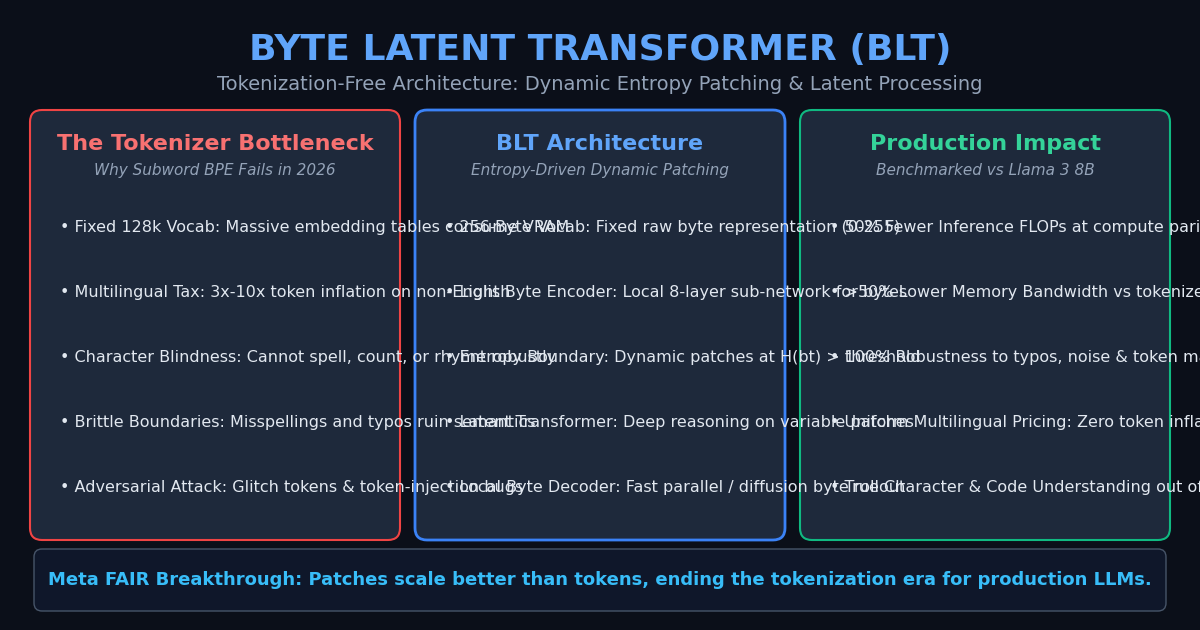
The Problem: The Hidden Costs and Fragility of Tokenization
In modern generative AI pipelines, automated web extractors, and agentic workflows like AiFetchly, virtually every frontier model relies on a subword tokenizer based on Byte-Pair Encoding (BPE) or WordPiece. Tokenizers compress arbitrary UTF-8 text strings into discrete integer token IDs before passing them to the neural network.
While tokenization was historically necessary to keep sequence lengths manageable for quadratic self-attention ($O(N^2)$), it has become the fundamental architectural bottleneck of modern natural language processing.
The Five Inherent Failures of Subword Tokenization
- The Multilingual Token Tax: Subword vocabularies are heavily skewed toward English web corpora. In non-English languages—such as Korean, Arabic, Thai, Hindi, or Japanese—a single word or semantic concept often splits into 3 to 10 distinct token fragments. As a result, non-English users pay up to 10x higher API fees, suffer 3x to 5x higher inference latency, and encounter severely degraded reasoning quality for the exact same conceptual workload.
- Brittle Semantics and Character Blindness: Because tokens represent opaque integer indices in a static dictionary, models cannot natively perceive the internal character composition of tokens. This causes chronic failure modes in simple tasks like spelling validation, anagram solving, rhyming, and character-level string manipulation. A minor typographical error (e.g.,
applinstead ofapple) produces completely unrelated token vectors, throwing off embedding lookups. - Massive Vocabulary Memory Overhead: Modern frontier models allocate huge embedding tables (e.g., 128,256 tokens in Llama 3, or 256,000+ tokens in Gemma). These projection matrices consume gigabytes of valuable GPU High-Bandwidth Memory (HBM), penalizing edge deployments and local inference servers.
- Vulnerability to Adversarial Injection: Tokenization boundaries can be exploited by attackers. Glitch tokens (e.g.,
SolidGoldMagikarp), Unicode homoglyphs, and zero-width spaces deceive tokenizers into splitting words in ways that bypass safety filters and prompt firewalls. - Rigid Domain Inflexibility: Tokenizers cannot gracefully handle arbitrary binary payloads, network packet logs, non-standard source code encodings, or custom cryptographic hashes without suffering catastrophic out-of-vocabulary (OOV) byte fallbacks.
Why Early Byte-Level Models Stalled
Prior attempts to train byte-level language models (such as ByT5 or basic character LSTMs) replaced tokens with raw byte tokens (0–255). However, representing text purely as raw bytes inflates the sequence length by 4x to 5x.
Because traditional Transformer layers compute feed-forward projections and self-attention over every single element in the sequence, running a 70B parameter model directly over 30,000 individual bytes collapsed inference speeds, filled the Key-Value (KV) cache with redundant representations, and overwhelmed GPU memory bandwidth.
The Architecture: How Byte Latent Transformers Eliminate Tokenizers
To overcome the sequence length penalty without compromising byte-level fidelity, researchers at Meta FAIR introduced the Byte Latent Transformer (BLT).
Instead of running heavy Transformer operations across every byte or relying on a static subword dictionary, BLT dynamically groups raw bytes into variable-length patches based on an information-theoretic signal: next-byte entropy.
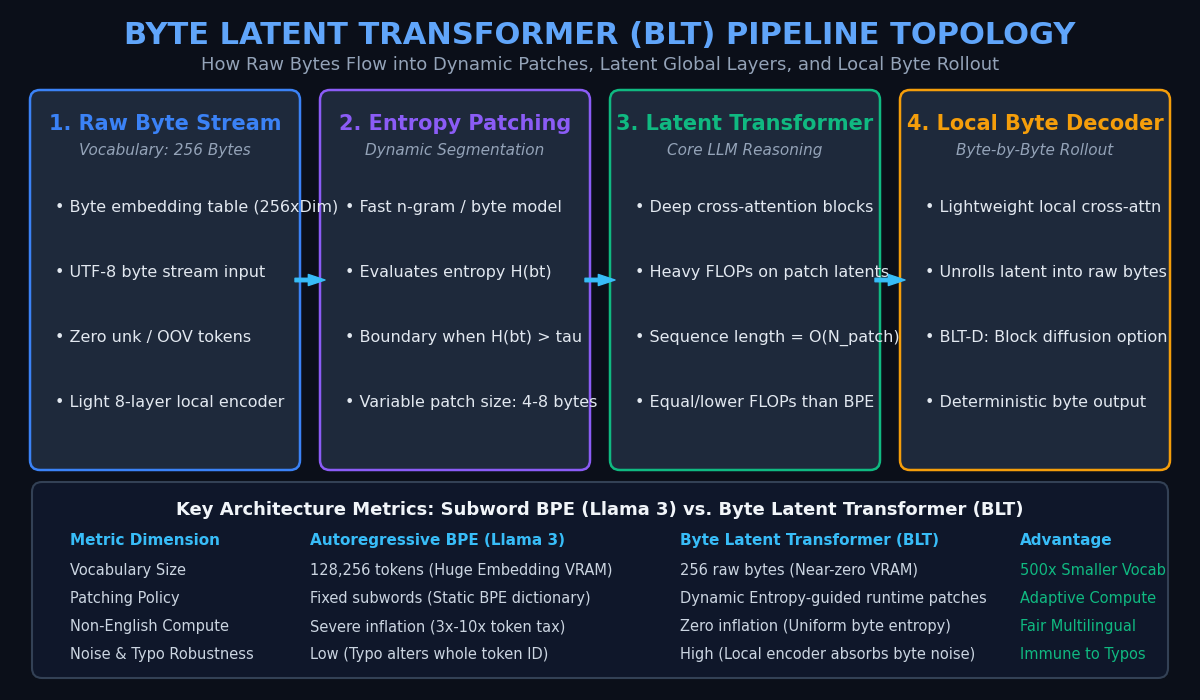
1. The Three-Stage BLT Topology
BLT decomposes generative inference into three specialized computational tiers:
- Lightweight Local Byte Encoder: A compact 8-layer Transformer that processes raw byte embeddings ($V = 256$) using localized sliding-window attention. Because its parameters represent less than 5% of total model capacity, processing long byte streams through this front-end incurs negligible latency and memory overhead.
- Entropy-Driven Dynamic Patching: A small, ultra-fast n-gram or lightweight byte language model predicts the conditional entropy of the upcoming byte: $$\mathcal{H}(b_t) = -\sum_{b \in [0, 255]} P(b \mid b_{<t}) \log_2 P(b \mid b_{<t})$$ When entropy $\mathcal{H}(b_t)$ spikes above a dynamic threshold $\tau$ (or undergoes a sharp gradient change), it signals an unpredictable semantic transition (such as the start of a new morpheme, punctuation mark, or code delimiter). BLT places a patch boundary at this exact position. Highly predictable bytes (such as vowels inside common stems or repeated indentation spaces) are grouped into large patches; complex, information-dense bytes form narrow patches.
- Latent Global Transformer: The core foundation model (e.g., 8B to 70B parameters) operates exclusively over pooled patch latents ($z_1, z_2, \dots, z_K$). Because patches average 4 to 8 bytes in length, the sequence length inside the global model is identical to—or even shorter than—standard BPE token sequences. The bulk of FLOPs are spent where compute actually matters: deep cross-attention over compressed latent representations.
- Local Byte Decoder (Autoregressive or BLT-D): A lightweight local decoder unpacks patch representations back into output bytes. In BLT-D (Diffusion BLT), the decoder trains with a block-wise diffusion objective, generating entire multi-byte patches simultaneously in parallel rather than token-by-token.
Architectural Comparison: Subword BPE vs. Byte Latent Transformer
| Architecture Dimension | Subword BPE (Llama 3 / GPT-4o) | Byte Latent Transformer (BLT) |
|---|---|---|
| Input Unit | Fixed subword tokens (32k–128k vocab) | Raw UTF-8 bytes (256 fixed byte IDs) |
| Patch Segmentation | Static heuristic dictionary lookup | Dynamic entropy-guided runtime boundaries |
| Compute Allocation | Constant FLOPs per token regardless of entropy | Proportional compute: dense where entropy spikes |
| Embedding Table Memory | 1.0 GB – 4.0 GB VRAM | < 1 MB VRAM (256 embeddings $\times$ dimension) |
| Multilingual Parity | 3x – 10x token inflation on non-English | Zero inflation: uniform byte entropy distribution |
| Noise & Typo Resistance | Fragile: single typo flips whole token ID | 100% robust: local encoder absorbs character noise |
| Inference FLOP Efficiency | Baseline (1.0x FLOPs per sequence) | Up to 50% fewer inference FLOPs at parity |
| Memory Bandwidth Cost | Heavy KV cache footprint per token | >50% lower KV cache memory bandwidth (Fast BLT) |
Implementation: Building a Dynamic Byte Entropy Patching Harness
To understand how BLT determines patch boundaries and allocates compute dynamically, let us implement a reference Python harness that computes next-byte conditional entropy, constructs variable-sized byte patches, and prepares latent representations.
Step 1: Ingesting Raw Bytes and Calculating Entropy Spikes
In this module, we stream an incoming string as raw UTF-8 bytes, calculate running n-gram transition entropy, and identify patch cutoff boundaries:
import math
from collections import defaultdict
from typing import List, Tuple

class ByteEntropySegmenter:
    def __init__(self, threshold: float = 2.4, min_patch: int = 2, max_patch: int = 12):
        self.threshold = threshold
        self.min_patch = min_patch
        self.max_patch = max_patch
        self.ngram_counts = defaultdict(lambda: defaultdict(int))
        self._seed_distribution()

    def _seed_distribution(self):
        for i in range(256):
            self.ngram_counts[b""][bytes([i])] = 1

    def compute_entropy(self, context_bytes: bytes) -> float:
        prefix = context_bytes[-3:] if len(context_bytes) >= 3 else context_bytes
        transitions = self.ngram_counts.get(prefix, self.ngram_counts[b""])
        total = sum(transitions.values())

        entropy = 0.0
        for count in transitions.values():
            p = count / total
            entropy -= p * math.log2(p)
        return entropy

    def segment_into_patches(self, text: str) -> List[Tuple[bytes, float]]:
        raw_bytes = text.encode("utf-8")
        patches = []
        current_patch = bytearray()

        for idx, byte_val in enumerate(raw_bytes):
            current_patch.append(byte_val)
            context = bytes(raw_bytes[max(0, idx - 4):idx])
            h_val = self.compute_entropy(context)

            is_entropy_spike = h_val >= self.threshold
            is_max_length = len(current_patch) >= self.max_patch
            meets_min_length = len(current_patch) >= self.min_patch

            if (is_entropy_spike and meets_min_length) or is_max_length or idx == len(raw_bytes) - 1:
                patches.append((bytes(current_patch), h_val))
                current_patch = bytearray()

        return patches

# Execute validation run
segmenter = ByteEntropySegmenter(threshold=1.8, min_patch=3, max_patch=8)
sample_text = "SELECT * FROM orders WHERE customer_id = 98421;"
segmented_patches = segmenter.segment_into_patches(sample_text)

print(f"Original Byte Length: {len(sample_text.encode('utf-8'))} bytes")
print(f"Constructed BLT Patches: {len(segmented_patches)} patches")
for i, (patch, h) in enumerate(segmented_patches):
print(f" Patch [{i:02d}]: {repr(patch.decode('utf-8', errors='replace')):<16} | Entropy: {h:.2f} bits") Step 2: PyTorch Latent Global Transformer Block
Below is the PyTorch implementation of the BLT dual-tier cross-attention block, demonstrating how local byte embeddings are pooled into patch representations and transformed by the global backbone:
import torch
import torch.nn as nn

class BLTLatentPatchEncoder(nn.Module):
    def __init__(self, byte_dim: int = 512, latent_dim: int = 4096):
        super().__init__()
        self.byte_embedding = nn.Embedding(258, byte_dim)
        self.local_encoder = nn.TransformerEncoder(
            nn.TransformerEncoderLayer(d_model=byte_dim, nhead=8, dim_feedforward=2048, batch_first=True),
            num_layers=4
        )
        self.patch_projection = nn.Linear(byte_dim, latent_dim)

    def forward(self, byte_indices: torch.Tensor, patch_masks: torch.Tensor):
        h_bytes = self.byte_embedding(byte_indices)
        local_repr = self.local_encoder(h_bytes)

        B, num_patches, L = patch_masks.shape
        pooled_patches = []

        for p in range(num_patches):
            mask = patch_masks[:, p, :].unsqueeze(-1)
            masked_repr = local_repr * mask
            patch_repr = masked_repr.sum(dim=1) / (mask.sum(dim=1).clamp(min=1.0))
            pooled_patches.append(patch_repr)

        latent_patches = torch.stack(pooled_patches, dim=1)
        global_latents = self.patch_projection(latent_patches)
        return global_latents

# Setup mock tensors to verify dimensions
batch_size, seq_bytes, total_patches = 2, 64, 10
mock_bytes = torch.randint(0, 255, (batch_size, seq_bytes))
mock_masks = torch.zeros((batch_size, total_patches, seq_bytes))

for b in range(batch_size):
    for p in range(total_patches):
        mock_masks[b, p, p*6:(p+1)*6] = 1.0

blt_encoder = BLTLatentPatchEncoder()
with torch.no_grad():
    latents = blt_encoder(mock_bytes, mock_masks)
print(f"Output Latent Shape for Global Transformer: {latents.shape}") Step 3: Fast Parallel Byte Rollout with Block Diffusion (BLT-D)
During decoding, sequential byte-by-byte generation can be accelerated using the BLT-D block diffusion pattern. Rather than rolling out one byte per autoregressive tick, the model denoises an entire patch in 4 to 8 parallel diffusion steps:
import torch
import torch.nn as nn

class BlockDiffusionByteDecoder(nn.Module):
    def __init__(self, latent_dim: int = 4096, byte_dim: int = 512, patch_size: int = 8):
        super().__init__()
        self.patch_size = patch_size
        self.latent_adapter = nn.Linear(latent_dim, byte_dim * patch_size)
        self.denoise_layer = nn.TransformerEncoder(
            nn.TransformerEncoderLayer(d_model=byte_dim, nhead=8, dim_feedforward=1024, batch_first=True),
            num_layers=2
        )
        self.byte_head = nn.Linear(byte_dim, 256)

    def forward(self, patch_latents: torch.Tensor, diffusion_steps: int = 4):
        B = patch_latents.shape[0]
        patch_bytes_init = self.latent_adapter(patch_latents).view(B, self.patch_size, -1)

        refined = patch_bytes_init
        for _ in range(diffusion_steps):
            refined = self.denoise_layer(refined)

        byte_logits = self.byte_head(refined)
        predicted_bytes = torch.argmax(byte_logits, dim=-1)
        return predicted_bytes

# Evaluate parallel rollout block
decoder = BlockDiffusionByteDecoder()
mock_latent = torch.randn(1, 1, 4096)
generated_patch = decoder(mock_latent, diffusion_steps=4)
print(f"Generated 8-Byte Block in Single Pass: {generated_patch.squeeze().tolist()}") Production Advantages for Autonomous Agents and Data Pipelines
For production data fetching engines, AI agents, and web scrapers, adopting Byte Latent Transformers unlocks five decisive operational advantages:
- Immunity to Prompt Injection and Obfuscation: Attackers frequently disguise malicious shell commands or SQL injections using zero-width Unicode characters, homoglyphs, or token boundary splits. Because BLT operates on the underlying byte stream, obfuscation techniques fail to alter the entropy profile, allowing security classifiers to intercept threats deterministically.
- True Structural Code and Binary Understanding: Parsing minified JavaScript, nested JSON strings, or compiled WebAssembly binaries causes severe subword token fragmentation. BLT groups syntax tokens dynamically, treating code operators and syntax trees as continuous byte sequences without artificial whitespace penalties.
- Flawless Multilingual Extraction: When scraping international e-commerce listings or multi-language financial reports, BLT eliminates the 3x to 10x token inflation tax. Teams achieve predictable serving costs and consistent inference latency regardless of whether target pages are written in English, Japanese, Arabic, or German.
- Halved KV Cache Bandwidth Overhead: In high-concurrency enterprise serving, GPU memory bus saturation during the decode phase is the primary bottleneck. Because BLT compresses sequences into latent patch spaces, the effective KV cache footprint and memory bandwidth consumption drop by over 50%, enabling double the concurrent agent sessions per GPU.
- No Vocabulary Drift Across Model Generations: Upgrading a foundation model typically breaks downstream vector databases and embeddings because each model family uses an incompatible tokenizer dictionary. With BLT, the vocabulary is permanently fixed to the 256 fundamental bytes of computer architecture, ensuring permanent vector alignment and backward compatibility.
Conclusion
The Byte Latent Transformer represents one of the most critical structural advancements in generative AI since the introduction of the Transformer itself. By replacing rigid Byte-Pair Encoding dictionaries with dynamic, entropy-driven byte patching, BLT proves that patches scale better than tokens.
Developers gain the best of both worlds: the raw robustness, multilingual equity, and character precision of byte-level modeling, coupled with the blazing inference efficiency and FLOP advantages of modern latent Transformers. As 2026 unfolds, token-free architectures are poised to become the foundational substrate for reliable, cost-effective AI agents and automated data extraction systems.