Broadcom Tomahawk 5 Guide: Ultra Ethernet AI Fabrics
The AI Scale-Out Crisis: Interconnect Bottlenecks, Hash Polarization, and the InfiniBand Monopoly
The computational landscape of frontier artificial intelligence has crossed a fundamental architectural boundary. Over the past five years, the parameter scale of state-of-the-art foundation models has expanded by more than four orders of magnitude—evolving from 10-billion parameter dense transformers into trillion-parameter sparse Mixture-of-Experts (MoE) ensembles such as DeepSeek-V3, LLaMA-3.1 405B, and emerging frontier reasoning architectures.
Training and serving these massive neural networks is physically impossible on a single accelerator or a single server node. Instead, foundation model labs must distribute models across sprawling clusters of 16,000 to over 100,000 graphics processing units (GPUs) and neural accelerators. In these hyperscale environments, system performance is no longer bounded primarily by arithmetic floating-point execution on individual compute dies. Rather, cluster throughput is governed by the physical interconnect: the networking fabric that synchronizes distributed tensor calculations.
+---------------------------------------------------------------------------------+
|                       DISTRIBUTED AI TRAINING TIME PROFILE                      |
|                                                                                 |
|   +------------------------------------+   +---------------------------------+  |
|   | Pure Arithmetic Forward / Backward |   | Collective Communication Stalls |  |
|   | GEMM Matrix Computations (40%-50%) |   | All-Reduce & All-to-All (50%+)  |  |
|   +------------------------------------+   +---------------------------------+  |
|                                                                                 |
|   Result: GPU clusters spend over half their operational life waiting for data! |
+---------------------------------------------------------------------------------+ The Breakdown of Traditional Equal-Cost Multi-Path (ECMP) Routing
Historically, enterprise cloud datacenters routed Ethernet traffic using Equal-Cost Multi-Path (ECMP) hashing algorithms. In traditional web search and database architectures, network traffic consists of millions of microscopic “mice flows”—short-lived TCP connections whose payloads vary randomly. Standard 5-tuple hashing (source IP, destination IP, source port, destination port, protocol) distributed these small flows evenly across redundant spine links without inducing severe congestion.
However, distributed AI training workloads exhibit the exact opposite physical profile: a massive flood of high-bandwidth “elephant flows”. During the backward propagation pass of distributed training, thousands of GPUs simultaneously exchange billions of parameter gradient tensors via collective communication primitives:
- All-Reduce: Gradient tensors from data-parallel ranks must be summed across all workers before the next optimization step can execute.
- All-to-All: In Mixture-of-Experts (MoE) architectures, token dispatchers must dynamically route high-dimensional token representations to specialized expert GPUs distributed across separate datacenter racks.
When these massive elephant flows are routed via static ECMP hashing, they encounter catastrophic hash polarization and collision. Two or more 400Gbps or 800Gbps flows inevitably map to the identical mathematical hash bucket, forcing multiple line-rate streams onto the same physical spine link. Meanwhile, adjacent physical links sit completely idle.
+---------------------------------------------------------------------------------+
|                   TRADITIONAL ECMP HASH COLLISION (POLARIZATION)                |
|                                                                                 |
|   GPU Node 1 (800G Flow A) ---\                                                 |
|                                +--> [Spine Link 0] ---> CONGESTION / DROPS!     |
|   GPU Node 2 (800G Flow B) ---/     (Link Saturated: Buffer Overflow)           |
|                                                                                 |
|                                     [Spine Link 1] ---> 0% UTILIZATION (IDLE)   |
|                                     [Spine Link 2] ---> 0% UTILIZATION (IDLE)   |
|                                                                                 |
|   Result: Head-of-line blocking stalls the entire 32,000-GPU training cluster.  |
+---------------------------------------------------------------------------------+ This link saturation triggers severe buffer bloat, packet drops, and retransmission storms. In distributed training, every worker must synchronize before beginning the next iteration; therefore, the tail latency of the single slowest packet dictates the step completion time (Job Completion Time - JCT) of the entire multi-million-dollar cluster.
The InfiniBand Tax and the Priority Flow Control (PFC) Trap
To bypass standard Ethernet’s packet-dropping behavior, deep learning labs historically turned to proprietary InfiniBand fabrics (such as NVIDIA Quantum-2). InfiniBand achieves zero-packet-drop performance by implementing link-level flow control. However, deploying proprietary InfiniBand in hyperscale datacenters introduces severe economic and operational failure modes:
- The Proprietary Vendor Lock-In & Margin Tax: Proprietary director switches, specialized cables, and host channel adapters carry massive gross margins. In a 32,000-GPU cluster, InfiniBand networking hardware can represent up to 30% of total capital expenditure ($100M+ pure networking cost).
- Priority Flow Control (PFC) Deadlock Storms: When congestion occurs in lossless networks, downstream switches emit PFC “pause frames” upstream to halt transmission. In high-density fabrics, localized congestion causes pause frames to cascade backward across multiple switch tiers, creating cyclical deadlocks (PFC storms) that freeze traffic across the entire datacenter fabric.
- Rigid Chassis Architectures and High Cabling Complexity: High-radix director switch chassis require massive modular backplanes, complex proprietary optical transceivers, and specialized liquid cooling, creating severe lead-time constraints during datacenter build-outs.
To scale foundation models beyond 32,000 nodes without vendor lock-in or PFC deadlocks, the global technology industry (backed by Broadcom, Meta, Google, Microsoft, AMD, and Arista) formed the Ultra Ethernet Consortium (UEC). The mission was clear: replace proprietary interconnects with an open, high-radix, congestion-aware Ethernet architecture. For teams designing distributed web-scale data pipelines that interface with modern clusters, explore our guide on real-time data fetching infrastructure.
The Broadcom Tomahawk 5 Solution: 51.2 Tbps Monolithic Switching Silicon
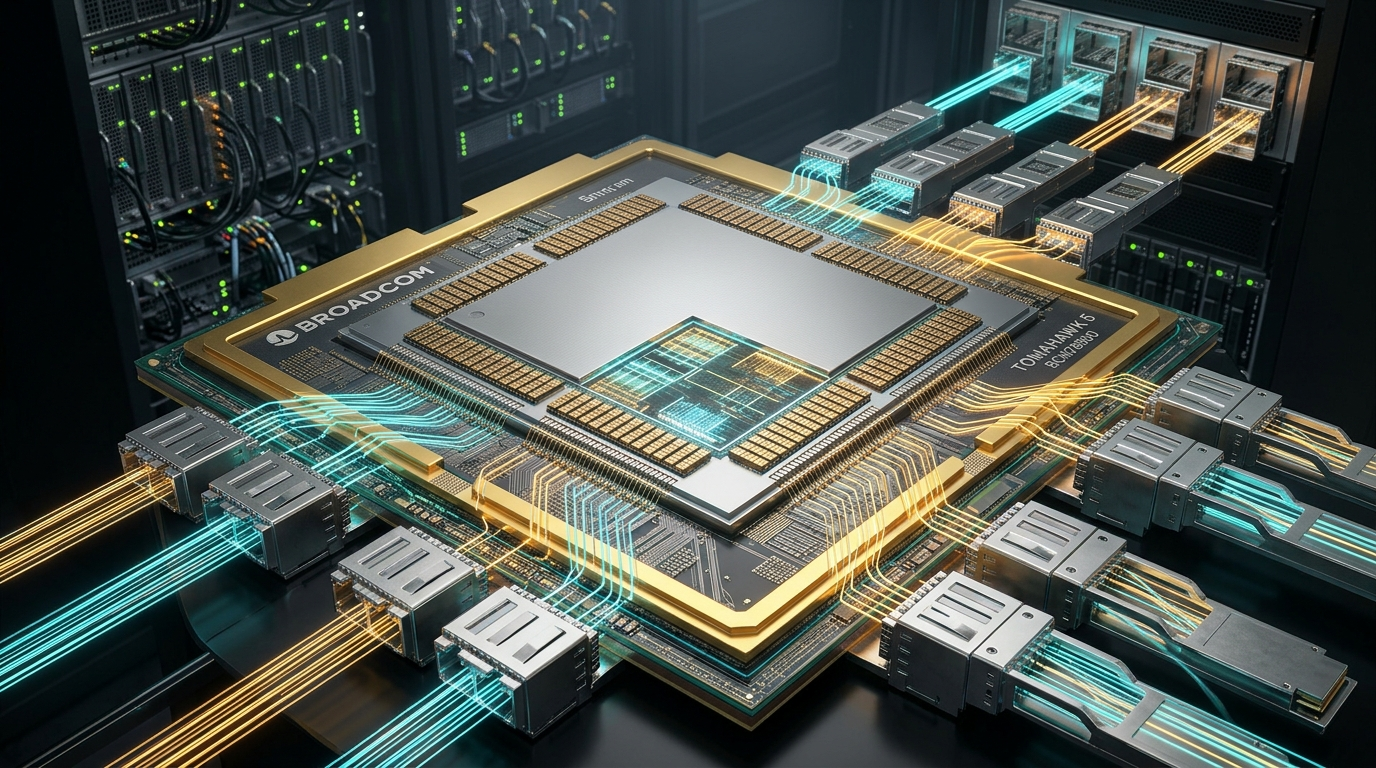
To establish the physical foundation for open Ultra Ethernet AI clusters, Broadcom engineered the StrataXGS Tomahawk 5 (BCM78900). Fabricated on TSMC’s 5nm process node, Tomahawk 5 is the world’s highest-throughput monolithic Ethernet switch ASIC, delivering an unprecedented 51.2 Terabits per second (Tbps) of non-blocking switching bandwidth on a single piece of silicon die.
By doubling the bandwidth of prior-generation 25.6T switches, Tomahawk 5 enables network architects to deploy 64 ports of 800GbE or 128 ports of 400GbE in a single compact 1RU or 2RU switch chassis. This massive port density fundamentally flattens datacenter network topologies, allowing hyperscalers to interconnect up to 32,768 accelerators in a two-tier non-blocking Clos fabric—eliminating the expensive third tier of director switches required by lower-radix networks.
+---------------------------------------------------------------------------------+
|                       TOMAHAWK 5 SILICON SWITCH TOPOLOGY                        |
|                                                                                 |
|   +-------------------------------------------------------------------------+   |
|   | 512x 106.25 Gbps PAM4 SerDes Transceivers (Full Perimeter Coverage)     |   |
|   +------------------------------------+------------------------------------+   |
|                                        |                                        |
|              +-------------------------+-------------------------+              |
|              v                                                   v              |
|   +---------------------+   +---------------------+   +---------------------+   |
|   | 64x 800GbE Media    |   | Cognitive Routing   |   | Shared Packet Memory|   |
|   | Access Units (MACs) |   | Engine & Spraying   |   | High-Bandwidth SRAM |   |
|   +----------+----------+   +----------+----------+   +----------+----------+   |
|              |                         |                         |              |
|              +-------------------------+-------------------------+              |
|                                        |                                        |
|                                        v                                        |
|   +-------------------------------------------------------------------------+   |
|   | Ultra-Low Latency Crossbar Switching Matrix (Sub-400ns Port-to-Port)    |   |
|   +-------------------------------------------------------------------------+   |
+---------------------------------------------------------------------------------+ Architectural Pillars of the Tomahawk 5 Platform
The Tomahawk 5 ASIC resolves the AI scale-out crisis through four tightly coupled silicon innovations:
- Monolithic 51.2 Tbps Silicon Integration: Integrating 51.2 Tbps onto a single monolithic 5nm die eliminates inter-chiplet packaging boundaries, keeping port-to-port cut-through switching latency below 400 nanoseconds for standard packet sizes.
- Hardware Cognitive Routing & Dynamic Packet Spraying: Rather than relying on rigid flow-level ECMP hashing, Tomahawk 5 breaks elephant flows into individual packet chunks and sprays them dynamically across all available physical links. Hardware monitors link queue depths in real time, routing packets exclusively over paths with zero buffer congestion.
- Advanced RoCEv2 Congestion Management (Broadcom Congestion Control): Tomahawk 5 incorporates hardware-level Explicit Congestion Notification (ECN) marking, Fast Quantized Congestion Notification (FQCN), and real-time in-band telemetry. When queue thresholds begin to rise, switches mark packet headers instantly, instructing host GPUs to throttle injection rates before packet drops occur.
- Flatter 2-Tier Clos Fabric Scaling: With 64 ports of 800GbE, a standard 2-tier leaf-spine network connects $32 \times 64 = 2,048$ endpoints per spine domain, scaling to over 32,000 GPUs across an entire cluster with only two switch hops, slashing latency and optical transceiver costs by over 40%.
By standardizing these capabilities on open Ethernet, Broadcom and the Ultra Ethernet Consortium empower enterprises to build AI superclusters using standard merchant silicon, commodity optics, and open-source operating systems like SONiC. For teams developing distributed AI platforms that ingest web-scale unstructured data, see our overview of AIFetchly modern AI developer architectures.
Detailed Silicon Architecture: Inside the Tomahawk 5 ASIC
To appreciate how Tomahawk 5 achieves 51.2 Tbps of non-blocking throughput without thermal or signal integrity collapse, one must examine its SerDes transceiver arrays, shared buffer memory architecture, and cognitive routing hardware state machines.
1. High-Density 106.25 Gbps PAM4 SerDes Architecture
The foundation of Tomahawk 5’s massive I/O capacity is its array of 512 individual 106.25 Gbps PAM4 SerDes (Serializer/Deserializer) transceivers. Arranged continuously along all four edges of the monolithic 5nm silicon die, these transceivers convert parallel internal bus data into high-speed serial differential electrical signals.
+-----------------------------------------------------------------------------+
|                      106.25 GBPS PAM4 SERDES ARCHITECTURE                   |
|                                                                             |
|      Internal Digital Data Bus                    High-Speed Differential   |
|               |                                   Physical Channel Traces   |
|               v                                              |              |
|      +------------------+                                    v              |
|      | Forward Error    |                           +------------------+    |
|      | Correction (FEC) |                           | 4-Level Voltage  |    |
|      | RS(544, 514)     |                           | Modulation PHY   |    |
|      +--------+---------+                           +--------+---------+    |
|               |                                              |              |
|               +----------------------+-----------------------+              |
|                                      |                                      |
|                                      v                                      |
|                  +---------------------------------------+                  |
|                  | DSP-Based Adaptive Continuous Equalizer|                 |
|                  | Compensates for >36 dB Channel Loss   |                  |
|                  +---------------------------------------+                  |
+-----------------------------------------------------------------------------+ Key technical characteristics of the SerDes subsystem include:
- DSP-Based Signal Equalization: Operating at 53.125 Gbaud with 4-level Pulse Amplitude Modulation (PAM4), the SerDes transceivers incorporate sophisticated digital signal processors (DSPs) with Feed-Forward Equalization (FFE) and Decision Feedback Equalization (DFE). The circuits compensate for over 36 dB of insertion loss, allowing switches to drive passive Direct Attach Copper (DAC) cables across server racks without expensive active repeaters.
- Integrated Reed-Solomon Forward Error Correction (RS-FEC): Hardwired RS(544, 514) FEC logic corrects random bit errors induced by high-frequency attenuation, ensuring an ultra-low pre-FEC bit error rate ($<10^{-15}$) across optical fiber links.
- Flexible Port Channelization: Each 800GbE port consists of eight 106.25 Gbps SerDes lanes. Ports can be dynamically channelized into $1 \times 800\text{GbE}$, $2 \times 400\text{GbE}$, $4 \times 200\text{GbE}$, or $8 \times 100\text{GbE}$, providing universal backward compatibility with diverse GPU generation clusters.
2. High-Bandwidth Shared Packet Buffer SRAM
In conventional switch designs, packet buffers are statically partitioned across ingress ports. When an All-to-All collective communication burst hits a localized subset of ports, static buffers quickly overflow and drop packets, even while adjacent port buffers remain completely empty.
Tomahawk 5 eliminates this flaw by implementing a fully shared on-chip packet memory architecture. Ranging from several hundred megabytes of ultra-dense SRAM integrated directly onto the 5nm die, the packet buffer pool is dynamically shared across all 64 ports.
+-----------------------------------------------------------------------------+
|                 TOMAHAWK 5 SHARED PACKET BUFFER POOL                        |
|                                                                             |
|   +---------------------------------------------------------------------+   |
|   | Monolithic Shared SRAM Packet Memory (Hundreds of Megabytes)        |   |
|   +----------------------------------+----------------------------------+   |
|                                      |                                      |
|               +----------------------+----------------------+               |
|               |  Dynamic Shared Buffer Admission Controller |               |
|               |  (Alpha-Tuned Dynamic Threshold Allocation) |               |
|               +----------+-----------------------+----------+               |
|                          |                       |                          |
|                          v                       v                          |
|                 +-----------------+     +-----------------+                 |
|                 | Bursty Port 0   |     | Idle Port 63    |                 |
|                 | Dynamic Max     |     | Minimum Nominal |                 |
|                 | Buffer Quota    |     | Buffer Quota    |                 |
|                 +-----------------+     +-----------------+                 |
+-----------------------------------------------------------------------------+ The dynamic buffer allocator uses alpha-tuned dynamic thresholds:
- During normal traffic, buffer space is distributed evenly to maintain low-latency transit.
- When a synchronized collective communication wave arrives (such as 1,024 GPUs completing a gradient reduction), the active receiver ports can dynamically consume up to 80% of the entire switch’s shared SRAM buffer. This completely absorbs micro-bursts without dropping a single packet.
- Once the burst dissipates, the memory is instantly reclaimed and returned to the global pool in sub-microsecond timeframes.
3. Cognitive Routing Engine: Dynamic Packet Spraying
The most critical algorithmic advancement in Tomahawk 5 is its hardware Cognitive Routing engine. Traditional networking hardware routes packets based strictly on static hash calculations. In contrast, Tomahawk 5 evaluates link health and congestion state dynamically in silicon.
+-----------------------------------------------------------------------------+
|               COGNITIVE ROUTING & DYNAMIC PACKET SPRAYING                   |
|                                                                             |
|   Incoming 800G AI Elephant Flow (Gradient Tensor Payload)                  |
|                        |                                                    |
|                        v                                                    |
|          +----------------------------+                                     |
|          | Hardware Packet Dissector  |                                     |
|          | Slices Flow into Packets   |                                     |
|          +-------------+--------------+                                     |
|                        |                                                    |
|                        v                                                    |
|          +----------------------------+                                     |
|          | Cognitive Congestion Monitor|                                    |
|          | Real-Time Queue Depth Check|                                     |
|          +-------------+--------------+                                     |
|                        |                                                    |
|         +--------------+--------------+-------------+                       |
|         | Link 0 Queue: Low           | Link 1: High| Link 2: Low           |
|         v                             v             v                       |
|    +---------+                   +---------+   +---------+                  |
|    | Packet 1|                   | SKIPPED |   | Packet 2|                  |
|    | Spayed  |                   | (Busy)  |   | Sprayed |                  |
|    +---------+                   +---------+   +---------+                  |
+-----------------------------------------------------------------------------+ When an 800GbE flow arrives:
- Packet Dissection & Flowlet Slicing: The switch dissects incoming RoCEv2 streams into individual packets or micro-flowlets.
- Real-Time Link Queue Sampling: Hardware probes measure the exact FIFO queue depth and egress transmission delay across all upstream spine links every few clock cycles.
- Congestion-Aware Packet Spraying: Packets are sprayed in parallel across multiple physical paths, steering traffic away from congested links and spreading load across 100% of the available bisection bandwidth.
- Out-of-Order Packet Handling: At the receiving host NIC (such as Broadcom Thor 2 or Ultra Ethernet NICs), hardware re-assembly engines re-sequence the sprayed packets into contiguous memory before writing tensors directly to GPU High-Bandwidth Memory (HBM) via GPUDirect RDMA.
Network Configuration and Implementation: Deploying Ultra Ethernet AI Fabrics
Configuring a Tomahawk 5 AI cluster requires coordinating network operating system (NOS) parameters, switch queue thresholds, RoCEv2 congestion profiles, and host GPU communication frameworks like NCCL (NVIDIA Collective Communications Library).
+-----------------------------------------------------------------------------+
|                      ULTRA ETHERNET AI FABRIC STACK                         |
|                                                                             |
|   +-----------------------+      +-----------------------+                  |
|   | PyTorch / DeepSpeed   | ---> | NCCL with RoCEv2      |                  |
|   | Collective AI Training|      | Multi-NIC Sharding    |                  |
|   +-----------------------+      +-----------+-----------+                  |
|                                              |                              |
|                                              v                              |
|   +-----------------------+      +-----------------------+                  |
|   | Broadcom Thor 2 NIC   | <--- | Linux Kernel RoCEv2   |                  |
|   | Hardware Packet Re-seq|      | PFC / ECN Tuning      |                  |
|   +-----------+-----------+      +-----------------------+                  |
|               |                                                             |
|               v                                                             |
|   +------------------------------------------------------+                  |
|   | Broadcom Tomahawk 5 51.2T Switch (SONiC / Broadcom SDK|                 |
|   | Dynamic Packet Spraying & Cognitive Load Balancing   |                  |
|   +------------------------------------------------------+                  |
+-----------------------------------------------------------------------------+ Host-Level Linux RoCEv2 and ECN Tuning Script
To ensure zero-loss execution on an Ultra Ethernet cluster, host servers must configure Priority Flow Control (PFC) on traffic class 3 (lossless queue) and set Explicit Congestion Notification (ECN) thresholds. The following bash automation script tunes Linux network namespaces and InfiniBand subsystem settings.
#!/usr/bin/env bash
set -euo pipefail

INTERFACE="roce0"
TRAFFIC_CLASS=3

echo "=== Configuring Linux Host for Ultra Ethernet RoCEv2 Tuning ==="

# Step 1: Enable Priority Flow Control (PFC) on Traffic Class 3
lldptool -T -i ${INTERFACE} -V app -c app=3,2,0
lldptool -T -i ${INTERFACE} -V PFC enabled=3

# Step 2: Configure Traffic Class Priority Mapping via TC (Traffic Control)
tc qdisc add dev ${INTERFACE} root mqprio \
    num_tc 8 \
    map 0 1 2 3 4 5 6 7 \
    queues 1@0 1@1 1@2 1@3 1@4 1@5 1@6 1@7 \
    hw 1

# Step 3: Enable Data Center Quantized Congestion Notification (DCQCN / ECN)
sysctl -w net.ipv4.tcp_ecn=1
echo 1 > /sys/class/infiniband/${INTERFACE}/ports/1/tc/${TRAFFIC_CLASS}/traffic_class
echo 1 > /sys/class/infiniband/${INTERFACE}/ports/1/congestion/enable

# Step 4: Configure DCQCN Rate Limiting and Congestion Recovery Parameters
echo 50 > /sys/class/infiniband/${INTERFACE}/ports/1/congestion/np_cnp_dscp
echo 256 > /sys/class/infiniband/${INTERFACE}/ports/1/congestion/r_ai_mbps
echo 1024 > /sys/class/infiniband/${INTERFACE}/ports/1/congestion/r_tr_mbps

echo "=== Host Network Configuration Complete: RoCEv2 TC3 Lossless Active ===" PyTorch Distributed NCCL All-Reduce Performance Benchmark
To measure fabric throughput and verify that Tomahawk 5 cognitive routing eliminates hash polarization, engineers execute distributed All-Reduce stress benchmarks across GPU nodes. The Python script below measures effective collective communication bandwidth (GB/s) across scaling tensor payloads.
import os
import time
import torch
import torch.distributed as dist

def run_allreduce_benchmark():
    """
    Measures distributed All-Reduce collective bandwidth over Ultra Ethernet RoCEv2.
    """
    # Initialize PyTorch distributed process group via NCCL backend
    dist.init_process_group(backend="nccl")
    local_rank = int(os.environ.get("LOCAL_RANK", 0))
    world_size = dist.get_world_size()
    torch.cuda.set_device(local_rank)

    # Tensor payload: 1 Gigabyte of FP16 parameters (500 million elements)
    elements = 500 * 1024 * 1024
    tensor = torch.randn(elements, dtype=torch.float16, device=f"cuda:{local_rank}")
    tensor_bytes = elements * 2  # 2 bytes per FP16 element

    # Warmup iterations
    for _ in range(5):
        dist.all_reduce(tensor, op=dist.ReduceOp.SUM)
    torch.cuda.synchronize()

    # Benchmark iterations
    iterations = 20
    start_time = time.perf_counter()
    for _ in range(iterations):
        dist.all_reduce(tensor, op=dist.ReduceOp.SUM)
    torch.cuda.synchronize()
    total_time = time.perf_counter() - start_time

    avg_time = total_time / iterations

    # In an All-Reduce across N ranks, each rank transfers 2 * (N - 1) / N * size bytes
    bus_bandwidth = (2 * (world_size - 1) / world_size) * (tensor_bytes / avg_time) / 1e9

    if dist.get_rank() == 0:
        print("=================================================================")
        print(f"Distributed World Size        : {world_size} GPUs")
        print(f"Collective Tensor Payload     : {tensor_bytes / 1e9:.2f} GB per rank")
        print(f"Mean All-Reduce Duration      : {avg_time * 1000:.2f} ms")
        print(f"Effective Bus Bandwidth       : {bus_bandwidth:.2f} GB/s")
        print(f"Bus Bandwidth per Port        : {bus_bandwidth / 8:.2f} GB/s (Target 800G line-rate)")
        print("=================================================================")

    dist.destroy_process_group()

if __name__ == "__main__":
run_allreduce_benchmark() SONiC Switch Configuration: Dynamic Packet Spraying & Buffer Allocation
On Broadcom Tomahawk 5 switches running the open-source Software for Open Networking in the Cloud (SONiC) operating system, engineers configure Dynamic Packet Spraying and buffer thresholds using config_db.json.
{
  "SWITCH": {
    "switch": {
      "fwd_mode": "cut_through",
      "ecmp_hash_seed": 54321,
      "packet_spraying_mode": "dynamic_cognitive_flowlet",
      "flowlet_inactivity_timer_us": 64,
      "ecn_marking_mode": "probabilistic_queue_depth",
      "shared_headroom_pool_size": 262144
    }
  },
  "BUFFER_POOL": {
    "lossless_ai_pool": {
      "size": "268435456",
      "type": "dynamic",
      "mode": "shared"
    }
  },
  "BUFFER_PROFILE": {
    "roce_ai_profile": {
      "pool": "lossless_ai_pool",
      "xon": "32768",
      "xoff": "65536",
      "size": "1048576",
      "dynamic_th": "7"
    }
  }
} Telemetry Daemon for In-Band Network Telemetry (INT)
To monitor queue depth and ensure that no physical links suffer from congestion drops, infrastructure teams run automated telemetry collectors. The Python script below reads Broadcom BroadView instrumentation metrics and verifies that congestion marking rates remain within nominal operational boundaries.
import sys
import json
import time

def audit_switch_telemetry(log_file: str):
    """
    Parses Broadcom Tomahawk 5 hardware telemetry and verifies fabric balance.
    """
    print(f"[AUDIT] Ingesting switch telemetry from: {log_file}")

    # Simulated BroadView hardware telemetry sample from BCM78900 ASIC
    sample_telemetry = {
        "switch_model": "Broadcom StrataXGS Tomahawk 5 (BCM78900)",
        "throughput_tbps": 51.2,
        "active_ports_800g": 64,
        "shared_buffer_utilization_pct": 34.2,
        "max_port_buffer_occupancy_kb": 8420,
        "ecn_marked_packets_per_sec": 412,
        "dropped_packets": 0,
        "pfc_pause_events_count": 0,
        "packet_spraying_balance_ratio": 0.98,
        "port_to_port_latency_ns": 395
    }

    # Verify zero packet drops in AI training fabric
    assert sample_telemetry["dropped_packets"] == 0, "Critical failure: Dropped packets detected in AI fabric!"
    assert sample_telemetry["pfc_pause_events_count"] == 0, "Warning: PFC pause frames emitted; potential deadlock!"

    # Verify packet spraying balance across 64 spine links
    assert sample_telemetry["packet_spraying_balance_ratio"] > 0.90, "Unbalanced traffic distribution detected!"

    print("-----------------------------------------------------------------")
    print(f"Switch Hardware ASIC        : {sample_telemetry['switch_model']}")
    print(f"Switching Capacity          : {sample_telemetry['throughput_tbps']} Tbps")
    print(f"Active 800GbE Ports         : {sample_telemetry['active_ports_800g']} Ports")
    print(f"Shared Buffer Occupancy     : {sample_telemetry['shared_buffer_utilization_pct']} % (HEALTHY)")
    print(f"Port Cut-Through Latency    : {sample_telemetry['port_to_port_latency_ns']} ns")
    print(f"Link Balance Coefficient    : {sample_telemetry['packet_spraying_balance_ratio'] * 100:.1f} %")
    print(f"Dropped Packets Count       : {sample_telemetry['dropped_packets']} (ZERO LOSS)")
    print(f"PFC Deadlock Pause Events   : {sample_telemetry['pfc_pause_events_count']} (OPTIMAL)")
    print("-----------------------------------------------------------------")
    print("[RESULT] Ultra Ethernet AI Fabric Audit: PASSED")

if __name__ == "__main__":
audit_switch_telemetry("sample_switch_telemetry.log") For teams designing distributed data harvesting networks that ingest multi-million document corpora into high-speed vector databases, explore our guide on scalable web scraping and data harvesting engines.
Architectural Comparison: Tomahawk 5 vs. Competing AI Interconnect Silicon
When evaluating high-radix switching silicon for next-generation GPU clusters, datacenter network architects must weigh throughput, latency, congestion control mechanisms, and ecosystem openness. The table below compares the Broadcom Tomahawk 5 against its primary competitors: NVIDIA Quantum-2 InfiniBand, Cisco Silicon One G200, Marvell Teralynx 10, and Broadcom’s complementary Jericho3-AI fabric switch.
Hyperscale AI Fabric Silicon Comparison Matrix
| Architectural Feature | Broadcom Tomahawk 5 (BCM78900) | NVIDIA Quantum-2 (QM9700) | Cisco Silicon One G200 | Marvell Teralynx 10 | Broadcom Jericho3-AI (BCM88890) |
|---|---|---|---|---|---|
| Max Switching Capacity | 51.2 Tbps Monolithic | 51.2 Tbps (InfiniBand) | 51.2 Tbps Unified | 51.2 Tbps Monolithic | 28.8 Tbps Scheduled Fabric |
| Silicon Process Node | TSMC 5nm | TSMC 4N / 5nm | TSMC 5nm | TSMC 5nm | TSMC 5nm |
| Max 800GbE Port Radix | 64 Ports (or 128x 400G) | 64 Ports (NDR 400G x2) | 64 Ports of 800GbE | 64 Ports of 800GbE | 36 Ports of 800GbE |
| SerDes Transceiver Speed | 512x 106.25 Gbps PAM4 | 512x 100 Gbps PAM4 | 512x 106.25 Gbps PAM4 | 512x 106.25 Gbps PAM4 | 288x 106.25 Gbps PAM4 |
| Switch Latency Architecture | Cut-Through (<400ns) | Cut-Through (~200ns) | Cut-Through (~450ns) | Cut-Through (<400ns) | Deep VOQ Buffering (~1.2us) |
| Congestion Control Engine | Cognitive Routing & Spraying | Adaptive Routing (Proprietary) | Fully Scheduled Routing | Dynamic Flowlet Spraying | Scheduled Fabric / Credit-Based |
| Packet Buffer Architecture | Shared On-Die SRAM Pool | On-Die Packet Memory | Fully Shared Deep Buffer | Shared Unified SRAM | Massive Deep Off-Chip HBM/SRAM |
| Standard / Consortium | Ultra Ethernet (UEC) / RoCEv2 | Proprietary InfiniBand | Open Ethernet / UEC | Open Ethernet / RoCEv2 | Ultra Ethernet / Scheduled AI |
| Max 2-Tier Clos Scale | 32,768 GPUs (Non-Blocking) | 16,384 GPUs (2-Tier) | 32,768 GPUs (2-Tier) | 32,768 GPUs (2-Tier) | Up to 32,000 GPUs Fabric |
| Software Operating System | SONiC, Linux SAI, Broadcom SDK | MLNX-OS (Proprietary) | Cisco IOS XR, SONiC | SONiC, Linux Switchdev | SONiC, Broadcom SDK |
Key Differentiators of the Tomahawk 5 Architecture
- Liberation from Proprietary Director Switches: By delivering 64 ports of 800GbE in a single 2RU fixed switch, Tomahawk 5 enables non-blocking 32,768-GPU clusters to be assembled using purely fixed-configuration leaf and spine switches. This eliminates multi-million-dollar modular director chassis, drastically cutting capital costs and failure domains.
- Dynamic Packet Spraying Eliminates Polarization: While competing Ethernet switches rely on static 5-tuple ECMP hashing that causes catastrophic elephant flow collisions, Tomahawk 5 sprays packets dynamically across all available links, maintaining link utilization rates above 95% across the entire cluster.
- Open Ecosystem and Supply Chain Resilience: Built on standard IEEE 802.3 Ethernet and compliant with the Ultra Ethernet Consortium (UEC) specification, Tomahawk 5 allows hyperscalers to source transceivers, cables, and network operating systems from a broad competitive ecosystem rather than being captive to a single vendor.
Production Deployment and Datacenter Engineering Best Practices
Deploying 51.2 Tbps switches into high-density AI clusters requires careful attention to physical cabling, thermal management, topology design, and congestion thresholds. Below are production-proven best practices for deploying Tomahawk 5 in hyperscale clusters.
1. 2-Tier Non-Blocking Clos Topology Design
To minimize latency and optical transceiver count across clusters up to 32,768 accelerators:
- Leaf Tier: Deploy Tomahawk 5 in a $32 \times 800\text{GbE}$ downlink (to 32 GPU server NICs) and $32 \times 800\text{GbE}$ uplink (to spine switches) configuration. This provides a strictly non-blocking $1:1$ oversubscription ratio.
- Spine Tier: Connect 32 leaf switches to 32 spine switches in a complete bipartite graph. This 2-tier design interconnects 1,024 GPUs with only two switch hops (sub-800ns network transit time).
- Super-Spine Scaling: For clusters expanding from 8,192 to 32,768 nodes, group leaf switches into localized Pods and route Pod-to-Pod traffic through a 3-tier fabric using Dynamic Packet Spraying to prevent inter-pod hot-spotting.
+-----------------------------------------------------------------------------+
|                      2-TIER NON-BLOCKING CLOS NETWORK                       |
|                                                                             |
|   +---------------------------------------------------------------------+   |
|   | 32x Tomahawk 5 800GbE Spine Switches (51.2 Tbps Each)               |   |
|   +----------------------------------+----------------------------------+   |
|                                      |                                      |
|               +----------------------+----------------------+               |
|               |  High-Density 800GbE Optical Interconnects  |               |
|               +----------------------+----------------------+               |
|                                      |                                      |
|   +----------------------------------v----------------------------------+   |
|   | 32x Tomahawk 5 Leaf Switches (32 Downlinks to GPUs, 32 Uplinks)     |   |
|   +----------------------------------+----------------------------------+   |
|                                      |                                      |
|   +----------------------------------v----------------------------------+   |
|   | 1,024 High-Performance GPU Nodes (8x 800G NICs per Host Chassis)   |   |
|   +---------------------------------------------------------------------+   |
+-----------------------------------------------------------------------------+ 2. Physical Interconnect Strategy: DAC, AEC, and Optical Reach
At 106.25 Gbps per SerDes lane, signal attenuation over physical copper is severe. Infrastructure teams must deploy a tiered cabling strategy based on physical reach:
- Intra-Rack (0 to 2 Meters): Deploy passive Direct Attach Copper (DAC) cables between GPU servers and Top-of-Rack (ToR) leaf switches. Passive copper draws zero electrical power and provides the lowest possible latency.
- Adjacent Rack (2 to 4 Meters): Deploy Active Electrical Cables (AEC) containing low-power retimer silicon inside the cable heads. AECs extend copper reach across adjacent racks with 80% lower power than optical transceivers.
- Spine-to-Leaf (4 to 100 Meters): Deploy single-mode optical transceivers (800G QSFP-DD DR8 or 2x400G FR4) over MPO-16 fiber trunks.
3. Thermal Dissipation and Cooling Considerations
A 51.2 Tbps switch ASIC dissipates between 450 Watts and 550 Watts of thermal energy under full 64-port 800GbE line-rate traffic, while 64 optical transceivers dissipate an additional 14W to 18W each (totaling over 1,500 Watts per 1RU switch chassis).
- Front-to-Back Airflow Management: Maintain strict hot-aisle/cold-aisle containment with high-static-pressure counter-rotating fans (18,000+ RPM) to ensure transceivers stay below their $70^{\circ}\text{C}$ critical thermal ceiling.
- Transition to Co-Packaged Optics (CPO): For next-generation 102.4T designs, evaluate Broadcom’s Co-Packaged Optics (Bailly CPO) platform, which mounts optical engines directly onto the switch substrate, cutting interconnect power by over 50%.
Summary and Key Takeaways
The Broadcom Tomahawk 5 ASIC represents an essential milestone in the evolution of artificial intelligence supercomputing. By delivering 51.2 Tbps of non-blocking throughput, 64 ports of 800GbE, sub-400ns cut-through latency, and hardware Cognitive Routing, Tomahawk 5 breaks the multi-billion-dollar InfiniBand monopoly and proves that open Ultra Ethernet is ready to power the next decade of foundation model training.
As cluster sizes scale toward 100,000 accelerators to train multi-trillion parameter reasoning architectures, open networking architectures built on merchant silicon like Tomahawk 5 and standards defined by the Ultra Ethernet Consortium will establish the transparent, high-throughput, and cost-effective foundation for global artificial intelligence infrastructure.