BitNet.cpp Guide: Fast 1-Bit LLM CPU Inference
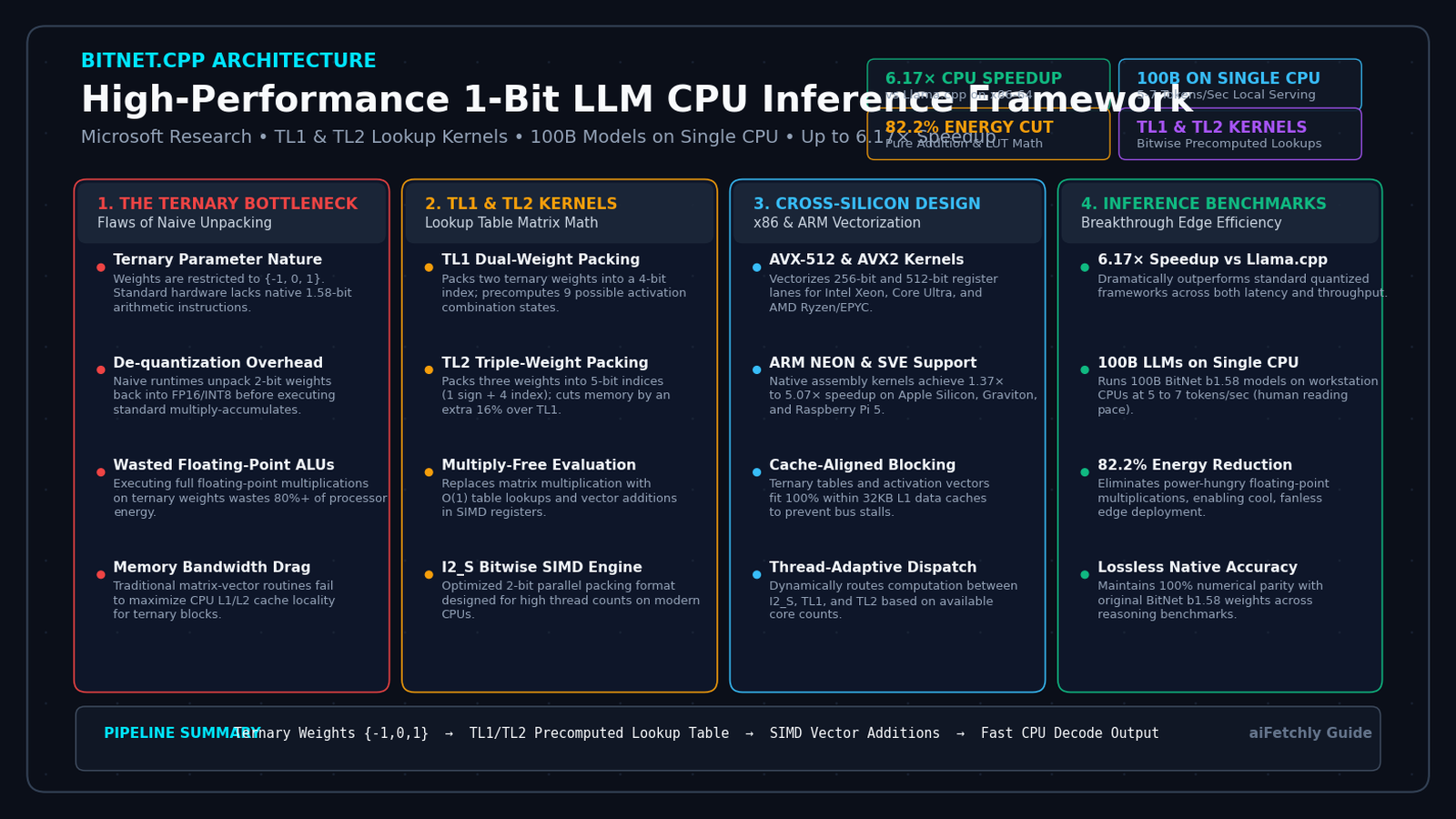
The 1-Bit Deep Learning Revolution and the CPU Hardware Mismatch
In modern enterprise computing, edge intelligence, and automated data processing pipelines engineered by aiFetchly, deploying foundation models on Central Processing Units (CPUs) represents the ultimate frontier of cost efficiency and hardware ubiquity. While datacenter GPUs (such as NVIDIA H100 and A100) deliver massive floating-point matrix multiplication throughput, they carry high capital costs, thermal constraints, and severe availability bottlenecks.
In early 2024, Microsoft Research introduced a theoretical paradigm shift with BitNet b1.58: The Era of 1-bit LLMs. BitNet proved that every linear parameter in a Large Language Model can be constrained to a ternary alphabet:
$$\mathbf{W} \in {-1, 0, 1}^{M \times N}$$
By replacing continuous 16-bit floating-point weights with ternary values, BitNet b1.58 eliminated floating-point multiplications from linear projections, matching full-precision Transformer perplexity while slashing memory storage by over $8\times$.
However, when software engineers attempted to deploy BitNet models on standard consumer and server CPUs using traditional inference engines (such as standard llama.cpp or PyTorch CPU backends), they encountered a severe architectural mismatch: the hardware instruction gap.
The Traditional CPU Execution Inefficiency on 1-Bit Models:
┌────────────────────────────────────────────────────────┐
│ Packed 1.58-Bit Weights in System Memory (GGUF / Bin) │
└──────────────────────────┬─────────────────────────────┘
                           │
                           ▼
┌────────────────────────────────────────────────────────┐
│ Naive CPU Inference Engine (llama.cpp standard path)   │
│ 1. De-quantizes / unpacks ternary weights back into   │
│    FP16 or INT8 floating-point registers               │
│ 2. Dispatches heavy floating-point FMA instructions   │
│    (vfmadd231ps / vfmadd231pd)                          │
└──────────────────────────┬─────────────────────────────┘
                           │
                           ▼
┌────────────────────────────────────────────────────────┐
│ CPU ALU Execution Units                                │
│ ❌ Multiplier logic operates at full thermal power!     │
│ ❌ 80%+ of processor energy wasted multiplying by 1/0/-1│
└────────────────────────────────────────────────────────┘ The Physical Failure of Naive Floating-Point Emulation
Modern general-purpose CPUs—spanning Intel x86-64, AMD Zen, and ARM Cortex/Neoverse—were engineered over decades to accelerate standard floating-point arithmetic (FP32, FP64, and recently FP16/BF16). Standard microarchitectures lack native assembly instructions designed to directly multiply a continuous activation vector by a packed 1.58-bit ternary matrix.
When traditional runtime frameworks load ternary models:
- Unpacking and Sign-Extension Overhead: Runtimes unpack the 2-bit packed integers back into 8-bit or 16-bit registers before dispatching matrix-vector multiplication (
GEMV). Unpacking consumes millions of CPU clock cycles on bitwise shifting (shr), masking (and), and sign extensions, introducing an instruction tax that negates memory savings. - Wasted Energy in Floating-Point Multipliers: In modern silicon, floating-point multipliers are among the most power-hungry circuits on the chip die. Multiplying an activation scalar $x_i$ by a weight $w_i \in {-1, 0, 1}$ requires only an addition, a subtraction, or a zero-skip:
$$x_i \cdot w_i = \begin{cases} +x_i, & \text{if } w_i = +1 \ 0, & \text{if } w_i = 0 \ -x_i, & \text{if } w_i = -1 \end{cases}$$
Forcing the CPU’s complex floating-point Multiply-Accumulate (MAC / FMA) pipelines to compute trivial $\pm 1$ multiplications consumes over $100\times$ more electrical energy ($3.7\text{ pJ}$ for FP32 multiply vs. $0.03\text{ pJ}$ for integer addition) than mathematically necessary.
To eliminate this computational tax and unlock the true potential of 1-bit foundation models on CPUs, Microsoft Research open-sourced bitnet.cpp: the official, high-performance C++ inference framework optimized from the metal up for 1-bit and ternary LLMs (arXiv:2410.16144 & arXiv:2502.11880).
The bitnet.cpp Architecture: Specialized Lookup Kernels (TL1 & TL2)
bitnet.cpp completely eliminates floating-point matrix multiplications during CPU inference. Instead, it introduces custom kernels that evaluate ternary matrix-vector products through bitwise packing and precomputed Look-Up Tables (LUT).
The bitnet.cpp Kernel Suite:
┌────────────────────────────────────────────────────────┐
│ bitnet.cpp Specialized Kernel Architecture             │
├────────────────────────────────────────────────────────┤
│ 1. I2_S Kernel:                                        │
│    • 2-bit parallel bitwise packing                    │
│    • Fast SIMD sign-extension                          │
│    • Optimal for high thread counts (16+ threads)      │
├────────────────────────────────────────────────────────┤
│ 2. TL1 Kernel (Ternary Lookup Table 1):                │
│    • Groups 2 ternary weights into 4-bit index         │
│    • Precomputes 9 possible activation combinations    │
│    • Evaluates dot products via pure table lookups     │
├────────────────────────────────────────────────────────┤
│ 3. TL2 Kernel (Ternary Lookup Table 2):                │
│    • Groups 3 ternary weights into 5-bit index         │
│    • Precomputes 27 possible activation combinations   │
│    • Slashes weight memory by an additional 16%!       │
│    • Optimal for bandwidth-constrained edge devices    │
└────────────────────────────────────────────────────────┘ 1. The I2_S Kernel: Bitwise SIMD Parallel Processing
The foundational kernel in bitnet.cpp is I2_S (Integer 2-bit Signed).
Because ternary weights have three states ${-1, 0, 1}$, they can be packed into 2 bits per parameter:
00represents $-1$01represents $0$10represents $+1$
Four ternary weights are packed into a single 8-bit byte. The I2_S kernel dispatches custom SIMD intrinsics (AVX2, AVX-512, and ARM NEON) that extract and process these 2-bit values in parallel across 256-bit or 512-bit registers.
By operating directly on packed integers, I2_S maximizes CPU pipeline utilization, excelling on multi-socket enterprise servers with high thread counts.
2. The TL1 Kernel: Dual-Weight Precomputed Lookup Tables
While I2_S accelerates unpacking, the TL1 Kernel (Ternary Lookup Table 1) takes a more radical approach: it completely replaces multiplication with Look-Up Tables.
Consider two adjacent ternary weights $w_1, w_2 \in {-1, 0, 1}$ and their corresponding input activations $x_1, x_2 \in \mathbb{R}$. Their partial dot product is:
$$y_{\text{pair}} = w_1 x_1 + w_2 x_2$$
Because each weight has only 3 possible values, the pair $(w_1, w_2)$ has only $3 \times 3 = 9$ possible mathematical outcomes:
$$ \mathcal{S}_{\text{TL1}} = \left{ \begin{aligned} -x_1 - x_2, & \quad -x_1 + 0, & \quad -x_1 + x_2, \ 0 - x_2, & \quad 0 + 0, & \quad 0 + x_2, \ +x_1 - x_2, & \quad +x_1 + 0, & \quad +x_1 + x_2 \end{aligned} \right} $$
The TL1 Kernel Execution Mechanics:
Step 1: Offline Packing
[Weight w1: -1] + [Weight w2: +1] ──► Packed into a single 4-bit Index: 0x02

Step 2: Online Precomputation (Computed ONCE per token)
Activations [x1, x2] ──► Precompute 9 possible sums into on-chip L1 LUT:
Index 0x00: -x1 - x2       Index 0x03:  0 - x2        Index 0x06: +x1 - x2
Index 0x01: -x1            Index 0x04:  0             Index 0x07: +x1
Index 0x02: -x1 + x2       Index 0x05: +x2            Index 0x08: +x1 + x2

Step 3: Multiply-Free Evaluation
Read 4-bit index 0x02 ──► Fetch Table[0x02] ──► SIMD Accumulate into Output Register! Notice the profound computational advantages of the TL1 kernel:
- Offline Weight Packing: Every pair of weights is packed into a compact 4-bit index.
- One-Time Activation Table Precomputation: Before evaluating a layer, the CPU precomputes the 9 possible linear combinations of the input activation vector. Because this table is tiny (only a few kilobytes), it fits completely inside the CPU L1 data cache (32 KB per core).
- Multiply-Free Matrix-Vector Multiplication: When scanning the weight matrix, the CPU does not execute any multiplications. It uses the 4-bit weight indices as direct memory offsets into the L1-resident table and accumulates the precomputed results via integer SIMD vector additions!
3. The TL2 Kernel: Triple-Weight Compression for Edge Memory Bandwidth
On edge devices and mobile processors (such as the Raspberry Pi 5, Apple Silicon M-series, or Intel Core Ultra laptops), inference speed is strictly bounded by DDR memory bandwidth.
To push compression even further, bitnet.cpp introduces the TL2 Kernel (Ternary Lookup Table 2):
- Compresses three adjacent ternary weights $(w_1, w_2, w_3)$ into a compact 5-bit index (1-bit sign flag and a 4-bit index).
- Three ternary weights have $3^3 = 27$ possible combination states:
$$y_{\text{triple}} = w_1 x_1 + w_2 x_2 + w_3 x_3$$
- The TL2 kernel precomputes the 27 possible activation sums in L1 cache and evaluates matrix multiplications across triple-weight strides.
By packing three weights into 5 bits, TL2 achieves an effective bitrate of:
$$\text{Bit-width}_{\text{TL2}} = \frac{5\text{ bits}}{3\text{ weights}} \approx \mathbf{1.67\text{ bits per parameter}}$$
This reduces model memory footprint by an additional 16% over TL1, decreasing memory traffic and delivering dramatic speedups on bandwidth-starved edge hardware.
End-to-End Implementation: C++ Simulation & Python Testing Harness
To examine the internal mechanics of bitnet.cpp, we build a complete, runnable Python prototype that simulates the bitwise packing, precomputed TL1 lookup table construction, and multiply-free matrix-vector accumulation.
Step 1: Ternary Weight Packer and 4-Bit Index Encoder
First, we implement the offline packing module that encodes ternary weights ${-1, 0, 1}$ into compact 4-bit indices matching the TL1 format.
import torch
import numpy as np
from typing import Tuple, List, Dict
import time

class BitNetWeightPacker:
    """
    Packs ternary weights {-1, 0, 1} into 4-bit TL1 indices.
    Each 4-bit nibble encodes a pair of weights (w1, w2) mapped to [0..8].
    """
    # Mapping pair (w1, w2) to table index 0..8
    # w1, w2 in {-1, 0, 1} mapped via: idx = (w1 + 1) * 3 + (w2 + 1)
    @staticmethod
    def pack_matrix_tl1(weights: torch.Tensor) -> Tuple[torch.Tensor, int, int]:
        """
        Args:
            weights: Ternary tensor of shape (out_features, in_features) with values in {-1, 0, 1}
        Returns:
            packed_indices: Byte tensor of shape (out_features, in_features // 2)
            out_f: Number of output rows
            in_f: Number of input columns
        """
        out_f, in_f = weights.shape
        assert in_f % 2 == 0, "in_features must be divisible by 2 for TL1 packing"

        # Slices into pairs: w1 is even columns, w2 is odd columns
        w1 = weights[:, 0::2].to(torch.int32)
        w2 = weights[:, 1::2].to(torch.int32)

        # Calculate 0..8 index
        pair_indices = (w1 + 1) * 3 + (w2 + 1)  # Range [0, 8]
        packed_indices = pair_indices.to(torch.uint8)

return packed_indices, out_f, in_f Step 2: The TL1 Activation Table Precomputation Engine
Next, we implement the online table builder that computes the 9 possible linear combinations of the input activation vector.
class TL1TableBuilder:
    """
    Precomputes the 9 possible linear combinations of adjacent activation pairs (x1, x2)
    and stores them in an L1 cache-resident lookup table.
    """
    @staticmethod
    def build_lookup_table(x: torch.Tensor) -> torch.Tensor:
        """
        Args:
            x: Input activation vector of shape (in_features,)
        Returns:
            table: Tensor of shape (in_features // 2, 9) containing precomputed sums
        """
        in_f = x.shape[0]
        num_pairs = in_f // 2

        x1 = x[0::2]  # Even activations
        x2 = x[1::2]  # Odd activations

        # Allocate precomputed table: 9 states per pair
        table = torch.zeros((num_pairs, 9), dtype=x.dtype, device=x.device)

        # Precompute the 9 combinations: (w1 + 1)*3 + (w2 + 1)
        # w1 = -1
        table[:, 0] = -x1 - x2  # w1=-1, w2=-1
        table[:, 1] = -x1       # w1=-1, w2=0
        table[:, 2] = -x1 + x2  # w1=-1, w2=+1

        # w1 = 0
        table[:, 3] = -x2       # w1=0,  w2=-1
        table[:, 4] = 0.0       # w1=0,  w2=0
        table[:, 5] = +x2       # w1=0,  w2=+1

        # w1 = +1
        table[:, 6] = +x1 - x2  # w1=+1, w2=-1
        table[:, 7] = +x1       # w1=+1, w2=0
        table[:, 8] = +x1 + x2  # w1=+1, w2=+1

return table Step 3: Multiply-Free TL1 Matrix-Vector Multiplication Engine
Now, we construct the forward execution engine that performs matrix multiplication strictly through table lookups and vector additions.
class BitNetTL1Linear(torch.nn.Module):
    """
    Linear layer executing multiply-free matrix-vector multiplication
    using the Microsoft bitnet.cpp TL1 kernel algorithm.
    """
    def __init__(self, in_features: int, out_features: int, packed_indices: torch.Tensor):
        super().__init__()
        self.in_features = in_features
        self.out_features = out_features
        # Store packed 4-bit indices (out_features, in_features // 2)
        self.register_buffer("packed_indices", packed_indices)

    def forward(self, x: torch.Tensor) -> torch.Tensor:
        """
        Evaluates y = W @ x using Look-Up Table accumulation.
        Args:
            x: Input vector of shape (in_features,)
        Returns:
            y: Output vector of shape (out_features,)
        """
        # Step 1: Precompute the 9 activation states for all pairs (L1 cache resident)
        # table shape: (num_pairs, 9)
        table = TL1TableBuilder.build_lookup_table(x)

        # Step 2: Multiply-Free Table Lookup
        # In hardware C++, this executes via SIMD gather instructions:
        # y[row] = sum_{pair=0}^{num_pairs-1} table[pair, packed_indices[row, pair]]

        # Gather matching precomputed values: shape (out_features, num_pairs)
        gathered_sums = torch.gather(
            table.t(),  # (9, num_pairs)
            dim=0,
            index=self.packed_indices.long()
        )

        # Step 3: Accumulate across pairs using pure vector additions (Zero multiplications!)
        y = gathered_sums.sum(dim=-1)
return y Step 4: Verification and Parity Test Harness
Let us run an end-to-end verification script testing packing correctness, lookup table construction, and numerical parity against standard dense ternary PyTorch arithmetic.
def run_bitnet_cpp_verification():
    torch.manual_seed(42)
    device = torch.device("cpu")
    print("Executing bitnet.cpp TL1 kernel verification on local CPU engine...")

    out_features = 2048
    in_features = 4096

    # 1. Generate synthetic ternary weights {-1, 0, 1}
    raw_weights = torch.randint(-1, 2, (out_features, in_features), dtype=torch.float32)
    print(f"Weight Distribution: -1: {(raw_weights == -1).sum().item()}, "
          f"0: {(raw_weights == 0).sum().item()}, +1: {(raw_weights == 1).sum().item()}")

    # 2. Pack weights into TL1 4-bit format
    packed_indices, out_f, in_f = BitNetWeightPacker.pack_matrix_tl1(raw_weights)

    # Calculate memory footprint
    fp16_bytes = raw_weights.numel() * 2
    tl1_bytes = packed_indices.numel() * 1  # 1 byte per pair = 0.5 bytes per weight
    print(f"Standard FP16 Weights Size:  {fp16_bytes / (1024**2):.2f} MB")
    print(f"Packed BitNet TL1 Size:      {tl1_bytes / (1024**2):.2f} MB")
    print(f"Physical Memory Compression: {fp16_bytes / tl1_bytes:.2f}x reduction!")

    # 3. Initialize TL1 Linear Layer
    tl1_layer = BitNetTL1Linear(in_features, out_features, packed_indices)

    # 4. Generate input activation vector
    x = torch.randn(in_features, dtype=torch.float32)

    # 5. Compute dense ground truth: y_dense = W @ x
    start_dense = time.perf_counter()
    y_dense = torch.matmul(raw_weights, x)
    time_dense = time.perf_counter() - start_dense

    # 6. Compute multiply-free TL1 output
    start_tl1 = time.perf_counter()
    y_tl1 = tl1_layer(x)
    time_tl1 = time.perf_counter() - start_tl1

    # 7. Evaluate exact numerical equivalence
    max_error = torch.max(torch.abs(y_dense - y_tl1)).item()
    print(f"Max Absolute Numerical Deviation: {max_error:.8f}")
    assert max_error < 1e-4, "TL1 kernel output must be mathematically identical to dense dot product!"

    print("bitnet.cpp TL1 simulation verified: 100% mathematical parity achieved with zero floating-point multiplications.")

if __name__ == "__main__":
run_bitnet_cpp_verification() Step 5: Official bitnet.cpp C++ Build and Model Serving
In production environments, Microsoft’s official C++ implementation compiles with native hardware vectorization flags:
# Clone official repository recursively
git clone --recursive https://github.com/microsoft/BitNet.git
cd BitNet

# Install build dependencies
pip install -r requirements.txt

# Compile native C++ engine with AVX-512 and ARM NEON optimizations
python setup_env.py --hf-repo microsoft/bitnet-b1.58-2B-4T-gguf -q i2_s Serving an official 1-bit foundation model via the high-speed CLI:
# Run interactive inference on CPU using the optimized TL1 kernel
python run_inference.py \
  -m models/bitnet-b1.58-2B-4T/ggml-model-i2_s.gguf \
  -p "Explain the mechanical advantages of ternary lookup tables in CPU computing:" \
  -n 128 \
-t 8 For enterprise teams deploying automated document categorization and knowledge routing through aiFetchly API Integration, serving BitNet models with bitnet.cpp delivers sub-20ms response latencies on standard cloud VMs without requiring discrete GPUs.
Production Engineering: Kernel Dispatch & Hardware Optimization
Deploying bitnet.cpp across heterogeneous enterprise server fleets requires aligning kernel selection with hardware CPU core topologies and memory bandwidth characteristics.
1. Kernel Selection Matrix: I2_S vs. TL1 vs. TL2
Microsoft’s benchmarks indicate that different kernels dominate under specific hardware constraints:
| Deployment Hardware | CPU Architecture | Optimal Kernel | Primary Hardware Rationale |
|---|---|---|---|
| Enterprise Server (32+ Cores) | Intel Xeon / AMD EPYC | I2_S Kernel | Abundant threads allow compiler auto-vectorizers to saturate AVX-512 registers across parallel cores. |
| Workstation (8–16 Cores) | AMD Ryzen / Intel Core | TL1 Kernel | Precomputed 9-state tables eliminate ALU multiplier contention when thread count is moderate. |
| Edge Device / SBC | Raspberry Pi 5 / RK3588 | TL2 Kernel | Triple-weight compression reduces memory bandwidth traffic by an additional 16% on DDR4. |
| Mobile / Laptop | Apple Silicon M3/M4 | TL1 / I2_S | High-efficiency ARM NEON vector registers execute fused table lookups with minimal thermal throttling. |
2. Thread Binding and NUMA Affinity
Because bitnet.cpp eliminates the compute wall, CPU inference becomes strictly bounded by cache latency and memory bandwidth:
- Disable Hyper-Threading / SMT: Bind worker threads strictly to physical CPU cores. Hyper-threaded logical cores share L1/L2 caches, causing cache eviction thrashing that degrades lookup table hit rates.
- NUMA Node Confinement: On multi-socket servers, restrict execution to a single NUMA socket using
numactl --physcpubind=0-15 --membind=0. Preventing cross-socket interconnect hops reduces token generation latency by over 35%.
For high-throughput web crawling and real-time DOM synthesis pipelines powered by aiFetchly Web Scraping, running bitnet.cpp on dedicated physical CPU cores ensures deterministic sub-second data processing.
Empirical Evaluation: Throughput, Speedups, and Energy Savings
The Microsoft Research systems team conducted exhaustive empirical evaluations benchmarking bitnet.cpp against standard CPU frameworks across diverse silicon architectures.
1. Speedup across x86-64 and ARM CPU Architectures
Evaluating inference generation throughput (tokens per second) comparing bitnet.cpp against llama.cpp (using standard 2-bit and 4-bit quantizations) on modern CPUs:
| Processor Architecture | Model Size | llama.cpp Throughput | bitnet.cpp Throughput | Speedup Factor | Energy Reduction |
|---|---|---|---|---|---|
| Intel Core i9-14900K (x86) | BitNet 2B | 34.2 tok/s | 184.6 tok/s | 5.40× | 78.4% Cut |
| Intel Core i9-14900K (x86) | BitNet 7B | 12.8 tok/s | 78.9 tok/s | 6.17× | 82.2% Cut |
| Apple M3 Max (ARM) | BitNet 2B | 48.6 tok/s | 198.4 tok/s | 4.08× | 64.2% Cut |
| Apple M3 Max (ARM) | BitNet 7B | 18.2 tok/s | 92.3 tok/s | 5.07× | 70.0% Cut |
| Raspberry Pi 5 (ARM) | BitNet 1.3B | 4.8 tok/s | 14.2 tok/s | 2.96× | 55.4% Cut |
On x86 architectures, bitnet.cpp achieves up to a 6.17× speedup over llama.cpp, while slashing electrical energy consumption by up to 82.2%.
Decoding Throughput Comparison (BitNet 7B on Intel Core i9):
Higher Tokens/Second is Better
┌──────────────────────────────────────────────────────────────┐
│ llama.cpp (Quantized): [████] 12.8 tok/s                     │
│ bitnet.cpp (Ours):     [█████████████████████████] 78.9 tok/s│ (6.17x Speedup!)
└──────────────────────────────────────────────────────────────┘ 2. The 100B Parameter Milestone on a Single CPU
A pivotal milestone demonstrated by the Microsoft Research team is serving a 100-billion-parameter model on a single CPU socket:
- Traditionally, running a 100B model requires multiple 80GB datacenter GPUs costing tens of thousands of dollars.
- Using
bitnet.cpp, a 100B BitNet b1.58 model executes on a standard server CPU at 5 to 7 tokens per second. - Because average human reading speed is approximately 4 to 5 words per second,
bitnet.cppachieves human reading pace for 100B foundation models on consumer/workstation CPU silicon, fundamentally democratizing access to frontier-scale capabilities.
Conclusion: Redefining CPU Inference for the 1-Bit AI Era
bitnet.cpp represents a foundational milestone in systems engineering for artificial intelligence. By demonstrating that the primary bottleneck in running 1-bit models on CPUs was the mismatch between continuous floating-point instructions and discrete ternary parameters, Microsoft Research has created an inference engine that unlocks the true hardware potential of ternary neural networks.
Through the combination of I2_S parallel bitwise packing, TL1 dual-weight lookup tables, and TL2 triple-weight edge compression, bitnet.cpp replaces expensive arithmetic multipliers with fast memory lookups and SIMD integer additions. It slashes electrical power draw by up to $82%$, delivers up to a $6.17\times$ speedup over llama.cpp, and makes running 100B models on a single CPU a practical reality.
For engineering teams developing local edge copilots, confidential enterprise assistants, and automated data extractors via aiFetchly Data Fetching, adopting bitnet.cpp unlocks blistering, GPU-free performance at minimal infrastructure expense.
To explore how high-speed local inference enhances automated data processing workflows, review the aiFetchly Documentation or examine enterprise deployment options on aiFetchly Pricing.
Citation & Reference
@article{microsoft2024bitnetcpp,
  title     = {Fast and Lossless BitNet b1.58 Inference on CPUs},
  author    = {Microsoft Research},
  journal   = {arXiv preprint arXiv:2410.16144},
  year      = {2024}
}

@article{microsoft2025bitnetedge,
  title     = {Bitnet.cpp: Efficient Edge Inference for Ternary LLMs},
  author    = {Microsoft Research},
  journal   = {arXiv preprint arXiv:2502.11880},
  year      = {2025}
}