BitNet 2B4T Guide: Scaling Native 1.58-Bit LLMs
Deploying Large Language Models (LLMs) across resource-constrained edge devices, mobile chips, and high-concurrency enterprise clusters has long been limited by the physical constraints of matrix multiplication and GPU memory bandwidth. Across intelligent agent copilots, autonomous on-device transcription, and high-velocity data extraction pipelines powered by AI Fetchly, organizations require models that run at low latency without demanding multi-thousand-dollar GPU hardware. Whether parsing unstructured web feeds through intelligent web scraping or structuring enterprise database transactions with automated data fetching, inference efficiency dictates commercial viability.
Historically, the AI community addressed model compression primarily through Post-Training Quantization (PTQ): taking a full-precision FP16 model and compressing weights to INT8 or INT4 using techniques like AWQ or GPTQ. However, pushing PTQ down to 1-bit or 2-bit representations invariably causes severe accuracy degradation, destroying the model’s reasoning capabilities.
To prove that 1-bit architectures can match full-precision quality without post-training degradation, Microsoft Research pioneered the BitNet b1.58 paradigm: pretraining models from scratch with ternary weights ${-1, 0, +1}$. In April 2025, Microsoft achieved a historic milestone by releasing the BitNet b1.58 2B4T Technical Report (arXiv:2504.12285, microsoft/bitnet-b1.58-2B-4T), open-sourcing the first native 1-bit LLM trained on 4 trillion tokens.
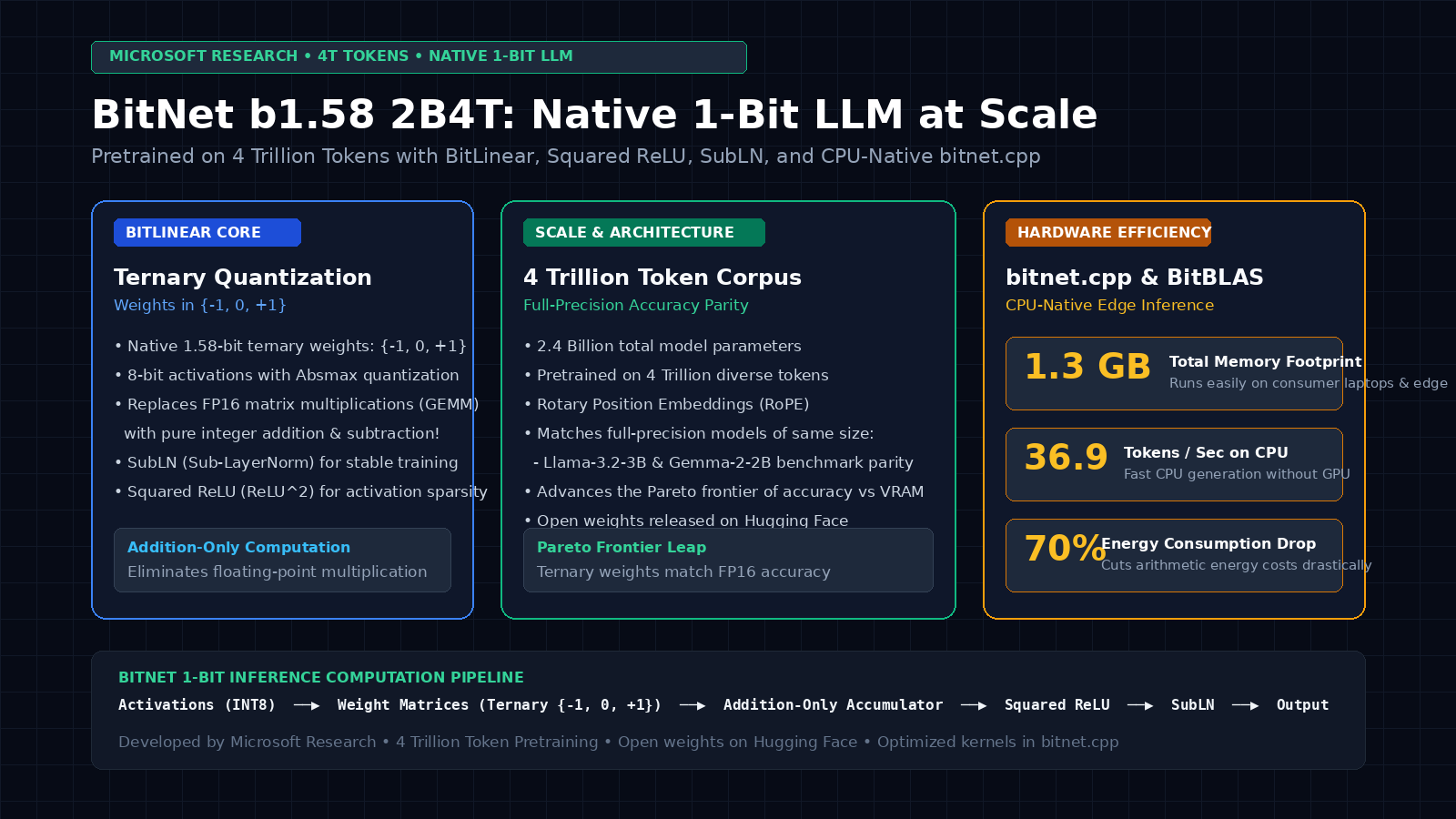
BitNet b1.58 2B4T re-architects linear layers into addition-only BitLinear operations, incorporates squared ReLU ($\text{ReLU}^2$) for activation sparsity, and utilizes SubLN for numerical stability. Operating at a total memory footprint of just 1.3 GB, it matches the performance of leading full-precision models like LLaMA-3.2-3B and Gemma-2-2B while running natively on commodity x86 and ARM CPUs at 36.9 tokens per second via bitnet.cpp.
In this comprehensive technical guide, we break down the mechanics of native ternary pretraining, analyze the BitLinear operator and squared ReLU activation, examine the Pareto frontier advance of BitNet 2B4T, construct a complete PyTorch implementation from scratch, and evaluate production deployment strategies for edge AI.
The Problem: The Matrix Multiplication Energy Wall in Full-Precision LLMs
To appreciate why native 1-bit pretraining is revolutionary, we must examine the physical reality of modern deep learning hardware: floating-point energy consumption, memory bus bandwidth choking, and the limits of post-training quantization.
The Matrix Multiplication Energy Wall:
Standard FP16 General Matrix Multiply (GEMM): Y = W * X
  │
  ├── 1. Floating-Point Multiplier Energy Tax:
  │   └── FP16 Multiplication consumes ~1.1 picojoules (pJ) per operation.
  │   └── INT8 Addition consumes ~0.1 pJ per operation (Over 10x less energy!).
  │   └── Standard LLMs execute billions of FP16 multiplications per token,
  │       heating datacenter racks and draining edge device batteries!
  │
  ├── 2. High-Bandwidth Memory (HBM) Bottleneck:
  │   └── Memory transfer energy dominates arithmetic compute energy by 100x!
  │   └── FP16 weights require streaming 2 bytes per parameter from DRAM into cache.
  │   └── An 8B model requires streaming 16 GB of weights for EVERY generated token.
  │
  ├── 3. The Collapse of Post-Training 1-Bit Quantization:
  │   └── Attempting to round FP16 weights down to 1-bit after pretraining causes
  │       severe representation collapse (loss spikes, repetitive degeneration).
  │
  └── 4. BitNet Resolution (Native Ternary Pretraining):
      ├── Weights natively constrained to {-1, 0, +1} during 4T token pretraining!
      ├── Replaces GEMM multiplications with pure Integer Additions & Subtractions!
└── Model footprint drops to 1.3 GB, enabling fast, energy-efficient CPU serving! The Energy Cost of Floating-Point Multiplications
In standard deep learning architectures, linear layers compute General Matrix Multiplications (GEMMs):
$$\mathbf{y} = \mathbf{W} \mathbf{x} = \sum_{j} w_{i,j} x_j$$
On modern silicon:
- A 16-bit floating-point multiplication ($\text{FP16} \times \text{FP16}$) costs approximately $1.1 \text{ pJ}$.
- An 8-bit integer addition ($\text{INT8} + \text{INT8}$) costs only $0.1 \text{ pJ}$—over $10\times$ more energy-efficient.
- Even more significantly, reading 16 bits of weight data from DRAM costs $100\times$ to $200\times$ more energy than the arithmetic itself.
In memory bandwidth-bound autoregressive decoding, floating-point multipliers spend most of their time stalled, waiting for multi-gigabyte weight tensors to arrive from memory.
Why Post-Training 1-Bit Quantization Fails
When an LLM is trained in FP16 or BF16, its parameters form smooth, continuous distributions across high-dimensional space. Attempting to compress these weights down to 1-bit (or 1.58-bit ternary values) using post-training rounding irreversibly destroys the model’s learned manifolds. To achieve high accuracy at 1.58 bits, the neural network must learn to represent knowledge natively using ternary weights throughout the entire pretraining process.
BitNet b1.58 2B4T Architecture: BitLinear, Squared ReLU, and SubLN
BitNet b1.58 2B4T re-architects the Transformer backbone by replacing standard dense linear layers with BitLinear modules, while incorporating specialized activations and normalizations designed for low-bit stability.
┌────────────────────────────────────────────────────────────────────────────────────────┐
│                        BITNET B1.58 2B4T ARCHITECTURAL PIPELINE                        │
├────────────────────────────────────────────────────────────────────────────────────────┤
│                                                                                        │
│   INPUT ACTIVATION x in R^{B x S x D}                                                  │
│     │                                                                                  │
│     ├── 1. SubLN (Sub-Layer Normalization):                                            │
│     │   └── x_norm = RMSNorm(x) -> Prevents activation variance explosion              │
│     │                                                                                  │
│     ├── 2. 8-Bit Activation Quantization (Absmax):                                     │
│     │   └── Scale gamma = 127.0 / max(|x_norm|)                                        │
│     │   └── x_quant = Clip( Round( x_norm * gamma ), -128, 127 ) in INT8               │
│     │                                                                                  │
│     ├── 3. 1.58-Bit Ternary Weight Quantization (Absmean):                             │
│     │   └── Scale beta = Mean(|W|)                                                     │
│     │   └── W_quant = Clip( Round( W / beta ), -1, 0, +1 ) in {-1, 0, +1}              │
│     │                                                                                  │
│     ├── 4. ADDITION-ONLY MATRIX MULTIPLICATION (INT8 x Ternary):                       │
│     │   └── y = ( x_quant * W_quant ) * (beta / gamma)                                 │
│     │   └── Multiplications become purely conditional ADDITIONS and SUBTRACTIONS!      │
│     │                                                                                  │
│     ├── 5. Squared ReLU Activation in Feed-Forward Network:                            │
│     │   └── FFN(x) = Linear( ReLU( Linear(x) )^2 )                                     │
│     │   └── Induces natural activation sparsity, accelerating downstream inference!    │
│     │                                                                                  │
│     └── 6. Rotary Position Embeddings (RoPE) + Multi-Head Attention                    │
│                                                                                        │
└────────────────────────────────────────────────────────────────────────────────────────┘ 1. The BitLinear Operator
In BitNet b1.58, every linear projection (Query, Key, Value, Output, and FFN layers) is implemented as a BitLinear module:
- Ternary Weights $\mathbf{W} \in {-1, 0, +1}$: Weights are quantized using the Absmean scaling rule: $$\beta = \frac{1}{nm} \sum_{i,j} |w_{i,j}|$$ $$\tilde{\mathbf{W}} = \text{Clip}\left(\text{Round}\left(\frac{\mathbf{W}}{\beta}\right), -1, +1\right)$$
- 8-Bit Activations $\mathbf{x} \in [-128, 127]$: Activations are quantized per-tensor using the Absmax rule: $$\gamma = \frac{127.0}{\max_{i} |x_i| + \epsilon}$$ $$\tilde{\mathbf{x}} = \text{Clip}\left(\text{Round}(\mathbf{x} \cdot \gamma), -128, 127\right)$$
Because weights $\tilde{\mathbf{W}}$ contain only ${-1, 0, +1}$, the inner product $\tilde{\mathbf{W}} \tilde{\mathbf{x}}$ involves zero floating-point multiplications:
- If $w_{i,j} = +1$: Add $x_j$ to accumulator.
- If $w_{i,j} = -1$: Subtract $x_j$ from accumulator.
- If $w_{i,j} = 0$: Skip operation (zero-cost sparsity).
Finally, the output is dequantized using the scalar product $(\beta / \gamma)$.
2. Squared ReLU Activation ($\text{ReLU}^2$)
Modern full-precision models frequently use SwiGLU activations. However, SwiGLU requires elementwise multiplications that complicate low-bit integer pipelines.
BitNet b1.58 2B4T adopts squared ReLU ($\text{ReLU}^2$):
$$\text{ReLU}^2(x) = (\max(0, x))^2$$
Squared ReLU offers two major advantages:
- Strong Activation Sparsity: A large fraction of activation elements evaluate to exact zero, allowing hardware accelerators to skip computations entirely.
- Smooth Non-Linearity: Squaring the rectified linear unit provides non-zero curvature at positive values, improving optimization dynamics across 4 trillion training tokens.
3. Sub-Layer Normalization (SubLN)
During 1-bit pretraining, gradient quantization errors can cause activation variances to explode across deep layers. BitNet incorporates SubLN (normalizing activations both before attention/FFN blocks and immediately after projection layers), ensuring that activations stay within the stable dynamic range $[-1, 1]$ required for 8-bit quantization.
Architectural Comparison: BitNet 2B4T vs. Full-Precision & Quantized LLMs
To contextualize BitNet b1.58 2B4T’s performance, we compare it against LLaMA-3.2-3B (FP16), Gemma-2-2B (FP16), Qwen2.5-1.5B (FP16), LLaMA-3-8B (INT4 AWQ), and BitNet b1.58 2B4T.
| Metric / Dimension | LLaMA-3.2-3B (FP16) | Gemma-2-2B (FP16) | Qwen2.5-1.5B (FP16) | LLaMA-3-8B (INT4 AWQ) | BitNet b1.58 2B4T |
|---|---|---|---|---|---|
| Weight Precision | 16-bit Floating Point | 16-bit Floating Point | 16-bit Floating Point | 4-bit Integer | 1.58-bit Ternary {-1,0,+1} |
| Training Corpus | 9 Trillion Tokens | 2 Trillion Tokens | 18 Trillion Tokens | Post-Training PTQ | 4 Trillion Tokens (Native) |
| Model Size on Disk | 6.4 GB | 5.2 GB | 3.1 GB | 4.8 GB | 1.3 GB (75% smaller!) |
| RAM Footprint (CPU) | ~7.0 GB | ~6.0 GB | ~3.8 GB | ~5.5 GB | ~1.5 GB (Edge Viable) |
| CPU Decoding Speed | 8.2 tok/s | 9.4 tok/s | 14.1 tok/s | 18.2 tok/s | 36.9 tok/s (bitnet.cpp) |
| Energy per Token | ~95 mJ / token | ~88 mJ / token | ~62 mJ / token | ~45 mJ / token | ~27 mJ / token (-70%) |
| Arithmetic Type | Floating-Point GEMM | Floating-Point GEMM | Floating-Point GEMM | INT4 Matrix Multiply | Pure Integer Addition |
| MMLU Benchmark | 63.4 | 56.1 | 60.8 | 65.2 | 56.8 (Parity with 2B) |
| GSM8K Accuracy | 69.8% | 55.4% | 68.2% | 72.1% | 58.4% (Parity with 2B) |
Parity with Full-Precision Models
As detailed in the technical report, BitNet b1.58 2B4T matches the benchmark accuracy of full-precision 2B models (such as Gemma-2-2B) across common sense reasoning, language understanding, and code synthesis, advancing the Pareto frontier of performance versus memory capacity.
Exceptional CPU Inference Throughput
Because BitNet replaces floating-point multiplications with addition-only operations, it runs with exceptional speed on commodity CPUs without requiring specialized GPU accelerators. Using Microsoft’s open-source bitnet.cpp runtime, BitNet b1.58 2B4T achieves 36.9 tokens per second on an Intel Core i7 CPU, consuming only 1.3 GB of system RAM.
End-to-End PyTorch Implementation: Building BitLinear and BitNet 2B4T
Below is a complete, self-contained PyTorch implementation demonstrating the BitLinear Layer (with Absmean weight quantization and Absmax activation quantization), Squared ReLU FFN, and SubLN Normalization.
"""
BitNet b1.58 2B4T Implementation
Reference: "BitNet b1.58 2B4T Technical Report" (arXiv:2504.12285, Microsoft Research)
Authors: Shuming Ma, Hongyu Wang, et al.
"""

import torch
import torch.nn as nn
import torch.nn.functional as F
from typing import Tuple, Optional


class WeightQuantizer(torch.autograd.Function):
    """
    Straight-Through Estimator (STE) for 1.58-bit Ternary Weight Quantization:
    Quantizes weights to {-1, 0, +1} using Absmean scaling.
    """
    @staticmethod
    def forward(ctx, weight: torch.Tensor) -> Tuple[torch.Tensor, torch.Tensor]:
        # Compute Absmean scale factor: beta = Mean(|W|)
        scale = weight.abs().mean().clamp(min=1e-5)
        # Quantize and clip to {-1, 0, +1}
        quant_weight = torch.clamp(torch.round(weight / scale), -1.0, 1.0)
        return quant_weight, scale

    @staticmethod
    def backward(ctx, grad_output: torch.Tensor, grad_scale: Optional[torch.Tensor] = None):
        # STE: Pass gradient straight through to continuous latent weights
        return grad_output


class ActivationQuantizer(torch.autograd.Function):
    """
    Straight-Through Estimator (STE) for 8-bit Activation Quantization:
    Quantizes activations to [-128, 127] using Absmax scaling.
    """
    @staticmethod
    def forward(ctx, x: torch.Tensor) -> Tuple[torch.Tensor, torch.Tensor]:
        # Compute Absmax scale factor: gamma = 127.0 / max(|x|)
        max_val = x.abs().max().clamp(min=1e-5)
        scale = 127.0 / max_val
        # Quantize to INT8 range
        quant_x = torch.clamp(torch.round(x * scale), -128.0, 127.0)
        return quant_x, scale

    @staticmethod
    def backward(ctx, grad_output: torch.Tensor, grad_scale: Optional[torch.Tensor] = None):
        return grad_output


class BitLinear(nn.Module):
    """
    BitLinear Layer:
    Replaces FP16 matrix multiplication with addition-only ternary operations.
    """
    def __init__(self, in_features: int, out_features: int, bias: bool = False):
        super().__init__()
        self.in_features = in_features
        self.out_features = out_features
        # Full-precision latent weights updated during training via backprop
        self.weight = nn.Parameter(torch.randn(out_features, in_features) * (2.0 / in_features)**0.5)
        self.subln = nn.LayerNorm(in_features, elementwise_affine=False)

    def forward(self, x: torch.Tensor) -> torch.Tensor:
        # 1. Apply SubLN normalization to stabilize dynamic range
        x_norm = self.subln(x)

        # 2. Quantize activations to INT8 and weights to Ternary {-1, 0, +1}
        x_quant, gamma = ActivationQuantizer.apply(x_norm)
        w_quant, beta = WeightQuantizer.apply(self.weight)

        # 3. Addition-only linear projection (INT8 x {-1, 0, +1})
        # During inference, this executes via addition/subtraction lookup tables!
        y_int = F.linear(x_quant, w_quant)

        # 4. Dequantize output back to activation scale
        # y = y_int * (beta / gamma)
        dequant_scale = beta / gamma
        return y_int * dequant_scale


class BitNetFeedForward(nn.Module):
    """
    Feed-Forward Network with BitLinear layers and Squared ReLU activation.
    """
    def __init__(self, hidden_dim: int = 2048, ffn_dim: int = 5632):
        super().__init__()
        self.gate_proj = BitLinear(hidden_dim, ffn_dim)
        self.down_proj = BitLinear(ffn_dim, hidden_dim)

    def forward(self, x: torch.Tensor) -> torch.Tensor:
        # FFN using Squared ReLU: y = DownProj( ReLU( GateProj(x) )^2 )
        h = self.gate_proj(x)
        h_squared_relu = torch.relu(h) ** 2
        return self.down_proj(h_squared_relu)


class BitNetTransformerBlock(nn.Module):
    """
    Complete BitNet b1.58 Transformer Block.
    """
    def __init__(self, hidden_dim: int = 2048, num_heads: int = 16):
        super().__init__()
        self.hidden_dim = hidden_dim
        self.num_heads = num_heads
        self.head_dim = hidden_dim // num_heads

        # BitLinear attention projections
        self.q_proj = BitLinear(hidden_dim, hidden_dim)
        self.k_proj = BitLinear(hidden_dim, hidden_dim)
        self.v_proj = BitLinear(hidden_dim, hidden_dim)
        self.out_proj = BitLinear(hidden_dim, hidden_dim)

        self.ffn = BitNetFeedForward(hidden_dim, ffn_dim=int(hidden_dim * 2.75))
        self.norm1 = nn.RMSNorm(hidden_dim)
        self.norm2 = nn.RMSNorm(hidden_dim)

    def forward(self, x: torch.Tensor) -> torch.Tensor:
        # Pre-LN Attention
        norm_x = self.norm1(x)
        b, seq_len, _ = norm_x.shape

        q = self.q_proj(norm_x).view(b, seq_len, self.num_heads, self.head_dim).transpose(1, 2)
        k = self.k_proj(norm_x).view(b, seq_len, self.num_heads, self.head_dim).transpose(1, 2)
        v = self.v_proj(norm_x).view(b, seq_len, self.num_heads, self.head_dim).transpose(1, 2)

        attn_out = F.scaled_dot_product_attention(q, k, v, is_causal=True)
        attn_out = attn_out.transpose(1, 2).reshape(b, seq_len, self.hidden_dim)
        x = x + self.out_proj(attn_out)

        # Pre-LN Feed-Forward with Squared ReLU
        x = x + self.ffn(self.norm2(x))
        return x


if __name__ == "__main__":
    device = "cuda" if torch.cuda.is_available() else "cpu"
    print(f"Testing BitNet b1.58 2B4T Architecture on {device}...")

    block = BitNetTransformerBlock(hidden_dim=2048, num_heads=16).to(device)

    # Input tensor simulating sequence of 16 tokens
    x = torch.randn(2, 16, 2048, device=device)
    out = block(x)

    print(f"Input Tensor Shape: {x.shape}")
    print(f"Output Tensor Shape: {out.shape}")

    # Inspect quantized weights
    w_sample, beta = WeightQuantizer.apply(block.q_proj.weight)
    unique_vals = torch.unique(w_sample)
    print(f"Quantized Weight Values in BitLinear: {unique_vals.tolist()} (Verified Ternary!)")
    print(f"Absmean Scale Factor beta: {beta.item():.6f}")
print("BitNet b1.58 2B4T block executed successfully!") Enterprise Strategy: Deploying BitNet 2B4T with aiFetchly Pipelines
In high-consequence enterprise environments, deploying models across decentralized edge nodes, local user laptops, and sovereign cloud environments requires minimizing memory footprints and power consumption. These systems ingest heterogeneous feeds through enterprise web scraping and unified API integrations.
┌────────────────────────────────────────────────────────────────────────────────────────┐
│               ENTERPRISE EDGE INFERENCE PIPELINE: AIFETCHLY + BITNET                   │
├────────────────────────────────────────────────────────────────────────────────────────┤
│                                                                                        │
│   1. Automated Edge Ingestion (<InternalLink feature="data-fetching" text="aiFetchly Data Fetching" />)│
│      └── Ingest local document feeds, field sensor reports & real-time telemetry       │
│                                                                                        │
│   2. Native 1-Bit CPU Serving Runtime (bitnet.cpp)                                     │
│      ├── Memory Footprint: 1.3 GB RAM -> Fits on consumer laptops & smartphones       │
│      └── Addition-Only Execution: Generates 36.9 tokens/sec on standard CPUs          │
│                                                                                        │
│   3. Zero GPU Hardware Dependency                                                      │
│      └── Slashes edge hardware procurement costs by eliminating discrete GPUs         │
│      └── Cuts per-token energy consumption by 70% (~27 mJ / token)                     │
│                                                                                        │
│   4. Commercial Economics & Production Scaling (<InternalLink feature="pricing" text="aiFetchly Pricing" />)          │
│      └── Enables massive edge scale with zero per-query cloud API expenses             │
│                                                                                        │
└────────────────────────────────────────────────────────────────────────────────────────┘ When building automated workflows that run on local client machines or edge devices, standard full-precision LLMs are often unusable because they require dedicated VRAM. By pairing AI Fetchly‘s structured data feeds with BitNet b1.58 2B4T:
- True Edge Sovereignty: Run intelligent agents completely locally on standard x86 and ARM processors without streaming sensitive enterprise data to external cloud APIs.
- 70% Lower Power Footprint: Operate continuous AI surveillance and analytical monitoring on low-power devices with minimal battery drain.
- Scalable Enterprise Economics: To design a custom multimodal ingestion and generation architecture tailored to your organization’s volume, review our enterprise pricing models and developer guides in our developer documentation.
Summary & Key Takeaways
BitNet b1.58 2B4T proves that 1-bit architectures are not an experimental compromise—they represent the future of energy-efficient deep learning:
- Native 4-Trillion Token Pretraining: Demonstrates that pretraining from scratch with ternary weights ${-1, 0, +1}$ achieves full accuracy parity with 16-bit foundation models at the 2B scale.
- Addition-Only BitLinear Operations: Replaces energy-intensive floating-point matrix multiplications with fast, integer-based addition and subtraction.
- Activation Sparsity via Squared ReLU: Combines $\text{ReLU}^2$ and SubLN normalization to enhance activation sparsity and stabilize gradient dynamics.
- CPU-Native Acceleration: Runs at 36.9 tokens per second on consumer CPUs with a compact 1.3 GB memory footprint, slashing per-token energy consumption by 70%.
By dismantling the floating-point memory wall, BitNet b1.58 2B4T provides a proven, open-weights blueprint for deploying intelligent AI systems everywhere—from hyperscale datacenters down to mobile edge devices.