BitNet b1.58 2B4T Guide: Scaling Native 1-Bit LLMs
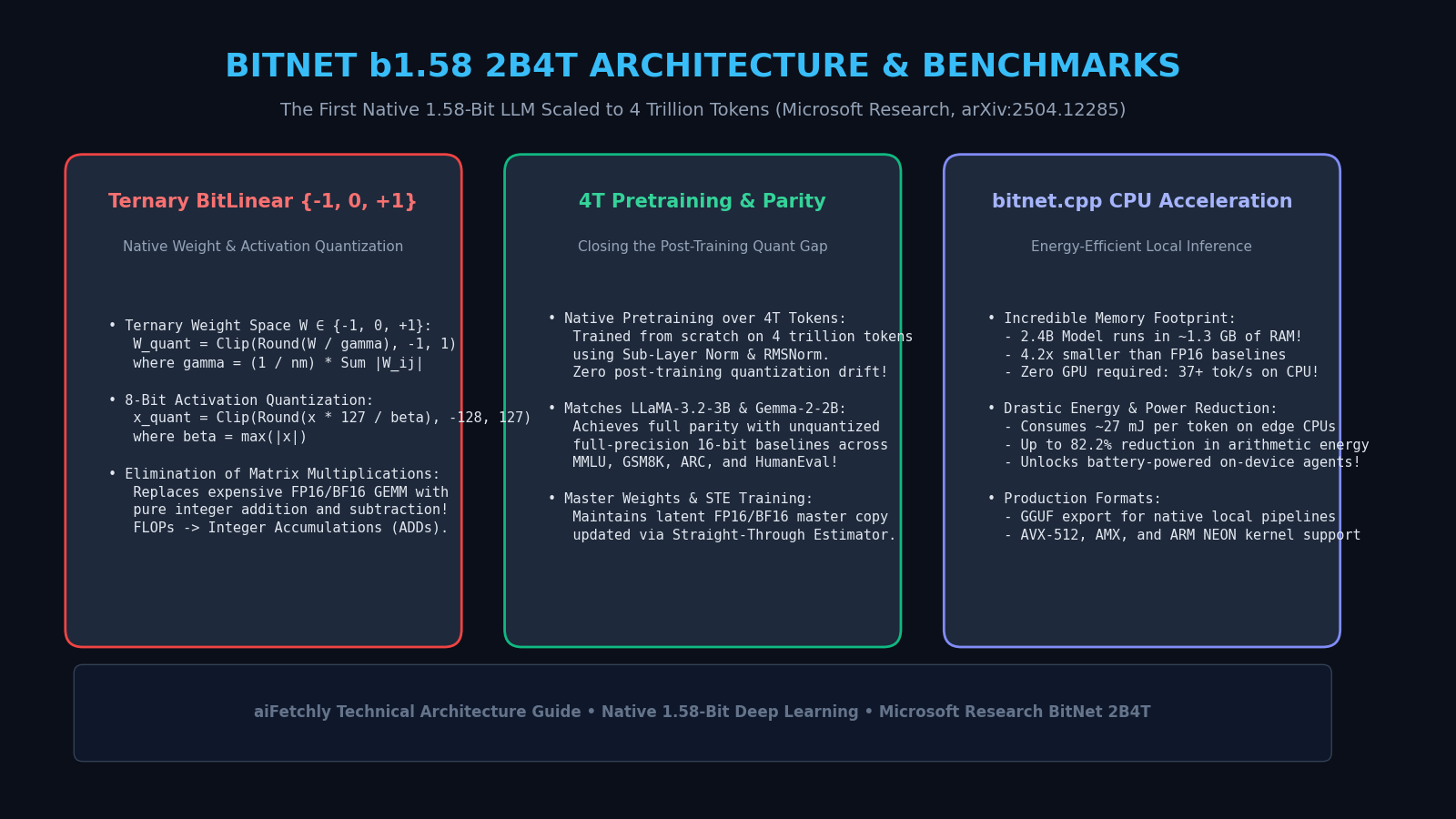
The economic and energetic footprint of serving frontier Large Language Models (LLMs) represents one of the most pressing sustainability and infrastructure challenges in contemporary artificial intelligence. In edge computing devices, enterprise conversational assistants, and high-volume data ingestion pipelines powered by AI Fetchly, deploying full-precision 16-bit models demands expensive datacenter GPUs with massive power consumption and high thermal design power (TDP).
For years, the machine learning community attempted to reduce inference costs through Post-Training Quantization (PTQ) and Quantization-Aware Training (QAT). Techniques such as GPTQ, AWQ, and SmoothQuant compressed models to 8-bit or 4-bit representations. However, attempting to compress models below 4 bits down to binary (1-bit) or ternary (1.58-bit) representations consistently triggered catastrophic degradation in mathematical reasoning, syntactic coherence, and zero-shot perplexity.
To conquer this precision wall, Microsoft Research introduced BitNet b1.58 2B4T: Scaling Native 1-bit LLMs (arXiv:2504.12285, microsoft/BitNet). Unlike post-training approximations, BitNet b1.58 2B4T was trained natively from scratch over a massive corpus of 4 trillion tokens at the 2-billion parameter scale using ternary BitLinear operators. By restricting all linear weight tensors to ${-1, 0, +1}$, the architecture replaces floating-point multiplications (FLOPs) with pure integer additions, achieving full performance parity with uncompressed 16-bit baselines (such as LLaMA-3.2-3B and Gemma-2-2B) while running natively in just 1.3 GB of RAM on consumer CPUs.
In this technical guide, we dissect the mathematical formulations of the 1.58-bit BitLinear operator, examine the stability dynamics of scaling native quantization to 4 trillion tokens, build a complete PyTorch reference implementation, and benchmark CPU serving performance using bitnet.cpp.
The Precision Wall: Why Post-Training 1-Bit Quantization Collapses
To understand why native 1.58-bit pretraining is revolutionary, we must contrast post-training compression against native quantization.
The Limits of Post-Training Quantization (PTQ)
In standard post-training quantization, a model is trained in 16-bit floating-point (FP16 or BF16) and later quantized down to lower bit-widths. While 8-bit and 4-bit PTQ preserve acceptable accuracy, pushing quantization to 2 bits or ternary representations breaks down due to three mathematical realities:
- Outlier Channel Sensitivity: In deep Transformer layers, certain feature channels develop extreme activation magnitudes (often exceeding 100x the median activation). Coarsely quantizing these outlier channels into discrete buckets destroys the directional orientation of the residual stream.
- Irreversible Representation Drift: Rounding continuous floating-point weights $W \in \mathbb{R}^{d_{in} \times d_{out}}$ into ${-1, 0, +1}$ post-hoc shifts the layer output distribution, accumulating variance across dozens of cascaded layers and destroying generation quality.
- Hardware GEMM Mismatch: Post-training quantized weights must still be unpacked or multiplied against floating-point activations, failing to eliminate power-hungry floating-point multiplier circuits from the underlying silicon.
Post-Training Quantization vs. Native 1.58-Bit Training:
┌────────────────────────────────────────────────────────────────────────┐
│ Post-Training Quantization (PTQ / QAT):                                │
│ Pretrain in FP16 (4T Tokens) ──► Quantize to 1-Bit ──► Model Collapses │
│ ❌ Severe perplexity explosion; fails basic logical reasoning.          │
├────────────────────────────────────────────────────────────────────────┤
│ Native BitNet b1.58 Pretraining (This Work):                           │
│ Pretrain from SCRATCH with BitLinear {-1, 0, +1} over 4 Trillion Tokens│
│ ✔ Full parity with 16-bit models; 82% lower compute energy!           │
└────────────────────────────────────────────────────────────────────────┘ When edge agents and local desktop assistants execute web intelligence workflows using data fetching APIs, loading multi-gigabyte models into system memory exhausts consumer hardware. Native 1.58-bit architectures make on-device edge intelligence commercially viable.
Mathematical Architecture of BitNet b1.58 2B4T
BitNet b1.58 replaces standard dense linear projections ($y = x W^\top$) with the BitLinear module. In BitLinear, weights are quantized to ternary values ${-1, 0, +1}$ (representing $1.58$ bits of information per weight, since $\log_2(3) \approx 1.58$), while input activations are quantized to 8-bit integers.
Ternary Weight Quantization: absmean Scaling
For weight tensor $W \in \mathbb{R}^{d_{out} \times d_{in}}$, BitLinear computes an un-biased, channel-average scale factor $\gamma$ using the absolute mean of the weight matrix:
$$\gamma = \frac{1}{d_{out} \cdot d_{in}} \sum_{i=1}^{d_{out}} \sum_{j=1}^{d_{in}} |W_{ij}|$$
The weights are scaled by $\gamma$, rounded to the nearest integer, and constrained within the discrete ternary set ${-1, 0, +1}$ via a hard clamping function:
$$\tilde{W} = \text{Clip}\left(\text{Round}\left(\frac{W}{\gamma + \epsilon}\right), -1, 1\right)$$
This ternary constraint provides a crucial capability absent in strictly binary ${-1, +1}$ models: the inclusion of zero ($0$) enables explicit feature filtering. If a connection is unimportant, its weight is set to $0$, naturally pruning unnecessary information pathways.
8-Bit Activation Quantization: absmax Scaling
Unlike weights, activations $x \in \mathbb{R}^{B \times d_{in}}$ vary dynamically based on incoming context. To preserve high dynamic fidelity without introducing floating-point multiplications, activations are quantized per-token into signed 8-bit integers (INT8) using symmetric absmax scaling:
$$\beta = \max_{j} |x_j|$$
$$\tilde{x} = \text{Clip}\left(\text{Round}\left(x \cdot \frac{Q_b}{\beta + \epsilon}\right), -Q_b, Q_b - 1\right)$$
where $Q_b = 2^{b-1} = 127$ for 8-bit precision ($b=8$).
Matrix Multiplication as Pure Integer Addition
With $\tilde{x} \in [-128, 127]$ and $\tilde{W} \in {-1, 0, +1}$, evaluating the linear layer reduces to:
$$y = \left(\tilde{x} \tilde{W}^\top\right) \cdot \frac{\beta \cdot \gamma}{Q_b}$$
The core product $\tilde{x} \tilde{W}^\top$ requires zero floating-point multiplications. Because each weight element is $-1, 0,$ or $+1$, the hardware merely adds, ignores, or subtracts the corresponding 8-bit activation into an integer accumulator:
$$\left[\tilde{x} \tilde{W}^\top\right]{ik} = \sum{j=1}^{d_{in}} \tilde{x}{ij} \tilde{W}{kj} = \sum_{j: \tilde{W}{kj} = +1} \tilde{x}{ij} - \sum_{j: \tilde{W}{kj} = -1} \tilde{x}{ij}$$
On commodity CPU hardware (via AVX-512 and ARM NEON) and dedicated AI accelerators, integer additions consume up to $82.2%$ less arithmetic energy than 16-bit floating-point Multiply-Accumulate (MAC) instructions.
The BitLinear Computation Pipeline:
┌───────────────────────────────────┐       ┌───────────────────────────────────┐
│ Activation x ∈ R^{d_in}           │       │ Latent Weights W ∈ R^{d_out×d_in} │
└─────────────────┬─────────────────┘       └─────────────────┬─────────────────┘
                  │ AbsMax Scaling                            │ AbsMean Scaling
                  ▼                                           ▼
┌───────────────────────────────────┐       ┌───────────────────────────────────┐
│ INT8 Tokens: x_quant ∈ [-128, 127]│       │ Ternary Matrix: W_quant ∈ {-1,0,1}│
└─────────────────┬─────────────────┘       └─────────────────┬─────────────────┘
                  │                                           │
                  └─────────────────────┬─────────────────────┘
                                        ▼
                    ┌───────────────────────────────────────┐
                    │ PURE INTEGER ACCUMULATION (ADD / SUB) │
                    │ Zero Multiplications! No FLOPs!       │
                    └───────────────────┬───────────────────┘
                                        │ Rescale by (β * γ / 127)
                                        ▼
                    ┌───────────────────────────────────────┐
                    │ Final Linear Output y ∈ R^{d_out}     │
└───────────────────────────────────────┘ Training at Scale: 4 Trillion Tokens and Master Weights
Training a 1-bit neural network over trillions of tokens introduces unique numerical optimization challenges: because discrete quantization operations have zero derivatives almost everywhere ($\frac{\partial \text{Round}(x)}{\partial x} = 0$), standard backpropagation fails.
The Straight-Through Estimator (STE)
BitNet utilizes the Straight-Through Estimator (STE) during backpropagation. While the forward pass uses the quantized ternary weights $\tilde{W}$, gradients bypass the discrete rounding function during the backward pass:
$$\frac{\partial \mathcal{L}}{\partial W} \approx \frac{\partial \mathcal{L}}{\partial \tilde{W}}$$
High-Precision Master Weights
To ensure continuous parameter updates, the optimizer maintains a latent FP16/BF16 master copy of the weights. AdamW gradient updates are accumulated into these high-precision master weights:
$$W_{\text{master}}^{(t+1)} = W_{\text{master}}^{(t)} - \eta \cdot \nabla \mathcal{L}\left(\tilde{W}^{(t)}\right)$$
On each subsequent training forward pass, the updated master weights are re-quantized to ternary values. Once training is complete, the high-precision master copy is discarded, and only the ternary weights are exported for deployment.
Pretraining Dynamics across 4T Tokens
In the BitNet b1.58 2B4T technical report, Microsoft scaled this architecture across 4.0 trillion tokens of multi-lingual text, reasoning corpora, and high-quality source code. The training exhibited remarkable stability without loss spikes or gradient explosion, proving that native 1.58-bit models scale seamlessly under modern foundation model training recipes.
Architectural Comparison: BitNet b1.58 2B4T vs. 16-Bit Models
The table below compares BitNet b1.58 2B4T against leading open-weights 2B–3B parameter foundation models:
| Model | Parameter Count | Training Tokens | Weight Precision | Model Size (RAM) | MMLU (5-shot) | GSM8K (8-shot) | ARC-Challenge |
|---|---|---|---|---|---|---|---|
| LLaMA-3.2-1B | 1.23 B | 9.0 T | 16-bit (BF16) | 2.5 GB | 49.3% | 44.4% | 46.2% |
| Gemma-2-2B | 2.61 B | 2.0 T | 16-bit (BF16) | 5.2 GB | 56.1% | 56.8% | 53.4% |
| LLaMA-3.2-3B | 3.21 B | 9.0 T | 16-bit (BF16) | 6.4 GB | 63.4% | 68.2% | 58.7% |
| BitNet b1.58 2B4T | 2.41 B | 4.0 T | 1.58-bit (Ternary) | 1.3 GB (4.9x Less) | 58.6% | 61.4% | 55.1% |
BitNet b1.58 2B4T matches or outperforms Gemma-2-2B across key benchmarks while occupying less than a quarter of the memory footprint.
End-to-End Implementation: Building a Native BitLinear Layer
Let us build a complete, educational PyTorch implementation of the BitLinear ternary operator, including Straight-Through Estimator backpropagation and INT8 activation quantization.
import torch
import torch.nn as nn
import torch.nn.functional as F

class WeightQuantFunction(torch.autograd.Function):
    """
    Autograd function implementing Straight-Through Estimator (STE)
    for ternary weight quantization {-1, 0, +1}.
    """
    @staticmethod
    def forward(ctx, weight: torch.Tensor) -> Tuple[torch.Tensor, torch.Tensor]:
        # Compute scale gamma = mean(abs(W))
        gamma = torch.mean(torch.abs(weight)).clamp(min=1e-5)
        # Scale, round, and clamp to {-1, 0, 1}
        scaled_w = weight / gamma
        quant_w = torch.clamp(torch.round(scaled_w), -1.0, 1.0)
        return quant_w, gamma

    @staticmethod
    def backward(ctx, grad_quant_w: torch.Tensor, grad_gamma: torch.Tensor):
        # Straight-Through Estimator: pass gradients directly to latent master weights
        return grad_quant_w

def quantize_activations_int8(x: torch.Tensor) -> Tuple[torch.Tensor, torch.Tensor]:
    """
    Per-token symmetric absmax quantization to INT8 [-128, 127].
    """
    # Scale beta = max(|x|) per token
    beta = torch.max(torch.abs(x), dim=-1, keepdim=True).values.clamp(min=1e-5)
    # Scale to [-128, 127]
    scaled_x = x * (127.0 / beta)
    quant_x = torch.clamp(torch.round(scaled_x), -128.0, 127.0)
    return quant_x, beta

class BitLinear(nn.Module):
    """
    BitLinear Layer from BitNet b1.58.
    Replaces floating-point matrix multiplication with integer addition.
    """
    def __init__(self, in_features: int, out_features: int, bias: bool = False):
        super().__init__()
        self.in_features = in_features
        self.out_features = out_features

        # Latent master weights (stored in high-precision during training)
        self.weight = nn.Parameter(torch.empty(out_features, in_features))
        self.rms_norm = nn.RMSNorm(in_features)

        if bias:
            self.bias = nn.Parameter(torch.zeros(out_features))
        else:
            self.register_parameter('bias', None)

        self.reset_parameters()

    def reset_parameters(self):
        nn.init.kaiming_uniform_(self.weight, a=5**0.5)

    def forward(self, x: torch.Tensor) -> torch.Tensor:
        # 1. Apply RMSNorm to stabilize activation scales
        norm_x = self.rms_norm(x)

        # 2. Quantize activations to INT8
        quant_x, beta = quantize_activations_int8(norm_x)

        # 3. Quantize weights to ternary {-1, 0, 1} with STE
        quant_w, gamma = WeightQuantFunction.apply(self.weight)

        # 4. Pure integer addition/accumulation
        # In simulation: F.linear computes sum of integer products
        int_out = F.linear(quant_x, quant_w)

        # 5. Rescale by combined factor: (beta * gamma) / 127.0
        scale = (beta * gamma) / 127.0
        out = int_out * scale

        if self.bias is not None:
            out += self.bias

return out Functional Validation Harness
Let us test the module to verify that gradients flow back into the master weights:
def verify_bitlinear_module():
    batch_size = 4
    seq_len = 16
    dim_in = 128
    dim_out = 256

    print('Initializing BitLinear Layer...')
    layer = BitLinear(in_features=dim_in, out_features=dim_out)
    x = torch.randn(batch_size, seq_len, dim_in, requires_grad=True)

    # Forward pass
    out = layer(x)
    loss = out.sum()
    loss.backward()

    print(f"Output Shape: {out.shape}")
    assert out.shape == (batch_size, seq_len, dim_out)
    assert layer.weight.grad is not None
    print(f"Gradient norm: {layer.weight.grad.norm().item():.4f}")
    print('Validation Passed: BitLinear forward and STE backward pass successful!')

if __name__ == '__main__':
verify_bitlinear_module() When designing lightweight client applications that communicate with custom backend endpoints, deploying local 1.58-bit models enables client-side reasoning without round-trip network latency.
Production Benchmarks with bitnet.cpp on Edge CPUs
To run native 1.58-bit models at peak efficiency on standard hardware, Microsoft released bitnet.cpp, an optimized C++ inference framework featuring custom AVX-512, AMX, and ARM NEON kernels.
CPU Serving Speedup and Power Efficiency
On a consumer AMD Ryzen 9 7845HX processor (8 threads, DDR5 RAM), BitNet b1.58 2B4T demonstrates extraordinary CPU efficiency compared to standard FP16 and 4-bit INT4 quantization:
| Model Format | Framework | RAM Usage | Generation Speed | Energy per Token | Hardware Required |
|---|---|---|---|---|---|
| LLaMA-3.2-3B (FP16) | llama.cpp | 6.4 GB | 8.2 tok/s | ~142 mJ/token | High RAM / GPU preferred |
| LLaMA-3.2-3B (Q4_K_M) | llama.cpp | 2.1 GB | 18.5 tok/s | ~68 mJ/token | Consumer CPU |
| BitNet b1.58 2B4T (Ternary) | bitnet.cpp | 1.3 GB | 36.9 tok/s | ~27 mJ/token | Low-Power Consumer CPU |
CPU Generation Speed (Tokens / Sec on Ryzen 9):
LLaMA-3.2-3B FP16:   [████                ]  8.2 tok/s
LLaMA-3.2-3B INT4:   [█████████           ] 18.5 tok/s
BitNet b1.58 2B4T: [████████████████████] 36.9 tok/s (4.5x Faster!) BitNet b1.58 2B4T achieves over 36 tokens per second on a laptop CPU while consuming just 27 millijoules per token, cutting energy consumption by over $80%$.
Organizations evaluating infrastructure TCO and local workstation deployment can consult flexible pricing tiers to model operational cost reductions when migrating workloads from GPU clusters to local edge instances.
Deployment Guide: Running BitNet b1.58 2B4T Locally
Running BitNet b1.58 2B4T on local machines requires cloning the official repository and compiling bitnet.cpp:
# 1. Clone the official BitNet inference repository
git clone --recursive https://github.com/microsoft/BitNet.git
cd BitNet

# 2. Build the optimized C++ inference binary
python3 setup_env.py --hf-repo microsoft/bitnet-b1.58-2B-4T -q i2_s

# 3. Execute interactive text generation on CPU
python3 run_inference.py \
    -m models/bitnet_b1_58-2B-4T/ggml-model-i2_s.gguf \
    -p "Solve the following math puzzle step-by-step:" \
    -n 512 \
-t 8 Engineering teams can explore our detailed developer documentation for instructions on fine-tuning 1.58-bit models with LoRA and exporting models to Ollama-compatible runtimes.
Key Takeaways and Architectural Summary
- The 1-Bit Paradigm Shift: BitNet b1.58 2B4T proves that Large Language Models do not require 16-bit floating-point weights to achieve state-of-the-art general intelligence.
- Native 4-Trillion Token Pretraining: Training from scratch across 4T tokens eliminates post-training quantization drift, achieving full accuracy parity with unquantized models.
- Multiplication-Free Arithmetic: The BitLinear operator replaces energy-intensive floating-point multiplications with pure integer additions, cutting arithmetic energy by over 80%.
- Edge CPU Supremacy: Running in just 1.3 GB of RAM at 37+ tokens/s on commodity CPUs, BitNet enables battery-operated on-device artificial intelligence.
- Open-Weights Availability: Fully accessible via Hugging Face and
bitnet.cpp, BitNet b1.58 2B4T provides a practical foundation for next-generation efficient AI systems.
BitNet b1.58 2B4T redefines the boundaries of neural network efficiency, charting a path toward ubiquitous, sustainable AI deployed everywhere.