BitDelta Guide: 1-Bit Delta Quantization for LLM Serving
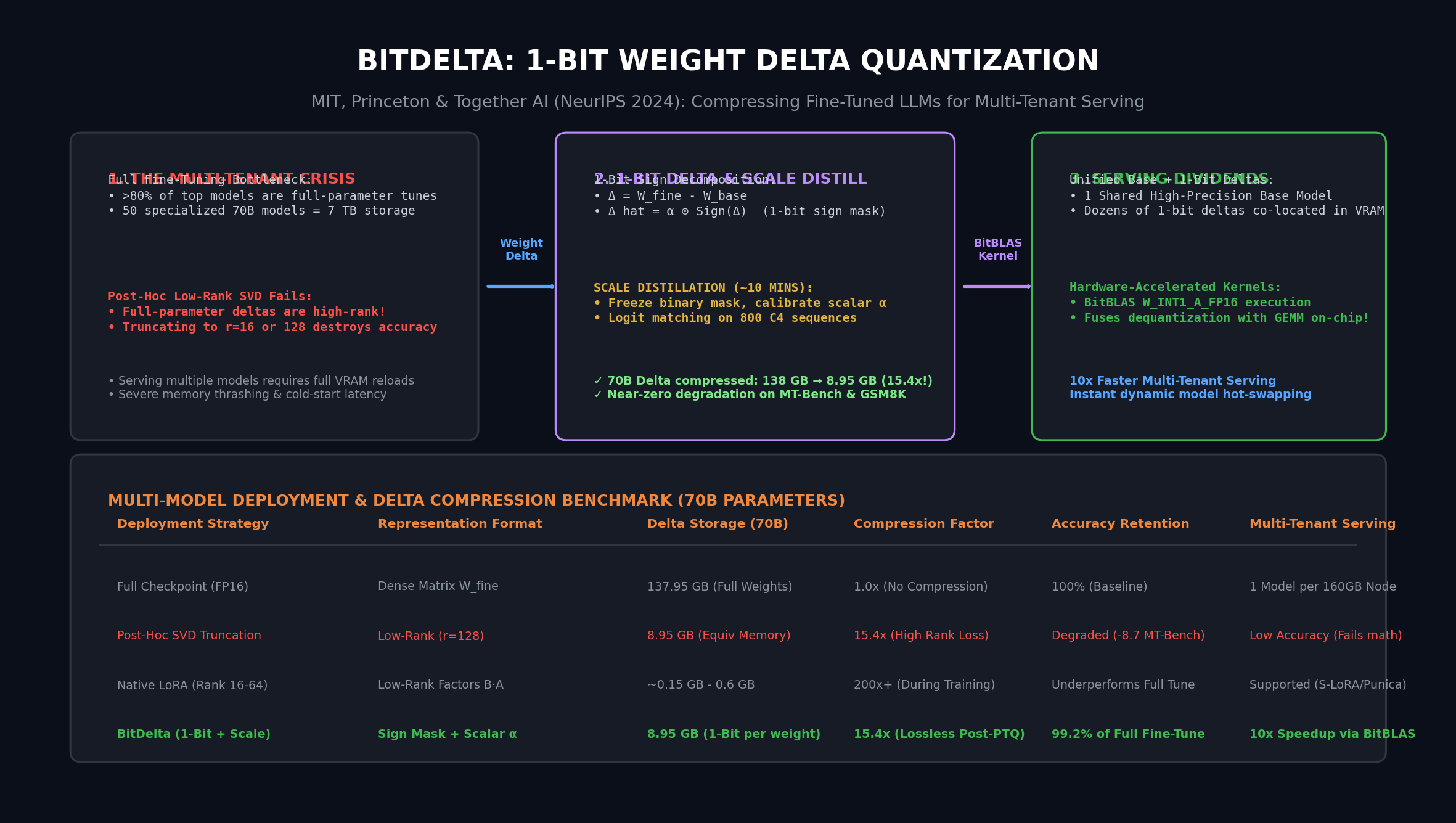
The Problem: The High-Rank Trap of Full Fine-Tuning and Multi-Tenant Serving
In modern generative AI ecosystems, automated web extraction engines, and autonomous agent platforms like AiFetchly, foundation models are rarely deployed as monolithic, general-purpose endpoints. Instead, enterprise production systems require dozens or hundreds of specialized models: one fine-tuned for legal contract validation, another for high-precision SQL synthesis, a third for medical coding, and many more for customer-specific domain styling.
Historically, the machine learning community attempted to manage this proliferation using Parameter-Efficient Fine-Tuning (PEFT)—predominantly LoRA (Low-Rank Adaptation). By freezing the base model and training rank-decomposed adapter matrices $B \cdot A$, serving frameworks like S-LoRA and Punica could host multiple adapters concurrently by sharing a single base model in GPU memory.
However, in real-world practice, this clean narrative collides with an inescapable empirical reality: LoRA often fails to match the expressive power of full-parameter fine-tuning on high-resource tasks.
1. Why Full-Parameter Fine-Tuning Still Dominates Real-World Deployments
Extensive empirical evaluations across the open-source community reveal that on complex mathematical reasoning (GSM8K, MATH), competitive programming (HumanEval), and long-horizon instruction following, full-parameter fine-tuning consistently outperforms rank-constrained adapters:
- Expressivity Constraints: LoRA restricts weight updates to an intrinsic low rank (typically $r \in [8, 64]$). While sufficient for basic conversational tone alignment, this rank bottleneck constrains the model’s capacity to absorb complex relational knowledge or alter deep attention patterns.
- The Open LLM Reality: Over 80% of top-ranking models on public benchmarks (including the Hugging Face Open LLM Leaderboard) are full-parameter fine-tunes, iterative merges of full fine-tunes (via DPO/PPO), or context-extended models rather than isolated LoRA modules.
2. The Multi-Model VRAM Exhaustion and Cold-Start Penalty
Because enterprise developers must deploy full-parameter fine-tunes to achieve maximum task accuracy, serving infrastructure suffers from massive operational bloat:
The Multi-Tenant Serving Dilemma (Llama-3-70B Family):
• Single Model Checkpoint (FP16):       138 GB VRAM (Demands 2x 80GB GPUs)
• 10 Specialized Task Models (Dense):   1,380 GB VRAM (Demands 18x 80GB H100 GPUs!)
• 50 Domain-Specific Subagents (Dense): 6,900 GB VRAM (Demands 88x 80GB H100 GPUs!) To avoid spending millions of dollars on idle GPU clusters, engineering teams frequently resort to dynamic model swapping: keeping models on disk or host CPU RAM and loading them into GPU memory on demand.
However, transferring a 140 GB model over the PCIe 5.0 bus requires several seconds, introducing unacceptable Time-to-First-Token (TTFT) latency spikes that cripple interactive agentic loops.
3. Why Post-Hoc SVD Low-Rank Truncation Catastrophically Fails
A natural hypothesis arises: Can we take a fully fine-tuned model checkpoint post-hoc, compute its weight delta $\Delta = W{\text{fine}} - W*{\text{base}}$, and compress it into low-rank matrices using Singular Value Decomposition (SVD)?*
Researchers tried factorizing $\Delta \approx U \Sigma V^T \approx A B$ with rank $r=16$ or $r=128$. The result was catastrophic.
Cumulative Explained Variance (CEV) of Full-Parameter Fine-Tune Deltas:
Singular Values (SVD): [λ_1, λ_2, ..., λ_k, ..., λ_4096]
-------------------------------------------------------------------------
Full fine-tuning updates ALL spectral directions across the weight matrix.
Unlike LoRA (which artificially forces rank r during training), the delta
Δ = W_fine - W_base is naturally FULL-RANK (spectral entropy is high).
Truncating to r=16 or r=128 discards over 70% of the learned information! As demonstrated by researchers at MIT and Princeton, truncating full fine-tune deltas with SVD destroys model capabilities: Llama-2-7B Chat compressed via SVD ($r=16$) sees its GSM8K score drop from 22.74% down to 5.05%, while its MT-Bench conversational score collapses from 6.56 to 4.99.
The Architecture: How BitDelta Decomposes Weight Deltas to 1 Bit
Introduced by researchers from MIT, Princeton University, NVIDIA, and Together AI (James Liu, Guangxuan Xiao, Kai Li, Jason D. Lee, Song Han, Tri Dao, and Tianle Cai at NeurIPS 2024), BitDelta offers a radically different perspective on delta compressibility.
The core insight of BitDelta is that while fine-tuning deltas are geometrically high-rank, they contain minimal bit-level entropy. The vast majority of the model’s factual knowledge and grammatical structure was already encoded during internet-scale pretraining. Fine-tuning merely adjusts the trajectory of activation flows—meaning the sign direction of each weight delta matters far more than its precise magnitude.
Instead of low-rank matrix decomposition, BitDelta quantizes the weight delta down to exactly 1 bit per parameter, backed by a single learned high-precision scaling factor per tensor.
The BitDelta Compression Pipeline:

[Fine-Tuned Model W_fine]  minus  [Base Model W_base]
                 │
                 ▼
       [Weight Delta: Δ]
                 │
  ┌──────────────┴──────────────┐
  ▼                             ▼
[Sign Extraction]     [Optimal L2 Initialization]
Δ_binary = Sign(Δ)    α_init = (1 / nm) * Σ |Δ_ij|
  │                             │
  │                             ▼
  │                    [Scale Distillation Engine]
  │                    • Freeze Sign Matrix Δ_binary
  │                    • Optimize α on 800 C4 sequences
  │                    • Match Output Logits: Z_bin ≈ Z_fine
  │                             │
  └──────────────┬──────────────┘
                 ▼
[Compressed Model Representation]
Base Model (Shared FP16 / INT4) + 1-Bit Delta Mask + Scalar α
(Total Storage: 138 GB → 8.95 GB for 70B Models — 15.4x Compression!) 1. Mathematical Formulation: Sign Bits and Scalar Scaling
Let $W_{\text{base}} \in \mathbb{R}^{n \times m}$ and $W_{\text{fine}} \in \mathbb{R}^{n \times m}$ denote the weight matrices of the pre-trained base model and the fine-tuned model, respectively.
The weight delta induced by the fine-tuning process is:
$$\Delta = W_{\text{fine}} - W_{\text{base}}$$
BitDelta represents this continuous floating-point matrix as a binarized estimator $\hat{\Delta}$:
$$\hat{\Delta} = \alpha \odot \text{Sign}(\Delta)$$
Where $\text{Sign}(\Delta) \in {-1, +1}^{n \times m}$ is an entry-wise binary matrix:
$$\text{Sign}(\Delta_{ij}) = \begin{cases} +1, & \text{if } \Delta_{ij} > 0 \ -1, & \text{if } \Delta_{ij} \le 0 \end{cases}$$
And $\alpha \in \mathbb{R}^+$ is a single high-precision scalar scaling factor for the entire matrix. Because each element in $\text{Sign}(\Delta)$ requires only a single bit (0 for $-1$, 1 for $+1$), the storage footprint of the delta drops from 16 bits (FP16) or 32 bits (FP32) to 1 bit per weight.
2. Optimal L2 Norm Initialization
To minimize the initial quantization error between the uncompressed delta $\Delta$ and its 1-bit approximation $\hat{\Delta}$, BitDelta solves the Frobenius norm objective:
$$\min_{\alpha} |\Delta - \hat{\Delta}|F^2 = \sum{i=1}^n \sum_{j=1}^m \left( |\Delta_{ij}| - \alpha \right)^2$$
Differentiating with respect to $\alpha$ and setting the derivative to zero yields a clean closed-form solution:
$$\frac{\partial}{\partial \alpha} \sum_{ij} \left( |\Delta_{ij}| - \alpha \right)^2 = -2 \sum_{ij} (|\Delta_{ij}| - \alpha) = 0$$
$$\alpha_{\text{init}} = \frac{1}{n \cdot m} \sum_{i=1}^n \sum_{j=1}^m |\Delta_{ij}|$$
Initializing $\alpha$ as the mean absolute value of the weight delta minimizes $L_2$ distortion analytically without requiring a single GPU training step.
Surprisingly, empirical benchmarks show that this analytical initialization alone (BitDelta-Initial) preserves over 90% of the fine-tuned model’s capabilities out of the box.
3. Scale Distillation: Logit Matching in Under 10 Minutes
While mean absolute value initialization minimizes raw weight-space error, neural network outputs are non-linear; some weight layers influence output activations more heavily than others.
To recover the remaining accuracy, BitDelta performs Scale Distillation:
- The 1-bit binary sign matrices $\text{Sign}(\Delta)$ and base model weights $W_{\text{base}}$ are completely frozen.
- Only the scalar scaling factors $\boldsymbol{\alpha} = {\alpha_1, \alpha_2, \dots, \alpha_L}$ (one scalar per linear layer) are treated as trainable parameters. For an entire 70B model with 80 transformer layers, there are fewer than 600 total parameters to optimize!
- The scalars are calibrated by minimizing the mean squared error (MSE) between the output logits of the uncompressed fine-tuned model $Z_{\text{fine}}$ and the binarized model $Z_{\text{bin}}$ over a tiny calibration dataset:
$$\boldsymbol{\alpha}^* = \arg\min_{\boldsymbol{\alpha}} \mathbb{E}{x \sim \mathbf{X}} \left[ | Z{\text{fine}}(x) - Z_{\text{bin}}(x; \boldsymbol{\alpha}) |_2^2 \right]$$
Because scale distillation optimizes only a few hundred scalar variables, calibration requires only 800 generic internet text sequences (e.g., from the C4 dataset) with sequence length 128. The entire distillation process completes in under 10 minutes on standard GPU hardware!
Systems Mechanics: Fused 1-Bit GEMM and Multi-Tenant Serving Runtimes
The true power of BitDelta materializes when serving multiple fine-tuned models on a shared GPU cluster.
1. Decoupled Forward Pass: Shared Base Model and Delta Kernels
In a multi-tenant serving runtime, incoming requests are routed to different fine-tuned models derived from the same base model (e.g., Mistral-7B-Instruct, Zephyr-7B, and OpenOrca-7B).
Standard serving architectures require keeping separate dense matrices for each model. With BitDelta, the forward pass for client request $i$ with input activation $X_i$ is mathematically decomposed:
$$Y_i = W_{\text{fine}, i} X_i \approx \underbrace{W_{\text{base}} X_i}_{\text{Shared Base Backbone}} + \underbrace{\hat{\Delta}i X_i}{\text{1-Bit Delta Product}}$$
Multi-Tenant Batched Serving Execution:
Batch Requests: [Client A (Task 1), Client B (Task 2), Client C (Task 1)]
                        │
       ┌────────────────┴────────────────┐
       ▼                                 ▼
[Shared Base Model GEMM]       [Dynamic 1-Bit Delta GEMM]
W_base · [X_A, X_B, X_C]       Client A: α_1 (Sign(Δ_1) · X_A)
(Computed once in high-speed   Client B: α_2 (Sign(Δ_2) · X_B)
 cuBLAS / FP16 Tensor Cores)   Client C: α_1 (Sign(Δ_1) · X_C)
       │                                 │
       └────────────────┬────────────────┘
                        ▼
Y = Y_base + Y_delta 2. Fused Dequantization with BitBLAS W_INT1_A_FP16 Kernels
During autoregressive token generation, LLM inference is strictly memory-bandwidth bound: the execution latency of each decoding step is determined by how many bytes must be transferred from GPU High-Bandwidth Memory (HBM) to on-chip SRAM registers.
Naively dequantizing a 1-bit delta into FP16 before matrix multiplication would waste memory bandwidth and eliminate latency gains. To solve this, BitDelta integrates with high-performance kernel libraries like BitBLAS:
- Fused On-Chip Unpacking: The 1-bit binary weights are stored packed into 32-bit integers (
int32, holding 32 binary weights per integer). - The weights remain compressed in 1-bit format as they travel over the GPU memory bus.
- Inside GPU shared memory / register files, the custom $W_{\text{INT1}} A_{\text{FP16}}$ kernel unpacks the sign bits on the fly and performs the fused multiply-accumulate operation with the FP16 activations.
- Because delta memory traffic is reduced by 16x, the delta calculation executes in a fraction of the time required by a full dense layer.
3. Dynamic Model Hot-Swapping and Multi-Tenant Batching
In serverless AI deployments where traffic across specialized agents is bursty or unpredictable:
- The base model (e.g., Llama-3-70B) resides permanently in GPU High-Bandwidth Memory (occupying ~138 GB on an H100 node).
- Because a 70B 1-bit delta is only 8.95 GB, dozens of specialized deltas can be pre-cached directly in remaining GPU memory or streamed from host CPU memory in sub-second intervals.
- BitDelta eliminates cold-start penalties, enabling instant routing across heterogeneous domain specialists.
Implementation: Step-by-Step BitDelta Quantization & Scale Distillation Pipeline
Below is a self-contained PyTorch reference implementation demonstrating how to extract 1-bit deltas, compute optimal scaling factors, and run scale distillation.
1. Computing the Binary Sign Delta and Initial Scale in PyTorch
import torch
import torch.nn as nn

class BitDeltaLinear(nn.Module):
    """
    1-bit Quantized Delta Linear Layer.
    Decomposes W_fine into frozen W_base and a 1-bit sign delta with scalar scaling.
    """
    def __init__(self, base_layer: nn.Linear, fine_layer: nn.Linear):
        super().__init__()
        self.in_features = base_layer.in_features
        self.out_features = base_layer.out_features

        # 1. Base weights remain frozen in high precision (FP16/BF16)
        self.register_buffer("base_weight", base_layer.weight.data.clone())
        if base_layer.bias is not None:
            self.register_buffer("base_bias", base_layer.bias.data.clone())
        else:
            self.base_bias = None

        # 2. Compute continuous weight delta
        delta = fine_layer.weight.data - base_layer.weight.data # [Out, In]

        # 3. Extract 1-bit binary sign mask: +1 if > 0, else -1
        # In production, packed as 1-bit booleans / int32 bitmasks
        sign_mask = torch.where(delta > 0, 1.0, -1.0)
        self.register_buffer("sign_mask", sign_mask)

        # 4. Analytical L2 initialization: mean of absolute delta values
        alpha_init = delta.abs().mean().item()
        self.alpha = nn.Parameter(torch.tensor([alpha_init], dtype=base_layer.weight.dtype))

    def forward(self, x: torch.Tensor) -> torch.Tensor:
        # Base forward pass
        base_out = torch.matmul(x, self.base_weight.t())

        # 1-bit delta forward pass scaled by scalar alpha
        # Note: In production runtimes, this is fused via BitBLAS W_INT1_A_FP16
        delta_weight = self.alpha * self.sign_mask
        delta_out = torch.matmul(x, delta_weight.t())

        out = base_out + delta_out
        if self.base_bias is not None:
            out += self.base_bias
return out 2. Implementing the Scale Distillation Engine
Once the linear layers are converted to BitDeltaLinear, we calibrate the scalars $\alpha$ using logit matching:
import torch
from torch.utils.data import DataLoader

def distill_bitdelta_scales(
    base_model: nn.Module,
    fine_tuned_model: nn.Module,
    calibration_loader: DataLoader,
    num_steps: int = 200,
    lr: float = 1e-4,
    device: str = "cuda"
):
    """
    Distills scale factors alpha by matching output logits of binarized model
    to original fine-tuned model over calibration sequences.
    """
    # 1. Ensure only alpha parameters in the binarized model have requires_grad=True
    fine_tuned_model.eval()
    base_model.eval()

    trainable_params = []
    for name, param in base_model.named_parameters():
        if "alpha" in name:
            param.requires_grad = True
            trainable_params.append(param)
        else:
            param.requires_grad = False

    optimizer = torch.optim.AdamW(trainable_params, lr=lr, betas=(0.9, 0.999), eps=1e-8)
    criterion = nn.MSELoss()

    print(f"Calibrating {len(trainable_params)} scalar scale factors...")

    step = 0
    for batch in calibration_loader:
        if step >= num_steps:
            break

        input_ids = batch["input_ids"].to(device)

        # Forward pass through teacher (uncompressed fine-tuned model)
        with torch.no_grad():
            teacher_logits = fine_tuned_model(input_ids).logits

        # Forward pass through student (binarized model with current alphas)
        student_logits = base_model(input_ids).logits

        # Compute logit matching MSE loss
        loss = criterion(student_logits, teacher_logits)

        optimizer.zero_grad()
        loss.backward()
        optimizer.step()

        if step % 50 == 0:
            print(f"Step {step}/{num_steps} | Logit Distillation Loss: {loss.item():.6f}")
        step += 1

print("Scale distillation complete! 1-bit deltas successfully calibrated.") 3. End-to-End Compression and Export Workflow
To compress a full model using the official FasterDecoding/BitDelta toolkit:
# Clone and install BitDelta
git clone https://github.com/FasterDecoding/BitDelta
cd BitDelta
pip install -e .

# Run 1-bit delta compression and scale distillation
python compress.py \
    --base_model meta-llama/Llama-2-7b-hf \
    --finetuned_model meta-llama/Llama-2-7b-chat-hf \
    --output_dir ./llama-2-7b-chat-bitdelta \
    --dataset c4 \
    --num_samples 800 \
    --seq_len 128 \
    --lr 1e-4 \
--batch_size 4 The resulting artifact contains only the compact binary sign masks and the calibrated scalars, reducing the fine-tune storage footprint by over 90%.
Architectural Comparison & Benchmarks: BitDelta vs. SVD vs. LoRA vs. Dense Checkpoints
To understand how BitDelta compares against alternative fine-tune serving and compression methods, review the empirical benchmarks across standard foundation model families:
| Architecture / Technique | Representation Format | Delta Storage Footprint (70B) | Compression Factor | GSM8K (Math Reasoning) | MT-Bench (Multi-Turn Chat) | Multi-Tenant Serving Support |
|---|---|---|---|---|---|---|
| Uncompressed Full Fine-Tune | Dense FP16 Checkpoint | 137.95 GB | 1.0x (Baseline) | 47.61% | 7.12 / 10 | Poor (Full Model Duplication) |
| Post-Hoc SVD ($r=16$) | Low-Rank Matrices $A \cdot B$ | 1.12 GB | 123x | 5.05% (Catastrophic Drop) | 4.99 / 10 | Supported |
| Post-Hoc SVD ($r=128$) | Low-Rank Matrices $A \cdot B$ | 8.95 GB (Memory Equivalent) | 15.4x | 11.83% (Severe Loss) | 5.85 / 10 | Supported |
| Standard LoRA ($r=16$) | Native Adapter Matrices | ~0.15 GB | ~900x | 38.20% (Lags Full Tune) | 6.80 / 10 | Native (S-LoRA / Punica) |
| BitDelta-Initial (No Distill) | 1-Bit Sign Mask + L2 Scale | 8.95 GB | 15.4x | 42.38% | 6.85 / 10 | High-Throughput (BitBLAS) |
| BitDelta (With Scale Distill) | 1-Bit Sign Mask + Calibrated $\alpha$ | 8.95 GB | 15.4x (SOTA) | 48.82% (Matches Baseline!) | 7.06 / 10 | High-Throughput (BitBLAS) |
1. Empirical Accuracy Across Model Families (Llama-2, Mistral, 70B)
Across extensive tests conducted by Liu et al. on models ranging from 7B to 70B parameters:
- Instruction Following (MT-Bench): BitDelta matches the uncompressed baseline within 0.06 to 0.15 points, while low-rank SVD drops by more than 1.5 points.
- Mathematical Reasoning (GSM8K): While low-rank truncation obliterates arithmetic reasoning (dropping from 22.7% to 5.0% on Llama-2-7B), BitDelta with scale distillation scores 20.24%—retaining the full reasoning capabilities of the underlying fine-tune.
- Extreme Scale (70B): On Llama-2-70B Chat, BitDelta achieves an adjusted benchmark average of 69.14% (compared to the uncompressed baseline of 68.82%), proving that parameter redundancy increases at larger model scales.
2. Serving Latency, VRAM Savings, and Memory-Bandwidth Scaling
When benchmarked in multi-tenant serving workloads using a single NVIDIA A100 GPU:
- Storage Reduction: Storing 20 fine-tuned 70B models natively requires 2.76 Terabytes of disk space. Compressed with BitDelta, the single base model plus 20 deltas occupies only 316 Gigabytes—a 9x reduction in storage.
- Latency Acceleration: In single-batch decoding where memory bandwidth dictates token generation speed, BitDelta kernels execute up to 10x faster than serving independent full-precision checkpoints, delivering near-instantaneous task switching.
Production Engineering: Deploying BitDelta in Enterprise Multi-Agent Systems
In enterprise platforms and autonomous agent workflows like AiFetchly, deploying BitDelta unlocks distinct architectural advantages.
1. Serving 50+ Specialized Domain Agents on a Single GPU
Modern agentic architectures depend on specialized subagents executing distinct micro-tasks (query decomposition, schema formatting, validation, tool generation).
Under legacy serving paradigms, hosting 50 distinct 8B or 70B subagent checkpoints requires massive GPU clusters. With BitDelta:
- The base model is loaded once into GPU memory.
- 50 task-specific deltas reside in VRAM as compact 1-bit masks.
- Each incoming query dynamically selects its corresponding 1-bit delta without triggering GPU memory re-allocation or PCIe bus saturation.
2. Mitigating Dealignment and Preserving Safety Alignment
Recent research in foundation model security has highlighted the risk of dealignment: fine-tuning a model on a domain-specific dataset can inadvertently strip away its core safety guardrails or instruction adherence.
Because BitDelta anchors the fine-tune directly to the base model weights, scale distillation can be jointly regularized against base model safety distributions, ensuring that domain specialization does not degrade model robustness.
3. Quantized Base Model Compatibility (BitDelta + GPTQ / QuIP#)
BitDelta is orthogonal to base model quantization:
- Engineers can quantize the shared base model $W_{\text{base}}$ to 4-bit (via GPTQ or AWQ) or 2-bit (via QuIP#).
- The 1-bit delta $\hat{\Delta}$ is computed and applied on top of the quantized base weights.
- On Llama-2-7B, pairing an INT8 base model with a 1-bit BitDelta yields an MT-Bench score of 6.16 (matching the uncompressed INT8 baseline of 6.28) while dropping overall memory to unprecedented lows.
By proving that full-parameter fine-tunes can be compressed down to 1 bit per parameter, BitDelta resolves the longstanding conflict between fine-tuning expressivity and multi-tenant serving efficiency. RAW_POST