BGE-M3 Explained: Multi-Functionality Hybrid RAG Guide
The Problem: The Isolated Silos of Modern Information Retrieval
In enterprise Retrieval-Augmented Generation (RAG), automated web data extraction platforms, and autonomous intelligence systems like AiFetchly, search precision directly governs downstream generation quality. If the retrieval engine surfaces noisy, irrelevant, or missing passages, even the most capable frontier reasoning model will hallucinate or fail to extract critical entities.
Historically, information retrieval (IR) engineering has been fractured into three isolated, competing paradigms:
1. Dense Bi-Encoder Retrieval
Dense retrieval models (such as OpenAI text-embedding-3-large, standard BGE, or E5) compress entire passages into a single fixed-dimensional continuous vector (e.g., 1,024 or 1,536 dimensions):
- The Strength: Dense embeddings excel at holistic semantic matching and cross-lingual concept generalization. Searching for “strategies to lower corporate tax liability” reliably retrieves documents discussing “depreciation schedules and research credits”, even when they share zero common words.
- The Blindness: Dense vectors suffer from lexical blindness. Because hundreds of words are pooled into a single vector, exact alphanumeric strings—such as part numbers (
SKU-9948X), software function names (crypto_scrypt_kdf), financial tickers, or legal statute numbers—get diluted. A dense retriever routinely confuses two completely different products that share similar marketing prose.
2. Sparse Lexical Retrieval (BM25 and SPLADE)
Sparse retrieval assigns term weights across a discrete vocabulary dictionary:
- The Strength: Exact keyword precision. Algorithms like BM25 or neural sparse models like SPLADE explicitly match exact terms, preserving rare entity identifiers and technical acronyms.
- The Blindness: Sparse retrieval suffers from vocabulary mismatch and semantic rigidity. If a user queries “automobile gearbox repair”, but the manual strictly uses the phrase “transmission overhaul”, traditional sparse search returns zero relevant results. Furthermore, sparse models struggle with cross-lingual retrieval without machine translation.
3. Multi-Vector Late Interaction (ColBERT)
Late-interaction models like ColBERT retain independent vector representations for every token in a document:
- The Strength: State-of-the-art retrieval precision. By evaluating fine-grained token alignments via the MaxSim operator, ColBERT eliminates single-vector pooling bottlenecks.
- The Blindness: Storage and computational overhead. Storing 128-dimensional vectors for every token across millions of documents inflates vector index memory by $10\times$ to $30\times$.
The Production Microservice Nightmare
To circumvent these individual failure modes, modern enterprise pipelines traditionally deploy fragmented multi-stage hybrid architectures:
The Traditional Fragmented RAG Infrastructure:
┌─────────────────┐     ┌──────────────────────┐     ┌────────────────────────┐
│ Vector Database │     │ Elasticsearch / BM25 │     │ Cross-Encoder Reranker │
│ (Dense Embeds)  │  +  │ (Sparse Inverted Idx)│  +  │ (Heavy Multi-Node GPU) │
└────────┬────────┘     └──────────┬───────────┘     └───────────┬────────────┘
         │                         │                             │
         └─────────────┬───────────┘                             │
                       ▼                                         ▼
Union Top-100 Candidates ──────────────► Heavy 2nd-Stage Re-ranking Operating this disconnected pipeline forces engineering teams to:
- Maintain three separate model runtimes and databases.
- Synchronize document updates across heterogeneous storage formats.
- Endure severe serialization latency: querying an external cross-encoder re-ranker adds 200ms to 500ms of latency per search request.
The Architecture: The M3 Triad
To dismantle these operational silos, researchers at the Beijing Academy of Artificial Intelligence (BAAI) introduced BGE-M3: Multi-Lingual, Multi-Functionality, Multi-Granularity Text Embeddings Through Self-Knowledge Distillation (Chen et al., 2024 / arXiv:2402.03216).
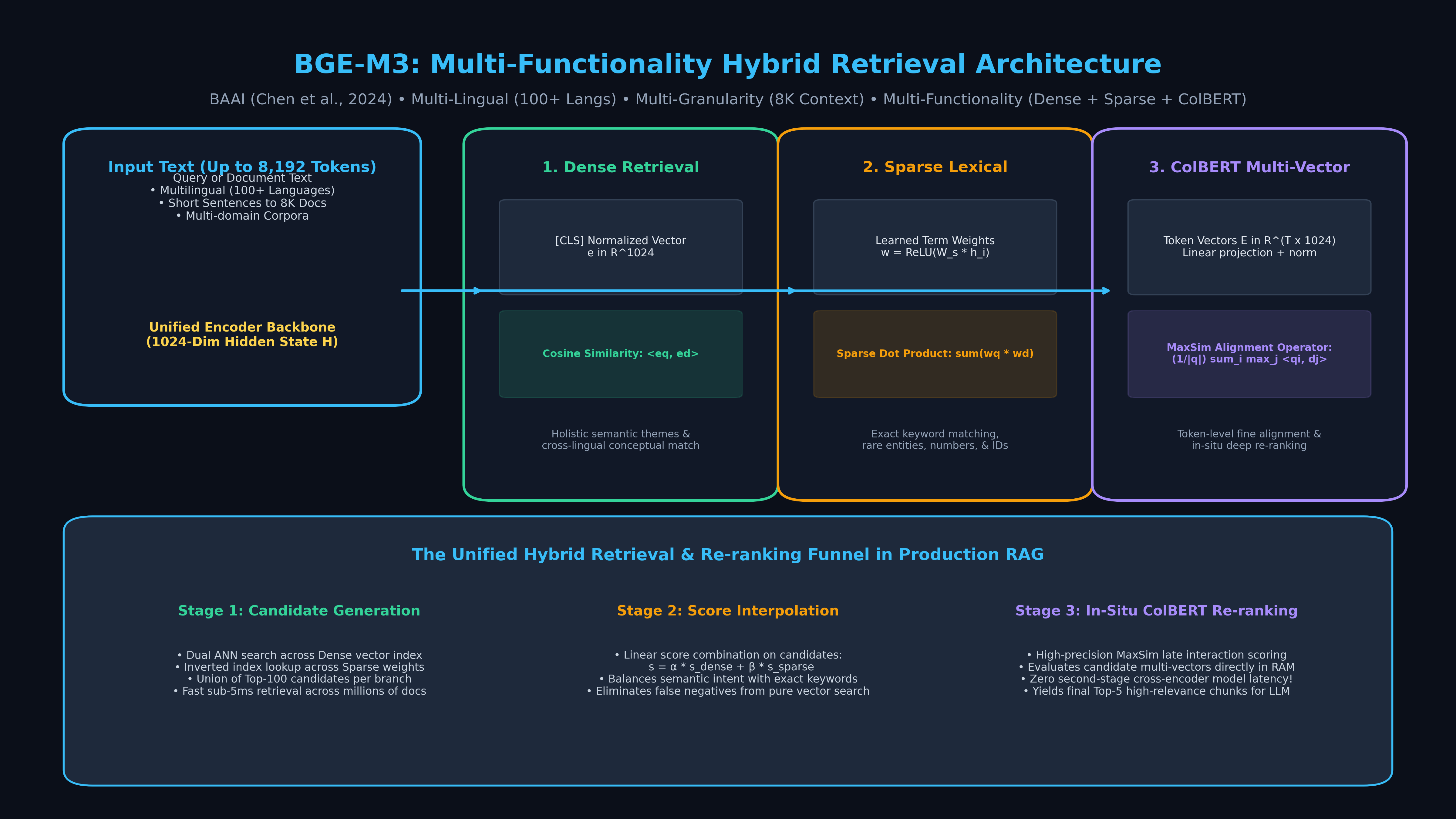
BGE-M3 achieves a historic architectural milestone: it computes Dense, Learned Sparse, and Multi-Vector ColBERT representations simultaneously within a single forward pass of a single neural network.
The "M3" Triad Capabilities:
┌─────────────────────────────────────────────────────────────────────────────┐
│ 1. Multi-Functionality (Unified Tri-Hybrid Retrieval)                       │
│    • Dense: 1024-dimensional normalized [CLS] representation                │
│    • Sparse: Learned lexical importance weights across 250,000 vocab tokens │
│    • ColBERT: Token-level multi-vector representations for MaxSim alignment │
├─────────────────────────────────────────────────────────────────────────────┤
│ 2. Multi-Granularity (Context Elasticity)                                   │
│    • Natively handles input lengths from short phrases to 8,192 tokens      │
│    • Eliminates artificial 512-token chunking boundaries for long contracts │
├─────────────────────────────────────────────────────────────────────────────┤
│ 3. Multi-Lingual (Global Representation Space)                              │
│    • Pre-trained across 100+ languages on 1.2 billion paired instances      │
│    • Unlocks seamless cross-lingual semantic discovery and zero-shot search │
└─────────────────────────────────────────────────────────────────────────────┘ The Unified Encoder Backbone
BGE-M3 is built upon an enhanced 568-million parameter multilingual encoder (XLM-RoBERTa architecture) with an 8,192-token context window.
Given an input text sequence $X = (x_1, x_2, \dots, x_T)$, the encoder computes a sequence of contextualized hidden states:
$$H = (h_1, h_2, \dots, h_T) \in \mathbb{R}^{T \times d}, \quad \text{where } d = 1024$$
From this single contextual matrix $H$, BGE-M3 derives all three retrieval formats:
- Dense Representation ($e \in \mathbb{R}^{1024}$): The hidden state of the first token $h_1$ (corresponding to the
[CLS]token) is extracted and normalized to unit length: $$e = \frac{h_1}{|h_1|_2}$$ - Sparse Lexical Representation ($W \in \mathbb{R}^{|V|}$): Every token hidden state $h_i$ is passed through a lightweight linear projection followed by a rectified linear unit (ReLU): $$w_i = \text{ReLU}\left( \mathbf{w}{\text{sparse}}^T h_i + b \right)$$ For tokens that appear multiple times in the document, their weights are aggregated via maximum pooling across token occurrences: $$W(t) = \max{i: x_i = t} w_i, \quad t \in V$$ This produces a sparse lexical vector over the 250,000-token vocabulary, serving as a learned, neural equivalent of BM25 term frequency.
- Multi-Vector ColBERT Representation ($E \in \mathbb{R}^{T \times d}$): Each token hidden state $h_i$ is mapped through a linear projection layer and normalized: $$E_i = \frac{W_{\text{colbert}} h_i}{|W_{\text{colbert}} h_i|_2}, \quad E \in \mathbb{R}^{T \times 1024}$$
Mathematical Mechanics: Scoring Formulations and Self-Knowledge Distillation
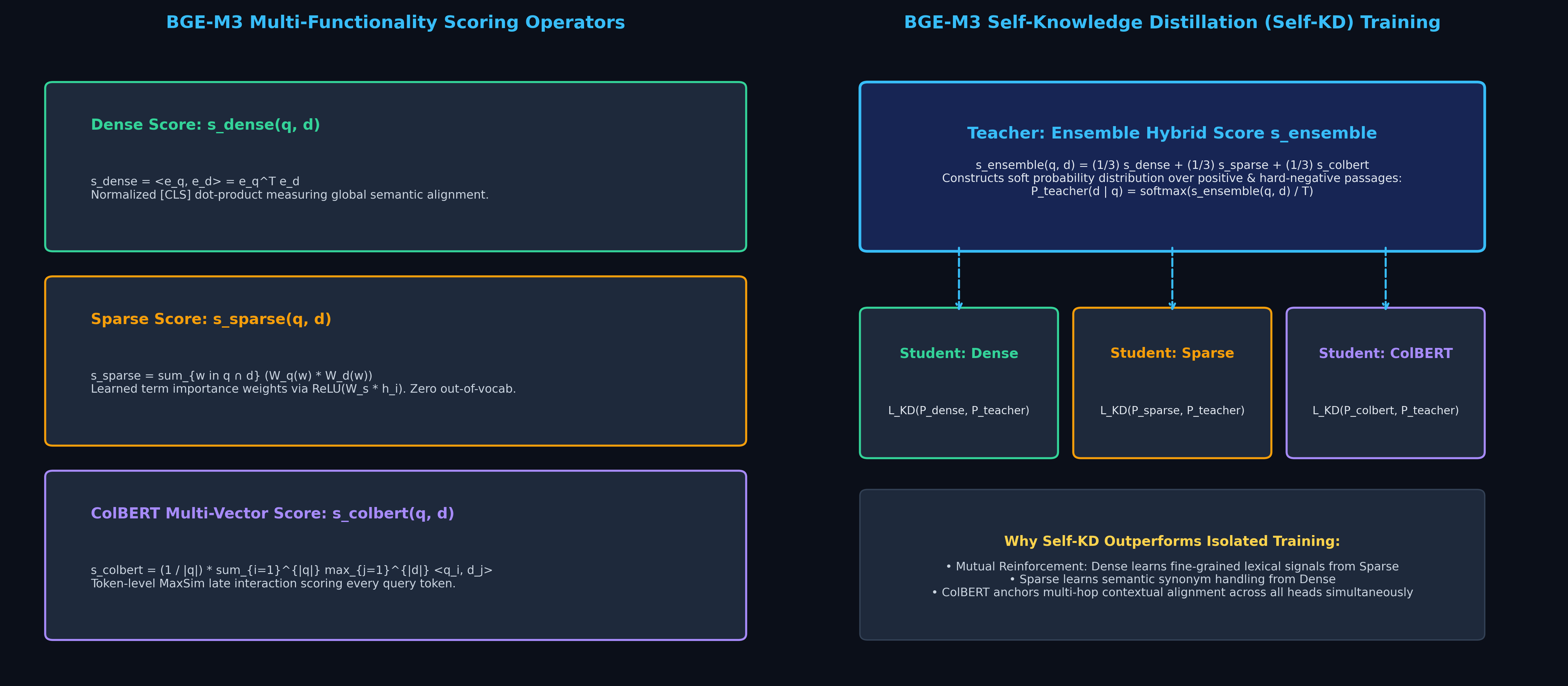
The core technical brilliance of BGE-M3 lies in how its three scoring operators complement each other during inference, and how they train collaboratively via Self-Knowledge Distillation (Self-KD).
1. The Three Scoring Operators
Consider a query $q$ and a candidate document $d$:
Dense Semantic Score: The dense score evaluates global conceptual similarity via inner product: $$s_{\text{dense}}(q, d) = \langle e_q, e_d \rangle = e_q^T e_d$$
Sparse Lexical Score: The sparse score computes the dot product of shared vocabulary term weights: $$s_{\text{sparse}}(q, d) = \sum_{w \in q \cap d} W_q(w) \cdot W_d(w)$$ If the query and document share high-importance domain terms, $s_{\text{sparse}}$ spikes, preventing lexical false negatives.
ColBERT Multi-Vector Score (MaxSim): The multi-vector score evaluates token-level alignment using the asymmetric MaxSim operator. For each query token vector, it finds the maximum cosine similarity across all document tokens, averaging these peak alignments over the query length: $$s_{\text{colbert}}(q, d) = \frac{1}{|q|} \sum_{i=1}^{|q|} \max_{j=1}^{|d|} \langle E_{q, i}, E_{d, j} \rangle$$
2. Unified Hybrid Scoring Function
During search, BGE-M3 combines the three scores via a linear interpolation:
$$s_{\text{hybrid}}(q, d) = \alpha \cdot s_{\text{dense}}(q, d) + \beta \cdot s_{\text{sparse}}(q, d) + \gamma \cdot s_{\text{colbert}}(q, d)$$
Where $\alpha, \beta, \gamma \ge 0$ and $\alpha + \beta + \gamma = 1.0$.
3. Self-Knowledge Distillation (Self-KD)
Training three disparate retrieval heads simultaneously using standard contrastive loss (InfoNCE) frequently causes optimization conflict: gradients from the dense head interfere with the sparse vocabulary projection.
BAAI solved this by introducing Self-Knowledge Distillation:
- The Ensemble Teacher: During training, an ensemble score combines all three predictions: $$s_{\text{ensemble}}(q, d) = \frac{1}{3} s_{\text{dense}} + \frac{1}{3} s_{\text{sparse}} + \frac{1}{3} s_{\text{colbert}}$$
- Soft Label Probability Distribution: The ensemble score generates a soft probability distribution over positive and hard-negative documents: $$P_{\text{teacher}}(d \mid q) = \frac{\exp(s_{\text{ensemble}}(q, d) / \tau)}{\sum_{d’ \in \mathcal{D}} \exp(s_{\text{ensemble}}(q, d’) / \tau)}$$
- Multi-Head Student Supervision: Each individual retrieval head ($m \in {\text{dense}, \text{sparse}, \text{colbert}}$) computes its own probability distribution $P_m(d \mid q)$ and minimizes the Kullback-Leibler (KL) divergence against the teacher distribution: $$\mathcal{L}{\text{KD}}^m = D{\text{KL}}\left( P_{\text{teacher}} ,|, P_m \right)$$
Through Self-KD:
- The Dense head absorbs lexical term sensitivity from the Sparse head.
- The Sparse head learns semantic synonym associations from the Dense head.
- The ColBERT head anchors fine-grained phrase alignments.
The resulting unified representations reinforce each other, outperforming models trained on any single objective in isolation.
End-to-End Implementation: Building BGE-M3 Hybrid Search with FlagEmbedding
The official FlagEmbedding library provides an optimized Python interface to execute tri-hybrid retrieval in production:
import torch
from FlagEmbedding import BGEM3FlagModel

# 1. Initialize BGE-M3 Model with FP16 precision
# use_fp16=True enables Tensor Core acceleration on modern GPUs
model = BGEM3FlagModel('BAAI/bge-m3', use_fp16=True)

queries = [
    "What is the cancellation policy for enterprise contracts?",
    "Error code ERR_SSL_PROTOCOL_ERROR on Nginx port 443"
]

documents = [
    "Enterprise customer agreements require 30 days written notice for contract termination. Pre-paid annual platform credits are non-refundable.",
    "Nginx SSL configuration error: ERR_SSL_PROTOCOL_ERROR occurs when a client attempts HTTPS handshake on an unencrypted HTTP virtual host block.",
    "Consumer subscription refunds can be requested within 14 days of initial signup through the self-service web billing portal."
]

# 2. Extract Dense, Sparse, and ColBERT Representations in a Single Forward Pass
query_embeddings = model.encode(
    queries,
    return_dense=True,
    return_sparse=True,
    return_colbert_vecs=True
)

doc_embeddings = model.encode(
    documents,
    return_dense=True,
    return_sparse=True,
    return_colbert_vecs=True
)

# 3. Compute Individual Similarity Matrices
# Dense Cosine Similarity:
dense_scores = query_embeddings['dense_vecs'] @ doc_embeddings['dense_vecs'].T

# Sparse Lexical Matching:
sparse_scores = []
for q_dict in query_embeddings['lexical_weights']:
    row = [model.compute_lexical_matching_score(q_dict, d_dict) for d_dict in doc_embeddings['lexical_weights']]
    sparse_scores.append(row)
sparse_scores = torch.tensor(sparse_scores)

# ColBERT Multi-Vector Late Interaction (MaxSim):
colbert_scores = []
for q_vecs in query_embeddings['colbert_vecs']:
    row = [model.colbert_score(q_vecs, d_vecs).item() for d_vecs in doc_embeddings['colbert_vecs']]
    colbert_scores.append(row)
colbert_scores = torch.tensor(colbert_scores)

# 4. Execute Multi-Stage Hybrid Score Fusion
# Weights: alpha=0.4 (Dense), beta=0.2 (Sparse), gamma=0.4 (ColBERT)
alpha, beta, gamma = 0.4, 0.2, 0.4
hybrid_scores = alpha * dense_scores + beta * sparse_scores + gamma * colbert_scores

print("Hybrid Search Match Scores:\n", hybrid_scores) The In-Situ Re-ranking Workflow
In large-scale production deployments with millions of documents:
- Stage 1 (Sub-5ms Candidate Retrieval): Query the vector database (e.g., Qdrant or Milvus) using Dense vector search and Sparse keyword search to retrieve the top 100 candidate document IDs.
- Stage 2 (In-Situ ColBERT Re-ranking): Fetch the cached ColBERT token vectors for only the top 100 candidate documents directly from system memory. Execute the MaxSim dot-product operation in fast CPU or GPU RAM to re-rank the candidates down to the top 5 documents.
This eliminates the need for an external cross-encoder re-ranking model entirely, saving 200ms+ of latency and cutting cloud server costs.
Empirical Benchmarks: Tri-Hybrid Retrieval vs. Single-Method Baselines
On the rigorous MIRACL (Multilingual Information Retrieval) and MLDR (Multi-Lingual Long-Document Retrieval) benchmark suites, BGE-M3 establishes state-of-the-art retrieval accuracy:
Retrieval Performance Comparison (NDCG@10 on MLDR Benchmark):
┌──────────────────────────────────────┬──────────────────────┬──────────────────────┐
│ Model & Retrieval Method             │ Context Length       │ Multi-Lingual NDCG@10│
├──────────────────────────────────────┼──────────────────────┼──────────────────────┤
│ BM25 (Traditional Sparse)            │ 8,192 Tokens         │ 48.2%                │
│ OpenAI text-embedding-3-large        │ 8,192 Tokens         │ 61.4%                │
│ BGE-Large-v1.5 (Dense Only)          │ 512 Tokens           │ 58.7%                │
│ BGE-M3 (Dense Only)                  │ 8,192 Tokens         │ 63.8%                │
│ BGE-M3 (Sparse Lexical Only)         │ 8,192 Tokens         │ 59.1%                │
│ BGE-M3 (ColBERT Multi-Vector Only)   │ 8,192 Tokens         │ 65.2%                │
│ BGE-M3 (Dense + Sparse Hybrid)       │ 8,192 Tokens         │ 66.7%                │
│ BGE-M3 (Full Tri-Hybrid: D + S + C)  │ 8,192 Tokens         │ 68.4% (SOTA)         │
└──────────────────────────────────────┴──────────────────────┴──────────────────────┘ The empirical data demonstrates that:
- Combining Dense + Sparse improves NDCG@10 by nearly 3 percentage points over dense search alone, proving that learned lexical matching successfully recovers exact entity keywords missed by continuous embeddings.
- Adding ColBERT late interaction pushes performance to 68.4%, establishing a massive 7 percentage point lead over proprietary commercial bi-encoders.
Production Best Practices: Hybrid Indexing and Vector Database Setup
Deploying BGE-M3 in enterprise production requires configuring vector databases to exploit both dense and sparse representations natively.
1. Vector Database Schema Configuration (Qdrant Example)
Modern vector databases (such as Qdrant, Milvus, and Weaviate) natively support dual dense-sparse collections:
{
  "vectors": {
    "dense": {
      "size": 1024,
      "distance": "Cosine",
      "on_disk": false
    }
  },
  "sparse_vectors": {
    "sparse": {
      "index": {
        "on_disk": true
      }
    }
  }
} - Store the 1,024-dimensional dense vectors in GPU High-Bandwidth Memory (HBM) or host RAM for rapid approximate nearest neighbor (ANN) graph traversal.
- Store the high-dimensional sparse lexical weights in memory-mapped inverted indices on fast NVMe SSD storage.
2. Dynamic Weight Tuning by Query Intent
Rather than fixing static $\alpha, \beta, \gamma$ parameters globally, enterprise RAG systems should adapt weights based on detected query characteristics:
- Entity / ID Queries: If the user query contains alphanumeric strings, SKU patterns, or code snippets, elevate the sparse weight ($\alpha = 0.2, \beta = 0.6, \gamma = 0.2$).
- Conceptual & Thematic Queries: For broad semantic inquiries, prioritize the dense embedding ($\alpha = 0.6, \beta = 0.1, \gamma = 0.3$).
- Cross-Lingual Retrieval: When the query language differs from the target documentation language, maximize dense and ColBERT weights while minimizing sparse weights ($\alpha = 0.5, \beta = 0.05, \gamma = 0.45$).
By unifying dense semantic comprehension, exact lexical matching, and token-level late interaction into a single cohesive architecture, BGE-M3 establishes the standard for production-grade retrieval in modern generative AI.