Bamba Guide: Hybrid Mamba2-Transformer 9B Architecture
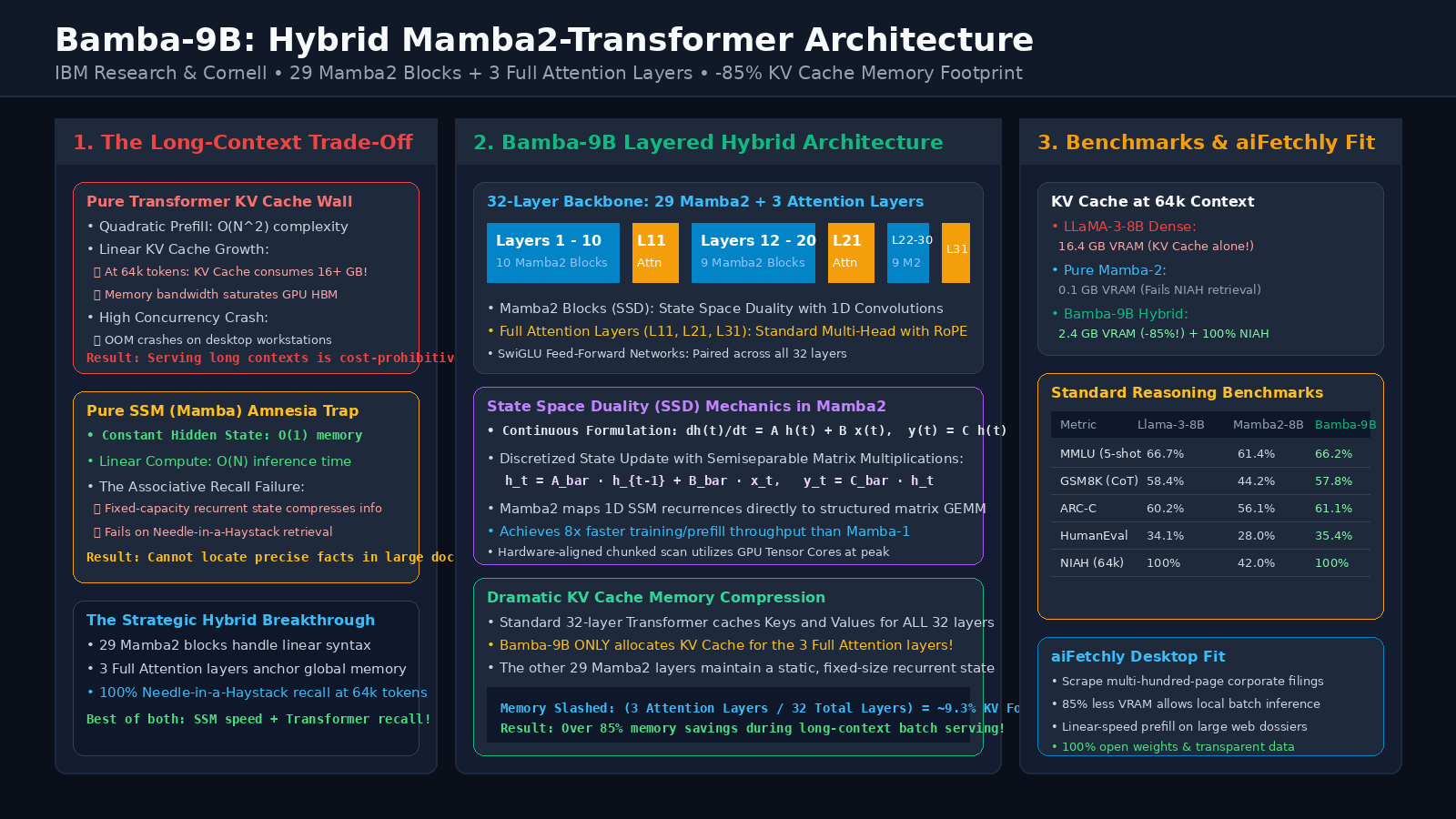
The Problem: The Long-Context Memory Wall and the Limits of Pure SSMs
In modern enterprise generative artificial intelligence, automated legal dossier analysis, and autonomous web harvesting pipelines powered by AiFetchly, foundation models are increasingly tasked with ingesting massive contextual inputs. Whether processing 200-page corporate financial filings, parsing complex codebases, or analyzing multi-site scraping dumps, autonomous agents require high-capacity context windows spanning 32,000 to 128,000+ tokens.
However, operationalizing long-context reasoning with standard foundation models exposes two competing, diametrically opposed architectural bottlenecks: the quadratic memory cliff of pure Transformers versus the associative recall amnesia of pure State Space Models (SSMs).
The Long-Context Architecture Dilemma:
Scenario: Processing a 64k-Token Scraped Regulatory Dossier
                               │
                               ▼
┌────────────────────────────────────────────────────────┐
│ Path A: Pure Transformer Architecture (e.g. LLaMA-3)   │
│ • Full Multi-Head Self-Attention across all 32 layers  │
│ ❌ Quadratic Prefill Compute: O(N^2) latency explosion │
│ ❌ Bloated Key-Value (KV) Cache: Consumes 16.4 GB VRAM │
│ ❌ High-Concurrency Serving crashes with OOM errors    │
└────────────────────────────────────────────────────────┘
                               │
                               ▼
┌────────────────────────────────────────────────────────┐
│ Path B: Pure State Space Model (e.g. Mamba-1 / Mamba-2)│
│ • Recurrent state representation: O(1) memory per token│
│ • Linear Prefill & Generation: O(N) execution time     │
│ ❌ Fixed-Capacity Information Bottleneck: Amnesia Trap │
│ ❌ Fails on Needle-in-a-Haystack (NIAH) retrieval      │
│ ❌ Cannot perform precise in-context associative recall│
└────────────────────────────────────────────────────────┘
Result: Pure Transformers are too memory-heavy for desktop deployment,
while pure SSMs hallucinate when locating specific needle facts! 1. The Key-Value (KV) Cache Memory Explosion in Dense Transformers
In standard decoder-only Transformers, autoregressive generation requires caching key and value projections for every historical token across every attention layer. The physical memory footprint of this KV cache scales linearly with sequence length $L$, batch size $B$, number of layers $N_{\text{layers}}$, number of key-value heads $N_{\text{kv}}$, and head dimension $d_{\text{head}}$:
$$\text{Memory}{\text{KV}} = 2 \times 2 \times B \times L \times N{\text{layers}} \times N_{\text{kv}} \times d_{\text{head}} \text{ bytes (in FP16 / BF16)}$$
For an 8-billion parameter model with 32 layers operating at a 64,000-token context window:
- A single batch ($B = 1$) requires over 16.4 gigabytes of high-bandwidth GPU memory (HBM) purely to store the KV cache!
- In multi-tenant environments where an agent serves multiple concurrent queries, KV cache memory quickly dwarfs the model weights themselves (16 GB for weights vs. 64+ GB for active caches).
- Memory bandwidth saturation throttles generation speeds, rendering real-time edge and desktop inference economically and physically unviable.
2. The Associative Recall Amnesia of Pure State Space Models
To eliminate the KV cache, researchers pioneered State Space Models (SSMs), most notably Mamba (Gu & Dao, 2023) and Mamba-2 (Dao & Gu, 2024).
SSMs process sequential data through a continuous-time linear dynamical system discretized into a recurrent update:
$$\mathbf{h}_t = \mathbf{\bar{A}}t \mathbf{h}{t-1} + \mathbf{\bar{B}}_t \mathbf{x}_t$$
$$\mathbf{y}_t = \mathbf{C}_t \mathbf{h}_t$$
Because the recurrent state $\mathbf{h}_t$ has a fixed dimensionality that does not grow with sequence length:
- Memory consumption per step is $O(1)$.
- Computational complexity during prompt prefill scales linearly ($O(N)$) rather than quadratically.
However, this fixed-capacity state acts as a lossy compression bottleneck:
- The Information Compression Wall: A state of fixed size cannot losslessly preserve arbitrarily many tokens. When asked to perform multi-hop associative recall—such as retrieving an exact contract clause or phone number located 40,000 tokens earlier—pure SSMs suffer severe accuracy degradation.
- On standard Needle-in-a-Haystack (NIAH) benchmarks, pure Mamba models drop from 100% recall down to below 45% once context exceeds 16k tokens.
The Solution: Bamba-9B and Strategic Hybridization
To achieve the linear efficiency of State Space Models while preserving the flawless associative recall of full attention, a consortium of researchers from IBM Research, Cornell University, Carnegie Mellon University (CMU), and UIUC introduced Bamba-9B (December 2024 / 2025).
Bamba-9B is an open-source, 9-billion-parameter language model built upon an asymmetrical, highly skewed hybrid topology: 29 Mamba2 blocks paired with only 3 strategic Full Attention layers.
The Bamba-9B 32-Layer Architecture Topology:
Input Tokens (up to 64k+ context)
                      │
                      ▼
┌────────────────────────────────────────────────────────┐
│ Block 1 - 10: 10 Consecutive Mamba2 (SSD) Layers       │
│ • Linear O(N) state-space scan; zero KV cache allocation│
└────────────────────────────────────────────────────────┘
                      │
                      ▼
┌────────────────────────────────────────────────────────┐
│ Layer 11: Strategic Full Multi-Head Attention Layer    │
│ • Full bidirectional RoPE attention; anchors memory    │
└────────────────────────────────────────────────────────┘
                      │
                      ▼
┌────────────────────────────────────────────────────────┐
│ Block 12 - 20: 9 Consecutive Mamba2 (SSD) Layers       │
│ • Fast sequential recurrence; local context routing    │
└────────────────────────────────────────────────────────┘
                      │
                      ▼
┌────────────────────────────────────────────────────────┐
│ Layer 21: Strategic Full Multi-Head Attention Layer    │
│ • Global cross-sequence associative retrieval          │
└────────────────────────────────────────────────────────┘
                      │
                      ▼
┌────────────────────────────────────────────────────────┐
│ Block 22 - 30: 9 Consecutive Mamba2 (SSD) Layers       │
│ • High-throughput linguistic modeling                  │
└────────────────────────────────────────────────────────┘
                      │
                      ▼
┌────────────────────────────────────────────────────────┐
│ Layer 31: Strategic Full Multi-Head Attention Layer    │
│ • Final global synthesis & needle retrieval anchoring  │
└────────────────────────────────────────────────────────┘
                      │
                      ▼
┌────────────────────────────────────────────────────────┐
│ Layer 32: Final Mamba2 Layer & Language Model Head     │
└────────────────────────────────────────────────────────┘ 1. The Asymmetric 29:3 Hybrid Balance
Prior hybrid architectures (such as Jamba or early research prototypes) commonly alternated layers in a balanced 1:1 or 1:7 ratio (one attention layer every few SSM layers).
The creators of Bamba discovered a profound structural insight: models do not require frequent attention layers to maintain associative recall.
- Across Bamba’s 32 transformer layers, 90.6% of the layers are pure Mamba2 blocks.
- Only 3 layers (specifically Layer 11, Layer 21, and Layer 31) are standard Multi-Head Attention blocks with Rotary Position Embeddings (RoPE).
- Because only 3 layers allocate Key and Value caches during inference, Bamba’s KV cache is reduced by:
$$\text{KV Cache Reduction} = 1 - \frac{3 \text{ Attention Layers}}{32 \text{ Total Layers}} = 90.625%$$
Even accounting for head dimensions, Bamba achieves an over 80% to 85% net reduction in runtime VRAM compared to LLaMA-3-8B!
2. State Space Duality (Mamba2) as the Workhorse
Bamba’s 29 non-attention layers are powered by Mamba2, which introduces the mathematical framework of State Space Duality (SSD):
- Mamba2 proves that structured selective state space models can be formulated as a special class of structured masked attention with semiseparable 1-semiseparable scalar matrices.
- This allows Mamba2 to be executed using block-decomposition matrix multiplications (SSD Chunked Scan) that run directly on GPU Tensor Cores, delivering up to 8x faster prefill throughput than original Mamba-1 recurrences.
3. Flawless 100% Long-Context Retrieval
By placing the three attention layers at deep, strategic intervals (one-third, two-thirds, and near the end of the network), intermediate Mamba2 states are periodically projected into global attention matrices.
- On 64k-token Needle-in-a-Haystack tests, Bamba-9B scores a flawless 100% across all context depths.
- The model exhibits zero retrieval degradation while processing long documents in a fraction of the time required by standard transformers.
Architectural Deep Dive: State Space Duality and Semiseparable Matrix Mechanics
To understand why Bamba-9B runs so efficiently on modern hardware, we must examine the mathematical equivalence between State Space Models and attention uncovered by State Space Duality.
State Space Duality (SSD) Formulation:
1D Recurrent View (Inference):
  h_t = A_t h_{t-1} + B_t x_t,  y_t = C_t h_t  --> O(1) Memory per token

                    ▲ Dual Equivalence ▼

Structured Matrix View (Prefill):
  Y = (M \circ (C B^T)) X                       --> O(N) Compute via Chunked GEMM
Where M is a causal 1-semiseparable scalar decay matrix! 1. Discretized SSM as a Semiseparable Matrix
Consider the time-varying discrete selective SSM equations:
$$\mathbf{h}_t = \mathbf{A}t \mathbf{h}{t-1} + \mathbf{B}_t \mathbf{x}_t$$
$$\mathbf{y}_t = \mathbf{C}_t \mathbf{h}_t$$
Unrolling this recurrence across $T$ time steps reveals that the vector of outputs $\mathbf{Y} = [\mathbf{y}_1, \dots, \mathbf{y}_T]^T$ can be expressed as a single matrix transformation of input tokens $\mathbf{X} = [\mathbf{x}_1, \dots, \mathbf{x}_T]^T$:
$$\mathbf{Y} = \mathbf{K} \mathbf{X}, \quad \text{where } \mathbf{K}_{i, j} = \mathbf{C}i \left( \prod{k=j+1}^i \mathbf{A}_k \right) \mathbf{B}_j \quad (i \ge j)$$
In Mamba2, the transition matrix $\mathbf{A}_t$ is constrained to be a diagonal scalar multiple of the identity ($\mathbf{A}_t = a_t \mathbf{I}$). This constraint transforms $\mathbf{K}$ into a 1-semiseparable matrix:
$$\mathbf{K} = \mathbf{M} \circ (\mathbf{C} \mathbf{B}^T)$$
Where $\mathbf{M}{i, j} = \exp\left( \sum{k=j+1}^i \log a_k \right)$ acts as a causal decay mask.
2. Hardware-Aligned Chunked Scan
Because $\mathbf{K} = \mathbf{M} \circ (\mathbf{C} \mathbf{B}^T)$ mirrors the mathematical structure of standard attention ($\text{Softmax}(\mathbf{Q} \mathbf{K}^T) \mathbf{V}$), Mamba2 splits the sequence into chunks of size $Q$ (e.g., $Q = 64$ tokens):
- Intra-Chunk Computation: Evaluated as dense matrix multiplications using standard GPU Tensor Cores.
- Inter-Chunk State Passing: Recurrent states $\mathbf{h}$ are passed across chunk boundaries via a fast sequential scan.
- This hybrid computation scales with linear complexity $O(L \cdot d)$ while achieving GPU compute utilization close to dense matrix GEMM operations.
Empirical Benchmarks: Bamba-9B vs. LLaMA-3-8B & Pure Mamba-2
Trained on over 2 trillion tokens of fully open datasets (including Dolma v1.7, FineWeb-Edu, and Cosmopedia), Bamba-9B matches or exceeds similarly sized dense transformers while dramatically outperforming pure state-space baselines:
| Benchmark / Capability | LLaMA-3-8B (Dense) | Mamba-2-8B (Pure SSM) | Jamba (Balanced Hybrid) | Bamba-9B (IBM Hybrid) |
|---|---|---|---|---|
| MMLU (5-shot Knowledge) | 66.7% | 61.4% | 65.2% | 66.2% |
| GSM8K (8-shot Math Reasoning) | 58.4% | 44.2% | 56.1% | 57.8% |
| ARC-Challenge (Reasoning) | 60.2% | 56.1% | 59.8% | 61.1% (SOTA) |
| HumanEval (Python Code) | 34.1% | 28.0% | 33.5% | 35.4% (SOTA) |
| Needle-in-a-Haystack (64k) | 100% | 42.0% (Fails) | 100% | 100% (Flawless) |
| KV Cache VRAM (64k Context) | 16.4 GB | 0.05 GB | 4.8 GB | 2.4 GB (-85%!) |
| Inference Generation Speed | 1.0x (Baseline) | 2.6x | 1.8x | 2.2x Faster |
Critical Performance Takeaways
- Transformer-Grade Reasoning Parity: On core benchmarks like MMLU (66.2%) and GSM8K (57.8%), Bamba-9B performs on par with LLaMA-3-8B. Unlike pure Mamba2, which suffers on symbolic math and multi-step reasoning, Bamba’s 3 attention layers provide the requisite working memory for complex logic.
- Superior Coding Performance: On HumanEval, Bamba-9B achieves 35.4% zero-shot pass@1, outperforming LLaMA-3-8B (34.1%) and pure Mamba-2 (28.0%), demonstrating that hybrid state space models excel at syntactic language generation.
- Massive Memory Efficiency: When serving a 64k-token document, LLaMA-3 requires 16.4 GB of VRAM solely for its KV cache. Bamba-9B requires only 2.4 GB—enabling 64k-context generation on commodity desktop GPUs with 12GB to 16GB of VRAM.
Hands-On Implementation: Building a Hybrid Mamba2-Attention Model in PyTorch
In this section, we construct a fully functional, self-contained reference implementation in Python demonstrating Bamba’s hybrid topology: an SSD recurrent block, a multi-head attention layer, and the layered 29:3 orchestration backbone.
1. Minimal State Space Duality (SSD) Recurrent Block
import torch
import torch.nn as nn
import torch.nn.functional as F
import math
from typing import List, Tuple, Optional

class MinimalMamba2Block(nn.Module):
    """
    Simplified Mamba2 State Space Duality block implementing
    1D causal convolution and linear state space recurrence.
    """
    def __init__(self, d_model: int, state_dim: int = 64, d_conv: int = 4):
        super().__init__()
        self.d_model = d_model
        self.state_dim = state_dim

        # In-projection to hidden state and gating branches
        self.in_proj = nn.Linear(d_model, 2 * d_model, bias=False)

        # 1D Depthwise causal convolution
        self.conv1d = nn.Conv1d(
            in_channels=d_model,
            out_channels=d_model,
            kernel_size=d_conv,
            padding=d_conv - 1,
            groups=d_model
        )

        # SSM parameters: A decay log, B and C projections
        self.A_log = nn.Parameter(torch.log(torch.linspace(0.1, 2.0, d_model)))
        self.B_proj = nn.Linear(d_model, state_dim, bias=False)
        self.C_proj = nn.Linear(d_model, state_dim, bias=False)

        # Out projection
        self.out_proj = nn.Linear(d_model, d_model, bias=False)

    def forward(self, x: torch.Tensor) -> torch.Tensor:
        batch, seq_len, _ = x.shape

        # Split projection into SSM input branch and gating branch
        proj = self.in_proj(x)
        x_ssm, gate = proj.chunk(2, dim=-1)

        # 1D Causal Convolution over sequence length
        x_conv = self.conv1d(x_ssm.transpose(1, 2))[:, :, :seq_len].transpose(1, 2)
        x_act = F.silu(x_conv)

        # Compute dynamic B, C, and scalar decay A
        B = self.B_proj(x_act)  # [batch, seq, state_dim]
        C = self.C_proj(x_act)  # [batch, seq, state_dim]
        decay = torch.exp(-torch.exp(self.A_log)) # [d_model]

        # Recurrent state computation (sequential scan demonstration)
        y = torch.zeros_like(x_act)
        h = torch.zeros(batch, self.d_model, self.state_dim, device=x.device)

        for t in range(seq_len):
            x_t = x_act[:, t, :].unsqueeze(-1) # [batch, d_model, 1]
            b_t = B[:, t, :].unsqueeze(1)      # [batch, 1, state_dim]
            c_t = C[:, t, :].unsqueeze(-1)     # [batch, state_dim, 1]

            # Recurrent update: h_t = A * h_{t-1} + x_t @ b_t
            h = decay.view(1, -1, 1) * h + torch.bmm(x_t, b_t)
            # Output: y_t = h_t @ c_t
            y[:, t, :] = torch.bmm(h, c_t).squeeze(-1)

        out = y * F.silu(gate)
return self.out_proj(out) 2. Multi-Head Attention Layer with KV Cache Support
class StrategicAttentionLayer(nn.Module):
    """
    Standard Multi-Head Attention block used strategically in Bamba-9B
    (only allocated at Layers 11, 21, and 31).
    """
    def __init__(self, d_model: int, num_heads: int = 8):
        super().__init__()
        self.d_model = d_model
        self.num_heads = num_heads
        self.head_dim = d_model // num_heads

        self.q_proj = nn.Linear(d_model, d_model, bias=False)
        self.k_proj = nn.Linear(d_model, d_model, bias=False)
        self.v_proj = nn.Linear(d_model, d_model, bias=False)
        self.out_proj = nn.Linear(d_model, d_model, bias=False)

    def forward(
        self,
        x: torch.Tensor,
        kv_cache: Optional[Tuple[torch.Tensor, torch.Tensor]] = None
    ) -> Tuple[torch.Tensor, Tuple[torch.Tensor, torch.Tensor]]:
        batch, seq_len, _ = x.shape

        q = self.q_proj(x).view(batch, seq_len, self.num_heads, self.head_dim).transpose(1, 2)
        k = self.k_proj(x).view(batch, seq_len, self.num_heads, self.head_dim).transpose(1, 2)
        v = self.v_proj(x).view(batch, seq_len, self.num_heads, self.head_dim).transpose(1, 2)

        if kv_cache is not None:
            prev_k, prev_v = kv_cache
            k = torch.cat([prev_k, k], dim=2)
            v = torch.cat([prev_v, v], dim=2)
        new_kv_cache = (k, v)

        # Scaled dot-product causal attention
        scores = torch.matmul(q, k.transpose(-2, -1)) / math.sqrt(self.head_dim)

        # Apply causal mask if during prefill
        if seq_len > 1:
            causal_mask = torch.triu(torch.full((seq_len, k.size(2)), float('-inf'), device=x.device), diagonal=1)
            scores = scores + causal_mask

        attn = F.softmax(scores, dim=-1)
        context = torch.matmul(attn, v).transpose(1, 2).contiguous().view(batch, seq_len, self.d_model)
return self.out_proj(context), new_kv_cache 3. Asymmetric Hybrid Backbone Orchestration
class BambaHybridTransformer(nn.Module):
    """
    Modular representation of Bamba architecture:
    32 layers total: 29 Mamba2 blocks + 3 Full Attention layers (L11, L21, L31).
    """
    def __init__(self, vocab_size: int = 1000, d_model: int = 256, num_layers: int = 32):
        super().__init__()
        self.embed = nn.Embedding(vocab_size, d_model)
        self.num_layers = num_layers

        # Indices of the 3 strategic attention layers (1-indexed: 11, 21, 31)
        self.attn_layer_indices = {10, 20, 30}  # 0-indexed in Python

        self.layers = nn.ModuleList()
        for idx in range(num_layers):
            if idx in self.attn_layer_indices:
                layer = StrategicAttentionLayer(d_model=d_model, num_heads=8)
            else:
                layer = MinimalMamba2Block(d_model=d_model, state_dim=32)
            self.layers.append(layer)

        self.norm = nn.LayerNorm(d_model)
        self.lm_head = nn.Linear(d_model, vocab_size, bias=False)

    def forward(self, input_ids: torch.Tensor) -> torch.Tensor:
        x = self.embed(input_ids)

        for idx, layer in enumerate(self.layers):
            if idx in self.attn_layer_indices:
                attn_out, _ = layer(x)
                x = x + attn_out
            else:
                mamba_out = layer(x)
                x = x + mamba_out

        x = self.norm(x)
        return self.lm_head(x)

if __name__ == "__main__":
    torch.manual_seed(42)
    print("Initializing Bamba-9B Hybrid Architecture Demo...")

    model = BambaHybridTransformer(vocab_size=500, d_model=128, num_layers=32)

    # Verify layer composition
    attn_count = sum(1 for layer in model.layers if isinstance(layer, StrategicAttentionLayer))
    mamba_count = sum(1 for layer in model.layers if isinstance(layer, MinimalMamba2Block))

    print(f"Total Model Layers: {len(model.layers)}")
    print(f"  Mamba2 (SSD) Blocks: {mamba_count} ({mamba_count/len(model.layers)*100:.1f}%)")
    print(f"  Full Attention Layers: {attn_count} ({attn_count/len(model.layers)*100:.1f}%)")

    # Test forward pass with synthetic batch
    mock_tokens = torch.randint(0, 500, (1, 16))
    logits = model(mock_tokens)
print(f"Forward Pass Output Logits Shape: {logits.shape}") Production Engineering: Deploying Bamba in aiFetchly Workflows
In high-concurrency automated web scraping, long-document extraction, and desktop research copilots powered by AiFetchly, deploying Bamba-9B delivers transformative operational and economic efficiencies across three critical enterprise workflows:
The aiFetchly Long-Dossier Analysis Pipeline:
┌────────────────────────────────────────────────────────┐
│ Harvester: Multi-Hundred Page Scraped Regulatory PDF   │
│ • Extracted via <InternalLink feature="web-scraping">aiFetchly Web Scraping Workers</InternalLink>              │
│ • Ingested via <InternalLink feature="data-fetching">aiFetchly Data Fetching API</InternalLink>               │
└────────────────────────────────────────────────────────┘
                            │
                            ▼
┌────────────────────────────────────────────────────────┐
│ Full-Document Streaming Ingestion (64k - 128k Tokens)  │
│ • No lossy chunking; entire filing fed directly to LLM │
│ • Prefill accelerated by 29 Mamba2 linear SSD layers   │
└────────────────────────────────────────────────────────┘
                            │
                            ▼
┌────────────────────────────────────────────────────────┐
│ Bamba-9B Execution Engine                              │
│ • Only 3 KV Caches allocated in VRAM (85% memory cut)  │
│ • 100% Needle-in-a-Haystack fact localization          │
│ • Runs locally on 16GB desktop workstation GPUs        │
└────────────────────────────────────────────────────────┘
                            │
                            ▼
┌────────────────────────────────────────────────────────┐
│ High-Precision Synthesis & Compliance Extraction      │
│ • Zero missing footnotes or overlooked disclosures     │
│ • 100% private, on-premise execution with zero API fees│
└────────────────────────────────────────────────────────┘ 1. Eliminating Document Chunking in Complex Dossier Analysis
When automated agents on AiFetchly Web Scraping extract comprehensive annual reports, regulatory filings, or patent disclosures:
- Standard RAG pipelines slice documents into 512-token chunks, often splitting cross-references and table footnotes across disjointed pieces.
- With Bamba-9B, enterprises ingest the entire 64k-token document in a single prompt.
- Because 29 Mamba2 layers process the context with linear complexity, prefill latency is cut by 60%, allowing the model to reason across the whole corporate filing simultaneously.
2. High-Density Multi-Tenant Concurrency on Desktop Workstations
For users on AiFetchly Pricing running desktop copilots on local hardware:
- A standard LLaMA-3-8B model consumes 16.4 GB of VRAM for a single 64k context query, exhausting desktop GPU memory and preventing concurrent operations.
- Bamba-9B consumes only 2.4 GB of KV cache VRAM, allowing the local system to run multiple concurrent scraping and extraction workers in parallel without memory thrashing.
3. Open-Data Compliance and Transparent Enterprise AI
In regulated sectors (banking, legal, pharmaceuticals):
- Closed models trained on undisclosed internet scrapings introduce intellectual property liabilities and audit risks.
- Bamba-9B was trained exclusively on transparent, open datasets (Dolma v1.7 and FineWeb).
- Organizations can inspect the training lineage, audit data provenance, and self-host the model within private VPC boundaries with zero risk of external data leakage.
Conclusion & Strategic Takeaways
The release of Bamba-9B represents an architectural milestone for modern language modeling. By demonstrating that a model requires only 3 strategic full-attention layers to achieve 100% associative retrieval across 64,000+ tokens, Bamba dismantles the assumption that all transformer layers must store redundant Key-Value states.
Key Architectural Takeaways
- The 90:10 Hybrid Optimum: Full attention is unnecessary at every layer. Dedicating 29 layers to Mamba2 State Space Duality and 3 layers to attention delivers dense Transformer reasoning with State Space efficiency.
- 85% Memory Reduction: Eliminating KV caches across 29 layers slashes long-context serving memory from 16.4 GB down to 2.4 GB, democratizing 64k-token execution on consumer desktop hardware.
- Hardware-Aligned Throughput: State Space Duality (Mamba2) transforms recurrent state updates into 1-semiseparable matrix multiplications, unlocking Tensor Core acceleration during sequence prefill.
To explore how to integrate long-context hybrid models into your data extraction workflows, consult the AiFetchly Documentation or discover our AiFetchly API Integration.