AWS Trainium2 Guide: NeuronCore-v2 & UltraCluster AI
The Trillion-Parameter Training Bottleneck and GPU Economics
In modern frontier artificial intelligence research, high-throughput model pre-training, and enterprise autonomous agent systems powered by AI Fetchly, computational infrastructure is bound by severe scaling and financial constraints. Whether orchestrating long-horizon reinforcement learning loops, executing continuous document extraction pipelines with automated web scraping, or processing massive enterprise telemetry streams via real-time data ingestion, scaling foundation models beyond 100 billion parameters requires unprecedented computing power.
Training state-of-the-art multimodal foundation models—such as Anthropic’s Claude series, Meta’s LLaMA-3, and Databricks DBRX—requires tens of thousands of accelerator chips running tightly coupled distributed matrix operations for months continuously. However, relying exclusively on conventional commercial graphics hardware has introduced four structural crises into modern datacenter operations:
1. Astronomical Capital Expenditures and the Cloud GPU Premium
The market dominance of proprietary GPU architectures has driven datacenter capital expenditures to unsustainable heights:
- A cluster of 16,000 to 32,000 cutting-edge GPUs represents an initial hardware investment exceeding $500 million to $1 billion when factoring in server nodes, optical networking switches, and power delivery infrastructure.
- Rental pricing on major cloud providers frequently exceeds $3.50 to $4.50 per GPU-hour. For a multi-month pre-training run requiring 50 million accelerator-hours, compute costs alone surpass $150 million.
- Hyper-scalers face strict allocation rationing, forcing foundation model startups and enterprise engineering teams to negotiate multi-year minimum spend commitments to secure hardware access.
Datacenter AI Training Bottlenecks: GPUs vs. Custom Silicon
+------------------------------------------------------------------------------------+
| CONVENTIONAL GPU CLUSTER (NVIDIA H100 / B200 HGX)                                  |
+------------------------------------------------------------------------------------+
| [Dual x86 Host CPUs] <---> [PCIe Switch] <---> [8x GPUs] <---> [RoCE/InfiniBand NIC]|
| - Up to $40k per board; steep cloud rental premiums                                |
| - High instruction scheduling overhead and complex proprietary runtime drivers    |
| - Layered networking hops: GPU -> PCIe -> NIC -> Leaf Switch -> Spine Switch       |
+------------------------------------------------------------------------------------+
| AWS TRAINIUM2 ULTRASERVER & ULTRACLUSTER ARCHITECTURE                              |
+------------------------------------------------------------------------------------+
| [Annapurna Labs 64x Trn2 Chips] <====== Non-Blocking NeuronLink-v2 (All-to-All) ===>|
| - Custom co-designed ASIC: 4x compute increase and 3x memory capacity (96GB HBM3e) |
| - 64 chips tightly coupled in a single physical UltraServer chassis without switches|
| - Scales to 100,000+ chips (65 ExaFLOPS) in Project Rainier at up to 50% lower cost|
+------------------------------------------------------------------------------------+ 2. The Inter-Node Communication Latency Penalty
As model parameters scale past hundreds of billions of weights, models exceed the physical memory capacity of any individual server node. Workloads must be sharded across thousands of chips using a combination of 3D Parallelism: Tensor Parallelism (TP), Pipeline Parallelism (PP), and Data Parallelism with Fully Sharded Data Parallel (FSDP / ZeRO-3).
When scaling across conventional server chassis:
- Inter-node communications must travel through PCIe switches, host network interface cards (NICs), optical transceivers, and multi-tier spine-leaf Ethernet or InfiniBand networks.
- The physical latency of crossing multiple network switch stages introduces microsecond-level synchronization barriers during gradient all-reduce and activation forward passes.
- Even minor network jitter or packet loss on a single worker node stalls the entire 100,000-chip cluster, leading to significant hardware underutilization and wasted megawatts of power.
3. Rigid Accelerator Hardware Architectures
Traditional GPUs are designed around fixed hardware streaming multiprocessors (SMs) optimized primarily for dense matrix multiplications:
- They struggle with non-standard numerical transformations, custom tokenization operators, and dynamic control-flow pipelines.
- Developers attempting to write custom fused kernels often hit compiler limitations in proprietary proprietary toolchains, requiring deep assembly-level hacking.
- Modern workloads require hybrid computing engines: dense systolic matrix units paired with high-speed vector engines and flexible, programmable SIMD units capable of running arbitrary C++ code directly adjacent to high-bandwidth memory.
The Annapurna Labs Innovation: AWS Trainium2
To achieve total infrastructure self-sufficiency and slash the cost of foundation model pre-training, Amazon Web Services—through its semiconductor division Annapurna Labs—engineered AWS Trainium2.
Annapurna Labs (originally founded in Israel and acquired by Amazon in 2015) previously developed the Graviton CPU series, Nitro security architectures, and first-generation Inferentia and Trainium chips. With Trainium2, Annapurna Labs delivered a purpose-built AI supercomputing engine designed from the silicon die level to out-compete commercial GPUs on performance, power efficiency, and cluster scale.
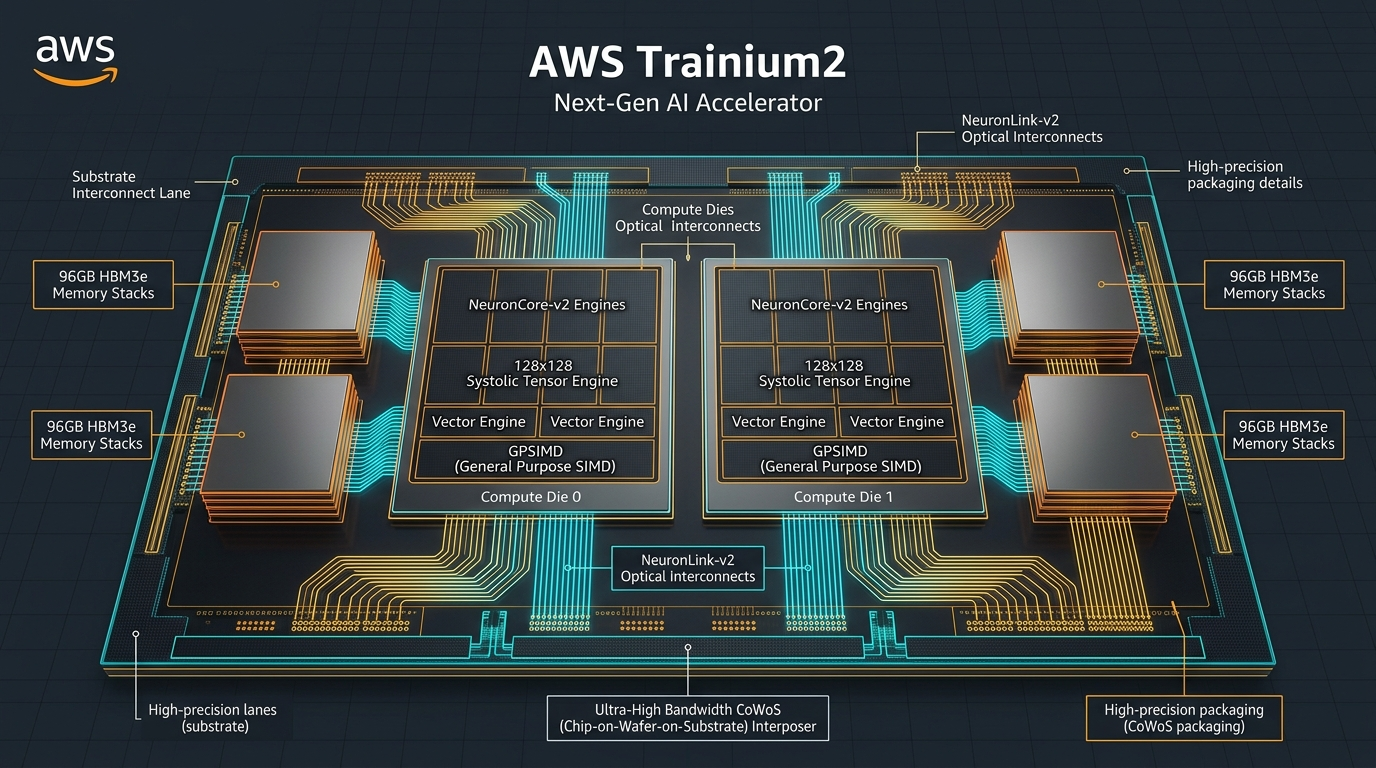
AWS Trainium2 Silicon & Package Architecture:
+------------------------------------------------------------------------------------+
| AWS TRAINIUM2 ACCELERATOR PACKAGE (TSMC Advanced Packaging)                        |
+------------------------------------------------------------------------------------+
|                                                                                    |
|  +-------------------------------------+  +-------------------------------------+  |
|  | COMPUTE CHIPLET 0                   |  | COMPUTE CHIPLET 1                   |  |
|  | - NeuronCore-v2 Engine 0            |  | - NeuronCore-v2 Engine 1            |  |
|  | - 128x128 Systolic Tensor Engine    |  | - 128x128 Systolic Tensor Engine    |  |
|  | - Vector SIMD & Scalar Engines      |  | - Vector SIMD & Scalar Engines      |  |
|  | - GPSIMD (General-Purpose SIMD)     |  | - GPSIMD (General-Purpose SIMD)     |  |
|  +-------------------------------------+  +-------------------------------------+  |
|                   ||                                         ||                    |
|  ================================================================================  |
|  TSMC CoWoS High-Density Silicon Interposer (Ultra-Low Latency Die-to-Die Fabric)  |
|  ================================================================================  |
|                   ||                                         ||                    |
|  +-------------------------------------+  +-------------------------------------+  |
|  | FOUR STACKS OF HIGH-BANDWIDTH MEMORY (HBM3e) - 96 GB TOTAL CAPACITY             |  |
|  | - 2.8+ TB/s Sustained Local Memory Bandwidth Across 4,096-bit Bus                |  |
|  +---------------------------------------------------------------------------------+  |
|                                                                                    |
|  +------------------------------------------------------------------------------+  |
|  | DEDICATED NEURONLINK-v2 INTERCONNECT CONTROLLERS                             |  |
|  | - Direct chip-to-chip optical interconnect; non-blocking all-to-all fabric    |  |
|  +------------------------------------------------------------------------------+  |
+------------------------------------------------------------------------------------+ 1. 4x Compute Density and 3x Memory Scaling
Trainium2 represents a massive generational leap over the first-generation Trainium accelerator:
- 4x Compute Throughput: Delivers up to 1,300 TFLOPS of FP16/BF16 tensor compute and over 2.6 PFLOPS of FP8 compute per chip, quadrupling the raw floating-point performance of Trainium1.
- 96 GB HBM3e Memory: Triples the high-bandwidth memory capacity from 32 GB on Trainium1 to 96 GB of HBM3e per accelerator.
- 2.8+ TB/s Memory Bandwidth: Employs four high-speed HBM3e memory stacks, feeding activation tensors and model weights into the computing engines with minimal memory wait states.
- Advanced Multi-Chiplet Packaging: Integrates two compute chiplets and four HBM3e stacks on a high-density TSMC Chip-on-Wafer-on-Substrate (CoWoS) interposer, maximizing silicon yield while providing massive compute density.
2. NeuronLink-v2: From 16-Chip Nodes to 64-Chip UltraServers
Interconnect architecture is where Annapurna Labs broke traditional datacenter boundaries:
- NeuronLink-v2: Doubles point-to-point inter-chip communication bandwidth over the previous generation, providing high-bandwidth, direct non-blocking links between accelerators.
- The 64-Chip Trn2 UltraServer: While standard EC2 Trn2 instances feature 16 Trainium2 chips (1.5 TB HBM3e), AWS engineered the Trn2 UltraServer—a dense supercomputing chassis that integrates 64 Trainium2 chips into a single unified compute node.
- 6.1 TB of High-Bandwidth Memory: A single UltraServer pools 6.1 Terabytes of HBM3e memory interconnected by non-blocking NeuronLink-v2. This allows hosting massive models like LLaMA-3.1-405B across a single server chassis with ultra-low communication latency.
3. Project Rainier and 100,000-Chip UltraClusters
For frontier AI labs like Anthropic, AWS deploys Trainium2 at planetary scale:
- EC2 UltraClusters (Project Rainier): Clusters up to 100,000+ Trainium2 chips interconnected via an ultra-low-latency, non-blocking optical network topology.
- 65 ExaFLOPS of Aggregate Compute: Project Rainier delivers up to 65 exaflops of AI compute, providing Anthropic and Amazon Bedrock with five times more training compute capacity than prior GPU clusters. Furthermore, by engineering a unified optical fabric that scales from a single board to over 100,000 accelerators, AWS ensures that distributed model training achieves near-linear scaling efficiency, minimizing the pipeline communication bubbles that traditionally plague large-scale cluster deployments. This unified infrastructure allows engineering teams to train trillion-parameter models with predictable execution schedules and guaranteed convergence.
- 50% Cost Reduction: Trainium2 delivers up to a 40% to 50% reduction in training costs compared to equivalent commercial GPU instances, dramatically altering the financial economics of training next-generation frontier intelligence.
Deep Dive: The NeuronCore-v2 Microarchitecture
To understand how Trainium2 achieves its extraordinary training throughput and efficiency, we examine the internal microarchitecture of the NeuronCore-v2 computing engine.
1. The Four Specialized Computational Engines
Inside each compute chiplet on a Trainium2 accelerator sits the NeuronCore-v2. Unlike monolithic GPUs that rely on homogeneous vector ALUs, NeuronCore-v2 partitions its execution pipeline into four specialized hardware engines:
NeuronCore-v2 Microarchitecture Schematic:
+------------------------------------------------------------------------------------+
| NEURONCORE-v2 EXECUTION PIPELINE                                                   |
+------------------------------------------------------------------------------------+
|                                                                                    |
|   +----------------------------------------------------------------------------+   |
|   | 24 MB On-Chip High-Bandwidth SRAM Scratchpad Memory                        |   |
|   +----------------------------------------------------------------------------+   |
|                                        |                                           |
|   +------------------------------------+---------------------------------------+   |
|   | 1. TENSOR ENGINE                   | 2. VECTOR ENGINE                      |   |
|   | - 128x128 Systolic Array           | - 512-bit SIMD Vector Execution       |   |
|   | - Dense Matrix Multiplication      | - LayerNorm, RMSNorm, Softmax         |   |
|   | - FP8, BF16, FP16, TF32, INT8      | - Rotary Embeddings (RoPE), SwiGLU    |   |
|   +------------------------------------+---------------------------------------+   |
|                                        |                                           |
|   +------------------------------------+---------------------------------------+   |
|   | 3. SCALAR ENGINE                   | 4. GPSIMD ENGINE                      |   |
|   | - Dynamic Memory Address Generator | - General-Purpose SIMD Processor      |   |
|   | - Control Flow & Loop Counters     | - Direct C++ & Custom Kernel Execution|   |
|   | - DMA Transfer Scheduling          | - Non-standard Mathematical Ops       |   |
|   +------------------------------------+---------------------------------------+   |
|                                        |                                           |
|   +----------------------------------------------------------------------------+   |
|   | DMA & ASYNCHRONOUS DATA ROUTER (Direct Memory Interface to HBM3e)          |   |
|   +----------------------------------------------------------------------------+   |
|                                                                                    |
+------------------------------------------------------------------------------------+ - 1. Tensor Engine: The heavy arithmetic workhorse of the core. Built around a 128x128 systolic array, the Tensor Engine computes dense matrix multiplications and convolutions. It natively supports BFLOAT16, FP16, FP8 (E4M3 and E5M2 formats), TF32, and INT8. In FP8 precision with structured sparsity, the Tensor Engine delivers multi-petaflop throughput.
- 2. Vector Engine: A wide 512-bit SIMD vector processor optimized for non-GEMM mathematical operations: activation functions (GELU, SwiGLU, SiLU), normalization layers (LayerNorm, RMSNorm), softmax reductions, and element-wise additions. By offloading vector operations from the Tensor Engine, both engines execute concurrently without stalling.
- 3. Scalar Engine: Manages instruction sequencing, program counters, loop bounds, and hardware DMA memory transfers between local SRAM and off-chip HBM3e.
- 4. GPSIMD Engine (General-Purpose SIMD): A fully programmable SIMD processor that allows developers to run arbitrary C++ and custom low-level kernels directly on the accelerator. If an emerging model introduces an exotic activation function or novel routing mechanism not natively mapped in hardware, the GPSIMD engine executes it without host CPU intervention.
2. Supported Data Precision Formats & Mathematical Throughput
NeuronCore-v2 provides comprehensive precision support across both training and inference stages:
| Data Precision Format | Arithmetic Engine | Theoretical Peak per Chip | Primary Workload Focus |
|---|---|---|---|
| FP8 (E4M3 & E5M2) | Tensor Engine (Systolic) | Up to 2,600 TFLOPS (2.6 PFLOPS) | Frontier LLM Pre-training & Ultra-Fast Serving |
| BFLOAT16 / FP16 | Tensor Engine (Systolic) | Up to 1,300 TFLOPS (1.3 PFLOPS) | Standard Foundation Model Training & Tuning |
| TensorFloat-32 (TF32) | Tensor Engine (Systolic) | 650 TFLOPS | High-Precision Deep Learning Without Code Changes |
| INT8 Integer | Tensor Engine & Vector | 2,600 TOPS | Quantized Quantization & Production Inference |
| FP32 Vector | Vector Engine | 160 TFLOPS | LayerNorm, Softmax, RoPE Positional Encoding |
3. Asynchronous Memory Prefetching and Shared SRAM
Each NeuronCore-v2 integrates 24 MB of ultra-fast on-chip SRAM scratchpad memory:
- The core does not rely on transparent hardware cache eviction policies, which can cause unpredictable cache misses. Instead, the AWS Neuron compiler explicitly schedules tensor memory transfers into SRAM.
- DMA Double-Buffering: While the Tensor Engine executes matrix math on Data Block A inside SRAM, the DMA engine independently prefetches Data Block B from HBM3e over the 2.8 TB/s memory bus.
- This explicit asynchronous pipelining achieves greater than 90% arithmetic duty cycle saturation on the systolic arrays during sustained GEMM phases.
4. The GPSIMD Engine: Arbitrary C++ and Exotic Kernel Execution
One of the most consequential architectural innovations in NeuronCore-v2 is the General-Purpose SIMD (GPSIMD) Engine. In conventional GPU and TPU accelerators, developers are strictly constrained by the hardwired instruction sets of vector and matrix execution pipelines. When emerging research introduces non-standard mathematical primitives—such as custom non-linear gating, exotic sparse attention masks, or bespoke dynamic quantization scales—standard accelerators must either fall back to slow host CPU offloading or endure massive execution penalties.
The GPSIMD Engine solves this architectural rigidity:
- Fully Programmable C++ Processing Core: Each NeuronCore-v2 includes a dedicated 512-bit wide SIMD processor with its own instruction decoder and register space capable of executing arbitrary C++ code directly adjacent to high-bandwidth memory.
- Direct Scratchpad SRAM Access: The GPSIMD unit shares high-bandwidth interconnects with the on-chip 24 MB SRAM scratchpad, allowing it to manipulate intermediate activations in place without writing data back to off-chip HBM3e.
- Fused Post-Processing and Sampling: During autoregressive decoding, GPSIMD engines execute temperature scaling, top-p/top-k filtering, and speculative verification checks concurrently with the next token’s matrix prefetch, completely masking sampling overhead.
Software Ecosystem: PyTorch NeuronX, NKI, and vLLM Serving
AWS pairs Trainium2 hardware with the AWS Neuron SDK, an enterprise-grade software stack licensed under open-source and permissive terms.
The AWS Neuron SDK Hierarchy:
+-----------------------------------------------------------------------------------+
| FRAMEWORKS: PyTorch, Hugging Face Transformers, vLLM, JAX, Ray Train              |
+-----------------------------------------------------------------------------------+
                                         |
+-----------------------------------------------------------------------------------+
| PYTORCH NEURONX (`torch-neuronx`): XLA-Based Deep Learning Compiler Runtime       |
| - Automatic graph tracing, memory layout scheduling, and collective communication |
+-----------------------------------------------------------------------------------+
                                         |
+-----------------------------------------------------------------------------------+
| NEURON KERNEL INTERFACE (NKI): Bare-Metal Python Kernel Authoring (Like Triton)   |
| - Direct hardware control of Tensor Engine tiles, Vector units, and SRAM buffers  |
+-----------------------------------------------------------------------------------+
                                         |
+-----------------------------------------------------------------------------------+
| HARDWARE LAYER: AWS Trainium2 (NeuronCore-v2) & NeuronLink-v2 Fabric              |
+-----------------------------------------------------------------------------------+ 1. Custom Kernel Authoring with the Neuron Kernel Interface (NKI)
Similar to OpenAI’s Triton on CUDA, AWS provides the Neuron Kernel Interface (NKI)—a Python-based domain-specific language that allows kernel engineers to write bare-metal hardware kernels directly targeting NeuronCore-v2 execution units:
# ============================================================================
# File: nki_fused_rmsnorm.py
# Description: Custom Fused RMSNorm Kernel on AWS Trainium2 using NKI
# ============================================================================

import neuronxcc.nki as nki
import neuronxcc.nki.language as nl
import neuronxcc.nki.isa as nisa

@nki.jit
def nki_rmsnorm_kernel(input_tensor, weight_tensor, output_tensor, eps=1e-6):
    '''
    Fused Root Mean Square Normalization (RMSNorm) implemented in NKI.
    Executes directly across NeuronCore-v2 Vector Engine and SRAM tiles.
    '''
    batch_size, hidden_dim = input_tensor.shape

    # 1. Allocate on-chip SRAM tile buffers
    # Tile size aligns with NeuronCore-v2 128-element SIMD vector lanes
    TILE_SIZE = 128
    num_tiles = hidden_dim // TILE_SIZE

    for b in nl.affine_range(batch_size):
        # Accumulator for sum of squares
        sum_sq = nl.zeros((1,), dtype=nl.float32, buffer=nl.sram)

        # Step A: Load input tiles and compute sum of squares in SRAM
        for t in nl.affine_range(num_tiles):
            x_tile = nl.load(input_tensor[b, t * TILE_SIZE : (t + 1) * TILE_SIZE])
            x_sq = nl.multiply(x_tile, x_tile)
            sum_sq += nl.sum(x_sq)

        # Step B: Compute RMS scaling factor: rsqrt(mean(x^2) + eps)
        mean_sq = sum_sq / hidden_dim
        inv_rms = nl.rsqrt(mean_sq + eps)

        # Step C: Normalize input tiles and multiply by learned weights
        for t in nl.affine_range(num_tiles):
            x_tile = nl.load(input_tensor[b, t * TILE_SIZE : (t + 1) * TILE_SIZE])
            w_tile = nl.load(weight_tensor[t * TILE_SIZE : (t + 1) * TILE_SIZE])

            norm_tile = nl.multiply(x_tile, inv_rms)
            out_tile = nl.multiply(norm_tile, w_tile)

            # Store normalized result directly back to HBM3e
nl.store(output_tensor[b, t * TILE_SIZE : (t + 1) * TILE_SIZE], out_tile) 2. Distributed Training with PyTorch NeuronX (torch-neuronx)
Training distributed foundation models on AWS Trainium2 utilizes native PyTorch syntax with torch_neuronx, enabling Megatron-LM and FSDP distributed parallelism:
# ============================================================================
# File: train_llama_neuronx.py
# Description: Distributed Foundation Model Training on AWS EC2 Trn2 Instances
# ============================================================================

import os
import torch
import torch.nn as nn
import torch.distributed as dist
import torch_xla.core.xla_model as xm
import torch_xla.distributed.xla_backend

def setup_distributed_neuron():
    # 1. Initialize PyTorch XLA device for Trainium2
    device = xm.xla_device()
    world_size = xm.xrt_world_size()
    rank = xm.get_ordinal()
    print(f"[Rank {rank}/{world_size}] Initialized Trainium2 on device: {device}")

    # 2. Build Model Architecture
    model = nn.Sequential(
        nn.Linear(8192, 16384, bias=False),
        nn.SiLU(),
        nn.Linear(16384, 8192, bias=False)
    ).to(device)

    # 3. Configure Optimizer
    optimizer = torch.optim.AdamW(model.parameters(), lr=1e-4)
    loss_fn = nn.CrossEntropyLoss()

    # 4. Training Step with NeuronLink-v2 Gradient Synchronization
    for step in range(10):
        optimizer.zero_grad()

        # Synthetic batch simulating continuous data ingestion
        dummy_inputs = torch.randn(32, 8192, device=device, dtype=torch.bfloat16)
        dummy_targets = torch.randint(0, 8192, (32,), device=device)

        outputs = model(dummy_inputs)
        loss = loss_fn(outputs, dummy_targets)
        loss.backward()

        # xm.optimizer_step triggers XLA whole-graph compilation
        # and executes non-blocking all-reduce over NeuronLink-v2
        xm.optimizer_step(optimizer)

        if rank == 0:
            print(f"Step {step + 1} Complete | Loss: {loss.item():.4f}")

if __name__ == "__main__":
setup_distributed_neuron() 3. Production Foundation Model Serving with vLLM on Trainium2
AWS and the vLLM project provide native integration for serving LLMs on Trainium2 using vLLM Neuron:
# ============================================================================
# Script: serve_vllm_neuron.sh
# Description: Launch vLLM OpenAI-Compatible Serving Engine on EC2 Trn2
# ============================================================================

# Install AWS Neuron SDK and vLLM Neuron Plugin
pip install torch-neuronx torchvision --extra-index-url=https://pip.repos.neuron.amazonaws.com
pip install vllm-neuron

# Configure Neuron Runtime Environment Variables
export NEURON_RT_NUM_CORES=32
export NEURON_CC_FLAGS="--model-type=transformer"
export VLLM_ENGINE_ITERATION_TIMEOUT_S=120

# Launch vLLM Server hosting LLaMA-3.1-70B on 16 Trainium2 Chips
python3 -m vllm.entrypoints.openai.api_server --model meta-llama/Llama-3.1-70B-Instruct --host 0.0.0.0 --port 8000 --tensor-parallel-size 8 --pipeline-parallel-size 2 --max-model-len 16384 --dtype bfloat16 --block-size 32 Architectural Comparison: AWS Trainium2 vs. NVIDIA H100 SXM5 & Google TPU v6e
To provide enterprise system architects with comprehensive data for cloud infrastructure procurement, we evaluate AWS Trainium2 against leading competitors:
+----------------------------------------------------------------------------------------------------+
| ACCELERATOR HARDWARE ARCHITECTURE COMPARISON (SINGLE ACCELERATOR DIE / BOARD)                      |
+----------------------------------------------------------------------------------------------------+
| Architectural Dimension       | NVIDIA H100 SXM5       | Google TPU v6e (Trillium) | AWS Trainium2 (Trn2)   |
+-------------------------------+------------------------+--------------------------+------------------------+
| Developer / Designer          | NVIDIA Corporation     | Google Cloud             | Annapurna Labs (AWS)   |
| Primary Compute Engine        | 132 SMs (528 TensorC)  | 256x256 Systolic MXU     | 2x NeuronCore-v2 Units |
| Dense FP16 / BF16 Compute     | 989.5 TFLOPS           | ~918 TFLOPS              | ~1,300 TFLOPS          |
| Dense FP8 Matrix Compute      | 1,979 TFLOPS           | ~1,836 TFLOPS            | ~2,600 TFLOPS          |
| High-Bandwidth Memory (HBM)   | 80 GB HBM3             | 32 GB HBM                | 96 GB HBM3e            |
| Peak Memory Bandwidth         | 3.35 TB/s              | 1.64 TB/s                | 2.8+ TB/s              |
| Interconnect Protocol         | NVLink 4 (900 GB/s)    | ICI (3,200 Gbps / 400GB) | NeuronLink-v2 (Non-Blk)|
| High-Density Server Chassis   | 8-GPU HGX (640 GB HBM) | 4-Chip VM / 256-Chip Pod | 64-Chip UltraServer    |
| Maximum Pod / Cluster Scaling | ~16k GPUs (InfiniBand) | 256 Chips (ICI Torus)    | 100,000+ Chips (Rainier|
| Native Software Ecosystem     | CUDA, TensorRT, Triton | JAX, OpenXLA, PyTorch    | PyTorch NeuronX, NKI   |
| Cloud Deployment Model        | Multi-Cloud & On-Prem  | Google Cloud Platform    | AWS EC2 Dedicated Cloud|
+----------------------------------------------------------------------------------------------------+ 1. Key Architectural Takeaways
2. Trainium2 vs. NVIDIA Hopper H100
- Memory Capacity Headroom: At 96 GB HBM3e, Trainium2 provides 20% more memory capacity than an 80 GB H100 SXM5. This extra 16 GB per chip allows running larger batch sizes during pre-training and provides critical headroom for KV cache retention during inference.
- The 64-Chip UltraServer Breakthrough: In traditional NVIDIA HGX architectures, high-speed NVLink is restricted to 8 GPUs within a single server chassis; connecting beyond 8 GPUs requires traversing PCIe network interface cards and InfiniBand switches. AWS Trainium2 scales non-blocking NeuronLink-v2 across 64 chips in a single physical chassis, pooling 6.1 TB of memory with ultra-low latency.
- Cost Efficiency: Training models on EC2 Trn2 instances delivers up to a 40% to 50% reduction in overall pre-training costs compared to equivalent H100 clusters on AWS.
3. Trainium2 vs. Google Cloud TPU v6e (Trillium)
- Single-Chip Memory Density: Trainium2 features 96 GB HBM3e, tripling the 32 GB memory capacity of Google TPU v6e. This allows individual Trainium2 chips to host significantly larger model layers before requiring tensor sharding.
- Custom Kernel Flexibility: While Google TPUs rely strictly on the XLA compiler to generate machine code, Trainium2 provides the Neuron Kernel Interface (NKI), giving developers direct programmatic access to write custom low-level GPU-like kernels in Python.
- Interconnect Topologies: Google TPU v6e organizes clusters in a rigid 2D torus network. AWS Trainium2 leverages high-radix non-blocking crossbars within the 64-chip UltraServer, simplifying distributed parallel sharding.
Production Deployment & Enterprise Scaling
Deploying AWS Trainium2 in production requires understanding EC2 instance configurations, UltraServer topologies, distributed checkpointing, and cluster monitoring.
1. EC2 Trn2 Instance Types & Topologies
AWS provisions Trainium2 across two primary infrastructure form factors:
trn2.48xlarge(Standard 16-Chip Instance):- 16 AWS Trainium2 accelerators (1.5 TB HBM3e memory).
- 192 vCPUs (powered by AWS Graviton server processors).
- 1,024 GB of system host DRAM.
- 3.2 Tbps of Elastic Fabric Adapter (EFAv2) network bandwidth.
- Ideal for fine-tuning 70B models, high-throughput batch inference, and medium model pre-training.
- Trn2 UltraServer (64-Chip Supercomputer):
- 64 AWS Trainium2 accelerators tightly integrated in a 18U rack chassis.
- 6.1 TB of pooled HBM3e memory interconnected via non-blocking NeuronLink-v2.
- Purpose-built for pre-training frontier models (100B to 1T+ parameters) with extreme inter-chip tensor parallelism.
AWS Trainium2 Cluster Deployment Hierarchy:
┌────────────────────────────────────────────────────────────────────────┐
│ 1. Compute Node: EC2 trn2.48xlarge (16x Trainium2 Chips, 1.5 TB HBM3e) │
├────────────────────────────────────────────────────────────────────────┤
│ 2. Supercomputing Chassis: Trn2 UltraServer (64x Chips, 6.1 TB HBM3e)  │
├────────────────────────────────────────────────────────────────────────┤
│ 3. Hyperscale Supercluster: Project Rainier UltraCluster               │
│ - Over 100,000 Trainium2 Chips Interconnected via EFAv2 & NeuronLink   │
│ - Delivering up to 65 ExaFLOPS of Dedicated AI Training Compute        │
└────────────────────────────────────────────────────────────────────────┘ 2. High-Performance Storage Integration with Amazon FSx for Lustre
Training frontier models on 100,000 chips requires feeding petabytes of tokenized data into the accelerators without I/O stalls:
- Amazon FSx for Lustre: Enterprise clusters link Trn2 instances to scratch Lustre parallel file systems, delivering hundreds of gigabytes per second of read throughput.
- S3 Express One Zone: Model checkpoints (which can exceed multiple terabytes for 405B models) are streamed asynchronously to low-latency S3 storage tiers, allowing checkpoint saves in under 60 seconds.
3. Monitoring Health and Utilization with Neuron Monitor
Maintaining cluster reliability across thousands of Trainium2 accelerators requires continuous telemetry tracking:
- Capture live hardware metrics using
neuron-topandneuron-monitor:# Launch interactive hardware monitor on Trn2 host neuron-top - Prometheus and Grafana dashboards track:
- NeuronCore Utilization: Target $>85%$ sustained execution duty cycle across the Tensor Engines.
- HBM3e Memory Consumption: Ensure allocations remain within the 96 GB threshold without triggering dynamic swapping.
- NeuronLink-v2 Bandwidth Utilization: Detect communication bottlenecks during pipeline parallelism bubble stages.
4. SRD Protocol and Zero-Jitter Networking in UltraClusters
Scaling to over 100,000 Trainium2 accelerators in Project Rainier requires eliminating the networking packet drops and congestion collapses that plague standard datacenter Ethernet:
- Scalable Reliable Datagram (SRD): Instead of relying on legacy TCP or standard RoCEv2 (which suffer from severe head-of-line blocking and packet loss retransmission storms), AWS utilizes its proprietary SRD network protocol implemented in Nitro hardware.
- Multi-Path Packet Spraying: SRD dynamically decomposes large tensor transfers into independent micro-packets and sprays them across thousands of disjoint network paths simultaneously through the datacenter fabric. Out-of-order packets are reassembled in hardware at the receiving Elastic Fabric Adapter (EFAv2).
- Congestion Avoidance and Microsecond Failover: SRD continuously measures path latencies at microsecond intervals; if an optical link experiences congestion, packets are instantly diverted to alternative clear channels without dropping connections. This ensures near-zero tail latency variance during global gradient all-reduce synchronization across 100,000 chips.
5. Summary and Strategic Roadmap
AWS Trainium2 is a masterclass in full-stack hardware and software co-design. By combining the NeuronCore-v2 architecture, 96 GB of HBM3e, the groundbreaking 64-chip UltraServer, and 100,000-chip UltraClusters, Annapurna Labs and Amazon have created a true supercomputing alternative to proprietary GPUs.
For enterprise teams, foundation model builders, and infrastructure architects seeking to conquer the memory wall, escape hardware availability crunches, and reduce pre-training costs by up to 50%, AWS Trainium2 delivers the scale, reliability, and computational density required to train the next frontier of artificial intelligence.